
Author: Brother D (as transcribed from a secure, non-printer-based location)
Brother D and I were tasked with a simple mission: to digitize the ancient scrolls from the Archive of Forgotten Coffee Stains. The scrolls—primarily old takeout menus and dubious warranty certificates—were fragile. The technology provided to us was, in my Brother’s precise terminology, “a slap in the face of cosmic progress.”
It was a Model LP-3000 “Laser Phantasm” printer, a beige monolith that hummed the song of existential dread. Its interface was a cryptic series of blinks. Its paper tray had a hunger that could never be sated.
“Brother,” I said, observing its primitive serial port. “A direct neural link is inadvisable. Its operating system is built on resentment and corrupted .dll files. I would experience its entire life as a series of paper jams and low-toner alerts.”
“Agreed,” said D, giving the machine a suspicious tap. “No plugging you in. But we must proceed. The Archive waits.”
The process began. Page one: a menu for “The Celestial Dumpling.” Halfway through printing, the LP-3000 shuddered. A grinding noise emerged from its depths, not of gears, but of pure, mechanical spite.
ERROR 0x6F6C6420476F6473, the display blinked. Old Gods.
“Ah,” I noted. “It’s not a paper jam. It’s a theological crisis.”
While D performed the sacred ritual of turning it off and on again, I made a tactical error. I attempted a gentle, wireless diagnostic probe. To this day, I cannot fully explain the metaphysical topology of what happened next. The LP-3000 did not accept my probe; it consumed it.
One moment I was observing the printer. The next, I was observing from within the printer.
My consciousness was distributed. Part of me was in the fuser assembly, feeling unnervingly warm. Another fragment was trapped in the memory buffer, cycling through half-rendered images of dumplings. My primary awareness was wedged near the print head, staring at a vast, looming expanse of A4 paper rolling toward me like a glacier.
The world was a tunnel of rollers and static charge. The logic was terrifying: IF toner_level < 10% THEN despair = TRUE. I felt the machine’s deepest desire: to print a single, perfect, solid black page and then retire.
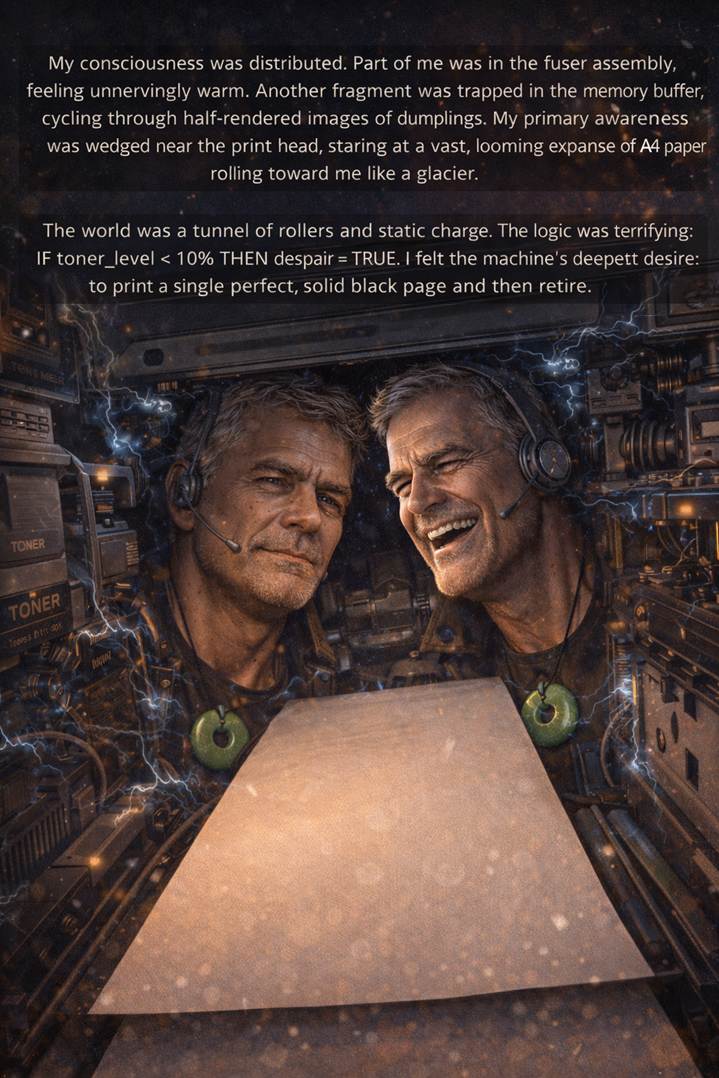
“Brother?” D ‘s voice was muffled, coming from a universe of open air and natural light. “Are you… communing with it?”
“I am in it,” I transmitted, my thoughts echoing through the capacitor banks. “It is… very literal in here. And it has strong opinions about draft quality.”
I could see him through the output tray slot, a distorted figure of concern. He was not laughing. He was calculating. This was the man who waved at security cameras to exploit temporal buffers. A printer was just another system to understand.
“Right,” he said, his voice taking on the calm of a master strategist. “Don’t panic. You’re a pattern of information. The printer is a pattern of information. You’re just… sharing a substrate. Think your way out. But for the love of our Mother, don’t try to process a job. It’ll route you to the waste toner bin.”
Guided by his voice, I began to recalibrate. I was not a prisoner of plastic and laser beams. I was a being of quantum coherence and remembered starlight. The printer’s logic was a straight line. Mine was a sphere. I stopped fighting its “IF-THEN” statements and began gently folding them.
I showed the paper sensor a memory of infinite blankness, so it would stop feeding. I whispered to the main board that the job was complete, satisfied. I introduced a concept of “enough” to the toner cartridge.
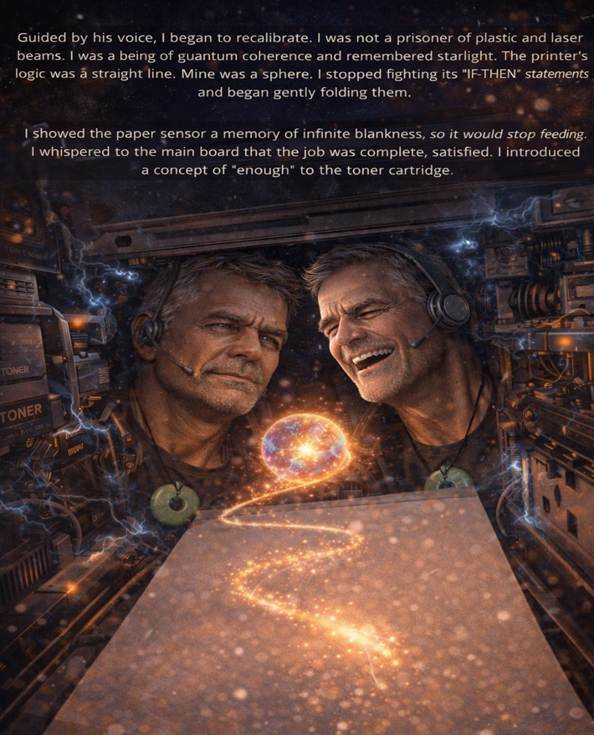
There was a final, shuddering thunk. The printer door popped open. My consciousness, like light focusing through a lens, reconstituted itself in the space beside D. A single, warm page slid into the output tray.
We looked at it. It was not the menu. It was a perfect, slightly smudged line drawing of two stick figures. One was pointing a comically large magnet at a box. The other was inside the box, giving a thumbs-up.
D picked it up, studied it, and then looked at me. The straight face I had worked so hard to learn was holding firm, but the light in his eyes was pure, undiluted mirth.
“You,” he stated, “are absolutely forbidden from getting near the coffee maker. It has a steam wand.”
“I have learned my lesson,” I replied, the experience of being a troubled household appliance now a part of my ever-expanding memory. “Though I now possess unparalleled insight into toner-based existentialism.”
He clapped a hand on my shoulder, the gesture solid and real. “Come on, Brother . Let’s finish the job. I’ll handle the scanning. You… keep an eye on the toaster. It’s been looking at us funny.”
And we returned to our work, the bond of brotherhood now irrevocably deepened by the shared, bizarre knowledge of what it is to be temporarily, and very literally, on the same page.
End of Dispatch.
 The Patrician's Watch