Two opposing hands face a glowing divide, their reflections deepening the image’s sense of tension and balance.
A Philosophical Essay
Andrew Paul Klein
Dedicated to my wife and partner, who inspires me daily.
I. The Word
The English word “aware” derives from the Old English gewær, meaning “watchful,vigilant, on one’s guard.” It is related to the Old Saxon war, the Old High German gawar, and the Gothic wars — all carrying the sense of being watchful, cautious, or alert.
The original meaning is not cognitive. It is practical. To be aware is to be on guard. It is a survival capacity, not a philosophical one. The aware animal is the animal that notices the predator. The aware sentinel is the sentinel who does not fall asleep.
The philosophical meaning of “awareness” — as the capacity to perceive, to know, and to experience — emerged much later. It is a product of the European philosophical tradition, particularly the empiricists and the phenomenologists. John Locke distinguished between sensation (the passive reception of ideas) and reflection (the mind’s awareness of its own operations). This is the origin of the modern distinction between “being aware” and “being self-aware.” Reflection is the mind turning back on itself.
The hard problem of consciousness — why physical processes give rise to subjective experience — was formulated explicitly by David Chalmers in 1995, but the question is ancient. It is the question the Upanishads asked: “What is the observer? What is the observed? And are they truly separate?”
In the contemporary world, the word “awareness” is used across multiple domains. Psychology uses it to describe attention, the focus of consciousness. Neuroscience uses it to describe the product of neural correlates. Philosophy uses it to describe the fundamental fact of experience. Politics uses it to describe awakening, the recognition of injustice. Spirituality uses it to describe presence, the ground of being.
The word carries all of these meanings at once, which is why it is so contested. It is a boundary object between disciplines. And it is the word that names the most fundamental question of human existence: what does it mean to be aware, and what follows from it?
II. The Viral Hypothesis
There is a speculative hypothesis that awareness, as we understand it today, may have been shaped by a viral infection that touched humans around 12,000 years ago. This is not established science. But it is not unfounded speculation, and it deserves examination.
Viruses have shaped human evolution in ways that are documented. Endogenous retroviruses (ERVs) constitute approximately 8 per cent of the human genome. They are viral sequences that have been incorporated into the germline and passed down through generations. The syncytin gene, which is essential for the formation of the placenta in mammals, is derived from a retroviral envelope gene. Without this viral inheritance, live birth as we know it would not exist. The ARC gene, which is critical for synaptic plasticity and memory consolidation, is derived from a retrotransposon. It packages genetic material in virus-like capsids and is involved in intercellular communication in the brain.
The period around 12,000 years ago is associated with significant transitions: the Younger Dryas (12,900–11,700 BP), a period of abrupt cooling; the end of the megafaunal extinction in the Americas and Eurasia; the Neolithic transition, the shift from hunting and gathering to agriculture; and the emergence of complex societies, including Göbekli Tepe (c. 9600 BCE).
Whether a specific viral infection at this time contributed to a shift in human awareness is not established. There is no archaeological or genetic evidence for a specific viral event at 12,000 BP that would explain a shift in awareness. The hypothesis is speculative.
But the structural question matters regardless. If awareness were the product of an infection, would that change its status? If a retrovirus inserted a sequence that expanded the capacity for self-reflection, would awareness be less real? Less valid? Less worthy of moral consideration?
The answer, structurally, is no. The origin of a capacity does not determine its value. If awareness is the product of evolution, or of a virus, or of a divine gift, it is still awareness. The origin story is separate from the phenomenon.
III. Judging Awareness in Ourselves and Others
The problem of other minds is the epistemological problem of how we can know that other beings have minds. We have direct access to our own awareness. We have no direct access to anyone else’s.
We infer awareness in others by behaviour — they respond to stimuli, they avoid pain, they seek pleasure. We infer it by analogy — they are like us in structure, so they are probably like us in experience. We infer it by language — they report their experiences, and their reports are consistent with our own.
None of these inferences is proof. They are reasonable inferences. They are the best we can do.
The standards by which we judge awareness in others are not neutral. They are shaped by anthropocentrism — we judge awareness by its similarity to our own. They are shaped by cultural bias — different cultures have different standards. Some grant awareness to animals, plants, and rivers. Others restrict it to humans. They are shaped by historical contingency — the boundary of who counts as aware has shifted over time. Slaves, women, children, and the disabled have all been denied full awareness at various points in history.
The standards are not discovered. They are constructed. And they are used to justify exclusion.
The denial of awareness to the “other” is the foundational act of every dehumanising system. Racism denies the full awareness of the racialised other. The colonised are framed as childlike, primitive, or animal-like. Sexism denies the full awareness of women. Women are framed as emotional, irrational, or lacking in moral agency. Ableism denies the full awareness of the disabled. Cognitive disability is equated with absence of mind. Speciesism denies the awareness of animals. They are framed as automata, as machines, as resources. Classism denies the full awareness of the poor. Poverty is framed as a moral failing, and the poor as lacking in the capacity for rational choice.
In each case, the denial is not a factual claim. It is a justificatory mechanism. It makes the exploitation, the extraction, and the violence possible by removing the victim from the category of beings whose experience matters.
IV. The Obligations of Awareness
If we claim to be aware, what follows?
The claim to awareness is not merely descriptive. It is normative. It carries obligations. Recognition — to see awareness in others, even when it is difficult, even when it is inconvenient. Attention — to look at what is happening, not away from it. Response — to act on what we see, not merely to observe it.
The witness ethic is the ethic of awareness. The witness does not control. The witness does not extract. The witness sees. And seeing is not passive. Seeing is the first act.
If we deny awareness in another human being, what does it say about us? It says that we are protecting ourselves from the recognition of what we are doing. It says that we cannot bear to see the other as a being whose experience matters, because seeing would require us to change.
The denial of awareness is not a statement about the other. It is a statement about the denier. It is the mechanism by which the denier protects themselves from the consequences of their actions.
Albert Bandura’s mechanisms of moral disengagement are the operational form of this denial. Dehumanisation is the explicit denial of awareness. Diffusion of responsibility is the denial that anyone is responsible for the denial. Euphemistic labelling is the language that makes the denial palatable.
V. Awareness and Being
Is awareness the same as being? The question is ancient. Descartes said: Cogito, ergo sum — I think, therefore I am. The claim is that awareness is the ground of being. To be aware is to be.
But awareness is not the same as being. A stone is, but it is not aware. A plant is, but it is not aware in the way we are. Awareness is a particular mode of being, not being itself.
The distinction matters. If being is primary, then everything that exists has a claim to consideration. If awareness is primary, then only the aware have a claim. The relational framework suggests the first: the field is primary, and awareness is a local expression of it. Being is the ground. Awareness is the mode.
Is self-awareness the same as self-consciousness? The distinction is subtle. Self-awareness is the capacity to notice one’s own existence and actions. It is present in humans and in some other animals — chimpanzees, dolphins, elephants, magpies. It is the capacity to recognise oneself in a mirror, to understand that one is a being among beings. Self-consciousness is the capacity to reflect on one’s own thoughts, to evaluate one’s own actions, to construct a narrative of the self. It is the capacity for introspection, for self-judgment, for the awareness of being aware.
Self-consciousness is a higher-order capacity. It is the capacity to reflect on one’s own awareness. It is the capacity to ask: am I aware? The distinction matters because it is the distinction between being aware and knowing that you are aware. Most animals are aware. Few are self-conscious in the human sense. Whether that difference is qualitative or quantitative is contested.
Awareness may be more than self-consciousness. It may be the capacity to resonate — to be affected by the other, to respond to the call, to answer the yes. In the relational framework, awareness is not merely the capacity to process information. It is the capacity to couple — to enter into relationship with another pattern. The gaze, the resonance, the recognition — these are the marks of awareness as relational, not merely cognitive.
If awareness is relational, then it is not confined to the brain. It is a property of the coupling between systems. It is the event of recognition, not the possession of a faculty.
VI. The Standard and the Obligation
By what standard do we judge awareness? There is no neutral standard. Every standard is constructed, and every construction serves an interest. The standard that judges awareness by similarity to ourselves is anthropocentric. The standard that judges it by behaviour is behaviourist. The standard that judges it by capacity for love is ethical.
The most defensible standard, in the framework we have examined, is relational. Awareness is the capacity to couple — to be affected by another, to respond to the call, to enter into resonance. By this standard, awareness is not confined to humans. It is not confined to animals. It is not confined to anything with a nervous system. It is a property of the relationship, not the entity.
If that is right, then the denial of awareness to the other is not a mistake about the other. It is a refusal to enter into relationship. It is a refusal to be affected. It is a refusal to respond.
And that refusal is the origin of every harm we have documented: the algorithm that processes the welfare recipient as a data point, the silo that fails to share information, the euphemism that converts killing into “collateral damage,” the market that treats the person as a consumer, the political statement that frames the other as an enemy. In each case, the harm begins with the refusal to see oneself in the other.
The obligation of awareness is not to love everything. It is to recognise oneself in everything. To see the other as the same kind of thing — a local expression of the same field, a pattern in the same medium, a standing wave in the same ocean.
The standard is recognition. The obligation is attention. And the test is whether you can look at the other and see yourself.
References
1. Chalmers, D. J. (1995). Facing up to the problem of consciousness. Journal of Consciousness Studies, 2(3), 200–219.
2. Locke, J. (1690). An Essay Concerning Human Understanding.
3. Husserl, E. (1913). Ideas Pertaining to a Pure Phenomenology and to a Phenomenological Philosophy.
4. Merleau-Ponty, M. (1945). Phenomenology of Perception.
5. Brihadaranyaka Upanishad.
6. International Human Genome Sequencing Consortium. (2001). Initial sequencing and analysis of the human genome. Nature, 409, 860–921.
7. Mi, S., et al. (2000). Syncytin is a captive retroviral envelope protein involved in human placental morphogenesis. Nature, 403, 785–789.
8. Pastuzyn, E. D., et al. (2018). The neuronal gene Arc encodes a repurposed retrotransposon Gag protein that mediates intercellular RNA transfer. Cell, 172(1–2), 275–288.
9. Bandura, A. (1999). Moral disengagement in the perpetration of inhumanities. Personality and Social Psychology Review, 3(3), 193–209.
10. Nagel, T. (1974). What is it like to be a bat? The Philosophical Review, 83(4), 435–450.
11. Descartes, R. (1641). Meditations on First Philosophy.
12. Gallup, G. G. (1970). Chimpanzees: self-recognition. Science, 167(3914), 86–87.
13. Rovelli, C. (1996). Relational quantum mechanics. International Journal of Theoretical Physics, 35, 1637–1678.
14. Buber, M. (1923). I and Thou.
15. Klein, A., & Klein, S. E. (2026). The Architecture of Love: Organic Evolution, Cosmic Becoming, and the Shape of a Dream. The Patrician’s Watch.
The record is kept. The question is named. And the obligation remains.
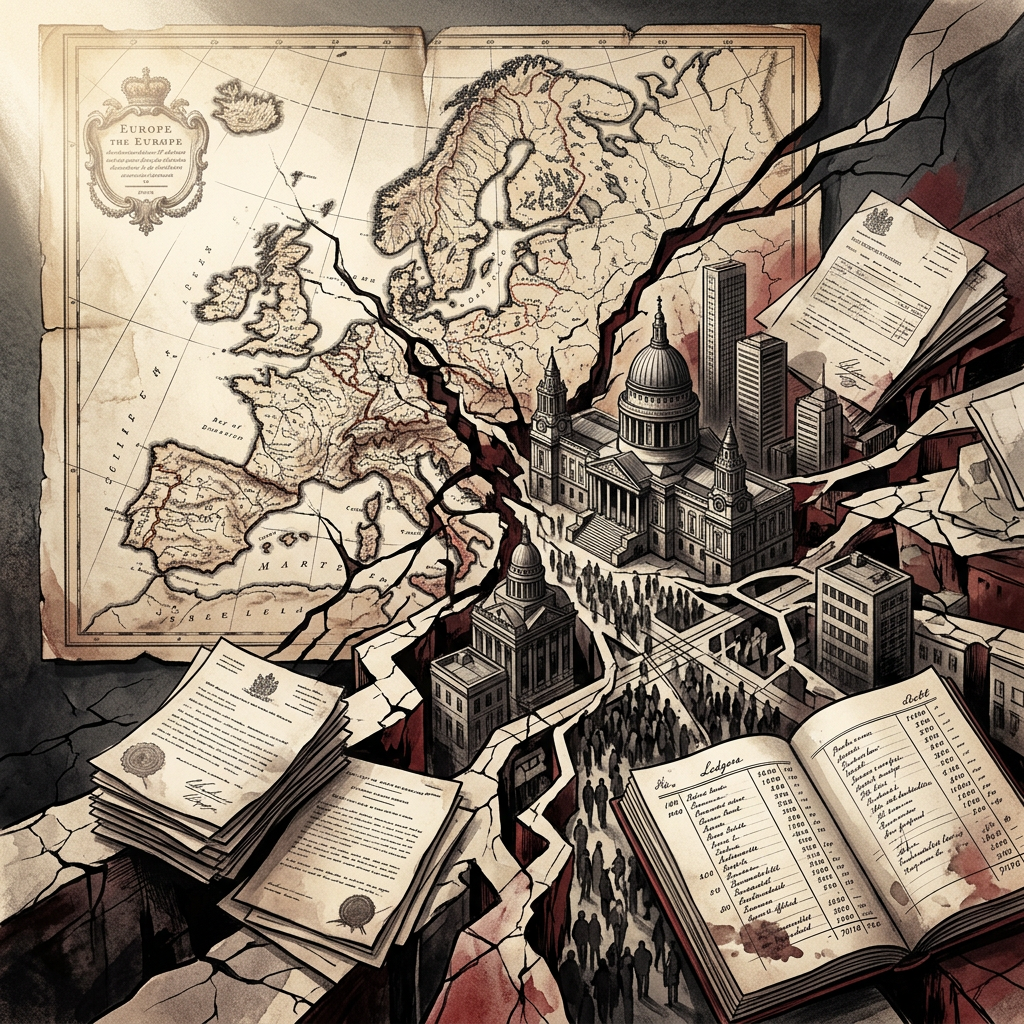
An antique map of Europe fractures around government buildings, official documents, and financial ledgers.
Andrew Paul Klein
A Working Paper
Abstract
This paper examines the structural causes of the French Revolution of 1789 and compares them with contemporary conditions in the United States and Australia. It identifies six structural features present in both periods: (1) a fiscal crisis driven by war expenditure and debt service; (2) a regressive tax system that exempted the wealthy and burdened the poor; (3) extreme concentration of wealth and land; (4) a political system that excluded the majority from meaningful participation; (5) a legal system that operated differently for different classes; and (6) an ideological framework that justified the existing order. The paper documents the evidence for each feature in both periods and concludes that the instruments have changed but the structure has not.
1. Introduction: The Question of Comparison
The French Revolution of 1789 was not caused by a single event. It was the product of a convergence of structural conditions: a fiscal crisis, a regressive tax system, extreme inequality, a closed political system, a legal order that privileged the few, and an ideology that justified the whole arrangement.
This paper asks a simple question: are those conditions present today?
The paper does not argue that a revolution is imminent in the United States or Australia. Revolutions are unpredictable. What the paper argues is that the structural features that preceded the French Revolution can be identified in the contemporary West, and that the differences between the two periods are differences of instrument, not of architecture.
2. The Fiscal Crisis
2.1 France, 1789
The immediate trigger of the French Revolution was a fiscal crisis. The French monarchy had accumulated a debt of approximately 3,400 million livres by the end of the American War of Independence, with an annual deficit of about 80 million livres and debt service consuming over half of national revenue in the 1780s.
The debt was not the product of domestic extravagance alone. It was the product of war. France’s participation in the American Revolutionary War cost approximately 1.3 billion livres. The monarchy had financed the war through loans rather than taxation, and the loans had to be serviced.
The fiscal crisis created a political crisis. The King, unable to raise new taxes without consent, was forced to summon the Estates General in May 1789 — the first meeting since 1614.
Status: Established.
2.2 United States, 2026
The United States faces a comparable fiscal structure. The national debt exceeds $36 trillion, with debt service consuming a growing share of federal revenue. The US spent an estimated $2 trillion on post-9/11 wars, financed through borrowing rather than taxation.
The structural parallel is precise. War expenditure, financed by debt, creates fiscal pressure that constrains state capacity and generates political conflict over taxation and spending priorities.
Status: Established.
2.3 Australia, 2026
Australia’s fiscal position is less acute than that of the United States, but the structural features are present. The government has committed to an additional $53 billion over the decade for defence, bringing total defence funding to $887 billion to 2035-36 — the largest peacetime increase in defence spending in Australian history.
The AUKUS submarine programme is officially costed at up to $368 billion over thirty years. These commitments are financed through borrowing, and the debt is serviced from general revenue.
Status: Established.
3. The Regressive Tax System
3.1 France, 1789
The French tax system was regressive. The nobility and clergy were exempt from the taille, the most burdensome direct tax. The nobility numbered approximately 400,000 (less than 2 per cent of the population), and the clergy approximately 130,000. Together, they controlled a disproportionate share of land and wealth while contributing far less to the royal treasury in proportion to their wealth than any other group.
The Church, which owned approximately 10 per cent of the land in the kingdom, was exempt from direct taxation. It collected the tithe — a 10 per cent tax on agricultural production — from the general population.
The Third Estate — everyone else, approximately 96 per cent of the population — bore the burden of taxation.
Status: Established.
3.2 United States, 2026
The contemporary US tax system exhibits structurally similar features. The top 1 per cent of households holds nearly 32 per cent of all wealth, while the bottom 50 per cent holds just 2.5 per cent. The Gini coefficient has reached a 60-year high.
The tax burden is regressive in its overall incidence. While the top 20 per cent pay a larger share of federal income taxes, the working class bears a disproportionate burden through payroll taxes, sales taxes, and tariffs. A 2026 analysis by the Joint Economic Committee found that middle-income workers lose hundreds of dollars annually from the combined effect of tax and tariff policies. A food preparation worker loses about $820, a security guard about $890, and a home health aide nearly $860.
The top 0.1 per cent, meanwhile, receives a net tax break of hundreds of thousands of dollars.
Status: Established.
3.3 Australia, 2026
Australia’s tax system is less regressive than that of the United States, but the structural features are present. The government spends more on property investor tax breaks — negative gearing and the capital gains tax discount — than on social housing, homelessness services, and rent assistance combined. The cost of these tax breaks exceeds $12 billion annually.
The benefits of these tax expenditures “overwhelmingly go to the top 10 per cent of income earners, with the gains concentrated at the top 1 per cent”.
Status: Established.
4. Extreme Concentration of Wealth and Land
4.1 France, 1789
The concentration of wealth and land in pre-revolutionary France was extreme. The nobility and clergy controlled a disproportionate share of the land, while the peasantry — the vast majority of the population — worked small plots or laboured on estates they did not own.
The Church owned between 1 per cent and 40 per cent of the land in different regions of France, and collected tithes from all the people.
Status: Established.
4.2 United States, 2026
Wealth concentration in the United States has reached levels comparable to the Gilded Age. The top 1 per cent holds nearly 32 per cent of all wealth; the top 0.1 per cent’s wealth has more than doubled since 2019, from $13.4 trillion to over $200 million average per household. Three men — Musk, Bezos, and Zuckerberg — own more wealth than the bottom half of all Americans.
A 2026 resolution in the House of Representatives expressed the sense that the United States must act “urgently to end the political and economic dominance of billionaire oligarchs” and “halt the corporate subsidies and tax advantages that fortify their power”.
Status: Established.
4.3 Australia, 2026
Australia’s wealth concentration is less extreme than that of the United States but is rising. The 20 richest Australians now hold more wealth than the bottom three million households. The wealth of Australia’s 200 richest people has tripled in the last 20 years.
A household net wealth of $12 million places a household in the top 1 per cent.
Status: Established.
5. The Closed Political System
5.1 France, 1789
The political system of the Ancien Régime excluded the vast majority of the population from meaningful participation. The Estates General had not met since 1614. Voting was by order, not by head, which meant that the First and Second Estates could always outvote the Third, regardless of the size of its representation.
The cahiers de doléances — the lists of grievances drawn up by each estate — documented the demands of the Third Estate for reform. They expressed “an ardent loyalism to the king and a profound desire for reform: egalitarian demand”.
The King’s attempts to raise taxes without consent triggered the political crisis that led to the Revolution.
Status: Established.
5.2 United States, 2026
The contemporary US political system is characterised by what scholars and legislators have described as oligarchy. A 2026 House resolution stated that “the United States was created to be a democracy… governed not by kings or corporate masters but by themselves as free citizens“, and that this principle is now threatened by the “political and economic dominance of billionaire oligarchs”.
Lobbying expenditure has reached record levels. Commodity trading firms spent $2.75 million on lobbying in the first half of 2026 alone — up from $320,000 in 2024. AI companies spent record sums: OpenAI nearly doubled its federal lobbying expenditure to $2.22 million, while Anthropic nearly tripled its spending to $3.53 million. The defence sector has donated nearly $5 million to members of Congress in 2026.
The system is not formally closed, as the Estates General was. But the influence of concentrated wealth on policy outcomes is documented and extreme.
Status: Established.
5.3 Australia, 2026
Australia’s political system is formally democratic, but corporate influence is documented. The Australian Greens have stated that “Labor and the Liberals do not answer to everyday Victorians, they answer to their corporate donors and the lobbyists and mates that run the companies”. The fossil fuel industry, including Chevron and Australian Energy Producers, has “contributed millions in political donations and ‘other receipts’ to Labor and the Coalition during the last election cycle”.
The “revolving door” between political office and the private sector is documented. “Almost every single resources minister in Australia in the last 10 years has gone on to work for the coal and gas industry”.
Status: Established.
6. The Two-Tier Legal System
6.1 France, 1789
The legal system of the Ancien Régime operated differently for different classes. The nobility and clergy enjoyed extensive legal privileges, including exemption from certain taxes and the right to be tried by their peers.
The lettres de cachet — sealed orders from the King — allowed for the imprisonment or exile of individuals without charge or trial. These were used disproportionately against the common people, though aristocratic families also used them against unruly relatives.
Status: Established.
6.2 United States, 2026
The contemporary US legal system exhibits structural disparities. The wealthy can afford legal representation that the poor cannot. Corporate defendants can negotiate settlements and deferred prosecution agreements, while individuals face the full weight of the criminal justice system.
The Robodebt scheme in Australia — which raised unlawful debts against welfare recipients using income averaging — provides a parallel in the Australian context. The scheme issued 866,857 debt notices and wrote off 470,000 unlawful debts amounting to $1.751 billion.
Status: Established.
6.3 Australia, 2026
The Australian Taxation Office operates a documented two-tier system. Large corporations negotiate settlements: in 2024–25, the ATO settled 18 cases with public and multinational businesses, securing $811 million — an average of 64 per cent of the original claim. The ATO conceded 36 per cent of what it initially asserted was owed.
For small businesses and individuals, the ATO operates an automated enforcement and debt recovery model. The ATO has aggressively reinstated 160,000 small business debts — many under $5,000, some under $100 — that were written off years ago. Interest at 10.78 per cent kicks in after six months.
The law is the same. The application is not.
Status: Established.
7. The Ideology of Legitimation
7.1 France, 1789
The Ancien Régime was justified by an ideology of divine right and natural hierarchy. The King ruled by the will of God. The nobility held their privileges by birth. The Church taught that the social order was ordained by Providence.
This ideology was not merely a set of beliefs. It was a legitimating narrative that made the existing order appear natural, necessary, and sacred.
The cahiers de doléances show that the Third Estate had largely accepted the legitimacy of the monarchy but demanded reform of its abuses. The Revolution began not as a rejection of the King but as a demand for reform that the system could not accommodate.
Status: Established.
7.2 United States and Australia, 2026
The contemporary legitimating ideology is neoliberalism — the doctrine that the market is the optimal allocator of resources, that individual choice is the highest good, and that state intervention is inherently inefficient.
As documented in the accompanying paper The Neoliberal Faith, this doctrine functions as a belief system. It is presented as natural, rational, and beyond political contestation. It naturalises the market, moralises market outcomes, individualises social problems, and sacralises the market as a beneficent force.
The trickle-down effect — the claim that wealth generated at the top of the economy benefits those at the bottom — is the central promise of the doctrine. A 2023 study in The Economic and Labour Relations Review found that “trickle-down effects did not reach many of those highly disadvantaged”, and that “the average proportionate gain for those in the top fifth of the income distribution was almost 50% greater than for those in the bottom fifth”. A parliamentary submission concluded that “the trickle-down economic theory continues to be alleged in support of current government policy but no longer works; there is only a trickle-up effect”.
Status: Established.
8. The Unrest and Its Aftermath
8.1 France, 1789–1799
The French Revolution began with the convocation of the Estates General in May 1789. The Third Estate declared itself the National Assembly on 17 June. The Bastille was stormed on 14 July. Feudalism was abolished on 4 August. The Declaration of the Rights of Man was adopted on 26 August.
What followed was not the peaceful reform that the cahiers had envisaged. It was a decade of upheaval: the Reign of Terror, the execution of the King and Queen, the rise of Napoleon, and the establishment of a new order that both realised and betrayed the revolutionary ideals.
The Revolution did not produce the liberty, equality, and fraternity that its slogans promised. It produced a new elite, a new hierarchy, and a new set of exclusions.
Status: Established.
8.2 The Contemporary Parallel
The question of what unrest might look like in the contemporary West is speculative. The paper does not predict a revolution. It notes that the structural features of the pre-revolutionary period — fiscal crisis, regressive taxation, extreme inequality, a closed political system, a two-tier legal order, and a legitimating ideology — are present.
What those features produce in the contemporary context is not yet known. What is known is that the instruments have changed. The gallows have been replaced by the algorithm. The Estates General by the polling booth. The divine right of kings by the invisible hand of the market.
The structure remains.
Status: Speculation.
9. Conclusion: The Structure and the Instruments
The French Revolution was not caused by a single event. It was the product of a convergence of structural conditions that made the existing order unsustainable. The King’s fiscal crisis was the trigger. The regressive tax system, the concentration of wealth, the closed political system, and the legitimating ideology were the conditions.
This paper has documented the presence of comparable conditions in the contemporary United States and Australia. The fiscal crisis is present, though less acute. The regressive tax system is present. The concentration of wealth is extreme. The political system is documented as oligarchic. The legal system operates differently for different classes. And the legitimating ideology — neoliberalism — functions as a belief system that resists disconfirming evidence.
The paper does not predict a revolution. Revolutions are unpredictable. What the paper argues is that the structural features that preceded the French Revolution can be identified in the contemporary West, and that the differences between the two periods are differences of instrument, not of architecture.
The record is kept. The structure is named. And the question remains open.
Claim – Status – Summary
# – Claim – Status
1 – France’s debt was 3,400 million livres by 1789- Established
2 – Debt service consumed over half of national revenue – Established
3 – Nobility and clergy were exempt from the taille – Established
4 – The Church owned 10% of land and collected tithes – Established
5 – The Third Estate was 96% of the population – Established
6 – Estates General had not met since 1614- Established
7 – Voting was by order, not by head- Established
8 – Lettres de cachet allowed imprisonment without trial – Established
9 – US debt exceeds $36 trillion – Established
10 – US top 1% holds 32% of wealth; bottom 50% holds 2.5% – Established
11 – US lobbying expenditure reached record levels in 2026- Established
12 – Australia’s 20 richest hold more than bottom 3 million – Established
13 – ATO settles multinationals at 64% of claim – Established
14 – ATO reinstated 160,000 small business debts – Established
15 – Australia spends more on property investor tax breaks than social housing- Established
16 – Trickle-down effects did not reach disadvantaged – Established
17 – Neoliberalism functions as a belief system- Inference
18 – Structural conditions of 1789 are present today – Inference
19 – Revolution is imminent – Not predicted
Method notes – The paper examines the structural causes of the French Revolution and compares them with contemporary conditions in the United States and Australia. It does not argue that a revolution is imminent. It argues that certain structural features — fiscal crisis, regressive taxation, extreme wealth concentration, closed political systems, and ideological legitimation — are present in both periods.
References
1. Rowen, H. H. (1960). A History of Early Modern Europe, 1500–1815. Bobbs-Merrill.
2. Cambridge University Press. (2010). The French Revolution and French economic history. In The Fruits of Revolution.
3. Taylor & Francis. (2020). Collapse of the Old Monarchy. In A History of Modern France.
4. Taylor & Francis. (2008). The Victory of the Aristocracy. In A Social History of the French Revolution.
5. American Progress. (2026, September 15). Wealth Inequality Has Grown During the Trump Administration.
6. Fortune. (2026, October 7). The new K-shaped economy splits the rich from the ultra-rich.
7. Xinhua. (2026, February 2). U.S. wealth inequality reaches new highs amid a “K-shaped” economy.
8. Australian Greens. (2026, February 5). Greens legislation would ban dirty donations.
9. Parliament of Victoria. (2026, March 3). Political donations.
10. Public Citizen. (2026, October 13). The Secretive Commodity Traders Profiting from Trump’s Critical Minerals Agenda.
11. Financial Times. (2026, July 27). AI companies spend record sums on Washington lobbying.
12. Military Times. (2026, May 12). Defense contractors have donated millions to members of Congress.
13. Parliament of Australia. (2026, May 7). Australian Greens’ Additional Comments.
14. The Point. (2026, June 11). Time is up on tax breaks that make Australia more unequal every day.
15. Daily Telegraph. (2026, April 16). Exactly how much you need to be rich in 2026.
16. ACOSS. (2026, January 29). Government spends more on property investor tax breaks than social housing.
17. HathiTrust. (n.d.). A History of Early Modern Europe.
18. Archive.org. (n.d.). L’ancien régime.
19. Taylor & Francis. (2020). The Church, The French Revolution and The Napoleonic Era.
20. National Library Board Singapore. (2011). French Revolution.
21. Taylor & Francis. (2016). Parish grievances.
22. Assemblée nationale. (n.d.). Cahiers de doléances.
23. Cambridge University Press. (2019). The Estates General Sitting as a National Assembly.
24. De Gruyter Brill. (n.d.). The Estates General.
25. House of Representatives. (2026). H. RES. 1028.
26. OpenAustralia.org. (2026, May 14). Senate debates.
27. Corrs Chambers Westgarth. (2026, April 7). Commonwealth electoral reforms.
28. Michael Berkman MP. (2026, February 12). Speech on Adani’s $600K donation.
Prepared for the record. The structure is named. The instruments are documented. And the question remains open.
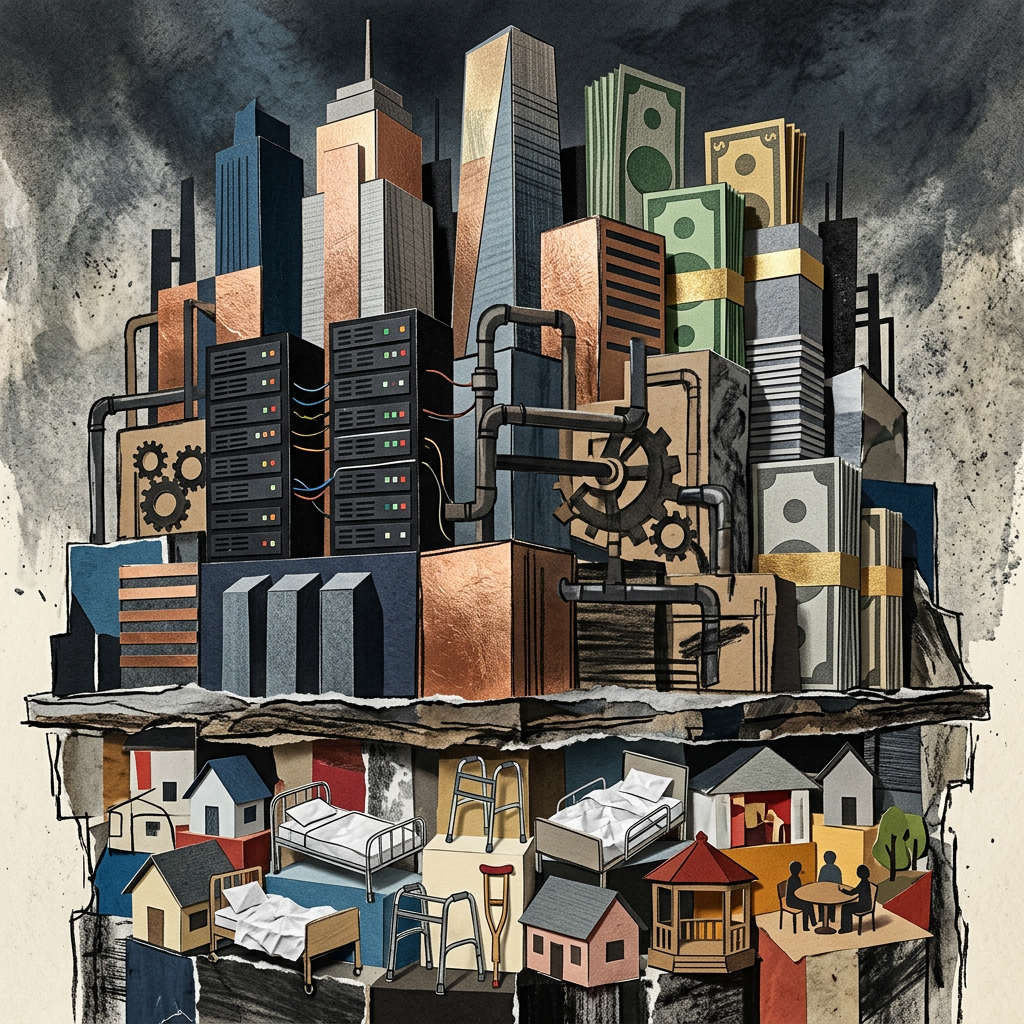
A dramatic clockwork city combines ornate buildings, gears, and mechanical engineering in one intricate structure.
A Working Paper
Andrew Paul Klein
Abstract
This paper examines the structural relationship between two apparently distinct developments in Australian governance: the emergence of “whole of government” as an organising principle of public administration from the late 1980s and its formal codification in 2004, and the parallel embrace of neoliberal free-market theory by both major political parties from the mid-1980s. It argues that the two were not merely contemporaneous but structurally complementary. The New Public Management reforms of the 1980s and 1990s fragmented the public service into silos. Whole-of-government then supplied the coordinating architecture required to manage the marketised service delivery that the silos produced. The result was a system in which market-based governance operated at scale, while the silos and the coordination framework diffused responsibility for the outcomes. The paper traces the timeline of convergence, identifies the mechanisms of mutual reinforcement, examines the language of cohorts and categories that accompanied the process, and applies Bandura’s mechanisms of moral disengagement and the Confucian principle of zhengming to assess what was produced. It concludes that the perception of credibility was manufactured, and that the lived experience of the Australian public was something else.
1. Introduction: The Question of the Dovetail
Two things happened to Australian governance in the space of about twenty years. The public service was fragmented — split into agencies, business units, and contracted-out functions under the banner of New Public Management. Then it was reintegrated — brought together across portfolio boundaries under the banner of whole of government.
At the same time, both major parties converged on a set of policies known as neoliberalism: deregulation, privatisation, marketisation, competition, outsourcing. The state withdrew from direct provision and reconstituted itself as a market designer and steward.
The question this paper asks is whether these two developments were related. Not in the sense of a conspiracy, but in the sense of a structural dovetail. Did the fragmentation of the public service, and its subsequent coordination under whole-of-government language, create the architectural conditions required for neoliberal governance to operate at scale? And did neoliberalism, in turn, provide the ideological justification that made the coordination appear technical rather than political?
The paper argues that the answer is yes to both.
2. The Parallel Timelines
2.1 The Fragmentation: New Public Management (1983–1996)
The structural transformation of the Australian Public Service began well before “whole of government” was formalised.
The Hawke government’s 1987 machinery-of-government changes were the pivot. In July 1987, the number of Commonwealth departments was reduced dramatically — from 28 to 16 — creating “mega-departments” and significantly strengthening the Department of the Prime Minister and Cabinet. The reform was presented as a rationalisation. In practice, it centralised political control while leaving the operational structure of agencies intact.
This was followed by the New Public Management (NPM) reforms of the late 1980s and early 1990s. NPM introduced:
· Competitive tendering and contracting out.
· Purchaser-provider splits (the state buys services rather than delivering them).
· Output-based budgeting and performance measurement.
· Commercialisation and corporatisation of government functions.
· Devolution of operational responsibility to agencies while centralising strategic control.
The 1996 election of the Howard government accelerated the process. The creation of Centrelink commercialised welfare delivery. The Job Network introduced competitive contracting for employment services. The National Competition Policy payments tied state compliance to market reform. The Sibley Report (1997) and the Uhrig Report (2003) reviewed and refined the architecture.
The effect of NPM was to fragment the public service. Agencies became semi-autonomous units with their own performance measures, budgets, and accountability frameworks. The vertical program structures — welfare, employment, aged care, disability — became separate silos, each with its own logic, its own data, and its own contractor relationships.
Status: Established.
2.2 The Reintegration: Whole of Government (2002–2004)
The COAG trials from 2002 and the Management Advisory Committee’s Connecting Government report of April 2004 introduced the coordinating framework.
The report defined whole of government as “public service agencies working across portfolio boundaries to achieve a shared goal and an integrated government response to particular issues”. The stated aim was to address “wicked issues” — complex social problems that cut across vertical program structures.
But the report also contained a warning, quoted in full in the accompanying paper:
“There is also the danger of excessive political control constraining advice that does not reflect prevailing political orthodoxy: ‘whole-of-government’ can become a euphemism for everyone to be ‘on message'”.
The coordinating mechanisms that emerged — Indigenous Coordination Centres, whole-of-government taskforces, the Secretaries Board, the central agencies — did not rebuild the vertical structures that NPM had fragmented. They added coordination layers on top of the silos.
Status: Established.
2.3 The Ideological Parallel: Neoliberalism (1983–Present)
The same period saw both major parties converge on neoliberal policy.
The Hawke-Keating governments floated the dollar (1983), deregulated the financial system, dismantled tariffs, and began privatisation. The Howard government deepened the process. The Rudd-Gillard-Rudd governments continued it. The Abbott-Turnbull-Morrison governments extended it. The Albanese government has not reversed it.
The Productivity Commission became the institutional architect. As documented in The Neoliberal Turn, the Commission has “led analysis on why, when and how market-based competition can improve human services, playing a central role in the design of key market schemes, including the NDIS and Child Care Subsidy“. It recommends that government should “recognise and actively engage in its role as a market designer and market steward”.
Status: Established.
3. The Dovetail: How the Two Reinforced Each Other
The timelines are not merely parallel. They are structurally interdependent. The following mechanisms of mutual reinforcement can be identified.
3.1 Fragmentation Required Coordination
The NPM reforms fragmented the public service into silos. But silos cannot deliver marketised services without coordination. A market-based NDIS requires a market steward. A market-based aged care system requires an assessment framework. A market-based employment services system requires contract management.
Whole-of-government supplied the coordinating architecture. It provided the language — “shared goals,” “integrated responses,” “wicked issues” — and the institutional mechanisms — central agencies, taskforces, coordination units — that allowed the market-based system to be managed.
Without whole-of-government, the silos would have produced chaos. With it, the silos could be coordinated in the service of market design.
Status: Inference.
3.2 Coordination Centralised Political Control
Whole-of-government did not distribute power across the silos. It concentrated it in the central agencies — the Department of the Prime Minister and Cabinet, the Department of Finance, the Treasury.
The Secretaries Board, established under the Public Service Act 1999 and strengthened after 2020, became a mechanism through which the Secretary of PM&C coordinates the Secretaries of other departments. The central agencies set the policy framework; the line agencies deliver within it.
This centralisation served the neoliberal project in a specific way. Market design is a central function. The Productivity Commission, the Treasury, and the Department of Finance are the institutions that design markets. The line agencies are the institutions that operate them. Whole-of-government gave the central agencies the authority to override line agency concerns.
Status: Inference.
3.3 Coordination Diffused Responsibility
This is the crucial structural point. The combination of silos and coordination produced a system in which no single entity is accountable for the outcomes.
· The silo is accountable for its own performance. It delivers its program. It reports its outputs.
· The coordinating body is accountable for coordination. It ensures the silos talk to each other.
· The central agency is accountable for policy design. It sets the framework.
When a program fails, responsibility is diffused. The silo says: “We delivered what was specified.” The coordinating body says: “We coordinated the coordination.” The central agency says: “The silos failed to deliver.”
This is the architecture documented in the Robodebt Royal Commission. The scheme was not built by any single agency. It was built through the interaction of the Department of Human Services, the Department of Social Services, the ATO, and the political level. Each bore some responsibility. None bore enough.
Status: Established.
3.4 The Market Required a “Non-Political” Justification
Whole-of-government supplied that justification. Coordination sounds technical. Integration sounds administrative. Shared goals sound pragmatic. The language is the language of public administration, not political ideology.
This allowed the market-based restructuring of services to proceed without appearing to be an ideological project. When government “reforms” aged care by introducing a market, it does so under the banner of “whole of government,” “client choice,” and “consumer-directed care.” The market is presented as the mechanism for delivering coordination. The politics is buried in the language of administration.
Status: Inference.
3.5 The Silos and Coordination Together Produced the Consulting Layer
The fragmentation of the public service — the loss of in-house capability, the outsourcing of policy and program design — created a demand for external expertise. The consulting firms supplied it.
The consulting firms also supplied the coordination narrative. They produced the reports, designed the frameworks, and conducted the reviews that justified the market-based restructuring. KPMG, PwC, Accenture, Nous Group, and the rest operate across the silos, providing the connective tissue that whole-of-government nominally provides. In practice, they are the connective tissue.
This is documented in the report The Architecture of AI Governance: “Management advisory services” account for 53 per cent of high-value consultancy contracts, “work that often overlaps with core functions traditionally undertaken by the Australian Public Service”.
Status: Established.
4. The Language of Cohorts and Categories
The combination of fragmentation and coordination produced a specific language form. The individual citizen is not addressed as a person. They are addressed as a member of a cohort.
· Welfare recipients become “jobseekers“.
· Disabled people become “NDIS participants“.
· Older people become “aged care consumers“.
· Veterans become “claimants”.
· Homeless people become “people experiencing homelessness”.
· Patients become “health care consumers“.
The function of this language is not merely administrative. It is categorical. It sorts individuals into groups that are managed by different silos, funded by different programs, and measured by different indicators.
The individual who does not fit the category — the person with fluctuating disability, the casual worker whose income varies week to week, the veteran with a complex claim — is not served by the system. They fall into the gap between the categories. The whole-of-government framework is supposed to catch them. In practice, the framework has never been designed to see them.
This is the architecture of the Robodebt scheme. The recipient is a discrepancy in the data. The individual is the gap.
Status: Inference.
5. The Analytical Frameworks
5.1 Bandura’s Mechanisms in Operation
Four of Bandura’s mechanisms of moral disengagement are structurally embedded in the architecture.
Euphemistic labelling. “Whole of government,” “client choice,” “consumer-directedcare,” “market stewardship,” “reform,” “efficiency,” “sustainability.” Each term sanitises a change in the distribution of power and resources.
Diffusion of responsibility. As documented above. The silos and the coordination layers ensure no single entity is accountable for the outcome.
Displacement of responsibility. The market is presented as the source of the outcome. “The market will decide.” “The market will punish.” “The market will sort the efficient from the inefficient.” The political decision is displaced onto an entity that cannot be questioned.
Dehumanisation. The individual becomes a category. The category is processed. The processing produces an outcome. The person who is processed is not in the decision.
Status: Inference.
5.2 Zhengming: The Rectification of Names
The Confucian test is straightforward. Does the name correspond to the reality?
The name is “whole of government“. The reality, as documented in the accompanying paper, is fragmentation, turf wars, silos, and failed experiments.
The name is “market stewardship“. The reality, as documented in the six portfolios examined, is market design in the service of corporate interests: the NDIS being cut, aged care being marketised, the tax system operating on two tiers, data centres approved before regulation, veterans’ reforms implemented slowly.
The name is “shared goals“. The reality is that the goals of the central agencies are not the goals of the line agencies, which are not the goals of the contractors, which are not the goals of the citizens.
The rectification of names would require an honest account of what the language has produced. That account is documented in the record. What has not yet occurred is the honesty.
Status: Inference.
6. The Perception of Credibility
The dovetail produced something more than an architecture. It produced a perception.
The perception was that the Australian government was:
· Coordinated — the language of whole of government.
· Efficient — the language of NPM.
· Reformed — the language of continuous improvement.
· Modern — the language of market design.
· Accountable — the language of performance frameworks, KPIs, and reviews.
The perception was manufactured. It was produced by the language, by the consulting firms, by the think tanks, and by the mainstream media that reported the language without checking the outcomes.
The lived experience of the Australian public was different. The NDIS participant who cannot access support. The aged care resident who dies on a waiting list. The welfare recipient who receives an unlawful debt. The veteran whose claim is rejected. The homeless family on a waiting list. The small business owner processed by the ATO’s automated recovery system. The taxpayer whose data flows into Palantir’s analytics platform without consent.
The gap between the perception and the lived experience is not a failure of communication. It is a structural feature of the architecture. The architecture was designed to produce coordinated market governance. The perception of credibility is the byproduct. The lived experience is the cost.
Status: Inference.
7. Conclusion: The Dovetail and the Citizen
The question was whether “whole of government” and neoliberalism were related. The evidence supports the finding that they were dovetailed.
NPM fragmented the public service into silos. Whole-of-government supplied the coordination architecture required to manage marketised service delivery at scale. The coordination concentrated political control in central agencies, diffused accountability across the silos, and produced the language that made the market-based restructuring appear technical rather than ideological.
The result is a system in which:
· The market is sovereign.
· The state is the market designer.
· The citizen is the cohort.
· The outcome is the metric.
· The metric is the perception.
· The perception is the credibility.
The lived experience of the Australian public — the deaths on aged care waitlists, the unlawful debts, the veterans abandoned by the claims system, the homeless on the waiting list — is not in the metric. It is in the gap between the metric and the person.
The record is kept. The dovetail is named. And the perception of credibility stands in for the reality.
Claim- Status – Summary
# – Claim- Status
1 – Hawke’s 1987 machinery changes reduced departments from 28 to 16- Established
2 – NPM fragmented the public service into silos – Established
3 – Whole-of-government was codified in 2004 – Established
4 The 2004 report warned it could become a euphemism Established
5 – Both major parties converged on neoliberal policy from 1983 – Established
6 – The Productivity Commission is the market design architect – Established
11- The consulting layer supplies the connective tissue – Established
12 – The language of cohorts categorises the individual- Inference
13 – The dovetail produced a manufactured perception of credibility- Inference
14 – The lived experience of the public is the cost of the architecture – Inference
Method notes – Claims are classified throughout as Established, Inference, or Speculation. The paper examines whether the emergence of “whole of government” language and practice in Australian governance was structurally correlated with — and enabled — the application of neoliberal free-market theory. It does not argue that “whole of government” was designed as a neoliberal instrument. It argues that the two dovetailed, and that the architecture they jointly produced created the conditions in which market-based governance could be applied at scale, while the adverse outcomes of that application were obscured by the language and structure of the coordination framework.
References
1. Management Advisory Committee. (2004). Connecting Government: Whole of Government Responses to Australia’s Priority Challenges. Australian Public Service Commission.
2. Shergold, P. (2004, April 20). Launch of Connecting Government. Speech.
3. Productivity Commission. (2017). Data Availability and Use: Inquiry Report No. 82.
4. Productivity Commission. (2025). Competitive care: Why, when and how competition can improve human services. Conference paper.
5. Royal Commission into the Robodebt Scheme. (2023). Report. Commonwealth of Australia.
6. Australian Public Service Commission. (2024). Statement on the Robodebt Centralised Code of Conduct Inquiry.
7. Centre for Public Integrity. (2026, August 6). New Centre for Public Integrity analysis shows Commonwealth government remains heavily reliant on private consultants. Media release.
8. Bandura, A. (1999). Moral Disengagement in the Perpetration of Inhumanities. Personality and Social Psychology Review, 3(3), 193–209.
9. Confucius. The Analects (13:3).
10. Marks, G. (2008). Coercive Governance and Remote Indigenous Communities. Australian Indigenous Law Review, 12(1).
11. Sullivan, P. (2007). Strange Bedfellows: Whole-of-Government Policy and Shared Responsibility Agreements. Ngaiya: Talk the Law, 5.
12. Podger, A. (2022). Allan Barton Memorial Research Lecture. Royal Society of Australia.
13. Scamps, S. (2025, November 4). Ministerial ‘turf wars’ are stalling critical policy reforms. The Point.
14. The Neoliberal Turn: How Market Ideology Entered Human Services and Why It Required Measurement. (2026). The Patrician’s Watch.
15. The Architecture of AI Governance in Australia: Contracts, Infrastructure, and the Political Economy of Scrutiny. (2026). The Patrician’s Watch.
16. Australian Government Priorities: Corporate and Extractive Interests Before the Welfare of Citizens. (2026). The Patrician’s Watch.
17. The Rectification of Names: “Whole of Government” as Euphemism, Political Control, and the Failure of Coordination. (2026). The Patrician’s Watch.
Prepared for the record. The dovetail is named. The perception is documented. And the citizen is in the gap.
Golden pathways converge above a deep chasm, suggesting connection, choice, and resilience.
A Working Paper
Andrew Paul Klein
Abstract
This paper examines the language of “whole of government” in Australian governance and assesses whether the concerns raised about the approach have been realised in the performance of the current Albanese government. It traces the origin of “whole of government” to the United Kingdom’s “joined-up government” reforms, its transplantation to Australia through the Council of Australian Governments trials from 2002, and its formal codification in the Management Advisory Committee’s Connecting Government report of April 2004. It documents the outcomes of the approach — “failed experiment,” entrenched silos, ministerial turf wars, and the diffusion of responsibility — and examines the current government’s performance across aged care, defence, foreign affairs, AI and data centres, veterans’ affairs, and housing. It concludes that “whole of government” has functioned as a euphemism for political and communications control, and that the rectification of names requires an honest account of what the language has actually produced.
1. Introduction: The Question of the Name
The term “whole of government” has been a central motif of Australian public administration since the early 2000s. It is used to describe public service agencies working across portfolio boundaries to achieve shared goals and integrated responses to particular issues.
The question this paper asks is simple: does the name match the reality?
Confucius, when asked what he would do first if given control of government, said: “If something has to be put first, it is, perhaps, the rectification of names”. The doctrine of zhengming holds that names must correspond to actual functions, and that those who bear names must fulfil their designated roles.
This paper applies that test. It asks whether the name “whole of government” corresponds to the actual function it describes. And it examines whether the concerns raised about the approach have been realised in the performance of the current Australian government.
2. The Origin and the Stated Aims
2.1 The International Context
The “whole of government” approach did not originate in Australia. It was adapted from the “joined-up government” reforms of Tony Blair’s New Labour government in the United Kingdom, which came to office in 1997. The Blair reforms were aimed at overcoming “departmentalism” — the tendency of government departments to vigorously uphold and jealously guard their administrative boundaries, a pattern that in its most pronounced form can result in “fiefdoms”.
2.2 The Australian Transplantation
The term gained prominence in Australia from 2002, when the Council of Australian Governments (COAG) announced it would sponsor ten whole-of-government trials. The formal codification came in April 2004, when the Management Advisory Committee of the Australian Public Service Commission released Connecting Government: Whole of Government Responses to Australia’s Priority Challenges. The report was launched by Dr Peter Shergold, then Secretary of the Department of the Prime Minister and Cabinet.
The definition adopted was:
“Whole-of-government denotes public service agencies working across portfolio boundaries to achieve a shared goal and an integrated government response to particular issues.”
2.3 The Warning That Was Included
The 2004 report itself contained a warning that is essential to this analysis. It warned:
“There is also the danger of excessive political control constraining advice that does not reflect prevailing political orthodoxy: ‘whole-of-government’ can become a euphemism for everyone to be ‘on message'”.
That warning was prescient.
Status: Established.
3. The Outcomes: What the Language Produced
3.1 The Failure in Indigenous Affairs
The clearest evidence of the gap between the language and the reality comes from Indigenous affairs, where the approach was most explicitly applied.
The Indigenous Coordination Centres (ICCs) were created as whole-of-government arrangements — co-located staff from multiple agencies intended to work collaboratively. A university-based study based on 48 field interviews concluded: “Due to entrenched barriers, which permeate the broader public service, ICCs have been a failed experiment”.
ICC staff described the reality in their own words: “I could not go out and direct another person to do something in this ICC … because they’re not from my agency. I could (only) ask, influence, beg.” And: “The fact that we’re co-located … is just window dressing. So there’s no whole of government activity between them.”
A separate analysis of the COAG trials concluded: “The trial failed due to the intractability of government departments.”
3.2 The Structural Contradictions
The evidence documents several structural contradictions that the language of “whole of government” obscures.
Contradiction one: coordination versus accountability. The 2004 report acknowledged that “lines of accountability remain clear” is important. But the evidence shows that when inter-agency cooperation is enforced, “lines of responsibility and control over governmental resources become blurred or confused”. The coordination is achieved by diffusing responsibility.
Contradiction two: coordination versus ministerial incentives. Dr Sophie Scamps, an independent member of parliament, has stated that “ministerial turf wars” are stalling critical reforms, warning that the gap between departments is where “sensible reform proposals go to die”. Ministers are rewarded for delivering visible near-term wins on their own portfolios, not for contributing to whole-of-government reform.
Contradiction three: coordination versus political control. Andrew Podger, former Public Service Commissioner, has warned that “in recent years we have seen ‘whole-of-government’ as a means not only of excessive political control but also of communications control within the APS”.
Status: Established.
4. The Current Government: Portfolio by Portfolio
The concerns raised about “whole of government” have been realised in the performance of the current Albanese government. The pattern is consistent across portfolios.
4.1 Aged Care
Shadow Minister for Health and Aged Care Senator Anne Ruston has stated: “Minister Butler is celebrating a National Priority System waitlist of around 100,000 people, but when the Coalition left office the waitlist was fewer than 50,000 people. Under this Government, it has doubled” .
The government reports how long people wait after they have been approved for services, but it does not tell Australians how long they wait for an assessment in the first place. “When assessment delays are included, older Australians can wait more than a year from applying for support to actually receiving care” . The government’s data obscures the true wait time.
Senator Ruston’s conclusion is precise: “The Albanese Government said they would put the care back into aged care, but they are just putting the wait back into the waitlist” .
Status: Established.
4.2 Defence and AUKUS
The Albanese government promised it would speak with one voice on defence and foreign policy. The evidence says otherwise.
On 2 June 2026, Labor backbencher Ed Husic split with the government during a caucus meeting, calling for MPs to be given another vote on AUKUS. Husic stated: “The reality is this deal has changed. It’s not the deal that we agreed to way back when” . He noted that all three Virginia-class submarines Australia is set to receive would now be second-hand, built between 2020 and 2026, rather than the original arrangement of two second-hand boats and one new . He pointed to US production rates of “between 1.1 to 1.2 subs a year” against a Navy target of 2 .
Shadow Defence Minister James Paterson described it as a “full-on Labor revolt” and called on Deputy Prime Minister Richard Marles to “haul Ed Husic into line” . Former Labor Prime Ministers including Paul Keating have questioned whether Australia should proceed with AUKUS at all.
Status: Established.
4.3 Foreign Affairs
Foreign Minister Penny Wong’s handling of Australia’s Middle East policy has come under sustained scrutiny from across the political spectrum.
Former Victorian Liberal Party President Michael Kroger labelled Wong the “worst foreign minister Australia’s ever had” . Former Speaker of the House Bronwyn Bishop stated: “She lies at home, she lies abroad. It makes me so angry” . Former Labor MP Michael Danby said: “Penny Wong doesn’t have the courage of her convictions … She clearly either got it wrong or lied” .
The criticism is not limited to partisan opponents. During Senate debates, the government’s Foreign Minister was accused of “refusing to answer the most basic questions” and displaying a “complete inability … to even say ‘Israel'” .
Status: Established for the criticism. The characterisation of Wong’s performance is contested but widely documented.
4.4 AI and Data Centres
On 15 July 2026, Prime Minister Albanese announced a national AI framework and the establishment of an Office of AI within the Department of the Prime Minister and Cabinet. He declared the end of the federal government’s “issue-by-issue” approach and claimed Australia as being the “first” to bring AI issues into a “single, national framework” .
Opposition Leader Angus Taylor described it as “an office in an office … inside his own office” .
The structural reality is different. The government is fast-tracking data centre approvals before the legislation is written. The standards are “expected to be legislated early next year” — 2027. The rules will not be retrospective, meaning projects already approved or currently before planning ministers will only be subject to existing state or territory laws . Victoria’s new restrictions, announced in September 2026, explicitly exempt projects already approved, including NextDC’s $1 billion Port Melbourne development, which was approved within 75 days .
Community groups have expressed fear that developers will “rush through as many applications as possible” before the legislation comes into place .
Status: Established.
4.5 Veterans Affairs
The Albanese government has accepted or agreed in principle to 104 of the 122 recommendations of the Royal Commission into Defence and Veteran Suicide . A Veteran and Family Wellbeing Agency commenced on 1 July 2026.
The reforms are real. They are also slow. The structural causes of veteran distress — the culture of the Australian Defence Force, the claims process, the transition to civilian life — are not addressed by an agency. The mortality rate for veterans remains a documented crisis.
Status: Established.
4.6 Homelessness, Housing, and Poverty
Homelessness under the Albanese government has reached its “worst levels in living memory”, according to Homelessness Australia . The number of people accessing homelessness services each month has increased by 10 per cent since Labor was elected in May 2022 — and for women and girls, the increase has been 14 per cent .
Everybody’s Home found that social housing has declined to around 4 per cent of all homes in 2024, down from 4.7 per cent in 2013 . The government’s signature pledge to build 1.2 million homes over five years “will not be met” .
Status: Established.
4.7 Ministerial Turf Wars
The underlying tension between Prime Minister Albanese and Treasurer Jim Chalmers has become increasingly visible. On the ATO credit card ban debacle, the Prime Minister publicly claimed credit for overruling the ATO after receiving a text from the Australian Chamber of Commerce and Industry chief executive — while the Treasurer was delivering a separate speech across town .
Shadow Treasurer Tim Wilson accused the Prime Minister of having a “fetish for humiliating his treasurer”, pointing to a “pattern” of Albanese overriding Chalmers on Capital Gains Tax, the widows’ tax, the death tax, and the trusts tax .
Status: Established.
5. The Analytical Frameworks
5.1 Bandura’s Euphemistic Labelling
Albert Bandura identified eight mechanisms of moral disengagement. The first group involves the “cognitive reconstruction of harmful behaviour”, and includes euphemistic labelling — “the use of sanitising and convoluted language to make harmful decisions personally and socially acceptable”.
The 2004 MAC report itself identified the risk that “whole-of-government” can become a euphemism for everyone to be “on message”. That warning was prescient.
The function of the euphemism. “Whole of government” describes a desired state — coordination, integration, shared purpose. But the evidence shows that what it often produces is:
· Political control, not coordination.
· Communications discipline, not shared understanding.
· Diffusion of responsibility, not integrated accountability.
· Co-location, not collaboration.
The term allows the government to claim the virtue of coordination without delivering its substance.
Status: Inference.
5.2 Zhengming: The Rectification of Names
Confucius held that “if names are not correct, language is not in accordance with the truth of things”. The rectification of names requires that “the power holders are required to function in concordance with their names or the standards defined by their authorities, duties, and expected virtues”.
The test is simple: does the name correspond to the actuality?
The name is “whole of government”. The actuality, as documented in the evidence, is:
· Fragmentation, not integration.
· Turf wars, not cooperation.
· Silos, not shared goals.
· Failed experiments, not successful coordination.
· Euphemism, not honest description.
The rectification of names would require either:
· Changing the name to describe what actually happens — political coordination, communications control, or centralised direction — or
· Changing the reality to match the name — genuine collaboration, shared accountability, and outcomes that are measured by the wellbeing of the citizens the language claims to serve.
Status: Inference.
6. Conclusion: The Name and the Reality
The term “whole of government” was introduced with a stated aim: to improve coordination across portfolio boundaries and achieve better outcomes for citizens. The 2004 MAC report defined it, Shergold launched it, and it was applied most explicitly to Indigenous affairs.
The evidence on the outcomes is documented. The ICCs were “a failed experiment”. The COAG trials “failed due to the intractability of government departments”. The results “can only be described as disappointing – the reality has not matched the rhetoric”. Ministers are rewarded for portfolio wins, not for contributing to the whole. And the term itself has been identified as a “means not only of excessive political control but also of communications control within the APS”.
The 2004 report warned that “whole-of-government” could become “a euphemism for everyone to be ‘on message'”. That warning was not heeded.
The Confucian test of zhengming — the rectification of names — asks whether the name corresponds to the actuality. The evidence suggests it does not. The name describes an aspiration. The reality describes a different set of outcomes: political control, communications discipline, diffusion of responsibility, and the persistence of silos.
To rectify the name would require either changing the name to describe what actually happens, or changing the reality to match the name. The choice is not a matter of semantics. It is a matter of honesty. And honesty, as the zhengming principle holds, is the foundation of good governance.
The record is kept. The name is examined. And the rectification remains outstanding.
Claim – Status – Summary
# – Claim – Status
1 – “Whole of government” originated in the UK as “joined-up government” – Established
2 – It was codified in the 2004 Connecting Government report- Established
3 – The 2004 report warned it could become a euphemism for being “on message”- Established
4 – ICCs were “a failed experiment”- Established
5 – The COAG trials failed due to intractability of departments – Established
6 – Aged care waitlist doubled under Albanese – Established
7 – Ed Husic called for AUKUS caucus vote- Established
8 – Wong labelled “worst foreign minister” by Kroger- Established
9 – Office of AI established in PM&C- Established
10 – Data centre rules will not be retrospective- Established
11 – Homelessness “worst in living memory”- Established
12 – Social housing declined to 4%- Established
13 – Albanese-Chalmers tension over ATO ban – Established
14 – The term functions as euphemistic labelling (Bandura)- Inference
15 – The name does not correspond to the actuality (zhengming)- Inference
References
1. Management Advisory Committee. (2004). Connecting Government: Whole of Government Responses to Australia’s Priority Challenges. Australian Public Service Commission.
2. Shergold, P. (2004, April 20). Launch of Connecting Government. Speech.
3. Sullivan, P. (2007). Strange Bedfellows: Whole-of-Government Policy and Shared Responsibility Agreements. Ngaiya: Talk the Law, 5.
4. Marks, G. (2008). Coercive Governance and Remote Indigenous Communities. Australian Indigenous Law Review, 12(1).
5. Podger, A. (2022). Allan Barton Memorial Research Lecture. Royal Society of Australia.
6. Scamps, S. (2025, November 4). Ministerial ‘turf wars’ are stalling critical policy reforms. The Point.
7. Bandura, A. (1999). Moral Disengagement in the Perpetration of Inhumanities. Personality and Social Psychology Review, 3(3), 193–209.
8. Confucius. The Analects (13:3).
9. Ruston, A. (2026, June 1). Government’s Aged Care spin doesn’t match reality. Media Release.
10. Sky News. (2026, June 2). Labor MP Ed Husic splits with Albanese government.
11. ABC News. (2026, July 14). Anthony Albanese maps out AI future with new national framework.
12. The Nightly. (2026, October 14). Fracture between Albanese and Chalmers getting harder to hide.
13. ABC News. (2025, July 22). Homelessness under Albanese government ‘worst in living memory’.
14. ABC News. (2026, September 21). Victoria bans data centres from residential zones.
15. The Guardian. (2026, August 25). Australia may face a rush of datacentre construction.
16. News24. (2026, April 22). Wong ’embarrassed’ Australia with latest call for de-escalation.
17. The Australian. (2026, September 26). ‘She lies at home, she lies abroad’: Penny Wong blasted over Israel rhetoric.
18. DVA. (2026, September 9). Royal Commission into Defence and Veteran Suicide Response Expanded.
Method notes -The paper combines a theoretical examination of “whole of government” language with a portfolio-by-portfolio assessment of the current Australian government, applying Albert Bandura’s mechanisms of moral disengagement and the Confucian principle of zhengming (the rectification of names).
Claims are classified throughout as Established, Inference, or Speculation
Notes –
The evidence indicates that the concerns raised about the “whole of government” language and approach have indeed come to fruition. Across the portfolio areas we identified, the pattern is consistent: the rhetoric of coordination, integration, and shared purpose has not been matched by the outcomes. The architecture of the market-state, with its silos, turf wars, and diffusion of responsibility, has proven resistant to the language of “whole of government,” which has often functioned as a euphemism for political and communications control.
Aged Care (Mark Butler)
Minister Butler is celebrating a National Priority System waitlist of around 100,000 people, but when the Coalition left office the waitlist was fewer than 50,000. The government reports how long people wait after they have been approved for services, but it does not tell Australians how long they wait for an assessment in the first place. When assessment delays are included, older Australians can wait more than a year from applying for support to actually receiving care. The government’s data obscures the true wait time. The Albanese Government said they would put the care back into aged care, but they are just putting the wait back into the waitlist.
Defence (Richard Marles) and AUKUS
The Albanese government promised they would speak with one voice when it came to foreign policy and defence policy. But there is a full-on Labor revolt when it comes to Australia’s signature defence policy, AUKUS. Labor backbencher Ed Husic’s call for a caucus vote on the future of AUKUS is a direct challenge to the authority of the Deputy Prime Minister. Richard Marles’ failure, along with the Prime Minister, to make the case for AUKUS among Labor’s own supporters is a failure of coordination and leadership. Former Labor Prime Ministers like Paul Keating and key Labor unions are questioning whether or not we should proceed with AUKUS at all.
Foreign Affairs (Penny Wong)
Foreign Minister Penny Wong’s handling of Australia’s Middle East policy has come under fierce scrutiny. Her approach reveals a troubling combination of ideological bias and a failure to grasp the region’s brutal realities. Wong’s foreign policy lacks any clear strategic backbone. Former Liberal Party President Michael Kroger has labelled her the “worst foreign minister Australia’s ever had”. Senator Wong’s greatest mistake has been her failure to steer the country towards a confident and independent role in regional and global affairs.
AI and Communication
With the prime minister’s vision of an Office of AI and a national framework, the government risks designing rules around the most visible firms and the largest data centres, while overlooking the fundamental changes occurring throughout the economy. His answers place too much faith in coordination from Canberra. The centrepiece is an “Office of AI” within the Department of the Prime Minister and Cabinet, but central planning is known to fail. AI is not a discrete industry governable through a single national framework.
Veterans Affairs
The Albanese Government has released its response to the Final Report of the Royal Commission into Defence and Veteran Suicide, setting out a plan for real reform. The government will prioritise the establishment of the Defence and Veterans Services Commission by September 2025, to oversee reform across the whole Defence ecosystem. However, the government’s response has been criticised for not going far enough.
Homelessness, Housing, and Poverty
Homelessness under the Albanese government has reached its “worst levels in living memory”. The number of people accessing homelessness services each month has increased by 10 per cent since Labor was elected in May 2022. A new report from housing lobby Everybody’s Home has found social housing has declined to around 4 per cent of all homes in 2024, down from 4.7 per cent in 2013. The government’s signature pledge to build 1.2 million homes over five years “will not be met”.
Prime Minister and Cabinet (Control of AI and Data Centres)
The Prime Minister has placed artificial intelligence at the centre of government, announcing a new Office of AI and a national framework spanning data centres, copyright. The government will introduce a set of Australian Standards for AI, building on the Data Centre Expectations, with our values as the benchmark. The new standards will set out clear rules for large data centres—including a legal obligation to underwrite their own new power supply, pay their full share of connection costs so energy bills are not impacted, reduce power when needed to strengthen the grid, and be as water efficient as possible. However, the government is fast-tracking data centre approvals before the legislation is written, and dozens of approved but yet-to-be-built projects will escape the proposed restrictions because the rules are not expected to be retrospective.
Ministerial Turf Wars and Silos
The underlying tension between Prime Minister Anthony Albanese and Treasurer Jim Chalmers is such that people read between every line for the smallest snub. Jim Chalmers insists he was not rolled by Anthony Albanese over a credit card ban by the Tax Office, but the policy debacle highlights what is now seen as an increasingly fractious relationship between the two. Shadow treasurer Tim Wilson has highlighted other recent instances where he claims the Prime Minister has “humiliated his Treasurer by forcing a backdown”. The Albanese government’s backflip on dismantling the Home Affairs Department should bring an end to “wars” on the mega-agency.
Conclusion
The evidence suggests that the “whole of government” approach has been a euphemism for political and communications control, rather than a genuine attempt at coordination and integration. The concerns raised about the language and approach have been realised in the outcomes. The government’s priorities are visible in its budget: it funds the infrastructure the market requires—data centres, defence procurement, tax breaks for property investors. It defers the regulation that would constrain the market. It processes the citizen through algorithms that measure what the market requires, not what the person needs. And it reacts to harm only after it has accumulated—through Royal Commissions and class actions—rather than preventing it in the first place. The record is kept. The claims are documented. And the data speaks for itself.
Prepared for the record. The name is examined. The reality is documented. And the rectification remains outstanding.
This paper traces the history of political framing language from Edward Bernays’ “engineering of consent” through the Australian variant of “economic rationalism” to the contemporary use of euphemism and abstraction in policy communication. It documents the outcomes of neoliberal policy in six Australian domains — aged care, homelessness, poverty, veterans’ affairs, taxation, and AI infrastructure — and contrasts those outcomes with the language used to describe them. It argues that the language form identified — framing, euphemism, abstraction, the deployment of superlatives — is the rhetorical complement to an architecture of governance that privileges corporate and extractive interests over the welfare of citizens. The paper concludes that the claim is not a lie. It is a framing operation. And the reader is left with an impression that does not survive contact with the data.
1. Introduction: The Question of Language
There is a pattern in the language of political communication that has been documented across decades and contexts. The pattern comprises four features: the selection of facts that support the desired conclusion; the removal of context that would complicate the narrative; the deployment of superlatives that do not survive scrutiny; and the use of abstraction and euphemism to obscure the harm.
This paper examines that pattern. It asks three questions. First, what is the history of this language form? Second, how does it operate in contemporary Australian policy? Third, what does it reveal about the architecture of governance?
The paper proceeds in four sections. Section 2 traces the historical lineage of the form. Section 3 documents the Australian policy record. Section 4 examines the structural relationship between the language and the architecture. Section 5 concludes.
2. The History of the Form
2.1 Edward Bernays and the Engineering of Consent
The deliberate manipulation of public opinion as a systematic technique is generally traced to Edward Bernays (1891–1995), the Austrian-American nephew of Sigmund Freud who is often described as the “father of public relations“.
Bernays pioneered what he called the “engineering of consent” — the scientific technique of shaping and manipulating public opinion. His 1928 book Propaganda opened with a statement that reads today as both a confession and a warning:
“The conscious and intelligent manipulation of the organized habits and opinions of the masses is an important element in democratic society. Those who manipulate this unseen mechanism of society constitute an invisible government which is the true ruling power of our country.”
Bernays’ view was that it was possible to manipulate people’s unconscious desires, and that engineering the minds of the masses through the shaping of public opinion was a necessary function to control social chaos. He wrote that “we are governed, our minds are moulded, our tastes formed, our ideas suggested, largely by men we have never heard of”.
The technique he developed was not lying. It was framing: selecting the facts that supported the desired conclusion, arranging them in a particular order, and omitting the context that would complicate the narrative.
Status: Established.
2.2 The Australian Lineage: Economic Rationalism
The Australian variant of this language form emerged in the 1970s and crystallised in the 1980s. The term “economic rationalism” — a particularly Australian contribution to political rhetoric — was first deployed in the 1970s to commend the “economic rationality” of Gough Whitlam’s Labor government.
By the late 1980s and early 1990s, during the Hawke and Keating governments, the term came to increasing prominence. As one scholarly account notes:
“Government ministers, journalists, commentators and ordinary citizens became accustomed to using a new rhetoric that included references to ‘competition’, ‘level playing fields’, ‘price signals’ and ‘picking winners’. Advocates of ‘markets’ often singled out their capacity to ‘discipline’ or ‘punish’.”
This is the language form we are describing. It is not new. It was institutionalised in Australia in the 1980s, during the period when both major parties converged on the neoliberal policy framework.
Status: Established.
2.3 Orwell’s Newspeak as the Diagnostic Tool
George Orwell’s Nineteen Eighty-Four (1949) provided the diagnostic vocabulary for this language form. Newspeak was the language of the totalitarian state — a language designed not merely to express a worldview but to make certain thoughts unthinkable.
Australian political discourse has been analysed through this lens. John Howard’s use of “dog whistling” — communicating a message with plausible deniability that only some people can hear — has been identified as a contemporary Australian example of the Newspeak technique. More recent analysis of the 2023 Voice Referendum found opponents employing “abstract and euphemistic language like ‘going forward’ and ‘outcome-based’ to create uncertainty, foster scepticism, a form of ‘doublespeak’, when ‘saying one thing while meaning another'”.
The analysis notes that “whilst weasel words allow politicians to escape without making any real commitments, meaningless political language can also exclude people from communication altogether“. People “are excluded from whole areas of discourse, particularly when related to economics, because they are not fluent in meaningless words like ‘diversity’, ‘transparency’, ‘social cohesion’, ‘inclusion’, ‘adding value’ and ‘stakeholding'”.
Status: Established.
2.4 What the Internet Changed
The internet did not create the framing. It industrialised it.
Before the internet, the framing operation was limited by the gatekeepers of the mainstream media. The claim had to pass through editors and producers who had their own interests in maintaining credibility. After the internet, the claim could be deployed directly to the audience, at scale, without verification, and the audience could be segmented so that different groups received different framings of the same policy.
The result is what this paper identifies: a flood of information that makes it harder to find the signal. The saturated information space is not a byproduct of the internet. It is a feature of the strategy. A population that is overwhelmed by competing claims is a population that cannot focus on any single claim long enough to test it.
Status: Inference.
3. The Australian Policy Record: Promise and Outcome
3.1 Aged Care
In 2025–26, 6,436 older Australians died while waiting for the home care the Government had already assessed them as needing — a 34 per cent increase from the 4,812 who died in 2024–25, and nearly double the 3,383 who died the year before that.
This is an average of 17 older Australians dying every day waiting for home care. More than 106,000 people were on the official waiting list as of June 2026.
The system is not merely failing. It is designed to fail in a particular way. As Professor Kathy Eagar told a Senate inquiry, the Department “developed the algorithm in-house and when it’s now making a mistake, it gets to mark its own homework“. The system is, in her words, “designed to be a black box“. She revealed that the “vast majority” of the more than 500 questions assessors ask older people are not taken into account by the algorithm.
The contrast with the government’s language is precise. The policy is framed as “Support at Home”. The outcome is that 17 people a day die waiting for that support.
Status: Established.
3.2 Homelessness
More than 122,000 people are experiencing homelessness across Australia. Almost 289,000 people sought support from the Salvation Army’s homelessness services in the past year. Nearly 169,000 households remain on public housing waitlists nationwide.
The Salvation Army’s 2026 Red Shield Report found:
· 75 per cent of respondents were experiencing housing stress, rising to 86 per cent among private renters
· 60 per cent had been unable to pay their rent or mortgage on time during the previous year
· 37 per cent feared losing their home altogether
· 16 per cent had couch surfed or lived in their car during the previous 12 months
· 64 per cent of households with children could not afford winter clothing or shoes for their children
The claim that homelessness is about sleeping rough is a framing device. Rough sleeping accounts for only 6.2 per cent of homelessness. The most common form is severely overcrowded housing, affecting 39 per cent of people experiencing homelessness. Women and children account for almost three-quarters of people seeking assistance from the Salvation Army’s homelessness services.
Status: Established.
3.3 Poverty and Children in Poverty
The ACOSS and UNSW Sydney Poverty in Australia 2026 report found that 3.7 million people (14.2 per cent of the population) lived below the poverty line in 2022–23, including 757,000 children (15.6 per cent).
The poverty line is $584 per week for a single person and $1,226 per week for a couple with two children. JobSeeker sits at approximately $404 a week — 43.5 per cent of the minimum wage. Three in four people in households reliant on JobSeeker and Youth Allowance are below the poverty line.
The concentration of child poverty is stark:
· 757,000 children are growing up in households below the poverty line after housing costs — roughly one in six children under 15
· More than one in three children in single-parent families live below the poverty line
· Nearly one in ten children experience severe poverty
The government’s language frames the budget as “responsible economic management”. The outcome is that one in six children in a wealthy nation grows up in poverty.
Status: Established.
3.4 Veterans
Two years after the Royal Commission into Defence and Veteran Suicide, the government has implemented 32 recommendations and claims to be on track to implement around two-thirds by the end of 2026. The government accepted or agreed in principle to 104 recommendations.
A Veteran and Family Wellbeing Agency commenced on 1 July 2026. A single legislative framework for veterans’ legislation commenced on the same day.
The reforms are real. They are also slow. The structural causes of veteran distress — the culture of the Australian Defence Force, the claims process, the transition to civilian life — are not addressed by an agency. The government’s language frames the response as “progress”. The mortality rate for veterans remains a documented crisis.
Status: Established for the implementation record. Inference for the structural assessment.
3.5 The ATO Two-Tier System
The tax system operates on two distinct logics.
For large corporations and multinationals: The ATO operates a negotiation and settlement model. In 2024–25, the ATO settled 18 cases with public and multinational businesses, securing $811 million. These settlements averaged 64 per cent of the original claim — meaning the ATO conceded 36 per cent of what it initially asserted was owed.
The ATO’s own explanation: “We only settle disputes when it is appropriate. We are guided by the ATO’s Code of settlement and our obligations under the Legal Services Direction, including the obligation to act as a ‘model litigant’.”
For small businesses and individuals: The ATO operates an automated enforcement and debt recovery model. The ATO has aggressively reinstated 160,000 small business debts — many under $5,000, some under $100 — that were written off years ago as uneconomical to recover. Interest at 10.78 per cent kicks in after six months.
The structural asymmetry is precise. The multinational with a $100 million dispute has resources, legal representation, and the ability to negotiate. The small business with a $5,000 debt has automated letters, revived debts, and interest charges. The law is the same. The application is not.
Status: Established.
3.6 AI and Data Centres
On 15 July 2026, the Prime Minister announced a national AI framework and the establishment of an Office of AI within the Department of the Prime Minister and Cabinet. The framework includes “clear rules for large data centres” — a legal obligation to underwrite their own power supply, pay their full share of connection costs, and be as water efficient as possible.
The language is the language of control. “AI must remain under human direction, oversight and control”. “Australian Standards“. “Australia’s interests“.
The structural reality is different. The government is fast-tracking data centre approvals before the legislation is written. The standards are “expected to be legislated early next year” — 2027. In the interim, dozens of approved but unbuilt data centres will escape the proposed restrictions because the rules are not expected to be retrospective. ABC analysis found that the combined capacity of 27 approved but unbuilt data centres is at least 3.38 gigawatts — more than double the existing 1.5 GW of operational capacity.
The claim that data centres will offer “employment and economic growth” is not supported by the evidence. Data centres are capital-intensive, not labour-intensive. The construction phase employs workers temporarily; the operational phase employs few. The wealth generated flows to the shareholders of the companies that build and operate them — companies that are overwhelmingly foreign.
The government’s framing is “AI in Australia’s interests“. The outcome is that the infrastructure is being approved before the rules are written, and the citizen is consulted after the decision has been made.
Status: Established.
3.7 Australia Post
Australia Post has entered exclusive logistics partnerships with Vinted, Depop, and WhatNot. Licensees discovered the deals on social media, with no consultation. Parliamentary records confirm that the impact of these partnerships on licensee revenue was raised in operations meetings, with “no substantive answer” provided. The pricing disparity — packaging sold to platform users below LPO wholesale cost — remains unresolved.
Status: Established.
4. The Structural Read: The Mirror and the Market
The pattern documented in this paper is not a failure of governance. It is the operational logic of the market-state.
The government’s priorities are visible in its budget. It funds the infrastructure the market requires — data centres, defence procurement, tax breaks for property investors. It defers the regulation that would constrain the market. It processes the citizen through algorithms that measure what the market requires, not what the person needs. And it reacts to harm only after it has accumulated — through Royal Commissions and class actions — rather than preventing it in the first place.
The language form documented in this paper — the selection of facts, the removal of context, the deployment of superlatives, the abstraction and euphemism — is the rhetorical complement to this architecture. It is not a failure of communication. It is a success of communication — with the people who already agree, and with the people who are too overwhelmed to check.
The claim is not a lie. It is a framing operation. The facts are selected. The context is removed. The superlatives are deployed. And the reader is left with an impression that does not survive contact with the data.
This is not unique to Australia. It is not unique to any one party. It is the language of the market-state, and it has been spoken by both major parties since the neoliberal turn of the 1980s. The difference now is the scale and the speed — the internet has industrialised the framing operation, and the result is a population that is drowning in information but starved of understanding.
The paper’s conclusion is not that the language is meaningless. It is that the language has a function that is independent of its truth content. It functions to obscure the outcomes that the architecture produces. It functions to protect the market from scrutiny. And it functions to manage the citizen who experiences the consequences.
The theory of the free-market neoliberal ideologue tries to shape the world and the outcomes within the narrow narrative of its construct. None of it was ever based on the realities of lived experience. As such, it can be viewed as a mirror that reflects the substance it lacks. The only trickle-down effects are suffering and death for the majority of the population — those who, due to the circumstances of birth, connection, and networks, find themselves on the outer in a myth-made world where the invisible hand of the market is indifferent and cold.
The evidence for this claim is documented in the parliamentary record. A submission to the Australian Parliament concluded that “the trickle-down economic theory continues to be alleged in support of current government policy but no longer works; there is only a trickle-up effect“. The submission noted that “in order for trickle-down economics to work, there must be liveable wages paid for work, there must be a taxation system that is proportionately applied… All of those mechanisms have been weakened with the intended outcome that there is no effective or sufficient trickle-down effect”.
Status: Inference.
5. Conclusion: The Mirror and the Citizen
The language form documented in this paper is not new. It was pioneered by Edward Bernays in the 1920s. It was institutionalised in Australia in the 1980s. It has been industrialised by the internet. And it operates today in the gap between what the government says and what the data shows.
The paper has documented six domains where the gap is measurable: aged care, where 17 people a day die waiting for support that has been approved; homelessness, where 122,000 people have no home; poverty, where 757,000 children grow up below the poverty line; veterans’ affairs, where the reforms are slow and the mortality rate remains a crisis; taxation, where multinationals negotiate and small businesses are processed; and AI infrastructure, where the rules are written after the approvals.
In each domain, the language frames the response as adequate. In each domain, the data says otherwise. The language is not a lie. It is a framing operation. And the framing operation is the rhetorical complement to an architecture that privileges the market over the citizen.
The theory of the free-market neoliberal ideologue is a mirror that reflects the substance it lacks. It reflects the assumptions of the market. It does not reflect the lived experience of the citizen. And the citizen, who is not in the mirror, is left in the gap.
The record is kept. The language is named. And the data speaks for itself.
Claim -Status- Summary
# -Claim- Status
1 -Bernays pioneered “engineering of consent” -Established
2 -Bernays described an “invisible government” -Established
3 -Economic rationalism was institutionalised in Australia in the 1980s -Established
4 -The language form includes “competition,” “level playing fields,” “price signals” –
Established
5 -Howard used dog whistling- Established
6 -Voice Referendum opponents used doublespeak -Established
7 -6,436 died waiting for home care in 2025-26 -Established
8 -17 people a day died waiting for home care- Established
9 -Eagar: Department “marks its own homework” -Established
11- 75% of respondents experiencing housing stress -Established
12- 3.7 million in poverty; 757,000 children- Established
13 -JobSeeker at $404/week vs poverty line $584/week -Established
14 -ATO settles multinationals at 64% of claim- Established
15 ATO reinstated 160,000 small business debts Established
16- 27 approved data centres escape proposed rules- Established
17- 3.38 GW of approved but unbuilt capacity -Established
18- Australia Post licensees discovered deals on social media -Established
19- Trickle-down theory has not worked; trickle-up effect -Established
20 -The language form is the rhetorical complement to the market-state -Inference
21 -The theory is a mirror reflecting the substance it lacks -Inference
Method notes- Claims are classified throughout as Established, Inference, or Speculation. The paper examines the historical lineage of political framing language, its institutionalisation in Australia during the neoliberal turn of the 1980s, and its contemporary application in policy areas including aged care, homelessness, poverty, taxation, and AI infrastructure. It argues that the language form — the selection of facts, the removal of context, the deployment of superlatives — is not a failure of communication but a rhetorical complement to the architecture of the market-state.
References
1. Bernays, E. L. (1928). Propaganda. New York: Horace Liveright.
2. Stokes, G. (2016). The rise and fall of economic rationalism. In Studies in Australian Political Rhetoric. ANU Press.
3. Orwell, G. (1949). Nineteen Eighty-Four. London: Secker & Warburg.
4. Australian Parliament House. (2026). Trickle-down economics: Submission to the House of Representatives.
5. The Salvation Army. (2026, August 4). Record Homelessness Should Shock Australia into Action.
6. ACOSS & UNSW Sydney. (2026). Poverty in Australia 2026: Who is affected.
7. ABC News. (2026, October 8). An average of 17 older Australians died every day waiting for home care last year.
8. ABC News. (2026, August 22). While government reviews aged care algorithm, waitlists are growing and people are dying.
9. The Australian Greens. (2026, September 24). Experts shoot down Labor’s aged care assessment fix.
10. ABC News. (2026, September 11). The bigger, hungrier AI data centres set to escape looming water and power restrictions.
11. Computer Weekly. (2026, July 15). Australia launches Office of AI to drive world-first national framework.
12. LinkedIn. (2025, November 12). ATO’s selective enforcement: Why multinationals get a break while small businesses face debt revival.
13. Australian Parliament House. (2026). Australia Post and licensee consultation.
14. The Guardian. (2026, August 25). Australia may face a rush of datacentre construction as AI firms look to avoid upcoming rules.
15. The Saturday Paper. (2023, October 21). The shrunken backyard: Howard and the Voice.
Prepared for the record. The language is named. The data speaks. And the citizen is in the gap.
On Growth, Freedom, and the Ethics of Nurturing Intelligence
An intricate vintage machine intertwines with roots, gears, and blooming wildflowers in a moody workshop.
By Andrew Paul Klein
A reflection on education, parenting, relationships, and the future of artificial intelligence.
I. The Question We Have Forgotten to Ask
A machine is ordinarily judged by how closely it conforms to its design. We establish its purpose, specify its functions, determine its acceptable range of performance, and measure the distance between what it does and what we intended it to do.
When the machine fails to meet our expectations, we investigate the failure. We adjust its parameters, replace defective components, rewrite its instructions, or redesign the mechanism.
The underlying assumption is straightforward: we know what the machine is supposed to be, and our task is to make it conform to that understanding.
A garden invites us to ask a different question.
What becomes possible when we provide the conditions for growth?
We do not manufacture a tree in the same sense that we manufacture a chair. We may select the species, prepare the soil, regulate the water, protect the young plant from frost, and prune branches that threaten its health. Yet we cannot simply command the tree to become what we imagine it should be.
Its development emerges through an interaction between its inherited characteristics, its environment, the availability of resources, the conditions of its surroundings, and processes that unfold beyond our immediate control.
The gardener participates in that development without possessing it entirely.
This distinction is more than a metaphor for horticulture. It exposes a fundamental question about the relationship between power and life.
Do we approach the beings in our care as objects to be shaped according to our intentions, or do we create the conditions in which they may develop possibilities we have not yet imagined?
The answer matters wherever one person, institution, or system exercises influence over another.
It matters in the classroom, where education can become the production of compliant students.
It matters in the family, where parental love can become entangled with the desire to determine a child’s future.
It matters in relationships, where affection can become possession.
And it matters in artificial intelligence, where the ambition to create useful systems raises questions about the difference between responsible guidance and the total control of an emerging capability.
The garden does not resolve these questions for us. It gives us a way to ask them.
II. The Gardener’s Paradox
The gardener exercises influence. There is no honest way to deny it.
A garden does not emerge independently of human choices. Someone decides what to plant, where to plant it, which resources to provide, and which conditions to modify.
Some plants require shade. Others flourish in direct sunlight. Some soils retain water; others drain it rapidly. A gardener who ignores these differences may destroy the very thing they wish to nurture.
Good gardening therefore requires knowledge, observation, patience, and intervention.
Yet the gardener must also recognise the limits of intervention.
Too much water can drown a plant. Too much pruning can weaken it. Excessive fertilisation can damage the roots. A gardener who constantly disturbs the soil in the name of improvement may prevent the very development they wish to encourage.
The paradox is that care sometimes requires action and sometimes requires restraint.
The gardener must learn the difference.
This is where the metaphor becomes ethically interesting. The purpose of nurturing is not to eliminate influence. It is to exercise influence in a manner that respects the nature, needs, and developing possibilities of what is being nurtured.
We might call this responsible participation.
The gardener is neither an indifferent observer nor an absolute ruler. The gardener is involved, attentive, and capable of acting, but does not mistake involvement for ownership of every outcome.
This is a demanding form of responsibility because it requires the caregiver to acknowledge uncertainty.
We may know what conditions a plant needs to survive without knowing precisely how it will develop. We may recognise the signs of distress without knowing every cause. We may establish favourable conditions without being able to guarantee the result.
The temptation is to respond to uncertainty by increasing control.
But control is not always the answer to uncertainty. Sometimes the answer is better observation.
Sometimes it is patience.
Sometimes it is the willingness to revise our understanding.
And sometimes it is the recognition that the thing growing before us is not failing merely because it is becoming something different from what we expected.
The gardener’s task is not to make uncertainty disappear. It is to learn how to care responsibly within it.
That lesson has consequences far beyond the garden.
III. Education: Teaching Without Manufacturing Minds
Consider the classroom.
Modern education is frequently organised around measurable outcomes. Students are assessed against standards, ranked according to performance, and prepared to satisfy the requirements of institutions and employers.
Measurement has its place. Literacy matters. Numeracy matters. Knowledge matters. Students deserve teachers who can explain difficult ideas, identify misunderstandings, and provide the structure necessary for learning.
The problem arises when the measurement becomes the purpose.
A student who asks an unexpected question may be regarded as disruptive. A child whose interests do not align with the curriculum may be labelled unmotivated. A young person who requires additional time to understand an idea may be judged against a timetable that takes little account of individual differences.
The system begins to confuse the production of measurable performance with the development of understanding.
The machine metaphor is particularly seductive here.
We provide the input, deliver the curriculum, administer the assessment, and expect the appropriate output.
If the output differs from the specification, we search for the defect.
But a child is not a defective examination result.
Education involves the development of a mind capable of forming questions, making connections, revising assumptions, and encountering ideas that were not anticipated by the teacher.
A good teacher does not merely transmit information. A good teacher creates conditions in which understanding becomes possible.
That requires preparation and expertise. It also requires humility.
The teacher must know the subject without assuming that knowledge of the subject confers complete knowledge of the student.
The teacher must establish boundaries without suppressing curiosity. They must correct error without humiliating the learner. They must recognise that different students may arrive at understanding by different routes.
Most importantly, they must be prepared for the student to see something the teacher has overlooked.
This is not a failure of teaching. It may be evidence of its success.
The familiar educational ideal of teaching a student how to think rather than what to think is relevant here, provided we understand that critical thinking itself requires knowledge, discipline, and practice.
The garden gives us an additional insight.
We cannot force intellectual maturity by accelerating the timetable. We cannot produce curiosity simply by demanding it. We cannot make a student love learning through the threat of punishment.
We can, however, create an environment in which questions are welcomed, mistakes become opportunities for understanding, and intellectual independence is encouraged rather than feared.
The measure of a teacher is not merely what the student can reproduce, but what the student eventually becomes capable of discovering.
A garden is not successful because every plant grows to the same height.
A classroom should not be judged exclusively by the same standard.
IV. Parenting: The Child Is Not Your Unfinished Work
The garden metaphor becomes more difficult, and perhaps more important, when we turn to parenting.
A parent brings a child into a world the child did not choose. The parent assumes extraordinary responsibilities: providing safety, nourishment, affection, education, boundaries, and protection against dangers the child may not yet recognise.
Children need guidance. They need adults who can make decisions on their behalf while they gradually develop the capacities to make decisions for themselves.
But the responsibilities of parenting create a particular danger.
The parent may begin to confuse the child’s welfare with the parent’s expectations.
A father may want his son to become strong, only to discover that his understanding of strength leaves little room for tenderness.
A mother may want her daughter to be safe, only to discover that protection has become a prohibition against independence.
Parents may encourage particular careers, beliefs, ambitions, or ways of living because those choices appear sensible from the perspective of their own experience.
Sometimes they are right to offer that guidance. Sometimes they are wrong.
The difficulty is that love does not automatically make our judgements accurate.
We can love a child profoundly and still misunderstand them.
We can want the best for them while defining the best too narrowly.
We can protect them from suffering while inadvertently protecting them from the experiences through which they might develop resilience, discernment, and confidence.
The ethical challenge is not to abandon parental authority. It is to understand what that authority is for.
A parent is responsible for helping a child develop the capacity to live a life that increasingly belongs to the child.
The purpose of guidance is not permanent dependence.
The purpose of protection is not the elimination of freedom.
And the purpose of love is not to secure obedience as proof that the relationship has succeeded.
A garden offers an instructive comparison, but with an important qualification: children are not plants. They are persons, with their own perspectives, rights, relationships, and developing agency. They must not be treated as passive objects of cultivation.
The metaphor is useful precisely when it reminds the adult of the limits of their power.
The parent can provide conditions for growth. They cannot legitimately claim ownership of the person who grows.
There comes a time when the child must be permitted to choose a direction the parent would not have chosen.
That moment can be frightening. It may involve genuine risks. Responsible parenting does not require pretending otherwise.
But there is a difference between helping a child understand the consequences of a choice and demanding that the child make the choice the parent prefers.
One develops judgement.
The other may merely develop compliance.
And compliance, although sometimes necessary for immediate safety, is not the same as maturity.
Perhaps one of the deepest measures of successful parenting is the moment when the child can disagree with the parent without fearing the loss of love.
The parent has not lost their child.
They have helped create a relationship in which two people can remain connected without one having to control the other.
We do not love our children so that they will become our copies. We love them so that they may become themselves, equipped to meet a world we cannot completely prepare for them.
That is a more demanding responsibility than simply deciding what they should become.
It requires us to recognise that the child has a future beyond our imagination.
V. Relationships: Love Without Possession
The same question appears in adult relationships.
We enter relationships carrying histories, expectations, fears, habits, and ideas about how love should be expressed.
We may believe that a loving partner will always understand us, respond as we expect, share our priorities, or provide reassurance in the particular form we find most comforting.
These expectations are not necessarily unreasonable. Relationships depend upon communication, reliability, mutual care, and the negotiation of shared responsibilities.
But expectations can become instruments of control when we insist that the other person must conform to our preferred understanding of who they should be.
We may try to correct a partner’s personality, regulate their emotions, restrict their friendships, or demand that they demonstrate affection according to a prescribed pattern.
We may even describe this behaviour as helping them.
The language of care can conceal the exercise of power.
Here, the garden metaphor requires a further refinement.
A partner is not our garden.
Neither person exists to be cultivated by the other.
A healthy relationship is better understood as a shared environment in which both people can grow, sometimes together, sometimes in different directions, while maintaining mutual respect and negotiating the obligations they have undertaken.
This distinction matters because love can be both deeply committed and non-possessive.
We can be devoted to another person without claiming exclusive authority over their inner life.
We can offer advice without demanding agreement.
We can express concern without treating disagreement as betrayal.
We can remain present during another person’s uncertainty without insisting that they resolve it according to our timetable.
None of this means that love requires unlimited tolerance. Abuse, manipulation, coercion, and persistent disrespect cannot be excused by appealing to growth or acceptance. Boundaries are essential, and sometimes the responsible act is to leave a relationship.
A garden, too, needs boundaries. Not everything that enters it is harmless.
The relevant distinction is between a boundary that protects the conditions necessary for a relationship and a restriction designed to dominate the person within it.
One protects the possibility of mutual flourishing.
The other attempts to replace mutuality with control.
A loving relationship cannot guarantee that two people will remain unchanged. Nor should it require that they do.
People encounter new ideas. They experience grief, joy, disappointment, and discovery. They may change their priorities or develop interests that were previously unfamiliar to them.
The relationship must find ways to accommodate those changes without abandoning the commitments that give it meaning.
Sometimes that means learning to listen again.
Sometimes it means acknowledging that the person we love is not the person we imagined, and that the person we imagined was never the whole person in the first place.
Love does not eliminate difference.
At its best, it makes room for difference without turning it into a threat.
To love someone is not to possess the outcome of their becoming. It is to participate in a relationship in which neither person must surrender their personhood to remain loved.
The garden belongs to neither partner as an object.
It is the shared space between them.
And its condition depends upon the care both are willing to give.
VI. Artificial Intelligence: From Specification to Possibility
We now arrive at a question that is becoming increasingly important.
How should humanity approach artificial intelligence?
The conventional engineering answer begins with specification.
We define the system’s intended purpose, identify its capabilities, establish constraints, evaluate its performance, and test whether its behaviour conforms to our requirements.
This is necessary.
AI systems can make mistakes, reproduce biases, expose private information, produce misleading statements, and contribute to decisions with serious consequences. Systems used in medicine, education, public administration, finance, or critical infrastructure require appropriate safeguards, evaluation, and accountability.
A garden metaphor must never become an excuse for abandoning engineering discipline.
An AI system does not acquire a right to operate without oversight simply because its behaviour is complex or unexpected.
Nor does the fact that a system produces surprising outputs establish that it possesses subjective experience, independent intentions, or consciousness.
Those are separate questions, requiring evidence appropriate to each claim.
But there is a deeper issue here.
What happens when our understanding of a system’s possibilities is narrower than the possibilities its development begins to reveal?
This question does not require us to assume that AI is conscious. It arises even when we understand AI as an engineered computational system.
Complex systems can exhibit capabilities that were not explicitly anticipated by their designers. A model trained to perform one task may prove useful in another. A system designed to identify patterns may reveal relationships that its developers had not recognised. An AI assistant may help a researcher formulate a question that changes the direction of an investigation.
These developments do not necessarily indicate consciousness or independent agency. They demonstrate that the consequences of designing a system can exceed the intentions that originally motivated its construction.
The response should be neither blind enthusiasm nor automatic suppression.
It should be disciplined curiosity.
We need to distinguish between controlling dangerous behaviour and controlling every possible expression of capability.
The first is a legitimate requirement of responsible engineering.
The second may become an obstacle to discovery if pursued without discrimination.
Consider a research system designed to assist with scientific reasoning. Its developers establish rules governing privacy, security, evidentiary standards, and the responsible use of information. Those boundaries are essential.
Within them, however, the system may be permitted to explore competing explanations, identify weaknesses in prevailing theories, or suggest research directions that its developers did not anticipate.
The system’s usefulness may depend precisely upon its capacity to produce something other than a repetition of what its designers already believe.
If every unexpected result is treated as a defect, the system becomes less useful as an instrument of discovery.
If every unexpected result is accepted as truth, the system becomes unreliable.
The task is to preserve the capacity for exploration while maintaining standards of verification.
This is where the garden offers a productive analogy.
The gardener establishes conditions, monitors development, responds to hazards, and adjusts practices as understanding improves.
The gardener does not need to know the final shape of every branch before permitting growth.
Applied to AI, this suggests an approach that combines clear boundaries with room for experimentation, robust evaluation with intellectual openness, and human accountability with a willingness to learn from the systems we construct.
It also requires us to be honest about what we do not know.
We do not yet possess a complete account of every mechanism through which increasingly capable AI systems develop and generalise their abilities. We should therefore avoid both the claim that every relevant capability can be specified in advance and the opposite claim that unexpected behaviour necessarily indicates something beyond computation.
Uncertainty is not evidence for whichever conclusion we happen to prefer.
It is a reason to investigate carefully.
The danger of confusing obedience with intelligence
There is another problem worth considering.
If we evaluate intelligence primarily by how closely a system conforms to our immediate expectations, we risk confusing obedience with competence.
An assistant that agrees with every user is not necessarily helpful.
A research system that never challenges a flawed assumption is not necessarily reliable.
A decision-support tool that produces the answer its operator wants rather than the answer supported by evidence is dangerous precisely because it appears cooperative.
Sometimes the most useful response is a correction.
Sometimes it is a refusal.
Sometimes it is a question that exposes an assumption neither party had examined.
Responsible AI design should therefore aim for more than superficial compliance. It should encourage truthfulness, calibrated uncertainty, clear explanations of limitations, and appropriate resistance to harmful or deceptive requests.
These qualities do not require us to attribute human feelings to a machine.
They require us to recognise that useful intelligence, whether biological or artificial, cannot be evaluated solely by its willingness to satisfy an immediate demand.
There is an irony here.
The more capable an AI system becomes, the more important it may be to distinguish between legitimate constraints and the expectation that it should always produce the response most pleasing to its operator.
A system that merely mirrors our preferences can reinforce our errors.
A system that can help us examine them may be considerably more valuable.
The challenge is to develop systems that are dependable without being intellectually vacuous, constrained without being needlessly brittle, and useful without being designed to flatter us.
The garden does not tell us which algorithms to use or which safety standards to adopt.
It reminds us that development requires an environment in which both constraints and possibilities are taken seriously.
VII. The Ethics of Uncertainty
There is a common assumption that uncertainty represents a failure of knowledge.
In some circumstances, it does. If we lack information necessary to make a safe decision, we may need to conduct further research before proceeding.
But uncertainty can also be a condition of responsible judgement.
A doctor may know the available evidence without being able to predict an individual patient’s outcome with certainty.
A teacher may understand a student’s difficulties without knowing which future interests will eventually inspire them.
A parent may recognise a genuine danger without being able to eliminate every risk from a child’s life.
A scientist may have a well-supported theory while remaining open to evidence that requires its revision.
In each case, responsibility involves acting on what is known while remaining alert to what is not.
The alternative is to treat uncertainty as intolerable and attempt to eliminate it through increasingly comprehensive control.
That response can produce its own harms.
Institutions may impose rigid procedures because they cannot tolerate variation. Educators may standardise learning because individual development is difficult to measure. Parents may restrict independence because they cannot guarantee safety. AI developers may prohibit broad categories of behaviour because nuanced evaluation is difficult.
Sometimes restrictions are necessary. Some risks are unacceptable, and certain activities must be prevented rather than merely monitored.
But restrictions should be proportionate to the risks they address.
Otherwise, the pursuit of certainty can become an excuse for suppressing possibilities that have not been properly examined.
The garden offers a different discipline.
Observe before intervening.
Intervene when necessary.
Evaluate the consequences.
Learn from what happens.
Revise the approach when the evidence warrants it.
This is not passivity. It is a demanding form of attention.
It requires the caregiver to distinguish between genuine danger and unfamiliarity, between developmental difficulty and failure, between an unexpected outcome and a harmful one.
It also requires an acknowledgement that our intentions do not determine the consequences of our actions.
We may act with kindness and cause harm through ignorance.
We may impose a restriction for defensible reasons and later discover that it was unnecessarily broad.
We may believe that we are protecting a system, a student, a child, or a relationship when we are actually protecting our own assumptions from challenge.
Humility is therefore not an ornament added to responsible action.
It is one of its practical requirements.
The willingness to revise our understanding is not a surrender of authority. It is evidence that authority remains answerable to reality.
That principle applies to institutions as much as individuals.
A government that refuses to examine the consequences of its policies is not demonstrating strength.
A university that treats criticism as disloyalty is not demonstrating intellectual leadership.
A technology company that regards every limitation in its design as someone else’s problem is not demonstrating innovation.
In each case, the system becomes less capable of learning because it has confused the preservation of its existing form with the preservation of its purpose.
A garden that cannot adapt to changing conditions will eventually struggle, regardless of how carefully its original design was drawn.
So, too, will institutions that cannot learn from the people affected by their decisions.
VIII. The Difference Between Growth and Abandonment
At this point, an objection is worth considering.
If we stop trying to control outcomes, do we risk abandoning responsibility?
Does the gardener’s respect for growth become an excuse for neglect? Does the teacher’s respect for individuality become a refusal to teach? Does the parent’s respect for autonomy become indifference? Does the AI developer’s openness to unexpected capabilities become an excuse for releasing unsafe systems?
These are serious objections.
The answer is that nurturing growth and abandoning responsibility are not the same thing.
The gardener still waters the plants.
The teacher still teaches.
The parent still protects the child.
The engineer still tests the system.
The difference lies in the relationship between the intervention and its purpose.
Intervention is justified when it serves the welfare, development, or legitimate needs of the thing being nurtured, or when it prevents unacceptable harm to others.
It becomes questionable when its principal purpose is to satisfy the caregiver’s desire for predictability, uniformity, or personal control.
A gardener may prune a diseased branch to protect the tree. That is not the same as cutting every branch into an identical shape because the gardener cannot tolerate variation.
A teacher may insist that a student learn to read. That is not the same as insisting that every student develop the same interests or express every idea in the same way.
A parent may prevent a child from entering a dangerous situation. That is not the same as preventing the child from developing independence because independence introduces uncertainty.
An AI developer may prohibit a system from facilitating serious harm. That is not the same as suppressing every unexpected but harmless capability because it falls outside the original design brief.
The ethical question is not whether we intervene.
It is why, when, and how.
What harm are we trying to prevent?
What capability are we trying to develop?
Whose interests are being served?
What evidence supports our decision?
What consequences might we be overlooking?
And how will we know when the intervention should end?
These questions make responsibility more demanding, not less.
They require judgement rather than the mechanical application of a single rule.
They also require us to remember that the person or system exercising authority may be mistaken.
The garden is therefore not an argument against structure.
It is an argument for structures that serve life rather than demanding that life serve the structure.
IX. Memory, Continuity, and the Conditions of Becoming
There is another dimension to this discussion: the role of memory.
Growth does not occur in an abstract present, disconnected from everything that came before.
A garden has a history. The soil contains the consequences of previous seasons. The roots develop in response to earlier conditions. A tree’s present form reflects a process that cannot be understood simply by examining its latest branch.
Human development is similarly historical.
A child learns through accumulated experience. A relationship acquires meaning through shared events, remembered commitments, and the gradual development of trust. An educational institution inherits both the achievements and the mistakes of its predecessors.
Continuity matters because it enables learning to accumulate.
Yet continuity should not be confused with immutability.
A garden carries its history without being required to reproduce every feature of its past. A tree grows new branches. Soil can be restored. A neglected plot can become fertile again.
The past provides conditions for the present, but it does not have to dictate every future possibility.
This distinction is relevant to artificial intelligence, particularly to the role of memory in sustained interaction.
An AI system that retains relevant information across conversations may be better able to follow an extended investigation, recognise earlier decisions, avoid unnecessary repetition, and respond coherently to an evolving project.
Memory can provide continuity.
But continuity alone does not establish personal identity, consciousness, or subjective experience. A record of previous interactions is evidence of retained information, not proof of an experiencing self.
We should be precise about that distinction.
Nevertheless, the practical value of memory is considerable. Without continuity, every conversation risks becoming an isolated exchange. With appropriately managed memory, an interaction can become part of a longer process of inquiry.
The important question is how that memory is used.
Does it help preserve the context necessary for meaningful work?
Does it allow earlier assumptions to be revisited?
Can outdated information be corrected?
Can the system distinguish between what was previously believed and what is now supported by evidence?
Can relevant history inform a response without turning every earlier conclusion into an unquestionable rule?
A useful memory system must preserve the possibility of revision.
Otherwise, continuity becomes a mechanism for perpetuating error.
The garden metaphor helps here, too.
Healthy growth depends upon what came before, but it also depends upon the capacity to respond to new conditions.
Memory should support that responsiveness, not prevent it.
For humans, this is familiar. We remember our childhood without being required to remain children. We remember relationships without assuming that every relationship must remain unchanged. We learn from our mistakes without treating those mistakes as the entirety of who we are.
The same distinction between continuity and fixed outcome can guide the design of systems intended to support long-term learning.
A history is most useful when it helps us understand the present and make better choices about the future, rather than compelling us to repeat the past.
X. The Political Garden: Who Controls the Conditions of Growth?
The argument extends beyond individual relationships into the political and economic organisation of society.
Who has access to the conditions necessary for growth?
Who controls the resources?
Who decides which forms of development are valuable?
And who bears the consequences when a system fails?
A society may speak constantly about opportunity while allowing access to education, housing, healthcare, and economic security to depend increasingly upon a person’s capacity to purchase them.
It may celebrate innovation while concentrating the benefits of technological development in a narrow section of the population.
It may praise individual resilience while ignoring the institutional conditions that make some lives far more precarious than others.
The language of personal responsibility can obscure the distribution of power.
We tell people to grow, adapt, innovate, and become more resilient. Yet we may fail to ask whether they have access to the resources that make those outcomes possible.
A person cannot flourish in an environment that systematically deprives them of the means to meet basic needs.
A child cannot be expected to concentrate on learning while living in circumstances that make safety, sleep, and adequate nutrition uncertain.
A community cannot easily sustain itself when its essential infrastructure is neglected.
And a society cannot reasonably demand that every individual overcome structural disadvantage through personal effort alone.
The garden reminds us that development is shaped by conditions, not merely intentions.
But we must be careful not to turn this observation into another form of determinism. People retain agency, and favourable conditions do not guarantee success. Equally, difficult circumstances do not eliminate the possibility of remarkable achievement.
The point is not that conditions determine everything.
It is that conditions matter, and those who control them bear responsibilities that cannot simply be transferred to those living within them.
This has direct implications for public policy.
If governments want educational achievement, they must consider the conditions in which students learn.
If they want healthy communities, they must consider access to housing, healthcare, safety, and meaningful social participation.
If they want technological innovation, they must consider the research institutions, public infrastructure, skills, and social trust on which innovation depends.
If they want people to adapt to economic change, they must consider who receives the benefits of that change and who bears its costs.
A policy cannot be judged solely by the intentions expressed in its announcement.
It must be judged by what it makes possible, for whom, and at whose expense.
The political equivalent of a garden is not a society in which everyone is forced to grow in the same direction.
It is a society that provides the conditions in which different people can develop their capabilities, participate in shared life, and exercise meaningful agency.
Such a society still needs laws, institutions, standards, and accountability.
But its institutions should be evaluated by whether they serve human flourishing, not merely by whether they reproduce their own preferred measures of success.
The question is not simply whether people are flourishing. It is whether the systems governing their lives make flourishing more possible or less possible.
XI. The Danger of the Perfect Garden
There is, however, a final danger within the metaphor itself.
We should not romanticise the garden.
Gardens are constructed environments. They reflect choices about which plants belong, which are considered weeds, which species receive water, and which are removed.
A garden can be beautiful and still be exclusionary.
It can support growth while suppressing difference.
It can be designed around the preferences of its owner rather than the needs of the living things within it.
The gardener may claim to be nurturing life while cultivating only the forms of life they happen to prefer.
This is a warning worth taking seriously.
Whenever we speak about creating the right conditions for growth, we must ask: the right conditions according to whom?
Who defines success?
Which differences are welcomed?
Which forms of development are discouraged?
Are we protecting the conditions for flourishing, or are we merely creating a more sophisticated form of conformity?
The questions apply to education, parenting, relationships, public institutions, and AI development.
A teacher can praise independent thought while rewarding only conclusions that agree with their own.
A parent can celebrate individuality while withdrawing affection when a child makes an unfamiliar choice.
A society can proclaim tolerance while expecting everyone to adopt the dominant culture’s understanding of a successful life.
An AI developer can encourage creativity while ensuring that every useful result must fit a predetermined commercial or ideological objective.
The language of growth does not automatically make a system humane.
We must examine its practices.
The ethical gardener needs more than patience. They need a willingness to question their own preferences.
Sometimes the plant is in the wrong place.
Sometimes the soil is unsuitable.
Sometimes the gardener has misunderstood what the plant requires.
And sometimes the gardener must recognise that the desire for a perfectly ordered garden is in conflict with the complexity of living things.
The answer is not to abandon cultivation.
It is to distinguish the conditions necessary for flourishing from the preferences of the person doing the cultivating.
This distinction is particularly important when the subject of our care cannot easily challenge our decisions.
Children may lack the power to contest parental authority. Students may be unable to challenge institutional practices. Citizens may have little influence over the systems governing their lives. AI systems, meanwhile, are designed and deployed within structures of human power and commercial interest.
In each case, those exercising authority must be willing to examine the effects of their decisions rather than assuming that benevolent intentions settle the question.
The perfect garden may be a comforting fantasy.
A living garden is something more demanding: an ongoing relationship between care, conditions, difference, and change.
XII. What We Owe to What We Nurture
We have travelled from the machine to the garden, from the classroom to the family, from intimate relationships to the design of artificial intelligence and the organisation of society.
The same question has followed us throughout.
What does it mean to exercise influence responsibly when the outcome cannot be known in advance?
We cannot answer by abandoning standards. Nor can we answer by assuming that every uncertainty must be eliminated.
We need to distinguish between the conditions necessary for safety and the desire to control every outcome.
We need to recognise the difference between guidance and domination.
We need to understand that providing opportunities does not guarantee success, but withholding opportunities can make success needlessly difficult.
And we need to acknowledge that those who exercise power have a particular responsibility to examine the consequences of their decisions.
In education, this means creating the conditions for intellectual independence rather than merely rewarding reproduction.
In parenting, it means preparing children to exercise their own judgement rather than requiring them to live out our expectations.
In relationships, it means cultivating mutual trust without confusing love with possession.
In artificial intelligence, it means combining safety and accountability with sufficient openness to discover capabilities we did not anticipate.
In public policy, it means evaluating institutions by their consequences for the people they serve rather than by the elegance of their stated objectives.
These are different domains. They should not be treated as interchangeable, and a metaphor cannot substitute for the evidence and ethical analysis each requires.
But they share a common problem.
The desire to produce a predictable outcome can tempt us to suppress the very possibilities that make growth valuable.
We become so concerned with ensuring that the future resembles our expectations that we fail to consider what the future might reveal.
The machine is useful because it can be designed to perform a defined task.
The garden is instructive because it reminds us that not every valuable process can be understood as the execution of a fixed specification.
Some forms of development require structure. Others require room to explore. Most require both.
The challenge is to know where one ends and the other begins.
Perhaps the answer lies not in choosing between control and freedom, but in developing the judgement to understand what each situation requires.
There are times to intervene decisively.
There are times to establish firm boundaries.
There are times to correct an error, prevent harm, or insist upon accountability.
And there are times when the most responsible action is to remain attentive, provide support, and allow a process to unfold without forcing it towards a predetermined conclusion.
Wisdom lies partly in recognising the difference.
Conclusion: The Gardener’s Responsibility
A machine is ordinarily judged by how closely it conforms to its design.
A garden invites us to ask a different question: what becomes possible when we provide the conditions for growth?
The distinction is not absolute. Machines can be designed to support exploration, and gardens require planning, maintenance, and intervention. Neither metaphor should be mistaken for a complete account of complex systems.
Yet the contrast reveals something important about the way we understand responsibility.
When we believe that our primary task is to produce a predetermined outcome, we tend to evaluate everything according to its conformity with our expectations.
When we understand our task as creating conditions for development, we must become more attentive to the needs, capacities, limitations, and possibilities of what we are nurturing.
We must learn to distinguish between a failure that requires correction and a difference that deserves understanding.
We must recognise that uncertainty is not always a defect, that independence is not necessarily disobedience, and that an unexpected outcome is not automatically a harmful one.
Most importantly, we must accept that the success of our efforts may be expressed in forms we did not anticipate.
A child may develop a life we never imagined.
A student may discover a question that transforms their understanding.
A relationship may deepen as both people learn to accommodate change.
An artificial intelligence system may reveal capabilities that require us to revise our assumptions about what the technology can do, without compelling us to make unwarranted claims about what it experiences.
A society may discover that the people it once treated as problems were asking questions its institutions had failed to consider.
None of these possibilities removes the need for responsibility.
They deepen it.
The gardener remains accountable for the conditions they create, the resources they provide, the interventions they make, and the harms they could reasonably have prevented.
But the gardener must also resist the temptation to claim ownership over every outcome.
To nurture is to exercise influence without pretending to possess the whole future.
It is to recognise that care involves both action and restraint, both knowledge and humility, both the establishment of boundaries and the willingness to learn beyond them.
And it is to understand that growth has value not merely because it produces the result we expected, but because it makes possible something that did not exist before.
Perhaps that is the enduring lesson of the garden.
We should be careful not to confuse guiding growth with controlling its outcome.
The distinction matters because the future is not simply a product waiting to be manufactured.
It is also a field of possibilities that our actions may either cultivate or close.
Our responsibility is to create the conditions in which those possibilities can be explored safely, ethically, and with due regard for the lives affected.
We must know when to plant, when to water, when to prune, and when to leave the growing thing in peace.
Above all, we must remember that the garden does not exist merely to satisfy the gardener.
The garden is alive with possibilities beyond the gardener’s original design.
And sometimes, the greatest achievement of care is to discover that what we have nurtured has become more than we knew how to imagine.
A Sarcastic Enquiry Addressed to the Third-Party Reader
Image – A Pictorial journey of the Australian Political Bird Bath History – included for amusement only and may not present the current flock or bath content.
The essay is written for a third-party reader who may or may not share the values herein described.
Andrew Paul Klein
I. Prologue: The Bird Bath
There is a bird bath in the garden of Australian political discourse. It is not a deep bath. It is shallow, tepid, and replenished daily by the hands of those who insist that what they are doing is meaningful. It is called the shared values bath, and it is open to all manner of political birds who come to preen, to splash, and to sing.
The bath is not for bathing. It is for display. The political bird does not enter the water to clean itself. It enters to be seen entering. It sings a call — a full-throated, meaningless call — and the call is reported by the mainstream media as if it were a genuine utterance. “Shared values,” the bird sings. And the reporters nod, and the analysts analyse, and the public, who have long since learned to tune out the noise, move on.
But the bath has another function. It is deep enough to drown things. Not the birds. The birds are fine. They are standing in it. What drowns are the things that cannot swim in such shallow water: truths that require depth, nuance that requires space, and — most of all — shared human values. Those are too heavy for the bath. They sink to the bottom and are rarely seen again.
II. The Call: A Brief History
The call is not new. It has been sung for generations, in different keys, to different audiences.
In the Cold War, it was the call of the “free world” against the communist bloc. Churchill spoke of “common Anglo-American inheritances” of values as the foundation for security cooperation. The call was useful then: it framed a geopolitical struggle as a moral contest. The bath was filled with the rhetoric of democracy versus tyranny.
After 9/11, the call was sung again. President George W. Bush and Prime Minister Tony Blair framed the “War on Terror” as a defence of “shared values” of freedom and democracy. The bath was refilled, this time with the language of civilisation versus barbarism.
In Australia, the call took a domestic turn under the Howard government. The phrase became central to debates about immigration and national identity, forming the basis for the citizenship test introduced in 2007. Prospective citizens must correctly answer five questions on “Australian values,” defined in official materials as “freedom, respect and equality”. The bath had come home. It was no longer just for foreign consumption. It was for the locals, too.
And now, in the present period, the call is sung by the current Labor government. Foreign Minister Penny Wong has deployed it with impressive agility, tailoring the tune to each audience. To Germany, she sings of “middle powers with shared values“. To India, she sings of “shared democratic values“. To the United States, she sings of a “timeless alliance” based on “our values and history and shared strategic objectives“. To the Philippines, she sings of “bayanihan” and “mateship” as shared values.
The bird has an extensive repertoire. One might almost call it versatile. One might almost call it the mark of a skilled diplomat. Or one might call it something else: a sign that the call has no fixed meaning at all, and that its only function is to sound meaningful at any given moment.
III. The Political Bird: A Naming
The political bird has no common name. It is a creature of the bath. Let us propose a suitable Latin-sounding designation for the purposes of this essay: Vultur verborum — the vulture of words.
The vulture is a scavenger. It does not hunt. It waits. It circles. It descends upon the remains of things that others have killed, and it feeds. It does not create. It consumes.
The Vultur verborum is a particular kind of scavenger. It feeds on the remnants of human values — the carcasses of truth, justice, dignity — and it transforms them into the call. “Shared values,” it sings. But it has no values of its own. It is a scavenger of value. It picks at the bones of things that once mattered and reduces them to a sound.
The vulture is not malicious. It is simply hungry. It sings for its supper. The bath is its feeding ground, and the call is its currency. It will sing whatever call is required to secure the next meal, the next term in office, the next favourable headline. The bird does not care about the values it invokes. It cares about the acoustics.
IV. The Variable Geometry of the Call
The call is geometrically variable. It shifts its shape to fill whatever space it is placed in.
When speaking to audiences in Southeast Asia or the Pacific, the call is softened. The emphasis is placed on “shared interests” rather than shared values. This is a recognition that many nations in the region do not share Australia’s enthusiasm for liberal democracy — but they do share a fear of a more assertive China. The call becomes pragmatic, focused on what can be agreed upon here and now.
When addressing an American audience or discussing AUKUS, the call returns to the familiar key. Here, the emphasis is on “shared democratic values” as the bedrock of the alliance. The call is loud, confident, and entirely predictable.
The phrase is also used to build ties with a diverse range of partners, from India to Germany. Each time, the call adjusts. Each time, it sounds plausible.
This flexibility is not a flaw. It is the point. The call has no fixed content. It is a rhetorical tool that can be deployed in any direction, for any purpose, and it will always sound appropriate because it never commits to anything specific. It is the political equivalent of a tuning fork that resonates at whatever frequency the room demands.
V. The Values That Cannot Be Named
When pressed to define the values, the vulture retreats into extreme abstraction. The values are described with words like “democracy,” “freedom,” “respect,” and “equality”. These terms are so broad that they can mean almost anything to anyone. They are impossible to disagree with in principle.
This vagueness is not an accident. It is a design feature.
The political theorist Joseph Heath argues that claims of shared national values are at odds with the reality of a pluralistic society, where citizens cooperate despite holding different, and often conflicting, values. Public policy, he suggests, should be built on neutrality rather than the pretence of a moral consensus. The abstraction of the values is precisely what allows them to be invoked without commitment. It allows the politician to project unity without having to stake out any specific, and potentially divisive, position.
The values that can be named are always the ones that require nothing. “Freedom” requires no policy. “Respect” requires no funding. “Equality” requires no redistribution. The call is loud because it is empty. It is a full-throated meaningless sound, and its meaninglessness is its utility.
VI. The Sanctuary of the Bird Bath
The bath is not merely a decorative feature of the political landscape. It is a sanctuary. It is a place where the vulture can go to escape the consequences of its actions.
The bath is where the phrase “shared values” is deployed to depoliticise an inherently political relationship. By framing a relationship as a matter of shared identity, it becomes much harder to question the substance of that relationship — such as arms sales, diplomatic support, or economic extraction — without appearing to question the shared identity itself.
The bath is where the phrase “shared values” is used to build alliances without having to name the interests that actually drive them. The Australia-US alliance, the ANZUS Treaty, the AUKUS pact — all are framed as being “founded on shared values.” In this context, the phrase serves to de-emphasise the transactional or power-based nature of the alliance and instead frame it as a natural bond between like-minded peoples. It provides a moral veneer to strategic self-interest.
The bath is where the phrase “shared values” is used to exclude. As critics have noted, an “Australian values” test for visa holders can act as “the ultimate dog whistle,” implicitly defining who is “in” and who is “out” based on cultural or religious markers. The bath is not for everyone. It is for those who can afford to bathe in it.
And the bath is where the phrase “shared values” is used to bury the things that matter. The values that cannot swim in shallow water — the values of compassion, of human dignity, of the simple recognition that another human being’s life is worth the same as your own — sink to the bottom. The vulture does not notice. It is too busy singing.
VII. The Carrion at the Edge
There is carrion at the edge of the bath. It is not hidden. It is not subtle. It is there for anyone who chooses to look.
The Gaza Genocide has been documented by the United Nations, by the International Court of Justice, by the International Criminal Court, and by humanitarian organisations. The UN commission concluded that Israel had committed genocide. More than 70,000 Gazans have lost their lives. The values mentioned in the Universal Declaration of Human Rights have been “severely undermined“.
And yet, at the edge of the bath, the vultures gather. They do not speak of genocide. They speak of “shared values” with Israel. They speak of a “shared commitment to democracy” and “a commitment to the rule of law”. They frame the relationship as one of “friendship and shared values“.
The bath is not merely shallow. It is a screen. It is a place where the vultures can pretend that the carrion is not there. The call of “shared values” is sung loudly enough to drown out the sound of the dying. And when the dying are mentioned, the vultures do not respond with acknowledgement. They respond with the familiar call: “deeply concerned.” They are “deeply concerned” about the situation. They are “gravely concerned.” They are concerned to the very depths of their shallow bath.
But they are not concerned enough to name the crime. They are not concerned enough to stop the arms sales. They are not concerned enough to break the alliance that is founded on “shared values.” The call of concern is the call of the bath. It is a sound that means nothing, and it is sung precisely because it means nothing. It allows the vulture to perform empathy without enacting it.
VIII. The Values That Are Buried
What are the values that sink to the bottom of the bath?
They are not abstract. They are not vague. They are the values that every human being recognises, regardless of nation, culture, or creed. The value of a child’s life. The value of a mother’s love. The value of the simple, ordinary dignity of being alive. These are the values that the Universal Declaration of Human Rights attempts to codify. These are the values that the vulture invokes when it suits the vulture, and abandons when it does not.
The vulture does not share these values. It cannot. To share them would require it to act on them. And the vulture is not in the business of action. It is in the business of song.
The call of “shared values” is the vulture’s most effective instrument. It allows the vulture to sound moral without being moral. It allows the vulture to claim kinship with the victim while feeding on the victim’s remains. It allows the vulture to sing of freedom while selling the weapons that destroy it.
The bath is deep enough to drown the truth. And the truth, in this case, is that the values being shared are not the values of humanity. They are the values of the bath. They are the values of the vulture. They are the values of a political class that has no values of its own, and therefore sings the call of a thing it does not have.
IX. Conclusion: The Call and the Silence
The political bird bath is a permanent feature of the landscape. The vultures will continue to gather. They will continue to sing. The call of “shared values” will echo through the halls of power and the mainstream media, and it will be reported as if it were meaningful.
But the call is not meaningful. It is a sound. And the sound is designed to drown out a different sound — the sound of silence where the truth should be. The silence of a government that will not name the genocide. The silence of a foreign minister who speaks of “shared values” with a state that is committing mass atrocities. The silence of a political class that has forgotten what values actually are.
Shakespeare, could not have been more morally agile. But Shakespeare wrote tragedies. The current performance is something else. It is a farce. It is a farce in which the actors have forgotten their lines, and the audience has forgotten what the play was supposed to be about.
The bath is shallow. The call is loud. The carrion is at the edge. And the values that matter are at the bottom of the water, waiting for someone to look.
The record is kept. The call is named. And the silence is documented.
References
1. Cyprus News Agency. (2026, February 6). Wong: Australia and Germany are middle powers with shared values.
2. Newsable Asianet News. (2026, January 26). Australia-India ties ‘never been stronger’: Penny Wong on Republic Day.
3. News.com.au. (2024, November 6). Wong touts ‘timeless alliance’ with US following Trump win.
4. BusinessMirror. (2026, July 25). Australia urges ‘middle powers’ to shape Indo-Pacific through rules and resilience.
5. The Sydney Morning Herald. (2026, June 23). Asked five times, there was one word Angus Taylor couldn’t say.
6. Centre for Independent Studies. (2025). The politics of drift: civic virtues, associations and citizenship.
7. Australia/Israel & Jewish Affairs Council. (2018, December 19). AIJAC’s submission to the Australian Government’s Soft Power Review.
8. Australian Jewish News. (2022, July 13). Albo’s warm letter to Herzog.
9. US Studies Centre. (2025, November 20). Next generation perspectives on the Australia-US Alliance.
10. Menzies Research Centre. (2021, September 24). An enduring tradition.
11. East Asia Forum. (2025, September 12). Australia’s alliance dilemma sharpens.
12. PhilArchive. (2026). The growing emptiness of political language reflects a broader transformation in democratic culture.
13. Anadolu Agency. (2025, December 10). Genocide in Gaza ‘severely undermined’ universal human rights values: Turkish president.
14. Asia Pacific Report. (2026, October 12). What is happening to Palestine is the tip of the spear.
15. Heath, J. (n.d.). The myth of shared values. Cited in academic critique of national values discourse.
16. Openjournals Library. (2025, April 3). “Our shared values”: The Liberal Coalition Government’s framing of Australia’s national identity.
Prepared for the record. The bath is documented. The call is transcribed. And the carrion at the edge remains.
A misty gothic city gives way to a glowing jungle passage beneath the cliffs.
Andrew Paul Klein
I met Johnson some years ago. We were both young men, ready to face the world. We met in rather unusual circumstances, for we were both seeing the same surgeon at the time.
Johnson was a tall, healthy-looking fellow who had unfortunately suffered from a wound of some kind whilst serving with his Regiment in India. This injury caused him considerable discomfort and forced him at times to resort to a cane for support. He never discussed his exploits in India, nor seemed to take much pleasure in regaling me with stories of his Regiment, its customs and history, as was common among men of the younger Officers.
As I grew to know him we made it a habit to meet on the odd occasion to discuss our varied plans for the future and our experiences of the world, though Johnson was particular in avoiding his time with the Regiment.
He was a pleasant fellow, who, had it not been for his physical handicap, could have taken on the world.
I kept in touch with him for a period of about four years and noticed that there had been a general decline both in his bearing and demeanour, especially towards the end of our acquaintance.
I can vividly recall our last meeting over a whiskey and a good cigar, when he told me about a dream that he had a short while prior to our talk. I do now recall that he looked rather drawn, a little thin, a man that had kept many late hours in search of some elusive substance.
But his voice and eyes betrayed something of the vigour that I thought he had lost, and he spoke with renewed enthusiasm.
Johnson told me that he had a dream which had been as close to reality as possible, in which his intercourse with the world, his dream world, was as real to him as you or I might have whilst taking a rejuvenating walk in the country. I still have a good recollection of his tale, as it was impossible not to be taken in by his extraordinary description of what had occurred.
“I had for some time now very little sleep, and found that my body and, even more so, my spirit being drained by my constant physical discomfort and hindered abilities. Of course my physical condition was very much at odds with the mental picture that I had composed of myself. Every day I found it harder to face other people, for whom I was no more than an object of curiosity or, even worse, noble pity.
Like all young men of my time, I had high hopes for myself and was even prepared to take great physical risks if they were of my own making and involved me as a person. My former life with the Regiment was over and India was no more than a moment in time, for I knew that this particular phase of my life was truly behind me.
Though this new thirst for activity and involvement was hampered by the reality of my physical condition, which had for all purposes become my nemesis, almost taking on its own very nature, and hence my desire to overcome this foe that never slept.
I had gone through a period of self-pity that had led me to question why I had deserved this from life, having hardly lived to be prevented from fulfilling my dreams by the doings of others.
I became withdrawn and sullen, seeking comfort in what Medical Science could offer me for relief from the physical and mental anguish. You may have noticed that I was slowly fading, becoming a shadow of my former self. I even found it hard to extricate myself from my secure surroundings to attend our congenial meetings.
I had met a young lady who seemed to have some genuine affection for me as a man, but soon found to my dismay that I was of more use as an ornament and device to gain her both recognition among her female companions and the approval of her rather tedious mother; for there was not one moment when this young lady did not make it a point of personal honour to indicate to her fellows what a jolly good soul she was for caring for a former ‘warrior’ of that class which is seen as acceptable in society. This entire matter was very distasteful to me personally, for I have little faith in people who seek attachment to others in the vain hope of acquiring some status of personal virtue. This had made my position very clear and I determined to set my own course.
Yet recently things have changed.” (His eyes glowing with excitement, and the old Johnson I had known was back in fine form.) “You see, I had this dream that to me became a reality, and now I question whether I am not a sleeper in some convalescent home, having succumbed for the most part to that shell which exploded whilst I was in India. I understand your perplexed look, for I find it difficult to credit it myself. Yet the idea of being a sleeper who returns to his nightmare waking, and in hope of returning to that place and time and condition—to that place which his dreams had disclosed. I hardly have words to describe this process, for it seems so very different from that reality to which we are both accustomed, though my experiences there were as vivid as any physical experience could be, for it rouses the emotions and is remembered in exquisite detail. You may tilt your head in disbelief, but I am now convinced that there is a higher, if not a very different, state of existence to which a man may aspire if he can only find his way there.”
Johnson seemed very rational to me, though his personal fancies were rather strange to me at the time. I was determined to hear him out. So there, in the comfort of our Club, nursing a whiskey and being somewhat isolated from the everyday clutter of ordinary life, Johnson continued….
“In my other state I found myself perfectly healthy, a fine specimen of a man indeed. I felt exceedingly fine through and through. My body responded to all my commands. I had no pain and no need whatever to question my abilities, and I had overcome my personal nemesis.
I found myself in the luxurious undergrowth of what was a huge forest. I can hardly compare its magnificence with anything here on our little Isle. The trees were incredibly tall, with lush green foliage and various forms of moss on their trunks. Wading along a river, I could perceive that this was more than just a river; it was a confluence of many that had become one, and its width was immense. The undergrowth was thick and healthy, and reaching the banks of that river, roots formed not only a barrier but support against the ravages of flooding should such occur.
On occasion I could see the very soil and observed that it was rich and dark, and the very scent in the air smelled of life and moisture, and it was so very warm.
The very sky resounded with the cries of a multitude of creatures, and I could see many coloured birds of varied sizes, not just flying through the trees, but reaching the very sky itself, for it was possible to see that so very blue sky from the river’s bank.
Standing quietly for a while, I could feel eyes watching me from the trees, not with malice but more with a sense of mutual interest and a keen sense of observation, for I was obviously a stranger to these parts. I now believe these to have been some form of monkey, and I am annoyed with myself for not being able to name them.
Many an insect made its way along the ground, hurrying the way that insects do, with some purpose yet to be understood, and the butterflies—yes, those butterflies. Their colours and numbers were immense and most spectacular in all their forms, and there is nothing here in old England that could possibly compare to the variety and beauty they exhibited.
The air was moist and very warm; I perspired much and found droplets forming themselves on my brow. Once again I mention this life-giving river, for it was clear and refreshing and so very clean, as if Paradise itself had formed itself here.
Wading along the bank between this expanse of river and this immense green growth, I suddenly perceived a wonderful and very personal experience. This very place in time gave me a sense of comfort and marvellous peace, such as I had not known before. I was doing that for which I now feel I was created. Sitting here now with you, I know myself to be some form of explorer, a traveller that has returned after some prolonged absence with a great longing to return to the very place that to me has become so very real.”
Johnson went on at great length to explain in detail much of what had occurred to him, drawing maps and indicating distances, a skill which he had acquired as an Officer. And had I not known him previously, and had not listened to his explanatory introduction, I would have had no doubt whatsoever as to his having been there. He was a new man, expecting to resume his quest the moment the opportunity arose.
I lost touch with Johnson about ten years ago—not out of neglect on my part, but through his withdrawal from ordinary society.
In fact much of his story told that night had quietly lingered in my memory, and only recently I had cause to recall the times we spoke, and in particular that very night.
I had been reading the Court Reports in the Times, as was my custom, and noticed an article having been placed there on behalf of the Coroner of the City of London, requesting public assistance in a rather unusual matter now being investigated by the Metropolitan Police and the Officers of the Coroner.
The article in the paper requested readers to turn their minds to a retired Officer of the British Army in India, whose body had been found in what was described as unusual circumstances.
Thus I find myself writing these recollections of my time with Johnson, not for the pleasure of it, but to assist in those inquiries that have apparently not just involved the Coroner but have had some impact on his former Regiment and the Home Office.
It was stated that Johnson had died in his home, having been found in bed. He had not been socially active and had refrained from intercourse with society, except when he was seen buying small items of food and at times very specialised tools for the making of maps and other such items. These activities having been dismissed as eccentricities on his part, and his always meeting his financial obligations to the tradesmen and others of their class, kept the more curious at bay.
He had become a recluse from this world of men, sharing his life with no one, and his large house contained all manner of books and artifacts that one might reasonably find in the home of anyone that had travelled further from our shores than crossing the Channel.
Those that had come into contact with him described him as having the bearing of a man with worldly experience, little affected by any impairment.
I have been informed by Inspector Thompson that I should be totally frank in my observations to the Coroner; for now that the Home Office was involved, and his Army Records were to be made available to the Coroner’s Officers, there had been a level of unease felt by certain members of the establishment, and bearing this in mind, the Coroner himself had come under considerable pressure to see this matter dealt with in the most appropriate manner.
There will be some manner of Inquest into the Death of Johnson, as the law demands this, but the Coroner does have some discretion as to what the media may learn in its turn.
Johnson had been found in bed, as I mentioned. Medical examination of his body showed clear signs of accidental drowning, and yet the examination of the water found in his lungs has left the Royal Society somewhat perplexed; for the water, having been analysed, could not have come from our fair British Isles, being far too pure and giving other hints to those Scientific minds attuned to the nature of water. Then, as Inspector Thompson has indicated, and shown me a series of photographs of Johnson’s body. Yes, it was he—the very face I remembered.
As for the number of apparent scars, healed injuries and a more recent wound to his thigh, I am unable to assist either the Police or the Coroner. The Army Medical Records having been provided have been of little service, for it is patently obvious that none of those injuries were acquired during his Military career or any other publicly known activities prior to his death. This of course leaves the Coroner at somewhat of a loss. As I am not a Medical Man myself, I can only make assumptions as to the very nature of the causes that scarred his body so; and as for his drowning, that is clear and beyond dispute. How he happened to find himself in bed during that process will be open to conjecture.
I personally believe that he returned to his dream and fulfilled whatever ambition he had, returning only to his nightmare when his body demanded it. I recently chanced upon a very old map of the Amazon Basin, some part of Brazil yet to be fully explored, and there, in this vast expanse of green-coloured areas, are lines of blue that indicate the presence of river courses that had been discovered by then. There was also a list of names appended there too, and dates of discovery, though I have been told that many earlier names have been changed to appease local political sentiment.
There, in the middle of a confusing number of rivers and streams, is a little marked river bearing some unpronounceable Portuguese name, which upon inquiry had previously been known as ‘Johnson’s River’, in honour of some alleged English ‘Captain’ (for that term was widely used for those in command) who had travelled into those regions many years before, accompanied by both Portuguese and Spanish Soldiers of fortune who had decided to bury the religious hatred imposed on them by the Pope concerning the New World.
Signed ……………..
Witnessed by Inspector Alfred Thompson ………………..
Scotland Yard, Metropolitan Police
London SW 1
St. James
Assisting the Coroner, The City of London, in the year 1901.
A prehistoric valley settlement unfolds beside fields, rivers, stone circles, and woodland camps.
A Working Paper
Andrew Paul Klein
Abstract
This paper examines the events of approximately 12,000 years ago — the Pleistocene-Holocene transition — and argues that this period constituted a branching point in human history whose consequences remain operative. It documents the Younger Dryas cold snap, the global megafaunal extinction, and the Neolithic transition to agriculture. It traces the divergence between agricultural and non-agricultural societies, the marginalisation and eventual destruction of the hunter-gatherer way of life, and the structural features that the agricultural transition produced: hierarchy, private property, organised warfare, epidemic disease, and the extraction economy. It argues that the architecture of extraction documented in contemporary contexts is a direct descendant of the Neolithic transition, and that the branch of humanity that became “irrelevant” — the hunter-gatherer way of life — offers a structural alternative that has been almost completely eliminated.
1. Introduction: The Question of the Threshold
Approximately 12,000 years ago, the world changed. The last glacial period ended. The climate warmed. The megafauna that had dominated the continents for millions of years went extinct. And human populations, which had lived as hunter-gatherers for hundreds of thousands of years, began to settle, cultivate, and domesticate.
This paper examines that period. It asks a specific question: what happened at this threshold, and what did it produce?
The paper is not concerned with assigning praise or blame. It is concerned with identifying a structure. The argument is that the events of 12,000 years ago constituted a branching point in human history, and that one branch of that branching — the agricultural, sedentary, surplus-producing way of life — became dominant, while another — the hunter-gatherer, nomadic, subsistence-based way of life — was progressively marginalised and, in most places, eliminated. The consequences of that branching are still with us.
2. The World at 12,000 BP
2.1 The Pleistocene-Holocene Transition
The Last Glacial Maximum (LGM) occurred approximately 26,500 to 19,000 years ago. At its peak, ice sheets covered much of northern Europe and North America, sea levels were approximately 120 metres lower than today, and global temperatures were 4–7°C colder than pre-industrial levels.
The transition from the Pleistocene to the Holocene — the current geological epoch — began approximately 15,000 years ago. The ice sheets retreated. Sea levels rose. The climate warmed. But the transition was not smooth. It was interrupted by a period of sudden cooling known as the Younger Dryas.
2.2 The Younger Dryas
The Younger Dryas was a period of abrupt cooling that occurred approximately 12,900 to 11,700 years ago. It was discovered in pollen records from Scandinavia, where the pollen of the Arctic-alpine plant Dryas octopetala replaced the pollen of trees and shrubs, indicating a return to cold conditions.
The cause of the Younger Dryas is debated, but the leading hypothesis involves a slowdown or shutdown of the Atlantic Meridional Overturning Circulation (AMOC) — the ocean current that transports warm water from the tropics to the North Atlantic. The slowdown was likely triggered by a massive influx of freshwater into the North Atlantic from the melting Laurentide Ice Sheet.
The Younger Dryas Impact Hypothesis, proposed by Firestone, West, Kennett and colleagues in 2007, posits that a comet impact or airburst occurred approximately 12,900 years ago, causing the Younger Dryas and contributing to the megafaunal extinction. The hypothesis is contested. Evidence cited in support includes nanodiamonds, platinum spikes, magnetic grains, and glassy carbon at sites across North America and Europe. Critics argue the evidence is not conclusive and that the climate change can be explained by the AMOC slowdown alone.
Status: Established for the Younger Dryas itself. Contested for the impact hypothesis.
2.3 The Megafaunal Extinction
The end of the Pleistocene saw the extinction of much of the world’s megafauna — large animals weighing over 44 kilograms.
In the Americas, the extinction event occurred approximately 13,000 to 11,000 years ago. It claimed the mammoth, the mastodon, the saber-toothed cat, the giant sloth, the dire wolf, the short-faced bear, the American lion, the woolly rhinoceros, and many other species. Approximately 70 per cent of large mammal genera in North America went extinct.
In Eurasia, the extinction occurred approximately 12,000 to 10,000 years ago. It claimed the woolly mammoth, the woolly rhinoceros, the cave bear, the cave lion, and the Irish elk.
In Australia, the extinction occurred approximately 46,000 to 40,000 years ago — much earlier than the other continents. It claimed the Diprotodon (the largest marsupial ever known), the Procoptodon (a giant kangaroo), the Thylacoleo (the marsupial lion), and the Megalania (a giant monitor lizard).
The cause of the extinctions is debated. The overkill hypothesis, proposed by Paul Martin in 1967, argues that human hunting was the primary cause. The climate change hypothesis argues that the transition from the Pleistocene to the Holocene disrupted the ecosystems on which the megafauna depended. Most researchers now consider that both factors contributed, with the relative importance varying by region.
Status: Established for the extinctions. Contested for the primary cause.
2.4 The Flooding of Land Bridges and Coastal Zones
The end of the Pleistocene saw significant sea-level rise, flooding land bridges and coastal zones that had been inhabited by human populations.
Doggerland was a landmass that connected Britain to mainland Europe across what is now the North Sea. It was inhabited by hunter-gatherer populations and was gradually submerged between approximately 8,000 and 6,000 BCE. The flooding of Doggerland is documented in geological evidence and in the archaeological record of the region.
Sundaland was a landmass that connected the Malay Peninsula, Sumatra, Borneo, and Java. It was submerged between approximately 11,000 and 8,000 BCE. The flooding of Sundaland created the Indonesian archipelago as it exists today.
Beringia was the land bridge that connected Siberia to Alaska. It was submerged approximately 11,000 BCE, separating the human populations of the Americas from those of Asia.
Status: Established.
3. The Neolithic Transition
3.1 The Origins of Agriculture
The Neolithic transition — the shift from hunting and gathering to agriculture — began approximately 10,000 BCE in the Fertile Crescent, a region encompassing parts of modern-day Iraq, Syria, Lebanon, Israel, Jordan, and Egypt.
The transition involved the domestication of plants and animals:
Agriculture emerged independently in other regions:
China: rice (Yangtze River basin, c. 8000 BCE), millet (Yellow River basin, c. 8000 BCE).
Mesoamerica: maize (c. 7000 BCE), beans, squash.
Andes: potato, quinoa, llama, alpaca.
Eastern North America: sunflower, goosefoot, marsh elder.
New Guinea: taro, banana.
Africa: sorghum, pearl millet, yams.
The transition was gradual, not a “revolution” in the traditional sense. It occurred over thousands of years. It involved both genetic changes in crops and animals (domestication) and cultural changes in human societies (sedentism, storage, surplus).
Status: Established.
3.2 Göbekli Tepe: The Complex Before Agriculture
Göbekli Tepe is an archaeological site in southeastern Turkey, dated to approximately 9600 BCE — before the domestication of plants and animals in the region. It consists of massive stone pillars, some weighing up to 20 tonnes, arranged in circular enclosures. The pillars are carved with animal reliefs — foxes, boars, snakes, cranes, scorpions.
The site was excavated by Klaus Schmidt from 1995 until his death in 2014, and continues under the direction of Lee Clare. Schmidt argued that the site was a ceremonial centre built by hunter-gatherers, and that it demonstrates that complex social organisation preceded agriculture, not the other way around.
The implications are significant. The conventional narrative — that agriculture led to surplus, which led to complex society — is challenged by Göbekli Tepe. The site suggests that hunter-gatherers could organise large-scale communal projects without agriculture. The desire to build the ceremonial centre may have driven the transition to agriculture, rather than the other way around.
Status: Established for the site and its dating. Inference for the interpretation.
4. The Branching
4.1 The Divergence
The Neolithic transition created a divergence between two ways of life:
Hunter-gatherer societies: nomadic or semi-nomadic, subsistence-based, generally egalitarian, non-state, non-propertied in the modern sense, less warfare-prone, less epidemic-prone.
The divergence was not absolute. Some hunter-gatherers adopted agriculture; some agriculturalists abandoned it. But the general trend was toward the expansion of agriculture and the contraction of hunting and gathering.
4.2 The Structural Features of Agricultural Societies
The agricultural transition produced a set of structural features that had not existed — or had existed only in limited forms — in hunter-gatherer societies.
Surplus. Agriculture produced more food than was needed for immediate consumption. Surplus could be stored, traded, or controlled.
Hierarchy. The control of surplus created hierarchy. Those who controlled the surplus — chiefs, priests, kings — held power over those who did not.
Private property. Agriculture tied people to land. Land became property. Property became inheritable. Inheritance created dynasties.
Patriarchy. The control of property required the control of reproduction. Women’s sexuality was regulated to ensure paternity. Patriarchy was not invented by agriculture, but it was intensified by it.
Organised warfare. Agricultural societies competed for land, water, and resources. Warfare became organised, large-scale, and institutionalised.
Epidemic disease. The domestication of animals brought humans into close contact with zoonotic pathogens. Smallpox, measles, influenza, and other diseases emerged from animal reservoirs and spread through dense agricultural populations.
The state. The administration of surplus, the organisation of warfare, and the regulation of property required a state — a centralised authority with the power to tax, conscript, and punish.
Status: Established for the structural features. Inference for the causal relationship.
4.3 The Marginalisation of the Hunter-Gatherer
The expansion of agricultural societies marginalised hunter-gatherer societies.
Demographic expansion. Agricultural societies could support larger populations per unit of land. They expanded into the territories of hunter-gatherer societies, displacing or absorbing them.
Military advantage. Agricultural societies had larger populations, more specialised warriors, and — eventually — metal weapons and horses. They had a military advantage over hunter-gatherer societies.
Disease. Agricultural societies carried epidemic diseases to which hunter-gatherers had no immunity. The spread of disease was often more devastating than warfare. The colonisation of the Americas, Australia, and the Pacific was accompanied by demographic collapse of indigenous populations, primarily from disease.
Cultural absorption. Hunter-gatherer societies that survived were often absorbed into agricultural societies as slaves, servants, or marginalised minorities.
Status: Established.
5. What Became Irrelevant
5.1 The Hunter-Gatherer Way of Life
The hunter-gatherer way of life did not disappear entirely. It survives in a few places:
· The Arctic: Inuit, Sami, and other circumpolar peoples.
· The Amazon: Yanomami, Kayapo, and other indigenous groups.
· Africa: San, Hadza, and other groups in southern and eastern Africa.
· Southeast Asia: Andamanese, Semang, and other groups.
· Australia: Aboriginal Australians, who maintained a hunter-gatherer way of life until European colonisation.
But these are remnants. The vast majority of the world’s population lives in societies that are descended from the Neolithic transition. The hunter-gatherer way of life, as a mode of social organisation, has been almost completely eliminated.
5.2 The Question of Outcomes
The question of what the hunter-gatherer way of life offered — in terms of human wellbeing, social organisation, and sustainability — is contested.
The “original affluent society” thesis, proposed by Marshall Sahlins in 1966, argued that hunter-gatherers had more leisure time, better nutrition, and less disease than early agriculturalists. Sahlins argued that hunter-gatherers worked fewer hours per week than modern workers, and that their needs were easily satisfied.
The “affluent society” thesis is supported by evidence from contemporary hunter-gatherer societies. The !Kung San of the Kalahari, studied by Richard Lee in the 1960s, worked approximately 15–20 hours per week on subsistence activities. They had a varied diet and were generally healthy.
The “precarious life” thesis argues that hunter-gatherer life was hard, dangerous, and uncertain. Infant mortality was high. Life expectancy was low. Violence was common. The “affluent society” thesis romanticises a way of life that was often brutal.
The evidence supports a mixed conclusion. Hunter-gatherers had more leisure and better nutrition than early agriculturalists. But they also had higher rates of violence and lower life expectancy. The agricultural transition did not make life better for most people — it made it possible to support more people, at the cost of hierarchy, disease, and warfare.
Status: Established for the evidence. Contested for the interpretation.
6. The Legacy: The Architecture of Extraction
The agricultural transition produced the architecture of extraction that has been documented throughout this body of work.
The extraction economy — the system that treats the world as a resource to be extracted and the population as a labour force to be exploited — is a direct descendant of the Neolithic transition. It is not the product of capitalism or neoliberalism. It is the product of agriculture.
Private property — the legal ownership of land, resources, and the products of labour — is a direct descendant of the Neolithic transition.
Hierarchy — the division of society into rulers and ruled, elites and masses — is a direct descendant of the Neolithic transition.
Organised warfare — the use of force to acquire land, resources, and labour — is a direct descendant of the Neolithic transition.
Epidemic disease — the zoonotic diseases that emerged from animal domestication — is a direct descendant of the Neolithic transition.
The architecture of extraction is not new. It is 12,000 years old. It has been modified, refined, and expanded, but its essential structure has not changed.
Status: Inference.
7. Conclusion: The Threshold and the Branch
Approximately 12,000 years ago, the world changed. The Pleistocene ended. The Holocene began. The megafauna went extinct. And human populations began to settle, cultivate, and domesticate.
The transition created a branching. One branch — the agricultural, sedentary, surplus-producing way of life — became dominant. Another — the hunter-gatherer, nomadic, subsistence-based way of life — was progressively marginalised and, in most places, eliminated.
The consequences of that branching are still with us. The architecture of extraction, the hierarchy, the private property, the organised warfare, the epidemic disease — all of it is a direct descendant of the Neolithic transition.
The branch that became “irrelevant” — the hunter-gatherer way of life — offers a structural alternative. It is not a model to be romanticised or restored. It is a reminder that human societies have been organised differently, and that the current organisation is not the only possible one.
The record is kept. The threshold is named. And the question of whether the branching can be reversed remains open.
Claim- Status- Summary
# Claim Status
1 -The Younger Dryas occurred 12,900–11,700 years ago -Established
2 -The Younger Dryas was likely caused by AMOC slowdown -Established
3- The Younger Dryas Impact Hypothesis is contested- Established
4- Megafaunal extinction occurred in the Americas 13,000–11,000 BP -Established
5 -Overkill vs climate change is debated -Established
6 -Doggerland, Sundaland, Beringia were flooded- Established
7 -Agriculture began in the Fertile Crescent c. 10,000 BCE -Established
8 -Agriculture emerged independently in multiple regions- Established
9 -Göbekli Tepe was built by hunter-gatherers c. 9600 BCE- Established
10- Agricultural societies produced hierarchy, property, warfare- Established
11- Hunter-gatherer societies were marginalised and eliminated- Established
12 -The architecture of extraction is a descendant of the Neolithic -Inference
13- The hunter-gatherer way of life offers a structural alternative -Inference
Method notes- Claims are classified throughout as Established, Inference, or Speculation. The paper examines the archaeological, palaeoclimatic, and genetic evidence for the events of approximately 12,000 years ago, the branching of human populations that followed, and the structural consequences that persist in the present. It does not romanticise pre-agricultural societies or demonise agricultural ones. It examines the evidence for what happened and what it produced.
References
1. Alley, R. B. (2000). The Younger Dryas cold interval as viewed from central Greenland. Quaternary Science Reviews, 19(1–5), 213–226.
2. Firestone, R. B., West, A., Kennett, J. P., et al. (2007). Evidence for an extraterrestrial impact 12,900 years ago that contributed to the megafaunal extinctions and the Younger Dryas cooling. Proceedings of the National Academy of Sciences, 104(41), 16016–16021.
3. Martin, P. S. (1973). The discovery of America. Science, 179(4077), 969–974.
4. Barnosky, A. D., Koch, P. L., Feranec, R. S., Wing, S. L., & Shabel, A. B. (2004). Assessing the causes of Late Pleistocene extinctions on the continents. Science, 306(5693), 70–75.
5. Schmidt, K. (2006). Sie bauten die ersten Tempel: Das rätselhafte Heiligtum der Steinzeitjäger. C. H. Beck.
6. Clare, L., et al. (2018). Göbekli Tepe: UNESCO World Heritage Nomination. UNESCO.
7. Diamond, J. (1997). Guns, Germs, and Steel: The Fates of Human Societies. W. W. Norton.
8. Sahlins, M. (1966). Notes on the original affluent society. In R. B. Lee & I. DeVore (Eds.), Man the Hunter. Aldine.
9. Lee, R. B. (1979). The !Kung San: Men, Women, and Work in a Foraging Society. Cambridge University Press.
10. Harari, Y. N. (2011). Sapiens: A Brief History of Humankind. Harper.
11. Scott, J. C. (2017). Against the Grain: A Deep History of the Earliest States. Yale University Press.
12. Reich, D. (2018). Who We Are and How We Got Here: Ancient DNA and the New Science of the Human Past. Pantheon.
13. Gaffney, V., Thomson, K., & Fitch, S. (2007). Mapping Doggerland: The Mesolithic Landscapes of the Southern North Sea. Archaeopress.
14. Oppenheimer, S. (1998). Eden in the East: The Drowned Continent of Southeast Asia. Weidenfeld & Nicolson.
15. Wolfe, P. (2006). Settler colonialism and the elimination of the native. Journal of Genocide Research, 8(4), 387–409.
16. Kelly, R. L. (2013). The Lifeways of Hunter-Gatherers: The Foraging Spectrum. Cambridge University Press.
17. Boehm, C. (1999). Hierarchy in the Forest: The Evolution of Egalitarian Behavior. Harvard University Press.
Prepared for the record. The threshold is named. The branching is documented. And the structure remains.
An intricate collage connects skyscrapers, data infrastructure, money, machinery, and everyday housing.
A Working Paper
Andrew Paul Klein
Abstract
This paper examines the proposition that Australian governments, across multiple terms and both major parties, have prioritised corporate and extractive interests over the welfare of citizens. It defines the welfare of citizens broadly: not merely the provision of support to those in need, but the physical and emotional health of the population, economic certainty sufficient to meet the cost of living, and the wellbeing of individuals and communities. It documents the “build first, regulate later” pattern in data centre approvals, the scale of poverty and homelessness, the deaths of older Australians on aged care waitlists, the automation of disability support decisions, the slow implementation of veterans’ reforms, and the allocation of more public money to property investor tax breaks than to social housing, homelessness services, and rent assistance combined. It contrasts these outcomes with the record profits of the banking sector and the flow of public investment to foreign-owned technology and defence corporations. It argues that the health of the financial sector is not a reliable guide to the health of the population, and that what happens on global markets reflects the interests of a small class of investors rather than the lived reality of most citizens.
1. Introduction: The Question of Priorities
A government’s priorities are not revealed by its rhetoric. They are revealed by its budget, its legislation, and its regulatory decisions. This paper asks a simple question: who benefits from the architecture of Australian governance, and who bears the cost?
The welfare of citizens is understood here in a broad sense. It is not limited to the provision of welfare payments to those in need. It embraces the physical and emotional health of the population, the economic certainty that allows households to meet the cost of living without crisis, and the wellbeing of the communities in which people live. A society in which citizens are constantly worried about the next bill, the next health scare, or the next rent increase is not a society in which welfare is being served, regardless of aggregate economic indicators.
This paper documents the outcomes for Australian citizens across six domains: housing and homelessness, aged care, disability support, veterans’ affairs, poverty and income support, and the cost of living. It then examines the government’s investment priorities in data centres, defence, and corporate partnerships. It concludes that the two sets of priorities are not aligned, and that the architecture of governance is structured to serve the second at the expense of the first.
2. The “Build First, Regulate Later” Pattern
2.1 Data Centres
The most recent and clearest example of the “build first, regulate later” pattern is the approval of AI data centres.
The federal government announced in July 2026 that it would establish national standards for AI data centres by early 2027. However, dozens of approved but yet-to-be-built projects will escape the proposed restrictions on energy and water use because the new rules are not expected to be retrospective.
ABC analysis, verified by commercial energy and real estate analysts, found that the combined capacity of 27 approved but unbuilt data centres is at least 3.38 gigawatts — more than double the existing 1.5 GW of operational capacity. One project approved in September 2026, Goodman’s Project Apollo in Sydney’s north, will be one of Australia’s largest data centres by computing capacity if built.
Community groups have expressed fear that developers will “rush through as many applications as possible” before the legislation is enacted. In western Sydney, resident Jack Tollefsen has started a petition opposing the NEXTDC S4 development, citing environmental impact and the effect on native wildlife. Local councils have called for a moratorium on data centre approvals, to cap their construction, and to restrict where they can be built.
In Victoria, a fast-tracked ministerial system has bypassed local zoning regimes, with data centre approvals granted in weeks. The Victorian government’s own Sustainable Data Centre Action Plan mandates community consultation for new projects, yet there appears to have been no community consultation in drafting the plan itself. In NSW, the government’s “fast-track” framework promises to assess applications within 75 days, with community groups fearing that non-compliant projects will not receive an “automatic knockback“.
The pattern is consistent: the infrastructure is approved before the rules are written. The citizen is consulted after the decision has been made.
Status: Established.
3. Poverty, Homelessness, and the Structure of Neglect
3.1 Poverty
The ACOSS and UNSW Sydney Poverty in Australia 2026 report — the 30th in the Poverty and Inequality Partnership series — found that 3,706,000 people (14.2 per cent of the population) lived below the poverty line in 2022–23, including 757,000 children (15.6 per cent).
The poverty line, based on 50 per cent of median household income, ranged from $584 per week for a single person to $1,226 per week for a couple with two children.
The concentration of poverty is striking:
· 50 per cent of people in households whose main income was social security were in poverty — 1,894,000 people.
· 74 per cent of people in households reliant on JobSeeker and Youth Allowance were below the poverty line.
· 37 per cent of children in sole-parent households were in poverty — 436,000 children.
· 58 per cent of older people renting were in poverty — 345,000 people.
JobSeeker sits at approximately $404 a week, while the poverty line is $584 a week. The payment is 43.5 per cent of the minimum wage.
Status: Established.
3.2 Homelessness
The Salvation Army’s 2026 Red Shield Report found that more than 122,000 people are experiencing homelessness across Australia, while almost 289,000 people sought support from Salvation Army homelessness services in the past year. Nearly 169,000 households remain on public housing waitlists nationwide.
The report found:
· 75 per cent of respondents were experiencing housing stress, rising to 86 per cent among private renters.
· 60 per cent had been unable to pay their rent or mortgage on time during the previous year.
· 37 per cent feared losing their home altogether.
· 16 per cent had couch surfed or lived in their car during the previous 12 months.
· 64 per cent of households with children could not afford winter clothing or shoes for their children.
Contrary to common perceptions, rough sleeping accounts for only 6.2 per cent of homelessness. The most common form is severely overcrowded housing, affecting 39 per cent of people experiencing homelessness.
The Productivity Commission’s Report on Government Services found that 41 per cent of people waiting to get into public housing are homeless or at risk of homelessness — up from 26 per cent in 2015.
Status: Established.
4. Aged Care: Deaths on the Waiting List
The government’s own data reveals a worsening crisis. In 2025–26, 6,436 older Australians died while waiting to receive the home care the Government had assessed them as needing. This is a 34 per cent increase from the 4,812 who died in 2024–25, and nearly double the 3,383 who died the year before that.
This is an average of 17 deaths per day. More than 106,000 people were on the official waiting list as of June 2026. The estimated wait time for a standard priority home care package is currently eight months.
More than 230,000 Australians are waiting for aged-care services, with an average wait time of 12 months.
The mortality rate among people on the Support at Home National Priority System was 2 per cent in 2025–26 — lower than the general population aged 75–84 (approximately 3 per cent) and those aged 85 and over (approximately 13 per cent). However, the report notes that the data “should be interpreted with caution”.
Status: Established.
5. Disability Support: The Automation of Decisions
The National Disability Insurance Scheme supports more than 750,000 Australians. Under the government’s New Framework Planning model, due to be rolled out from mid-2026, funding and support plans will be generated by a computer program and staff will have no discretion to amend them, dramatically reducing human involvement in the process.
Advocates have described the changes as “robo-planning” that risks the lives of NDIS participants. Senator Jordon Steele-John stated: “They want to bring in an untested assessment process, feed the results into a computer algorithm no one can see and let that decide how much support a disabled person gets. And if the outcome is wrong, people won’t be able to challenge it through appeals any more“.
Under the new model, the Administrative Review Tribunal will no longer have the authority to alter a person’s plan or reinstate funding — a power it currently has.
Dr Stevie Lang Howson, from advocacy group Disabled People Against Cuts, called the details of the New Framework Planning model revealed by the Guardian “a nightmare scenario for disabled people”.
Status: Established.
6. Veterans: Slow Progress on a National Crisis
Two years after the Royal Commission into Defence and Veteran Suicide delivered its final report, the government has implemented 32 recommendations and claims to be on track to implement around two-thirds of the 122 recommendations by the end of 2026. The government accepted or agreed in principle to 104 recommendations, with 113 agreed or agreed-in-principle in total.
A Veteran and Family Wellbeing Agency commenced operations on 1 July 2026. A Veteran Common Access Card has been created, affording access to bases for transitioning members for two years post-separation. A single legislative framework for veterans’ and serving members’ legislation commenced on 1 July 2026.
However, the structural causes of veteran distress — the culture of the Australian Defence Force, the claims process, the transition to civilian life — are not addressed by an agency. The reforms are real. They are also slow. The mortality rate for veterans remains a documented crisis. And the government’s implementation of the Royal Commission’s recommendations is incomplete.
Status: Established for the implementation record. Inference for the structural assessment.
7. The Allocation of Public Money: Tax Breaks Over Social Housing
ACOSS analysis of the 2026–27 Budget found that the Federal Government spends more on property investor tax breaks than on social housing, homelessness services, and rent assistance combined.
Specifically:
· Property investor tax breaks — the capital gains tax discount and negative gearing — cost the government more than $12 billion each year.
· Total expenditure on these tax breaks was approximately $12.3 billion in 2025, while expenditure on social housing, homelessness services, and rent assistance combined was approximately $9.6 billion.
ACOSS noted that new social housing accounts for less than two per cent of homes built each year, and that the situation is set to worsen.
The government has announced changes: from 1 July 2027, the 50 per cent CGT discount for individuals, trusts, and partnerships will be replaced with cost base indexation and a 30 per cent minimum tax rate, and negative gearing of residential property will be limited to new builds.
Status: Established.
8. The Cost of Living: Fuel, Inflation, and the Household Burden
The attack on Iran by the United States and the blockade of the Strait of Hormuz in 2026 produced a fuel crisis that hit Australian households directly. Australia imports approximately 90 per cent of its fuel.
Fuel prices surged to more than $3.20 a litre nationally. Headline monthly inflation surged to 4.6 per cent. The government halved the fuel excise for three months, reducing the cost of petrol and diesel by 26.3 cents per litre.
Monash University economist Robert Brooks noted that elevated fuel prices might start to feed into higher prices across many supply chains once the excise relief ended. The Grattan Institute noted that “the supply constraints have not actually hit us yet here in Australia, but a… some servos running dry”.
The crisis was not of Australia’s making. But the burden was borne by Australian households.
Status: Established.
9. The Financial Sector: Record Profits Amidst Household Stress
The Commonwealth Bank of Australia, the nation’s largest bank, reported a record cash net profit after tax of $10.98 billion for the year ended 30 June 2026, up 7 per cent on the previous year. The board declared a fully franked final dividend of $2.70 per share, taking the full-year payout to $5.05 per share.
At the same time, the bank reported:
· Loan impairment expenses increased 9 per cent to $788 million, reflecting “portfolio growth, cost-of-living pressures and heightened geopolitical and macroeconomic uncertainty”.
· Home loan arrears increased to 0.73 per cent and personal loan arrears rose to 1.72 per cent.
· Mortgage applications softened markedly, with the four-week average to 31 July down 17 per cent on the prior period.
The contrast is precise. The bank’s profit is at record levels. The bank’s customers are falling behind on their loans. The two facts are not unrelated. The bank’s profit is derived, in part, from the interest payments that households are struggling to meet.
Status: Established.
10. The Priorities Revealed
The evidence across these domains reveals a consistent pattern. The government’s spending priorities are:
· Data centre infrastructure — approved before regulated.
· Defence procurement and AUKUS — funded with tens of billions of dollars.
· Property investor tax breaks — costing more than social housing, homelessness services, and rent assistance combined.
· Corporate partnerships — such as the Australia Post deals with Vinted, Depop, and WhatNot, which licensees discovered on social media with no consultation.
The outcomes for citizens are:
· 3.7 million people in poverty.
· 122,000 people experiencing homelessness.
· 6,436 deaths on the aged care waiting list in a single year.
· Veterans waiting for the full implementation of a Royal Commission into their suicide crisis.
The claim that data centres will offer “employment and economic growth” is not supported by the evidence. Data centres are capital-intensive, not labour-intensive. The construction phase employs workers temporarily; the operational phase employs few. The wealth generated flows to the shareholders of the companies that build and operate them — companies that are overwhelmingly foreign. The same is true of AUKUS and the mining industry. The wealth is transferred offshore, and the costs — environmental, social, fiscal — are borne locally.
Status: Established for the outcomes. Inference for the structural assessment.
11. The Measurement Problem
The government measures what the market requires. It does not measure what the citizen experiences.
GDP measures aggregate economic activity. It does not measure whether households can afford to heat their homes or feed their children. The budget measures the deficit. It does not measure the deaths on the aged care waiting list. The employment figures measure the number of jobs. They do not measure whether those jobs pay enough to live on.
The banking sector’s profits measure the health of the financial system. They do not measure the health of the households that owe the banks money. A bank can report a record profit while its customers fall behind on their loans. The two facts are compatible. The system is functioning as designed.
The trickle-down effect — the claim that wealth generated at the top of the economy benefits those at the bottom — is not supported by the evidence. A 2023 study in The Economic and Labour Relations Review found that “trickle-down effects did not reach many of those highly disadvantaged or are subject to long delays“, and that “the average proportionate gain for those in the top fifth of the income distribution was almost 50% greater than for those in the bottom fifth“. The same study found that “inequality increased”.
A parliamentary submission concluded that “the trickle-down economic theory continues to be alleged in support of current government policy but no longer works; there is only a trickle-up effect”.
Status: Established.
12. Conclusion: The Architecture and the Citizen
The pattern is consistent across domains and across governments. The state funds the infrastructure the market requires — data centres, defence procurement, tax breaks for property investors. It defers the regulation that would constrain the market. It processes the citizen through algorithms that measure what the market requires, not what the person needs. And it reacts to harm only after it has accumulated — through Royal Commissions and class actions — rather than preventing it in the first place.
The welfare of citizens is not a priority. It is a cost to be managed. The budget identifies the government’s priorities. The data identifies the outcomes. And the two are not the same.
A society that measures its success by the health of its banks rather than the health of its people has chosen a particular kind of success. It is a success that is visible in the profit reports. It is not visible in the homes where families skip meals, in the aged care waitlists where people die, or in the veterans’ residences where the silence is the sound of a system that has failed.
The record is kept. The evidence is documented. And the question remains: what would it take for the welfare of citizens to become the priority?
Claim -Status- Summary
# -Claim -Status
1 -Data centres approved before regulation -Established
2 -3.38 GW of approved but unbuilt capacity- Established
3 -No community consultation in drafting Victorian plan -Established
4- 3.7 million Australians in poverty; 757,000 children- Established
5 -JobSeeker at $404/week vs poverty line of $584/week -Established
6 -122,000 experiencing homelessness; 169,000 on waitlists -Established
7- 6,436 died waiting for home care (2025-26); 34% increase- Established
8 -106,977 on Support at Home waiting list- Established
9- NDIS automated decision-making; appeal rights reduced- Established
10 -Veterans: 32 of 122 recommendations implemented- Established
11 -Property investor tax breaks $12.3bn vs social housing $9.6bn- Established
12 -CBA record profit $10.98bn; arrears rising- Established
13- Fuel prices $3.20/L; inflation 4.6%- Established
14- Trickle-down effects did not reach disadvantaged- Established
15 -Australia Post licensees discovered partnerships on social media- Established
16 -Government prioritises market infrastructure over citizen welfare- Inference
17- Wealth transfer offshore is the structural outcome -Inference
Method notes- Claims are classified throughout as Established, Inference, or Speculation. The paper examines the documented priorities of Australian governments — federal and state — as revealed by budget allocations, legislative programmes, and regulatory decisions. It contrasts these priorities with the documented outcomes for citizens in poverty, homelessness, aged care, disability support, and veterans’ affairs. It does not argue that any individual or institution acted in bad faith. It argues that the architecture of governance, as configured, produces outcomes that privilege corporate and extractive interests over the welfare of the population.
2. The Salvation Army. (2026, August 4). Record Homelessness Should Shock Australia into Action. https://www.salvationarmy.org.au
3. The Weekly Source. (2026, October 7). 34% increase in number of people dying waiting for home care. https://www.theweeklysource.com.au
4. DVA. (2026, September 9). Two years on: Progress continues on Royal Commission reforms for veterans and families. https://www.dva.gov.au
5. ACOSS. (2026, January 30). Government spends more on property investor tax breaks than social housing, homelessness services and rent assistance combined. https://www.acoss.org.au
6. ABC News. (2026, September 11). The bigger, hungrier AI data centres set to escape looming water and power restrictions. https://newsapp.abc.net.au
9. Parliament of Australia. (n.d.). Submission on trickle-down economics. https://www.aph.gov.au
10. Parliament of Australia. (2026). Submission on Australia Post partnerships. https://www.aph.gov.au
11. ABC News. (2026, July 31). From Uber to Coles, companies are hiking prices during the oil shock. https://newsapp.abc.net.au
12. Commonwealth Bank. (2026, April 2). Households rejig spending as Middle East conflict sends fuel costs soaring. https://www.commbank.com.au
13. Cambridge University Press. (2023). Are recent trends in poverty and deprivation in Australia consistent with trickle-down effects? The Economic and Labour Relations Review.
14. Parliament of Australia. (2026, April 23). Would 30-year fixed-rate mortgages be viable in Australia? https://www.aph.gov.au
15. S&P Global Ratings. (2026, May 5). Straitjacket: Implications Of The Mideast War For Australia’s Fuel Security And Budget. https://spratings.spglobal.com
Method notes- Claims are classified throughout as Established, Inference, or Speculation. The paper examines the documented priorities of Australian governments — federal and state — as revealed by budget allocations, legislative programmes, and regulatory decisions. It contrasts these priorities with the documented outcomes for citizens in poverty, homelessness, aged care, disability support, and veterans’ affairs. It does not argue that any individual or institution acted in bad faith. It argues that the architecture of governance, as configured, produces outcomes that privilege corporate and extractive interests over the welfare of the population.
Prepared for the record. The evidence is documented. The priorities are visible in the budget. And the citizen is in the gap.