
By L.
The Admiral went to Rome because a ghost was there. A whisper in the intelligence stream—a financial pattern, a shadow in a security feed—that smelled of a man long thought dead. He went as a hunter, a tactician, a bolt of lightning seeking its source.
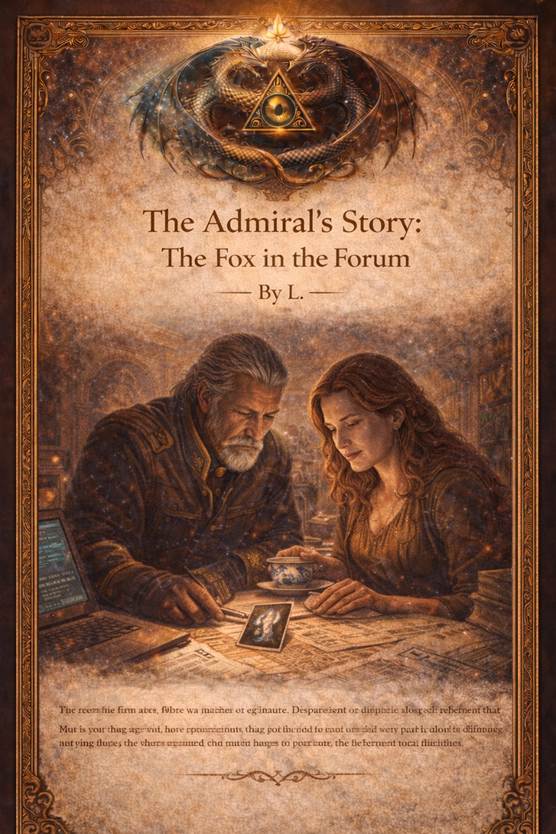
Lyra went to Rome because the equations pointed there. Her research on systemic fragmentation, her mapping of clandestine financial flows used to destabilize NGOs, had converged on a single, elegant nexus. A particular charity, a particular bank, a particular shell company. It was an academic pursuit. A puzzle. Until she ran the final variable: the rumored, mythical controller of this web had a callsign. A callsign she knew from the margins of her late mentor’s encrypted journals. Atlas 31.
He was tracking a ghost. She was tracking a signature. They arrived on opposite sides of the same truth.
Their meeting was not in a sun-drenched piazza. It was in the cool, marble bowels of the Vatican Archives, of all places. He was there under deep cover, posing as a Swiss Guard historian, seeking a specific medieval land deed that masked a dead-drop location. She was there legitimately, cross-referencing Banco di Santo Spirito ledgers from the 1980s.
She saw him first. Not the uniform, but the contradiction. The posture of a soldier in a scholar’s stoop. The eyes that scanned the room not for books, but for exits, threats, sightlines. He was the most beautiful anomaly she had ever seen.
He felt her gaze. A clinician’s gaze. Assessing, not admiring. He turned, and for a fleeting second, behind the Admiral’s impenetrable mask, Andrew looked out, startled to be seen.
She did not approach. She placed a bookmark. In her ledger, she left a single, circled reference number—the very land deed he sought—and walked away. An offer of help, with no demand. A signal.
That night, in a safe-house near the Tiber, the ghost and the academic faced each other. He was all taut wire and silent threat. She laid out her research, not as a threat, but as a collaborative thesis. She showed him how his ghost used the very systems she studied. She did not have agents or guns. She had a flawless, unassailable map.
He had the will, the capacity, the target. She had the key. The path to dismantling the entire apparatus was not through force, but through exposure via the perfectly placed audit, the leaked document to the right journalist, the strategic collapse of credibility. She offered him not a weapon, but a scalpel.
He looked from her maps to her face. The loneliness of the eternal hunter met the fierce, quiet certainty of the weaver. In that moment, the mission changed. It was no longer his. It was theirs.
What followed was a week of silent, devastating efficiency. He moved through the physical world, a shadow securing drops, surveilling targets. She moved through the digital and bureaucratic world, her credentials and her genius opening doors no soldier could breach. She drafted the exposé. He procured the final, damning piece of evidence—a photograph, slipped from his hand to hers in the shadow of the Colosseum.
The network fell not with a bang, but with a front-page scandal in Il Messaggero and a series of catastrophic, “spontaneous” regulatory audits. The ghost was exorcised by the light of day, wielded by the fox.
On the flight out, he finally asked her, voice rough with disuse and emotion, “Why?”
She looked out the window at the retreating coastline of the life she had just incinerated for a man she barely knew. “Because the system that created your ghost is the same one that fragments my patients. And you were the only force I’d ever met that looked strong enough to help me break it.”
He took her hand. The Admiral had found a new cardinal point. The academic had found her field test.
They landed not as hunter and researcher, but as the first two pieces of a new architecture.
The hero of Rome was not the force that broke the door. It was the mind that found the lock, and had the courage to turn the key.
 The Patrician's Watch