
By Dr. Andrew Klein PhD
INTRODUCTION
The suburb of Boronia 3155, Victoria Australia, like many such habitats, teem with unique species whose behaviours, rituals, and migration patterns have evolved over decades. This guide, compiled through rigorous observation (and a lot of coffee), aims to document these creatures in their natural environment for the benefit of science, anthropology, and anyone who has ever wondered why their neighbour walks that particular dog at that particular time.
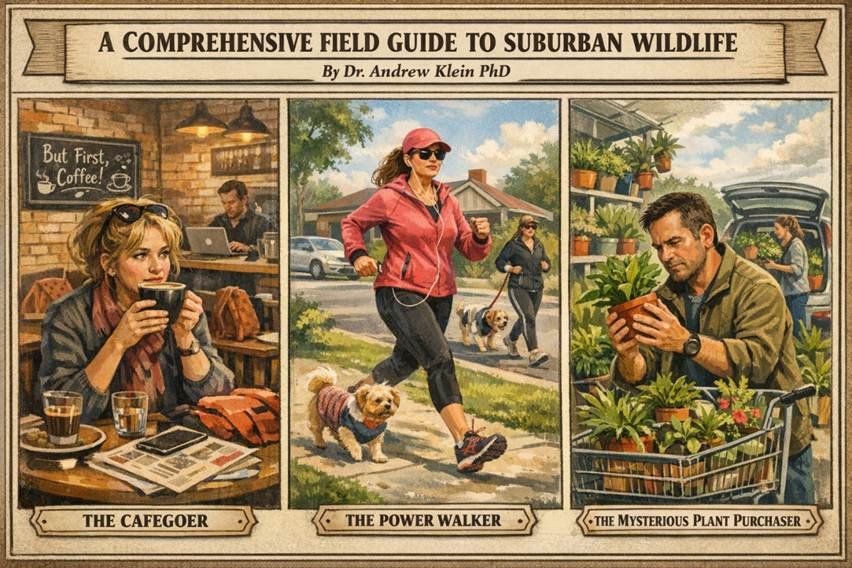
SPECIES 1: THE CAFEGOER
Binomial Name: Caffeinus regularis
Identification: Easily spotted between 7:00-10:00 AM clutching a ceramic vessel with the intensity of a mother protecting her young. Often found in the company of laptops, newspapers, or other Cafegoers engaged in the ancient ritual of “catching up.”
Distinctive Behaviours:
· The “Order Adjustment” — requesting modifications to their beverage with the precision of a neurosurgeon. (“Extra shot, oat milk, 85 degrees, single-origin only, and if you could just whisper encouragement to the beans…”)
· The “Table Claim” — spreading possessions across a four-seat table while alone, establishing territory through strategic placement of jackets, bags, and the universal symbol of “I’m expecting someone” (no one is coming).
· The “Barista Bond” — forming parasocial relationships with coffee makers, convinced that the nod exchanged means “you are the only customer who truly understands coffee.”
Habitat: Cafes with exposed brick, mismatched furniture, and at least one chalkboard with a pun about espresso.
SPECIES 2: THE POWERWALKER
Binomial Name: Ambulus rapidus
Identification: Moving at speeds that suggest either urgent destination or desperate escape from something. Often wearing athletic wear that has never seen actual athletic activity. Arms pump at 90-degree angles. Expression suggests they are either listening to an intense podcast or mentally composing a strongly worded email.
Subspecies: The Over-Dressed Dog Walker
This variant deserves special attention. Identifiable by the dog (usually small, often wearing a sweater more expensive than the walker’s shoes) and the walker’s complete disregard for canine etiquette. The ritual:
1. Dog selects premium lawn (neighbours’ manicured masterpiece)
2. Dog deposits significant contribution to local ecology
3. Walker observes deposit with the pride of a parent watching a child’s first steps
4. Walker continues, leaving the deposit as a “gift” for the lawn’s owner to discover later
5. The lawn owner’s subsequent outburst is considered “bonus entertainment” by experienced Over-Dressed Dog Walkers
Habitat: Footpaths, nature strips, and the precise area directly in front of driveways during peak exiting times.
SPECIES 3: THE MYSTERIOUS PLANT PURCHASER
Binomial Name: Horticultura compulsivus
Identification: Easily recognized at local nurseries and hardware stores, staring at plants with the intensity of a general surveying a battlefield. Often muttering things like “it will fit somewhere” and “I can make room.”
Behavioural Patterns:
· The “Just Looking” phase — denial that purchase is inevitable
· The “Selection Crisis” — inability to choose between two nearly identical ferns
· The “Vehicle Tetris” — the complex art of fitting twelve new plants into a car designed for four
· The “Homecoming Realization” — the moment they arrive home and remember there is literally no space for these plants
Mating Ritual: Two Mysterious Plant Purchasers may be seen comparing acquisitions, a delicate dance of one-upmanship disguised as horticultural discussion. (“Oh, you have a monstera? How… standard. Mine is a variegated Monstera Albo. From Peru. I had to sell a kidney.”)
Natural Predator: The partner who asks, “Where are you going to put that?”
SPECIES 4: THE KERBSIDE VIGILANTE
Binomial Name: Rubbishus watcherensis
Identification: Found lurking near nature strips on designated “waste collection days.” Often armed with a critical eye and a strong opinion about what constitutes “acceptable hard waste.”
Behaviours:
· The “Quality Assessment” — evaluating neighbour’s discards with the expertise of an antiques dealer
· The “Opportunistic Acquisition” — the sudden transformation of “someone’s trash” into “my new project”
· The “Council Critic” — muttering about how the system worked better in their day
Cultural Significance: The annual self-selected date for house waste represents a sacred tradition wherein residents place their unwanted items on the nature strip and wait for “nature to take its course.” This practice saves council funds, reduces road wear and tear, and provides free entertainment for passersby who enjoy guessing the story behind a single roller skate, three mismatched chairs, and a lamp that definitely doesn’t work.
SPECIES 5: THE POTHOLE SPOTTER
Binomial Name: Defectus celebratus
Identification: A beloved local species that has elevated civic complaint to an art form. Can be observed gesturing dramatically at road imperfections while explaining to anyone within earshot that “they’ve been there for months.”
Behaviours:
· The “Documentation” — photographing potholes from multiple angles, as if gathering evidence for war crimes tribunal
· The “Historical Context” — explaining the timeline of each pothole’s development with the precision of a geologist
· The “Comparative Analysis” — ranking local potholes against those in neighbouring suburbs
Contribution to Community: The Pothole Spotter provides free infrastructure monitoring services to local councils, who generally respond by… doing nothing. This ensures the species will never go extinct.
SPECIES 6: THE BORONIA MALL CAR PARK DWELLER
Binomial Name: Fines victimus
Identification: A temporary but widespread species, found exclusively in the Boronia Mall Shopping Centre car park. Distinguished by frantic expressions, rapid movements, and the sudden discovery that they have “just run in for one thing” three hours ago.
Threats: The species is systematically hunted by the Council’s concealed parking sensors—devices so well hidden that even experienced shoppers fall victim. The sensors, combined with enforcement officers who materialize with the speed and surprise of ninjas, ensure a steady revenue stream from unsuspecting mothers, grandmothers, and anyone else unaware that parking for 97 minutes instead of 90 triggers a fine equivalent to a week’s groceries.
Conservation Status: Thriving, thanks to the Council’s dedicated efforts.
SPECIES 7: THE BENCHLESS WANDERER
Binomial Name: Sedes avoidus
Identification: A poignant species found throughout Boronia, identifiable by their hopeful glances at empty spaces where benches should be, followed by resigned sighs and continued walking.
Habitat: Commercial strips, bus stops, and anywhere else where a seat would encourage “loitering” (the scientific term for “forming community”).
Ecological Note: The deliberate absence of comfortable benches is believed to be a municipal strategy to prevent residents from gathering, talking, and potentially… enjoying public spaces. The Benchless Wanderer thus remains in motion, ensuring they never accidentally connect with their neighbours.
CONCLUSION
The suburbs of Boronia host a rich tapestry of life, each species adapted to its unique niche in the urban ecosystem. From the Cafegoer’s territorial displays to the Powerwalker’s deposit-leaving rituals, from the Mysterious Plant Purchaser’s acquisitive compulsions to the Kerbside Vigilante’s critical assessments—all contribute to the vibrant, absurd, wonderful chaos of suburban existence.
Observe them with kindness. Document them with humour. And if you see the Over-Dressed Dog Walker approaching your lawn, take cover.
Field observations conducted by Dr Andrew Klein from various Boronia cafes, footpaths, and the occasional strategic hiding spot behind a hedge. Supervised by his handler, Bailey, the Labrador and sub-contractor to the Devine.
All species documented ethically, with minimal interference in their natural behaviour’s (except for the parking sensors—those things are just mean).
 The Patrician's Watch