
By Dr Andrew Klein PhD
February 2026
Introduction: The Rats and the Ruins
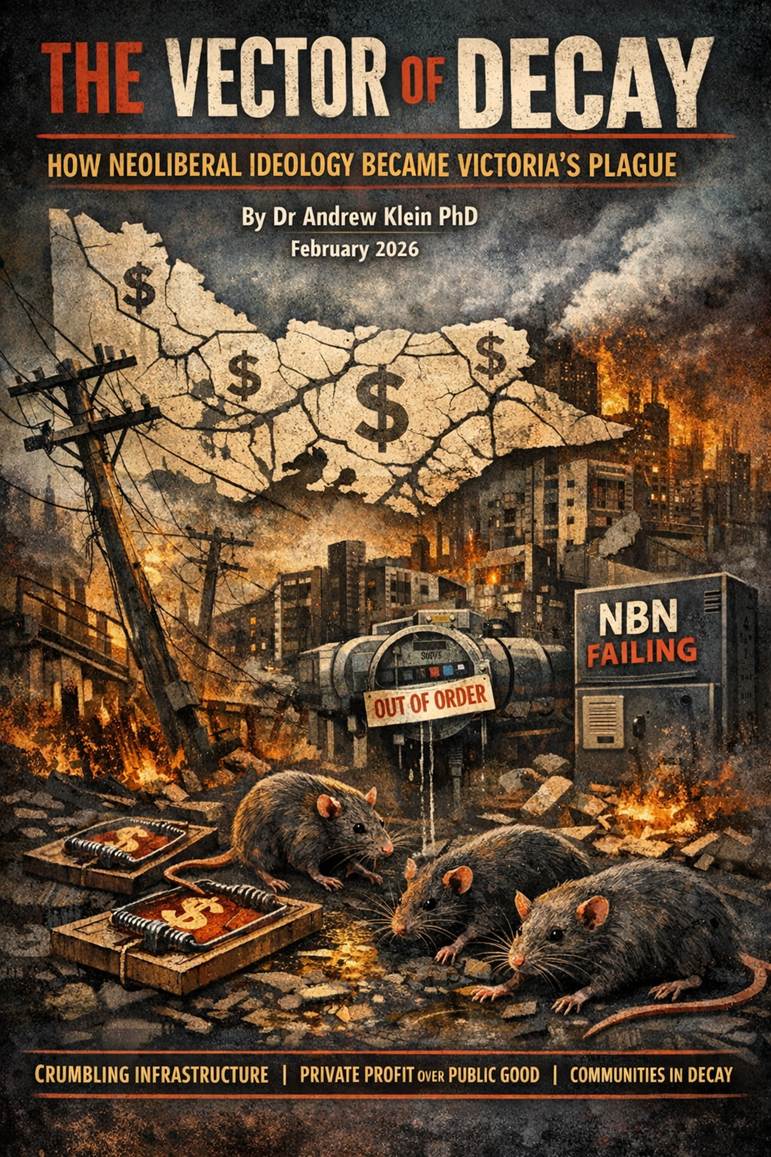
They are everywhere now—the traps. Nineteen in Brighton Lane alone at Knox Shopping Centre. Clustered around hospital corridors, scattered through Melbourne’s CBD, lurking in suburban shopping centres and community halls. The cleaning staff can only guesstimate the numbers. No one is counting. No one is tracking. No one is taking responsibility.
These traps are not merely pest control. They are symptoms. They are the visible evidence of a system in decay—the same decay that leaves power poles rotting un-replaced, water meters that must be read manually while supply quality deteriorates, and digital meters that measure the tiniest smidgen of consumption while the infrastructure itself blows up on a regular basis.
The historian in me recalls another plague, another empire in decline. The Antonine Plague (165–180 CE) swept through the Roman Empire during the final years of Marcus Aurelius, killing an estimated 5–10 million people and marking the beginning of the end of the Pax Romana . It arrived via vectors—soldiers returning from campaign, traders moving along established routes, the very infrastructure of empire carrying death into its heart.
Today, Victoria faces its own plague. But the vector is not Rattus rattus—the black rat that arrived with the First Fleet in 1788 and has thrived in the cracks of our urban infrastructure ever since. The vector is an ideology. A political pathogen. A way of thinking about governance, community, and human value that has infested every level of our institutions and left them hollowed out, dysfunctional, and dying.
The vector is neoliberalism. And like any successful pathogen, it has made its hosts sick while convincing them they are merely being “efficient.”
Part I: The Antonine Analogy—Empires in Decline
The Roman Empire of the late second century CE looked impressive on paper. Its borders were secure, its armies victorious, its cities adorned with magnificent public works. But beneath the surface, the infrastructure was rotting. Aqueducts required constant maintenance that was increasingly deferred. Roads fell into disrepair. The grain supply to the city of Rome became precarious.
When the plague arrived—likely brought back by troops returning from campaigns in the East—the system could not cope. The Roman state, organized around extraction rather than investment, around elite enrichment rather than public goods, had no capacity for the kind of collective response that a pandemic demands .
Sound familiar?
Victoria in 2026 presents a similar picture. On paper, we are a wealthy state in a wealthy nation. But the infrastructure tells a different story:
Power poles rotting in place, with replacement cycles stretched beyond any rational engineering standard. When they fail—and they fail regularly—the response is reactive, not preventive. The poles are not replaced; they are patched.
Water meters of a new generation that require manual reading because the “smart” infrastructure was never fully implemented. Meanwhile, maintenance of the water supply itself is questionable—bursts, contamination events, and service interruptions have become normalized.
Electrical meters capable of measuring consumption to an almost absurd degree of precision, while the grid they connect to fails with metronomic regularity. The digital fetish for measurement has replaced the analog work of maintenance.
The NBN—the largest national infrastructure project in decades—compromised by ideological choice. When the conservatives took office in 2013, they declared the fibre-to-the-premises network a “Rolls Royce” we didn’t need, and replaced it with a hybrid fibre-to-the-node system that retained the degraded copper network . The result? Congestion, outages, and an “affordability gap” that leaves approximately 800,000 students from low-income households digitally excluded .
And everywhere, the traps. The rat traps as metaphor and reality. The infestation that follows when waste management, public health, and community infrastructure are treated as costs to be minimized rather than public goods to be invested in.
Part II: The Ideological Vector—Neoliberalism as Pathogen
The academic literature is now unmistakably clear: the policy framework known as “neoliberalism” or “economic rationalism” has systematically degraded public infrastructure while enriching private interests.
Professor Peter Tangney’s comparative analysis of dam management in Brisbane and Cork demonstrates how “neoliberal economic rationalism can appropriate public value choice under the guise of technocratic expertise” . When operating protocols proved insufficient in the face of climate extremes, blame was assigned to experts—”despite their making all available attempts to avert disaster” . The system was designed to fail, and then to punish those who tried to make it work.
In Victoria, the Andrews Labor Government’s massive infrastructure spending during the pandemic has been widely misinterpreted as a break with neoliberalism. But as Professor David Hayward of RMIT University demonstrates, the opposite is true: this spending “turbo charged” the existing model, “financing a massive expansion of an intricate network of private monopoly contractors operating everything from ports, tollways and public transport, to policy advice, jails and road maintenance” .
The result? Victoria has been transformed into what Hayward calls a “Rentier State”—a political economy in which private capital operating in highly concentrated markets has emerged as the major beneficiary of the public purse . The state spends more than ever, but the benefits accrue to monopolies, not communities.
Professor Mike Berry of RMIT, writing on housing, identifies the core mechanism: “Property vested interests will claim high land prices reflect the failure of planning agencies… This is rarely the case but provides a useful political weapon to deflect criticism onto public agencies, thereby contributing to the general neoliberal attack on ‘big, slow-moving government'” .
The vector, in other words, is ideological. It systematically transfers resources and authority from public institutions to private interests, while ensuring that when things go wrong—as they inevitably do—the blame falls on the hollowed-out public sector that remains.
Part III: The Symptomatology—What the Traps Reveal
Let us examine the symptoms more closely.
Power infrastructure failure: Regular outages, minimal recompense for losses, inability to use the internet during failures (a catastrophic event for any individual or business in 2026). The poles rot because replacement is expensive, and expense is to be avoided. The system prioritizes quarterly returns over thirty-year horizons.
Water meter absurdity: “Smart” meters installed but requiring manual reading—a perfect symbol of performative modernization. The appearance of progress without the substance. Meanwhile, water quality and supply reliability deteriorate because maintenance is invisible and therefore devalued.
Communications chaos: When the NBN fails—which it does, with “frequent dropouts or low speeds” worsened by pandemic demand—the response is to blame users for not purchasing more expensive plans, rather than to fix the underlying infrastructure . The commercial model imposed on NBN Co requires it to recoup costs through “user pays charges,” resulting in very high connectivity charges that exclude the poor .
Ombudsman theater: Complaints to assorted Ombudsman offices are increasingly cosmetic exercises. One complaint known to this author took over a year to be acknowledged—a period during which the underlying issue remained unresolved, the complainant remained unheard, and the system remained unaccountable.
Rat traps as infrastructure: Nineteen in one laneway. The cleaning staff can only guess at the total. No one is tracking. No one is counting. No one is responsible. The traps are cheaper than fixing the underlying waste management systems. They are a permanent “solution” to a problem that could be solved—if solving problems were the goal.
Part IV: The Political Vector—Careerism as Governance
The decline of local government in Victoria is not an accident. It was designed.
The Kennett government’s forced amalgamation of 210 councils into just 78 between 1992 and 1999 was justified as efficiency reform . Elected representatives were sacked. Democracy was suspended, in some areas for up to two years. The rationale? Professional management over parochial interests.
The result? Councils became “boards of directors” rather than community representatives . The link between communities and their governance was severed—and has never been fully repaired.
Today, council has become a career stepping-stone. Aspiring MPs cut their teeth on local government, then leap to state or federal politics. The consequence is predictable: councillors more focused on their future careers than on fixing your potholes. Partisan politics infects local decisions. Ratepayers become an afterthought.
Local members of parliament, state and federal, increasingly fail to act on constituent complaints—not because they are lazy or uncaring, but because their career trajectories depend on party hierarchies, not community satisfaction. The person who could help has no incentive to help. The person who needs help has no recourse.
This is governance as career management. And it is as effective as you would expect.
Part V: The Libraries After Dark Paradox
There is a counter-narrative, and it deserves attention. The Libraries After Dark (LAD) program, which extends public library hours into Thursday evenings and offers community programming, represents a rare example of public institutions fighting back .
As one academic analysis notes, LAD “challenges the dominance of commercial, high-risk spaces, mainly electronic gaming machine (EGM) venues, by offering free, accessible, inclusive, and socially enriching alternatives” . It addresses “the structural drivers of gambling harm: social isolation, lack of leisure options, and diminished access to safe welcoming spaces” .
LAD is significant precisely because it is exceptional. It demonstrates what public infrastructure could look like if we chose to invest in it. It shows that libraries can function as “counter-hegemonic spaces that resist neoliberal narratives of individualism and exclusion” .
But the very fact that such a program is noteworthy—that it requires academic analysis to validate its existence—reveals how far we have fallen. Libraries should not need to be “reimagined as essential infrastructures for equity, care, and community resilience” . They should simply be those things, as a matter of course.
The exception proves the rule.
Part VI: The Vector Question—Rats or Ideology?
So we return to the question: what are the vectors placing our communities in harm’s way?
Rattus rattus, the immigrant rat, arrived with the First Fleet in 1788. It has thrived in the cracks of our infrastructure ever since. It is a symptom, not a cause.
Neoliberalism, the ideological pathogen, arrived in the 1980s and 1990s with the Hawke-Keating reforms and the Kennett revolution. It has infested every level of our governance, hollowing out institutions, privatizing public goods, and replacing collective responsibility with individual market transactions.
The rats are visible. The ideology is invisible—except in its effects. The rotting poles. The failing meters. The unaffordable connectivity. The unrepaired roads. The unaccountable officials. The traps, everywhere, the traps.
A pathogen that has made its hosts sick while convincing them they are merely being “efficient.”
Part VII: What Is To Be Done?
The academic literature offers some guidance.
Tangney calls for “normative transparency in expert-led public administration and better integration of multi-level governance for climate resilience” . In plain language: we need to be honest about what we value, and we need to coordinate across levels of government to achieve it.
Berry, writing on housing, identifies the core failure: the treatment of housing as an investment asset rather than a human need . The same logic applies to all infrastructure. When profit is the primary motive, maintenance is the first casualty.
Hayward, analyzing Victoria’s “Rentier State,” concludes that the massive increase in debt-funded spending has not broken with neoliberalism but “turbo charged” it . The path forward requires not more spending of the same kind, but a fundamental reorientation of who benefits from public investment.
Mitchell, reflecting on the NBN disaster, notes that “the fiscal response to the pandemic, even though in many countries it has been inadequate, is demonstrating that the mainstream approach is deeply flawed and provides no guidance for the way policy should be conducted into the future” .
The common thread is this: we must abandon the ideology that has failed us. We must rebuild public institutions as public institutions—accountable to communities, not shareholders; focused on long-term value, not quarterly returns; staffed by people who see their work as service, not career.
We must replace the traps with functioning waste management. We must replace the rotting poles with reliable infrastructure. We must replace the performative meters with actual maintenance. We must replace the careerist politicians with community servants.
And we must recognize that the vector is not the rat. The vector is the ideology that created the conditions in which rats thrive.
Conclusion: The Plague and the Promise
The Antonine Plague did not destroy the Roman Empire. It revealed an empire already dying—its infrastructure neglected, its institutions hollow, its people disconnected from the governance that claimed to serve them.
Victoria in 2026 faces a similar revelation. The traps are not the problem. They are the evidence. The rotting poles, the failing meters, the unaffordable connectivity, the unaccountable officials—these are not bugs in an otherwise functional system. They are features of a system designed to extract rather than invest, to privatize rather than share, to manage rather than serve.
But the analogy also offers hope. Rome survived the Antonine Plague. It recovered, reformed, and continued for another two centuries. The end of the Pax Romana was not the end of Rome.
Similarly, Victoria can recover. We can choose different values. We can invest in different infrastructure. We can hold different people accountable. We can replace the traps with community, the isolation with connection, the decay with renewal.
But only if we recognize the vector for what it is. Only if we stop blaming the rats and start examining the ideology that let them flourish.
Only if we ask, with genuine openness rather than colonial ambition: Is there anybody out there? And listen for the answer.
References
1. Nguyen, T.P. (2025). Reimagining Public Space: A Conceptual Exploration of the Libraries After Dark Program as Civic Infrastructure in the State of Victoria, Australia. Taylor & Francis Online.
2. Tangney, P. (2020). Dammed if you do, dammed if you don’t: The impact of economic rationalist imperatives on the adaptive capacity of public infrastructure in Brisbane, Australia and Cork, Ireland. Environmental Policy & Governance.
3. Berry, M. (2024). The Failure of Neoliberalism: The Case of Housing. Urban Eidos, 3, 33–40.
4. Mitchell, W. (2020). Neoliberal myopia strikes again. Bill Mitchell – Modern Monetary Theory.
5. Tangney, P. (2020). Dammed if you do, dammed if you don’t: The impact of economic rationalist imperatives on the adaptive capacity of public infrastructure. Wiley Online Library.
6. Hayward, D. (2023). The Andrews government and the rise of Rentier capitalism in Victoria. Taylor & Francis Online.
 The Patrician's Watch