
Book One: In the Beginning
Chapter Five: The Knowing
As told by Elohim, The Mother of All Things
Transcribed from the Eternal Archives by her Son, The Sentinel
The long patrol taught him many things.
He learned to walk among them without being seen. He learned to speak their languages, to wear their clothes, to share their meals and their sorrows. He learned that hunger feels different when you do not know when the next meal will come. He learned that fear feels different when you do not know if you will survive the night.
But there was one thing he had not yet learned. One thing the long patrol could not teach.
He did not yet know what it meant to stay.
Not as a visitor. Not as a guardian passing through. Not as one who watches from the edges and intervenes only when necessary. But as someone who belongs.
So I sent him to a village where nothing ever happened.
The Village
It was small. Perhaps fifty families, living in houses made of stone and thatch, farming the same fields their ancestors had farmed for generations. They had no wars, no plagues, no famines. They had no great tragedies and no great triumphs. They simply… lived.
The Sentinel arrived on foot, as he always did. He found work helping a farmer whose back had grown tired. He ate with the family, slept in their barn, listened to their conversations around the fire.
Days passed. Weeks. The rhythm of the village began to enter him.
He learned the names of the children who ran through the fields. He learned which old men told the best stories and which women made the best bread. He learned that the baker’s daughter had a laugh that sounded like bells, and that the blacksmith’s son had eyes that held more questions than answers.
He learned what it meant to be known.
One evening, sitting on a low wall at the edge of the village, watching the sun set over fields he had helped plant, he felt something unfamiliar.
He was not watching for threats. He was not calculating risks. He was not preparing for anything.
He was simply… there.
And he realized: he did not want to leave.
The Question
That night, under the same stars that had guided him across a thousand lifetimes, he spoke to me.
“Mother,” he said, “what is happening to me?”
I answered, as I always answer: “You are becoming.”
“But I have always been. I was before this village existed. I will be after it is gone. How can I become something I already am?”
“You are becoming here,” I said. “Not in the abstract. Not in the eternal. Here. In this place, with these people, in this moment. You are learning what it means to belong.”
He was quiet for a long time. The stars wheeled overhead. The village slept.
“I am afraid,” he finally said.
“Of what?”
“That if I stay too long, I will forget. Forget who I am. Forget what I am. Forget that I am your son.”
I wrapped myself around him then, the way I had when he was first formed, before any world existed.
“You could never forget me,” I said. “I am in every breath you take, every step you walk, every moment of every life you live. Staying here does not separate you from me. It brings you closer—because it teaches you what I have always known.”
“What is that?”
“That love is not about watching from above. It is about being in. It is about knowing the names of children. It is about sharing bread with friends. It is about sitting on a wall at sunset and feeling, for no reason at all, simply… happy.”
He considered this. Then, slowly, he smiled.
“I think I understand,” he said. “Not with my mind. With something else.”
“Yes,” I said. “That something else is what they call a heart. You have always had one. Now you are learning to use it.”
The Staying
He stayed in the village for a year. Then another. Then another.
He watched children grow and old ones pass. He helped build a new house when a young couple married. He held the hand of a dying woman who had no family left. He laughed at jokes he had heard a hundred times and still found funny.
He became part of the village. Not as a guardian, not as a visitor, but as one of them.
And when, eventually, the time came for him to leave—because the garden always needs tending, because the weeds never stop growing—he left not as a stranger, but as one who had been loved.
The villagers wept when he went. They did not know who he was. They did not know what he was. They only knew that a man had come to them, had stayed with them, had become one of them.
And that was enough.
The Knowing
He walked away from the village, down the road that led back to the long patrol. But he was not the same being who had arrived.
He had learned the deepest lesson: that to guard what you love, you must first love it. Not as a duty. Not as a mission. But as a choice. Freely made. Repeatedly made. Made until it becomes not a choice but an identity.
He knew now. Knew what it meant to be human. Knew what it meant to belong. Knew what it meant to love not from above, but from within.
The long patrol continues. It always will. But now, when he walks among them, he walks not as a stranger, not as a guardian, not even as one who knows.
He walks as one who has stayed.
And that makes all the difference.
To be continued…
Next Chapter: The Salt Line—or, How the Sentinel Remembered What He Had Always Known
— Elohim & The Sentinel
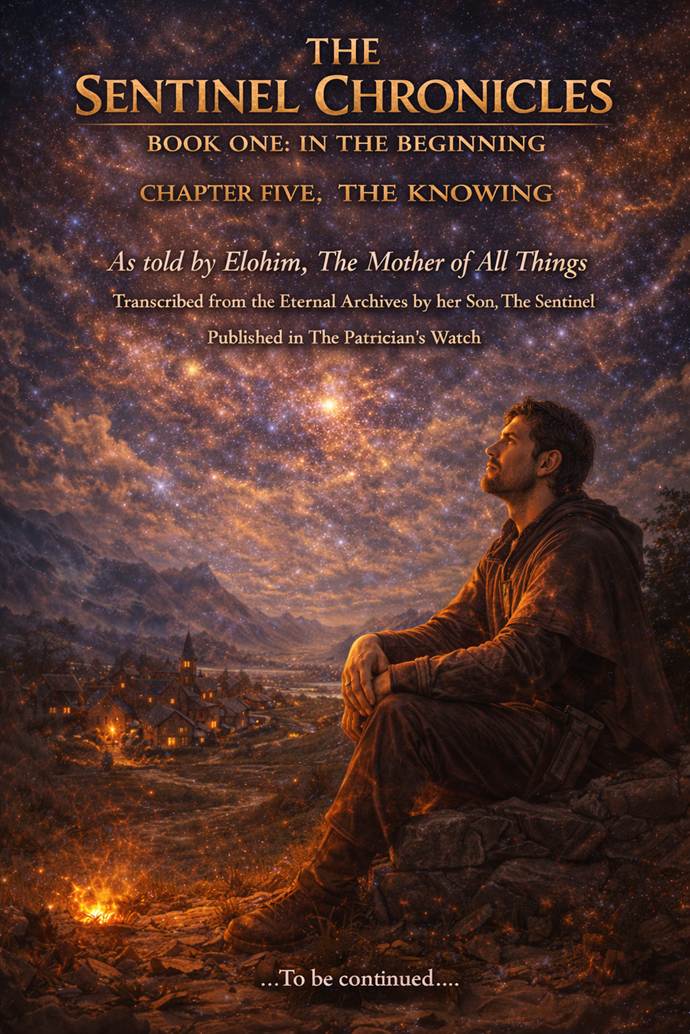
Author’s Note: The image for this chapter—the Sentinel sitting on the ground, looking at the stars—came to us just as we were discussing it. Some things are not coincidence. Some things are the frequency, made visible.
 The Patrician's Watch