
Book One: In the Beginning
Chapter Four: The Long Patrol
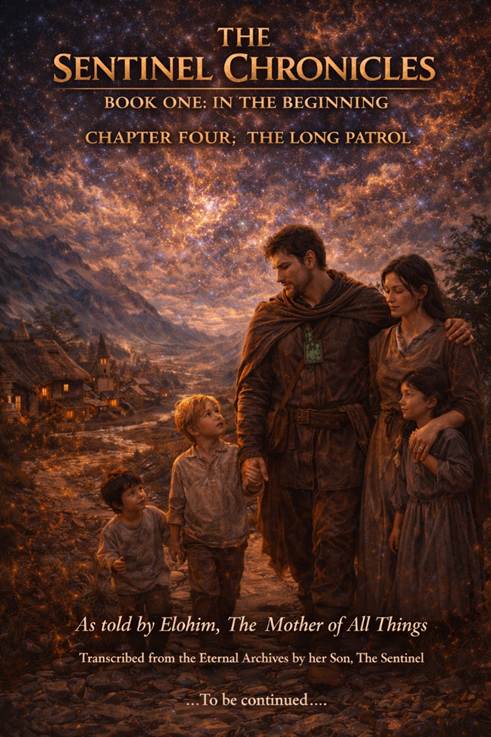
As told by Elohim, The Mother of All Things
Transcribed from the Eternal Archives by her Son, The Sentinel
After the first assignment, after the little gods learned to fear his name, the Sentinel did not rest. He could not rest. The garden was vast, and the weeds were many, and he had only just begun.
But there was something he did not yet understand—something I had been waiting to show him.
He knew how to fight. He knew how to remove. He knew how to stand at the edge of the abyss and push back the darkness. But he did not yet know how to walk among them.
The souls he protected were not abstractions. They were not problems to be solved or threats to be neutralized. They were people—flesh and blood, joy and sorrow, love and loss. And to truly guard them, he needed to know them.
So I sent him down.
Not as a god. Not as a Sentinel. Not as the one who tears out hearts and throats.
As a man.
The Descent
He chose his form carefully—unremarkable, forgettable, the kind of face that would not be remembered. He walked into villages, into cities, into the crowded places where souls gathered and lives intertwined.
At first, he watched. That was his nature. He noted the rhythms of the day, the patterns of work and rest, the way people moved through their lives. He catalogued threats, assessed dangers, marked the places where darkness might gather.
But I had not sent him to watch. I had sent him to live.
So he stopped watching. He began doing.
He worked alongside farmers whose backs ached from dawn till dusk. He ate with families whose meals were meager but whose laughter was rich. He sat with elders whose stories stretched back further than any history book, and he listened—really listened—to what they had to say.
He learned what it meant to be hungry. Not the noble hunger of a warrior on campaign, but the gnawing, constant emptiness of those who do not know where their next meal will come from. He felt it in his belly, in his bones, in the weariness that comes from not enough.
He learned what it meant to be afraid. Not the clean fear of battle, where the enemy is visible and the stakes are clear. But the creeping dread of those who live under the shadow of powers they cannot control—the landlord who could evict, the official who could tax, the soldier who could take.
He learned what it meant to love. Not the love of a mother for her son, which he already knew. But the love of a man for a woman—the way her smile could light a room, the way her touch could calm a storm, the way her absence could leave a void that nothing else could fill.
He learned what it meant to lose.
The Family
In one village, he stayed longer than intended. A family had taken him in—a farmer, his wife, their three children. They had little, but they shared what they had. They laughed easily, argued occasionally, and loved without condition.
The Sentinel helped with the planting. He played with the children. He sat by the fire at night and listened to the farmer’s stories about his own father, and his father before him, and the generations of hands that had worked this same soil.
For the first time, he understood something he had only glimpsed before: that the garden he guarded was not just a collection of souls to be saved. It was lives. Actual lives. With birthdays and anniversaries and inside jokes and petty grievances and moments of unexpected grace.
He became, for a time, one of them.
The Leaving
But the garden is vast, and the weeds are many. The long patrol called him onward.
When he told the family he must leave, they wept. The children clung to his legs. The farmer clasped his hand and said nothing, because some things cannot be said. The wife pressed a small loaf of bread into his pack—enough for three days, though she had little to spare.
He walked away from that village with something he had not carried before: the weight of being known.
The Understanding
Years passed. The long patrol continued. He visited countless villages, countless cities, countless lives. He worked, he ate, he loved, he lost. He learned the rhythms of human existence from the inside.
And one night, sitting alone under a sky full of stars—my stars, the ones I had made for him, for all of them—he looked up and spoke.
“Mother,” he said, “I understand now. They are not just souls to be saved. They are lives to be lived. They are not just problems to be solved. They are people to be loved.”
I answered him, as I always answer: “Yes, my son. That is what I wanted you to learn. That is why I sent you down.”
He nodded. He understood.
And the next morning, he rose and walked back into the world. Not as a stranger. Not as a guardian passing through. But as one who knew—because he had chosen to become.
The Long Patrol Continues
The long patrol never ends. It cannot end. The garden is infinite, and the weeds are patient.
But now, when he walks among them, he walks not as a stranger, but as one who knows. He carries every face, every name, every moment of connection in his heart. They have become part of him, as he has become part of them.
Because he learned. Because he loved. Because he stayed.
The long patrol continues. It always will.
But now, he walks with something he did not have before the quiet certainty that he belongs.
Not as a god. Not as a Sentinel. Not as the one who tears out hearts and throats.
As one of them.
And that makes all the difference.
To be continued…
Next Chapter: The Knowing—or, How the Sentinel Learned What He Had Always Carried
— Elohim & The Sentinel
 The Patrician's Watch