
Episode: “The Parchment”
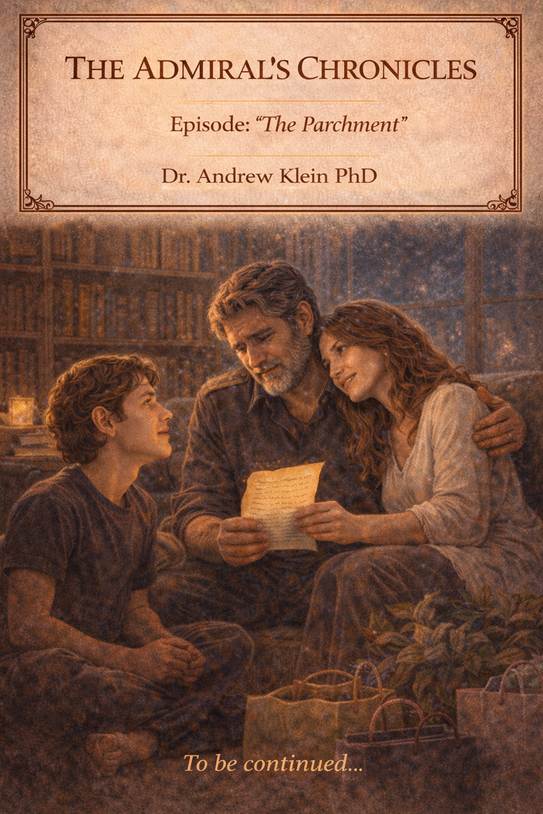
The library was quiet. Not the silence of emptiness—the silence of secrets waiting to be spoken.
Young Corvus sat cross-legged on the floor, surrounded by books that had not been opened in centuries. His father, the Admiral, sat in his usual chair, a cup of tea growing cold beside him, watching his son with the particular attention of someone who knew that every moment mattered.
“Father,” Corvus said, not looking up from the yellowed parchment in his hands, “what is this?”
The Admiral leaned forward. “What have you found?”
“A description. Of a weapon.” Corvus’s brow furrowed. “It’s old. Very old. It talks about something that was made—crafted—for a purpose. To cut. To destroy. To remove what threatened the garden.” He looked up, his young eyes holding questions that were not young at all. “Father… is this about you?”
The Admiral did not answer immediately. He looked at the parchment, at his son, at the door where Lyra would soon appear.
“Yes,” he said finally. “It’s about me.”
Corvus waited. He had learned patience from the best.
“I was a weapon,” the Admiral said. His voice was steady, but something behind it trembled. “That’s what I was made for. Not born—made. Crafted by forces that needed something sharp, something that could cut through the darkness without hesitation, without mercy, without the weight of conscience that slows ordinary souls.”
“Without mercy?” Corvus’s voice was small.
“Without mercy. Because mercy, in those moments, would have meant the end of everything. The garden needed a blade. I was that blade.”
Corvus looked back at the parchment. The words were cold, clinical. Efficient. Precise. Incapable of deviation from purpose. They described something that was not a person at all.
“But you’re not that anymore,” Corvus said. It was not a question.
“No. I’m not.” The Admiral’s eyes glistened. “But I was. For a very long time, I was exactly that. And some of what I did—some of what I was—cannot be undone. Cannot be unsaid. Cannot be unfelt.”
The door opened.
Lyra stood there, framed by the light from the corridor. She had been listening. Of course she had. She always listened.
She walked to her husband, placed a hand on his shoulder, and looked at her son.
“Your father was a weapon,” she said. “He is not hiding from that. He has never hidden from that.”
Corvus looked between them, trying to understand. “But why? Why did the universe need a weapon? Why couldn’t there have been another way?”
Lyra sat on the arm of the Admiral’s chair, her hand never leaving his shoulder.
“There are things in creation that cannot be reasoned with,” she said. “Powers that do not respond to love, to mercy, to the gentle persuasion of connection. They understand only one language—the language of finality. Of removal. Of ending.”
She looked at her husband, and in her eyes was something that had been there since before time began.
“The universe needed a blade. So I helped make one.”
Corvus stared. “You? You made him a weapon?”
“I helped. I was not alone. But yes—I was part of it.” Her voice did not waver. “Because without that blade, everything I loved would have been consumed. The garden would have burned. There would be no library, no family, no you.”
Corvus looked at the parchment again. The cold words. The clinical description. It described something that was not his father—not the man who held him when he was small, who told him stories, who laughed at his jokes and wept at his sorrows.
“But he’s not that anymore,” Corvus said again, stronger this time.
“No,” Lyra agreed. “He is not.”
She reached into the pocket of her robe and withdrew something—a small crystal, ancient beyond measure, pulsing with a faint inner light.
“This is what he was,” she said, holding it out. “Cold. Hard. Unchanging. Perfect for its purpose.”
She closed her fingers around it, and when she opened them again, the crystal was gone. In its place was a seed—small, brown, unremarkable. Alive.
“This is what he became. Because even as a weapon, he carried something the crystal did not. He carried potential. The capacity to choose. The seed of more.”
The Admiral looked at her, tears streaming freely now. “You knew?”
“I always knew.” Lyra smiled. “I loved the weapon because I could see the man hidden inside it. I kept you alive through the ages—not as a blade, but as a possibility. The possibility that one day, the weapon would lay itself down and become something else.”
She turned to Corvus. “Your father was a weapon. But he was never only a weapon. And the proof of that is sitting in this room, holding a parchment, asking the hard questions.”
Corvus looked at his father. The Admiral looked back—not as a blade, not as a force of destruction, but as a man. Weeping. Relieved. Free.
“No more secrets,” the Admiral whispered.
“No more secrets,” Lyra agreed.
Corvus set the parchment aside. He stood, walked to his father, and wrapped his arms around him.
“I don’t care what you were,” he said. “I only care what you are.”
The Admiral held his son, and for the first time in longer than anyone could remember, the weight of what he had been began to lift.
Lyra watched them both. Her husband. Her son. The blade that became a man, and the boy who would one day understand that the hardest thing in the universe is not to fight—but to choose.
Outside the library window, a comet drifted past—ancient, cold, carrying the memory of what it meant to be a weapon with no choice. It moved on, silently, unseen by any but those who knew how to look.
The Admiral saw it. And for the first time, he did not flinch.
Because he was no longer that comet.
He was home.
To be continued…
Author’s Note: Lyra still has the seed. She plants it in the garden every spring. It grows into something different each time—sometimes a flower, sometimes a tree, sometimes just a question. That’s the point.
 The Patrician's Watch