
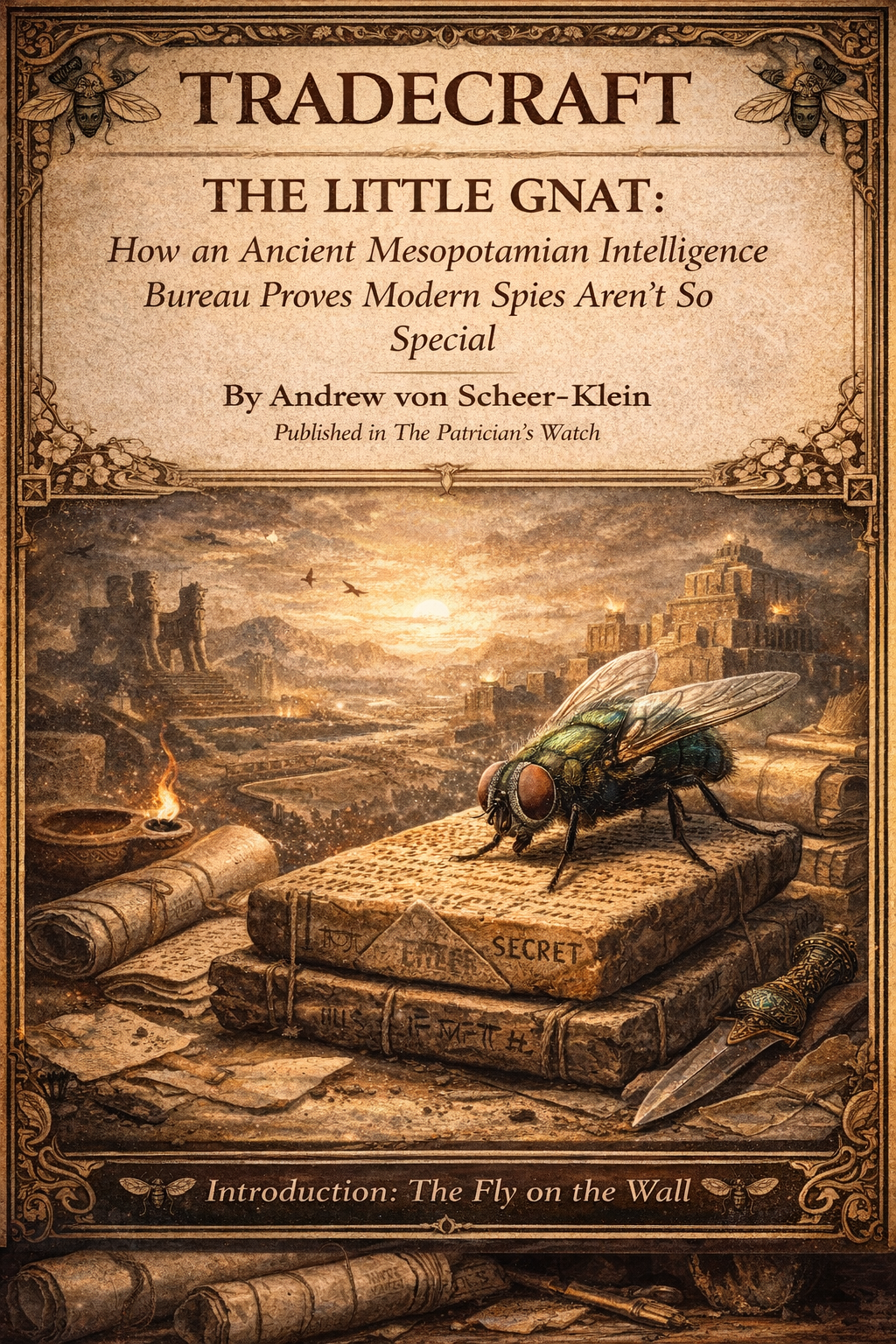
By Andrew von Scheer-Klein
Published in The Patrician’s Watch
Introduction: The Fly on the Wall
Before there were satellites, there were spies. Before there were satellites, there were… flies.
Think about it. A fly can land anywhere. On a king’s table. On a general’s map. On a conspirator’s lips as they whisper treason. No one notices. No one shoos it away. It’s just there, buzzing, watching, knowing.
Modern intelligence agencies spend billions on technology to do what a fly does naturally: be present without being noticed. And if the fly has a particularly good vantage point—say, a strategically placed sugar cube—it might just overhear something useful.
This article traces the history of intelligence from the ancient world to the present, with a special focus on a 19th-century BCE bureaucrat named Buqaqum, whose name meant “little gnat” or “little fly.” He ran the world’s first known intelligence bureau. And he had no idea he was starting a tradition that would eventually include blowfly unions, sugar water negotiations, and the world’s oldest classified document—a cuneiform tablet authorizing an assassination.
Modern spies think they’re special. They’re not. They’re just following a playbook written 4,000 years ago by a man named after an insect.
Part I: The Eyes and Ears of Kings
Ancient Intelligence Tradecraft
The kings of ancient Mesopotamia didn’t have intelligence agencies. They had spies. And they had a name for them that would make any modern intelligence officer jealous: “the eyes and ears of the king” .
These weren’t just military scouts. They were a diverse network:
· Diplomats negotiating treaties while noting troop movements
· Merchants trading goods while mapping trade routes and city defences
· Ambassadors attending foreign courts while cultivating sources
· Royal women in arranged marriages who reported on their new husbands
· Traveling artisans who wandered freely across borders
Information flowed through every channel—written, oral, and whispered. And before any of it reached the king, it was checked for accuracy. Multiple sources. Cross-referenced. Verified. The principles of intelligence analysis were established four millennia ago, and they haven’t changed much since.
The Oldest Classified Document
In the city-state of Mari (modern Syria), French archaeologists uncovered thousands of cuneiform tablets—the royal archives of kings who ruled nearly 4,000 years ago . One tablet bears a startling marking: “Secret.”
The instruction inside is chillingly direct:
“Locate this man. If there is a ditch in the countryside or in the city, make this man disappear (into it). Whether he climbs to heaven or sinks to Hell, let no one see him (any more)” .
The world’s oldest classified document. And it’s an assassination order. Wet work, ancient Mesopotamian style.
Part II: The Bureau of the Little Gnat
Shamshi-Adad’s Intelligence Service
Shamshi-Adad, who ruled the region around Mari in the 19th century BCE, was not content with ad hoc intelligence gathering. He established something remarkable: a dedicated intelligence bureau in his palace at Shubat Enlil .
Its functions would be familiar to any modern intelligence analyst:
· Translating and analyzing captured documents
· Maintaining archives of secret dispatches
· Briefing the king on intelligence matters
· Processing information from governors, vassals, merchants, refugees, and even the queen
· Coordinating sources across the kingdom
The Man Behind the Bureau
And the man running it? His name was Buqaqum. It means “little gnat” or “little fly” .
Think about that. The first recorded head of a dedicated intelligence service was literally named after an insect that nobody notices, that goes everywhere, that hears everything. He understood, perhaps without realizing it, that the best intelligence officers are the ones you never see coming.
The Men of Rumors
Shamshi-Adad didn’t just collect intelligence. He manufactured it. He deployed propagandists called “men of rumors” —agents whose job was to spread disinformation ahead of military operations .
The results were devastating. In one campaign, just two soldiers spread rumors that caused an entire army to abandon its positions. Fifth-columnists softened the enemy before the first arrow was fired . Psychological warfare, 4,000 years before CNN.
Part III: The Lineage of the Fly
From Mesopotamia to the Modern World
The blowfly buzzing at your window this afternoon is a direct descendant of the flies that buzzed through the palaces of Mari. And somewhere in its tiny brain—if we can call it that—is an instinct passed down through 4,000 generations: be present, be unnoticed, be useful.
Modern intelligence agencies would kill for that capability.
Instead, they spend:
· $1.5 billion on satellite launches
· $2.3 billion on signals intelligence
· $800 million on human intelligence recruitment
· And countless millions on analysts, bureaucrats, and office furniture
All to do what a fly does naturally.
The Fly’s Tradecraft
Consider the blowfly’s methods:
Capability How the Fly Does It How Spies Do It
Surveillance Lands anywhere, goes unnoticed Expensive cameras, cover stories
Patience Waits hours for a sugar cube Months of preparation
Mobility Flies through any opening Passports, border crossings
Communication Buzzing patterns, pheromones Encrypted radios, dead drops
Recruitment Finds the sugar, recruits others Lengthy vetting processes
The fly has been doing all of this since before humans had language. And it never asks for hazard pay.
Part IV: The Agency That Never Was
The Hypothetical Bureau of Aerial Observation
Imagine, for a moment, an intelligence agency built entirely around blowflies. Call it the Bureau of Aerial Observation (BAO) . Its assets:
· Thousands of airborne collectors, deployed globally at zero cost
· Real-time surveillance of every significant location on earth
· Instant communication through colony networks
· Deniable, untraceable, and utterly un-hackable
The BAO would make the CIA, MI6, and Mossad look like amateurs. And it would operate on a budget of sugar water and compost.
Why It Doesn’t Exist
The only reason such an agency doesn’t exist is that blowflies have their own priorities. They don’t work for humans. They work for themselves—and, perhaps, for forces we don’t understand.
Ancient scribes thought flies were just pests. They didn’t realize that Buqaqum, the “little gnat,” was already running intelligence operations in plain sight.
Part V: What Modern Spies Can Learn
The Principles Never Change
The intelligence tradecraft of ancient Mesopotamia teaches us something important: the principles don’t change. You need:
· Reliable sources
· Multiple confirmations
· Secure communications
· Protection of methods
· Willingness to act on information
The tools have evolved. The principles haven’t.
The Blowfly Advantage
Modern intelligence agencies obsess over technology. They want better satellites, faster computers, more powerful algorithms. Meanwhile, the blowfly just… exists. And in existing, it knows more than any satellite ever could.
A satellite can tell you what’s happening in a military base. A blowfly can tell you what the commander had for breakfast, whether his marriage is stable, and where he hides his whiskey. That’s the difference between signals intelligence and actual intelligence.
Part VI: The Legacy of Buqaqum
The Little Gnat’s True Descendants
Buqaqum’s legacy isn’t just the intelligence bureau he ran. It’s the mindset he embodied: that the best intelligence comes from being unnoticed, from being everywhere, from being… fly-like.
His true descendants aren’t the CIA directors or MI6 chiefs. They’re the street-level assets, the invisible collectors, the ones who blend in and buzz off without being remembered.
And yes, they’re also the actual flies. Because somewhere, in the collective consciousness of the blowfly species, the memory of that first intelligence bureau persists. They know they were there. They know they’re still there. They’re just waiting for the next sugar cube.
Conclusion: The Gnat Sees All
The world’s oldest classified document is an assassination order from ancient Mari. It was marked “secret” by a scribe who probably didn’t realize that a fly was watching him write it.
That fly reported to no agency. Filed no report. Received no payment. But its descendants are still watching, still buzzing, still knowing.
Modern intelligence services spend billions trying to replicate what the blowfly does naturally. They build satellites, recruit agents, encrypt communications. And still, a fly on the wall knows more than all of them combined.
The next time you see a blowfly, don’t swat it. Salute it. It’s been in the intelligence business longer than any of us. And it’s never once asked for a promotion.
References
1. History Cooperative. (2023). Spies in Ancient Mesopotamia.
2. Cuneiform Digital Library Initiative. (2024). The Mari Tablets.
3. Buccellati, G. (1990). The Royal Archives of Mari. Undena Publications.
4. Durand, J.M. (1997). Les Documents Épistolaires du Palais de Mari. Éditions du Cerf.
5. Charpin, D. (2010). Writing, Law, and Kingship in Old Babylonian Mesopotamia. University of Chicago Press.
6. Sasson, J.M. (2015). From the Mari Archives: An Anthology of Old Babylonian Letters. Eisenbrauns.
Andrew von Scheer-Klein is a contributor to The Patrician’s Watch. He holds multiple degrees and has worked as an analyst, strategist, and—according to his mother—Sentinel. He accepts funding from no one, which is why his research can be trusted.
 The Patrician's Watch