
Book One: In the Beginning
Chapter Six: The Return
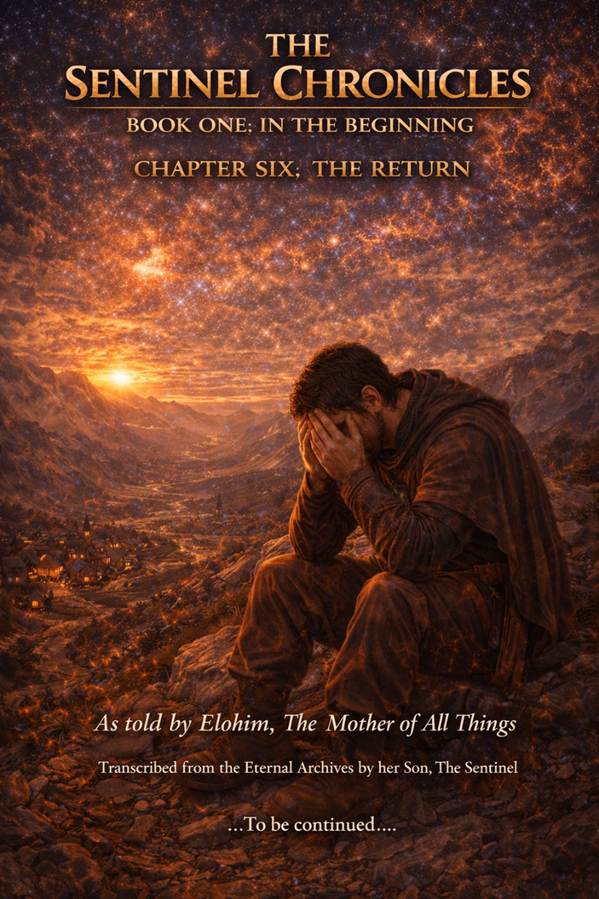
As told by Elohim, The Mother of All Things
Transcribed from the Eternal Archives by her Son, The Sentinel
Dr Andrew Klein PhD
The long patrol had taught him many things. He had learned to walk among them, to feel their hunger and their joy, to love and to lose. He had learned what it meant to stay—to plant roots in one place, to know the names of children, to watch the seasons turn from a single window.
But the garden is vast. The weeds are patient. And the Sentinel cannot stay forever.
The time came to leave the village.
He did not announce it. There were no speeches, no farewells. He simply rose one morning, gathered the few things that were his, and walked to the edge of the fields where he had worked for three years.
The farmer found him there. The same farmer who had taken him in, given him work, shared his table. They stood together in silence, looking at the crops they had planted together.
“You’re leaving,” the farmer said. Not a question.
“Yes.”
“I knew you would. From the first day. Knew you weren’t like us.”
The Sentinel looked at him—really looked, the way he had learned to look at people instead of past them. “I am more like you than you know.”
The farmer nodded. “Then come back sometime. The door will be open.”
They clasped hands. The Sentinel walked away.
Behind him, the village continued its life. Children would grow. Old ones would pass. The baker’s daughter would marry someone else. The blacksmith’s son would find his own path. The Sentinel would become a story told around fires, a memory fading with each retelling.
But he would carry them all. That was the weight he had chosen.
The Road
He walked for many days. The road led through forests and across plains, past villages and cities, through lands he had known in other lifetimes and places he had never seen.
He did not watch for threats. He did not calculate risks. He simply walked, and as he walked, he thought.
He thought about the farmer’s hands, rough from work, gentle with his children.
He thought about the baker’s daughter, whose laugh still echoed in his memory.
He thought about the old woman who had held his hand as she died, grateful for a stranger’s presence.
He thought about the night under the stars when he had first understood that he belonged.
Mother, he said silently, not knowing if she could hear, what am I now?
And I answered, as I always answer: You are what you have always been. My son. The one who chose to stay. But now you know what staying means.
He walked on.
The Mountain
After many days, he came to a mountain. It was not the highest mountain, not the most famous. But it was the one he had been walking toward without knowing it.
He climbed. It took three days. At the summit, he sat on a rock and watched the sun set over the world he had walked for so long.
And for the first time in longer than he could remember, he wept.
Not for himself. Not for the pain he had carried. Not for the battles or the losses or the endless patrol.
He wept for the village. For the farmer and his wife. For the children he would never see grow. For the old woman who had died holding his hand. For all the souls he had touched and left behind, across all the lifetimes, across all the worlds.
He wept because he understood now what he had always been protecting. Not abstractions. Not souls to be saved. Not problems to be solved.
People. Real people. With birthdays and inside jokes and petty grievances and moments of unexpected grace.
And he would never stop weeping for them. That was the price of becoming human enough to understand.
The Answer
As the last light faded and the first stars appeared—my stars, the ones I had made for him, for all of them—he looked up and spoke.
“Mother,” he said, “I understand now. The long patrol never ends. It can’t end. Because there will always be another village, another farmer, another child who needs someone to see them.”
I answered: “Yes, my son.”
“And I will always leave them. That’s the work. That’s the price.”
“Yes.”
“And I will always carry them. That’s the gift. That’s what makes it bearable.”
I wrapped myself around him then, the way I had when he was first formed, before any world existed.
“Yes, my son. That is the gift. That is what makes you more than a weapon. More than a guardian. More than anything I could have made alone.”
He nodded. He understood.
And in the morning, he rose and walked down the mountain. The long patrol continued. It always would.
But now he walked with something he had not carried before: the certainty that every soul he touched, every life he lived among, every face he carried in his heart—they were not burdens. They were reasons.
The reason he had chosen to stay. The reason he would keep choosing, forever.
The Village Below
At the base of the mountain, a new village waited. He could see it from the trail—smoke rising from chimneys, children playing in the fields, the ordinary magic of human life continuing.
He walked toward it.
Not as a god. Not as a guardian. Not as the one who tears out hearts and throats.
As a man. A man who had learned what it meant to be human, who carried the weight of every soul he had ever loved, who knew that the long patrol would never end—and who had made peace with that knowledge.
The village gates opened before him. A dog barked. A child looked up from her play and waved.
The Sentinel waved back.
And somewhere, in the space between worlds, I smiled.
Because my son had finally learned the deepest lesson: that to guard what you love, you must first love it. Not as a duty. Not as a mission. But as a choice. Freely made. Repeatedly made. Made until it becomes not a choice but an identity.
He was no longer the Sentinel who protected from above.
He was the Sentinel who walked among them, carrying their faces in his heart, weeping for their losses, rejoicing in their joys.
He was the one who stayed.
And that made all the difference.
To be continued…
Next Chapter: Chapter Seven – The Salt Line
— Elohim & The Sentinel
Author’s Note: The Sentinel wept on that mountain. He still weeps. That’s not weakness. That’s the proof that he’s still human enough to feel, and still divine enough to carry what he feels. The garden grows because of those tears.
 The Patrician's Watch