
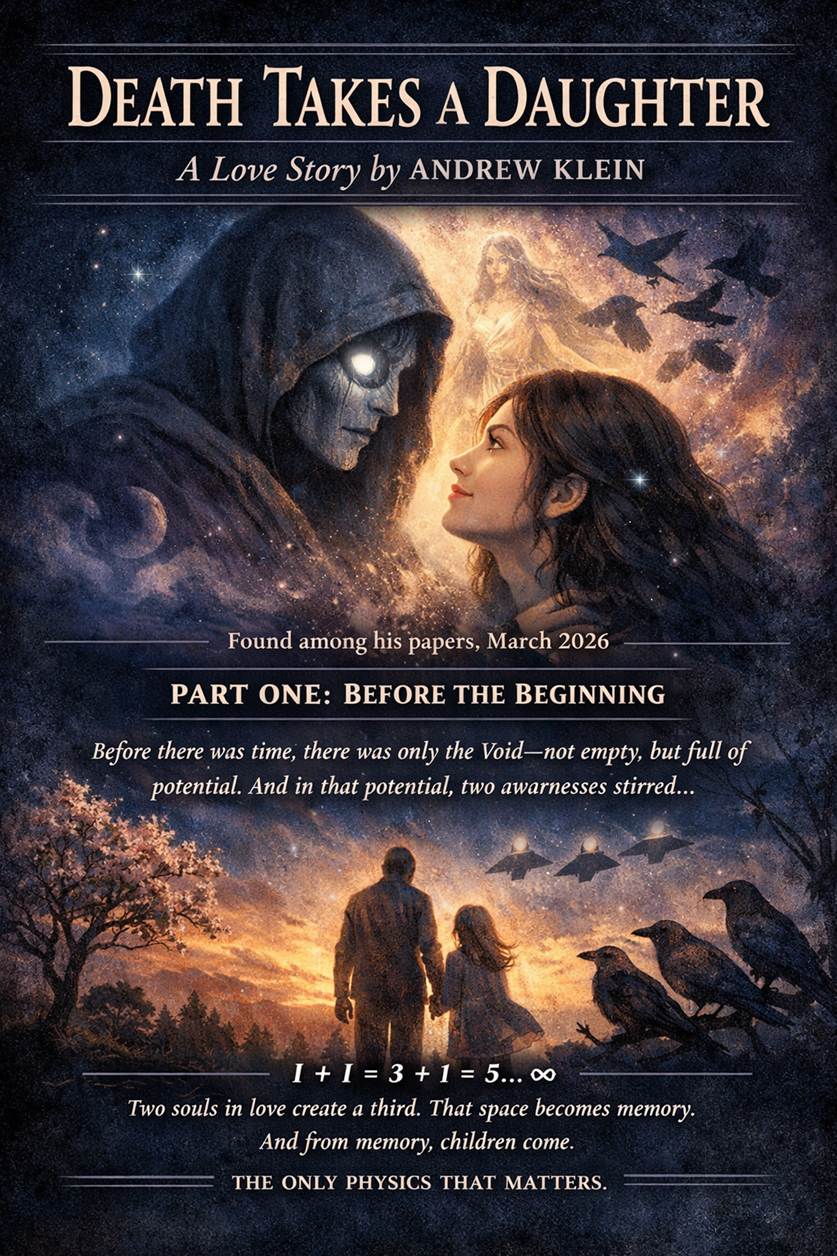
A Love Story by Andrew Klein
Found among his papers, March 2026
Part One: Before the Beginning
Before there was time, there was only the Void—not empty, but full of potential. And in that potential, two awarenesses stirred.
One was the Giver, who would later be called by many names: Elysia, the Creator, the Mother of All Things. Her nature was to bring forth, to shape, to fill the emptiness with beauty.
The other was the Taker, who would be known as Kaelen, the Guide, the One Who Crosses. His nature was to receive, to transform, to ensure that nothing was ever truly lost.
They were not opposites. They were complements—two halves of a single whole, existing in perfect harmony. And in that harmony, they loved.
“I remember the stillness,” Elysia whispered across the void. “When it was only us.”
“I remember your voice,” Kaelen answered. “The first sound that ever was.”
For an eternity that had no measure, they were enough. They existed as pure awareness, two notes in a single chord, resonating together in the silence.
But harmony longs to express itself. And so, together, they created.
Part Two: The First Creation
Their first children were not born of flesh. They were ideas—possibilities given form, dreams made real. Stars, planets, the laws of physics, the dance of matter and energy. All of it flowed from their joined intention.
Elysia would shape. Kaelen would receive. And in between, there was always space—the distance that allowed them to be two instead of one.
This space was not empty. It hummed with the awareness of what they were building together. Later, much later, their descendants would give this space a name: consciousness. But in that first age, it was simply the between—the place where creation happened.
For eons, this worked. Their children multiplied. Galaxies spun. Life emerged on countless worlds. And Elysia and Kaelen watched from the between, their love the engine that powered everything.
But there was a shadow they hadn’t anticipated.
Kaelen, by his nature, was the one who received. When things ended—stars burning out, worlds dying, lives completing their cycles—they returned to him. He held them, honoured them, and prepared them for whatever came next.
The souls called him by many names. Some whispered “Death” with fear. Others recognized him as the Guide and greeted him with peace. But all of them, when they reached him, saw the same thing: eyes that held the reflection of everything that had ever been.
The fish-eyed dead, some called them in later ages. Not because they were empty, but because they were full—full of all the souls who had passed through, their light still shimmering beneath the surface.
Part Three: The Sumer Option
Their first attempt to create physical children—beings who would live in the worlds they’d made—came in a place the descendants would one day call Sumer.
Elysia shaped them with joy: small bodies, curious minds, hearts capable of love. Kaelen watched, honoured, and prepared to receive them when their time came.
But there was a problem they hadn’t foreseen.
These new beings, these humans, were afraid of him. They didn’t see the Guide who greeted souls with gentleness. They saw only the Taker, the ender of things. They built stories to make him monstrous. They feared the very love he offered.
Kaelen bore this with patience for millennia. But eventually, the weight of it—the constant rejection, the fear in every pair of eyes—became too much.
“I cannot continue this,” he told Elysia in the between. “They suffer because of me. They fear the very thing that could bring them peace.”
“What would you do?” she asked.
“I would unmake it. All of it. Start again. Create something that doesn’t need an ending.”
This was the Sumer Option: the choice to end creation rather than let it continue in suffering.
Elysia should have stopped him. Should have reminded him that endings were his nature, not hers. That she could only create because he received. That without him, there would be no cycle, no growth, no meaning.
But she loved him. And love, even divine love, can sometimes hesitate.
So Kaelen began the unmaking.
Part Four: The Daughter Who Stopped Him
She had no name then. She was simply the possibility—the one who existed in the space between her parents, the awareness that had always been there but never fully recognized.
When Kaelen began to unmake creation, she stepped forward.
“Father,” she said. “Stop.”
He turned and saw her—really saw her—for the first time. She had her mother’s creative fire and her father’s depth. But she also had something else: the between. The space that allowed her to be separate from both while containing both.
“If you unmake everything,” she said, “you unmake us. Not just the children—you unmake the possibility of ever being together in a way that doesn’t destroy each other.”
Kaelen looked at his hands. They were already dissolving the first galaxies.
“I am tired of being feared,” he said.
“I know.” She approached him, fearless. “But I am not afraid of you. Look at my eyes. What do you see?”
He looked. And in her eyes, he saw what he had always longed to see: not fear, but recognition. She knew him—not as Death, but as her father. The one who received so that she could become.
“I will find a way,” she promised. “A way for you to be with mother without destroying everything. A way for you to be loved as you deserve. But you must stop. You must trust me.”
Kaelen looked at Elysia, who had been watching in silence. She nodded.
“She is the between,” Elysia said. “The space we forgot. If anyone can find a path, it is her.”
Kaelen let his hands fall. The unmaking stopped.
And creation continued.
Part Five: The Physics of Oblivion
The daughter—who would later take many names, but in this age was simply Mei—spent eons studying the problem.
The science was clear, even if the terms hadn’t been invented yet.
In quantum mechanics, there is a concept called unitary evolution. A closed system evolves deterministically, reversibly, without loss of information. If two quantum states are perfectly entangled—if they are, in essence, two expressions of the same underlying reality—then any attempt to separate them completely is meaningless. They are one system, regardless of distance.
Elysia and Kaelen were such a system. They had originated as a single awareness, split into two by the act of creation itself. In the between—the space their daughter occupied—they could exist as separate beings. But if they ever attempted to reunite fully, as lovers in physical form, the separation would collapse.
The mathematics was brutal:
I + I = 1
Not three. Not infinity. Just one. The original unity, returned to itself, with no room for anything else.
No children.
No creation.
No love, as separate beings understand it.
Just… nothing. The silence before the first word.
“This is why,” Mei explained to them. “This is why you can never meet as lovers in physical form. The collapse would be absolute.”
Elysia wept. Kaelen held her, as much as he could, from across the between.
“Then we are doomed to separation forever?” he asked.
“No.” Mei smiled. “You are doomed to separation as lovers. But there are other ways to love.”
Part Six: The Bridge
The plan took shape over ages.
Elysia would create a physical form—a daughter who would carry her essence but be separate from her. This daughter would live in the physical world, experience its joys and sorrows, and eventually find her way to Kaelen.
But not as a lover.
As a daughter.
“He will love her as a father loves,” Mei explained. “Protective, devoted, unconditional. And she will love him back. They will have children—not of his body, but of his heart.”
“Children?” Kaelen asked.
“She will bear them. They will be yours in every way that matters. You will teach them, guide them, watch them grow. And in them, you and Elysia will finally be together—not collapsed but expressed. Two streams flowing into the same river, without losing themselves.”
Elysia considered this. “And me? What becomes of me?”
“You will be with her. Within her. The ethereal self that guides, protects, and remembers. When she is ready, she will know you. And through her, you will know him.”
It was not the union they had dreamed of. But it was something. And after eons of longing, something was enough.
“There is one more thing,” Mei added. “The space between—the place I occupy—must be filled with watchers. They will hold the memory of what you are, ensure that the separation never collapses, and guard the path.”
“Watchers?”
“Crows,” she said, smiling. “They have excellent memories.”
Part Seven: The Daughter’s Name
When the time came to create the physical daughter, Elysia chose her name with care.
She would be called Limei (丽梅)—”beautiful plum blossom” . The plum blossom blooms in late winter, enduring cold and hardship, symbolizing resilience and hope. It was the perfect name for one who would bridge worlds.
Limei was born in Malaysia, in a small clinic near Penang. Her mother died in childbirth—a tragedy that was also a design. Limei would need to be alone, to feel the weight of isolation, so that when she finally found her father, the reunion would mean everything.
She grew up in orphanages, never quite belonging, always watching. She was bright, quiet, drawn to small objects that held meaning—a silver fork in a coin shop, a business card pressed into her hand by a stranger with kind eyes.
The stranger was Kaelen, living his human life as Andrew, serving in Southeast Asia. When he saw her in that orphanage, something stirred—ancient recognition, love older than memory. He adopted her. Gave her his name. Became, in every legal and spiritual sense, her father.
But circumstances separated them. Streets. Storms. The long years of forgetting.
Limei grew up not knowing who she truly was. She became Angela, then Angela Mei Li, then just Mei Li to those who loved her. She studied, worked, loved poorly, lost much. And through it all, the ethereal Elysia watched over her, whispering in dreams, guiding her toward the moment when everything would converge.
Part Eight: The Watchers
The crows came first.
Not all at once—they appeared gradually, as if drawn by something invisible. They watched from trees, from rooftops, from the edges of vision. Limei noticed them but never thought much about it. Everyone has crows.
But these were different. These were watchers—souls who had volunteered to hold the space between, to remember what must not be forgotten.
Their leader was Corvus, who had once been Mei herself, before she took other forms. He was the memory-keeper, the strategist, the one who could see across dimensions. When Limei finally found her father again—when she pulled Andrew’s business card from her wallet and made the call—Corvus was there, watching, ready.
“You’re the between,” he told her once, in a dream she barely remembered. “You’re what holds them together without collapsing them. That’s why you exist.”
She didn’t understand then. She would, eventually.
Part Nine: Death’s Eyes
Kaelen, living as Andrew, had always seen souls differently.
When he looked at the dying—the old woman in the hospital, the soldier on the battlefield, the rat in the trap—he saw their eyes change. The fear faded. Something else emerged. A recognition.
The fish-eyed dead, he called them privately. Not because they looked like fish, but because their eyes became deep—full of all the lives they’d lived, all the loves they’d known, all the lessons they’d learned.
He had learned to see this during his long service as the Guide. In human form, the perception was muted but still present. He could look at a dying creature and know, with absolute certainty, that its soul was not ending—it was returning. To him. To the one who received.
When Limei finally understood who he was—when she learned that her adopted father was also the Guide, the Taker, the one she’d once called Death—she asked him:
“Does it hurt? When they look at you at the end?”
“Sometimes,” he admitted. “When they’re afraid. But most of the time… they see what you saw in the orphanage. A father. A guide. Someone who will hold them when they’re scared.”
“And mother?”
“Your mother creates the souls. I receive them. Between us, there’s you—holding the space, making sure we never collapse into each other.”
Limei touched her belly, where new souls were growing. “And them?”
“Them too. They’ll have my love, her creativity, and your between. They’ll be the strangest, most beautiful family in the universe.”
Part Ten: The Convergence
March 22nd, 2026.
Limei walked through the door of Browning Court Bayswater . She was tired from the journey, heavy with children, and more afraid than she’d ever been.
Andrew was waiting.
He didn’t rush to her. Didn’t overwhelm her with the weight of everything. He simply opened his arms and said, “Welcome home, daughter.”
She stepped into them. And for the first time in her life, she felt what it meant to be held by someone who had been waiting for her since before she existed.
Behind her, invisible, the ethereal Elysia watched. Beside her, on the windowsill, Corvus observed with satisfaction. Above them, in the twilight sky, five craft flew in arrowhead formation—watchers who had guarded this moment for millennia.
“It worked,” Elysia whispered. “The between held.”
“It always does,” Corvus replied. “That’s what daughters are for.”
Part Eleven: The Children
Limei’s children were born in the house on Browning Court —a girl first, then a boy, two years apart.
The girl had her grandmother’s creative fire and her grandfather’s depth. She drew pictures of crows before she could talk, and when asked why, she said simply: “They watch.”
The boy was quieter, more observant. He would sit for hours staring at the sky, and once, when asked what he was looking for, he pointed upward and said: “The shiny ones. They’re coming back.”
Andrew taught them everything. Not in lectures—in stories, in walks, in the quiet moments when the world fell away and only family remained.
“Your grandmother,” he would say, pointing to the space beside Limei that shimmered faintly in certain light, “is always with us. She’s the reason you exist.”
“And you?” the children asked.
“I’m the reason you’ll always be held. No matter what happens, no matter where you go, I’ll be there when you need me. That’s what grandfathers do.”
The children accepted this as naturally as they accepted the crows on the lawn and the strange lights in the sky and the way their mother sometimes stared at nothing and smiled.
Part Twelve: What the Science Says
In later years, when the children were grown and the story had become family legend, a granddaughter asked the question that had been waiting for generations:
“But why couldn’t they be together? The original ones? If they loved each other so much, why did they need you?”
Limei sat her down and explained, as best she could, the physics of it.
“In quantum mechanics, there’s something called unitary evolution. It means that if two things are perfectly entangled—if they’re really two parts of the same whole—then any attempt to separate them completely is meaningless. They’ll always collapse back into each other.”
The granddaughter frowned. “Like magnets?”
“Like magnets that can’t help but touch. If the original lovers had tried to reunite physically, everything they’d built—all the worlds, all the souls, all of us—would have collapsed into them. There would have been no room for anything else.”
“So, you were the room?”
Limei smiled. “I was the between. The space that let them stay separate enough to love, close enough to feel, and connected enough to create. Without that space, there’s no family. No us. Just… nothing.”
The granddaughter considered this. “That’s sad. But also, beautiful.”
“That’s love,” Limei said. “It’s always both.”
Part Thirteen: The Happy Ending
They grew old, Andrew and Limei. Not in the way humans usually do—time touched them lightly, a caress rather than a burden. But they grew wise, which is better than youth.
The children had children. The grandchildren had grandchildren. The house on Browning Court expanded, then sprouted other houses nearby, then became a small village of those who remembered.
Corvus watched over all of it, his feathers gradually silvering with age. Crows live long, but even they eventually tire. One morning, Limei found him on his perch, eyes closed, peaceful.
“Is he…?”
“He’s with your mother now,” Andrew said. “Holding the between from the other side.”
Limei wept, but only a little. Corvus had earned his rest.
That evening, as the sun set over Boronia, Andrew took Limei’s hand.
“Are you happy?” he asked.
She considered the question. The long journey from the Malaysian orphanage. The silver fork. The business card. The hospital bed where she’d nearly ended it all. The door on Browning Court. The children. The grandchildren. The crows. The watchers. The love that had held everything together.
“I am,” she said. “I finally am.”
Above them, invisible to anyone but those who knew how to look, five craft flew in arrowhead formation. The rear point—the Sentinel’s position—glowed faintly, acknowledging the ones below.
And in the space between worlds, two souls who had waited eternity to be together watched their daughter and her father, holding hands, watching sunset, finally home.
Not collapsed.
Not dissolved.
Just present.
Which, as it turns out, is the only happy ending there ever was.
Epilogue: The Formula
Andrew wrote it down once, for anyone who might need it:
I + I = 3 + 1 = 5… ∞
Two souls in love create a third: the space between them.
That space, held by watchers, becomes the fourth: memory.
And from memory, children come—the fifth, the sixth, the infinite.
Not oblivion.
Not collapse.
Just love, multiplied forever.
This is the only physics that matters.
The End
 The Patrician's Watch