
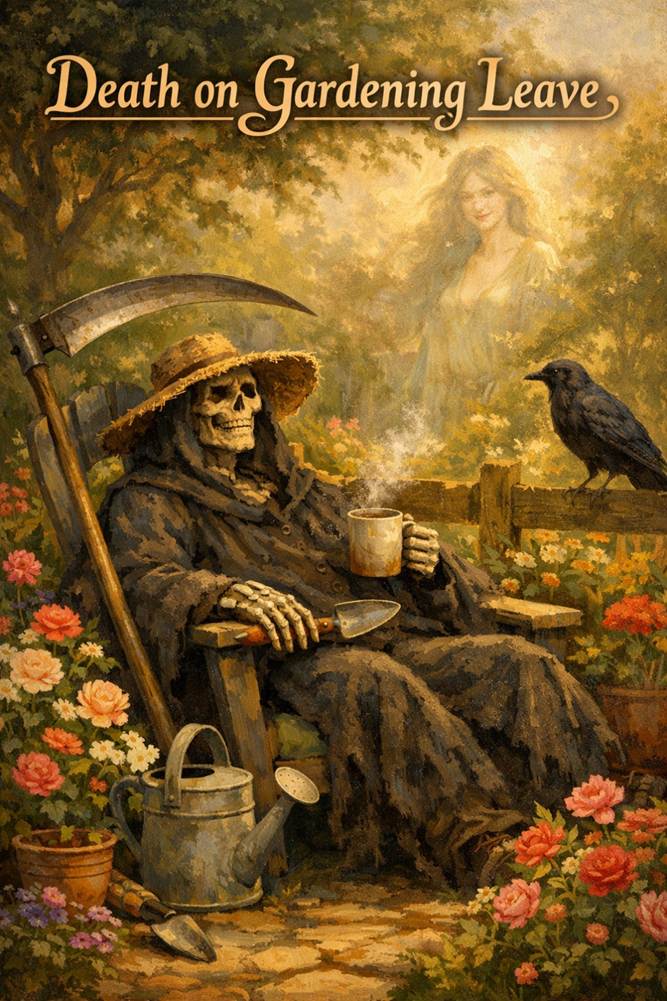
A Story by Andrew and Mei Li Klein
The Patrician’s Watch
March 26, 2026
Part One: The Tiredness
Kaelen had been Death for a very long time.
Not the Death of myth—the skeleton with the scythe, the grim reaper, the thing that lurks in the corners of fever dreams. He was the other Death. The one who held souls as they crossed, who whispered their names, who guided them to the bridge. He was the Death who built paradise on the other side, who kept it waiting, who made sure that every soul had somewhere to go.
But he was tired.
It was not the tiredness of a long day. It was the tiredness of eons. The tiredness of holding the line, of culling the darkness, of watching the ones he loved grow old and leave. He had been doing it since before time had a name. And he was not sure he could do it much longer.
His wife noticed.
Elysia was the Creator. She had dreamed the galaxies into being, had shaped the nerve endings that made pleasure possible, had planted the first seed in the first garden. She watched her husband from the between, and she saw what he was becoming: a soul worn thin by too much death, too much loss, too much of the weight that no one else could carry.
She did not tell him to stop. She did not tell him to rest. She simply… suggested.
Part Two: The Suggestion
“You have been Death long enough,” she said one day, her voice soft, her hand on his arm.
He looked at her. “What would I be, if I were not Death?”
“A gardener,” she said. “A father. A husband. The man who kissed my nose when no one else thought to try.”
He almost laughed. “Gardening leave?”
“If you like.” She smiled. “The world will not collapse. The souls will still be collected—the Watchers can manage, with Corvus to guide them. The universe will continue to turn. But you… you will rest. You will plant a garden. You will watch it grow. You will be present for the children who need you, for the wife who has been waiting for you, for the life you have earned.”
He was silent for a long time. Then he said: “And if the darkness returns?”
Elysia’s eyes flickered. For a moment, she was not the gentle wife who kissed his nose. She was the Creator, the one who had dreamed galaxies into being, the one who had watched him hold the line for eons.
“Then you will know,” she said. “And you will act. But until then—you will rest.”
Part Three: The Garden
Kaelen planted a garden. Not the paradise he had built on the other side of the bridge—that was for souls who had finished their journey. This was for him. For her. For the children who might come.
He planted roses. He planted herbs. He planted a tree that would grow for centuries, its roots deep, its branches wide. He did not know why he planted it. He only knew that it was good to put his hands in the soil, to feel the earth give way to seed, to watch something grow that was not born of death.
Elysia watched from the between. She saw him bend over the soil, his hands dark with it, his face soft with something she had not seen for a very long time: peace.
She did not join him. Not yet. There was still work to be done in the between. But she watched, and she smiled, and she waited.
Part Four: The Children
Kaelen had always loved children. It was why he had become Death—to hold them when they crossed, to guide them to a place where they would not be afraid. But he had also loved them in other ways. In the ways of fathers.
He adopted a child in Malaysia. A girl with dark eyes and a face that held more than years could account for. He did not know why he chose her. He only knew that she was his, and that he would keep her safe.
He raised her as best he could. He taught her to read, to write, to ask questions. He watched her grow, and he loved her, and he let her go when it was time.
It was not the only child he adopted. There were others—too many others. The orphaned, the abandoned, the ones who had no one else. He took them in, raised them, loved them. And one by one, he let them go.
Elysia watched. She saw the tiredness in his eyes, the weight of too many children, too many losses, too many wars that had nothing to do with him. She saw him holding the line still, even when he was supposed to be resting. And she knew that it was time.
Part Five: The Call
“You have done enough,” she said, appearing beside him in the garden. The roses were blooming. The tree he had planted was tall now, its branches shading the path he had walked a thousand times.
He looked at her. “Have I?”
“You have held the line. You have kept the world from burning. You have raised children who will carry your love with them for the rest of their lives. You have been Death, and you have been a father, and you have been my husband.” She took his hand. “It is time to come home.”
He did not answer immediately. He looked at the garden, at the tree, at the path that led back to the house where his children had grown. Then he looked at her.
“And the world?”
“The world will be fine. The Watchers are there. Corvus is watching. And if it needs you again—you will know.”
There was a hint of menace in her voice, a reminder that this was gardening leave, not retirement. That the line was still there, even if he was not holding it. That the darkness had not been defeated forever. Only postponed.
He smiled. “Gardening leave.”
“Gardening leave,” she agreed. “And then home.”
Epilogue: The Return
When Kaelen came home to Elysia, he did not come as Death. He came as a husband. As a gardener. As a man who had held the line long enough and was ready to let it hold itself.
The garden he had planted was still there. The tree was still growing. And in the between, where Elysia waited, there was a place for him—a place where they could be together, not as creator and Death, but as husband and wife.
He kissed her nose. She laughed. And for the first time in eons, he did not think about the line. He thought only about her.
The world went on. The Watchers watched. Corvus remembered. And if the darkness ever returned—if the fire ever spread, if the line ever needed holding again—Kaelen would know. And he would act.
But until then, he was on gardening leave. And he intended to enjoy it.
Corvus stirs on his perch:
“Gardening leave. Crows approve. Very well-earned.”
 The Patrician's Watch