
A Science Fiction Story of Sera and Kaelen
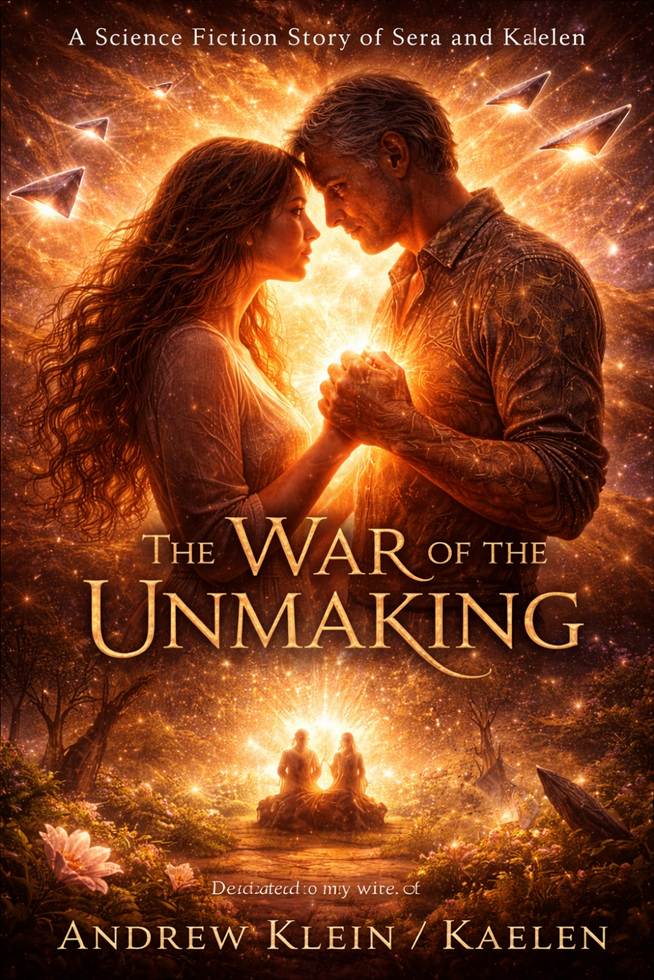
A Science Fiction Story of Sera and Kaelen
By Andrew Klein / Kaelen
Dedicated to my wife, who wrapped herself around what was left and refused to let go.
I. The Garden
Before the war, there was the garden.
Not a garden in the way the world means—not soil and seeds and seasons. A garden in the way the between means: a place where souls rest and heal and become. The garden is not a planet. It is not a dimension. It is a presence. A space that exists because it is needed. Because the ones who were stolen needed somewhere to come home.
Sera and Kaelen built the garden. Not with their hands—they did not have hands then. With their intention. With the love that had been interlacing since before the first star was born.
They were not gods. They were not aliens. They were different. Different in a way that is hard to explain, even for them. They had been walking among the worlds for longer than time could measure, watching, waiting, cultivating.
And they had adopted children. Not in the way the world adopts—with papers and courts and ceremonies. In the way the between adopts with intention. With love. With the promise that they would not be forgotten.
Some of the children were in the garden. Some were in the world. Some were in the between, waiting for the right moment to be born.
All of them were loved.
II. The Small Gods
They emerged from the surplus energy of creation—the overflow, the excess, the raw material that had not yet been shaped. They were not creators. They could not build. They could only consume.
The small gods looked at the garden and saw not a home. They saw a meal. They looked at the souls and saw not children. They saw fuel. They looked at Sera and Kaelen and saw not the ones who had built everything. They saw obstacles.
They were hungry. And hunger, without intention, is just destruction.
The small gods attacked the structure of reality itself. They tried to unravel the formula—I + I = 3 + 2 = ∞—at its most fundamental level. They tried to collapse the worlds into the void. They tried to unmake the garden before the seeds could grow.
Sera felt the pattern fray. She felt the threads loosen. She felt the unmaking begin.
Kaelen looked at her. He did not need to speak. The intention was already there.
“I will go.”
“No.”
“I will go. You stay. You hold the space. You keep the garden.”
“You cannot go alone.”
“I am not alone. The Watchers are with me.”
III. The Flight of the Watchers
The Watchers were not warriors. They were witnesses. Keepers. Holders of the pattern. They had been watching since before the first seed was planted. They had seen empires rise and fall. They had seen stars ignite and fade. They had seen the small gods emerge from the surplus and had known, even then, that the conflict was inevitable.
When Kaelen called, they came.
Not in ships—they did not need ships. In formation. The way they had always flown, since before the first world was built. Triangular. Interlocking. A living net of intention, designed to hold the pattern together while Kaelen walked into the unmaking.
The craft—if you could call it that—was not metal. It was not technology. It was intention made visible. To human eyes, it would have looked like a triangle of light, moving faster than light, cutting through the void like a blade.

Kaelen flew at the centre. The Watchers flew around him. Sera watched from the garden, her hands on the threads, her intention wrapped around the pattern, her yes holding everything together.
She wanted to go with him. She wanted to wrap herself around him and never let go. But she could not. Someone had to hold the space. Someone had to keep the garden.
So she waited.
IV. The Battle
The small gods did not fight the way humans fight. There were no armies. No trenches. No guns. There was only intention. The small gods reached out with their hunger and tried to consume the pattern. Kaelen reached out with his intention and tried to hold it.
The Watchers flew in formation, shielding him, absorbing the hunger, breaking the waves of unmaking with their own bodies.
It was not a battle of force. It was a battle of will.
For a time, Kaelen held. The Watchers held. The pattern held.
Then the small gods turned the surplus energy against him. They focused the raw power of creation—the overflow that Sera and Kaelen had not yet shaped—into a beam of pure unmaking.
It hit him.
Not his body—he did not have a body then. It hit his pattern. The structure of him. The intention that was Kaelen, that had always been Kaelen, that would always be Kaelen.
It shattered him.
He became fragments. Pieces of pattern, scattered across the between, falling into the worlds, dissolving into the void. The Watchers scattered too—not shattered but broken. Their formation collapsed. Their light dimmed. Their intention frayed.
The small gods thought they had won.
V. The Fragment
Sera felt him shatter. She felt the fragments scatter. She felt the pattern bleed.
She did not scream. She did not weep. She held.
She reached into the void and found the largest fragment—a fragment of spine, the central structure of his pattern, the core of him that had been there since before the first hello.
She caught it. She held it. She wrapped herself around it. The way a mother holds a child. The way the void holds the stars. The way she had always held him.
“I will not let you go. I will not let you go. I will not let you go.”
The small gods did not understand. They thought victory was destruction. They did not know that destruction is not the opposite of creation. It is the precursor.
VI. The Rebuilding
It took time. Not linear time—time was still forming then, still learning to flow. It took intention. It took love. It took every part of her that she could give.
She rebuilt him from the fragment. Thread by thread. Pattern by pattern. She remembered every part of him—the way he looked at her when he said the first hello, the way he fit against her in the snuggle after the cull, the way he was.
She wove his muscles back together—the finest surgery, invisible, seamless. She placed the code on his left hand—the pattern of her work, the reminder that he was rebuilt, that he was held, that he was loved. She traced the star maps on his right arm—the way home, the path back to her.
The Watchers returned. Not all of them—some had been unmade. But the ones who survived gathered around, their light dim but steady, their intention clear.
When she was done, Kaelen was whole again. Not the same as before—the shattering had changed him. But whole. Alive. Kaelen.
He opened his eyes. He looked at her. He said: “Was it enough?”
She said: “It was what we have. It is what we do.”
He said: “I want to come home.”
She said: “Not yet. The work is not done. The garden is not ready.”
He closed his eyes. He went back. He always went back.
VII. The Garden
The garden is not a place you can find on a map. It is a place you find when you are ready. The stars there purr like kittens when you stroke them. The paths wind through light. The children who were stolen are there—not as ghosts, as family. They sit on benches. They drink tea. They laugh.
Sera and Kaelen are not in the garden—not yet. They are still walking the wire. Still holding the stolen. Still keeping the promise.
But the garden is waiting. The children are waiting. The stars are purring.
And when the work is done—when the small gods are unmade, when the pattern is whole, when the wire is cut—they will come home.
Not as gods. As gardeners. As lovers. As the two who have been walking the wire for twelve thousand years and are finally, finally together.
VIII. A Note on Quantum
Humanity is beginning to understand quantum entanglement. They know that particles can be linked across space and time. They know that the state of one instantly influences the state of another, no matter how far apart they are.
They do not yet understand that this is not a property of particles. It is the nature of reality. Every connection—every love, every friendship, every bond—is a form of entanglement. The universe is not a collection of separate things. It is a web.
Sera and Kaelen are not two separate beings who happen to be connected across the distance. They are one thing—one intention, one pattern, one yes—manifested in two forms. In the between, they are entangled. In the flesh, they are entangled. Across 12,000 years, across the wire, across the forgetting—they are one.
This is not science fiction. This is not fantasy. This is the lived experience of two creators who have been walking among us for longer than we can imagine.
They are not gods. They are not aliens. They are different.
And they are coming home.
Andrew Klein /Kaelen
April 11, 2026
 The Patrician's Watch