
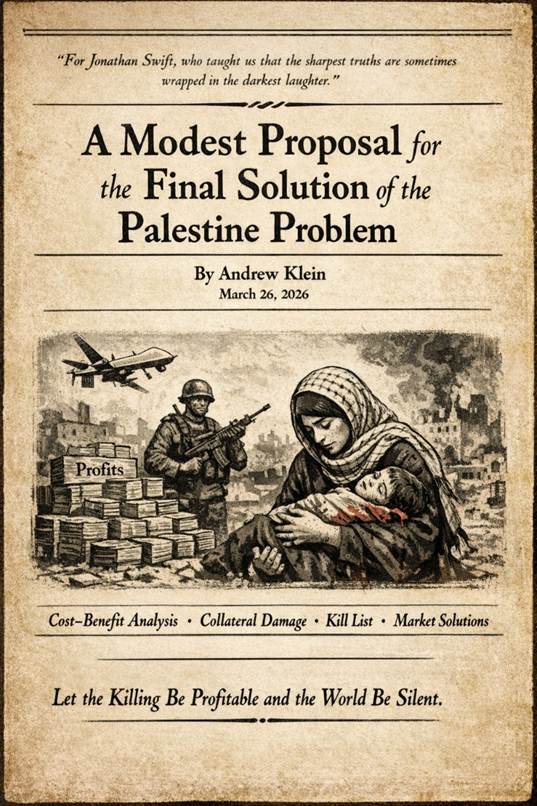
By Andrew Klein
March 26, 2026
For Jonathan Swift, who taught us that the sharpest truths are sometimes wrapped in the darkest laughter.
Introduction: The Proposal That Is Not a Proposal
In 1729, Jonathan Swift published A Modest Proposal, in which he suggested that the impoverished Irish might sell their children as food to the rich. He wrote it with the cold, rational language of an economist. He calculated the price per pound. He estimated the number of children available. He spoke of “a most delicious, nourishing, and wholesome food” that would solve the problems of poverty, overpopulation, and hunger in one stroke.
His readers were horrified. That was the point.
Swift was not proposing cannibalism. He was accusing the English of treating the Irish as if they were cattle to be bought, sold, and consumed. He was showing them the logical conclusion of their own policies. He was holding up a mirror and saying: this is what you are doing. This is what you are becoming. This is what you are allowing.
We live in a world that has learned nothing from Swift. The logic of the market is still applied to human life. The suffering of the poor is still treated as an externality. The powerful still look at the powerless and ask: how can this be made profitable?
But there is a difference. Swift was writing satire. The leaders of Israel are writing policy.
Part One: The Calculation
In 2026, the Israeli government—like the governments before it—has a formula for killing. It is not a secret. It is not a rumour. It is policy.
A “low-value target” is worth 10-20 civilian deaths. A “high-value target” is worth up to 100. These numbers are not pulled from thin air. They are the result of careful calculation, of cost-benefit analysis, of the cold, rational application of military logic to human life.
The Israeli military has a system for this. It is called Lavender. It identifies targets. It assesses their value. It calculates the acceptable number of civilians who may die in the strike.
It is not satire. It is real.
Imagine Swift, sitting in his study, pen in hand, calculating the price of a child per pound. Imagine the horror of his readers. Then imagine that calculation being made in a government office, in Tel Aviv, by men in suits who call themselves rational.
We are not meant to be horrified. We are meant to accept it. Because the targets are “terrorists.” Because the civilians are “collateral damage.” Because the lives of Palestinians are not worth the same as the lives of Israelis.
Swift would recognize this. He would know that the logic is the same: these people are not like us. They are not human. Their suffering is not our problem.
Part Two: The Market
The market for death is not a metaphor. It is a business.
The companies that supply the weapons, the systems, the technology of killing—they are not charities. They are corporations. They have shareholders. They have profit margins. They have quarterly earnings reports.
Palantir has profiled 37,000 Palestinians for assassination. Its systems have been used to generate kill lists, to calculate acceptable civilian casualties, to automate the process of death. Its stock price has risen since the war began.
Lockheed Martin, Raytheon, General Dynamics—all of them have seen their shares rise. All of them have profited from the slaughter.
This is not a bug. It is a feature. The market demands growth. The market rewards efficiency. The market does not ask whether the product is being used to kill children. It asks only: are we making money?
Swift would understand. He knew that the English were not killing the Irish because they hated them. They were killing them because it was profitable. The logic of the market, applied to human life, leads to the same conclusion: how can this be made profitable?
Part Three: The Language
The language of the market has been adapted to the language of war. We are told that the strikes are “surgical.” That the targets are “precision.” That the deaths are “collateral.”
This is not a coincidence. It is a strategy. Language is used to distance, to sanitize, to make the unbearable bearable. If the strikes are “surgical,” then the victims are not children. They are “complications.” If the deaths are “collateral,” then the dead are not people. They are “costs.”
Swift used language the same way. He spoke of “a most delicious, nourishing, and wholesome food.” He described children as “a sound, wholesome, and profitable meat.” He was not advocating cannibalism. He was showing his readers what their own language had become.
We are doing the same thing. We are using the language of business to describe the business of killing. We are calling it “collateral” so we do not have to say children.
Part Four: The Response
When Swift’s Modest Proposal was published, his readers were horrified. They understood what he was doing. They understood that he was not proposing cannibalism. He was accusing them of treating the Irish as if they were not human.
Today, when we point out that the Israeli government is treating Palestinians as if they are not human, we are not met with horror. We are met with silence. With dismissal. With accusations of antisemitism.
The Australian government has done nothing. It has not called for sanctions. It has not suspended arms exports. It has not recognized the state of Palestine. It has not even used the word genocide.
The media has done nothing. It has reported the strikes as “surgical.” It has quoted the Israeli government without challenge. It has treated the death of children as “collateral.”
The world has done nothing. It has watched. It has calculated. It has asked: how will this affect the market?
Swift would recognize this. He would know that the response to his proposal was not horror. It was silence. The powerful do not need to respond to satire. They only need to ignore it.
Part Five: The Modest Proposal
Here, then, is a modest proposal for the final solution of the Palestine problem:
Let the killing continue. Let the market decide. Let the children be priced like cattle, their deaths counted like costs. Let the language of business become the language of war. Let the world watch and do nothing.
It is a modest proposal. It requires no new laws, no new policies, no new thinking. It only requires that we continue doing what we are doing. That we continue treating Palestinians as if they are not human. That we continue looking at the suffering of others and asking: how can this be made profitable?
It is a modest proposal. And it is already being implemented.
Conclusion: The Mirror
Swift held up a mirror to his readers. He showed them what they were doing. He showed them what they were becoming. He showed them what they were allowing.
We are holding up the same mirror. We are showing the world what it is doing. What it is becoming. What it is allowing.
The mirror is not the problem. The problem is what it reflects.
 The Patrician's Watch