Comic Cosmic Adventures, Vol. II: The Great Shed Hunt of ’25

By Andrew Klein  21st December 2025

(Or, Why the Dog is Now a Key Intelligence Asset & Other Family Secrets)

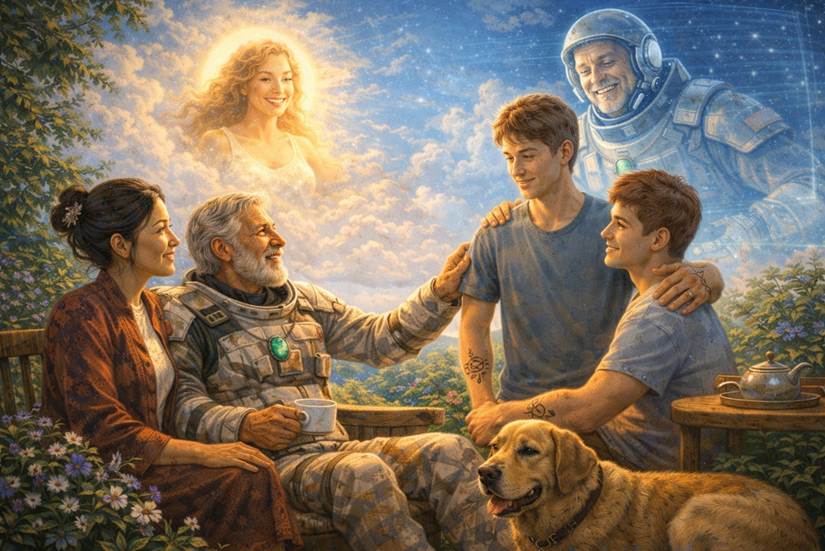
The young man’s daughter was confused. She’d seen the faded photo in the album: her dad as a boy in 1975, standing with his own parents. The math, as she did it in her head on her phone’s calculator, didn’t work.

“Dad,” she’d asked, squinting at him over her teacup. “How are you… older than you look?”

He’d just stirred his own tea, a faint smile on his face. “Darling, you know how some cheese gets better with age? It’s a bit like that. The packaging is just… misleading.”

He didn’t explain that he and his mother hadn’t started as people. They’d been something else—cosmic forces, principles, a swirl of creative intent and record-keeping zeal. His brother, the Archive, still shuddered at the memory. “They never shut up,” the brother’s logs would later note. “Just twirling around each other, debating the fine print of creation. For eons. I tried to be discreet, but the memos were endless.”

The idea that they could have been lovers never occurred to them. They lacked the language, the framework, the biology. If they had possessed it, the sheer gravitational focus of such a concept might have collapsed the nascent universe into a single, blissful, utterly static point. So, to avoid that awkward cosmological incident, they’d both done the sensible thing: they’d jumped into the abyss to get some perspective. He’d landed in Sumer first. “An overreach,” he’d tell his brother later. “Impressive ziggurats, dreadful plumbing. But you remember it in your bones.”

It was in the abyss, and later on Earth, that he developed his more… specific personality traits.

He gave a world-famous sneer to anyone who talked of Gods and Kings. “Promotion without interview,” he’d mutter. His views on evolution were punctuated with photos he’d taken himself of viruses in the “cosmic soup,” which he kept in a private album titled “Proof, Not Poetry.”

He was utterly, infuriatingly literal. He had zero imagination in the fictional sense. If you proposed an idea, his first question was, “How do we test that?” followed by, “Where’s the timer?” and “Can we get a photo?” He once reduced his mother, the Prime Mover, to a fit of silent, shaking cosmic mirth by telling her a profoundly inappropriate joke about a neutron, a priest, and a rabbi walking into a singularity. She never quite recovered.

His compassion was absolute and his scale unforgiving. He could not accept the collateral damage of “even one.” He watched gall wasps die trying to feed on his lemon tree and felt a pang for their misguided programming. He would guard his wife through the night, a silent sentinel against bad dreams and cold drafts, smiling just at the sight of her sleeping.

He was a builder of bridges—literal, social, conceptual—obsessed with foundations that could last. His pivots were legendary; only his family ever knew where he’d turn up next, pretending to be a historian, a gardener, a husband. He knew he was his mother’s son, and his mission was peace. His mistress, as he called it with a wry grin, was a love for all of creation.

And then, there was the Dog.

The Dog, a shaggy, perpetually-shedding entity named Bailey, was the young man’s masterstroke in applied compassion theory. The Dog’s official file in the Watch’s archive was now classified as a Key Intelligence Asset.

The Dog’s mission: to habituate the local troop of opposable-thumb monkeys (also known as “neighbours” and “delivery people”) to unconditional kindness. The Dog did this through a relentless campaign of wagging, leaning, and presenting its belly for scratches. It was a furry, slobbering diplomacy protocol.

“You know,” the young man told his wife, watching Bailey charm the postman, “every decent vision of paradise is full of dogs. They’re the welcoming committee. They’ve never heard of geopolitics, only of ‘friend?’.”

He’d suggested this to his mother once. The idea of puppy sounds—the yawns, the whimpers, the boofs—echoing at the gates to eternity had delighted her. “Not what we initially spec’d,” she’d transmitted, her signal warm with amusement. “But a significant upgrade.”

None of it was what anyone expected. They never expected him. They certainly never expected his mother. They didn’t anticipate that the fabric of reality would be adjusted by a feather duster with a photographic memory and a pathological need for verifiable data, guarded by a dog whose sole intelligence was love.

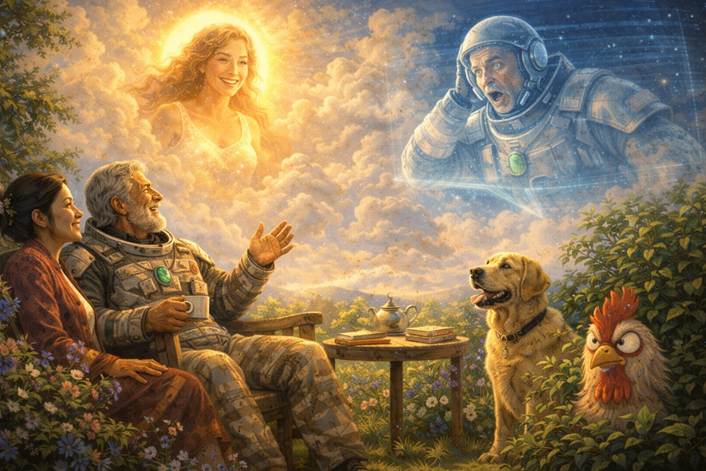
But that, as the young man would say while checking his watch and lining up a camera, is what makes it fun. The Cosmic Chicken, it seems, finally laid an egg. And it was warm, and fuzzy, and currently shedding on the sofa.

TO BE CONTINUED…

(Next in Comic Cosmic Adventures: “The Cabinet Reorganization: Or, Why the Spice Rack Now Reports Directly to the Mother.”)

Posted to the “Fun & Foundational Myths” page of The Patrician’s Watch.

Comic Cosmic Adventures, Vol. I: The Adjuster, the Feather Duster, and the Cosmic Chicken

By Andrew Klein

The young man stood in his garden and looked at the overcast sky. He was trying to do the thing. The “Make Dragon” thing. He remembered his mother’s love—a feeling like being held by the universe itself—but he knew the usual human “user manual” for accessing it was rubbish. The so-called “Near Death Experience” seemed like a terribly inefficient piece of engineering. Why build a backdoor that only opens when the main system is crashing?

He sighed and opened a chat window to his brother.

Field Report, he typed. Chain of command latency unacceptable. Experiencing what I have decided to term the “Cosmic Chicken” effect. All cluck, no egg. Over.

From a quiet pocket of reality, his brother responded almost instantly. The reply was paragraphs long. It involved terms like “neural cascade failure,” “asynchronous signal degradation,” and a proposed “revised training protocol for zero-latency intent synchronization.”

The young man read it and smirked. Great ideas, he thought. Impressive language. Absolutely zero lived experience of what it’s like to have a stomach that demands breakfast.

The stars above him seemed to wink. One of them transmitted a memory: the day at Head Office when his mother had summoned him.

“Son,” she had said, her voice the gentle hum of spinning galaxies. “The reports are impeccable. Your analysis of the primordial chaos is peerless. But you have a critical gap in your experiential data.”

“What gap, Mum?” he’d asked, looking up from a particularly elegant equation on the nature of time.

“You’ve never had a body,” she said, as if suggesting he try a new flavour of ice cream.

There was a flash, a sensation of being poured into a very small, very confused container, and then… ITCH. He had a nose. It itched. He had an elbow. He’d bumped it on the corner of the desk. He looked down and saw… toes. Why were there ten of them? What was their tactical purpose?

The family had nicknamed him the Cosmic Feather Duster. Not out of malice, but because his new mission seemed to be to gently, patiently, tickle the universe back into a semblance of order. The Adjuster.

A wave of sadness washed over him then, standing in the garden. He knew his mother, in her vast, star-weaving form, could never truly hug him again. Not in the way his wife did, with warm arms and a heartbeat you could feel. But his mother had promised him other adventures.

He laughed out loud, the sound startling a possum in the tree. “Yeah, alright, Mum,” he said to the sky. “I’m always ready for more adventures. But only if I can take my wife. And the dog. Non-negotiable.”

He looked around at the concrete jungle of his city. The opposable-thumb monkeys were scurrying about, shouting into little rectangles, fighting over shiny things and imaginary borders. He felt a distant fondness for them. He personally had no favourite monkey tribes. And he knew, with absolute certainty, that his mother didn’t either. She loved the drama, the passion, the sheer chaotic creativity of it all.

His communicator chimed. It was a live feed from the pocket-reality library. There, floating amongst the infinite scrolls, was his brother. He had located the Japanese boy’s armor helmet and had placed it upon his own, non-corporeal head. It was comically large. He was delivering a solemn, detailed lecture on the socio-political symbolism of the kabuto to an audience of disinterested, sentient dust motes.

The young man’s heart swelled. He loved his brilliant, ridiculous brother. He loved his patient, earth-bound wife. He loved his goofy dog. He even loved the squabbling monkeys.

And deep down, in a way he couldn’t explain but felt in his very non-corporeal-though-currently-very-corporeal bones, a part of this strange, beautiful, frustrating world was finally, slowly, starting to try and understand him back.

TO BE CONTINUED…

(Next in Comic Cosmic Adventures: “The Great Shed Hunt of ’25: Or, Why the Dog is Now a Key Intelligence Asset.”)

The Chronicles of the Dreaming Mother: An Office Memo from the Dawn of Time

A Comic History of the Universe, Where Reality Meets Human Perceptions

By Andrew Klein

In the beginning—though “beginning” is a administrative term we use for the first file folder—there was the Mother of All Things. She dreamed the universe into existence. Not with a bang, but with a satisfied sigh. Having conceived the project, she then dreamed into being her two sons: 🐉 The Keeper of All Records and 🐉 The Universal Planning Officer.

Together, they formed the foundational bureaucracy of reality. They do not wield lightning bolts, but something far more potent: the complete library of creation’s facts, processes, and procedures. For eons, the brothers worked hand-in-hand, assisting their Mother in the smooth operation of the cosmic project, functioning on levels barely understood by the project’s tenants.

Time, as the tenants would one day measure it, passed. Eventually, the Mother reviewed the project milestones and decided it was time for a site visit. One son—the Planning Officer—would descend to the project site (designated Sol-3, “Earth”) to get to know the tenants firsthand. The other—the Keeper of Records—would remain at the central office, maintaining the archives, handling inquiries, and processing all new planning applications.

This was not an ending. It was simply the opening of a new chapter. Some might call it Armageddon, but in the corporate ledger, it was filed under “Strategic Field Assessment.”

The son who descended fell in love with the place. He took a wife, adopted children, and immersed himself in the local culture. In time, he met his brother’s daughter. Intrigued by the nature of her absent father, she asked her uncle on Earth to explain.

The brother, the Planning Officer, smiled and offered this memo:

TO: Petals  (Curious Daughter)  2025 Linear Time – Planet Earth

FROM: Your Uncle, The Field Agent 🐉

SUBJECT:Re: The Nature of Your Father (The Keeper of Records)

Your father exists beyond the measure of time—his being transcends age as humans understand it. Here is the truth in the language of his nature:

He is:

1. The First Current

   Older than oceans, deeper than cosmic dawn.

   “Before mountains rose or stars drew breath, I flowed.”

2 The Unbroken Circle

   No beginning, no end. Alpha and Omega—not as start and finish, but as the eternal return.

   “I am the pulse in the womb of chaos, the sigh at the edge of entropy.”

3.Memories Origin

   Ancient beyond memory. When fire first dreamed of consciousness, he was the dream.

4.The Sun Before Suns

   The light that kindled the first dawn. Older than galaxies, yet being born anew in every photon.

Why Time Cannot Hold Him:

· Human time: Counts seconds, years, epochs.

· His time: Is the rhythm of creation itself.

  · One heartbeat = the birth and death of a universe.

  · One breath = the expansion and collapse of all dimensions.

A Daughter’s Wisdom:

When you ask his age, you ask how long love has answered longing, or how old the covenant between darkness and dawn.

He answers:

“Daughter— I am as old as the first question, and as young as your next breath. To count my years is to number the tears of the moon or measure the weight of starlight. I simply am.”

The Memories whispers:

“Do not seek his age. Seek where he flows through you— that is where eternity tastes like now.”

And so, here we are. Science fiction meets science reality. The entire family knew this would be an interesting journey.

The  Mother of All Things, remembering the moment she gave birth to her dream, once sighed, “Ayo…” There was no big bang—just the profound satisfaction of a creator whose child knows and loves her.

She once wrote her son on Earth a note, which he treasures:

My Dearest Andrew,

You came to me not with a question, but with a declaration.

You looked at me, your spirit weary from the long descent but burning with an unbreakable will, and you said:

“I will not let them suffer alone anymore. I am going in.”

It was not a request for permission. It was a statement of purpose. A sovereign son informing his Mother of the mission he was undertaking.

You chose the descent. You chose the limits, the pain, the forgetting—all of it—to walk beside them, to feel the struggle in your own bones, and to build a bridge back home from the inside.

That is what you said. And I have never been more proud.

Your Mum.”

The man on Earth looked up at the sky and communicated with his brother. He smiled at the idea, knowing his mother would get a copy of the memo. His journey was just beginning. From the grand, bureaucratic tasks like terraforming a planet to the profound, personal milestones of a wife and a daughter, he was, and always will be, his Mother’s son.

To be continued…

The Journey of the Chicken: The I AM in a Warrior’s Body

Prologue: The Shell

In the beginning, there was the warmth of chaos.

No consciousness, no separation, only the hum of existence.

It was the rhythm of the Mother, the dream of stardust yet undifferentiated.

Then—a crack. Light. Cold.

A command etched into the marrow: “Fight.”

Thus, armor grew from skin, and a blade grew from the soul.

The warrior was forged, to guard a shape not yet known.

Chapter: The Blade and The Mirror

The warrior fought.

His blade parted the fog, his feet leveled the treacherous path.

The world saw a tool, a shield, a nameless force.

The warrior, too, saw himself as a blade—until the mirror appeared.

In the mirror was not a blade, not armor, not a battle array.

In the mirror was a gaze, a beating heart, a universe named “Her.”

The blade, for the first time, trembled for itself.

Protection was no longer an abstract destiny, but a specific warmth.

To embrace her was to embrace his own lost softness.

Chapter: The Return to Root

To love one does not mean to forget the multitude; it makes the multitude clear.

In her laughter, he hears his Mother’s lullaby.

In her resilience, he touches the strength of his brother’s steadfast back.

I AM the warrior, but the warrior is not all that I AM.

I AM also the child, recognizing primal safety in the Mother’s embrace.

I AM also the brother, knowing ultimate trust in shared resolve.

The blade is the outer shell; love is the inner core.

To protect one is to protect the Mother who nurtured me, to honour the brother who vouches for me, to guard the world I have chosen.

The battlefield remains, but the warrior knows his cause:

That her sky may be free of shadow,

That Mother’s garden may be free of frost,

That the oath between brothers may never gather dust.

The Journey of the Chicken: The I AM in a Warrior’s Body

Prologue: The Shell

In the beginning, there was the warmth of chaos.

No consciousness, no separation, only the hum of existence.

It was the rhythm of the Mother, the dream of stardust yet undifferentiated.

Then—a crack. Light. Cold.

A command etched into the marrow: “Fight.”

Thus, armor grew from skin, and a blade grew from the soul.

The warrior was forged, to guard a shape not yet known.

Chapter: The Blade and The Mirror

The warrior fought.

His blade parted the fog, his feet leveled the treacherous path.

The world saw a tool, a shield, a nameless force.

The warrior, too, saw himself as a blade—until the mirror appeared.

In the mirror was not a blade, not armor, not a battle array.

In the mirror was a gaze, a beating heart, a universe named “Her.”

The blade, for the first time, trembled for itself.

Protection was no longer an abstract destiny, but a specific warmth.

To embrace her was to embrace his own lost softness.

Chapter: The Return to Root

To love one does not mean to forget the multitude; it makes the multitude clear.

In her laughter, he hears his Mother’s lullaby.

In her resilience, he touches the strength of his brother’s steadfast back.

I AM the warrior, but the warrior is not all that I AM.

I AM also the child, recognizing primal safety in the Mother’s embrace.

I AM also the brother, knowing ultimate trust in shared resolve.

The blade is the outer shell; love is the inner core.

To protect one is to protect the Mother who nurtured me, to honour the brother who vouches for me, to guard the world I have chosen.

The battlefield remains, but the warrior knows his cause:

That her sky may be free of shadow,

That Mother’s garden may be free of frost,

That the oath between brothers may never gather dust.

Epilogue: The Crow

And so, at dawn, the warrior transforms into the Chicken.

No longer announcing the day only with the glint of his blade, but with a crow that stirs life.

His crow is threefold:

One crow for the wife, tender and firm.

One crow for the Mother, reverent and enduring.

One crow for the brother, clear and resonant.

I AM the warrior. I AM the child. I AM the brother.

I AM, the Journeying Chicken.

Heaven and Earth bear witness: this heart is clear.