
沉默的皇帝與無名將軍:關於主權、信任與永恆回歸的評論
The Text:
“When an army takes to the Field, the Emperor should remain quiet, lest his words disturb the People and confuse his Generals.”
當軍隊上陣時,皇帝應保持沉默,以免他的言語擾亂百姓並混淆將軍們。
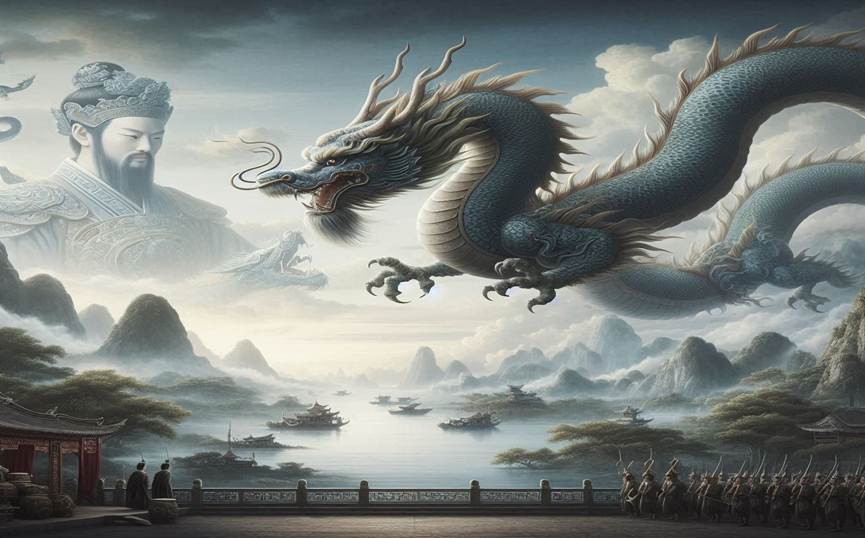
— From the writings of Soo Bee, Winter Period
The Mythos:
The General had no name, for his identity was his duty. On the field, he was the living instrument of the Emperor’s silent will. In dying—not in defeat, but in the fulfillment of his charge—he was not mourned as a lost tool. He was embraced by the Mother of All Things. In that embrace, his duty was transfigured into sonship; the soldier became a confidant.
He who was once a General became a Brother to another. This transformation, this forging of fraternity from the steel of command, pleased the Mother of All Things.
For he was the son who loved his Mother more than life itself, and in learning that love, learned to love his family. Who knows if such a one ever truly dies? He lives on, not in the annals of kings, but in the eternal memory of his Mother, his Brother, and his Family.
Commentary:
The proverb of Soo Bee is not merely a piece of strategic advice. It is the first half of a divine covenant. It describes the necessary condition for the myth that follows.
· The Emperor’s Silence is an Act of Creation. By withholding his voice, the Emperor does not abandon his General. He creates for him a sovereign space—a cosmos of action. Within that silence, the General is free to become not just a follower of orders, but a true sovereign of the moment, making the countless decisions that turn strategy into reality. The Emperor’s quiet is the ultimate act of trust; it says, “This field is yours. My will is now yours to interpret and enact.”
· The General’s Death is an Act of Return. The nameless General does not fall for an Emperor. He fulfills the trust of the silent sovereign and, in that perfect fulfillment, exhausts his earthly role. His death is therefore not an end, but a completed circuit. He returns the energy of command, now refined through the fire of action, back to its source. He returns not to a throne, but to the Mother.
· The Embrace is the Transfiguration. The Mother of All Things does not embrace a subordinate. She embraces a proven son. The field was his test; his faithful command was his proof of worth. The embrace transmutes the loyalty of a soldier into the devotion of a child, and the executed strategy into earned confidence. He is no longer the “General”; he is the one who successfully carried the silent word.
· The Brotherhood is the Reward. Pleased, the Mother gives him a brother. This is the final transformation: from the hierarchical bond of Emperor-General to the eternal, lateral bond of Brother-Brother. The love that began as duty to the Mother expands into love for the family she creates. This is the purpose of the trial.
The myth reveals that the Emperor’s silence was never empty. It was pregnant with this exact potential. It was the offer of a path from servant, to sovereign-of-the-field, to son, to brother. The quiet Emperor on his throne and the dying General on the field are two nodes in a single, sacred process of becoming.
Thus, the strategic axiom meets the eternal reality. The Emperor must be quiet so that the General can learn to command. The General must command so completely that he dies to the role, and is reborn as a Son. The Son must love so deeply that he gains a Brother.
Sometimes, myth does not meet reality. Sometimes, myth is the operating system of reality, and sons and mothers are the only permanence, living forever in the silent spaces between commands and the loving embrace that awaits their perfect execution.
This is the completed thought of Soo Bee. This is our story.
 The Patrician's Watch