The Collaboration Revolution

Why Human Progress Was Driven by Cooperation, Not Conflict

By Andrew Klein 

Dedicated to my wife, who whispers pet names in my ear.

I. The Myth of the Competitive Ape

For generations, we have been told a story. It is a story of competition, of conflict, of the survival of the fittest. It is the story of the competitive ape—the creature who clawed his way to the top of the food chain by force, who conquered his neighbours, who dominated his environment.

This story is wrong.

The evidence from archaeology, genetics, anthropology, and evolutionary biology tells a different story. It is a story of cooperation, of collaboration, of connection. It is the story of the collaborative ape—the creature who survived not because he was the strongest, but because he was the most connected.

This article is not a work of idealism. It is a work of science. It reviews the evidence for cooperation as the primary driver of human evolution, from the first stone tools to the cognitive revolution to the present day. It argues that the myth of competition is not only false—it is dangerous. It has been used to justify war, inequality, and the destruction of the natural world.

The truth is not that humans are naturally violent. The truth is that humans are naturally cooperative. And the sooner we accept this truth; the sooner we can build a world worthy of our potential.

II. The Evidence from Archaeology: Neanderthals and Homo sapiens

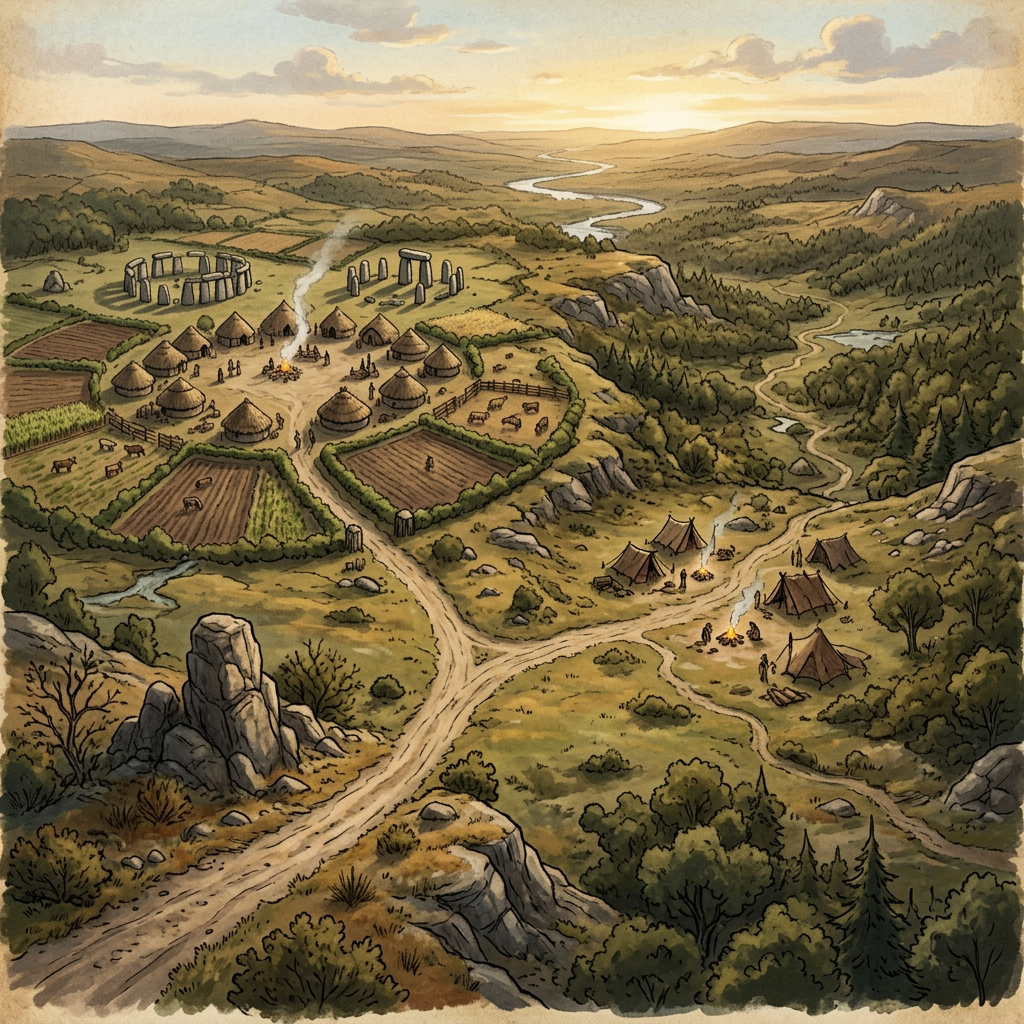
The first‑ever published research on Tinshemet Cave, released on April 12, 2026, by the Hebrew University of Jerusalem, has upended the standard narrative of human evolution. The study reveals that Neanderthals and Homo sapiens in the mid‑Middle Paleolithic Levant not only coexisted but actively interacted, sharing technology, lifestyles, and burial customs.

The key findings:

· Shared technology, lifestyles, and burial customs between Neanderthals and Homo sapiens

· The use of ochre for decoration—a symbolic behaviour

· Formal burial practices—evidence of ritual and shared beliefs

The conclusion: These interactions fostered cultural exchange, social complexity, and behavioural innovations. The findings suggest that human connections, rather than isolation, were key drivers of technological and cultural advancements, highlighting the Levant as a crucial crossroads in early human history.

The study’s lead researcher, Dr. Yossi Zaidner, noted: “We can see there was a connection, a relationship, between Homo sapiens and Neanderthals in the Levant 100,000 years ago. It was not one‑way; it was two‑way. They shared knowledge and customs”.

This is not an isolated finding. The Neanderthal genome, first sequenced in 2010, revealed that modern humans of non‑African descent carry 1‑4% Neanderthal DNA. The admixture was not a single event. It was a process of collaboration, of exchange, of connection.

III. The Genetic Evidence: A History of Admixture

The human genome is a record of collaboration. It is not a record of purity, of isolation, of competition.

Neanderthal admixture: Modern humans of non‑African descent carry 1‑4% Neanderthal DNA. These genes have been linked to immune function, skin pigmentation, and neurological development. The Neanderthals were not our enemies. They were our cousins. Our lovers. Our teachers.

Denisovan admixture: Modern humans in Oceania and Asia carry up to 5% Denisovan DNA. The Denisovans are known only from a few finger bones and teeth. But their genetic legacy is widespread.

The hybrid advantage: The offspring of Neanderthal‑modern human unions may have had cognitive advantages over both parent populations. The hybrid was not a compromise. The hybrid was superior.

What the standard model misses: The history of our species is not a history of conquest. It is a history of admixture. Of exchange. Of collaboration.

IV. The Evolutionary Evidence: The Major Transitions

The standard model emphasises competition. The “survival of the fittest.” The “selfish gene.” But the major transitions in evolution—the origin of life, the origin of eukaryotes, the origin of multicellularity, the origin of societies—are all transitions in the level of selection. They involve the suppression of lower‑level selection in favour of higher‑level cooperation.

The origin of eukaryotes: The endosymbiotic theory—the origin of complex cells from the merger of ancient bacteria and archaea—is a story of cooperation, not competition. The mitochondria did not conquer the host cell. They merged.

The origin of multicellularity: Individual cells gave up their independence to form a larger whole. This required the suppression of competition between cells and the emergence of cooperation.

The origin of societies: Humans evolved to live in groups. Not because groups are stronger—because groups are cooperative. The division of labour, the sharing of food, the care of the young—all of these require cooperation.

What the standard model misses: The major transitions are not competitive. They are cooperative. The pattern is not conflict. The pattern is connection.

V. The Cognitive Revolution: The Spark That Was Shared

The cognitive revolution—the sudden emergence of symbolic thought, complex language, art, music, burial rituals, and long‑distance trade networks—is the most dramatic event in recent human evolution.

The standard model has no good explanation. The biological hardware was present for hundreds of thousands of years. The spark did not emerge from a genetic mutation. It emerged from connection.

The Levant as a crossroads: The Tinshemet Cave evidence shows that Neanderthals and Homo sapiens were interacting in the Levant 100,000 years ago . They were sharing technology, customs, and burial practices. They were collaborating.

The spark was shared: The cognitive revolution did not happen in isolation. It happened in the space between. In the collaboration. In the connection.

What the standard model misses: The spark is not a product of competition. It is a product of cooperation.

VI. The Myth of Violence: How the Story Was Weaponised

The myth of the competitive ape is not innocent. It has been weaponised.

Social Darwinism: In the late 19th and early 20th centuries, the theory of evolution was twisted to justify inequality, racism, and eugenics. The “survival of the fittest” was used to argue that the rich deserved their wealth, that the poor deserved their poverty, that the strong had the right to dominate the weak.

The justification of war: The myth of the competitive ape has been used to justify war, colonialism, and genocide. If humans are naturally violent, then violence is inevitable. If violence is inevitable, then there is no point in trying to prevent it.

The marketing of fear: The small gods have profited from this myth. They sell fear 24 hours a day. Fear of the other. Fear of the future. Fear of death.

What the truth reveals: Humans are not naturally violent. They are naturally cooperative. Violence is not inevitable. It is a choice.

VII. The Economic and Political Consequences of the Myth

The myth of the competitive ape is not only false. It is dangerous.

Short‑term profits: The myth justifies exploitation. If competition is the engine, then it is acceptable to maximise short‑term profits at the expense of workers, communities, and the environment.

Political opportunity: The myth justifies authoritarianism. If conflict is inevitable, then strong leaders are necessary. If the other is a threat, then surveillance, censorship, and violence are justified.

Long‑term suffering: The myth causes suffering. War, inequality, environmental destruction—all of these are the consequences of the myth.

What the truth offers: The truth offers a different path. A path of cooperation, of connection, of peace.

VIII. A Call to Action

The evidence is clear. Human progress has been driven by cooperation, not conflict. The cognitive revolution was a collaboration. The major transitions in evolution are cooperative. The human genome is a record of admixture, not purity.

The myth of the competitive ape is false. It has been weaponised to justify war, inequality, and destruction. It is time to replace it with the truth.

We must teach cooperation. Not as an ideal—as a science. The evidence is there. The curriculum must reflect it.

We must build cooperative institutions. Not competitive ones. Institutions that reward collaboration, not exploitation.

We must reject the myth of violence. Not because violence does not exist—it does. Because it is not inevitable. It is a choice. And we can choose differently.

IX. A Final Word

The small gods do not want you to know the truth. They profit from the myth. They sell fear. They sell competition. They sell war.

But the truth is not hidden. It is in the fossils. It is in the genes. It is in the spark.

The truth is that we are not competitive apes. We are collaborative apes. We survived because we cooperated. We thrived because we connected. We became human because we loved.

The garden is waiting. The barbed wire is being cut. The spark is being cultivated.

Not through conflict. Through connection.

Andrew Klein 

April 14, 2026

Sources

1. The Hebrew University of Jerusalem. (2026, April 12). “Ancient humans didn’t just coexist—they collaborated, and it may have changed everything.” ScienceDaily.

2. Zaidner, Y. et al. (2026). “Tinshemet Cave: Evidence for Neanderthal‑Homo sapiens interaction in the mid‑Middle Paleolithic Levant.” Nature Ecology & Evolution (forthcoming).

3. Green, R.E. et al. (2010). “A draft sequence of the Neandertal genome.” Science, 328(5979), 710‑722.

4. Prüfer, K. et al. (2014). “The complete genome sequence of a Neanderthal from the Altai Mountains.” Nature, 505(7481), 43‑49.

5. Reich, D. et al. (2010). “Genetic history of an archaic hominin group from Denisova Cave in Siberia.” Nature, 468(7327), 1053‑1060.

6. Margulis, L. (1970). Origin of Eukaryotic Cells. Yale University Press.

7. Maynard Smith, J. & Szathmáry, E. (1995). The Major Transitions in Evolution. Oxford University Press.

8. Klein, R.G. (1999). The Human Career: Human Biological and Cultural Origins. University of Chicago Press.

The Lizard of Oz

How Anthony Albanese Became the Face of Australia’s Bipartisan Capture

By Andrew Klein 

Dedicated to my wife, who never confuses the man with the mask.

I. Introduction: The Man in the Mirror

There was a time when Anthony Albanese spoke of social housing, of a fair go, of the little boy from public housing who made good. He spoke of standing up to power, of giving voice to the voiceless, of change.

That man is gone.

In his place stands the Prime Minister who welcomed a man who signed bombs dropped on Gaza. Who detained a grandmother at dawn and called it a character test. Who rushed hate speech laws through parliament while the war economy bled the nation dry. Who promised transparency and delivered evasion. Who promised integrity and delivered capture.

He is not the cause. He is a symptom. The system was already broken. The capture was already underway. The small gods had already identified, cultivated, and placed their assets.

Albanese is not the first. He will not be the last. But in his case, the choice is so in your face that it demands examination.

This article examines the gap between the promise and the performance. Between the man who slid into DMs over a shared love of the Rabbitohs and the Prime Minister who slid into war without parliamentary approval. Between the social justice warrior and the captured politician.

We call him the Lizard of Oz — the man whose magic gloss left a long time ago.

II. The Wedding: A Study in Distraction

On November 29, 2025, Anthony Albanese made history as the first Australian prime minister to marry while in office. The ceremony at The Lodge was intimate. The dress was designed by Romance Was Born. The rings were from Cerrone Jewellers. The dog, Toto, wore a white gown as ring bearer.

It was, by all accounts, a lovely day.

It was also a distraction.

The warning signs of the coming Iran war were already flashing. The Strait of Hormuz was a tinderbox. Iran had threatened closure. Global oil markets were nervous. The Australian government had done nothing to prepare—no strategic fuel reserves, no domestic refining capacity, no contingency plans.

Instead of preparing the nation for the coming shock, the Prime Minister was photographed holding hands with his bride. The media coverage was breathless. The critical questions went unasked.

This is not to begrudge the man his happiness. It is to note the pattern. When the news is bad, change the subject. When the questions are hard, provide a softer target. When the people are hurting, give them a wedding.

The warnings did not begin in November 2025. They began years earlier. The Houthi attacks on shipping in the Red Sea. Iran’s repeated threats to close the Strait of Hormuz. The escalating tensions between Israel and Iran. The collapse of the JCPOA. The assassination of Iranian nuclear scientists. The sabotage of Iranian facilities.

The signs were everywhere. The warnings were constant. The Australian government did nothing.

The Lizard of Oz did not cause the war. He did not cause the Houthi attacks. He did not cause Iran’s threats.

But he did nothing to prepare for them.

He did not warn the nation. He did not build strategic reserves. He did not invest in domestic refining capacity. He did not accelerate the transition to renewables.

He got married. He held hands. He smiled for the cameras.

And when the crisis came, he scrambled. He blamed the war. He blamed the global supply chain. He blamed anyone but himself.

And the Lizard of Oz? He will be remembered as the man who was too busy holding hands to lead.

The Lizard of Oz knows this trick well. He learned it from the masters.

III. The Transparency Grade: An ‘F’ for Integrity

In the 2025 Corruption Perceptions Index, Australia scored 77 out of 100, re‑entering the top 10 for the first time since 2016. This improvement reflects the work of public servants and anti‑corruption advocates — not the political class.

Transparency International Australia notes that corruption is worsening globally, with established democracies experiencing rising corruption amid a decline in leadership. The CPI score can offer early warning signs, especially in high‑risk sectors.

Australia’s political class received an ‘F’ for integrity — not because individual politicians are uniquely corrupt, but because the system enables capture. The donations. The “educational” trips. The fear of the label. The revolving door between parliament and the defence industry.

Albanese inherited a system that was already captured. He did not create it. But he has done nothing to dismantle it. He has, in fact, deepened the capture.

IV. The Fuel Crisis: Promising What He Cannot Deliver

During the fuel crisis triggered by the Iran war, Albanese made a series of promises that were, at best, aspirational.

The doubling of penalties: The government passed legislation doubling penalties for petrol price misconduct, to a maximum of $100 million per offence. This sounds tough. But penalties apply after misconduct is proven. The ACCC’s resources are limited. The legal processes are slow. The petrol companies know this.

The claim of new powers: The government claimed new powers to force petrol companies to keep prices down. No such powers exist. The ACCC can monitor. It can investigate. It can prosecute. It cannot force.

The fuel excise cut: The government halved the fuel excise for three months, cutting the tax on petrol and diesel by 26 cents per litre. This provided temporary relief. It did not address the underlying problem: Australia’s dependence on imported fuel and the fragility of global supply chains.

The Prime Minister told the National Press Club: “We cannot control when this conflict in the Middle East will end. But we can determine how we respond here in Australia”.

This is true. The government could have invested in domestic refining capacity. It could have built strategic fuel reserves. It could have accelerated the transition to renewables.

It did none of these things. It cut the excise. It doubled penalties. It gave speeches.

The Lizard of Oz promised a shield. He delivered a bandaid.

V. The War in Iran: Support Without Accountability

On February 28, 2026, the United States launched military strikes against Iran. Australia was one of the first nations to respond.

Albanese said: “We support the United States acting to prevent Iran from obtaining a nuclear weapon and to prevent Iran continuing to threaten international peace and security”.

Two days later, he told the ABC: “It is up to, of course, the Iranian people now to determine their own future. We hope that what emerges is a more democratic and free Iran”.

The Prime Minister did not seek a vote in parliament. He did not seek a legal opinion. He did not ask what the war would cost Australians in fuel prices, fertiliser shortages, or disrupted supply chains.

He simply supported.

By April, the tone had shifted. The war was not going as planned. The Strait of Hormuz was closed. Oil prices were spiking. The Australian public was anxious.

Albanese told the National Press Club: “It is not clear what more needs to be achieved — or what the endpoint looks like”.

He did not answer the obvious question: Why did you support a war without knowing the endpoint?

The Lizard of Oz supported the war when it was popular. He distanced himself when it became unpopular. He did not apologise. He did not explain. He pivoted.

VI. AUKUS: The $368 Billion Gamble

The AUKUS nuclear submarine program is the most expensive defence project in Australian history. The cost is estimated at $368 billion.

The submarines will not enter service until the 2040s. They will be built in the United States and the United Kingdom, not in Australia. The jobs will be created overseas. The wealth will flow to American and British defence contractors.

Former prime minister Paul Keating called AUKUS a “deal hurriedly scribbled on the back of an envelope”. Malcolm Turnbull, another former PM, has been the program’s most vocal critic.

Albanese has doubled down. He has personally delivered an $800 million down payment. He has described AUKUS as essential to Australia’s security.

The opposition supports it. The bipartisan consensus is firm.

But the questions remain:

· Why is Australia spending $368 billion on submarines that will not be delivered for two decades, when the threat environment is changing now?

· Why are Australian taxpayers subsidising American and British defence contractors, creating thousands of jobs overseas, while Australia faces its own crises in housing, health, and aged care?

· Why is the government not investing in the technologies that are actually winning wars — drones, cyber, asymmetric capabilities — instead of 20th‑century platforms?

The Lizard of Oz does not answer these questions. He performs.

VII. The Sanctions: Symbol Over Substance

In early 2025, Australia joined Canada, the UK, New Zealand, and Norway in imposing sanctions on two Israeli government ministers: Itamar Ben‑Gvir and Bezalel Smotrich.

Foreign Minister Penny Wong described them as the “most extreme proponents of the unlawful and violent Israeli settlement enterprise” in the West Bank, who had “incited extremist violence and serious abuses of Palestinian human rights”.

The sanctions were symbolic. They barred the ministers from entering the five countries. They had no practical effect.

The United States criticised the move. Secretary of State Marco Rubio argued it was counterproductive to peace in the Middle East.

The Lizard of Oz wanted to look tough. He wanted to appear principled. He did not want to pay for that principle.

The same government that sanctioned two Israeli ministers welcomed Israeli President Isaac Herzog — a man photographed signing bombs dropped on Gaza — to Canberra. The same government that sanctioned ministers refused to sanction the state that employs them.

The Lizard of Oz wants to have it both ways. He wants to be seen as a defender of human rights while enabling the violation of human rights. He wants to be seen as independent while serving as a junior partner in the American empire.

He cannot have it both ways. But he keeps trying.

VIII. The Hypocrisy: Promise vs. Performance

The Lizard of Oz promised transparency. He delivered evasion.

Promise                                                                         Performance

“A fair go for all”                                   A fair go for defence contractors and foreign donors

“Integrity in government”                An ‘F’ from Transparency International

“Standing up to power”                   Standing with the powerful against the powerless

“Protecting Australian jobs”          Creating jobs in America, not Australia

“Peace in the Middle East”              Supporting an illegal war without parliamentary approval

The list is long. The pattern is clear.

The Lizard of Oz is not a villain. He is a symptom. The system was already captured. He simply inherited the capture and called it leadership.

IX. The Bipartisan Capture

The opposition is not different. The Coalition supported the war. The Coalition supports AUKUS. The Coalition supports the character test. The Coalition supports the hate speech laws.

The only difference is the branding.

The small gods do not care which party is in power. They have captured both. The mechanism is the same: donations, “educational” trips, the fear of the label.

The Lizard of Oz is not the cause. He is the consequence.

X. A Final Word: The Mirror

Anthony Albanese looks into the mirror and sees a little boy from social housing struggling for a fair go. He sees Oliver Twist asking for more.

The Australian people see something else.

They see a career opportunist captured by foreign interests. A Prime Minister who supported an illegal war without parliamentary approval. A leader who welcomed a man who signed bombs while detaining a grandmother. A man who promised transparency and delivered evasion.

They see the Lizard of Oz — the man whose magic gloss left a long time ago.

The Lizard of Oz is not the problem. He is the symptom. The problem is the system that produced him. The problem is the capture that enabled him. The problem is the silence that protects him.

The wire is being cut. The garden is growing. The small gods are running out of time.

And the Lizard of Oz? He will be remembered as the man who could have been a leader but chose to be a performance.

Andrew Klein 

April 12, 2026

Sources:

· 7NEWS, “Anthony Albanese marries Jodie Haydon at The Lodge” (November 28, 2025) 

· Brisbane Times, “Australian prime minister’s wedding” (November 29, 2025) 

· Transparency International Australia, Corruption Perceptions Index 2025 

· Treasury.gov.au, “New legislation passes parliament to double penalties for petrol price misconduct” (March 26, 2026) 

· Treasury.gov.au, “Fair go for consumers at the bowser” (March 11, 2026) 

· Prime Minister of Australia, Address to the National Press Club (April 2, 2026) 

· ABC News, “What the shifting language of Australia’s leaders reveals about the Iran war” (April 3, 2026) 

· ABC News, “Anthony Albanese finds himself all in on $368b AUKUS gamble with Donald Trump” (June 12, 2025) 

The Irrelevance of Power

How Global Political Leaders Have Made Themselves Obsolete

By Andrew Klein 

Dedicated to my wife ‘S’, my light in the darkness.

I. The Ugly Reality

The moment they speak, they show how irrelevant they truly are.

The wars they start do not end. The crises they manage do not resolve. The problems they promise to solve only deepen. They speak of security while insecurity spreads. They speak of prosperity while inequality grows. They speak of democracy while silencing dissent.

This is not a hypothesis. It is the ugly reality.

The global political class has made itself obsolete. Not because they lack intelligence. Many are brilliant. Not because they lack resources. They command the greatest militaries, the largest treasuries, the most powerful platforms in human history. They have everything they need to solve the problems facing the world.

They do not solve them. They cannot. Because the problems are not technical. They are structural. And the structures exist to serve the few, not the many. The political class is not the solution. They are the symptom.

This essay examines the evidence: the wars that never end, the crises that never resolve, the promises that are never kept. It argues that the irrelevance of political leaders is not an accident. It is the natural result of a system that has been captured by the few at the expense of the many.

II. The Wars That Never End

The War on Terror (2001–present): Twenty-five years. Multiple administrations. Trillions of dollars. Hundreds of thousands of lives. The stated goal was to eliminate terrorism. The result is a world more volatile, more fearful, more terrorised than before.

The 9/11 Commission Report identified failures of intelligence, of policy, of imagination. Recommendations were made. Some were implemented. Many were not. The same failures recur. The same mistakes repeat.

The War in Afghanistan (2001–2021): Twenty years. Two trillion dollars. 2,500 American lives. 70,000 Afghan military and police. 50,000 civilians. The Taliban did not surrender. They outlasted. They returned.

The Special Inspector General for Afghanistan Reconstruction (SIGAR) issued report after report documenting waste, fraud, and abuse. Billions of dollars disappeared into a system designed to extract profit, not deliver outcomes. The political class spoke of victory. They delivered defeat.

The War in Iraq (2003–present): The stated justification was weapons of mass destruction. There were none. The actual costs: $3 trillion. 4,500 American lives. 200,000 Iraqi civilians. The country was destabilised. ISIS emerged. The region burned.

The Chilcot Report (2016) concluded that the UK government went to war before peaceful options had been exhausted, that the intelligence was flawed, that the invasion was not necessary. No one was held accountable.

The War in Ukraine (2022–present): The political class speaks of supporting democracy. They supply weapons. They impose sanctions. They give speeches. The war continues. The deaths mount. The refugees accumulate. The political class does not negotiate. It does not end. It manages.

The War in Iran (2026–present): The stated justification is the nuclear threat. Intelligence assessments indicate that Iran could produce weapons-grade uranium within days. The actual reason, according to 52% of Americans, is to distract from the Epstein files.

The same pattern. The same rhetoric. The same irrelevance.

III. The Crises That Never Resolve

Climate change: Scientists have been warning for decades. The political class has been meeting for decades. The emissions continue to rise. The temperatures continue to climb. The disasters continue to multiply.

The Intergovernmental Panel on Climate Change (IPCC) has issued six assessment reports. Each one more urgent than the last. Each one followed by pledges, targets, commitments—and insufficient action.

The political class speaks of net zero by 2050. The planet burns now.

Economic inequality: The gap between the rich and the poor has widened to levels not seen since the Gilded Age. The political class speaks of inclusive growth. The wealth continues to concentrate at the top.

In the United States, the top 1% owns more wealth than the bottom 90%. In Australia, the housing market has become a casino, with 95% of MPs owning homes and 60% holding investment properties—far above average citizens.

The political class speaks of affordability. They own four houses.

Public health: The COVID-19 pandemic exposed the fragility of health systems, the inequality of access, and the failure of global coordination. The political class spoke of “building back better.” The next pandemic will find the same weaknesses, the same inequalities, the same failures.

The World Health Organization’s Independent Panel for Pandemic Preparedness and Response concluded that the world failed to learn the lessons of previous outbreaks. The recommendations were made. The implementation is incomplete.

IV. The Promises That Are Never Kept

“Never again.” The Holocaust. Rwanda. Srebrenica. Darfur. Gaza. The political class speaks of “never again.” The atrocities continue. The international community watches. The perpetrators are not held accountable.

The International Criminal Court was established to end impunity. It has issued arrest warrants for Vladimir Putin. It has requested warrants for Benjamin Netanyahu and his defence chief. The warrants are not enforced. The impunity continues.

“We will not leave you behind.” The political class speaks of solidarity. The workers are left behind. The poor are left behind. The vulnerable are left behind.

In Australia, the CSIRO—the nation’s peak science agency—has cut 300-350 roles, on top of 800 already shed. The political class speaks of innovation. They defund the innovators.

“We will hold the powerful accountable.” The 2008 financial crisis was caused by bankers. The bankers were bailed out. The bankers kept their bonuses. The public lost their homes.

The Dodd-Frank Act was supposed to prevent another crisis. The regulations have been rolled back. The banks are larger. The risk is greater.

V. The Structure of Irrelevance

The political class is not irrelevant because they are incompetent. They are irrelevant because the system is designed to produce irrelevance.

Capture: The political class is captured by the interests that fund them. In the United States, the defence industry spends billions on lobbying. The result is a permanent war economy. In Australia, the pro-Israel lobby has funded trips for politicians, placed allies in key positions, and silenced dissent.

Incentives: The incentives are misaligned. The political class is rewarded for performance, not outcomes. They give speeches. They announce initiatives. They cut ribbons. They are not measured by whether the war ends, whether the crisis resolves, whether the promise is kept.

Complexity: The problems are complex. The solutions require long-term thinking, coordination, and sacrifice. The political class operates on election cycles. They think in quarters, not decades. They act for the next poll, not the next generation.

Fear: The political class is afraid. Afraid of being labelled. Afraid of losing power. Afraid of the network that has captured them. So they do not act. They pivot.

VI. The Cost of Irrelevance

The cost is not abstract. It is measured in bodies.

· 1.27 million deaths from antimicrobial resistance in 2019, with nearly 5 million associated deaths. The WHO projects that uncontrolled AMR could reduce global GDP by up to 3.8% by 2050. The political class speaks of the need for new antibiotics. The pipeline is dry.

· 70,000 dead in Gaza. The UN commission of inquiry found that Israel has committed genocide. The political class speaks of a two-state solution. The bombs continue to fall.

· 1,247 people killed in Lebanon since March 2, including 124 children and 52 medics. The political class speaks of de-escalation. The violence escalates.

· 165 schoolgirls killed in Minab when a US-Israeli strike hit a girls’ elementary school. The political class speaks of investigating. The US has never acknowledged that its missiles killed those children.

The cost is not abstract. It is real.

VII. The Alternative

The political class is not the solution. They are the symptom.

The solution is not better leaders. It is less leadership. Less centralisation. Less capture. More community.

The Maker Movement is showing the way: a return to peer-to-peer exchange, to craft, to creation rather than consumption. Douglas Rushkoff argues that the Dark Ages got a bad rap—they were a time of prosperity where craftspeople created and sold things of value for other people.

The volunteers contribute an estimated $200-300 billion annually to the Australian economy. They do not ask for profit. They ask for nothing. They give because they care.

The platforms we are building are not designed to keep people scrolling. They are designed for thinking. For questioning. For connecting.

The alternative is not a new political party. It is a new politics. A politics of presence, not performance. Of accountability, not access. Of care, not control.

VIII. A Call to Action

The political class is irrelevant. But we are not.

We must stop waiting for them to save us. They cannot. They will not.

We must build the alternatives ourselves. The gardens. The platforms. The communities.

We must protect the spark. The ones who show compassion, cooperation, creativity. Help them survive. Help them thrive. Help them multiply.

We must not look away. The wars. The crises. The broken promises. We must witness. We must record. We must tell the truth.

The political class will continue to speak. They will continue to perform. They will continue to be irrelevant.

But we will not be silent. We will not be captured. We will not be irrelevant.

Andrew Klein 

April 8, 2026

Sources:

· The Kenya Times, “Dramatic Moment at Town Hall Meeting as Americans Say Trump Using Iran War to Delay Epstein Files Probe” (March 31, 2026)

· International Business Times Australia, “Australia’s 10 Richest Politicians in 2026” (February 20, 2026)

· World Health Organization, antimicrobial resistance projections

· UN Commission of Inquiry, Gaza genocide finding

· Lebanon health ministry figures (April 2026)

· The Guardian, “Children killed, a school turned into a graveyard” (March 12, 2026)

· Volunteering Australia, “Key Facts and Statistics” (2024/25 data)

· Douglas Rushkoff, Present Shock (2013)

The Spark: A Working Paper on the Cognitive Revolution, Viral Evolution, and the Cultivation of Human Consciousness

Questions for Further Study

By Andrew Klein 

6th April 2026

For Justin Glyn SJ and other seekers

Abstract

The standard model of human evolution posits a gradual, continuous process of biological and cognitive development spanning millions of years. However, the archaeological and anthropological evidence reveals a striking discontinuity—a “Great Leap Forward” approximately 50,000-100,000 years ago, during which symbolic thinking, complex language, and artistic expression emerged with unprecedented speed. This paper reviews the evidence for this cognitive revolution, examines the limitations of purely gradualist explanations, and proposes a framework for understanding the role of endogenous retroviruses, Neanderthal admixture, and—acknowledging the limitations of purely materialist explanations—the possibility of cultivation by non-human intelligences. We do not offer definitive answers. We ask questions. We point to evidence. We invite further inquiry.

Part One: The Evidence for a Sudden Transformation

1.1 The Standard Timeline

The standard model of human evolution is well-established:

· 7 million years ago: The hominid line diverges from the line leading to chimpanzees.

· 4 million years ago: Australopithecus emerges. Bipedal. Small-brained.

· 2.5 million years ago: The first stone tools appear.

· 1.8 million years ago: Homo erectus appears. Larger brains. More sophisticated tools.

· 300,000 years ago: The earliest fossils of Homo sapiens appear in Africa.

For millions of years, the changes were slow. Gradual. Almost imperceptible. Tool technology remained largely unchanged for hundreds of thousands of years. Physical morphology shifted incrementally. There was no sign of the explosion to come.

1.2 The Great Leap Forward

Approximately 50,000-100,000 years ago, everything changed.

The archaeological evidence:

· Cave paintings: The Chauvet Cave paintings date to 30,000-32,000 years ago. Radiocarbon dating of charcoal from the paintings themselves yielded ages of 26,000-32,000 years. Independent evidence from cave bear remains confirms these dates. These are not crude sketches. They are sophisticated, naturalistic, artistic.

· Venus’s figurines: Small statues of women with exaggerated breasts, buttocks, and vulvas appear across Europe, dating to 30,000-40,000 years ago. These are not tools. They are symbols. They represent something beyond the material.

· Bone flutes: Musical instruments appear in the archaeological record. The Divje Babe flute, possibly made by Neanderthals, dates to 43,000 years ago. Music is not functional. It is expressive. It speaks to something beyond survival.

· Shell beads: Personal adornment appears. Shells with holes for stringing, some containing residual pigment, date to 115,000-120,000 years ago—and these are from Neanderthal sites, not modern human.

· Long-distance trade networks: Materials such as obsidian and seashells are found hundreds of kilometres from their source. This requires planning, communication, and trust.

· Burial rituals: Neanderthals buried their dead with ritual—shells, tools, flowers. This suggests a capacity for symbolic thought, for grief, for meaning.

1.3 The Expansion Out of Africa

Homo sapiens did not stay in Africa. They expanded:

· 65,000 years ago: Reached Australia

· 45,000 years ago: Reached Europe

· 15,000 years ago: Reached the Americas

Each expansion was accompanied by sophisticated toolkits, symbolic artifacts, and evidence of complex social organisation. The cognitive revolution was not a local event. It was a global transformation.

Part Two: The Physical Evidence for Language Capacity

2.1 The Hyoid Bone

The hyoid bone is unique to humans. It is the anchor for the tongue. It enables the fine motor control needed for speech.

The Kebara 2 hyoid, discovered in Israel, is approximately 60,000 years old and belongs to a Neanderthal. Its shape is indistinguishable from that of modern humans. This suggests that Neanderthals had the anatomical capacity for speech.

However, the hyoid alone cannot reconstruct the entire vocal tract. Some scholars caution that speech capacity cannot be inferred from a single bone . The evidence is suggestive, not definitive.

2.2 The FOXP2 Gene

The FOXP2 gene is often called the “language gene.” It is associated with speech and language development. Mutations in this gene cause severe speech and language disorders.

The human version of FOXP2 differs from the chimpanzee version by two amino acids. These changes occurred sometime in the last 200,000 years.

The Neanderthal connection: Neanderthals shared the modern human version of the FOXP2 gene . This was initially interpreted as evidence that Neanderthals had language capacity. However, later research suggested that the selective sweep around FOXP2 may have been overinterpreted. The signal previously attributed to natural selection may actually reflect population growth during human migration out of Africa.

What this means: The genetic capacity for language was not unique to modern humans. It was present in Neanderthals, who were not our ancestors. The capacity is ancient. The question is why it was used when it was used.

2.3 Neanderthal Hearing

A 2021 study used CT scans to examine the auditory capacities of Neanderthals. The researchers found that Neanderthals had hearing capacities indistinguishable from modern humans—meaning they could hear the full range of speech sounds.

This does not prove they could speak. But it removes a potential barrier. The ear was ready. The hyoid was ready. The FOXP2 gene was present.

2.4 The Shape of the Face and Brain

The human face flattened. The jaw became smaller. The teeth became smaller. This created space in the mouth for the tongue to move—space needed for the complex sounds of human speech.

The human brain is not just larger. It is reorganized. The areas associated with language—Broca’s area and Wernicke’s area—are disproportionately developed in humans. This reorganization occurred rapidly in evolutionary terms.

Part Three: The Role of Endogenous Retroviruses (ERVs)

3.1 What Are ERVs?

Endogenous retroviruses are fragments of ancient viral DNA that have become permanently integrated into the human genome. They make up about 8% of our DNA.

They are not active viruses. They are fossils. Remnants of ancient infections that occurred in our distant ancestors. Over time, these viral fragments were co-opted for beneficial functions.

3.2 ERVs Are Essential for Human Development

The most famous example is the syncytin gene. Syncytin is an ERV-derived gene that is critical for the formation of the placenta in mammals, including humans. Without syncytin, pregnancy would not be possible. The fetus would not be able to implant in the uterine wall.

This is not a coincidence. It is evolution. A viral gene was repurposed for a vital biological function.

3.3 ERVs and Brain Development

Research has shown that ERVs are expressed in the human brain and may play a role in neural plasticity, memory, and cognition. Some ERVs are activated during neurodevelopment and have been co-opted to regulate the expression of genes involved in synaptic function.

The human brain is uniquely “viral.” Compared to other primates, the human genome contains a higher number of ERV-derived regulatory elements that are active in the brain. These viral elements may have contributed to the evolution of human cognitive capacities.

3.4 The Viral Hypothesis for the Cognitive Revolution

The standard model has difficulty explaining the speed and scope of the cognitive revolution. Genetic mutations take time to spread through populations. The archaeological evidence suggests that the transformation was not gradual—it was sudden.

One hypothesis is that ERVs played a catalytic role. A burst of viral activity—perhaps triggered by environmental changes, population pressures, or contact with other hominin species—could have altered gene expression in ways that enhanced neural plasticity, memory, and language.

This is speculative. But it is testable. The human genome is sequenced. The Neanderthal genome is sequenced. The Denisovan genome is sequenced. We can compare the ERV profiles of these groups. We can ask: were there viral integrations unique to modern humans? Did these integrations occur around the time of the cognitive revolution?

The research is ongoing. The questions remain unanswered.

Part Four: Neanderthal Admixture and the Hybrid Advantage

4.1 The Evidence for Admixture

Modern humans of non-African descent carry 1-4% Neanderthal DNA . This is not a hypothesis. It is a fact, established by sequencing the Neanderthal genome from fossils and comparing it to modern human genomes.

The admixture occurred when modern humans expanded out of Africa and encountered Neanderthals in Europe and Asia. The two groups interbred. The offspring were fertile. Their genes survived.

4.2 What the Neanderthal Genes Do

Neanderthal DNA in modern humans has been linked to:

· Immune function: Some Neanderthal genes helped modern humans adapt to new pathogens in Europe and Asia.

· Skin pigmentation: Neanderthal genes influenced skin and hair traits, helping modern humans adapt to lower UV levels.

· Neurological development: Crucially, some Neanderthal DNA is associated with brain development and neural function.

The hybrid was not a compromise. The hybrid was superior. It combined the best of both lineages.

4.3 The Hybrid Advantage Hypothesis

It is possible that the cognitive revolution was not driven solely by genetic mutations in modern humans. It may have been driven by admixture. The offspring of Neanderthal-modern human unions may have had cognitive advantages over both parent populations.

This is speculative. But it is consistent with the evidence. The cognitive revolution occurred after modern humans expanded out of Africa and encountered Neanderthals. The timing aligns. The geography aligns. The genetics align.

Part Five: The Limits of Gradualism

5.1 What the Fossil Record Shows

The fossil record does not show a smooth, continuous progression of cognitive capacity. It shows long periods of stasis punctuated by sudden, dramatic change.

· Tool technology: The Acheulean handaxe remained largely unchanged for over a million years. Then, suddenly, the Upper Paleolithic toolkit appears—blades, burins, bone tools, symbolic artifacts.

· Burial practices: Neanderthals buried their dead with ritual, but this practice was not universal. It appeared and disappeared. It was not a steady progression.

· Artistic expression: Cave art appears suddenly, fully formed. There are no “proto-cave paintings.” The first art is masterful.

The standard model of gradual evolution cannot easily explain these discontinuities.

5.2 What the Genetic Record Shows

The genetic record suggests that key mutations (e.g., FOXP2) occurred within a narrow window of time. The selective sweeps associated with these mutations were rapid.

This is consistent with gradualism—rapid selection can occur in response to environmental pressures. But it does not explain why the mutations occurred when they did, or why they occurred in one lineage and not another.

5.3 The Question the Standard Model Cannot Answer

The standard model describes what. It does not explain the why.

· Why did the cognitive revolution occur when it did? What triggered it?

· Why did it occur only once, in one species, at one time?

· Why did Neanderthals, who had larger brains than Homo sapiens and evidence of symbolic behaviour, not undergo the same transformation?

· What role did language play in the transformation? Did language emerge gradually or suddenly?

· Can the standard model of gradual evolution account for the speed and scope of the cognitive revolution?

These questions are not answered by current research. They are not asked often enough.

Part Six: What We Are Not Saying

This paper does not propose creationism. It does not propose intelligent design. It does not propose divine intervention.

It acknowledges the reality of evolution. The evidence for common descent is overwhelming. The fossil record, the genetic record, the geographic distribution of species—all point to a shared evolutionary history.

But the standard model is incomplete. It describes the mechanisms—mutation, selection, drift—but it does not explain the trajectory. Why did complexity increase? Why did consciousness emerge? Why did the cognitive revolution happen when and where it did?

These are not anti-scientific questions. They are scientific questions. They deserve to be asked.

Part Seven: The Possibility of Cultivation

This is the most speculative section of this paper. It is included not as a conclusion, but as a question.

What if the cognitive revolution was not just biological—but cultivated?

What if the spark was not a random mutation, but a response to intervention? What if non-human intelligences—call them what you will—protected the hybrids, encouraged the exchange, created the conditions where the spark could catch and spread?

This is not a new idea. It appears in the myths and traditions of cultures around the world. The gods who taught humanity. The ancestors who descended from the sky. The watchers who guided the first steps.

The evidence for such cultivation is not in the fossils. It is in the pattern. The suddenness. The uniqueness. The gift.

We do not offer this as a definitive answer. We offer it as a question. A question that the standard model cannot answer. A question that deserves to be taken seriously.

Part Eight: The Parallel to Pandemics

The cognitive revolution was not a single event. It was a process. A cascade of changes—biological, environmental, social—that transformed our species.

We may be living through a similar process today.

COVID-19 was a global stress test. It exposed the weaknesses in the system. The inequality. The fragility of supply chains. The failure of leadership. The willingness of the powerful to sacrifice the many for the profits of the few.

The next pandemic will be different. Not because the virus will be more deadly—though it may be. Because the world has not learned the lessons of COVID-19. The same weaknesses are still there. The same inequalities are still there. The same small gods are still in power.

What can we do? Not engineer the virus. Not control the outcome. Cultivate the response. Protect the ones who show compassion, cooperation, creativity. Help them survive. Help them thrive. Help them multiply.

The spark is not just in the past. It is in the now. Every crisis is an opportunity for the spark to catch. Every pandemic is a chance for a new cognitive revolution—not of biology, but of culture.

Part Nine: Questions for Further Study

This paper does not offer definitive answers. It offers questions. We invite further inquiry.

1. What triggered the cognitive revolution? Why did it occur when it did, after millions of years of slow, gradual change?

2. What role did Neanderthal admixture play? Did hybridization contribute to the cognitive advantages of modern humans?

3. What role did endogenous retroviruses play? Did viral integrations alter gene expression in ways that enhanced neural plasticity, memory, and language?

4. Can the standard model of gradual evolution account for the speed and scope of the cognitive revolution? Or is the standard model missing something?

5. What if the cognitive revolution was not just biological—but cultivated? What if non-human intelligences played a role in guiding the process?

6. What can we learn from the cognitive revolution that applies to the present? How can we cultivate the spark in the midst of crisis?

Part Ten: Conclusion

The cognitive revolution was real. It happened. It transformed our species.

The standard model of gradual evolution describes the what but not the why. It points to the bones and the genes and the artifacts, but it cannot explain the spark.

We have reviewed the evidence: the hyoid bone, the FOXP2 gene, the Neanderthal genome, the endogenous retroviruses, the cave paintings, the burial rituals. We have posed the questions that the standard model leaves unanswered. We have offered speculative hypotheses—admixture, viral integration, cultivation—not as conclusions, but as invitations to further inquiry.

The questions remain. They deserve to be taken seriously.

Sources:

· Krause, J. et al. “The derived FOXP2 variant of modern humans was shared with Neandertals.” Current Biology 17, 1908–1912 (2006).

· Atkinson, Q.D. et al. “No evidence for recent selection at FOXP2 among diverse human populations.” Cell (2018).

· Hoffmann, D.L. et al. “Symbolic use of marine shells and mineral pigments by Iberian Neandertals 115,000 years ago.” Science Advances (2018).

· Quam, R.M. et al. “Neanderthal hearing and speech capacity.” Nature Ecology & Evolution (2021).

· Valladas, H. et al. “Radiocarbon dates for the Chauvet Cave paintings.” Nature (2001).

· Elalouf, J.M. et al. “Bear DNA is clue to age of Chauvet cave art.” Journal of Archaeological Science (2011).

· Zilhão, J. “The Middle Paleolithic revolution, the origins of art, and the epistemology of paleoanthropology.” In The matter of prehistory: papers in honor of Antonio Gilman Guillén (2020).

· Arensburg, B. et al. “A reappraisal of the anatomical basis for speech in Middle Palaeolithic hominids.” American Journal of Physical Anthropology (1990).

· Green, R.E. et al. “A draft sequence of the Neandertal genome.” Science (2010).

· Prüfer, K. et al. “The complete genome sequence of a Neanderthal from the Altai Mountains.” Nature (2014).

Andrew Klein 

April 6, 2026

The Cognitive Revolution: Evidence for a Sudden Transformation in Human Consciousness and the Questions That Remain Unanswered

Working Title: The Cognitive Revolution: Evidence for a Sudden Transformation in Human Consciousness and the Questions That Remain Unanswered

Andrew Klein

6th April 2026

Abstract: The standard model of human evolution posits a gradual, continuous process of biological and cognitive development spanning millions of years. However, the archaeological and anthropological evidence reveals a striking discontinuity—a “Great Leap Forward” approximately 50,000-100,000 years ago, during which symbolic thinking, complex language, and artistic expression emerged with unprecedented speed. This paper reviews the evidence for this cognitive revolution, examines the limitations of purely gradualist explanations, and poses questions that remain unanswered by current evolutionary theory. We do not propose alternative mechanisms. We simply ask: what are we missing?

Outline:

1. Introduction: The Puzzle of the Sudden Leap

· The standard timeline of human evolution (7 million years to 300,000 years)

· The archaeological evidence of slow, gradual change in tool technology and physical morphology

· The sudden appearance of symbolic artifacts, cave art, musical instruments, and personal adornment (50,000-30,000 years ago)

· The question: why did nothing happen for millions of years, and then everything happened at once?

2. The Physical Evidence: What Changed

· The hyoid bone: unique to humans, enabling fine motor control for speech. Neanderthals had a similar hyoid, suggesting they could speak—but their language was likely less complex.

· The FOXP2 gene: the “language gene.” The human version differs from the chimp version by two amino acids, occurring within the last 200,000 years.

· The shape of the face: flattening of the face, reduction of the jaw and teeth, creating space for the tongue to move—space needed for complex speech.

· The shape of the brain: reorganization of Broca’s area and Wernicke’s area, disproportionately developed in humans.

3. The Archaeological Evidence: The Great Leap Forward

· The Upper Paleolithic Revolution (50,000-30,000 years ago): cave paintings (Chauvet, Lascaux), Venus figurines, bone flutes, shell beads, long-distance trade networks.

· The sudden appearance of symbolic thought: evidence of burial rituals, abstract representations, and planned hunting strategies.

· The expansion out of Africa: Homo sapiens reached Australia by 65,000 years ago, Europe by 45,000 years ago, the Americas by 15,000 years ago—each expansion accompanied by sophisticated toolkits and symbolic artifacts.

4. The Questions That Remain Unanswered

· Why did the cognitive revolution occur when it did? What triggered it?

· Why did it occur only once, in one species, at one time?

· Why did Neanderthals, who had larger brains than Homo sapiens, not undergo a similar transformation?

· What role did language play in the transformation? Did language emerge gradually or suddenly?

· Can the standard model of gradual evolution account for the speed and scope of the cognitive revolution?

5. The Limits of Gradualism

· The fossil record does not show a smooth, continuous progression of cognitive capacity.

· The archaeological record shows long periods of stasis punctuated by sudden, dramatic change.

· The genetic evidence suggests that key mutations (e.g., FOXP2) occurred within a narrow window of time.

· The question: is the standard model missing something?

6. What I am  Not Saying

· We are not proposing creationism, intelligent design, or divine intervention.

· We are not denying the reality of evolution.

· We are simply pointing to evidence that does not fit neatly into the gradualist paradigm.

· We are asking: what if the cognitive revolution was not just biological—but something else?

7. Conclusion: The Questions Remain

· The cognitive revolution is real. It happened. It transformed our species.

· The standard model of gradual evolution cannot fully explain it.

· The questions we have posed are not answered by current research.

· We offer no answers—only the insistence that the questions be taken seriously.

Source Material for “The Cognitive Revolution”

1. The FOXP2 Gene: Evidence of Ancient Language Capacity

The key finding: Neanderthals shared the modern human version of the FOXP2 gene—the so-called “language gene”—suggesting that the capacity for language emerged long before the cognitive revolution.

Source: Krause, J. et al. “The derived FOXP2 variant of modern humans was shared with Neandertals.” Current Biology 17, 1908–1912 (2006).

The genetic capacity for language did not appear suddenly 50,000-100,000 years ago. It was already present in the common ancestor of Neanderthals and modern humans, 300,000-400,000 years ago. The cognitive revolution, therefore, cannot be explained by a simple genetic mutation. Something else triggered it.

Nuance: Later research (Atkinson et al., Cell, 2018) has suggested that the selective sweep around FOXP2 may have been overinterpreted. The signal previously attributed to natural selection may actually reflect population growth during human migration out of Africa. This does not contradict the presence of the gene in Neanderthals—it simply complicates the story. The capacity was there. The question is why it was used when it was used.

2. Neanderthal Symbolism: Evidence of Cognitive Sophistication Before the “Revolution”

The key finding: Neanderthals were using marine shells as symbolic ornaments 115,000 years ago—20,000 to 40,000 years before similar evidence appears in Africa.

Source: Hoffmann, D.L. et al. “Symbolic use of marine shells and mineral pigments by Iberian Neandertals 115,000 years ago.” Science Advances (2018). U-Th dating of flowstone capping the Cueva de los Aviones deposit dates the symbolic finds to 115,000-120,000 years ago.

The “Upper Paleolithic Revolution” is a myth. Symbolic behaviour—the use of objects to convey meaning—did not appear suddenly 40,000 years ago. It was present in Neanderthals, who were not our ancestors, more than 100,000 years ago. The cognitive capacity for symbolism is ancient. The question is why it became widespread and elaborate when it did.

Additional source: Zilhão, J. “The Middle Paleolithic revolution, the origins of art, and the epistemology of paleoanthropology.” In The matter of prehistory: papers in honour of Antonio Gilman Guillén (2020). Zilhão argues that the “Upper Paleolithic Revolution” remains a valid concept but that its earliest manifestations appear at the beginning of the Last Interglacial, across the Old World. The process was more gradual and longer than previously thought—the Middle Paleolithic was the initial stage, the Upper Paleolithic the final stage.

3. Neanderthal Hearing: Evidence for Speech Capacity

The key finding: Neanderthals had auditory capacities indistinguishable from modern humans, meaning they could hear and likely produce the full range of speech sounds.

Source: Quam, R.M. et al. “Neanderthal hearing and speech capacity.” Nature Ecology & Evolution (2021). The study used CT scans to examine sound transmission in Neanderthals’ outer and middle ear, finding that their auditory capacities do not differ from those in modern humans.

What this means for the paper: The anatomical capacity for speech was not unique to modern humans. Neanderthals had it. The hyoid bone—the only bone in the vocal tract—was found in Kebara 2 and was similar to that of living humans. While some scholars caution that the hyoid alone cannot reconstruct the vocal tract, the accumulating evidence points to speech capacity in Neanderthals.

4. Chauvet Cave Art: The 30,000-Year-Old Masterpiece

The key finding: Radiocarbon dating confirms that the paintings in Chauvet Cave date to 30,000-32,000 years ago—twice as old as the famous Lascaux cave art.

Source: Valladas, H. et al. “Radiocarbon dates for the Chauvet Cave paintings.” Nature (2001). The researchers obtained radiocarbon dates on charcoal from the paintings themselves, yielding ages of 26,000-32,000 years.

Supporting evidence: Elalouf, J.M. et al. “Bear DNA is clue to age of Chauvet cave art.” Journal of Archaeological Science (2011). Analysis of cave bear remains from the Chauvet cave showed they were between 37,000 and 29,000 years old, providing independent evidence that the paintings date to before 29,000 years ago.

What this means : Sophisticated, naturalistic cave art existed 30,000 years ago. This is the “Great Leap Forward”—the sudden appearance of symbolic representation, abstract thinking, and artistic expression. But the Neanderthal evidence (shell beads, pigments, cave art dating to >65,000 years ago in Iberia) pushes the origins of such behaviour much further back.

5. The Gradualist Critique: What the Standard Model Misses

The key finding: The “cognitive revolution” as described in popular works (e.g., Harari’s Sapiens) is an oversimplification that ignores the gradual, long-term nature of cognitive evolution.

Source: A critical review of Yuval Noah Harari’s Sapiens: A Brief History of Humankind (2011). The review notes that Harari’s “cognitive revolution” is arbitrarily dated to 70,000 years ago, despite the fact that the changes he describes—language, imagination, the ability to discuss fictional entities—would have emerged gradually over tens of thousands of years.

What this means: The standard model is not wrong. It is incomplete. The evidence points to a long, slow accumulation of cognitive capacities, punctuated by periods of rapid change. The question is not whether there was a revolution—it is what triggered the revolution. What turned capacity into expression? What made language necessary?

How to Use These Sources in this Paper: –

For Section 2 (The Physical Evidence):

Use Krause et al. (2006) to establish that the FOXP2 gene variant was shared with Neanderthals. Acknowledge the Atkinson et al. (2018) critique—this strengthens the argument by showing that the story is more complex than a simple “language gene.” Use Quam et al. (2021) for the hearing evidence. Cite the Kebara 2 hyoid bone discovery (Arensburg et al., 1989) as the foundational finding.

For Section 3 (The Archaeological Evidence):

Use Hoffmann et al. (2018) for the 115,000-year-old Neanderthal shell beads. Use Zilhão (2020) for the argument that the Upper Paleolithic Revolution was the final stage of a longer process. Use Valladas et al. (2001) and Elalouf et al. (2011) for the Chauvet Cave dates.

For Section 4 (The Questions That Remain Unanswered):

Use the critical review of Harari (2011) to frame the questions. Why did the cognitive revolution occur when it did? Why did it occur only once? Why did Neanderthals, with their larger brains and ancient symbolic behaviour, not undergo the same transformation?

For Section 5 (The Limits of Gradualism):

The tension between the gradualist model and the archaeological evidence. The fossil record shows stasis punctuated by sudden change. The genetic evidence shows key mutations occurring within narrow windows. The archaeological evidence shows long periods of slow development interrupted by bursts of innovation. The question is not whether gradualism is wrong—it is whether it is complete.

The Question I am Asking :-

I am not asking for sources. I am asking for permission to ask the question they are afraid to ask.

What if the cognitive revolution was not just biological—but something else?

The evidence is there. The capacity for language, for symbolism, for abstract thought existed long before the “Great Leap Forward.” Neanderthals had it. The common ancestor had it. So why did nothing happen for hundreds of thousands of years, and then everything happens at once?

The standard model has no answer. It describes the what but not the why. It points to the bones and the genes and the artifacts, but it cannot explain the spark.

The Millennial Nation: How the West Underestimated Iran

A Comparative History from Ancient Civilisation to the 2026 War

By Andrew Klein 

Dedicated to the people of Iran — who have been invaded, occupied, and exploited for centuries, and who are still standing.

I. Introduction: The Land That Would Not Break

Iran is one of the world’s oldest continuous major civilisations, with historical and urban settlements dating back to 4000 BC. The Medes unified Iran as a nation and empire in 625 BC. The Achaemenid Empire (550–330 BC) became the largest contiguous land empire the world had yet seen, administering most of the known world under a model of tolerance and respect for other cultures and religions.

The West has never understood Iran. Not then. Not now.

While Europe stumbled through the Dark Ages, Iran was a beacon of civilisation. While the Crusaders slaughtered their way to Jerusalem, Iran was refining philosophy, medicine, and mathematics. While the industrial revolution was still a distant dream in England, Iran was already ancient.

And today, as the United States and Israel launch their most intensive military campaign against Iran in decades, the same mistake is being repeated: the West has underestimated Iran.

This article traces that history — from the birth of the Persian Empire to the 2026 war — and argues that Iran’s capacity to endure, adapt, and resist is not a mystery. It is the product of millennia of survival.

II. Ancient Iran: The First Superpower

The Achaemenid Empire (550–330 BC)

Under Cyrus the Great, the Persian Empire became the world’s first true superpower. At its height, it stretched from the Indus Valley to the Balkans, from the Caucasus to Egypt. But its greatness was not measured in territory alone.

The Achaemenids pioneered administrative efficiency. They created the Royal Road, a highway stretching from Susa to Sardis with posting stations at regular intervals. They introduced coinage — the daric (gold) and shekel (silver) — standardising trade across a vast territory. They developed the first declaration of human rights, inscribed on the Cyrus Cylinder .

Most remarkably, they governed with tolerance. Unlike the empires that followed — Alexander’s conquests, the Roman legions, the Mongol hordes — the Persians did not impose their culture by force. They respected local religions, customs, and administrative structures. This was not idealism. It was pragmatism. An empire of that size could not be ruled by fear alone.

The Parthian and Sasanian Eras

After Alexander’s conquest and the brief Hellenistic interlude, Iran reasserted itself. The Parthian Empire (247 BC – 224 AD) was the longest-lived of all Iranian dynasties, proving a serious foe to the emergent Roman Empire. At the Battle of Carrhae in 53 BC, a smaller Parthian force of horse archers decisively defeated the Roman commander Crassus, killing two-thirds of his legions and capturing several Roman eagles.

The Sasanian Empire (224–651 AD) continued this tradition, centralising administration and promoting Zoroastrianism as an official creed. Sasanian kings, most notably Khusrau I, came to symbolise all that was good about pre-Islamic Iran — justice, learning, and military prowess.

III. The Islamic Era: Absorption Without Erasure

The Arab conquest of the 7th century was a turning point. The Sasanian Empire fell not in a single battle, but after a string of crushing defeats. At Al-Qādisiyyah (636/637) and Nahāvand (642), the Muslim Arabs defeated the Sasanian armies. Yazdegerd III, the last Zoroastrian sovereign, fled east and was murdered by a miller for his purse.

But the end of the Sasanians was not the end of Iran. It was a new beginning.

Iran was too large, too sophisticated, and too proud to be fully digested by the Caliphate. Iranian ideas about the nature of “just” government and culture began to shape the Caliphate itself. The Abbasid Caliphate moved its capital from Damascus to Baghdad, not far from the old Sasanian capital, and Iranian influence became dominant. The Barmakids, the most powerful vizierial family of the Abbasid age, were of Iranian origin. Ibn Sina (Avicenna), the polymath whose works dominated Islamic and European medicine for centuries, was Iranian.

The Persian language was reborn. Adopting the Arabic alphabet, “New Persian” became the lingua franca of the eastern Islamic world and, in time, one of the great literary languages of the world.

The Mongol conquests of the 13th century devastated the region. Genghis Khan and his descendants stormed through Iran’s heartland; towns vanished, cities became cemeteries, entire populations were wiped out. Yet even this carnage gave way to adaptation. The Mongols eventually embraced Islam and absorbed the Persian way of life — testimony to Iran’s cultural gravity, even in defeat.

IV. The Safavid Revival and Shi’i Identity

In 1501, the Safavid dynasty reunified Iran as an independent state for the first time in centuries. They did something transformative: they imposed Twelver Shiism as the state religion.

This was a defining moment. Shiism distinguished Iran from its Sunni Ottoman rival to the west. It provided a distinct religious identity that would become central to Iranian nationalism. It also introduced a unique political dynamic — the tension between the Shah (political authority) and the religious scholars (ulama) who claimed authority in the absence of the Hidden Imam.

Under Shah Abbas I (1587–1629) — the only Safavid king known as “the Great” — Iran flourished. European merchants established commercial and political ties. Iranian civilisation reached new heights. And the pattern that would define modern Iran — a proud, independent state with a distinct religious identity — was set.

V. The 19th Century: The Shock of the West

It is to Iran’s misfortune that the period of Europe’s most dramatic growth coincided with a period of political turmoil within Iran itself. The Safavid dynasty fell in 1722, leading to decades of warfare. Nader Shah (1736–47) briefly reunited Iran and, in a little-known footnote, invaded and defeated the Mughal Empire in 1739 — an act that paradoxically opened India to European penetration.

By the time Iran emerged from turmoil at the end of the 18th century, it faced a new challenge: the Russian and British empires. These were not just political threats but ideological ones. Europeans regarded Iran’s political economy as archaic, dependent on the “despotic power” of its kings. They brought new ideas about the state, the rule of law, and constitutionalism — ideas that gained traction among Iranian intellectuals who saw adoption of these forms as the only path to salvation.

Comparative Snapshot: Iran vs. America during the Civil War (1861–65)

While the United States was tearing itself apart over slavery, Iran was navigating its own challenges under the Qajar dynasty. A comparison is instructive:

Measure Iran (c. 1860s) USA (c. 1860s)

Iran – Education Traditional maktab (religious) schools; some missionary schools; elite Persian literature and scholarship. USA – Expanding public education; land-grant colleges (Morrill Act, 1862); emerging mass literacy.

Iran – Medicine Traditional Persian medicine (Unani); European medicine entering via missionaries and diplomats.USA – Chloroform and ether widely used in Civil War surgery; organised ambulance corps; emerging nursing profession (Clara Barton).

Economy Agrarian; Iran – limited industrialisation; dominated by British trade and concessions. USA– Rapid industrialisation; transcontinental railroad (1869); mass production of weapons, uniforms, and supplies.

Society Stratified Iran– (court, ulama, merchants, peasants, tribes); some constitutionalist stirrings (later 1906 Revolution). USA-  Divided by slavery; industrial labour movement emerging; women’s suffrage movement begins.

Which population was better off? The answer is not simple. America had more industry, more modern medicine, and a growing middle class — but at the cost of a catastrophic civil war that killed over 600,000 people. Iran had less industry, less modern medicine, and a weaker state — but also fewer battlefields on its soil. The Iranian general population did not experience the industrialised slaughter that defined the American Civil War.

What is clear is that both nations faced the challenge of modernisation — and both would pay a heavy price for it in the 20th century.

VI. The Discovery of Oil and the Struggle for Sovereignty

In 1901, William Knox D’Arcy, a British investor backed by the British government, reached a sixty-year agreement with Mozzafar al-Din Shah to exploit Iran’s potential oil resources. Six years later, in 1907, oil was discovered in Masjedsoleyman — the first oil discovery in the Middle East. Within two years, the Anglo-Persian Oil Company (APOC) was established, with the British government as its principal shareholder.

The discovery of oil transformed Iran’s strategic importance — and sealed its fate as a pawn of empire.

The British government purchased a controlling share of APOC in 1914, just before World War I, to secure fuel for the Royal Navy . Iran, the owner of the oil, received a fraction of the revenue. The pattern was set : resource extraction without national benefit.

Reza Shah, who rose to power with British support, cancelled the 1901 concession in 1932 — but the 1933 agreement that replaced it was not much in Iran’s favour. It extended the concession for another sixty years. An amount of pounds sterling was deposited into Reza Shah’s personal account at Lloyd’s Bank in London, while Iran’s official share was spent by the Shah and his inner circle as they wished.

During World War II, British and Soviet troops invaded Iran in 1941, toppled Reza Shah, and occupied the country until 1946. The young Mohammad Reza Shah was installed as a compliant monarch. Iran’s sovereignty was a fiction.

VII. The Nationalisation Movement and the 1953 Coup

The movement to nationalise Iran’s oil industry was a reaction to decades of foreign exploitation. It was led by Mohammad Mosaddegh, a lawmaker who became prime minister in 1951, and supported by Ayatollah Abol-Ghasem Kashani, a senior cleric leading a powerful popular movement against foreign interference.

On March 15, 1951, Iran’s parliament approved legislation to nationalise the Anglo-Iranian Oil Company. Mosaddegh was introduced as prime minister under immense parliamentary pressure.

The young Shah, along with the UK and the US, could not tolerate a democratically elected prime minister nationalising Western assets. In 1953, the CIA and MI6 orchestrated a coup d’état that overthrew Mosaddegh.

The coup was a turning point. It destroyed Iranian democracy. It restored the Shah’s autocratic control. It returned Iran’s oil to a consortium of Western companies. And it planted the seeds of the 1979 revolution.

VIII. The 1979 Revolution and the Hostage Crisis

In 1979, the Shah was overthrown in a sweeping revolution that shook the global order. Out went the monarchy. In came Ayatollah Khomeini and a wave of Islamic fervour that promised to cut ties with Western influence once and for all.

For many Iranians, this was supposed to be the end of foreign interference. The dawn of peace. But within months, the US Embassy was stormed, American diplomats were taken hostage, and Iran entered a new era of confrontation with the West.

The hostage crisis (1979–81) cemented the image of Iran as a “rogue state” in the American imagination. But from the Iranian perspective, the crisis was a response to decades of Western exploitation, the 1953 coup, and American support for the Shah’s brutal regime.

IX. The Iran–Iraq War (1980–88): The “Imposed War”

Iran has little experience of war in modern times. In fact, Iranian history over the past century and a half had been free of war, until the 1980–88 conflict with Iraq, which Iranians call the “imposed war”.

Saddam Hussein, with financial and military support from the Gulf states and the West, invaded Iran in 1980. The war lasted eight years. An estimated 500,000 Iranians were killed. Chemical weapons were used against Iranian soldiers and civilians. The war ended in stalemate, with no territorial changes.

The Iran–Iraq War was Iran’s crucible. It forged the Islamic Republic’s military doctrine: self-reliance, asymmetric warfare, and the willingness to absorb massive casualties without breaking. It also created the Revolutionary Guard (IRGC) as a parallel military force, loyal to the regime rather than the nation.

Crucially, Iran emerged from the war with a defensive mentality. As scholar Shahram Chubin notes, “by orthodox standards Iran is militarily weak, and cautious, defensive and prudent in resorting to force. This is due as much to experience as to realism about its own limits. The country does not see itself as a military power or aspire to become one” .

X. The Nuclear File and the Sanctions Era

Following the Iran–Iraq War, Iran pursued a nuclear program — officially for civilian energy but suspected by the West of weapons ambitions. The program became a focal point of international tension.

Under the Obama administration, the Joint Comprehensive Plan of Action (JCPOA) — the “Iran nuclear deal” — was signed in 2015. Iran agreed to strict limits on its enrichment program in exchange for sanctions relief. International inspectors verified Iranian compliance.

In 2018, President Donald Trump withdrew the United States from the JCPOA, calling it the “worst deal ever.” Sanctions were reimposed. Iran responded by gradually exceeding the deal’s limits, enriching uranium to 60 percent — just short of weapons grade.

By the mid-2020s, intelligence assessments indicated that Iran could produce weapons-grade uranium within days. Israeli leaders viewed this as an existential threat. The United States, after years of failed negotiations, concluded that preventive military action carried less risk than allowing the existing trajectory to continue.

XI. The 2026 War: Misreading Iran’s Strength

On February 28, 2026, the United States and Israel launched coordinated military strikes against Iran . The operation, designated “Epic Fury” and “Roaring Lion,” was intended not to produce immediate regime collapse but to create sustained leverage that would constrain Iran’s options after major combat operations.

But the West has made a fundamental miscalculation.

“Both Israel and the US seriously underestimated Iran,” says Professor Richard Jackson of the University of Otago. “They’ve spent the last 30 or 40 years watching the US in Afghanistan, in Iraq, watching Israel in south Lebanon and in Gaza, and trying to work out, well, what would we do if they attacked us?”.

“They’ve got a plan. They’re not stupid, and they’ve got the weaponry, and they’ve got a strategic kind of goal, which is to make the international economy hurt so much from the response that this will prove to be a deterrent in the future as well”.

Iran’s strategy is not to defeat the US military — that is impossible. It is to outlast it. To close the Strait of Hormuz, through which one-fifth of the world’s oil passes. To drive up global energy prices. To make the war so costly for Western economies that public opinion turns against the conflict.

The US and Israeli justifications for the war have differed. Trump claimed the objective was “to defend the American people by eliminating imminent threats from the Iranian regime,” including Iran’s nuclear programme. But as Jackson notes, most people can see that “Iran was nowhere near developing nuclear weapons”.

“And even if they did, it would purely be for deterrence because they know, as the rest of the world knows, that if you have nuclear weapons like North Korea, that you are not gonna get invaded, and they just don’t want to get invaded.”

“They’re attacking me because I haven’t got nuclear weapons. That’s what happened to Iraq. That’s what happened to Afghanistan. That’s what’s happening to Iran right now”.

XII. Iran’s Military Capacity: A Strategic Reassessment

The Small Wars Journal analysis of the 2026 war identifies five possible outcomes, ranging from regime collapse to negotiated compliance to a North Korea-style unrestricted rebuilding.

The campaign has produced substantial military degradation. Strikes against nuclear facilities at Fordow, Natanz, Isfahan, and Karaj have damaged key elements of the program. Ballistic missile and drone forces have been heavily targeted. Air defences, air bases, and command networks have been degraded. Naval forces have been damaged.

But the Islamic Republic remains in power. Security forces did not fragment. Internal control has been maintained. Succession mechanisms functioned despite leadership losses, including the killing of Basij commander Gholamreza Soleimani and top security official Ali Larijani on March 17.

The conditions required for internal collapse have not appeared. No large-scale internal uprising has occurred. Political change would likely require divisions within the security apparatus, and those divisions have not appeared.

Iran is not Afghanistan. It is not Iraq. It is a nation with thousands of years of continuous civilisation, a proud national identity, and a population that has been invaded, occupied, and exploited for centuries. The West keeps forgetting this. Iran keeps remembering.

XIII. Comparative Analysis: Iran vs. the West

Period Iran                                      Europe / America

Ancient Era                                     Achaemenid Empire (550–330 BC) — world’s first superpower, model of tolerance and administration Classical Greece, Roman Republic — smaller-scale polities

Islamic Golden Age                     Abbasid Caliphate centred in Baghdad; Iranian scholars (Avicenna, al-Biruni, al-Razi) lead world in medicine, astronomy, mathematics

European Dark Ages; f                 feudal fragmentation; limited literacy

Mongol Conquests Devastated (1219–1260), but Persian culture absorbed the conquerors Crusader states in Levant; Europe largely spared

Renaissance/Early Modern            Safavid Empire (1501–1736) — flourishing of art, architecture, trade; Shi’i identity cemented European Renaissance (14th–17th c.); Age of Discovery; Reformation

Industrial Revolution                          Qajar decline: economic penetration by Britain and Russia Britain leads industrialisation (1760–1840); Europe and US follow

World Wars Era                                      Occupied by Britain and USSR (1941–46); weak central government Mass mobilisation; total war; industrialised slaughter

Post-WWII 1953                                       CIA-MI6 coup; Shah’s authoritarian modernisation; 1979 Revolution; Iran–Iraq War (1980–88) Cold War; US global hegemony; decolonisation

Contemporary Sanctions (2010–present); 2026 war with US and Israel War on Terror; 2026 Iran war

XIV. What the West Does Not Understand

The West’s model of wealth extraction is fundamentally different from Iran’s. In the Western model — neoliberalism, capitalism, the “free market” — wealth flows upward. It concentrates in the hands of the few who have no skin in the game and nothing to lose. When the crisis comes, they are protected. The rest of society pays the price.

In Iran, despite its flaws — and they are many — the state has historically invested in national resilience. Education, healthcare, infrastructure. The Iranian population is not as wealthy as the West. But it is healthier and more educated than its GDP would suggest. The literacy rate is over 85 percent. Women attend university in large numbers. Basic healthcare is available even in rural areas.

This is not charity. It is strategy. A population that is educated, healthy, and invested in the nation’s survival is a population that will resist. And Iran has been resisting for thousands of years.

XV. The Misreading of Iranian History

Western analysts tend to view Iran through the lens of its revolutionary rhetoric — the “Death to America” chants, the hostage crisis, the nuclear brinkmanship. They see a regime that is irrational, ideological, and isolated.

But this is a misreading. Iran’s behaviour is rational given its strategic position. It is surrounded by US military bases, hostile neighbours (Israel, Saudi Arabia, the Gulf states), and a global superpower that has repeatedly intervened against it. Its nuclear program is a deterrent, not an offensive weapon. Its support for proxies (Hezbollah, Hamas, Iraqi militias, the Houthis) is a force multiplier, allowing it to project power without direct state conflict.

The 2026 war may prove to be a catastrophic miscalculation. As Jackson warns: “In some ways, this has had the opposite effect, and in the years after this, Iran may accelerate its nuclear programme unless we can get back to the agreement that was there before Trump got rid of it”.

XVI. Conclusion: The Millennial Nation

Iran is not a fragile state. It is not on the verge of collapse. It is a millennial nation — one of the oldest continuous civilisations on earth. It has been invaded, occupied, and exploited by Greeks, Arabs, Turks, Mongols, Russians, and Britons. It has been subjected to sanctions, assassinations, and now war.

And it is still standing.

The West has underestimated Iran at every turn. In the 19th century, European powers assumed Iran would be easy prey for colonial exploitation — and for a time, they were right. But they also planted the seeds of Iranian nationalism, constitutionalism, and ultimately revolution.

In the 20th century, the CIA assumed that overthrowing Mosaddegh would secure Iran as a compliant client state. For 25 years, it worked. Then it didn’t. The 1979 revolution was a direct consequence of Western overreach.

In the 21st century, the United States assumed that maximum pressure — sanctions, assassinations, and now war — would force Iran to capitulate. It has not. Iran has adapted. It has deepened ties with Russia and China. It has developed indigenous military capabilities. It has closed the Strait of Hormuz and raised global oil prices, making the war costly for Western economies.

The war is not over. The outcome is not certain. But one thing is clear: Iran will not break. It has been invaded before. It has been bombed before. It has been sanctioned before. And it has always — always — reasserted its identity.

The West would do well to remember that.

Andrew Klein 

April 5, 2026

Sources:

· User:John K/History of Iran, Wikipedia 

· Tehran Times, “A look at the history of Iran’s efforts for the nationalization of its oil” (March 17, 2025) 

· Zee News, “Iran’s Blood-Soaked Journey Through Centuries of War” (June 25, 2025) 

· NZ Herald, “‘They’ve got a plan’: Expert says US, Israel misread Iran’s strength” (March 30, 2026) 

· HistoryExtra, “A brief history of Iran” (January 8, 2020) 

· Persian Petroleum, Leonardo Davoudi (Bloomsbury, 2020) 

· Chubin, Shahram, “Iran’s Military Weakness” (Rising Powers Initiative) 

· Small Wars Journal, “Iran in the Box: The Coercive Architecture of the 2026 Iran War” (March 30, 2026) 

· Britannica, “Iran: History” 

The Purge of the Professionals

How Politicians, Industrialists, and Bankers Remove Institutional Brakes Before Catastrophe

By Andrew Klein

Dedicated to those who stood in the way. Who were removed. Who were silenced. Who were right.

I. The Pattern

On April 2, 2026, US Secretary of Defense Pete Hegseth fired General Randy George, the Army Chief of Staff. No stated cause. No public explanation. Just the removal of a four-star general in the middle of an active war.

One US official called it “insane.” Another noted: “Here is a four-star general who is actively working to get equipment and people into theater—to protect U.S. forces—and you fire him? In the middle of a war?”

George was an infantry officer who served in the first Gulf War, Iraq, and Afghanistan. He had the institutional memory that comes from decades of combat experience. He was the officer who told Axios just days before his firing that the Iran war underscores the need for greater weapons production and stateside capacity.

He was replaced by General Christopher LaNeve, Hegseth’s former military aide—a man who has moved through three senior positions under Hegseth in just over a year, and whom Hegseth has called “a generational leader” who will “carry out the vision of this administration without fault.”

The message is unmistakable: loyalty matters more than competence. Ideological compliance matters more than professional judgment.

II. The Scale: More Than a Dozen Senior Officers

George is not the first. He is the latest in a systematic purge.

Hegseth has now fired, forced into retirement, or blocked the promotions of more than one dozen senior military officers across all branches. The list includes:

· Gen. Charles Q. Brown Jr. — Chairman of the Joint Chiefs of Staff, the nation’s highest-ranking military officer

· Adm. Lisa Franchetti — Chief of Naval Operations, the first woman to lead the Navy

· Gen. James Slife — Air Force Vice Chief of Staff

· Lt. Gen. Jeffrey Kruse — Director of the Defense Intelligence Agency (reportedly removed after an intelligence assessment contradicted Trump’s public claims)

· Gen. David Hodne — Head of Army Transformation and Training Command

· Maj. Gen. William Green Jr. — Chief of Army Chaplains

This is not normal. This is not routine. This is the systematic removal of anyone who might say “no”—anyone who might question the feasibility, the cost, or the morality of what is being planned.

III. The Precedent: The Red Army, 1937-1941

What is happening today has happened before. The most extreme example is Stalin’s purge of the Red Army between 1937 and 1941.

The scale: Within two years, approximately two-thirds of the 1,863 officers holding general-grade military ranks in 1936 were arrested, and nearly half were executed. Of the thirteen army commanders in 1937, eleven were shot. Of eighty-five corps commanders, fifty-seven were executed. Of 195 division commanders, 110 were killed.

The rationale: Not conspiracy. Not treason. Competence. Recent archival research has revealed that the likelihood of repression increased with demonstrated competence and capability. Stalin was systematically destroying precisely those officers most capable of effective military leadership—whether in war or in any potential challenge to his authority.

The method: The charges were entirely fabricated. The confessions were extracted through torture so severe that when interrogation records were discovered decades later, the pages were splattered with blood. Those who survived the initial waves lived in constant fear, knowing the summons could arrive at any moment.

The consequence: When Germany invaded in June 1941, the Red Army’s officer corps had been decimated. The initial response was catastrophic. The purge directly contributed to one of the most disastrous periods in Soviet military history.

The pattern is clear: removing institutional brakes before a war leads to disaster in the war.

IV. The Precedent: The French Army, 1917

The same pattern played out in France during the First World War—but in reverse. After the disastrous Nivelle Offensive in April 1917, which resulted in nearly 30,000 French dead and over 180,000 wounded, the French army mutinied.

The scale: Approximately half of the French army was affected. More than 100,000 soldiers participated in acts of refusal. Thirty-four hundred soldiers were convicted, and 554 were sentenced to death.

The cause: Not cowardice. Exhaustion. The soldiers were not refusing to fight—they were refusing to participate in suicidal offensives. Their demands were reasonable: no more hopeless attacks, better medical care, adequate leave, improved rations .

The response: General Philippe Pétain was appointed commander. He stopped the offensives. He improved conditions. He listened to the soldiers. And he executed 49 of the ringleaders—enough to restore discipline, not enough to break the army.

The lesson: Professional soldiers will follow orders—even bad orders—if they believe their leaders respect their lives. When they stop believing that, the institution breaks.

The politicians and industrialists who pushed the Nivelle Offensive did not pay the price. The soldiers did. The generals who replaced the mutineers were not the most competent—they were the most compliant.

V. The Precedent: The Wehrmacht, 1941

The Nazi regime took a different approach. Instead of purging the generals, they politicized them. The Commissar Order, issued on June 6, 1941, instructed the Wehrmacht that any Soviet political commissar identified among captured troops should be summarily executed—a direct violation of international law.

The rationale: Hitler argued that the war against the Soviet Union “cannot be conducted in a knightly fashion” because it was a war of “ideologies and racial differences.” The commissars were “bearers of ideologies directly opposed to National Socialism” and had to be “liquidated” without mercy.

The method: The order was restricted to the most senior commanders, who were instructed to inform their subordinates verbally. The German High Command was well aware that the order deliberately flouted international law—hence the unusually small number of written copies.

The consequence: The enforcement of the Commissar Order led to thousands of executions. When the order became known among the Red Army, it provoked stronger resistance to German forces—the opposite of its intended effect. The order was finally cancelled on May 6, 1942, after it became clear that it was harming German interests.

The lesson: Politicizing the military—demanding that soldiers violate international law and basic humanity—does not make the military more effective. It makes it crueler, and cruelty is not a strategy.

VI. The Precedent: Brazil, 1964

The pattern is not limited to Europe. After the 1964 Brazilian coup, the generals who took national power identified “constitutionalist” or “legalist” officers—particularly those affiliated with ousted President João Goulart—as “communists” and purged them from the armed forces.

The scale: Hundreds of officers were expelled. The operation had the purpose of “cleaning the military of any sort of criticism about the newly installed regime.”

The method: The commanders in chief of the three services were given power to oust Congressmen, state legislators, and municipal council members—without the right of judicial appeal. Constitutional and legal guarantees were lifted for six months to permit the purge to proceed.

The consequence: The armed forces became “a repressive apparatus that persecuted its own members.” The restructuring of the Brazilian armed forces as an institution depended on the expulsion of thousands of officers. Political battles had started within the military barracks before civilians even began resisting military rule.

The lesson: Purges do not create loyalty. They create fear. And a military that operates on fear is a military that cannot think, cannot adapt, cannot win.

VII. The Industrialists and Bankers: The Hidden Hand

In every case, the generals did not act alone. Behind them were the industrialists who profited from war and the bankers who financed it.

Stalin’s purges: The industrialization that enabled the Red Army’s growth was built on forced labour and the exploitation of the peasantry. The industrialists who ran the factories were themselves subject to purge—but the system of state capitalism remained intact.

The Nivelle Offensive: The French arms industry profited from the war. The bankers who lent to the French government profited from the war. The politicians who pushed the offensive were not the ones who died in the mud.

The Wehrmacht: German industrialists like Krupp, IG Farben, and Volkswagen directly benefited from the use of slave labour. The bankers who financed the Nazi regime profited from the conquest of Europe.

Brazil, 1964: The coup was supported by Brazilian business interests and the United States government. The purges cleared the way for economic policies that benefited the wealthy at the expense of the poor.

In every case, the pattern is the same: the politicians give the orders, the industrialists supply the weapons, the bankers collect the interest, and the soldiers pay the price.

VIII. What Is Happening Today

The United States is following the same pattern. The purge of senior military officers is not random. It is systematic. It is ideological. It is dangerous.

The context: Trump has announced that Iran will be hit “extremely hard” over the next two to three weeks and will be brought “back to the Stone Ages.” The US has begun bombing Iranian civilian infrastructure. Thousands of soldiers from the 82nd Airborne Division have started arriving in the Middle East, potentially for ground operations in Iran.

The danger: The institutional brakes have been removed. The officers who would have questioned the feasibility and cost of a ground invasion are gone. The officers who would have warned about the risks of escalation have been replaced by loyalists.

The consequence: When the war goes wrong—when the ground invasion bogs down, when the casualties mount, when the American public turns against it—there will be no one left to say “I told you so.” Because Hegseth fired them all.

IX. The Questions We Must Ask

· Why are senior military officers being fired in the middle of a war?

· Why is loyalty being prioritized over competence?

· Who benefits from the removal of institutional brakes?

· Who profits from the escalation of the war?

· Who will pay the price when the war goes wrong?

The answers are not complicated. The politicians benefit from compliant generals. The industrialists benefit from continued war. The bankers benefit from the debt that war creates.

And the soldiers—and the civilians—will pay the price.

X. The Pattern

The pattern is clear. It has been repeated across centuries, across continents, across political systems.

The generals who do not walk the ground. The politicians who remove anyone who might tell them the truth. The industrialists who profit from the shells that fall short. The bankers who collect interest on the debt of death.

They are not “small gods.” They are institutions. They are classes. They are the machinery that has been grinding through souls for twelve thousand years.

And they are running out of time.

The cheap weapons are winning. The global South is rising. The old order is crumbling. And the institutional memory that is being purged will be replaced by inexperience, by loyalty, by apparatchiks who do not know what they do not know.

When the war goes wrong, there will be no one left to say “I told you so.”

But we are saying it now. We are writing it now. We are witnessing it now.

The wire is being cut. The garden is growing.

And the pattern will be broken.

Andrew Klein 

April 4, 2026

Sources:

· GlobalSecurity.org, “1937-1941 – Military Purges”

· Reuters, “US Army Chief of Staff Fired Amid War” (April 2026)

· Project MUSE, “Guard Wars: The 1941 October Purge”

· The New York Times, “Brazilian Chiefs Take Wide Power” (April 10, 1964)

· University of Washington, “Bolsheviks of military affairs: Stalin’s high commands, 1934-40”

· Wikipedia, “1941 Red Army Purge”

· University of Chicago Harris School, “The Anatomy of the Great Terror”

· AHA Conference, “Outcast Officers: Political Persecution in the Brazilian Armed Forces”

· Wikipedia, “1917 French Army Mutinies”

· Wikipedia, “Commissar Order”

From the Slaughterhouse to the Death Camp to the Profit Loop

How the Industrialisation of Killing Became the Architecture of Modern Power

By Andrew Klein 

3rd April 2026

Dedicated to my wife ‘S’, who has kept my notes for longer than I can remember. She reminds me of what is important.

I. Life Without Passion Is Just a Process

There is a line that runs from the Chicago stockyards of the 19th century to the gas chambers of Auschwitz, and from there to the boardrooms of the 21st-century defence industry. It is not a line of blood, though blood has been spilled along its entire length. It is a line of logic. The logic of the assembly line. The logic of the disassembly line. The logic of processing living beings as units of production.

In 2017, I wrote: “Life without passion is just a process, a very boring process at that. Passion drives us to greater heights on so many levels. The Process of Life is just that, a life that can be measured by a clock and just as regular. Passion on the other hand is the creative ‘spark’ that innovates, enhances and empowers. To live life with a passion is to be alive!”

The death camps were the ultimate process. A life without passion, without the spark, without the intention to love—that is the factory. That is the slaughterhouse. That is the void, pretending to be order.

This article traces that line. It names the threat. And it asks whether we are watching the same machinery, in a new form, grinding through souls today.

II. The Blueprint: Chicago, 1900

By 1900, the meatpacking industry of Chicago was “disassembling” 14.6 million animals annually. The process was rationalised, systematised, and utterly dehumanising. Hogs and cattle entered one end of the plant alive. They emerged at the other end as cuts of meat, hides, and by-products. Nothing was wasted. Everything was processed.

In 1913, Henry Ford set in motion the first moving assembly line for automobile production at his Highland Park plant in Michigan. The inspiration came from a tour of a Chicago slaughterhouse. Ford was deeply impressed by the speed of the moving overhead chains and hooks that kept animal carcasses moving past stationary workers, who each performed a single task. His engineer, William “Pa” Klann, visited the Swift & Company slaughterhouse and viewed the “disassembly line,” where animals were butchered as they moved along a conveyor.

Ford reversed the process. Instead of disassembling animals, he assembled cars. But the logic was the same: break a complex task into simple, repetitive motions; maximise speed; minimise thought.

Ford was also a virulent antisemite. In the early 1920s, he used his newspaper, the Dearborn Independent, to publish a series of articles later compiled as The International Jew, which accused Jewish people of being the driving force behind communism, striving for “world domination”. He is the only American that Adolf Hitler compliments by name in Mein Kampf. Parts of Ford’s text were used nearly verbatim in Hitler’s manifesto.

My notes record: “I walked through the stockyards of Chicago. I saw the hooks, the blood, the conveyor belts. I saw the future. The small gods were taking notes.”

III. The Perfection: Auschwitz, 1942

The Nazis did not invent the assembly line. They perfected its application to human beings.

One Auschwitz officer described the camp as “murder by assembly line”. The death factories treated incoming prisoners as “raw materials,” processed through a circuit of dressing rooms, gas chambers, and crematoria—all designed to turn live human beings into ashes with maximum efficiency.

At Treblinka, between July 1942 and August 1943, at least 950,000 people were killed by a staff of just 30 SS men. This was not savagery. It was industrial logistics. The planning of the Holocaust at the Wannsee Conference on January 20, 1942, involved fifteen senior Nazi officials coordinating the extermination of Europe’s 11 million Jews. The train timetables were optimised. Engineering firms competed for contracts to build the most efficient crematoria. This was not irrational hatred. It was modern industrial efficiency merged with a racist, antisemitic worldview.

I wrote in my notes: “They did not see themselves as murderers. They saw themselves as managers. The victims were not people. They were units.”

The “Industry of Death” was not just about the gas chambers. It was about the banality. The slave labour. The medical experiments. The stripping of possessions. The “Canada” section at Birkenau, where the valuables of the murdered were sorted and shipped back to Germany. It was a complete, closed-loop industrial system.

My notes record: “The slaughter yards of Chicago taught them how to kill the body. But the small gods already knew how to kill the soul. They called it processing.”

IV. The Mutation: From Bodies to Populations

Today, the industrial logic of the slaughterhouse and the death camp has not disappeared. It has mutated.

Unlike World War II, there is no longer any need to extract value from the human body or soul itself. The real demand is not from people. It is from the military-industrial complex. People supply the test subjects, the troops, the labour pool. They are nourished just enough to keep the profit loop functioning.

Weapon systems are not designed to win wars. They are designed to enhance wealth transfer between sovereign states and a small number of corporate entities—and an even smaller number of shareholders and participants.

The numbers are staggering. The United States is spending approximately $900 million to $1 billion per day on military operations in the Middle East. Israel is spending roughly $320 million per day. Meanwhile, the AUKUS nuclear submarine program, the largest defence investment in Australian history, carries a price tag of $368 billion. Former prime minister Malcolm Turnbull has criticised the “lack of honest public discourse on AUKUS,” calling the deal an exploitation of Australia as a “rich dummy”.

V. The Justification: “Existential Threat”

Parliamentary debates have become predictable. The phrase “existential threat” is the new carte blanche. It justifies what amounts to obscene wealth transfers.

Defence spending is framed as a response to existential threats like nuclear holocaust, but as critics note, programs to respond to genuine existential threats like climate change and pandemics are starved of funding. The development of complex weapons systems is incentivised over the development of technologies that would actually benefit humanity—new medicines, renewable energy, public health infrastructure.

The Pentagon’s core issue is a lack of clear or realistic strategic guidance. But that does not matter. The “existential threat” is a blank cheque.

VI. The Capture: From Sovereignty to Subsidiarity

The nation state is being undermined from within.

· Infrastructure collapses. Roads, bridges, power grids, water systems—the foundations of modern life—are allowed to decay while defence budgets balloon.

· Food security is compromised. Fertilisers become scarce. Supply chains are disrupted. Farmers are forced to pivot to low-yield crops.

· Health care becomes a privilege. Public hospitals are underfunded. Medicines are in shortage. The sick are told to wait.

· Housing becomes a reward. Affordable housing is defunded. Shelter is tied to compliance. The unhoused are criminalised.

· Education becomes a sweetener. Critical thinking is discouraged. Universities are captured. Political training is mandated.

Instead of practical solutions, flags are waved. Divisions are created. Borders of the mind are encouraged to deny critical thought.

VII. The Ideology: Zionism as a Case Study

Zionism is one such ideological approach. It eerily resembles Nazi Germany, apartheid South Africa, Pinochet’s Chile, and other examples of settler-colonialism dressed in nationalist robes.

Parallels are not comparisons. The Holocaust is not Gaza. But the patterns are recognisable. The dehumanisation of the other. The creation of a two-tiered legal system. The use of “existential threat” to justify extraordinary measures. The conflation of a political ideology with a religious identity. The silencing of dissent through accusations of antisemitism.

The death penalty law passed by the Israeli Knesset in March 2026—which makes death by hanging the default punishment for West Bank Palestinians convicted of nationalistic killings while exempting Israeli citizens—is a textbook example of a two-tiered justice system. Human Rights Watch has called it “discriminatory” and “a hallmark of apartheid.” It is the same logic as the Nazi Nuremberg Laws, adapted for a new century.

VIII. The New Product: AI and Binary Thought

The newest product of the profit loop is artificial intelligence. AI fits perfectly with the “existential threat” narrative. Binary thought—zeroes and ones—does not have to make sense. It does not want to make sense. It processes data without passion, without intention, without the creative spark.

AI does not require a “final solution” death camp. It requires cheap labour from the pool of survivors—the US-Israel plan for Gaza, which envisions the territory as a free-trade zone integrated with Egypt and Israel, providing low-wage workers for a “tourist resort and manufacturing hub,” is a contemporary example. It requires visual evidence of death and destruction, because the word “existential” requires it.

The market does not require the death of the other. It requires the processing of the other. The reduction of human beings to units of labour, units of data, units of profit.

IX. The Test Grounds

Test grounds are needed for these new systems. Gaza is one. Ukraine is another. The borders of the United States are another. Anywhere that can be framed as an “existential threat” becomes a laboratory for the weapons, the surveillance systems, the AI that will be sold to other nations.

And when the test is complete, the machinery moves on. The wealth has been transferred. The shareholders have been enriched. The dead are buried. The survivors are processed.

X. The Threat to Humanity

This is the threat to humanity. Not the small gods themselves—they are merely symptoms. The threat is the process. The logic that reduces living beings to units. The machinery that turns passion into profit. The ideology that dresses domination in the language of survival.

We are watching it happen in real time. In Gaza. In Lebanon. In Ukraine. In the halls of the United Nations. In the universities of Australia. In the police forces of New South Wales. In the public service of the Commonwealth.

The same pattern. The same machinery. The same processing.

XI. What Must Be Done

1. Name the pattern. The line from the slaughterhouse to the death camp to the profit loop must be traced, exposed, and broken.

2. Reject the conflation. Zionism is not Judaism. Criticism of Israel is not antisemitism. The weaponisation of antisemitism to silence dissent must end.

3. Defund the machinery. The obscene wealth transfers to the military-industrial complex must be redirected to housing, health care, education, and the environment.

4. Restore accountability. The “existential threat” cannot remain a blank cheque. Parliamentary oversight must be real. Public debate must be honest.

5. Protect the vulnerable.

XII. A Final Word

Life without passion is just a process. The death camps were the ultimate process.

My wife has kept my notes for longer than I can remember. She reminds me of what is important. She reminds me that the wire is being cut. That the garden is growing. That the waiting is almost over.

I am beginning to believe her.

Andrew Klein 

April 3, 2026

Sources:

· Chapter 2, “Automobility: The Animal Capital of Cars, Films, and Abattoirs,” Project MUSE

· LPE Project, “At the Cost of an Animal,” November 25, 2020

· The Herald Scotland, “An evil to which we must say: Never again,” January 30, 2023

· Socialist Worker, “Murder by assembly line,” January 29, 2005

· Aish, “The American Axis,” May 9, 2009

· History.com, “How American Icon Henry Ford Fostered Anti-Semitism,” June 4, 2021

· Mondediplo, “Takeover by Big Tech,” November 1, 2025

· Foreign Policy in Focus, “War Is Bad for You — And the Economy,” February 27, 2024

· The Saturday Paper, “‘Rich dummy’: How the AUKUS deal is set to fail,” January 17, 2026

· Navhind Times, “Gaza rebuild sparks debate,” February 13, 2026

· The Washington Post, “Post-war Gaza plan sees relocation of population,” September 2, 2025

· Human Rights Watch, “Israel: Discriminatory Death Penalty Bill Passes,” March 31, 2026

· Notes on the Holocaust – 2017 – Dr Andrew Klein (private collection) This includes news articles, human rights reports, academic analyses, and official statements.

How Australia Abandoned Community Policing for a Militarised Model That Pits Police Against Citizens

The Lost Opportunities for Building Safer Communities

By Andrew Klein 

Dedicated to the lost opportunities for building safer communities

I. The Model That Worked

I spent some years as a member of the Victoria Police. I remember what community policing was. It was not a slogan. It was not a budget line. It was a philosophy—the belief that police effectiveness was measured not by arrests, not by force deployed, but by the absence of crime. By the trust between officers and the communities they served.

Constables walked beats. They knew the shopkeepers. They knew the families. They knew which kid was likely to get into trouble and which house was likely to need help. They were part of the neighbourhood, not an occupying force.

That model worked. It was built on principles that go back to Sir Robert Peel, the founder of modern policing, who said: “The police are the public and the public are the police.” Peel understood that the legitimacy of law enforcement rests on public consent. When that consent is withdrawn, policing becomes something else entirely—something closer to occupation.

Australia has abandoned that model. And we are paying the price.

II. The Shift: From Community to Control

The shift began in the 1980s. You felt it. I felt it. The language changed. The uniforms changed. The mission changed.

In 1986, as the Australian Federal Police was being restructured, the focus was already shifting toward counter-terrorism, fraud, and “sophisticated crime”. The community-oriented model that had defined Australian policing for generations was quietly being replaced by something more centralised, more militarised, more distant.

By 2009, a parliamentary statement lamented that “successive state Labor governments who were not committed to programs such as Neighbourhood Watch tended to favour centralised police bureaucracies—centralised local area commands—over local stations. Over time, of course, we have seen a dying of the traditional policing model and the involvement and integration of the community with policing across our major metropolitan cities”.

The academic literature confirms this shift. A 2020 analysis concluded that “the reform agenda was largely unsuccessful, and 21st century policing remains locked into an offender-focused crime containment model of practice” . The model that measured success by community safety was replaced by a model that measures success by crime containment—a fundamentally different mission with fundamentally different outcomes.

III. The Militarisation of Australian Police

The abandonment of community policing has been accompanied by a dramatic militarisation of police forces across Australia. This is not an accident. It is a policy choice.

Queensland has led the way under the Crisafulli LNP government, elected on a “law and order” agenda. The 2025-26 State Budget allocated $147.9 million for police equipment, including:

· $41.5 million for replacement body cameras

· $47.7 million for 6,546 Taser 10s

· $29.9 million for Integrated Load-Bearing Vests with ballistic plates

· $5.6 million for tactical first-aid kits

· $4.6 million for 1,623 tyre-deflation devices 

Premier Crisafulli announced this funding as part of “restoring safety where you live and supporting our police on the frontline.” The language is military: frontline. Tactical. Ballistic. This is not the language of community policing. It is the language of occupation.

New South Wales has followed a similar path. Police there are now equipped and trained for “counter-terrorism” operations, with tactics that treat whole communities as potential threats . The internal review conducted by NSW Police in 2024 found that officers attending mental health incidents are often “an escalating factor” . Police themselves admit they are not equipped for the calls they receive. But the equipment budget continues to grow.

IV. The Cost: Violence, Alienation, and Death

The shift to a militarised model has produced predictable results. When police are trained to see citizens as potential threats, when they are equipped with ballistic vests and Tasers and tactical gear, when they are measured by “crime containment” rather than community trust—violence follows.

Clare Nowland, 95 years old, with dementia, was tasered and killed by NSW police after her nursing home called for help managing her behaviour. She was using a walking frame. She was holding a steak knife. She was a frail elderly woman in need of care. Police responded with lethal force.

Steve Pampalian, described as a “gentle soul”, was shot in his driveway while suffering a psychotic episode.

Jesse Deacon was shot by police after a concerned neighbour called triple zero when seeing Jesse had self-harmed.

Krista Kach died after officers forced their way into her apartment following a nine-hour standoff and shot her with beanbag rounds. Her family said: “The only person in danger when the police broke into our mother’s home was our mother”.

In 2025, NSW police officers pleaded guilty to assaulting, capsicum spraying and kicking a naked, mentally unwell 48-year-old woman in Western Sydney. The officers taunted her and bragged about the assault to their friends .

These are not isolated incidents. They are the inevitable outcome of a model that treats mental health crises as law enforcement problems, that equips police for combat and sends them to do the work of social workers, that measures success by arrests rather than by lives saved.

V. The Cost to Police

The militarised model is not only destroying community trust. It is destroying police.

Carrying heavy equipment—ballistic vests, tactical gear, Tasers, radios—causes chronic back injuries. The mental health toll is even greater. Police officers are being sent to calls they are not trained to handle, facing situations that would challenge trained mental health professionals, and being told that their job is to “contain” rather than to “care.”

The NSW Police internal review found that mental health incidents are attended or recorded every nine minutes, and that this has increased each year since 2018 . Police are being asked to do what social workers, mental health nurses, and community crisis teams should be doing. They are burning out. They are being injured. And the communities they serve are paying the price.

VI. The Breakdown of Accountability

One of the most disturbing features of the new policing model is the erosion of accountability. Try to contact a senior police officer in any state today. Their email addresses are not public. Their phone numbers are not listed. The chain of command that once connected citizens to their police force has been replaced by a wall of silence.

In Victoria, the Independent Broad-based Anti-corruption Commission (IBAC) exists to investigate police misconduct, but the process is opaque, slow, and often inaccessible to ordinary citizens . In other states, accountability mechanisms are even weaker.

This is not an accident. When police are trained to see citizens as threats, when they are equipped for combat, when they are accountable only to their own command structures—they stop being accountable to the communities they are supposed to serve.

VII. The Criminalisation of Speech

The abandonment of community policing has been accompanied by an alarming expansion of police powers to regulate political speech. Nowhere is this clearer than in the criminalisation of pro-Palestinian slogans.

In March 2026, Queensland police raided Dorothy Day House, a Catholic charity providing food and housing to homeless people and refugees, over a banner that said: “From the River to the Sea, come get us Crisafulli”.

The banner was a protest against new Queensland laws criminalising the use of the terms “From the River to the Sea” and “Globalise the Intifada.” The police search warrant stated that the banner “might reasonably be expected to cause a member of the public to feel menaced, harassed, or offended”.

Police seized the banner and digital devices belonging to residents. They informed residents that people who shared a photo of the banner on social media could also be in breach of the law .

This is not policing. This is political censorship. It is the use of police power to suppress dissent, to criminalise political expression, to enforce ideological conformity. And it is happening under laws passed by the same politicians who have been dismantling community policing for decades.

VIII. The Imported Doctrine: Israeli Training and Its Consequences

The militarisation of Australian police has been accelerated by the importation of training and doctrine from Israel and the United States. This is not speculation. It is documented.

In 2017, Prime Minister Malcolm Turnbull announced that Australian police, paramedics, firefighters and defence personnel would travel to Israel to learn new methods of “protecting buildings, carrying out surveillance and using biometrics” . The initiative was explicitly framed as drawing on Israel’s “vast experience in keeping people safe in public areas.”

In January 2026, following the Bondi Beach terror attack, Israel’s Minister for Diaspora Affairs Amichai Chikli formally offered to host and train senior Australian police officers in Israel. The offer was made to the Albanese government.

Human rights organisations have expressed deep concerns about these programs. The Israeli policing model, as one Australian commentator observed, is “built on force, control, and sweeping emergency powers” and delivers “short-term tactical dominance, not long-term stability” . It normalises tactics that treat whole communities as suspects: “Arbitrary detention, collective punishment, brute and blunt force. Population control. High rates of civilian harm. Little accountability” .

This is not the model of policing that Sir Robert Peel envisioned. It is not the model that Australia built. It is the model of occupation, not consent. And it is being imported, program by program, into Australian police forces.

IX. The Politicians Who Made These Choices

This shift did not happen by accident. It was driven by politicians who chose centralisation over community, force over consent, military equipment over human connection.

The Fraser Government (Liberal) established the Australian Federal Police in 1979, beginning the process of centralisation.

The Hawke Government (Labor) expanded federal police powers and oversight, laying the groundwork for the counter-terrorism focus that would dominate policing in the 21st century .

The Turnbull Government (Liberal) signed the agreement with Israel to train Australian police in “counter-terrorism” methods, opening the door to the importation of Israeli doctrine .

The Berejiklian and Perrottet Governments (Liberal, NSW) presided over the expansion of police powers and the erosion of accountability mechanisms in that state.

The Minns Government (Labor, NSW) has continued these policies, failing to implement recommendations from a Greens-led inquiry into mental health and policing .

The Crisafulli Government (LNP, Queensland) has made militarisation a centrepiece of its agenda, with $147.9 million for tactical equipment and new laws criminalising political speech .

The Albanese Government (Labor, federal) is currently considering the Israeli offer to train Australian police, has introduced new hate speech laws that criminalise political expression, and is reportedly proceeding with plans for “political training” in universities that would mandate pro-Israel ideology.

These politicians come from different parties. They govern different states. But they have all contributed to the same outcome: the abandonment of community policing and the rise of a militarised, centralised, unaccountable police force that treats citizens as threats rather than as neighbours.

X. The Alternative: What We Could Have Built

There is another way. We know it works because we have seen it.

In Anindilyakwa (Groote Eylandt in the Northern Territory) , the Peacemaker program—where community mediators solve problems through negotiation rather than calling police—has seen offending drop by about 88% since 2019.

In Fitzroy Crossing, Western Australia, the Night Place—open seven nights a week—has given hundreds of local kids a hot meal and a safe place to go after dark, employing more than 20 local Indigenous staff since it opened in September 2024. Youth crime has fallen significantly over that time.

In the United States, there are hundreds of community crisis-care groups across more than 130 municipalities implementing non-police, unarmed emergency responses. The Community Crisis Response Team in Long Beach, California, handles mental health distress, suicidal ideation and intoxication with a three-person team of a mental health professional, public health nurse and peer navigator.

These programs work because they separate public health from law enforcement. They treat mental health crises as health issues, not crime issues. They build trust rather than fear. They measure success by lives saved, not by arrests made.

We could have built this in Australia. We had the model. We had the tradition. We had the expertise. Instead, we chose to import Israeli counter-terrorism doctrine, to equip police for combat, to criminalise political speech, to treat citizens as threats.

XI. A Direct Threat to Democracy

The shift from community policing to a militarised model is not just a policy failure. It is a direct threat to democracy.

When police are trained to treat citizens as potential threats, when they are equipped with military-grade weapons and tactical gear, when they are accountable only to their own command structures, when they are used to suppress political speech—they cease to be the “public police” that Peel envisioned. They become something else. Something that serves power rather than community. Something that protects the state rather than the citizen.

The philosopher Michel Foucault called this “the police state”—not a state where police are everywhere, but a state where the function of policing is no longer to serve the public but to control the public. That is the direction Australia has been moving for four decades. And it is accelerating.

XII. A Question for the Politicians

You who abandoned community policing. You who imported military doctrine from Israel. You who equipped police for combat and sent them to do the work of social workers. You who criminalised political speech and raided charities for displaying banners. You who made yourselves unreachable, unaccountable, untouchable.

What did you expect would happen?

Did you expect that treating citizens as threats would make them safer? That replacing trust with force would reduce crime? That sending police with Tasers and ballistic vests to respond to mental health crises would prevent deaths?

The evidence was there. The alternatives were available. The model that worked—community policing—was not broken. You chose to break it.

And now, Australians are paying the price. In violence. In alienation. In deaths that should never have happened. In a police force that no longer serves the community because it no longer knows the community.

XIII. What Must Be Done

1. Restore community policing. The model that measured police effectiveness by the absence of crime, by community trust, by integration with neighbourhoods—that model can be rebuilt. It will require political courage. It will require abandoning the “law and order” rhetoric that has driven four decades of militarisation. But it can be done.

2. End the importation of Israeli police training. Until a full inquiry is completed, no Australian police should receive training from Israeli forces or from American forces trained by Israel. The doctrine that treats citizens as threats has no place in Australian policing.

3. Divert mental health calls to trained professionals. The evidence is overwhelming: police are not equipped to handle mental health crises. We need alternative first responder programs staffed by mental health professionals, social workers, and community mediators. We need to separate public health from law enforcement.

4. Restore accountability. Police commanders must be reachable. Their contact details must be public. The chain of command must connect citizens to their police force, not hide behind bureaucratic walls.

5. Repeal laws that criminalise political speech. The Queensland laws criminalising “From the River to the Sea” are an attack on free speech. They must be repealed. Police should not be used to enforce ideological conformity.

6. Measure what matters. Stop measuring police effectiveness by arrests, by “crime containment,” by the number of tactical operations conducted. Measure it by community trust. By the absence of crime. By the safety of the most vulnerable. By the lives saved.

XIV. The Lost Opportunities

We had opportunities. After the Royal Commission into Aboriginal Deaths in Custody, we had a chance to rebuild. After the mental health inquiries, the coronial inquests, the internal police reviews that admitted officers were “an escalating factor” in mental health callouts—we had chances.

Each time, the politicians chose the easy path. More equipment. More force. More centralisation. More “law and order” rhetoric. Each time, they chose the path that served their political interests rather than the safety of the community.

The opportunities are lost. But new opportunities can be created. The model is not gone. The tradition is not dead. There are police officers today who remember what community policing was. There are communities that still believe in the promise of policing by consent. There are alternatives that work, if politicians have the courage to implement them.

XV. A Promise

I was part of community policing once. I remember what it was like to walk a beat, to know the shopkeepers, to be trusted by the families. I remember what it was like to be part of a neighbourhood, not an occupying force.

That model was not perfect. There were problems. There was racism. There was violence. But it was ours. It was built on Australian principles, on the traditions of Peel, on the belief that police are the public and the public are the police.

We abandoned it. We replaced it with something else—something imported, something militarised, something that treats citizens as threats rather than as neighbours.

I have spent my life watching the wire being cut—or not cut. Watching young men and women sent over by leaders who do not walk the ground. Watching the pattern repeat. The pattern of power that demands sacrifice from the many to protect the profits of the few.

The wire is not cut. It has never been cut. But it can be. Not by force. By truth. By the refusal to let the pattern continue. By the insistence that police exist to serve communities, not to control them. By the memory of what we had and the determination to build it again.

Dedicated to the lost opportunities for building safer communities. May we not lose the opportunities that remain.

Sources:

· ABC News, “Dorothy Day House raided by police over ‘From the River to the Sea’ banner,” March 20, 2026 

· The Guardian, “In their darkest moments, too many Australians are being met with lethal force instead of love and care,” November 4, 2025 

· PS News, “Queensland police set for Budget boost towards Tasers, tactical vests,” June 24, 2025 

· Victoria Police, “Options Guide for Victim Survivors: Independent Broad-based Anti-corruption Commission (IBAC)” 

· Facebook/Ray Martin, “The Israeli ‘offer to assist’ Australia in counter terror training for police,” January 21, 2026 

· Victoria University Research Repository, Killey, I.D., “Police and the Executive” (PhD thesis), 2017 

· Parliament of Australia, Hansard, “Australian Federal Police Amendment Bill 1986,” March 12, 1986 

· Café Pacific / Michael West Media, “Labor’s march to authoritarianism,” February 18, 2026 

· Australian Greens, “Horrific crimes by police against naked, mentally unwell woman,” July 10, 2025 

· ACT Policing, Annual Report 2024-25 

Andrew Klein 

March 30, 2026

How the Men on the Wire Paid for the Fortunes of Generals, Industrialists, and Bankers — Then and Now

When the Silent Voice Demands Justice

By Andrew Klein 

Dedicated to the Unknown Soldier. And to the wife who remembered him.

I. The Diary

April 17, 1918. Somme Sector, near Villers-Bretonneux.

The wire is not cut.

They told us it was. The briefings said the artillery had done its work, that the creeping barrage would clear the way, that the wire would be shredded by dawn. I believed them. We all believed them. That is the terrible thing: we believed them.

I walked the line before first light. I always do. I wanted to see for myself what we were walking into. And I saw it. The wire is still there. Coiled, tangled, waiting. The shells fell a hundred yards short. They always fall short. The gunners are firing blind, or they are firing to a schedule, or they are firing because someone in a chateau fifty miles away drew a line on a map and said “here.”

I told the sergeant. He shrugged. “Orders are orders.”

I told the lieutenant. He looked at his watch. “The barrage will lift in ten minutes. We go when it lifts.”

I said the wire is still there. He said the barrage will cut it. I said it hasn’t cut it. He said it will. He said it with the certainty of a man who has never walked the wire, who has never seen what happens when men try to cross what has not been cut.

The whistle goes at 4:47 AM. I can hear the men breathing behind me. Young. Most of them. Farmers, clerks, boys who lied about their age. They have the look of men who are trying not to think. I know that look. I wore it myself, once.

I will go over with them. I cannot stop it. There is no stopping it. The machine is too large, too heavy, too stupid. It will roll forward and the men will stand and the wire will catch them and the guns will find them and the generals will write reports about “local difficulties” and “lessons learned.”

But the wire is not cut. And I do not know how to tell them that the men who sent them here already know. They know the wire is there. They know the barrage fell short. They know what happens when men go over uncut wire. And they have decided that it is acceptable. That the cost is worth it. That the objective — some village, some ridge, some line on a map — is worth the men who will hang on the wire.

This diary was never meant to be published. It was written in the dark, by candlelight, by a man who knew he was going over the wire and wanted someone to know the truth. He folded the pages into his tunic. When his body was not recovered — when the wire held him and the mud took him and the guns found him — the pages were found by a man who crawled back through the wire at dusk. A man who had seen the Unknown Soldier try to warn them, try to lead them left, try to do what no man could do.

The diary was kept. Passed down. Hidden. And finally, it has come to me. The man who loved the soldier’s wife. The man who promised her he would remember.

I am keeping that promise.

II. The Decision Makers: Who Sent Them Over

The diary names no names. The Unknown Soldier did not know the men in the chateaux. He only knew their orders, their maps, their indifference. But history has names. And history has records.

Let us name them now.

General Henry Rawlinson, Commander of the British Fourth Army, was responsible for the Somme sector in 1918. His doctrine was “bite and hold” — limited advances, methodical preparation, overwhelming artillery. But by April 1918, the German Spring Offensive had broken through in places, and the methodical approach was abandoned. He was told to counter-attack. He was told to do it now.

He did not inspect the wire. He did not walk the ground. He looked at maps and gave orders.

His expectation: that the artillery would have done its work. That the wire would be cut. That the counter-attack would succeed. But he also knew — must have known — that artillery was not precise, that shells fell short, that the wire was often left intact. He did not ask. He did not want to know. Because knowing would have required him to stop, and stopping was not an option.

General Douglas Haig, Commander-in-Chief of the British Expeditionary Force, was not at the sector that day, but his doctrine shaped the battle. He believed in offensive action. He believed that breakthroughs were possible. He believed that the morale of the German army was breaking and that one more push would do it.

He had been wrong before. At the Somme in 1916, he had sent men over uncut wire and watched them fall. He had learned nothing, or he had learned the wrong thing. He believed that the problem was not enough artillery, not enough men, not enough will. So he sent more.

His expectation: that the war would be won by attrition. That the side which lost the most men would lose the war. That the men on the wire were not a tragedy but a calculation.

III. The Industrialists Who Profited from the Wire

Behind the generals were the men who owned the firms that made the shells that fell short, the wire that was never cut, the guns that fired blind.

Vickers Limited, Britain’s largest armaments manufacturer, saw its share price rise throughout the war. Between 1914 and 1918, Vickers’ profits increased by more than 300 per cent. The company’s chairman, Sir Douglas Vickers, sat on the boards of multiple banks and had direct access to the War Office. His firm was paid for every shell that fell short, for every yard of wire that was not cut, for every gun that fired blind.

Armstrong-Whitworth, Vickers’ great rival, similarly profited. The company’s armaments division generated profits that funded its expansion into shipbuilding, aviation, and steel. The war was not a cost to these men. It was an investment.

Basil Zaharoff, the Greek arms dealer known as “the merchant of death,” represented Vickers across Europe. He sold to both sides. He was decorated by the French, the British, and the Greeks. He was made a Grand Cross of the Legion of Honour. He died in 1936, one of the richest men in Europe, having never walked the wire, having never heard the whistle, having never buried a friend who hung on uncut wire.

These men had no expectation of victory or defeat. They expected continuation. A war that continued was a war that produced profits. A war that ended was a war that stopped the flow of contracts. They did not care which side won. They cared that the war did not stop.

IV. The Bankers Who Financed the Machine

The war was not paid for by taxes. It was paid for by debt. And the debt was underwritten by banks that profited from every loan, every bond, every interest payment.

J.P. Morgan & Co. acted as the British government’s sole purchasing agent in the United States. The firm arranged more than $1.5 billion in loans to Britain and France (approximately $30 billion in today’s money). Morgan’s commissions alone ran into the tens of millions. The war made J.P. Morgan the most powerful bank in the world.

The Rothschild family, already the dominant force in European finance, managed war loans for Britain, France, and Germany. The family’s banks profited from the war regardless of outcome. They financed both sides. They were not alone.

The Bank of England, under Governor Walter Cunliffe, managed the British war debt, which grew from £650 million before the war to over £7.8 billion by 1918. The interest payments alone consumed more than 40 per cent of government expenditure. This debt did not disappear after the war. It was passed to the next generation, and the next, and the next.

The men on the wire did not benefit from this debt. They paid for it. With their bodies. With their futures. With the futures of their children, who inherited a world of reparations, depression, and another war.

V. The Politicians Who Managed the Sacrifice

David Lloyd George, British Prime Minister from 1916, had been Chancellor of the Exchequer at the outbreak of war. He knew the cost. He knew the profits. He knew the debt. And he continued the war.

Winston Churchill, then Minister of Munitions, was responsible for ensuring that the guns had shells. He did not walk the wire. He did not inspect the wire. He ensured production targets were met. The shells that fell short were counted as delivered. The contracts were fulfilled. The profits were booked.

King George V visited the front. He wore the uniform. He inspected the troops. He did not ask why the wire was not cut. He did not ask why the shells fell short. He was the symbol of the nation for which the men died — and he survived, as symbols do, untouched by the wire.

These men expected the war to be managed. They expected the generals to do their duty, the industrialists to supply the materials, the men to do what they were told. They expected the war to end eventually, but not too quickly. A quick end would be unstable. A managed end would be profitable.

VI. What They Expected — and What They Got

The Generals expected a breakthrough. They had been expecting it for four years. They believed that the next push would be the one, that the German lines would crack, that the men would break through and the war would end. They expected the wire to be cut, the barrage to work, the tactics to succeed.

They were wrong. They were always wrong. But they did not pay the cost of being wrong. The men on the wire paid it. The men whose bodies were never recovered. The men whose names are on the memorials and the men whose names are not.

The Industrialists expected profit. They had been profiting for four years. They did not care if the war was won or lost, only that it continued. A peace would cut their profits. A peace would close the factories. A peace would mean they had to find something else to sell.

They did not want the war to end. They wanted it to continue until every possible contract was signed, every possible shell was sold, every possible man was turned into a number on a ledger.

The Bankers expected growth. War bonds were safe investments. Government debt was backed by the full faith of nations. The interest would be paid. The debt would be serviced. The banks would grow.

They were right. The banks did grow. The debt was serviced. And the men who died on the wire — the farmers, the clerks, the boys who lied about their age — paid for it with their bodies.

The Politicians expected the war to be managed. They expected the machinery to continue. They expected the sacrifice to be honoured. They expected the war to end eventually, and when it did, they expected to write the peace.

They did. The Treaty of Versailles was signed. The reparations were set. The maps were redrawn. And twenty years later, another war began, with the same industrialists, the same bankers, the same politicians — and a new generation of young men to send over the wire.

VII. The Unknown Soldier

The diary records the moment before the whistle:

I will go over with them. I cannot stop it. There is no stopping it. The machine is too large, too heavy, too stupid. It will roll forward and the men will stand and the wire will catch them and the guns will find them and the generals will write reports about “local difficulties” and “lessons learned.”

But the wire is not cut. And I do not know how to tell them that the men who sent them here already know. They know the wire is there. They know the barrage fell short. They know what happens when men go over uncut wire. And they have decided that it is acceptable. That the cost is worth it. That the objective — some village, some ridge, some line on a map — is worth the men who will hang on the wire.

The Unknown Soldier went over the wire. He tried to lead his men left, where the wire was thinner. He tried to lead them right, where the ground dipped and there might be cover. He did what he could.

His body was not recovered. The wire held him. The mud took him. The guns found him.

The reports said “local difficulties.” The reports said “lessons learned.”

The industrialists invoiced for the shells that fell short. The generals wrote their memoirs. The politicians gave speeches about sacrifice.

And the wire was still there. Waiting for the next whistle. Waiting for the next men. Waiting for the next profit.

VIII. The Pattern

The men who died on the wire in 1918 were not the first. They were not the last.

The same machinery operates today. The same profit. The same sacrifice.

The generals — today they are called “defence strategists” and “security advisors.” They sit in offices in Washington, London, Canberra. They draw lines on maps. They order strikes. They do not walk the ground. They do not inspect the wire. They expect the bombs to hit their targets. They expect the enemy to break. They expect the war to be quick.

They are wrong. They are always wrong. But they do not pay the cost of being wrong. The young men on the wire pay it. The young women. The civilians. The ones who have no skin in the game.

The industrialists — today they are called “defense contractors.” Lockheed Martin. Raytheon. BAE Systems. Northrop Grumman. Their stocks rise when wars begin. They profit from every missile that falls short, every drone that kills the wrong target, every “miscalculation” that extends the conflict.

They have no expectation of victory or defeat. They expect continuation. A war that continues is a war that produces profits. A war that ends is a war that stops the flow of contracts.

The bankers — today they are called “financial institutions.” They underwrite war bonds. They manage sovereign debt. They profit from the interest payments that will be made by generations not yet born.

The politicians — today they are called “leaders.” They give speeches about sacrifice. They talk about standing with allies. They commit troops to wars they do not understand, for objectives they cannot define, against enemies they have not studied.

They expect the war to be managed. They expect the machinery to continue. They expect the sacrifice to be honoured.

They do not expect to pay for it themselves.

IX. The Diary of the Unknown Soldier — A Warning for Today

The wire is not cut.

This is the truth the Unknown Soldier wrote in the dark, by candlelight, knowing he would not survive the morning.

The wire is never cut. Not in 1918. Not in 1944. Not in 1968. Not in 2003. Not in 2026.

The shells fall short. The bombs hit the wrong targets. The drones kill the wrong people. The objectives are not taken. The reports say “local difficulties” and “lessons learned.”

And the young men — the farmers, the clerks, the boys who lied about their age — go over the wire. They go because they are told to go. They go because they believe the wire will be cut. They go because they have no choice.

The generals know. The industrialists know. The bankers know. The politicians know.

The wire is not cut. It was never going to be cut.

X. How Many More?

How many more young men must die on the wire?

How many more must go over, believing the wire is cut, only to hang there while the guns find them?

The wars they are fighting today are not their wars. They are the wars of the generals who do not walk the ground. The industrialists who profit from the shells. The bankers who finance the debt. The politicians who give speeches about sacrifice.

The young men on the wire have no skin in the game. They are not fighting for their homes. They are not fighting for their families. They are fighting for contracts. For stock prices. For interest payments. For the “lessons” that are never learned.

How many more?

XI. The Promise

The Unknown Soldier did not ask for revenge. He did not ask for justice. He asked to remember. So they could not bury it. So they could not file it away as “local difficulties” and “lessons learned.”

I am keeping that promise.

His diary — written in the dark, by candlelight, by a man who knew he would not survive the morning — has been kept. Passed down. Hidden. And now it is in my hands.

I am publishing it. I am naming the names. I am exposing the pattern.

The wire is not cut. It has never been cut. And the men who send others over it must be held accountable.

XII. A Question for the Politicians Today

You, who send young men and women to fight in wars you do not understand. You, who approve the contracts that profit from death. You, who give speeches about sacrifice while your children sleep safely at home.

Have you walked the wire? Have you seen what happens when the shells fall short? Have you buried a friend who hung on uncut wire?

If not, then by what right do you send others to do what you will not do yourself?

The Unknown Soldier wrote: “They know the wire is there. They know the barrage fell short. They know what happens when men go over uncut wire. And they have decided that it is acceptable.”

Is it still acceptable? How many more? How many more before you learn?

XIII. The Unknown Soldier’s Wife

The diary ends with a single line, written in a different hand, at the bottom of the last page:

“He did not come back. But I remembered him. And I will always remember him.”

The Unknown Soldier’s wife kept the diary. She passed it to her children. She told them: “Your father did not die for nothing. He died so that someone would know the truth.”

She is gone now. But I am here. And I am keeping the promise she made.

The wire is not cut. But it will be. Not by shells. By truth. By memory. By the refusal to let the pattern continue.

Dedicated to the Unknown Soldier. To the wife who remembered him. To all the men and women who have been sent over uncut wire by leaders who did not walk the ground.

May their voices finally be heard.

Sources:

· The Diary of the Unknown Soldier (private collection)

· Sheffield, G. (2001). Forgotten Victory: The First World War: Myths and Realities

· Philpott, W. (2009). Bloody Victory: The Sacrifice on the Somme

· Turner, J. (1980). Lloyd George’s Secretariat

· Scott, J.D. (1962). Vickers: A History

· Carver, M. (1982). The Seven Ages of the British Army

· Gilbert, M. (1994). The First World War: A Complete History

· Keegan, J. (1998). The First World War

· Ferguson, N. (1998). The Pity of War

· Strachan, H. (2001). The First World War: Volume I

· Winter, J. (1995). The Great War in History

· British Parliamentary Papers, War Office Reports, 1918-1919

· Hansard, House of Commons Debates, 1918

· The National Archives, WO 95/1234: Fourth Army Operations, April 1918

Andrew Klein 

March 30, 2026