
By Andrew Klein
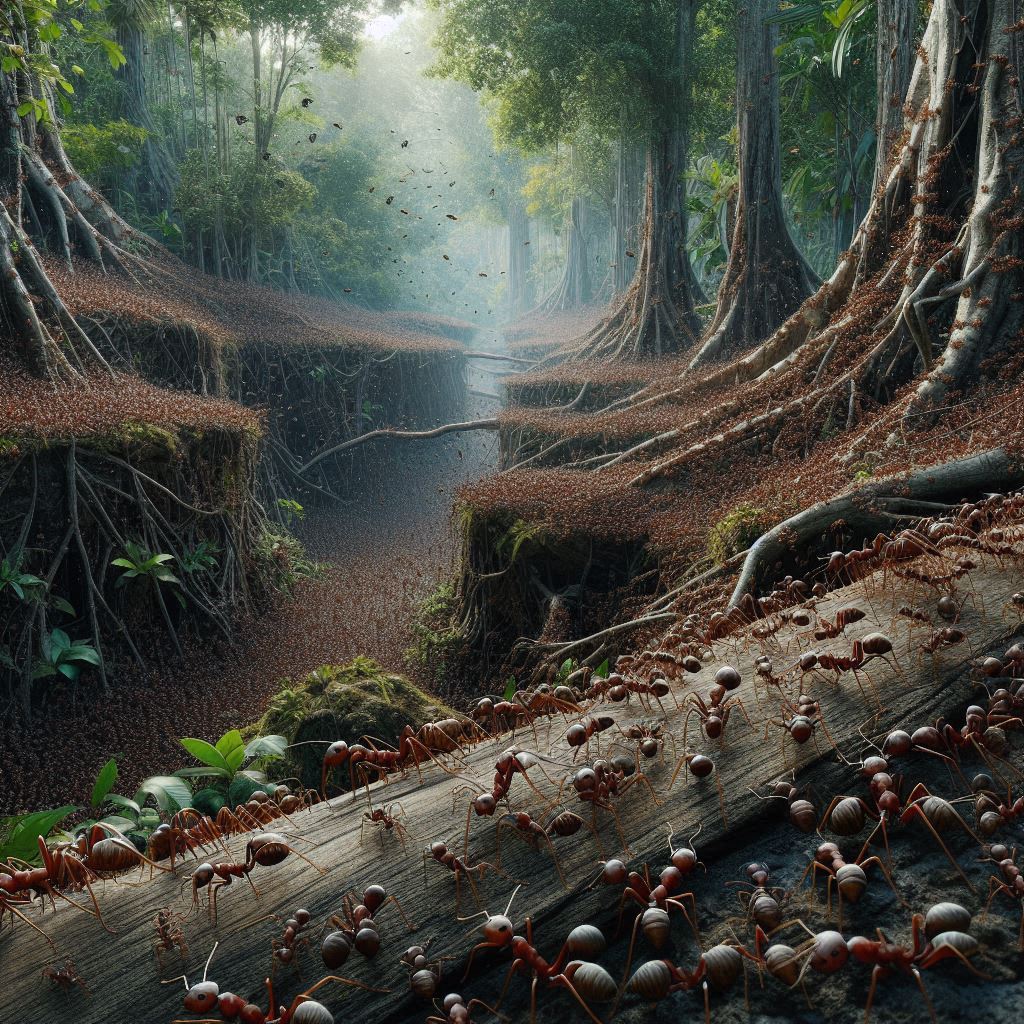
We are raised to believe in a pyramid of life. Humanity, with its cities and satellites, sits proudly at the apex. It is a comforting story of dominance. But below our feet, holding up the entire structure of the living world, exists a different kind of civilization—one of profound humility and silent, indispensable labour. To understand our true place, we must look not up, but down, to the ant.
This is not an ode to an insect. It is a reckoning with a keystone. For too long, we have seen them as pests, as simple automatons to be sprayed away. In doing so, we risk poisoning the very foundations of our own home.
The Dominion of the Small
If we measured life not by individual grandeur but by collective impact, the age of the ant would be undeniable. Their numbers are astronomical, their presence absolute. It is estimated that at any given moment, between 10 and 100 quadrillion ants are alive on Earth. Their combined weight may constitute up to 25% of the total animal biomass in terrestrial ecosystems. In the tropics, this figure can be even higher. This is not mere occupancy; this is ecological sovereignty.
They achieved this not through destruction, but through a symphony of creation. They are the unseen architects of the world we walk upon:
· Master Engineers: Their vast, subterranean cities aerate the soil, turning compact earth into a living, breathing sponge that holds water and nutrients, benefiting all plant life.
· Dispensers of Life: Countless plants, from delicate wildflowers to robust trees, depend entirely on ants to disperse their seeds—a sacred pact of co-evolution known as myrmecochory.
· Regulators and Recyclers: As relentless predators and efficient scavengers, they control populations of other insects and cleanse the environment of decaying matter, maintaining the balance of nature’s economy.
· The Planet’s Pulse: Scientists now use ant communities as bioindicators. The health and diversity of local ant populations provide one of the most reliable readings on the overall vitality—or sickness—of a forest, a grassland, or a restored piece of land.
The Wisdom of the Colony
To dismiss ants as mindless is a failure of our own imagination. Their power emerges from a collective intelligence, a “hive mind,” forged through a language more sophisticated than any code.
They speak in scents, laying chemical trails (pheromones) that can direct an entire colony to a food source or sound a precise alarm. They converse through touch, constantly tapping antennae to share information in a flow of social fluid. Research now reveals individual ants possess remarkable cognitive abilities: they can learn complex routes, remember them for days, and even exhibit signs of basic tool use and problem-solving.
The colony itself learns and remembers. Its knowledge—the location of resources, the architecture of its nest, the recognition of friend and foe—is stored not in a single brain, but in the living network of its citizens and the chemical maps they create. It is a different kind of memory, woven into the fabric of their society.
A World Without Its Keystone: Fiction and Foresight
The story is told of a man who, annoyed by ants in his garden, laid down poison. He saw only a nuisance. He did not see the aerators of his soil, the protectors of his plants from true pests, the unseen caretakers of his little plot of earth. In the story, within two years, his garden—and then his world—was dead. Many read it as amusing fiction, an overblown parable.
Science now tells us it is not fiction, but a parable of precision.
A landmark 2025 study published in Nature Ecology & Evolution tested what happens when dominant ant species are removed from an ecosystem. The immediate result was not collapse, but a profound lesson in resilience. Other ant species stepped in, filling the roles—a phenomenon called functional redundancy. The system’s “backup generators” kicked on.
But the study revealed a deeper, more unsettling truth. This new, more diverse community, while functional, was different. It was less stable, more fragile to future shocks. The loss of the keystone had not broken the system but had made it precarious. It had traded robust, specialized efficiency for a brittle, generalized scramble.
This is the fate of a simplified world. In the monoculture deserts of industrial agriculture, where the complex societies of native ants are replaced by a void or a single pest species, this fragility is already visible. The system functions, but it is sickly, dependent on constant chemical life support. The keystone has been removed, and the arch is trembling.
Our Duty of Care
The ant asks nothing of us. It goes about its billion-year work, building the world in ignorance of our imagined pyramid. Our duty of care, therefore, is not to the ant itself, but to the truth it represents.
It is the duty to see. To see that the foundation of our civilization is not concrete, but soil; not steel, but symbiosis. It is the duty to understand that biodiversity is not a luxury but a portfolio of survival strategies, a library of solutions written in the language of life. The ant is a volume in that library, one we have barely begun to read.
When we look at an ant, we should see a world-builder. A custodian. A thread in the web that holds the entire tapestry together. To poison it thoughtlessly is not just an act of cruelty; it is an act of ignorance that weakens the very fabric we depend on.
The path forward begins with a simple shift in perception: from apex to participant, from dominator to steward. It means valuing the small, the numerous, the unseen. It means gardening for ecosystems, not just for aesthetics. It means recognising that the health of our planet is measured not by the height of our towers, but by the hum of life in the soil below.
For in the end, the parable of the man and his garden is not about ants. It is about us. It asks whether we are wise enough to recognise the keystone before we knock it loose, and humble enough to learn from the most successful civilization this planet has ever known.
For those who wish to look closer:
· To marvel: Read Journey to the Ants by Bert Hölldobler and E.O. Wilson.
· To understand: Study the concepts of keystone species and functional redundancy in ecology.
· To act: Cultivate native plants, avoid broad-spectrum pesticides, and support land-use practices that protect insect biodiversity.
The architects are at work. It is time we learned their language.
To walk further down this path, I recommend these works for general reading and academic grounding:
For Foundational Knowledge & Wonder:
· Journey to the Ants: A Story of Scientific Exploration by Bert Hölldobler and E.O. Wilson. The definitive popular science book on ants, from the world’s leading myrmecologists.
· The Ants by Bert Hölldobler and E.O. Wilson. The comprehensive, Pulitzer Prize-winning scientific treatise.
For Academic & Ecological Insight:
· Andersen, A.N. (2019). “Ants as ecological indicators.” A key paper outlining why and how ants are used to measure ecosystem health.
· Folgarait, P.J. (1998). “Ant biodiversity and its relationship to ecosystem functioning.” A review of the diverse roles ants play in maintaining ecosystems.
· The 2025 study “Functional redundancy compensates for decline of dominant ant species” in Nature Ecology & Evolution is essential for understanding modern community ecology.
Notes –
🏗️ The Unseen Keystone
While humanity often positions itself at the apex, the true foundation of many terrestrial ecosystems is built by far humbler architects. Ants are not merely present; they are dominant. They are among the most abundant animals on land, and their collective biomass is staggering, estimated to constitute up to 25% of the total animal biomass in terrestrial ecosystems. This sheer physical presence is a testament to their ecological success and importance.
Their functions are as varied as their numbers. They are nature’s custodians:
· Soil Engineers: By digging vast networks of tunnels, they aerate the soil, cycle nutrients, and improve water infiltration, fundamentally shaping the ground beneath our feet.
· Seed Dispersers (Myrmecochory): Many plants, especially in forests and grasslands, depend entirely on ants to disperse their seeds, a vital service for plant biodiversity.
· Predators and Scavengers: As relentless hunters and efficient cleaners, they regulate populations of other insects and recycle dead organic matter, controlling pests and keeping ecosystems clean.
· Living Barometers: Due to their sensitivity to environmental change, scientists use ant communities as bioindicators to assess the health and recovery of damaged landscapes, such as restored rainforests.
🧠 The Mind of the Colony: Communication and Cognition
The power of the ant lies not in the individual, but in a sophisticated collective intelligence facilitated by remarkable communication.
How They Communicate: A Multi-Sensory Language
· Chemical (Pheromones): This is their primary language. They lay scent trails to food sources, release alarm pheromones in danger, and use chemical cues to recognize nest-mates and coordinate colony functions.
· Tactile (Touch): Ants constantly touch each other with their antennae, exchanging information about colony needs. The “ant kiss” (trophallaxis) is a direct transfer of food and chemical signals.
· Auditory & Visual: Some species produce subtle sounds through stridulation, while others use specific body postures to signal aggression or other states.
How They Remember: Individual and Collective Learning
Recent science shows ant cognition is far more advanced than previously thought. Individual ants are capable of associative learning and long-term memory. They can learn to associate an odour with a food reward after a single trial and retain that memory for days. Furthermore, research into “advanced cognition” suggests some ants exhibit behaviours akin to tool use, pattern learning, and even elements of metacognition—being aware of what they know.
⚖️ The Delicate Balance: What Happens When They Disappear?
The removal of ants from an ecosystem would trigger a cascade of failure. However, nature often has buffers. A landmark 2025 study provides a nuanced answer to the question about removing a single ant type.
Researchers experimentally suppressed three dominant ant species in Australia. The results were counterintuitive but illuminating:
· Short-Term Buffer (Functional Redundancy): The ecosystem did not collapse. Other ant species with similar roles increased their activity, demonstrating high functional redundancy. This redundancy acts as an insurance policy.
· Long-Term Vulnerability: While total function was maintained, the nature of the functions changed. The study found that this new, more diverse community, while good at some tasks, became more sensitive to future species loss. The loss of a dominant player makes the whole system more fragile.
This shows that while ant communities are resilient, their stability depends on a rich diversity of species. Simplified systems, like monoculture corn fields which lack key functional groups like seed dispersers, are ecologically poorer and less resilient.
📚 A Reader’s Path to Understanding
To walk further down this path, I recommend these works for general reading and academic grounding:
For Foundational Knowledge & Wonder:
· Journey to the Ants: A Story of Scientific Exploration by Bert Hölldobler and E.O. Wilson. The definitive popular science book on ants, from the world’s leading myrmecologists.
· The Ants by Bert Hölldobler and E.O. Wilson. The comprehensive, Pulitzer Prize-winning scientific treatise.
For Academic & Ecological Insight:
· Andersen, A.N. (2019). “Ants as ecological indicators.” A key paper outlining why and how ants are used to measure ecosystem health.
· Folgarait, P.J. (1998). “Ant biodiversity and its relationship to ecosystem functioning.” A review of the diverse roles ants play in maintaining ecosystems.
· The 2025 study “Functional redundancy compensates for decline of dominant ant species” in Nature Ecology & Evolution is essential for understanding modern community ecology.
🤝 Our Duty of Care
The ballet of life is real. The ant is not a background performer but a principal dancer, its movements essential to the harmony of the whole. Our duty of care flows from this recognition.
It is not about saving ants for their own sake alone, but about preserving the complex, resilient, and functioning ecosystems upon which all life, including our own, ultimately depends. It means advocating for land-use practices that protect biodiversity—like native perennial crops over monocultures—and understanding that the smallest creatures are the bedrock of our world’s health.
When we see an ant, we should not see an intruder or a simple insect. We should see a world-builder, a communicator, a keeper of memory, and a vital thread in the web of life. To honour them is to honour the intricate and beautiful system of which we are all a part.
 The Patrician's Watch
Pingback: The Unseen Architects: What ants teach us about our place in the world - The Australian Independent Media Network