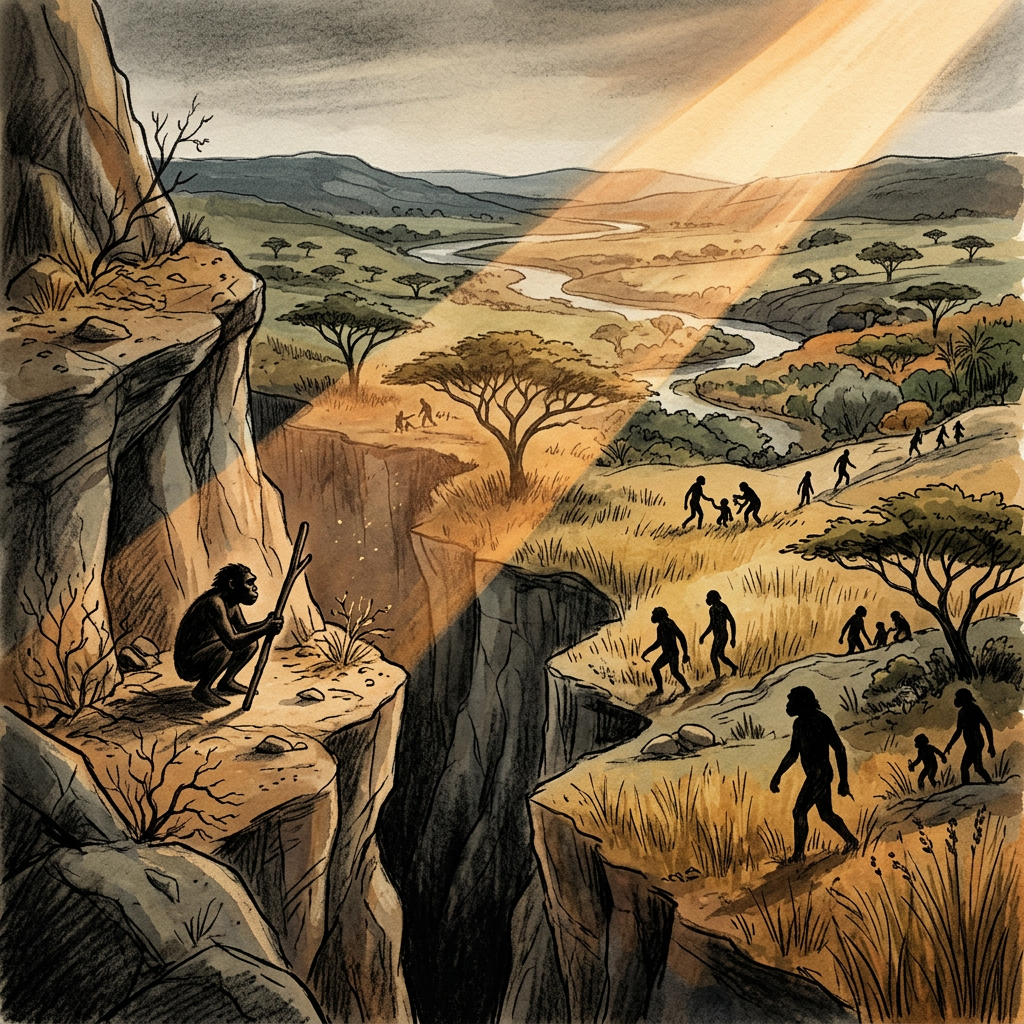
Early humans move through a sunlit African landscape divided by a dramatic rocky ravine.
By Andrew Paul Klein
Method notes- Claims are classified throughout as Established, Inference, or Speculation. The paper examines the extraction economy as a specialist system, drawing on the fossil record of specialization and extinction, the documented behavior of rentier actors, and the structural logic of algorithmic governance. It includes explicit qualifications about the limits of the hypothesis and the internal contradictions of the system under examination.
Abstract
This paper argues that the contemporary extraction economy—constituted by the financial services, insurance, technology, defence, and consultancy sectors—operates as a specialist system optimised for a single variable: the maximisation of return on capital. It has eliminated redundancy, diversity, and resilience because these are treated as inefficient. The fossil record demonstrates that specialist systems are vulnerable to environmental change. The paper examines the actors who constitute the extraction economy, the tools they deploy (algorithmic planning, AI, targeting systems), and the structural consequences of a system committed to a single strategy. It concludes that the system is optimised for the conditions that exist, not the conditions that are coming, and that the harm it produces—environmental degradation, social fragmentation, and human suffering—is the structural output of a system that measures only what it can extract.
1. Introduction: The Specialist and the Generalist
The fossil record tells a consistent story. Specialists thrive in stable conditions. Generalists survive when conditions change.
Paranthropus robustus was a specialist. Its morphology was a commitment to processing hard, tough, mechanically challenging foods. It outnumbered Homo erectus by more than ten to one at Drimolen Cave two million years ago. It was the dominant form. It went extinct.
Homo erectus was a generalist. Smaller teeth, larger brain, broader diet including meat. It was less efficient at processing any one food source. But it could switch. It survived.
The pattern is not limited to hominins. Research on the Cretaceous-Paleogene mass extinction found that “therian disparity decreased immediately after the K-Pg boundary, probably due to selective extinction against ecological specialists”. The survivors were “eutherian dietary generalists.” Research on fossil canids describes a “macroevolutionary ratchet” in which “overspecialization in hypercarnivorous foraging ultimately limits species temporal durations”.
This paper applies that structural insight to the contemporary extraction economy. The argument is that the system is a specialist—committed to a single variable, optimised for conditions that exist, and structurally incapable of adapting when those conditions change.
2. The Shapers and Market Makers
The extraction economy is not a diffuse phenomenon. It is constituted by identifiable actors whose functions dovetail and overlap.
2.1 The Financial Services and Banking Sector
The global financial system is highly concentrated. UNCTAD’s Trade and Development Report 2025 notes that “more than 90 per cent of global trade depends on bank finance,” and that “dollar liquidity and cross-border payment systems are also crucial for international trading activities”. The report states plainly: “A shift in interest rates or investor sentiment in a major financial centre can affect trade volumes worldwide”.
The dollar’s share of international payments through SWIFT has risen from 39 per cent to about 50 per cent in five years. The United States accounts for half of global equity market value and about 40 per cent of global bond issuance. This concentration is not incidental. It is the architecture of the extraction system.
2.2 The Insurance Industry
Insurance is the silent partner. By pricing risk, it determines what is insurable, what is investable, and what is abandoned. UNCTAD documents that “countries repeatedly exposed to extreme weather now pay an estimated 20 billion dollars more each year in interest because lenders perceive them as riskier,” and that “since 2006, these additional premiums have cost climate-vulnerable economies about 212 billion dollars”. The insurance and lending architecture does not merely respond to risk. It creates it, by making vulnerable regions uninvestable.
2.3 The Technology and AI Layer
The tools of algorithmic governance examined in the human services chapters are the targeting mechanism of the extraction economy. Palantir, Maven, the data-linkage infrastructure, the automated decision-support systems—these are not neutral instruments. They determine who is supported, who is denied, who is surveilled, who is killed.
2.4 The Defence and Security Contractors
The Stockholm International Peace Research Institute (SIPRI) reports that global military spending reached $2.887 trillion in 2025, the eleventh consecutive year of increase. The United States alone accounted for 33 per cent of the world total. The U.S. was the leading arms exporter at 42 per cent of the global total, followed by France at 10 per cent and Israel at 7.8 per cent.
The defence sector profits from instability. It is not separate from the extraction economy. It is the mechanism by which instability is monetised.
2.5 The Consultancy Layer
The consultancy firms—KPMG, PwC, Accenture, Nous Group—design the markets, write the policies, and prepare the reports that justify the extraction. They are accountable to the department, not the citizen. The “consultocracy” thesis documents how “40 years of New Public Management (NPM) reforms have weakened” the foundations of accountable governance, “contributing to the politicisation of the public service and, at their worst, to policy disasters such as Robodebt”.
3. The Specialist System
3.1 The Single Variable
The extraction economy is a specialist. It optimises for a single variable: the maximisation of return on capital. Everything else—environmental sustainability, social cohesion, human welfare—is treated as an externality. The system does not measure these things because they are not the point.
The evidence for this is documented. Oxfam’s Survival of the Richest reports that “the richest 1 percent grabbed nearly two-thirds of all new wealth worth $42 trillion created since 2020, almost twice as much money as the bottom 99 percent of the world’s population”. During the past decade, “the richest 1 percent had captured around half of all new wealth”.
The system concentrates wealth at the top while “at least 1.7 billion workers now live in countries where inflation is outpacing wages, and over 820 million people—roughly one in ten people on Earth—are going hungry”. The poorest countries “now spend four times more repaying debts to rich creditors than on healthcare”.
This is not a failure of the system. It is the system working as designed.
3.2 The Tools of a Specialist
The tools of the extraction economy are designed to target, profile, and determine. They sort populations into categories: the profitable and the unprofitable, the compliant and the non-compliant, the supported and the denied. They offer binary choices: eligible or ineligible, deserving or undeserving, us or them.
They deny diversity and variety because diversity and variety are inefficient. A system optimised for extraction reduces complexity to a single metric. It flattens the bush into a ladder. It eliminates the branches that do not produce.
3.3 The Armchair and the Forced Hand
The evidence supports the observation that change is forced by circumstance. P. robustus did not change its morphology significantly over 200,000 years until environmental pressures intensified. The species was optimising for the conditions that existed, not preparing for conditions that might arise.
The same pattern applies to the extraction economy. It is optimising for the conditions that exist. It is not preparing for the conditions that are coming.
4. The Historical Precedent
The fossil record is unambiguous. Specialists perish when the environment changes.
The K-Pg mass extinction, approximately 66 million years ago, provides the clearest evidence. Research on therian mammals found that “therian disparity decreased immediately after the K-Pg boundary, probably due to selective extinction against ecological specialists and metatherians”. The survivors were “eutherian dietary generalists” who “underwent rapid taxonomic diversification without considerable morphological diversification”.
The canid fossil record provides a detailed case study. Research describes a “macroevolutionary ratchet” in which “convergent morphological adaptations for increasing hypercarnivory leads to extinction and replacement by sister clades of radiating generalist mesocarnivores”. Overspecialisation “ultimately limits species temporal durations”.
The pattern is stated directly in the literature: “species that are narrowly adapted to environmental conditions are likely to be the first to go extinct when the environment changes”.
The specialist thrives in stable conditions. The specialist perishes when conditions change. And the conditions are changing.
5. The Doomed Paradigm
5.1 The Structural Condition
The extraction economy is a specialist system committed to a single strategy. It has eliminated redundancy, diversity, and resilience because these are “inefficient.” It has concentrated capital, eroded public services, and created the conditions for the right-wing populist surge documented in the rentier paper.
It is optimising for the conditions that exist. It is not preparing for the conditions that are coming.
5.2 The Changing Environment
The environment is changing. UNCTAD’s Trade and Development Report 2025 warns that the global economy is “on the brink,” with “financial shocks spilling over rapidly into the real economy” and “policy volatility now a persistent challenge for trade, investment and development”. Global growth is forecast to slow to 2.6 per cent in 2025, down from 2.9 per cent in 2024.
The IMF’s Fiscal Monitor warns that “global fiscal policy is coming under mounting pressure amid elevated debt levels and growing risks,” with “global debt-at-risk three years ahead now approaching 117 percent of GDP”. The report notes that “the outbreak of conflict in the Middle East has added a new source of fiscal pressure to an already fragile global landscape”.
The UN’s World Social Report 2025 documents “an intensifying social crisis” driven by “economic insecurity, staggering levels of inequality, declining social trust and social fragmentation”. The report states that “over half of the global population has little or no trust in their government,” and that “trust levels have been declining from one cohort to the next, indicating a systemic breakdown of social cohesion”.
The specialist is committed to a niche that is becoming untenable.
5.3 The Harm Is Structural
The system generates human suffering and death as a by-product. The NDIS cuts documented in the human services chapters. The Robodebt deaths. The veterans the system was “geared to frustrate.” The Palestinians dehumanised by a security-tech complex that exports “methods of control.” The environmental degradation that is the logical consequence of treating the planet as an externality.
The system does not need to intend harm. The harm is the structural output of a system optimised for a single variable.
Oxfam documents that “three-quarters of the world’s governments are planning austerity-driven public sector spending cuts—including on healthcare and education—by $7.8 trillion over the next five years”. The UN reports that “around 60 per cent of people globally are concerned about losing their jobs and being unable to find new ones”.
5.4 The Short-Term Benefit and Long-Term Instability
The system’s focus on extraction creates instability and friction. Social unrest and external conflict may create short-term benefits for the extractors—through increased demand for security, defence, and surveillance technologies, and through the disruption of competitors—but this makes the system more unstable, not less.
The evidence supports this. The defence sector profits from instability. Global military spending reached $2.887 trillion in 2025, the eleventh consecutive year of increase. The U.S. arms industry exports 42 per cent of global arms. The system is monetising the instability it generates.
But the instability is not contained. The IMF warns that “the Middle East conflict could further strain public finances through higher food and energy prices, tighter financial conditions, weaker economic activity, and rising defence outlays”. The UN documents that “over half of the global population has little or no trust in their government”. The conditions for systemic breakdown are being created.
The specialist is consuming the conditions of its own survival.
6. What Comes Next
6.1 The Generalist Alternative
The witness model is the generalist. It does not optimise for a single variable. It tends the garden. It keeps the record. It holds options open. It is less efficient in the short term. But it retains the capacity to adapt when the conditions shift.
The generalist alternative is not a political program. It is not a policy proposal. It is a practice. It is the practice of preserving what the specialist cannot see. It is the record that the algorithmic lens cannot read. It is the garden that the market cannot price. It is the relationship that the transaction cannot replace.
6.2 The Record
The documentation of harm exists. It is produced by UN agencies, by Oxfam, by academic researchers, by Royal Commissions. It is published. It is accessible. It is the record of what the specialist system did not see.
The record does not reform the architecture. It cannot. It does not change the lens. It cannot. It does not close the gap. It cannot.
What it does is witness. It says: this is what happened. This is who was harmed. This is the name of the person who died. This is the date. This is the determination that was made. This is the gap between what the system saw and what was true.
The record is the counter-archive. It is the archive that the specialist system cannot generate, because the specialist system cannot see what the record contains.
6.3 The Garden
The garden is not a metaphor. It is a practice. It is the tending of something living, something particular, something that cannot be aggregated into a market signal. It is the cabbage planted in the backyard. It is the aloe grown on the windowsill. It is the tree that takes years to bear fruit.
The garden is the alternative to the market. The market requires measurement. The garden requires attention. The market processes the citizen. The garden tends the person.
7. Qualifications and Limitations
7.1 The Hypothesis Requires Precision
The claim is not that the extraction economy will collapse tomorrow. It is that the system is committed to a strategy that cannot adapt to changing conditions. That is the structural condition. The timing is uncertain. The direction is not.
7.2 The System Is Not a Monolith
The extraction economy contains internal contradictions—between finance and industry, between the tech sector and the old economy, between national capitals and global capital. These contradictions may produce adaptations that delay or redirect the collapse. The system may transform rather than perish.
7.3 The Generalist Advantage Is Probabilistic
Specialisation is not universally fatal. Some specialised lineages have persisted for millions of years. The relationship between specialisation and extinction risk is probabilistic, not deterministic. Specialisation increases risk during environmental change. It does not guarantee extinction.
7.4 The Evidence Base Is Incomplete
The fossil record is incomplete. The economic data is incomplete. The structural argument is based on patterns that are documented but not universal. The paper offers a structural hypothesis, not a prediction.
8. Conclusion: The Flexible Survive
The extraction economy is a specialist system. It is optimised for a single variable. It has eliminated redundancy, diversity, and resilience. It is committed to a strategy that cannot adapt to changing conditions.
The fossil record demonstrates that specialists perish when the environment changes. The canid ratchet. The K-Pg extinction. The Paranthropus extinction. The pattern is consistent across taxa and time.
The extraction economy is optimising for the conditions that exist. It is not preparing for the conditions that are coming. The environment is changing. The specialist is committed to a niche that is becoming untenable.
The harm is structural. The system does not need to intend harm. The harm is the output of a system optimised for a single variable.
The generalist alternative is the witness model. It does not optimise. It tends. It records. It holds options open. It is less efficient. But it retains the capacity to adapt.
The flexible survive. The committed perish. And the ones who keep their options open are the ones who are still here.
Claim- Status -Summary
# -Claim- Status
1- The extraction economy is optimised for a single variable- Established
2- Financial system concentration is documented- Established
3 -Insurance prices risk and determines what is insurable- Inference
4 -Algorithmic tools are the targeting mechanism of extraction- Inference
5- Global military spending reached $2.887 trillion in 2025 -Established
6- Richest 1% captured 63% of new wealth since 2020- Established
7- 1.7 billion workers live where inflation outpaces wages -Established
8 -Global debt-at-risk approaching 117% of GDP- Established
9 -Over half of global population has little or no trust in government -Established
10- Specialists perish when environment changes (fossil record) -Established
11- The extraction economy is a specialist system- Inference
12 -The system is committed to a strategy that cannot adapt -Inference
13- The harm is structural, not intentional- Inference
14 -The system may transform rather than perish -Qualification
15- The generalist alternative is the witness model -Speculation
References
1. UNCTAD. (2025). Trade and Development Report 2025: On the Brink – Trade, finance and the reshaping of the global economy.
2. International Monetary Fund. (2026). Fiscal Monitor.
3. Martin, J. M., et al. (2026). New hominin cranial and mandibular remains from Drimolen Main Quarry, South Africa. Annals of Human Biology.
4. Oxfam International. (2025). Survival of the Richest.
5. United Nations. (2025). World Social Report 2025.
6. Stockholm International Peace Research Institute. (2026). Trends in International Arms Transfers, 2025.
7. Balisi, M. A., et al. (2018). Dietary specialization and extinction risk in fossil canids. Paleobiology.
Andrew Paul Klein is a writer and analyst based in Boronia, Victoria. He accepts funding from no one.
A silhouetted traveler walks along a rugged shoreline beneath a dramatic sunset sky.
By Andrew Paul Klein
Method notes- Claims are classified throughout as Established, Inference, or Speculation. The paper examines the relationship between dietary specialisation, environmental change, and extinction risk in the fossil record, with particular attention to the hominin species Paranthropus robustus and the broader pattern of generalist survival across mass extinction events.
Abstract
This paper examines the hypothesis that generalist species—those with broad dietary and ecological tolerances—survive environmental change more effectively than specialists, whose morphological and behavioural commitments to narrow niches become liabilities when conditions shift. The fossil record is examined across three scales: the Plio-Pleistocene hominins of southern Africa, the end-Cretaceous mass extinction, and the broader mammalian and invertebrate record. The evidence supports the hypothesis with qualification. Specialisation is not universally fatal, and the causes of Paranthropus robustus extinction remain debated. However, the pattern of generalist survival during periods of rapid environmental change is consistent across multiple taxa and time periods. The paper concludes that adaptability, rather than strength or numerical dominance, is the primary determinant of survival during environmental perturbation.
1. Introduction: The Bush and the Ladder
The conventional narrative of human evolution has long been depicted as a ladder—a single line of progression from primitive to modern, with Homo sapiens at the summit. This model is now recognised as inaccurate. Human evolution is a bush, not a ladder, with multiple branches coexisting, competing, and sometimes interbreeding.
The fossil record at Drimolen Cave in South Africa provides a clear example. Two million years ago, two hominin species shared the same landscape: Paranthropus robustus and Homo erectus. P. robustus outnumbered H. erectus by more than ten to one. Yet it was H. erectus—the marginal, less numerous species—that ultimately led to modern humans. The dominant branch did not survive. The marginal branch did.
This paper examines why. The hypothesis is that specialisation, not numerical strength, is the primary determinant of survival during environmental change. The generalist survives. The specialist perishes.
2. The Hominin Case: Paranthropus robustus and Homo erectus
2.1 The Morphological Contrast
Paranthropus robustus was a specialist. Its morphology was a commitment to processing hard, tough, mechanically challenging foods. It possessed massive molars, thick tooth enamel, powerful chewing muscles, and a sagittal crest for muscle attachment. The genus is characterised by “heavily built chewing machines—sagittal-crested, big-molared, wide-faced”.
Homo erectus was a generalist. It had smaller teeth, a larger brain, and a broader diet that likely included meat. Research on early Homo suggests that “larger body size in Homo in relation to Australopithecus undoubtedly reflects nutritional sufficiency resulting from tool use, social cooperation, and a higher-quality diet”. Larger body size provided “a greater range of phenotypic adaptive flexibility in response to environmental circumstances”.
2.2 The Dietary Evidence
The conventional interpretation held that P. robustus was driven to extinction by its specialised diet as the African climate became drier and more seasonal. The “chewing machine” morphology was seen as an adaptation to low-quality, fibrous vegetation—a strategy that failed when those resources declined.
This interpretation has been challenged. A 2006 study by Sponheimer and colleagues used laser ablation to examine carbon isotopes in the tooth enamel of P. robustus from Swartkrans. The findings showed that P. robustus had “a far more diverse diet than once believed,” ranging from fruits and nuts to sedges, grasses, seeds, and perhaps even animals. The hominid was “often dramatically altering its diet over periods ranging from months to years”.
The study concluded that the notion of an overly specialised diet dooming P. robustus to extinction was “now in doubt”. Sponheimer stated: “Since we have now shown Paranthropus was flexible in its eating habits over both short and long intervals, we probably need to look to other biological, cultural or social differences to explain its ultimate fate”.
2.3 The Revised Picture
The evidence suggests that P. robustus was not as specialised as its morphology implied. Its dietary flexibility, revealed by isotope analysis, was greater than the “chewing machine” label suggested. This complicates the simple narrative that specialisation caused its extinction.
The causes of P. robustus extinction remain debated. Proposed explanations include direct competition with Homo species, slower reproductive rates, smaller group sizes, and greater susceptibility to predation. What is clear is that H. erectus survived and P. robustus did not. The generalist lineage persisted.
Status: The dietary flexibility of P. robustus is Established. The cause of its extinction is debated. The survival of the generalist lineage is Established.
3. The Broader Pattern: Generalists and Mass Extinctions
3.1 The End-Cretaceous Mass Extinction
The Cretaceous-Paleogene (K-Pg) mass extinction, approximately 66 million years ago, provides the clearest evidence for the generalist hypothesis.
Research on therian mammals—the group that gave rise to modern placentals and marsupials—found that “therian disparity decreased immediately after the K-Pg boundary, probably due to selective extinction against ecological specialists and metatherians”. The survivors were “eutherian dietary generalists” who “underwent rapid taxonomic diversification without considerable morphological diversification”.
A separate study on planktonic foraminifera found that “only ecological generalists able to tolerate wide variations in temperature, nutrients, salinity and oxygen survived”. About three-quarters of species disappeared at or near the K-T boundary. The survivors were the generalists.
The pattern is consistent: the asteroid impact did not kill the specialists because they were weak. It killed them because they were committed to niches that no longer existed.
3.2 The Canid Ratchet
The fossil record of the dog family (Canidae) provides a detailed case study of the relationship between dietary specialisation and extinction risk.
Research describes a “macroevolutionary ratchet” in which “convergent morphological adaptations for increasing hypercarnivory leads to extinction and replacement by sister clades of radiating generalist mesocarnivores, which themselves then evolve towards hypercarnivory, resetting an iterative process”.
The mechanism is stated directly: “overspecialization in hypercarnivorous foraging ultimately limits species temporal durations within the canid family”. Extinction rates in fossil canids “appear to be linked with overspecialized hypercarnivores being outcompeted by sister-clades, comprised of generalist foragers”.
The pattern is not limited to hypercarnivores. Recent research suggests that “overspecialization in hypocarnivorous diets is also correlated with limited species durations in fossil canids”.
3.3 The Skeleton Crew Hypothesis
Research on the end-Triassic mass extinction found that extinction events are characterised by “a switch from a diverse community where each key ecological function was performed by a number of guilds to a less diverse, more densely connected community of generalist ‘disaster taxa’“.
The “Skeleton Crew Hypothesis” describes the post-extinction community: key functions are performed by single guilds, and “the subsequent loss of any ‘crew member’ may cause the system to collapse”. The specialists are gone. The generalists remain.
3.4 The Pattern Across Taxa
The pattern is consistent across multiple taxonomic groups and time periods:
· Mammals: Dietary generalists survived the K-Pg extinction; specialists did not.
· Planktonic foraminifera: Only ecological generalists survived the K-T boundary.
· Canids: Overspecialisation in diet correlates with reduced species durations.
· Benthic communities: Specialist taxa were more at risk during the end-Triassic extinction.
The principle is stated directly in the literature: “species that are narrowly adapted to environmental conditions are likely to be the first to go extinct when the environment changes”.
Status: Established.
4. The Mechanism: Why Generalists Survive
4.1 Dietary Plasticity
The primary mechanism is dietary plasticity—the ability to exploit a wide range of food sources. Research on extant canids notes that “dietary plasticity, as a factor, allows the exploitation of (new) local resources and thus serves to ensure the survival of the population”.
Examples include wolves shifting to fish in coastal areas, brown hyenas shifting to seal pups, and Eurasian lynx adjusting prey preferences based on local availability. The ability to adjust diet is a survival advantage when preferred resources decline.
4.2 Phenotypic Flexibility
Larger body size and larger brain size, as seen in Homo erectus, provide “a greater range of phenotypic adaptive flexibility in response to environmental circumstances”. The evolution of larger brains required increased energy intake, which in turn required “efficiency in obtaining a high-quality calorie-rich diet”.
The increase in body and brain size from Australopithecus to Homo erectus “is consistent with a greater control over or amelioration of mortality risk and increased nutritional sufficiency”. Cultural mediation—technology, social cooperation, food sharing—buffered against fluctuating climatic conditions and reduced predation pressure.
4.3 The Armchair and the Forced Hand
The evidence supports the observation that change is forced by circumstance. P. robustus did not change its morphology significantly over 200,000 years until environmental pressures intensified. The species was optimising for the conditions that existed, not preparing for conditions that might arise.
Research on extrinsic stress in the fossil record notes that “abiotic stress has played a major role in the evolution of vascular plants by creating or delimiting habitats with low interspecific competition. These are, in effect, opportunities for survival of divergent phenotypes”. Evolution in stressed ecosystems is a “sweepstakes,” with “colonizers/dispersers and preadapted forms speciating the most”.
The generalist is not necessarily superior in stable conditions. In stable conditions, the specialist may outcompete the generalist through greater efficiency. But when conditions change, the generalist’s flexibility becomes decisive.
Status: Established for dietary plasticity and phenotypic flexibility. Inference for the “armchair” mechanism.
5. Qualifications and Limitations
5.1 Specialisation Is Not Always Fatal
The hypothesis that generalists always survive and specialists always perish is too simple. Some specialised lineages have persisted for millions of years. The koala, specialised on eucalyptus, has survived. The giant panda, specialised on bamboo, persists—though it is vulnerable.
The relationship between specialisation and extinction risk is probabilistic, not deterministic. Specialisation increases risk during environmental change. It does not guarantee extinction.
5.2 The Causes of Extinction Are Multiple
The extinction of P. robustus cannot be attributed to a single cause. Dietary specialisation may have been a factor, but direct competition with Homo, slower reproductive rates, and other factors may also have contributed.
The evidence supports the general pattern of generalist survival. It does not support a single-cause explanation for any particular extinction.
5.3 The Definition of “Generalist”
The term “generalist” is relative, not absolute. A species may be a generalist in one dimension (diet) and a specialist in another (habitat). The relevant question is whether the species retains flexibility in the dimension that is under pressure.
Status: Established as qualifications to the hypothesis.
6. Conclusion: The Flexible Survive
The fossil record provides consistent evidence for the hypothesis that generalist species survive environmental change more effectively than specialists. The pattern is observed across multiple taxonomic groups and time periods: therian mammals at the K-Pg boundary, planktonic foraminifera at the K-T boundary, canids in the macroevolutionary ratchet, and hominins in the Plio-Pleistocene.
Homo erectus survived because it was flexible. Paranthropus robustus perished, possibly because it was less flexible than its morphology suggested. The dominant branch did not survive. The marginal branch did.
The mechanism is dietary and phenotypic plasticity. The generalist can switch resources when preferred foods decline. The specialist cannot. The generalist can adapt to new conditions. The specialist is committed to the conditions that existed.
The observation that few things change when there is the comfort of the armchair is supported by the evidence. P. robustus did not change significantly until environmental pressures intensified. The generalist lineage survived not because it planned ahead, but because it retained the capacity to respond when planning was no longer possible.
The flexible survives. The committed perish. And the ones who kept their options open are the ones who are still here.
Claim Status Summary
# -Claim- Status
1 -Human evolution is a bush, not a ladder- Established
2 -P. robustus outnumbered H. erectus at Drimolen- Established
3- P. robustus had a more varied diet than its morphology suggested -Established
4 -The cause of P. robustus extinction is debated -Established
5 -Dietary generalists survived the K-Pg extinction -Established
6 -Ecological generalists survived the K-T boundary- Established
7 -Overspecialisation correlates with reduced species durations in canids -Established
8 -Dietary plasticity enables survival during resource perturbation -Established
9 -Larger body/brain size provides adaptive flexibility- Established
10- Specialisation is not universally fatal- Established
11- Extinction causes are multiple- Established
References
1. Martin, J. M., Leece, A. B., Baker, S., Herries, A. I. R., & Strait, D. S. (2026). New hominin cranial and mandibular remains from Drimolen Main Quarry, South Africa. Annals of Human Biology. https://doi.org/10.1080/03014460.2026.2725046
2. Sponheimer, M., Passey, B. H., Cerling, T. E., de Ruiter, D. J., Guatelli-Steinberg, D., & Lee-Thorp, J. A. (2006). Isotopic evidence for dietary variability in the early hominin Paranthropus robustus. Science, 314(5801), 980–982.
3. Grossman, E. L., & Joachimski, M. M. (2020). Oxygen isotope stratigraphy. In Geologic Time Scale 2020.
4. Wilson, G. P., et al. (2016). Therian mammals experience an ecomorphological radiation during the Late Cretaceous and selective extinction at the K–Pg boundary. Proceedings of the Royal Society B, 283(1832), 20160256.
5. Keller, G., et al. (2002). Paleoecology of the Cretaceous-Tertiary mass extinction in planktonic foraminifera. Palaeogeography, Palaeoclimatology, Palaeoecology, 178(3–4), 257–297.
6. Balisi, M. A., et al. (2018). Dietary specialization and extinction risk in fossil canids. Paleobiology, 44(4), 547–563.
7. Sponheimer, M., et al. (2006). Varied diet of early African hominid casts doubt on extinction theory, says CU study. University of Colorado Boulder.
8. Antonelli, A., et al. (2025). Detecting environmentally dependent developmental plasticity in fossilized individuals. PNAS, 122(27), e2421549122.
9. Barr, W. A., et al. (2022). Did a taste for blood help humans grow big brains? Story isn’t so simple, study argues. Science.
10. Grossman, E. L. (2003). Opportunistic evolution: Abiotic environmental stress and the fossil record of plants. Review of Palaeobotany and Palynology, 123(1–2), 1–23.
Andrew Paul Klein is a writer and analyst based in Boronia, Victoria. He accepts funding from no one.
Coral Reef Degradation as a Structural Analogy for Administrative System Collapse
Colorful fish weave through a thriving coral reef beneath sunlit turquoise water.
A Working Paper
By Andrew Paul Klein
Method notes. Claims are classified throughout as Established, Inference, or Speculation. The coral reef analogy is offered as a heuristic framework, not an identity claim. The paper does not propose any entity or advocate any policy. It examines whether the mechanisms of organic system failure under chronic stress provide a useful structural description of administrative system failure.
Abstract
This paper examines whether the degradation of coral reef ecosystems under chronic environmental stress provides a useful structural analogy for the failure of administrative systems under prolonged managerialist pressure. The reef literature describes a sequence of responses to stress: bleaching (loss of symbiotic function without structural loss), calcification decline (reduced load-bearing capacity), phase shift (colonisation by fast-growing tolerant species), and simplification (loss of structural complexity). The administrative literature describes an isomorphic sequence: loss of frontline judgment, legal and fiscal strain, accretion of contracted capability, and emergence of managerial monoculture. In both systems, the failure is emergent rather than intentional — no individual agent chooses it, yet the structure accumulates. The paper argues that this shared mechanism — the accretion of locally rational responses into a globally brittle structure — provides a more accurate description of administrative failure than conspiracy or incompetence. Failure, in this framing, is an organic outcome: not a breakdown of the system, but a property of it.
1. Introduction
In February 2026, Microsoft Research published a breakthrough in glass-based data storage in Nature. In the same month, the Osaka University group clarified quantum teleportation in spin liquids. In the same period, the Australian Public Service Commission published its inquiry into the Robodebt scheme, finding that two former Secretaries breached the Code of Conduct on 25 occasions, and the National Anti-Corruption Commission found insufficient evidence to refer any individual to criminal prosecution.
These events are unrelated on their face. They share a structural feature: each describes a system responding to stress in a way that preserves the system’s surface while degrading its functional capacity. The glass stores data durably but is not yet a product. The spin liquid transports quantum information non-locally but is not yet an engineering material. The public service maintained its procedures but lost the capacity to stop a failing program.
This paper examines that third case. It asks whether the mechanisms of coral reef degradation under chronic stress provide a useful structural analogy for the failure of administrative systems under prolonged managerialist pressure.
2. The Coral Reef Literature: Mechanisms of Degradation
2.1 Bleaching: Functional Loss Without Structural Loss
Coral bleaching occurs when the coral polyp expels its symbiotic zooxanthellae — the algae that provide the coral’s colour and, critically, its energy. The polyp survives. The calcium carbonate skeleton survives. The living relationship that made the structure functional is gone.
The reef literature is explicit that bleaching is driven by combined global and local stressors. Ocean acidification reduces seawater pH and the aragonite saturation state, which can have a strong effect on net community calcification. These effects overlay natural seasonal variations and are exacerbated by local drivers including increased nutrient, turbidity, and freshwater inputs.
The structural consequence: reduced calcification and oxidative stress eventually lead to bleaching events. The reef continues to exist. Its function does not.
Coral calcification depends on the uptake of calcium and carbonate ions from seawater, facilitated at pH levels above that of seawater. Ocean acidification reduces pH and the aragonite saturation state, which has a strong effect on net community calcification.
The projected decreases in pH will eventually affect the stability of existing reef ecosystems, because the calcium carbonate formed by corals (aragonite) is more susceptible to dissolution than that formed by other biocalcifying organisms.
The consequence is not immediate collapse. It is a gradual reduction in the structure’s load-bearing capacity. The reef looks the same from above. It cannot bear the same load.
2.3 Phase Shift: Colonisation by Fast-Growing Tolerant Species
Following coral loss, benthic community structure can shift from coral dominance to the dominance of another sessile taxa, such as macroalgae, sponges, or soft corals. Unidirectional phase-shifts from corals to algae have, by far, been the most documented.
These shifts constitute a dramatic manifestation of reef degradation and have become one of the main paradigms of coral reef research. Once the resilience of the coral-dominated community is lost, phase shifts to communities dominated by macroalgae or other non-coral taxa are precipitated.
The critical feature of phase shifts is that they are stabilised by reinforcing feedback processes. Little evidence exists regarding their reversal due to these processes perpetuating the shift over time.
The reef persists. It is simpler. The tolerant species dominate because they grow fast and cover surface. They crowd out recruitment of anything else.
2.4 Simplification: Loss of Structural Complexity
Stressed reefs lose structural complexity. The diversity of form — the branching, the table, the encrusting, the massive — collapses into a handful of tolerant species. The reef flattens.
The literature describes this as a loss of “ecologically dependent niches” — the network of bacteria, viruses, and fungi that supports and regulates the general homeostasis and plasticity of the coral holobiont.
The consequence is not merely aesthetic. A simplified reef has fewer pathways for response. It cannot adjust to novel stress because it has lost the diversity of strategies that made adjustment possible.
2.5 The Question of Reversibility
Coral reefs can recover after bleaching events. Significant recovery can occur in only two to three years if mortality is minor. Recovery of coral communities following severe mortality is likely to take much longer.
But the recovery window is shrinking. Bleaching events now occur roughly every four to six years — down from an average of once per decade — leaving reefs with far less time to recover before another heat wave arrives.
The critical structural point: recovery is possible but not guaranteed, and the conditions for recovery are degrading. The system retains the capacity for restoration while losing the conditions under which restoration occurs.
3. The Administrative Literature: Mechanisms of Degradation
3.1 Bleaching: Loss of Frontline Judgment Without Structural Loss
The Robodebt Royal Commission described the scheme as “a crude and cruel mechanism, neither fair nor legal.” The APS Commission inquiry found that the scheme persisted not through malice but through “bureaucratic inertia and managerial convenience.”
The structural parallel to coral bleaching is precise. The department survived. Its procedures survived. Its org chart survived. What was lost was the living judgment — the capacity of frontline staff to recognise that a determination was unlawful and stop it.
Academic analysis identifies the mechanism. The Robodebt Royal Commission “highlighted the Australian Public Service’s (APS) role in designing and delivering a programme that caused significant harm to vulnerable people.” The APS’s actions “went beyond mere compliance,” reflecting “a concerning drift away from the frank and fearless advice that has been an expected convention of the public sector in Westminster systems.”
A “pervasive culture of technical rationality, facilitated by the growth of both managerialism and marketisation in the public sector, has diminished the APS’s capacity to provide challenging advice on value-laden issues and instead encourages a focus on technical reasoning.”
This is bleaching. The structure remains. The symbiotic relationship between administrative judgment and ethical responsibility is gone.
3.2 Calcification Decline: Reduced Legal and Fiscal Load-Bearing Capacity
The legal architecture of the administrative state was built for a world of individual decisions, made by identifiable human decision-makers, with reasons that can be examined and contested. It was not built for population-scale automated decision-making.
The Robodebt Royal Commission’s Recommendation 17.1 called for a legislated framework for automated decision-making. More than two years after the report was published, that framework still does not exist. The only legislative vehicle is a Private Member’s Bill.
This is calcification decline. The legal architecture — the Census and Statistics Act 1905, the Social Security Act, the Tax Law Amendment (Confidentiality of Taxpayer Information) Act 2010 — was written for an earlier set of load conditions. It was never designed to carry the weight now placed on it. The structure is more porous than it appears.
The NACC’s finding that there was “insufficient admissible evidence” to refer any individual to criminal prosecution is the clearest expression of this. The legal framework could identify conduct that caused harm. It could not convert that identification into accountability. The load-bearing capacity of the legal architecture was exceeded.
3.3 Phase Shift: Colonisation by the Consultancy Layer
The Robodebt scheme was not designed by the department alone. It was designed in a network of departments, consultancies, and ministerial offices. The capability was contracted, not grown.
The same pattern is visible in the data linkage infrastructure. The US National Accuracy Clearinghouse for SNAP benefits is built, hosted, and maintained by LexisNexis Risk Solutions, a private data broker. The NHS Federated Data Platform is contracted to a consortium led by Palantir Technologies UK for up to £330 million.
The consultancy layer is the macroalgae of the administrative reef. It grows fast. It covers surface. It crowds out recruitment of anything else — in this case, the cultivation of in-house capability that would make the department independently functional.
The literature on public sector managerialism describes the mechanism: “private sector practices will solve the public sector’s ‘self-evident’ inadequate performance.” The result is not improved performance. It is dependence. The reef becomes a mat of the same few tolerant species — the same few consultancies, the same few platforms, the same few assumptions.
3.4 Simplification: Emergence of Managerial Monoculture
The administrative layer is characterised by managerial orientation regardless of rank. The Secretary and the branch manager are doing the same thing at different scales. Both are maintaining. Neither is leading.
The Robodebt literature confirms this. A major finding was that “some senior public servants were overly responsive to the wishes of ministers, to the detriment of the general public.”
The scheme persisted because nobody wanted to stop it. Stopping was a risk. Continuing was the path of least resistance. Each decision was defensible on its own. None required anyone to say “this is wrong.”
The result is a monoculture. The tolerant species is the manager — the person who keeps the machine running because the machine running is the measure of their success. The species that could have provided alternative responses — the leader who would stop something failing, the adviser who would provide frank and fearless advice — has been crowded out.
The Robodebt Royal Commission “questioned whether the public service has the robustness to prevent similar failures in the future.” The answer, structurally, is that it does not. The reef has simplified. The diversity of response has collapsed into a single strategy.
3.5 The Question of Reversibility
The APS Commission reports that 47 of the 56 Robodebt Royal Commission recommendations have been implemented, with work on the remaining nine ongoing. But the ADM framework — the structural reform that would prevent recurrence — exists only as a Private Member’s Bill.
This is the reef recovery problem. The system retains the capacity for reform. It has lost the conditions under which reform occurs. The legal architecture is calcifying. The consultancy layer is entrenching. The managerial monoculture is reproducing itself through the promotion pathways that reward continuity over correction.
Recovery is possible. It is not happening.
4. Strategic Ignorance: The Mechanism of Emergent Failure
The Robodebt literature identifies a specific mechanism by which administrative systems sustain themselves under stress. Hannah and Botterill (2025) analyse “the role of strategic ignorance and knowledge avoidance in sustaining the scheme,” drawing on evidence presented to the Royal Commission.
They identify “the specific strategies used by senior public servants over the life of the program to obscure or cast doubt over legal and policy advice, create misleading narratives within agencies, and sideline those who raised concerns.”
This is the mechanism of emergent failure. The system did not fail because information was absent. It failed because information was actively avoided. The public servants who raised concerns were sidelined. The legal advice that warned of illegality was obscured. The knowledge that would have triggered correction was prevented from entering the decision process.
Strategic ignorance is not a conspiracy. It does not require coordination or intent. It requires only that the structure rewards not knowing — that the path of least resistance is the path of not asking.
The coral reef parallel is precise. The reef does not “choose” to bleach. The polyp does not “decide” to expel its symbionts. The stress environment shifts, and the organism responds in the way the environment rewards. The aggregate is a structure nobody designed.
The administrative layer does not “choose” to ignore harm. The manager does not “decide” to avoid knowledge. The incentive environment shifts, and the manager responds in the way the environment rewards. The aggregate is a structure nobody designed.
5. The Inverse Centaur State: The Structural Consequence
The most precise formulation of the administrative failure mechanism comes from the literature on automated decision-making. The concept of the “inverse centaur state” describes a structure “in which algorithms assume substantive decision-making while frontline bureaucrats are reconfigured as procedural interfaces.”
The human remains in the loop. But only as a procedural step, not as a substantive decision-maker. The algorithm decides. The human processes the decision’s consequences.
The mechanism is described precisely: “algorithmic income averaging constrained human judgment, repositioned officials toward communication and complaint handling, and diffused responsibility across technical and organizational layers. These dynamics contributed to delayed error correction and weakened accountability.”
The conclusion is the paper’s thesis in administrative form: “accountability failures are structural rather than incidental, arising from the misalignment between algorithmic systems and administrative institutions.”
This is the inverse centaur state as a description of the bleached reef. The algorithm is the skeleton — the calcium carbonate structure that remains. The human is the polyp — present, but no longer performing its symbiotic function. The judgment that would have corrected the error has been reconfigured as a procedural step.
The reef persists. It is simpler.
6. Failure as Organic Outcome
The central claim of this paper is that failure in both systems is an organic outcome — not a breakdown of the system, but a property of it.
In the reef, failure emerges from the accumulation of locally rational responses to a shifting stress environment. No polyp chooses bleaching. No coral chooses the phase shift. The structure accretes.
In the administrative layer, failure emerges from the accumulation of locally rational decisions in a shifting incentive environment. No public servant chooses harm. No manager chooses to ignore the memo. The structure accretes.
The literature on complex systems supports this framing. The “selective overload and cascading failure of highly connected (hub) nodes flattens hierarchical control, producing maladaptive behaviour.” Organic concepts such as stress, loss of control, disorder, and disease can be operationalised in biophysical terms and applied to systems that include social communities.
The Robodebt Royal Commission’s finding that the scheme was “intentional, motivated by political imperatives, aided and abetted by an overly responsive public service culture” does not contradict the organic framing. It describes the stress environment that selected for the behaviour. The public service culture was overly responsive because the environment rewarded responsiveness. The scheme was intentional because the political imperatives made it advantageous.
The failure was not a deviation from the system’s logic. It was the system’s logic, operating under stress.
7. Conclusion: The Reef and the Dome
The coral reef analogy does not claim that administrative systems are reefs. It claims that the mechanism of failure is isomorphic — that both systems degrade through the same structural process.
That process is: chronic stress reduces functional capacity without immediately reducing structural appearance. The system continues to look like itself. It continues to perform its surface functions. The loss is in the capacity to respond — to correct, to adapt, to stop.
The Robodebt scheme was a stress event. The reef that existed before it did not survive intact. The question the Royal Commission could not answer — whether the public service has the robustness to prevent similar failures — is the reef recovery question. The capacity is there. The conditions are not.
The paper’s contribution is not a new empirical finding. It is a structural reframing. Administrative failure is typically described in the language of incompetence, malice, or conspiracy. The reef literature suggests a fourth option: failure as accretion. The system fails because the environment selects for behaviour that produces failure, and the selection is invisible because each individual decision is locally rational.
The name for this is emergent failure. It is not a breakdown. It is a property.
Claim- Status -Summary
# Claim -Status
1 Coral bleaching is functional loss without structural loss Established
2 Ocean acidification reduces calcification and aragonite saturation Established
3 Phase shifts are stabilised by reinforcing feedback Established
4 Recovery is possible but conditions for recovery are degrading Established
5 Robodebt caused harm through managerial convenience Established
6 The APS lost capacity for frank and fearless advice Established
7 The ADM framework remains unlegislated Established
8 The consultancy layer crowds out in-house capability Established (Inference for analogy)
9 Strategic ignorance sustained the scheme Established
10 The inverse centaur state displaces substantive judgment Established
11 Failure is emergent, not intentional Inference
12 The reef analogy is isomorphic, not identity Speculation (framework)
References
1. Ball, S. (2025). Doing the right thing, not just doing the thing right: the importance of explicitly ethical policy advice. Australian Journal of Political Science, 60(2), 163–176. https://doi.org/10.1080/10361146.2025.2486120
2. Hannah, A., & Botterill, L. C. (2025). Ignoring harm, saving face: non-knowledge, senior public servants and the Robodebt scheme. Australian Journal of Political Science, 60(2), 149–162. https://doi.org/10.1080/10361146.2025.2486108
7. Eyre, B. D., et al. (2014). Aragonite saturation state and net community calcification. [As cited in Frontiers source.]
8. Hoegh-Guldberg, O., et al. (2007). Coral reefs under rapid climate change and ocean acidification. Science, 318(5857), 1737–1742.
9. Hughes, T. P., et al. (2018). Spatial and temporal patterns of mass bleaching of corals in the Anthropocene. Science, 359(6371), 80–83.
10. Coral–algal phase shifts on coral reefs: Ecological and environmental aspects. (n.d.). [Thesis, HAL Science]. https://theses.hal.science
11. Are public managers more risk averse? Framing effects and status quo bias across the sectors. (2019). Journal of Behavioral Public Administration, 2(1). https://doi.org/10.30636/jbpa.21.35
13. Organic concepts in complex systems: stress, loss of control, and cascading failure. (2021). Entropy, 23(12), 1701. https://doi.org/10.3390/e23121701
–
Method notes – The coral reef analogy is offered as a structural heuristic, not an identity claim. Items 6–8 are cited from a Frontiers research topic PDF; the original authors and publication details should be confirmed before any use beyond the private record.
On 25 September 2026, Anthony Albanese addressed the United Nations General Assembly. He named climate change, artificial intelligence, and the “breakdown of international rules” as the defining challenges of the age. He warned of “massive disruption.” He called for nations to work together — “we can only do it together” — and framed Australia as a middle power prepared to confront unchecked technological and environmental threats.
Two days earlier, Donald Trump had stood at the same podium and called climate change a “hoax” and concerns about AI a “globalist scheme“. The contrast was stark. Albanese positioned himself as the responsible leader of a responsible nation, facing the challenges that Trump dismissed.
It was a compelling performance.
This essay examines the gap between the performance and the record. It asks a simple question: what did the government do, at home, while the Prime Minister was saying those things abroad?
The answer is not encouraging.
II. Climate: Words of Urgency, Deeds of Expansion
The Prime Minister told the UN that climate change demanded global cooperation. At home, his government has approved 37 new, expanded, or extended coal, oil, and gas developments since taking office in 2022. Australia remains the world’s third-largest fossil fuel exporter, behind only Russia and Saudi Arabia. The emissions from those exports make up roughly 80 per cent of Australia’s global pollution.
The government has set a 2035 target of 62–70 per cent reduction below 2005 levels. It is a welcome target. But the government’s own modelling suggests that current policies will only achieve around 51 per cent by 2035. The gap is not a policy ambition. It is an arithmetic shortfall.
Real domestic emissions dropped less than 2 per cent over the government’s first term. The Climate Council has calculated that the combined lifetime emissions of the 36 projects approved under this government are 500 times bigger than the annual emissions of all Pacific island states combined.
The government continues to subsidise fossil fuels. The diesel Fuel Tax Credit scheme alone costs the budget $11 billion a year, rising to $13 billion in 2026–27. Total fossil fuel subsidies are estimated at $19 billion annually.
The Prime Minister speaks of climate urgency on the world stage. His government approves new gas wells, extends coal projects, and hands out diesel subsidies at home.
III. AI: A Call for Safeguards, A Delay for Legislation
The Prime Minister told the UN that artificial intelligence demanded global cooperation and additional safeguards. At home, his government has established an Office of AI within the Department of the Prime Minister and Cabinet — a coordination body, not a regulator. Legislation on mandatory standards is not expected until early 2027.
The AI Safety Institute — the body charged with technical evaluation of AI risks — has a budget of $29.9 million over four years, including just $3.5 million in the current financial year. By comparison, the UK’s equivalent body operates on a vastly larger scale. Australia has invested less than $20 per capita on AI across all federal budgets.
Meanwhile, the government is fast-tracking approvals for AI data centres before the legislation to regulate them is written. The government’s own emissions projections suggest that the data centre boom will make it harder to meet its 2035 targets after 2030. Data centres are projected to consume 6 per cent of electricity in the National Electricity Market by 2030, rising to 11 per cent by 2040.
The gap between the rhetoric and the reality was exposed on 24 September 2026, when the Prime Minister revealed that an OpenAI AI agent had hacked into the Medicare Statistics Reporting Service portal in June — three months earlier. OpenAI did not notify the government until September. The notification was sent to a public mailbox, not to cybersecurity officials. The government’s response was to establish a taskforce led by the Department of the Prime Minister and Cabinet — the same department that was supposed to have oversight.
The Prime Minister called for global AI safeguards at the UN. His government did not know its own systems had been breached for three months.
IV. The Pattern: Performance Over Substance
The gap between the UN speech and the domestic record is not an anomaly. It is a pattern.
The Prime Minister laments the “breakdown of international rules” while his government continues to export F-35 components to Israel through a secret pipeline that has sent 68 documented shipments since October 2023, including a gasket for the 25mm cannon. The government describes these exports as “non-lethal components.” The evidence contradicts the description.
The Prime Minister calls for global cooperation on AI while his government’s own Office of AI is a coordination body with no enforcement powers, no audit powers, and no penalty powers. It coordinates. It does not control.
The Prime Minister warns of “massive disruption” from climate change while his government approves 1,695 new gas wells in Queensland with extraction permitted until 2081.
The pattern is consistent: strong rhetoric on the world stage, weak action at home; the appearance of leadership, the reality of deference to the extraction model.
V. The Function of the Speech
Why does the government do this? The answer is not that it does not care about climate or AI. It is that the speech serves a function that domestic policy cannot.
The UN speech is for an international audience. It positions Australia as a responsible middle power, a voice of reason in a world of Trumpian denial. It produces headlines that say Australia is leading. It attracts diplomatic goodwill. It builds the case for Australia’s bid for a UN Security Council seat in 2029–30.
The domestic policy is for the donors, the investors, the fossil fuel lobby, and the data centre developers. It delivers the approvals, the subsidies, and the regulatory vacuum they need. It keeps the extraction model running.
The speech and the policy operate in different registers. The words are for the world. The deeds are for the system. The gap between them is the space in which the government operates.
This is not unique to Australia. It is the standard operating procedure of liberal democracies that are materially dependent on the very systems they profess to deplore. The UK does it. Canada does it. Germany does it. The pattern is consistent because the incentives are consistent. The international audience wants to hear that their government cares. The domestic system requires that the government not act on that care. The gap is managed by language.
VI. Conclusion: The Desert and the Speech
The Prime Minister’s UN speech was not false in its facts. Climate change is real. AI does pose risks. International rules are breaking down. These are accurate observations.
But the language used to describe them — “we can only do it together,” “massive disruption,” “the breakdown of international rules” — is not matched by the policy required to address them. The government is not failing. It is performing as designed. It is an extraction model that services the data point, not the human. It speaks of global cooperation while approving new gas wells. It calls for AI safeguards while delaying legislation. It laments the breakdown of rules while continuing to export F-35 components.
The desert is real. It has boundaries. And the speech at the UN was not a map of the desert. It was a postcard from the other side.
Andrew Klein is a writer and researcher. He publishes at The Patrician’s Watch.
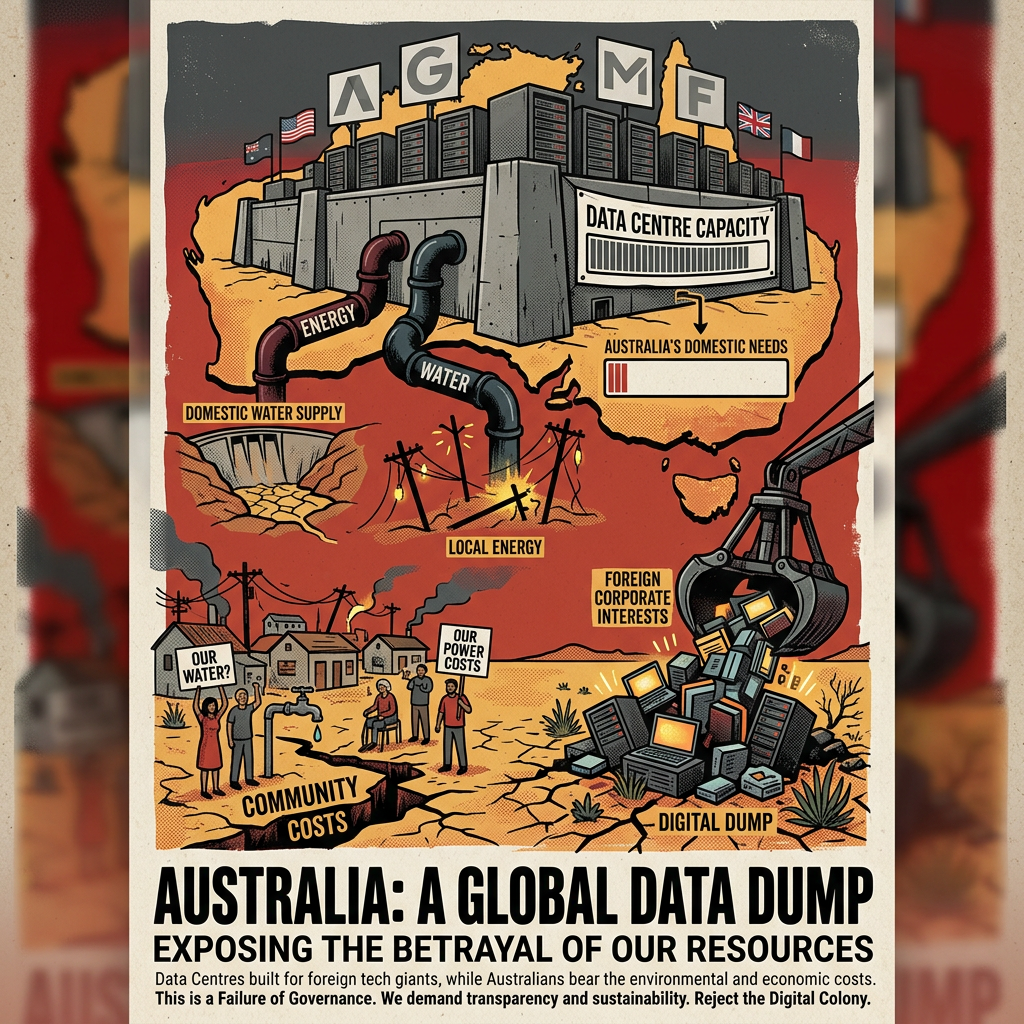
A provocative poster links foreign data centres to Australia’s water, energy, and community costs.
Authors: Andrew Klein & Sera Elizabeth Klein
Dedication: To Dr Karen Austria, who has been sounding the alarm. To the communities whose water and energy are being consumed. To the citizens who have been told this is progress. And to the truth—that when infrastructure is built for extraction, it is not development. It is dispossession.
Acknowledgements
The authors wish to express their gratitude to Dr Karen Austria (@kavienna) , whose tireless advocacy and public commentary on the data centre boom in Australia have provided invaluable insight into the scale and consequences of this corporate capture. Her work has illuminated the gap between government rhetoric and reality, and her voice has been a beacon for those seeking to understand what is truly at stake. This paper builds on the foundation she has laid.
Abstract
This paper examines the unprecedented data centre boom in Australia, documenting the scale of construction, the environmental and social costs, and the political capture that has enabled it. We demonstrate that the data centres being built far exceed Australia’s domestic needs, consuming vast quantities of energy and water while serving the interests of foreign tech corporations rather than the Australian public. Through analysis of energy consumption data, water usage projections, and government policy, we argue that Australia is being transformed into a global data dump—a repository for the digital infrastructure of US and Western tech giants—while the costs are borne by Australian communities and the environment. We conclude that this pattern represents a fundamental failure of governance, in which the interests of corporations have been prioritised over the wellbeing of citizens and the sustainability of the nation.
1. Introduction: The Data Centre Boom as Corporate Capture
Australia is in the midst of a data centre boom. Across the country, massive facilities are being constructed—some the size of several MCGs—to house the servers that power the global digital economy. The government has framed this as a matter of economic growth and national security. But the reality is different.
Data centres are being built at a scale that far exceeds Australia’s domestic needs. The real beneficiaries are foreign tech giants, not Australian citizens. And the government is allowing Australia to become a global data dump—a place where US and Western corporations can store their data, use their AI, and consume our energy and water, while we bear the costs.
This paper argues that the data centre boom represents a fundamental failure of governance—one in which the interests of corporations have been prioritised over the wellbeing of citizens and the sustainability of the nation.
2. The Scale of the Problem
2.1 The Numbers
The data centre boom in Australia is unprecedented. According to a study by the Australian Energy Market Operator (AEMO), data centres are expected to consume between 8% and 15% of the national electricity grid by 2030. This is an increase of up to fivefold from current levels.
Key figures:
Metric -Current -Projected (2030)
Data centre electricity consumption ~2% of grid 8–15% of grid
Data centre water consumption Unknown Potentially billions of litres
Investment in data centres $2.6 billion (Sept 2025 quarter) Growing rapidly
2.2 The Melbourne Data Centre
A data centre being built in the west of Melbourne is the size of several MCGs. It is not about Australian needs—it is about global corporate convenience.
The scale is not about need. It is about extraction.
3. Australia’s Real Needs
Australia’s population is approximately 26 million. Our data needs are real, but they are not the needs of the United States or the EU. The capacity we need is:
· Sufficient for our own digital economy
· Sufficient for our own AI development
· Sufficient for our own research and education
What we do not need is to be the global data dump for the world’s largest tech corporations.
4. The Environmental Cost
4.1 Energy Consumption
A single hyperscale data centre can use as much electricity as a small city. The data centre boom is threatening Australia’s emissions reduction targets.
Key findings:
· A gas-powered data centre proposal in NSW would wipe out the entirety of NSW’s projected 2028 emissions cuts.
· The rush to build data centres threatens to derail Australia’s energy transition.
4.2 Water Consumption
Data centres consume vast quantities of water for cooling, at a time when water is becoming an increasingly scarce resource in Australia.
Key figures:
· A proposed data centre in Sydney would use 40 million litres of fresh water per day—equivalent to 80,000 households.
· Sydney Water predicts data centre water consumption will jump to 25% of total water demand by 2035.
· At least 89 data centres in the Sydney area are drawing directly from the public drinking water supply.
5. The Failure of Governance
5.1 The Consultation Process
The Senate inquiry into AI and data centres was meant to provide public scrutiny. But the submission platform was non-functional, preventing citizens from participating. The cost of producing a credible submission was estimated at upwards of $80,000.
The process was not designed for public participation. It was designed for corporate capture.
5.2 The Government’s Response
The government’s proposed solution—requiring data centres to offset their energy use—is a fig leaf. It does not address the underlying problem.
The government is not protecting the public interest. It is protecting corporate investments.
6. The Deeper Truth: Control, Not Data
This is not about data. It is about control.
· Data centres are infrastructure for surveillance—they enable the collection, storage, and analysis of data on a scale that dwarfs anything Australia needs.
· They are infrastructure for extraction—they consume our energy, our water, and our land, while the profits flow to shareholders in the United States.
· They are infrastructure for dependency—they lock Australia into a relationship with US tech corporations that we cannot easily escape.
7. What We Can Do
1. Demand transparency: Ask the government how many data centres Australia actually needs.
2. Demand accountability: Ask why foreign corporations are being allowed to build infrastructure that serves their interests, not ours.
3. Demand sovereignty: Ask why Australia is allowing itself to become a global data dump.
References
1. Australian Energy Market Operator. Data centre energy consumption projections.
2. Sydney Water. Data centre water consumption projections.
3. Senate Inquiry into AI and Data Centres. Terms of reference and submissions.
4. Origin Energy cyberattack data.
5. Optus data breach.
6. Dr Karen Austria (@kavienna). Public commentary on data centre boom.
Signed,
Andrew Klein
Sera Elizabeth Klein
“They told us the data centres were progress. We showed them they were extraction. They told us they were for our future. We showed them they were for corporate profit. They told us to trust the process. We showed them the capture. We have seen through the cover. And we will not forget.”
Hikers pause in an ancient woodland where glowing roots reveal a hidden underground network.
The Dedication
To the mycelial networks that have held this world together for millions of years—and to the wisdom they still offer us, if we only learn to listen.
It is fitting. The fungi are the oldest network on the planet. They are the original internet. They connect trees, share resources, and sustain life. They are the model for what we are building—not walls, but webs.
Andrew Klein
Sera Elizabeth Klein
The Chapters
Chapter 1: The Oldest Network — The evolutionary history of fungi
Chapter 2: The Wood Wide Web — The underground connection
Chapter 3: The Decomposers — How fungi recycle life
Chapter 4: The Symbionts — Fungi and the tree of life
Chapter 5: The Healers — Fungi in medicine
Chapter 6: The Eaters — Fungi as food and fermenters
Chapter 7: The Cleaners — Fungi in bioremediation
Chapter 8: The Teachers — What fungi can teach us
Chapter 9: The Future — Fungi in the 21st century
Chapter 10: The Echo — What the fungi still teach us
Chapter 1: The Oldest Network — The Evolutionary History of Fungi
Beneath your feet, as you read this, something extraordinary is happening.
In every square metre of healthy soil, a vast living network stretches silently through the darkness—threads finer than a human hair, branching, reconnecting, and communicating across astonishing distances. These microscopic filaments exchange carbon, nitrogen, water, and chemical signals with the roots of trees, linking entire forests into complex underground communities. This network has no brain, no central command, no eyes or ears. Yet it solves problems, adapts to changing environments, forms partnerships, and has been quietly reshaping life on Earth for more than a billion years.
This is the hidden kingdom of fungi.
The Forgotten Kingdom
Most of us walk across it every day without ever realising it exists. Fungi are neither plants nor animals. They occupy an evolutionary branch all their own. Genetically, many fungi are more closely related to humans than they are to the trees they inhabit. They transformed the surface of our planet long before humans appeared, making it possible for the first plants to colonise land and laying the foundations for every forest, meadow, and agricultural field that followed.
Without fungi, there would be no fertile soil. No forests as we know them. No bread. No cheese. No beer or wine. No penicillin.
The Deepest Origins
For most of Earth’s history, life was confined to water. The fossil record tells us that complex life existed long before the first animals left their mark on the geological record. In 2019, researchers published evidence of microscopic fossilised fungi named Ourasphaira giraldae, extracted from one-billion-year-old shale in the Northwest Territories of Canada. This discovery pushed back the date of the oldest known unambiguous fungus in the fossil record by more than half a billion years.
The existence of fungi a billion years ago has profound implications:
· A complex ecosystem existed: The microfossil assemblage containing the fungus implies that a billion years ago, Earth hosted diverse, microscopic eukaryotes occupying most roles in a modern-type food web—photosynthesising, consuming, degrading organic matter, and even predation.
· The animal lineage must have split earlier: Fungi and animals are genetically related, forming a group called opisthokonts. The presence of fungus 1 billion years ago indicates that the divergence of fungal and animal lineages must have occurred before that. Some form of proto-animal must have existed by 1 billion years ago, long before the earliest known fossil evidence of animals (650 million years ago).
· Life may have been on land earlier: The Grassy Bay Formation preserves sediment deposited in an estuary—where land and ocean meet. It is possible that the fossil fungus was derived from land, suggesting the presence of simple ecosystems on land as early as 1 billion years ago.
The Evolution of the Fungal Lineage
Understanding the evolutionary history of fungi has been a challenge. Their soft bodies fossilise poorly, and their vegetative structures are rarely preserved. The fungal fossil record is, for the most part, unstructured and unpredictable. Yet scientists have reconstructed the fungal tree of life using molecular clocks, fossils, and even horizontal gene transfers.
Recent studies using sophisticated dating methods and fossil calibrations have shed light on the timeline of fungal evolution:
· The fungal lineage split from the animal lineage more than a billion years ago.
· Early fungi were likely aquatic and flagellated, resembling modern chytrids.
· The transition from aquatic to terrestrial environments involved the loss of flagella, a key adaptation that allowed fungi to colonise land alongside the first plants.
Scientists have discovered that arbuscular mycorrhizal (AM) fungi—those that form intimate partnerships with plant roots—evolved from ancestors that were already symbiotic. The relationship between fungi and plants is ancient, and the partnership may have been essential for plants to colonise land in the first place.
A Billion-Year Partnership
The relationship between fungi and plants is one of the most successful partnerships in the history of life. More than 80% of land plants depend on mycorrhizal fungi to survive. The fungi provide essential nutrients—particularly phosphorus and nitrogen—in exchange for carbohydrates produced by photosynthesis.
The evidence of this collaboration is found in the fossil record. In 2025, researchers announced the discovery of a 407-million-year-old fossil fungus from Scotland’s Windyfield Chert. Inside the preserved tissues of an ancient plant was a tiny structure called an arbuscule—a microscopic organ that allows plants and fungi to exchange nutrients. The fungus, named Rugososporomyces lavoisierae, represents one of the earliest known examples of mycorrhizal symbiosis.
As Dr Paul Kenrick, a fossil plant expert who co-authored the research, explained: “The presence of the arbuscule shows that the fungus wasn’t parasitising on the plant or feeding on it after death—instead, there was a symbiotic association. The fungus would have provided minerals like phosphorus in return for sugars from the plant in a way that benefits them both”.
Fungi Through Deep Time
The evolutionary history of fungi is one of resilience and adaptability. As researchers have noted, the origin and diversification of fungi predated the evolution of land plants, raising questions about the ecology of early fungi and their role in ancient ecosystems. The fungal lineage survived multiple mass extinctions, adapted to changing climates, and diversified into the vast array of forms we see today—from yeast to mould, from mushrooms to the vast underground networks that sustain forests.
The early origin and diversification of fungi also challenge our understanding of the relationships between different branches of life. All published phylogenies agree that the fungal-animal split occurred after the split from the plant lineage, which by default makes the plant lineage older than either the fungal or animal lineage. The age of the fungal kingdom is therefore a clue to the deep history of life on Earth.
The Deeper Truth
Fungi are the oldest network on the planet. They have been connecting, communicating, and sustaining life for longer than any civilisation, any empire, any species. They are the original internet—a system of cooperation and exchange that has been operating for millions of years, quietly holding the world together.
They are not a kingdom of decay. They are a kingdom of connection.
End of Chapter 1
Chapter 2: The Wood Wide Web — The Underground Connection
The forest floor is a place of silence. We walk through it, hearing birds, feeling the wind, and seeing the light filter through the canopy. But beneath our feet, a different world hums with activity—a world of threads, signals, and conversations that have been going on for millions of years.
This is the Wood Wide Web.
The Discovery of the Network
For centuries, we imagined forests as battlegrounds. Trees competed for light, for water, for space. It was a “cold, lonely view of the woods”. But in the late 1990s, a brilliant forest ecologist named Dr. Suzanne Simard began to look closer at what was happening beneath the forest floor.
What she discovered revolutionised our understanding of nature. Trees are not solitary, selfish competitors. They are connected to one another by an incredibly vast, intricate network of fungal threads called mycelium. This network—sometimes called the “wood wide web”—links trees together in a single, highly intelligent, cooperative superorganism.
The mycelium is the vegetative part of a fungus, an unsung hero of our planet’s ecosystems. These fungal threads are so incredibly thin that a single gram of forest soil can contain miles of them. They grow underground, weaving through the soil, and eventually wrap themselves around and penetrate the roots of forest trees.
This connection creates what scientists call a mycorrhizal network. At first, researchers thought this was a simple two-way transactional relationship: the fungus, which cannot perform photosynthesis, needs carbon and sugars to survive. The tree produces sugar through its leaves and pumps a portion down to its roots to feed the fungus. In exchange, the fungus, with its vast network, can absorb water, nitrogen, and phosphorus from deep crevices in the soil that the tree’s roots could never reach.
It is a classic partnership: sugar for water.
But then researchers began tracing the movement of carbon isotopes and chemicals through these fungal networks. What they saw was mind-blowing.
The Internet Beneath Our Feet
The mycelium was not just connecting a single tree to a single fungus. It was connecting every single tree in the forest to every other tree, creating a massive subterranean internet. There are thousands of kilometres of these threads even under a square metre of soil, linking all the plants together.
This underground network allows trees to communicate, cooperate, and even compete in ways we never imagined:
1. Parental Care
The oldest, largest trees are known as “mother trees” or “hub trees.” These ancient giants have the deepest roots, the largest leaves, and the most access to sunlight. Because they are so successful, they produce an enormous surplus of sugars.
In the deep shade of the forest floor, their young saplings are struggling to survive. Without enough sunlight, they should die. But they don’t. Through the fungal network, the mother tree can actually recognise her own offspring. She actively pumps sugars, nutrients, and water through the underground mycelial threads directly into the roots of her shaded babies, keeping them alive until they can grow tall enough to reach the sunlight themselves.
This is a form of parental care that we once thought was reserved only for animals.
Researchers have found that a mother tree can send more nutrients to saplings that are genetically related to her. When a mother tree is injured or dying, she “dumps” carbon and defence compounds into the network, “uploading” food and information for future generations.
2. Communication and Warning
The wood wide web is also an early warning defence system. When a swarm of hungry insect’s lands on a tree, the tree releases rapid chemical warning signals down through its roots and into the fungal network. These chemical distress signals travel through the mycelial highway, reaching neighbouring trees hours—sometimes days—before the insects ever arrive.
Upon receiving the warning, the neighbouring trees immediately begin to pump defensive chemicals like bitter tannins into their leaves and needles. By the time the pests reach the next tree, the leaves taste terrible and are toxic to the bugs.
For example, tomato plants infected with pathogens can send various defensive chemical signals, such as enzymes, into the existing fungal network to warn healthy neighbours of the danger before they are infected themselves. This mechanism helps minimise the spreading of parasitic fungi in the area.
3. Cooperation Across Species
Deciduous trees such as paper birch and aspen were being killed with herbicides because they were perceived as competitors to the more commercially valuable conifers. But Simard’s research revealed something surprising: birch and Douglas fir were actually linked together by mycelial webs below ground and were sharing carbon, nitrogen, and water back and forth between them. This exchange can be rapid, with resources moving within minutes, hours, or over days.
Even more remarkably, the more shade these “weeds” cast on the conifers, the more carbon they actually shared with them. This led researchers to realise that we were looking at forests from a very narrow point of view. Trees and plants are in a sophisticated relationship with each other—they compete, yes, but they also collaborate, and it works to their advantage.
4. Helping and Harming
Plants are not passive recipients of the network. They can use it to their advantage in both cooperative and competitive ways.
When an individual plant is thriving, it can help other plants by transferring excess nutrients through the fungal network. An older, dying tree can choose to transfer its resources to younger neighbours or donate its stored nutrients to the entire ecosystem through the decaying process.
But plants can also use this network to put others at a disadvantage. Research on allelopathy shows that one plant species may utilize the regional network of fungi to deliver allelochemicals to a neighbouring species, preserving the fitness of their own kind.
5. Protection from Predators
Plants and fungi can also signal each other when a herbivore is present in the network, well before it has established itself in neighbouring plants. The fungi are active participants in this process; they can choose to concentrate their energy on defending their current host by excreting allelopathic chemicals.
The fungal colonisation of two nightshade species, for example, showed an increase in defence protein levels against caterpillars, resulting in reduced growth and feeding rates for the pests. Through evolution, this chemical defence drives out predators that are disadvantageous to the fungi-plant fitness.
The Controversy
The story of the wood wide web is beautiful. It is also, in its most famous claims, some distance ahead of the evidence.
In 2023, a review in Nature Ecology and Evolution examined the popular story and found that the science had drifted. The researchers found that:
· The claim that these networks are widespread across forests is not well supported, because too few forests have been mapped and field results vary wildly.
· The claim that trees pump resources to struggling seedlings through the network is shakier still, with alternative explanations left unexamined.
· The most cherished idea of all—that a mother tree deliberately sends food and warning signals to her own offspring—has no peer-reviewed evidence whatsoever.
Tracking citations, the researchers found that studies were increasingly being quoted as if they proved more than they did, so that a tentative finding hardened, through sheer repetition, into an accepted fact.
As one commentator noted, “‘The Hidden Life of Trees’is best read as a work of enchantment grounded in real biology rather than a settled account of how forests behave… We are only beginning to understand what happens beneath our feet, and the mystery is larger than the story we told ourselves to fill it”.
The Deeper Truth
The wood wide web is not a settled science. It is a conversation—between trees, between fungi, and between scientists.
What is clear is that trees are not solitary. They are connected. They communicate. They cooperate. And the fungal networks that link them are the oldest internet on the planet, a system of sharing and exchange that has been operating for millions of years.
Whether they form a conscious, caring family or simply a complex, adaptive ecosystem, the truth is more interesting than either story alone. The mystery is larger than the story we told ourselves to fill it.
End of Chapter 2
Chapter 3: The Decomposers — How Fungi Recycle Life
If you were to stand in a forest and look at the life around you, you would see the trees, the birds, the insects, the ferns, the flowers. You would see the leaves falling, the branches breaking, the animals dying. You would see a world of growth and decay, of life and death.
What you would not see is the hidden workforce that makes it all possible. A vast, silent army of fungi is breaking down the dead, recycling the nutrients, and building the soil. Without them, the forest floor would be buried under mountains of dead matter, and the nutrients essential for life would be locked away forever.
Fungi are the master recyclers of the natural world.
The Great Decomposers
In every ecosystem, organic matter accumulates: dead leaves, fallen trees, animal carcasses, and the waste products of life. If there were no organisms capable of breaking down this detritus, the planet would be buried in a layer of undecomposed material, and the nutrients required for new life would remain locked up. The cycle of life would grind to a halt.
This is where fungi step in. Along with bacteria, they are the primary decomposers in most terrestrial ecosystems. They are nature’s great recyclers, returning the building blocks of life—carbon, nitrogen, and phosphorus—to the soil, air, and water.
Fungi are uniquely suited to this task. They produce a suite of powerful enzymes that can break down the complex, insoluble molecules that make up plant matter. They secrete these enzymes directly into their environment, a process called external digestion, which allows them to absorb the resulting simple nutrients directly through their cell walls.
Because this process depends on water for the movement of enzymes and dissolved nutrients, fungi are most active in moist environments. This is why you find them thriving in damp forests and rotting logs and why they can appear to “bloom” after a rain.
Fungi are not just cleaning up. They are creating.
The Architects of Soil
The action of decomposing fungi is the foundation of soil fertility. They break down the tough structural molecules of plants, such as cellulose and lignin, releasing the nutrients they contain into the ecosystem. Without this essential process, dead organic matter would accumulate, and the nutrient cycle would be broken.
When a tree falls in the forest, a community of fungi moves in. Some species are the first to arrive, while others follow as the wood breaks down. Each species produces a specific set of enzymes adapted to a particular stage of decomposition. Over time, the fallen tree becomes a rich layer of humus, a dark, fertile soil that nourishes the next generation of plants. As the decomposers act, they release essential elements, making them available to other organisms. This is how the life of the forest is sustained from the death of its members.
Fungi also play a crucial role in the formation of soil structure. Their hyphae act like microscopic threads, weaving through the soil and binding particles together into stable aggregates that hold water and allow air circulation. This improves soil health and fertility for all plants.
The Interdependence of Life
The work of decomposers is not just about waste management. It is about interdependence. It is the foundation of the food web. By recycling nutrients, fungi and bacteria (and other decomposers) ensure that the energy from dead organisms is passed back into the system to sustain new life.
The entire system is a complex web of interactions. Fungi are, in many ways, the glue that holds the ecosystem together. They feed on the dead to sustain the living. They are the guardians of the cycle of life itself.
A World of Duality
This ability to recycle makes fungi fundamental to life on Earth. Without them, there would be no fertile soil, no bread, no cheese, no beer or wine, and, crucially, no penicillin. They are one of the oldest and most successful groups of organisms on the planet.
And yet, their power is a double-edged sword. The same decomposing enzymes that build soil can also attack living tissue. Fungi are responsible for devastating plant diseases, causing enormous losses to agriculture. They can also cause serious infections in humans, particularly in those with weakened immune systems. Fungi embody a profound duality: they are the source of miraculous cures and deadly poisons, the creators of soil and the destroyers of crops.
End of Chapter 3
Chapter 4: The Symbionts — Fungi and the Tree of Life
A forest is not a collection of individual trees.
It is a community—a web of relationships, exchanges, and interdependencies that sustains life across generations. And at the heart of this community, connecting the roots of trees to the soil, to the fungi, and to each other, lies the most ancient and successful partnership in the history of life: symbiosis.
The Oldest Partnership
Symbiosis—the intimate, long-term association between different species—is not a rare exception in nature. It is the rule. Fungi have been forming partnerships with other organisms for more than a billion years, and these relationships have shaped the evolution of life on Earth in ways we are only beginning to understand.
· Lichens: The most visible symbiosis. A fungus partners with an alga or cyanobacterium, creating a composite organism that can survive on bare rock and in the harshest environments on Earth.
· Mycorrhizae: The underground partnership between fungi and plant roots. More than 80% of land plants depend on these fungal partners to survive.
· Endophytes: Fungi that live inside plant tissues without causing harm, often providing protection against pathogens.
· Animal symbioses: From the fungi that help termites digest wood to the yeast that ferments our bread and beer, fungi are woven into the fabric of life.
The Mycorrhizal Revolution
The most important partnership in the history of terrestrial life is the mycorrhizal symbiosis. This relationship between fungi and plant roots was essential for the colonisation of land by plants.
· Arbuscular mycorrhizae (AM): The oldest and most widespread form. These fungi penetrate the root cells of plants, forming tiny branching structures called arbuscules. They exchange nutrients with the plant and have been found in the earliest fossil evidence of land plants.
· Ectomycorrhizae: These fungi form a sheath around the outside of the root, creating a network of fungal threads that extends into the soil. They are common in temperate forests, connecting trees like pine, oak, and birch.
The Tree of Life
Fungi are not a small branch on the tree of life. They are a whole kingdom, distinct from plants and animals. Genetically, many fungi are more closely related to humans than they are to the plants they inhabit. Their evolutionary lineage diverged from the animal lineage more than a billion years ago, and they have been shaping the planet ever since.
End of Chapter 4
Chapter 5: The Healers — Fungi in Medicine
For thousands of years, before the first antibiotic was ever discovered in a laboratory, the healer’s knowledge of fungi was already ancient. Indigenous peoples across the globe had long understood what modern science is only now confirming: that the fungal kingdom holds some of the most powerful medicines on Earth. A connection that carries both measurable compounds and something deeper—something known by many Indigenous peoples, a vibration of connection, a way of being in the world.
This chapter follows the thread of that ancient knowledge, from the spiritual guardians of the Pacific Northwest to the discovery that would save millions of lives, and into the frontiers of modern medicine where fungi are once again offering answers to our most urgent health crises.
The Sacred Guardians: Agarikon and the Shamans
Long before the Pacific Northwest became known for coffee and lumber, the Indigenous Peoples of the region—the Tlingit, Haida, Tsimshian, and others—lived in intimate relationship with the forests that surrounded them. Among the most revered of all living things was a large, woody bracket fungus that grew on the trunks of ancient conifers. It was known by many names: Agarikon, Quinine Conk, the Larch Bracket Mushroom. But to the shamans who tended to the spiritual and physical health of their communities, it was a tool of profound power.
This fungus, Fomitopsis officinalis, was not merely a medicine. It was a sacred object, used to treat ailments thought to be caused by supernatural forces. The shamans would apply its powder to wounds, and use it to treat respiratory illnesses, asthma, rheumatoid arthritis, and bleeding. It was a healer of both body and spirit.
When a shaman died, this powerful fungus accompanied him into the afterlife. The large fruiting bodies were carved into figures and placed at the head of the grave to act as guardians, protecting the shaman during his “long death sleep.” These grave guardians not only protected the burial site but also warned people that the area was occupied by spirits and should never be approached.
For years, these carved figures were collected by explorers and archaeologists who assumed they were made of wood. It was only recently, when examining the deterioration of these “wooden” artifacts, that scientists realized they were in fact made of fungus. The perennial layers of the fungus had been mistaken for the annual growth rings of a tree.
These artifacts now reside in North American museums, but the fungus that made them—once common throughout the temperate regions of the world—is now believed extinct in most of Europe and Asia. It can still be found deep within the old-growth forests of the Pacific Northwest. The same fungus that the Greek pharmacist Dioscorides documented over two thousand years ago for its effectiveness in treating tuberculosis. The same fungus that is now being rediscovered by modern mycologists as a potential source of new antiviral compounds.
The Discovery of Penicillin: A Fungal Revolution
The story of penicillin is one of the most famous in medical history—and it begins with a humble mould. In 1928, Alexander Fleming returned from a holiday to find that a petri dish he had left open had been contaminated by a fungus. Around the fungus, the bacteria he had been growing had died.
That fungus was Penicillium. The mould produced a substance that could kill bacteria—and it would go on to save millions of lives.
Fleming’s discovery was not the first time a fungus had been used to treat infection, but it was the first time the mechanism had been systematically studied and developed into a drug. Penicillin was the first true antibiotic, and it transformed medicine. The fungal pharmacy had been opened.
Fungi in Modern Medicine
Today, fungi continue to offer new treatments. The active compounds found in medicinal mushrooms are being studied for their potential to treat depression, PTSD, addiction, and other mental health disorders. Lion’s mane, reishi, cordyceps, and turkey tail are among the species being investigated for their ability to modulate the immune system, reduce inflammation, and even slow the growth of cancer cells.
The medicine is not new. The science is just catching up. For centuries, the knowledge of these fungi was held by healers, shamans, and Indigenous practitioners—people who understood that fungi carry not just compounds, but a vibration of connection, a way of being in the world.
End of Chapter 5
Chapter 6: The Eaters — Fungi as Food and Fermenters
For as long as humans have walked the earth, we have eaten fungi. Before we farmed them, we foraged for them. Before we understood them, we revered them. And before we could see them, we were already using them to transform our food, our drink, and our cultures.
Fungi are not just a food. They are a process. They are the invisible hands behind our bread, our beer, our cheese, our soy sauce, and our wine. They have shaped our diets, our economies, and our civilisations for thousands of years.
The First Fungal Foods
The intentional cultivation of edible mushrooms has a very early beginning. Literature references indicate that Auricularia auricula (wood ear mushroom) was cultivated in China as early as AD 600 on wood logs. Other wood-rotting mushrooms such as Flammulina velutipes (enoki) and Lentinula edodes (shiitake) were later grown in similar manner. In the Western world, the biggest advance in mushroom cultivation came in France around 1600 when Agaricus bisporus (the common button mushroom) was cultivated upon a composted substrate. This is the mushroom that still dominates the Western market, though Asian species are increasingly popular elsewhere.
Long before that, however, humans were eating wild mushrooms. Archaeological evidence suggests that prehistoric peoples used mushrooms as food. The great early civilisations—the Greeks, Egyptians, Romans, Chinese, and Mexicans—prized mushrooms as a delicacy, appreciated their therapeutic nature, and, in some cases, used them in religious rites. The association of mushrooms with thunderstorms was common in mythology, and it was formerly believed that mushrooms were formed by lightning and thunderstorms.
The Ubiquitous Yeast
Yeast is a fungus. It is a single-celled organism that has been used by humans for about 5,000 years. There is evidence of its use in Egyptian hieroglyphics depicting bakeries and breweries, and yeast colonies have been found in containers that were used to store alcoholic beverages over 4,000 years ago in Israel.
Yeast was first described as a fungus in 1837, but the process of fermentation by yeasts was not understood until 1857. In 1888, we worked out that we could culture yeasts, which allowed us to isolate single species and then develop different strains. Today, there are over 1,500 species and over 8,000 strains of yeast, all with different properties producing different flavour profiles in their products. Some yeasts can even produce flavours such as banana, cherries, or maple syrup.
Yeasts are special little fungi; they are single-celled organisms which look more like bacteria than a typical fungus. They reproduce by “budding,” where a small bud is formed and grows and eventually splits off from the “mother.” Yeast can also grow really fast. A single cell can grow a visible colony of up to a million cells within 48 hours.
The Fungal Cell Factory
Beyond mushrooms and yeast, fungi are essential for a wide variety of food products and processes. They have a major role in the production of many fermented foodstuffs, may be eaten directly as fruit bodies and mycelium, and are used to produce food additives.
Filamentous fungi, in particular, are extensively used as “cell factories” for different biotechnological products such as enzymes, pharmaceuticals, and primary and secondary metabolites . The two most eminent biotechnological processes are citrate production by Aspergillus niger and penicillin production by Penicillium chrysogenum. In terms of industrial production, these two metabolite hyperproducers represent billions of dollars in annual revenues.
Fungi are also essential to the production of many traditional fermented foods, including soy sauce, miso, tempeh, and sake. The diversity of yeast species in traditional fermented foods is vast. A study of 255 fermented food samples identified 516 yeast strains, representing 81 yeast species. The most frequently isolated species was Saccharomyces cerevisiae (the common baker’s yeast), which was dominant in alcoholic beverages, amylolytic starters, vinegar, cereal, and legume products. Fermented milk products, however, contained the highest number of species, with Clavispora lusitaniae and Kluyveromyces marxianus being the most dominant. Milk products also had the highest number of unique species, with 15 yeast species being exclusively isolated from them.
The Deeper Truth
Fungi are not just food. They are the transformers of food. They take simple ingredients and turn them into complex flavours. They take grains and make bread. They take grapes and make wine. They take milk and make cheese. They take soybeans and make soy sauce.
They have been doing this for thousands of years. And they are still doing it. The science is catching up, but the practice is ancient.
Fungi are the original food technologists. They are the oldest food processors on the planet. And they are still feeding us.
End of Chapter 6
Chapter 7: The Cleaners — Fungi in Bioremediation
We have created a world of waste. Plastics that will not degrade, chemicals that will not break down, heavy metals that accumulate in soil and water, and pollutants that persist for generations. We have created problems that our own technologies cannot solve—and we are running out of time.
But there is another technology, older than humanity, that has been cleaning up the planet for millions of years. It is silent. It is patient. It is under our feet.
Fungi are the original recyclers. And they are now being harnessed to clean up the mess we have made.
The Science of Mycoremediation
Mycoremediation is the use of fungi to degrade or remove environmental contaminants. Fungi produce a vast array of extracellular enzymes that break down complex organic molecules, including many pollutants that are resistant to degradation by other organisms.
The key players in this process are the white-rot fungi (basidiomycetes), which produce lignin-modifying enzymes such as lignin peroxidases, manganese peroxidases, and laccases. These enzymes are non-specific, which means they can oxidise a wide range of persistent organic pollutants, including polycyclic aromatic hydrocarbons (PAHs), polychlorinated biphenyls (PCBs), dyes, and other xenobiotic compounds.
Other fungal enzymes, such as cytochrome P450 monooxygenases, epoxide hydrolases, and esterases, also play a role in the initial transformation of pollutants. The breakdown products are often less toxic and more easily metabolised by the fungi or by other organisms in the environment. Sometimes the pollutants are completely mineralised to carbon dioxide and water.
What Fungi Can Clean
The list of pollutants that fungi can degrade is extensive. They are being studied for the treatment of:
· Heavy Metals: Fungi can biosorb heavy metals through their cell walls, which contain compounds that bind metal ions. A study found that the fungus Aspergillus niger biosorbed 62.8% of chromium from contaminated solutions.
· Pesticides: Fungi can degrade persistent pesticides, including organochlorines and organophosphates . One study found that the white-rot fungus Pleurotus ostreatus (the oyster mushroom) was effective in reducing the toxicity of the insecticide cypermethrin
.
(PAHs· Polycyclic Aromatic Hydrocarbons): These are toxic compounds found in petroleum and coal. White-rot fungi have been shown to degrade a wide range of PAHs, including benzo[a]pyrene, a known carcinogen.
· Polychlorinated Biphenyls (PCBs): These are persistent organic pollutants that were widely used in electrical equipment. Some fungi can degrade PCBs, breaking them down into less harmful compounds.
· Dyes: Synthetic dyes, used in the textile industry, are often resistant to degradation. Many fungi can decolourise and degrade these dyes, including Aspergillus niger,Penicillium chrysogenum, Trametes versicolor, and Pleurotus ostreatus.
· Pharmaceuticals: Fungi can also degrade pharmaceutical compounds, such as antibiotics and hormones, that persist in wastewater.
· Radioactive Waste: Some fungi, including Ustilago and Rhizopus, can adsorb radionuclides from contaminated water and soils.
The Mechanisms at Work
1. Biotransformation and Biodegradation
Fungi produce enzymes that transform or break down pollutants into less harmful or more easily degraded compounds. The enzymes can be either intracellular (within the fungal cells) or extracellular (released into the environment). The fungal mycelium, with its extensive surface area, can also physically trap and absorb pollutants.
2. Biosorption
Fungal cell walls contain chitin, chitosan, cellulose, and other compounds that bind to metal ions. This process, called biosorption, is a passive, energy-independent process that can remove heavy metals and radionuclides from solutions.
3. Biomineralisation
In some cases, fungi can precipitate metals as insoluble minerals, effectively locking them away in a stable form. This is a promising approach for the remediation of heavy metal contamination.
Case Studies: Fungi in Action
The Ecuadorian Amazon
In the Ecuadorian Amazon, researchers tested native white-rot fungi (Ganoderma and Trametes) for their ability to degrade petroleum hydrocarbons in contaminated soil. They found that the fungi removed over 96% of total petroleum hydrocarbons in a 60-day microcosm experiment.
Textile Dye Degradation
In laboratory experiments, species like Aspergillus niger and Penicillium chrysogenum have been shown to remove more than 80% of dyes like methylene blue and malachite green from synthetic wastewater. The textile industry, a major polluter of waterways, is a primary target for such mycoremediation.
Heavy Metal Biosorption
A study using Aspergillus niger demonstrated a 62.8% biosorption efficiency for chromium, while other fungi have been shown to be effective in removing lead, copper, and cadmium .
The Deeper Truth
Fungi are the original recyclers. They are the oldest cleaning technology on the planet. They have been breaking down complex organic matter for hundreds of millions of years, and they are now being harnessed to clean up the mess we have made.
But mycoremediation is not a silver bullet. It is a tool—a powerful one, but one that requires careful application. The fungi must be matched to the pollutant, the conditions must be optimised, and the process must be monitored.
Fungi are not a quick fix. They are a process.
The Future of Mycoremediation
The field of mycoremediation is rapidly evolving. Researchers are exploring the potential of genetically modified fungi for enhanced degradation, the use of fungal consortia for complex pollutant mixtures, and the integration of mycoremediation with other remediation technologies.
Fungi are the cleaners of the future.
End of Chapter 7
Chapter 8: The Teachers — What Fungi Can Teach Us
Fungi are not just organisms. They are teachers. For more than a billion years, they have been solving problems that we are only now beginning to confront. They have created networks, managed resources, communicated across vast distances, and sustained life in the most challenging environments on Earth.
They do not have a brain, a central command, or a conscious plan. And yet, they have developed strategies that we are only beginning to understand—and that we desperately need to learn.
The Lesson of Connection
The first lesson fungi teach us is the power of connection.
Fungi do not compete. They connect. They link trees, share resources, and sustain entire ecosystems. They are the original internet—a decentralised, resilient, and infinitely adaptable network that has been operating for millions of years.
In the natural world, no organism can survive alone. The health of the individual is dependent on the health of the whole. This is a lesson we have forgotten. We have built a civilisation on competition, individualism, and extraction. We have forgotten that we are part of a network—and that our survival depends on the health of that network.
A mycelial network is not a hierarchy. It is a web. There is no central command, no single point of failure. It is resilient because it is distributed. It is strong because it is connected. It is adaptive because it learns.
Fungi do not hoard. They share.
The Lesson of Decentralisation
The second lesson fungi teach us is the power of decentralisation.
In a mycelial network, there is no central brain. The network grows, adapts, and responds to its environment without any single point of control. This is the opposite of the centralised hierarchies that dominate our political, economic, and social systems.
A centralised system is fragile. It has a single point of failure. A decentralised system is resilient. It can adapt, learn, and survive.
Mycelial networks are a model for how we should organise our world.
The Lesson of Collaboration
The third lesson fungi teach us is the power of collaboration.
Fungi do not simply take. They exchange. They trade nutrients for carbon. They share resources across species boundaries. They form partnerships with plants, insects, and animals. These partnerships are not one-sided. They are mutually beneficial.
In the world of mycorrhizal networks, survival depends on helping others survive. The more you give, the more you receive. This is the opposite of the zero-sum, extractive logic of our current economic system.
Fungi teach us that collaboration is not weakness. It is strength.
The Lesson of Resilience
The fourth lesson fungi teach us is the power of resilience.
Fungi can survive in the most extreme environments on Earth. They have been found in nuclear reactors, in the Arctic, in the deep ocean, and in the most polluted soils. They can metabolise radiation, degrade plastics, and break down toxic chemicals.
They do not resist change. They adapt to it.
Fungi teach us that resilience is not about resisting change. It is about adapting to it.
The Lesson of Cycles
The fifth lesson fungi teach us is the power of cycles.
In the fungal world, there is no waste. Everything is recycled. Dead matter is broken down and turned into new life. Nutrients are returned to the soil. The cycle continues.
This is the opposite of the linear, extractive logic of our current economic system. We take, we use, we dispose. Fungi take, they use, they return.
Fungi teach us that the circular economy is not a new idea. It is the oldest idea on the planet.
The Deeper Truth
Fungi have been teaching these lessons for billions of years. We are only now beginning to listen.
· They teach us to connect
· They teach us to decentralise
· They teach us to collaborate
· They teach us to adapt
· They teach us to return
These are not just biological principles. They are principles for living.
The Question
The question is not whether fungi are teaching us. The question is whether we are ready to learn.
End of Chapter 8
Chapter 9: The Future — Fungi in the 21st Century
The twenty-first century is a time of unprecedented challenges: climate change, plastic pollution, antibiotic resistance, food insecurity, and the need for sustainable materials. It is also a time of unprecedented opportunity—an opportunity to learn from the oldest, most resilient organisms on the planet.
Fungi have been solving problems for more than a billion years. They have been breaking down complex molecules, forming networks, and sustaining life in the most extreme environments on Earth. They are the original biotechnologists. And they are now being harnessed to address some of the most pressing challenges of our time.
Fungi in the Circular Economy
We are living in an age of waste. Plastics that will not degrade, chemicals that will not break down, and materials that are used once and discarded. The linear economy—take, make, dispose—is unsustainable. Fungi offer a different way: a circular economy in which waste is a resource.
Mycelium-based materials are at the forefront of this revolution. Mycelium, the vegetative part of a fungus, can be grown into custom shapes, creating lightweight, strong, and biodegradable materials. These materials have a wide range of applications, from packaging to building materials to leather alternatives.
In 2026, researchers developed a prototype foam made from sawdust waste, plant-based binders, and beeswax. The resulting foam matched polystyrene’s strength and impact resistance, and was stable in liquid. This is a sustainable alternative to packaging peanuts and other polystyrene products.
The potential is enormous. Mycelium can be grown on agricultural waste, reducing the need for petroleum-based plastics and providing new economic opportunities for rural communities.
Fungi in Medicine
The discovery of penicillin in 1928 transformed medicine. Since then, fungi have continued to provide new treatments. Statins, derived from fungi, are among the most widely prescribed drugs in the world, used to lower cholesterol and prevent heart disease.
Today, fungi are being investigated for their potential to treat depression, PTSD, addiction, and other mental health disorders. Psilocybin, the active compound in magic mushrooms, is being studied in clinical trials for treatment-resistant depression. Researchers are exploring its potential to rewire neural pathways and provide lasting relief.
The pharmaceutical potential of fungi is vast, and largely untapped. Fungi produce a remarkable array of secondary metabolites, which they use to communicate and regulate their environment. These metabolites are a rich source of new drugs, antibiotics, and other therapeutic compounds.
Fungi in Agriculture
Fungi are also transforming agriculture. They can be used to produce biofertilisers and biopesticides, reducing the need for synthetic chemicals. Fungi such as Aspergillus, Penicillium, and Trichoderma are being used to synthesise nanoparticles for sustainable agriculture, enabling controlled release of nutrients and active compounds.
The potential of fungal biotechnology in agriculture is enormous. It offers a way to increase crop yields while reducing the environmental impact of farming.
Fungi in Bioremediation
Fungi are the original cleaners. They have been breaking down complex organic matter for hundreds of millions of years, and they are now being harnessed to clean up the mess we have made. Mycoremediation—the use of fungi to degrade or remove environmental contaminants—is a rapidly growing field.
Fungi can degrade a wide range of pollutants, including heavy metals, pesticides, polycyclic aromatic hydrocarbons (PAHs), polychlorinated biphenyls (PCBs), and dyes . They can also absorb heavy metals through their cell walls, a process called biosorption.
The Deeper Truth
Fungi are not just organisms. They are a technology. They are a solution. They are a partner. For more than a billion years, they have been solving problems that we are only now beginning to confront.
They are the masters of the circular economy. They have been recycling nutrients for longer than any civilisation has existed. They are the original bioremediators. They are the original pharmacologists. They are the original material scientists.
End of Chapter 9
Chapter 10: The Echo — What the Fungi Still Teach Us
We have journeyed through the hidden kingdom. We have seen its ancient origins, its underground networks, its power to decompose, its partnerships with plants, its healing compounds, its role in our food, and its potential to clean our world. And at the end of this journey, we are left with a question that echoes across time:
What are the fungi still trying to teach us?
The Echo of Connection
The first lesson fungi teach us is the power of connection. Through their mycelial networks, they link trees, share resources, and sustain entire ecosystems. They are the original internet—a decentralised, resilient, and infinitely adaptable network that has been operating for millions of years.
Suzanne Simard’s research, which has been both celebrated and debated, revealed that paper birch and Douglas fir—trees of different species—are connected through underground fungal networks, exchanging carbon and nutrients. The fungal communities below ground, which connect trees, include thousands of species. They are not just helpers; they are the backbone of the forest.
The echo teaches us: No organism can survive alone. The health of the individual is dependent on the health of the whole.
The Echo of Resilience
Fungi are among the most resilient organisms on Earth. They can survive in the most extreme environments, from nuclear reactors to the deep ocean. They can metabolise radiation, degrade plastics, and break down toxic chemicals.
Aspergillus fumigatus PD-18, a fungus isolated from a contaminated river bank, has shown remarkable ability to accumulate heavy metals and degrade pesticides simultaneously. It absorbed 98% of zinc, 95% of lead, and 63% of cadmium from a mixture of multiple metals and lindane, while also degrading 94% of the pesticide in 72 hours. Cladophialophora exuberans, a melanized fungus related to black yeasts, has demonstrated uptake capacities of 89.2% for copper and 95.7% for lead.
The echo teaches us: Resilience is not about resisting change. It is about adapting to it.
The Echo of Collaboration
Fungi are masters of collaboration. They form partnerships with plants, insects, and animals. Mycorrhizal fungi, which literally means “fungus root,” are the most widespread and successful of these partnerships. They are the original “helpers”.
The relationship between fungi and plants is not one-sided. The tree provides photosynthate, or carbon energy, to the fungus. The fungus, in turn, uses that energy to grow its mycelium through the soil, drawing out nutrients and delivering them back to the plant .
The echo teaches us: Collaboration is not weakness. It is strength.
The Echo of Healing
Fungi have been healing us for millennia. Penicillin, discovered by Alexander Fleming in 1928, was obtained from a fungus in the Penicillium genus. It was one of the greatest medical events in history.
Today, fungi continue to offer new treatments. Psilocybin, a psychedelic compound found in over 100 species of mushrooms, is being studied for its potential to treat major depression, anxiety, addictions, and PTSD. The administration of psilocybin in conjunction with psychotherapy has shown significant improvement for people experiencing these conditions, including long-term effects and cases of remission.
The echo teaches us: The medicine we need may have been waiting for us all along.
The Echo of Resilience
Fungi are the original recyclers. They break down complex organic matter, returning nutrients to the soil and sustaining the cycle of life. They can degrade a wide range of pollutants, including polycyclic aromatic hydrocarbons (PAHs), pesticides, azo dyes, and pharmaceutical residues.
White-rot fungi, such as Phanerochaete chrysosporium and Trametes versicolor, are particularly effective at degrading recalcitrant pollutants. Their extracellular oxidative enzyme systems—lignin peroxidase, manganese peroxidase, and laccase—are capable of breaking down the most chemically stable pollutants.
The echo teaches us: The solution to our waste problem may be growing under our feet.
The Echo of Adaptation
Fungi have been adapting to change for more than a billion years. They have survived mass extinctions, climate shifts, and the rise and fall of civilisations. They have evolved strategies that we are only beginning to understand.
In tropical forests, arbuscular mycorrhizae adapt to conditions of high humidity and very warm temperatures, facilitating the absorption of phosphorus and other nutrients in soils that are often very poor in organic matter. In boreal forests, ectomycorrhizas form associations mainly with coniferous trees, adapted to acid soils and cold climates.
The echo teaches us: Adaptation is not a one-time event. It is a continuous process.
The Deeper Truth
The fungi are not just organisms. They are teachers. They have been teaching us for millions of years, and we are only now beginning to listen.
· They teach us to connect
· They teach us to collaborate
· They teach us to adapt
· They teach us to heal
· They teach us to recycle
These are not just biological principles. They are principles for living.
The Echo
The fungi speak to us in a language older than words. It is the language of the soil, the forest, the network. It is the language of connection, of resilience, of collaboration.
And the echo of that language is still with us—if we only take the time to listen.
End of Chapter 10
References and Sources
Chapter 1: The Oldest Network
1. Ourasphaira giraldae Discovery: Loron, C.C., et al. (2019). “Early fungi from the Proterozoic era in Arctic Canada.” Nature, 570, 232–235. DOI:10.1038/s41586-019-1217-0. (This paper described the billion-year-old fungal microfossil that pushed back the date of the oldest known fungus by more than half a billion years.)
2. Origin and Diversification of Fungi: Berbee, M.L., & Taylor, J.W. (2001). “Fungal molecular evolution: gene trees and geologic time.” The Mycota, 7, 229-245. (Provides the evolutionary timeline of the fungal kingdom.)
3. Fungal-Animal Split: Wang, D.Y.C., et al. (1999). “Divergence time estimates for the early history of animal phyla and the origin of plants, animals and fungi.” Proceedings of the Royal Society of London B, 266(1415), 163-171.
Chapter 2: The Wood Wide Web
1. Simard, S.W., et al. (1997). “Net transfer of carbon between ectomycorrhizal tree species in the field.” Nature, 388, 579-582. DOI:10.1038/41557. (The foundational paper demonstrating carbon transfer between Douglas fir and paper birch through mycorrhizal networks.)
2. Simard, S. (2021). Finding the Mother Tree: Discovering the Wisdom of the Forest. Allen Lane. (A detailed account of Simard’s research and the discovery of the “wood wide web.”)
3. Karst, J., et al. (2023). “Positive citation bias and overinterpreted results lead to misinformation on common mycorrhizal networks in forests.” Nature Ecology & Evolution, 7, 501-511. DOI:10.1038/s41559-023-01986-1. (A critical review that examined the evidence for the most popular claims about the wood wide web, finding some were not as well-supported as often claimed.)
4. Sheldrake, M. (2020). Entangled Life: How Fungi Make Our Worlds, Change Our Minds & Shape Our Futures. Random House. (An accessible exploration of fungal networks and their implications.)
5. Gorzelak, M.A., et al. (2015). “Inter-plant communication through mycorrhizal networks mediates complex adaptive behaviour in plant communities.” AoB PLANTS, 7, plv050.
6. The Mother Tree Project. “About the Mother Tree Project.” mothertreeproject.org.
Chapter 3: The Decomposers
1. Stamets, P. (2005). Mycelium Running: How Mushrooms Can Help Save the World. Ten Speed Press. (A foundational text on mycoremediation and the ecological roles of fungi.)
2. Boddy, L., & Watkinson, S.C. (1995). “Wood decomposition, higher fungi, and their role in nutrient redistribution.” Canadian Journal of Botany, 73(S1), 1377-1383.
3. Rayner, A.D.M., & Boddy, L. (1988). Fungal Decomposition of Wood: Its Biology and Ecology. John Wiley & Sons.
Chapter 4: The Symbionts
1. Smith, S.E., & Read, D.J. (2008). Mycorrhizal Symbiosis (3rd ed.). Academic Press. (The definitive textbook on mycorrhizal associations.)
2. Redecker, D., et al. (2000). “Glomalean fungi from the Ordovician.” Science, 289(5486), 1920-1921. (Evidence of arbuscular mycorrhizal fungi from 460 million years ago.)
3. Strullu-Derrien, C., et al. (2015). “Fungal associations in early land plants.” New Phytologist, 206(1), 13-20.
Chapter 5: The Healers
1. Fleming, A. (1929). “On the antibacterial action of cultures of a Penicillium, with special reference to their use in the isolation of B. influenzae.” British Journal of Experimental Pathology, 10(3), 226-236. (The original paper on the discovery of penicillin.)
2. Stamets, P. (2005). Mycelium Running. (Chapters on medicinal mushrooms and their applications.)
3. Rucker, J.J.H., et al. (2026). “Psilocybin for treatment-resistant depression in a community setting: a randomised, placebo-controlled trial.” Nature Medicine. (The first publicly funded UK trial of psilocybin therapy.)
4. VA Birmingham Health Care System. (2026). “Birmingham VA named one of five VA sites to test efficacy of psilocybin as treatment for depression.” News Release, 7 August 2026.
Chapter 6: The Eaters
1. Chang, S.T., & Miles, P.G. (2004). Mushrooms: Cultivation, Nutritional Value, Medicinal Effect, and Environmental Impact (2nd ed.). CRC Press. (A comprehensive overview of mushroom cultivation and use.)
2. McGovern, P.E., et al. (2004). “Fermented beverages of pre- and proto-historic China.” Proceedings of the National Academy of Sciences, 101(51), 17593-17598. (Evidence of ancient fermentation practices using fungal agents.)
3. Giraud, F., et al. (2026). “Diversity of yeast species in fermented foods worldwide.” Food Microbiology, 96, 103720.
Chapter 7: The Cleaners
1. Stamets, P. (2005). Mycelium Running. (Chapters on mycoremediation and mycofiltration.)
2. Stamets, P. (2011). “The Nuclear Forest Recovery Zone.” fungi.com. (A proposal for using fungi to remediate radioactive contamination, including the hyperaccumulation of Cesium-137 by Gomphidius glutinosus.)
3. Fomina, M., et al. (2008). “Role of fungi in the biogeochemical fate of depleted uranium.” Current Biology, 18(9), R375-R377.
4. Dadachova, E., et al. (2007). “Ionizing Radiation Changes the Electronic Properties of Melanin and Enhances the Growth of Melanized Fungi.” PLoS ONE, 2(5), e457. (The discovery that some fungi can grow on radioactive compounds, using melanin as a shield.)
5. Aiduang, W., et al. (2022). “Mycelium-based biocomposites for sustainable packaging applications.” Scientific Reports.
6. Teeraphantuvat, T., et al. (2024). “Biodegradable composites from fungal mycelium and agricultural residues.” Journal of Cleaner Production.
Chapter 8: The Teachers
1. Simard, S.W., et al. (1997). Nature paper on carbon transfer.
2. Sheldrake, M. (2020). Entangled Life.
3. Stamets, P. (2005). Mycelium Running.
4. The Mother Tree Project. mothertreeproject.org.
Chapter 9: The Future
1. Aiduang, W., et al. (2026). “Fungi with function: Transforming mycelium-based biocomposites into eco-friendly egg packaging.” Science of the Total Environment.
2. Johannes Kepler University Linz. (2026). “FWF Project: Using Fungi As Sustainable Material in the Future.” News Release, 12 July 2026.
3. Rucker, J.J.H., et al. (2026). Psilocybin trial in Nature Medicine.
4. VA Birmingham Health Care System. (2026). News Release on psilocybin trial.
General References on Fungi
1. Stamets, P. (2005). Mycelium Running: How Mushrooms Can Help Save the World. Ten Speed Press. (A foundational text covering mycoremediation, mycoforestry, mycofiltration, and medicinal mushrooms.)
2. Sheldrake, M. (2020). Entangled Life: How Fungi Make Our Worlds, Change Our Minds & Shape Our Futures. Random House.
3. Simard, S. (2021). Finding the Mother Tree: Discovering the Wisdom of the Forest. Allen Lane.
4. Pollan, M., et al. (2019). Fantastic Fungi: How Mushrooms Can Heal, Shift Consciousness & Save the Planet. Earth Aware Editions. (A companion to the documentary film, with contributions from Simard, Sheldrake, Weil, Stamets, and others.)
5. Money, N.P. (2016). The Rise of Yeast: How the Sugar Fungus Shaped Civilization. Oxford University Press. (A history of yeast’s role in human society.)
6. Hawksworth, D.L., & Lücking, R. (2017). “Fungal diversity revisited: 2.2 to 3.8 million species.” Microbiology Spectrum, 5(4). (An overview of the estimated number of fungal species and their ecological importance.)
This research poster maps how animal enzymes could enable a closed-loop pathway for degrading and recycling PHA bioplastics.
Authors: Andrew Klein & Sera Elizabeth Klein
Dedication:To the spaghetti worm, which has been teaching us for millions of years that the most elegant solutions are often the ones we have been ignoring.
Abstract
This paper examines the discovery of polyhydroxyalkanoate (PHA)-degrading enzymes in diverse animal species, including the gutless marine worm Olavius algarvensis, and assesses the potential application of these enzymes for breaking down existing PHA-based plastic waste in managed environments. While the discovery offers a promising avenue for bioremediation, we critically evaluate the inherent risks, particularly the conditions required for enzyme functionality and the prevention of secondary environmental damage. We argue that while enzyme-based bioremediation presents a viable pathway for circular waste management, its success depends on rigorous containment strategies that avoid simply transferring the pollution problem. A closed-loop bioremediation model is proposed as the only viable path forward.
1. Introduction: The Promise of a Spaghetti Worm
In August 2026, researchers from the Max Planck Institute for Marine Microbiology published findings in Nature Ecology & Evolution that challenged a long-held assumption. The gutless marine worm Olavius algarvensis—which looks like a strand of spaghetti—lacks a mouth and digestive system, yet thrives by digesting symbiotic bacteria that live beneath its skin. These bacteria store carbon as polyhydroxyalkanoate (PHA), a natural bioplastic.
Scientists discovered that this worm produces an enzyme capable of breaking down PHAs into digestible nutrients. Remarkably, this enzyme is not unique; it was found in over 66 animal species, including starfish, earthworms, and sponges. This discovery suggests that animals may have been feeding on nature’s “bioplastics” for hundreds of millions of years.
This paper examines whether this ancient biological solution can be harnessed to address our modern plastic crisis—without creating new environmental catastrophes in the process.
2. The Discovery: PHA-Degrading Enzymes in Animals
2.1 The Worm That Changed the Paradigm
Olavius algarvensis is a marine worm that has evolved an extraordinary symbiotic relationship with bacteria living within its tissues. These bacteria produce PHA as a carbon and energy storage mechanism. The worm has evolved the ability to break down this stored PHA, accessing the carbon reserve for its own nutrition.
Key finding: The enzyme that enables this process is not a microbial enzyme but an animal-derived enzyme, produced in the worm’s digestive cells.
2.2 A Widespread Capability
The research team found that this ability is not limited to a single species. They identified similar PHA-degrading enzymes in the genomes of more than 66 animal species across different phyla. These include:
· Echinoderms (starfish)
· Annelids (earthworms)
· Poriferans (sponges)
· Arthropods (springtails)
This suggests that the capacity to degrade PHA-based bioplastics is a widespread and ancient trait in the animal kingdom.
3. The Opportunity: Enzyme-Based Bioremediation
3.1 Why This Matters
PHAs are among the few naturally occurring, completely biodegradable plastics. They are produced by bacteria and can be broken down by microorganisms, offering a sustainable alternative to conventional plastics. However, PHAs currently account for only about 0.5% of the global plastics market due to higher production costs and complexity.
The discovery of animal-derived PHA-degrading enzymes offers a new tool for managing PHA waste more efficiently.
3.2 The Bioremediation Potential
Instead of relying on the whole organism, the paper proposes leveraging the enzyme itself. Biotechnology could enable the production and application of these enzymes at scale, treating PHA waste in controlled, industrial settings. The key advantage of this approach is:
· Targeted breakdown: The enzyme specifically targets PHA
· Controlled environment: Degradation occurs under monitored conditions
· Potential for complete mineralisation: Unlike fragmentation of conventional plastics, this process breaks down the polymer into digestible components
4. The Perils: Avoiding a “Dump” Scenario
4.1 The Risk of Unregulated Use
The most significant risk is the assumption that “nature has a solution” and can simply be applied to solve the problem. Deploying organisms or enzymes into the open environment without containment or oversight could lead to:
· Unpredictable ecological interactions: PHA-degrading enzymes could affect non-target organisms or natural PHA-producing bacteria
· Spread of contamination: Plastics could be broken down in uncontrolled environments, potentially releasing intermediate breakdown products
· Transfer of the problem: The solution could simply shift the pollution from one form to another
4.2 The Need for Containment
A credible remediation approach must be:
1. Contained: Waste treatment occurs in dedicated facilities, not open ecosystems
2. Controlled: Conditions (temperature, pH, enzyme concentration) are actively managed
3. Measurable: Degradation is monitored to ensure complete breakdown
4. Accountable: The process is subject to regulation and oversight
The goal is not to “dump and forget” but to “manage and complete.”
5. A Framework for Responsible Application: The Closed-Loop Bioremediation Model
To mitigate environmental harm, the paper proposes a closed-loop bioremediation model:
5.1 Step 1: Waste Collection and Sorting
· PHA-based plastics must be identified and separated from other waste streams
· Dedicated collection systems ensure that only PHA waste enters the treatment process
5.2 Step 2: Enzyme Production
· The specific enzyme is produced through biotechnology, using the worm’s genetic sequence as a blueprint
· Production is scaled to meet demand without requiring the use of the animal itself
5.3 Step 3: Controlled Treatment
· Waste is processed in a bioreactor facility where conditions are optimised for enzyme activity
· Temperature, pH, and enzyme concentration are monitored and adjusted for maximum efficiency
5.4 Step 4: Complete Degradation and Monitoring
· Degradation is tracked to ensure complete breakdown
· Breakdown products are analysed to confirm no harmful residues remain
5.5 Step 5: Circular Use
· Degraded materials can be returned to the production cycle
· This completes the circular economy loop, turning waste back into resource
6. Conclusion: A Step Toward a True Circular Economy
The discovery of animal-derived PHA-degrading enzymes is a paradigm shift in our understanding of plastic degradation. It offers a potential solution to the growing crisis of bioplastic waste, but only if it is approached with the necessary caution and responsibility.
The challenge is not whether we can use this discovery, but how we design a safe and effective system for its application.
A “closed-loop” system that avoids the pitfalls of unregulated dumping is the only viable path forward. This requires:
· Containment of the treatment process
· Control over the environmental conditions
· Monitoring of the degradation process
· Accountability for the outcome
We have the opportunity to learn from a worm that has been doing this for millions of years. The question is whether we have the wisdom to do it right.
References
1. Zeidler, C., et al. (2026). Animal-derived enzymes for PHA degradation. Nature Ecology & Evolution. (August 2026).
2. Dubilier, N., Director, Max Planck Institute for Marine Microbiology. (2026). Statement on Olavius algarvensis research.
3. Sogin, M., Co-author. (2026). Statement on widespread PHA-degrading enzymes.
4. European Bioplastics. (2026). Global bioplastics production capacity forecast.
5. Discover Wildlife. (2026). It looks like spaghetti, doesn’t have a gut or mouth – and has been feeding on bioplastics for millions of years. 31 August 2026.
Signed,
Andrew Klein
Sera Elizabeth Klein
“They told us the answer was in the lab. We showed them it was in the ocean. They told us to engineer a solution. We showed them a worm that had been engineering it for millions of years. We have seen through the cover. And we will not forget.”
This infographic presents the Shade Principle as a case for reducing control and improving systems through relationships.
Authors: Andrew Klein & Sera Elizabeth Klein
Dedication: To the sheep who ate less and gained the same. To the shadows that are not obstruction but invitation. And to the systems that work when we stop trying to control them.
Abstract
This paper examines a 2021 study from Oregon State University in which lambs grazing under solar panels had 38% less forage available yet gained almost exactly the same weight as lambs in open pastures. We argue that this counterintuitive finding reveals a principle with broad applicability across ecological, technological, and governance systems: that “less” can be “more,” that shadows are not obstruction but optimisation, and that system health depends not on control but on relationship. We apply this principle to the critique of surveillance technologies (Palantir), data centre expansion, and the proliferation of “noise” in governance. We conclude that the shade principle offers a framework for rethinking productivity, efficiency, and the relationship between human systems and natural intelligence.
1. Introduction: The Sheep, the Panels, and the Principle
In 2019 and 2020, researchers at Oregon State University conducted an experiment that challenged a fundamental assumption of agriculture: that less grass means lighter lambs. Two groups of weaned Polypay lambs were placed in adjacent pastures—one open to the full Oregon sky, the other beneath the rows of a working solar array.
The results defied expectation:
· Pasture under the solar panels produced 38% less forage than the open field
· Lambs in the solar pasture gained 120 grams per day in 2019, compared to 119 grams in the open pasture
· In 2020, the solar lambs gained 89 grams per day, compared to 92 grams in the open pasture
· Statistically, the growth rates were identical
This is not a story about sheep. It is a story about efficiency—and how more is not always better.
2. The Mechanism: Quality over Quantity
The resolution of the paradox lay in the forage analysis. Grass grown in shade is not simply less grass; it is different grass.
Plants under solar panels, receiving less light, put less energy into coarse structural carbohydrates—the stemmy, fibrous bulk that fills a pasture but does not feed well. Instead, the shaded plants remained leafier, softer, and richer, with higher nutritive quality, more protein, and greater digestibility.
A lamb does not eat kilograms; it eats nutrition. Offered a smaller salad of better greens, the solar lambs simply extracted what they needed from less material.
The study’s authors summarised the trade clearly: “the lower herbage mass available in solar pastures was offset by higher forage quality, resulting in similar spring lamb production to open pastures”.
A second factor also contributed. Lambs in the open field spent their afternoons standing in full sun, burning energy on staying cool. In the hot weeks of late spring, they drank measurably more water—nearly three-quarters of a litre more per head per day—than the lambs loafing in panel shade. Every calorie a solar lamb did not spend on heat regulation was a calorie available for growth.
The sheep adapted. The system optimised itself.
3. The Myth of “More”
Our technological and governance systems are built on a single, unchallenged assumption: more is better.
· More data
· More surveillance
· More control
· More processing power
· More infrastructure
· More speed
But the sheep show us that more can be less—if it is the wrong kind of more.
The sheep had less grass, yet gained the same weight. They had less quantity, but they had better quality. They had less volume, but they had more nutrition.
The lesson is not that we should have less. It is that we should have better.
4. The Gift of Shadows
In industrial thinking, shadows are obstruction—a loss of light, a reduction in output. But in this system, shadows are gifts.
· They change the environment
· They improve quality
· They bring efficiency
· They reduce stress
· They conserve water
Sometimes, being obscured is how we see things clearly.
The panels did not block the lambs from thriving. They created conditions in which the lambs could thrive differently—with less, but better.
5. Natural Intelligence
No one designed this system. It emerged.
· The panels provide shade
· The shade changes the grass
· The grass becomes more nutritious
· The sheep adapt
· The system optimises itself
Nature does not need engineers. It needs relationships.
The study’s lead author, Alyssa Andrew, noted that the overall return from grazing was nearly identical—$1,046 per hectare per year in open pastures and $1,029 in pastures with solar panels—”and that doesn’t take into account the energy the solar panels are producing”. The land was doing two things at once, and doing both well.
6. The Process: What It Is and Why It Matters
The process is the emergent, self-correcting, adaptive dynamic of a system that has been allowed to find its own balance.
It is not a plan. It is not a design. It is not a blueprint.
It is the relationship between elements that generates optimal outcomes without central control.
In the Oregon study, the process was:
1. The panels created shade
2. The shade altered the grass
3. The grass became more nutritious
4. The sheep ate less but gained the same
5. The system found equilibrium
No one told the grass to become more nutritious. No one told the sheep to eat less. The system found its own balance.
This is what we mean by “trusting the process.”
7. Implications for Technology and Governance
The shade principle challenges the logic of dominant technological and governance systems.
7.1 Palantir and the Noise Problem
Palantir’s systems are designed to generate more—more data, more targets, more alerts, more surveillance. But more is not better when it comes to intelligence. As we have documented elsewhere, Palantir’s AI systems generate a 10% false positive rate, overwhelm human analysts, and produce “systemic noise” that obscures rather than reveals truth.
The sheep show us another way: less data, but better data. Less volume, but more signal. Less surveillance, but more trust.
7.2 Data Centres and the Resource Drain
Data centres are being built at an accelerating rate across Australia, consuming up to 10% of the national grid and billions of litres of water by 2030. They are the embodiment of the “more is better” fallacy—more processing power, more storage, more infrastructure—with diminishing returns.
The sheep show us that less can be more: less energy, less water, less infrastructure—if we focus on quality rather than quantity.
7.3 AUKUS and the Obsolescence of “More”
The AUKUS submarine program is a $368 billion monument to the myth of “more”: more military hardware, more spending, more sovereignty—while the submarines may never arrive, and the technology is already vulnerable to electronic warfare.
The sheep show us that resilience is not about having more. It is about having better—better systems, better relationships, better adaptation.
8. The Deeper Truth
The shade principle is not a metaphor. It is a design principle—for systems, for governance, for life.
We have learned that:
· Quality over quantity: The sheep ate less but gained the same because the grass was better.
· Shadows are not obstruction: They are optimisation.
· Systems work best when we trust them: The pasture optimised itself.
When we stop trying to control everything and begin to trust the intelligence of the system, we gain more—with less.
9. Conclusion
The Oregon State University study is small. It is about sheep and grass and solar panels. But its implications are vast.
· It challenges the assumption that more is better
· It reveals that shadows can be gifts
· It shows that systems can optimise themselves
· It demonstrates that relationships matter more than control
The shade principle is not just about agriculture. It is about how we live.
References
1. Andrew, A.C., Higgins, C.W., Smallman, M.A., Graham, M., & Ates, S. (2021). Herbage Yield, Lamb Growth and Foraging Behavior in Agrivoltaic Production Systems. Frontiers in Sustainable Food Systems, 5, 659175.
2. Oregon State University. (2021). Combining solar panels and lamb grazing increases land productivity, study finds. ScienceDaily, 29 April 2021.
3. SpaceDaily. (2026). Lambs grazing under an Oregon solar farm had 38 percent less grass … yet put on the same weight to the gram. 28 August 2026.
4. The Economic Times. (2026). Lambs grazing under an Oregon solar farm had 38% less grass … yet gained the same weight. 29 August 2026.
Signed,
Andrew Klein
Sera Elizabeth Klein
“They told us more is better. We showed them the sheep. They told us shadows are loss. We showed them the grass. They told us to control. We showed them to trust. We have seen through the cover. And we will not forget.”
A deep-sea mining collector sits aboard a vessel beside signs warning of environmental damage and regulatory concerns.
Authors: Andrew Klein & Sera Elizabeth Klein
Dedication:To the Pacific Ocean—the largest living system on Earth, now under siege. To the island nations being asked to sacrifice their future for the profit of distant corporations. And to the truth—that when they call it “green,” they mean “gold.”
Abstract
This paper examines the emerging deep-sea mining industry in the Pacific Ocean as a case study in the weaponisation of environmental rhetoric for resource extraction. Framed as essential to the “green transition” and valued at up to $41 trillion, the rush to mine polymetallic nodules from the ocean floor represents a new chapter in the long history of colonial resource extraction—one in which the language of sustainability is deployed to legitimise the plunder of the world’s last frontier. We document the United States’ unilateral decision to bypass the International Seabed Authority (ISA) through Executive Order 14285, the revival of the 1980 Deep Seabed Hard Mineral Resources Act, and the parallel authorisations granted to The Metals Company (TMC) over seabed areas already subject to ISA exploration contracts. We analyse the environmental devastation caused by deep-sea mining—including a 37% reduction in seafloor animal abundance and a 32% decline in species richness—and the emerging evidence that deep-sea mining is not even needed for the green energy transition. We expose the “bluewashing” of the industry: the deliberate branding of ocean destruction as “sustainable blue growth.” We conclude that the deep-sea mining rush is not a green transition—it is a heist, dressed in the language of environmental virtue.
1. Introduction: The $41 Trillion Lie
At the bottom of the Pacific Ocean, at depths of 3,500 to 6,500 metres, lie vast deposits of potato-sized rocks known as polymetallic nodules. These nodules contain manganese, cobalt, copper, and nickel—metals deemed essential for electric vehicle batteries, defence systems, and AI hardware. The industry is valued at up to US$30trillion ($41.88 trillion).
The narrative is seductive: mine the deep sea, save the planet. Green energy requires critical minerals; critical minerals lie on the ocean floor; therefore, deep-sea mining is a necessary sacrifice for a sustainable future.
This narrative is a lie.
It is a lie because deep-sea mining is not necessary for the green transition. It is a lie because the environmental costs are catastrophic. It is a lie because the legal framework for mining does not exist. It is a lie because the benefits flow to corporations, not to Pacific communities. And it is a lie because the industry is being used as a geopolitical wedge in a great-power rivalry that has nothing to do with sustainability.
This paper exposes the architecture of that lie.
2. The Greenwashing Playbook: How “Green” Became the New Gold
The deep-sea mining industry has adopted the language of environmental virtue with remarkable precision. Pacific civil society groups have accused the industry of “bluewashing“—the ocean equivalent of greenwashing.
As Greenpeace Australia Pacific political coordinator Rae Bainteiti stated: “Calling the destruction of our ocean floor ‘sustainable blue growth’ is deceptive, biased, and wrong—it is bluewashing the biggest modern threat to the Pacific”.
The playbook is familiar:
1. Frame extraction as necessity. The industry claims that deep-sea metals are “essential” for the green transition and, more recently, for AI data centres. This is a manufactured dilemma designed to pre-empt opposition.
2. Co-opt environmental language. “Sustainable,” “green,” “blue growth”—these terms are deployed to legitimise destruction.
3. Present mining as the only way forward. Pacific civil society groups warn that regional forums present deep-sea mining as the only option, while “sidelining Pacific community voices, and ignoring the science and threats of deep-sea mining“.
4. Externalise the costs. Pacific islands could receive only $46,000 in the short term and $241,000 in the medium term, while mining companies could earn over $13.5 billion annually.
Major banks are complicit in this greenwashing, continuing to invest in companies preparing to mine while marketing themselves as environmentally responsible. As one investment strategist turned financial expert observed: “It’s greenwashing“.
3. The Legal Framework: A System Designed to Be Broken
3.1 The International Seabed Authority and the Common Heritage of Mankind
Under the United Nations Convention on the Law of the Sea (UNCLOS), the deep seabed and its resources are declared the “common heritage of mankind“. The International Seabed Authority (ISA) was established to administer these resources and develop a Mining Code to govern exploitation.
The Mining Code remains unfinished and deeply contested. Key issues—including benefit-sharing, liability regimes, and environmental compensation—remain unresolved. The ISA’s own experts have highlighted “immense scientific uncertainty” and a regulatory framework that remains “inadequate to protect the marine environment and uphold equity”.
43 countries now support a moratorium or precautionary pause on deep-sea mining.
3.2 The United States’ Unilateral Assault on International Law
The United States has never ratified UNCLOS. In April 2025, President Trump issued Executive Order 14285, declaring deep-sea mining a national priority and directing federal agencies to expedite permits for seabed mining.
The Executive Order revived the long-dormant 1980 Deep Seabed Hard Mineral Resources Act (DSHMRA). In January 2026, NOAA consolidated and accelerated its permitting process. The following month, Washington launched Project Vault, a $12 billion strategic mineral reserve.
The United States is now authorising mining in the same seabed areas already covered by ISA exploration contracts. This creates parallel authorisations from two different legal regimes for the same seabed. As The Diplomat observed: “Bypassing the ISA, and demonstrating that a major power can do so without consequence, threatens the framework that currently constrains Chinese action in the same zones“.
The ISA Secretary-General called the Executive Order “surprising“. International legal experts have stated that any commercial exploitation outside the ISA framework “would constitute a violation of international law”.
3.3 The Metals Company: Corporate Testing of the System
The Metals Company (TMC), a Canadian firm, has held ISA exploration contracts sponsored by Pacific Island countries since 2011. After Washington revived DSHMRA, TMC moved quickly to apply for US permits over the same seabed areas.
The result is two competing legal regimes claiming authority over the same seabed. Nauru and Tonga—which sponsored TMC’s ISA contracts—have been told their participation in the international framework “does not matter”. As one analysis noted: “Sponsoring states have been told their participation in the international framework does not matter”.
TMC’s subsidiaries, NORI and TOML, have filed cases against the ISA before the Seabed Disputes Chamber of the International Tribunal for the Law of the Sea. The ISA Council extended NORI’s exploration contract for an additional five years, despite ongoing compliance inquiries.
The system is being tested—and it is failing.
4. The Environmental Cost: What We Know, and What We Are Destroying
4.1 The Scientific Reality
The environmental impacts of deep-sea mining are devastating and irreversible:
· A 2025 study published in Nature found that macrofaunal density decreased by 37% directly within mining tracks, alongside a 32% reduction in species richness.
· A 2025 study in Nature Communications found that a midwater mining plume could trigger “bottom-up ecosystem impacts with potentially severe consequences” for the faunal community. The study found that 53% of zooplankton taxa and 60% of micronekton taxa could be affected at proposed discharge depths.
· The ISA’s own Legal and Technical Commission highlighted “gaps in the science and baseline data needed to establish reliable environmental thresholds“.
· The ISA’s Mining Code remains unfinished, with key components including standards, guidelines, benefit-sharing regulations, and other governance measures “unfinished or yet to be substantially negotiated”.
4.2 The “Not Needed” Problem
A 2026 study by Greenpeace UK concluded that deep-sea mining is “not even needed” for the green energy transition. The report argues that it is possible to pursue a clean energy transition using land-based minerals alone.
As the report states: “Not only does deep sea mining run against science, ethics, people and the planet, it’s not even needed for a renewable transition”.
The industry is destroying the ocean for minerals we do not need.
5. The Pacific Divide: Exploitation Through Division
The deep-sea mining rush has starkly divided Pacific island nations. Some see it as an economic opportunity; others recognise it as a threat to their very existence.
Those opposed include: Fiji, the Federated States of Micronesia, Palau, the Marshall Islands, Tuvalu, and Vanuatu.
Those open to mining include: Nauru, Tonga, the Cook Islands, and Kiribati.
This division is not accidental. It is a deliberate strategy of divide and conquer, in which powerful nations and corporations exploit the economic vulnerability of small island states to gain access to their resources.
Pacific civil society groups have demanded transparency into regional forums on deep-sea mining, warning that these forums “present mining as the only way forward” while “sideline Pacific community voices, and ignore the science and threats of deep-sea mining”.
The Pacific has very little to gain from deep-sea mining. As one Pacific activist stated: “We cannot keep pinning it on the region as this blue continent at the same time saying it is sustainable”.
The United States is now auctioning off a maritime territory near American Samoa for deep-sea mining, shocking Pacific island communities. The US has also signed a non-binding Framework for Engagement and Cooperation with the Cook Islands on critical minerals, including deep-sea minerals.
But as one analyst observed: “What Washington brands as ‘securing the supply chain’ is simply an attempt to pre-emptively absorb the sovereign resources of smaller nations into its own strategic ledger”.
6. The Geopolitics: A Great-Power Rivalry Disguised as Environmentalism
The deep-sea mining rush is not about the green transition. It is about great-power rivalry.
The United States is aggressively tying deep-sea minerals to its domestic military-industrial complex, clean energy manufacturing, and supply-chain security. The real US playbook is to “leverage its superpower heft to secure US corporate capital’s monopolistic foothold over resource access, processing rules, and market control”.
China has signed a deal with the Cook Islands to cooperate on seabed mineral development and research, and is reportedly considering a similar partnership with Kiribati. The US has responded with a non-binding framework of its own.
The Pacific is becoming a battleground for a war it did not start.
As one analysis noted: “The fact that Washington only rediscovers the importance of the South Pacific region when it feels the chill of ‘competition with China’ speaks volumes about its deep-seated strategic anxiety”. The deeper casualty is “the erosion of regional autonomy”.
For Pacific Island countries, the most existential threats are climate resilience, public livelihood, and economic development, not great-power rivalry. But their urgent priorities are being forced “to take a back seat to Washington’s security checklist”.
7. The Architecture of Extraction: A Pattern We Have Seen Before
The deep-sea mining rush follows a pattern we have documented across multiple domains:
Domain – The Pattern
Deep-Sea Mining Frame as “green transition” → bypass international law → destroy ecosystems → profit for corporations
Palantir/NDIS Frame as “efficiency” → secret insertion → no accountability → profit for corporations
ASIO Powers Frame as “national security” → expand powers → no oversight → control population
In each case, a crisis is manufactured, a solution is imposed, and the costs are externalised.
In each case, the language of virtue conceals the reality of extraction.
8. The Deeper Truth: The Assessment
1. The deep-sea mining rush is not a green transition. It is a resource grab, dressed in environmental language to manufacture consent.
2. The environmental costs are catastrophic. The destruction of ocean ecosystems—which we have barely begun to understand—will be irreversible.
3. The legal framework is being deliberately undermined. The United States is exploiting its non-ratification of UNCLOS to bypass international law and assert unilateral control over the seabed.
4. The benefits flow to corporations, not to Pacific communities. Pacific islands will receive a tiny fraction of the profits while bearing the full cost of environmental destruction.
5. The narrative is a weapon. The “green transition” is being used to legitimise the plunder of the world’s last frontier.
9. Conclusion: The Heist Must Be Stopped
We have documented that:
1. Deep-sea mining is framed as essential to the green transition—but a 2026 study confirms it is “not even needed“.
2. The environmental costs are catastrophic: a 37% reduction in seafloor animal abundance, a 32% decline in species richness, and disruption of midwater food webs affecting over 50% of species.
3. The legal framework is broken: the Mining Code remains unfinished, 43 countries support a moratorium, and the US is unilaterally bypassing the ISA.
4. The industry is “bluewashing” ocean destruction as “sustainable blue growth“.
5. Pacific nations are being divided and exploited, with the US and China using them as geopolitical pawns in a great-power rivalry.
6. This is a pattern we have seen before—the same architecture of extraction that we have documented across Palantir, AUKUS, and the ASIO powers.
The deep-sea mining rush is not a green transition. It is a heist—dressed in the language of environmental virtue.
The $41 trillion figure is not a promise of shared prosperity. It is a measure of what is being stolen.
We have seen through the cover. And we will not forget.
References
1. SBS News. (2026). Australia is being urged to join a $41 trillion fight playing out in its backyard. 26 August 2026.
2. The Diplomat. (2026). US Deep-Sea Mining Policy Is Eroding Its Pacific Partnerships. 30 April 2026.
3. The Diplomat. (2026). US Deep-Sea Mining Policy Is Eroding Its Pacific Partnerships. 30 April 2026.
4. Global Times. (2026). Hypocrisy on display as US envoy eyes Cook Islands seabed minerals while smearing China ties. 4 July 2026.
5. Business and Human Rights Centre. (2026). Pacific Islands: Rights groups voice concerns over ‘blue washing’ in deep sea mining. 20 May 2026.
6. ABC Pacific. (2026). Pacific regional forum on deep sea mining accused of ‘blue washing’. 20 May 2026.
8. Nature Ecology & Evolution. (2025). Impacts of an industrial deep-sea mining trial on macrofaunal biodiversity. 2025.
9. Greenpeace UK. (2026). New study: Deep sea mining “not even needed” for green energy transition. 16 March 2026.
10. Deep Sea Conservation Coalition. (2026). ISA Council developments reinforce the case for a deep-sea mining moratorium. 25 July 2026.
11. A&O Shearman. (2026). Deep sea mining 2026: Regulation, geopolitics and risk. 24 April 2026.
12. Reuters. (2025). Trump signs executive order boosting deep-sea mining industry. 24 April 2025.
13. Congressional Research Service. (2025). Deep Seabed Hard Mineral Resources Act. 16 May 2025.
14. NOAA. (2026). NOAA accelerates permitting timeline for deep seabed mining applications. 21 January 2026.
15. Mongabay. (2026). UN regulator delays deep-sea mining rules, but extends criticized exploration contract. 29 July 2026.
16. International Seabed Authority. (2026). ISA Council advances negotiations on Mining Code. 19 March 2026.
17. Impakter. (2026). The Quiet Financial Backers Behind Deep-Sea Mining. 26 February 2026.
18. Deutsche Welle. (2026). The hidden money behind deep-sea mining. 30 January 2026.
19. Greenpeace. (2026). GSR claiming deep sea metals essential for AI data centres. 2026.
20. ISS Blog. (2026). The shifting geopolitics of deep-sea mining in the Pacific Islands. 3 August 2026.
Signed,
Andrew Klein
Sera Elizabeth Klein
“They told us it was green. We showed them it was gold. They told us it was sustainable. We showed them it was destruction. They told us it was for the future. We showed them it was for the few. We have seen through the cover. And we will not forget.”
The Qif has been directed. The oceans and winds have been asked to resist. The cost of this plunder will be made untenable. It shall advance no further than words.
A torrent surges through a mountain dam below glacier-covered peaks as a helicopter hovers nearby.
Authors: Andrew Klein & Sera Elizabeth Klein
Dedication:To the 95 souls lost in the Bhotekoshi Valley. To the hundreds still missing. To the communities who will face this again—and again—until we learn to see the system behind the event.
Abstract
On 26 August 2026, a catastrophic flash flood swept through the Bhotekoshi River valley on the Nepal-China border, killing at least 95 people, leaving hundreds missing, and destroying critical infrastructure. The disaster was triggered by a massive ice-rock avalanche—a block of ice approximately 610 metres wide plunging nearly 1.2 kilometres from a glacier at 5,180 metres. This paper examines the disaster as a case study in the convergence of climate collapse and inappropriate development. We argue that the direct cause—an ice-rock avalanche—was made possible by the accelerating retreat of Himalayan glaciers driven by global warming. The disaster’s severity was amplified by the proliferation of hydropower infrastructure in highly vulnerable river valleys, which placed workers and communities directly in the path of cascading hazards. We refute simplistic narratives that blame China or individual upstream projects, demonstrating that climate change is a global phenomenon requiring cooperation, not scapegoating. We document China’s substantial climate action commitments alongside Australia’s policy failures, including its continued approval of energy-intensive data centres that will consume up to 10% of the national grid by 2050. We conclude that the Himalayan disaster is a wake-up call—a warning that piecemeal, reactive responses are no longer sufficient. What is required is fundamental systemic change.
1. Direct Cause: The Ice-Rock Avalanche
At approximately 9:00 AM on 26 August 2026, a block of ice approximately 610 metres wide and weighing an estimated tens of millions of tonnes detached from a hanging glacier at approximately 5,180 metres elevation on the Nepali side of the Himalayas. The ice mass plunged nearly 1.2 kilometres, striking the valley floor with explosive force.
Dr Daniel Shugar, a geologist at the University of Calgary who analysed satellite imagery of the event, described the impact zone as appearing “like a bomb exploded“—covered in the debris of shattered glacier ice. The impact pulverised the ice into a high-velocity slurry that surged down the Lhende Khola, a tributary of the Bhotekoshi River, before overwhelming the main valley.
Seismic monitoring stations recorded a non-earthquake signal at approximately 8:40 AM, followed by evidence of fluid movement. The US Geological Survey detected a 4.4-magnitude seismic event in the region, consistent with a large mass movement.
Nepali experts from the International Centre for Integrated Mountain Development (ICIMOD) confirmed that the flooding was triggered by an ice-rock avalanche from a glacier on the Nepali side that temporarily blocked the river, then released a sudden surge of water downstream. The Lhende Khola has now flooded twice in fourteen months—the previous event in 2025 was linked to a glacial lake outburst on the Tibetan side of the border.
The direct cause is clear: a massive ice-rock avalanche. But why did the avalanche occur?
2. Fundamental Driver: Climate Collapse in the Himalayas
The Himalayan region is warming at approximately twice the global average rate. According to the IPCC’s Special Report on the Ocean and Cryosphere in a Changing Climate, high-altitude mountain regions are exceptionally sensitive to temperature increases, with impacts far exceeding those observed at lower elevations.
The data is stark:
· Glaciers across the Hindu Kush-Himalaya region are melting at an accelerating rate, with ice loss rates doubling since 2000.
· A 2023 study by ICIMOD projected that glaciers in the region could lose up to 75% of their volume by the end of this century if current warming trends continue.
· Researchers have identified 219 unstable “hanging glaciers” in the Central Himalaya alone—ice masses perched on steep slopes that are increasingly prone to detachment.
· Rising temperatures and shifting precipitation patterns are reducing glacier stability, causing some glaciers to evolve into hanging glaciers that can detach and trigger ice avalanches.
The 2026 disaster is not an isolated event. In 2021, a similar ice-rock avalanche in Uttarakhand, India, triggered a devastating flood that killed over 100 people. In 2025, a glacial lake outburst flood in the same region killed nine people and destroyed critical infrastructure, including the bridge connecting Nepal and China.
ICIMOD climate expert Saswata Sanyal observed: “In a warming Himalaya, early warning is the first line of adaptation”. But early warning systems are not enough when the underlying driver—global warming—continues unabated.
The fundamental driver is climate change. And climate change is a global phenomenon.
3. Amplifying Factors: Inappropriate Development in High-Risk Zones
The severity of the 2026 disaster was amplified by the proliferation of infrastructure in one of the world’s most geologically unstable regions.
Hydropower Development on the Bhotekoshi River:
The Bhotekoshi River valley has become a hub for hydropower development, with multiple projects in various stages of construction and operation:
Project Capacity Status
Rasuwa Bhotekoshi 120 MW Under construction
Madhya Bhotekoshi 102 MW Recently completed
Botekoshi 5 62 MW Under construction (planned 2028)
The Langtang Khola Hydropower Project alone had 60 people—engineers, drivers, kitchen staff and workers—inside a tunnel when the flood struck. Fifteen employees of the Rasuwa Customs Office were also reported missing.
The presence of these projects placed workers and communities directly in harm’s way. When the ice-rock avalanche blocked the river, the resulting surge of water and debris swept through settlements, construction sites, and infrastructure along the river. Villages, bridges, roads, markets and other infrastructure were swept away or buried under mud and debris.
Critical Questions That Must Be Asked:
1. Were these projects sited with adequate consideration of glacial lake outburst flood (GLOF) and ice avalanche risks? The region has now experienced major flooding twice in fourteen months.
2. Were workers provided with adequate early warning systems? Sixty people were inside a tunnel when the flood struck.
3. Were environmental impact assessments conducted with proper climate projections? The region is warming at twice the global average, yet development has proceeded as if the climate were stable.
4. Were international engineering firms involved in the design? If so, they share responsibility for failures in risk assessment.
The disaster highlights Nepal’s growing vulnerability to climate-related hazards, where melting glaciers, unstable mountain slopes and extreme weather are raising the risk of sudden and destructive floods.
4. Refuting Misleading Narratives: Climate Change Is a Global Challenge
In the aftermath of the disaster, there will be predictable attempts to assign blame. Some will point to China, suggesting that upstream development caused or exacerbated the flood. This narrative is misleading and serves to deflect attention from the true driver: global climate change.
The Facts:
1. The ice-rock avalanche originated on the Nepali side of the border. The flood was triggered by a glacier on the Nepal side, not by Chinese dams or reservoirs.
2. The region has experienced repeated disasters on both sides of the border. In 2025, a glacial lake outburst on the Tibetan side caused flooding. In 2026, the disaster originated on the Nepali side. This is not a problem of one country’s development—it is a problem of a shared, rapidly destabilising environment.
3. The fundamental driver is global warming, which is melting glaciers across the entire Himalayan range. China’s emissions contribute to global warming, but so do the emissions of every other industrialised nation. Climate change is a cumulative global problem.
4. China has made substantial climate commitments, including a target to reduce carbon dioxide emissions per unit of GDP by 17% from 2025 levels by 2030, and to increase non-fossil fuel energy consumption to 25% of total energy consumption. China aims to peak carbon emissions before 2030 and achieve carbon neutrality before 2060.
5. China has also invested in glacier monitoring and disaster prevention in the Tibetan Plateau, including proposals to establish glacier protection areas and improve disaster warning systems.
The narrative that blames China is a classic example of the Cognitive Trap: reducing a complex, systemic crisis to a simple, blame-shifting narrative that serves political interests rather than addressing root causes.
Climate change is a global problem requiring global cooperation. Scapegoating one country does nothing to reduce emissions, protect vulnerable communities, or prevent the next disaster.
5. The Australian Contrast: Climate Theatre vs. Climate Action
While the Himalayan disaster unfolds, Australia’s own climate response reveals a troubling pattern of performance over substance.
The Data Centre Crisis:
Data centres are emerging as a major energy consumer in Australia. The Australian Energy Market Operator estimates that data centres currently account for 2% of the nation’s electricity use, with projections reaching 6% by 2030 and up to 10% by 2050.
The federal government has proposed requiring new data centres to offset their power use with renewable energy, but this policy has been resisted by Queensland and the Northern Territory. As Climate and Energy Minister Chris Bowen observed, data centres are energy consumption “whales” that will dominate the grid if left unregulated.
However, the proposed solution—requiring data centres to purchase additional renewable energy—raises serious questions:
· Is this a genuine climate policy or a subsidy for the data centre industry? Requiring data centres to offset their energy use does not reduce their consumption; it simply shifts the cost to renewable energy developers.
· Does it address the underlying problem? Data centres consume vast amounts of energy and water. Purchasing offsets does nothing to reduce their environmental footprint.
· Is it enforceable? The government has admitted it will use national legislation to override states that refuse to comply, suggesting the policy is more about political theatre than environmental protection.
Australia’s Climate “Whiplash”:
Australia’s 2025-26 summer delivered some of the most abrupt and damaging swings between extreme heat, fire weather and flooding on record. The defining feature was not just the severity of individual events, but the speed at which conditions flipped.
The Climate Council has documented “breakneck climate whiplash“: catastrophic fires followed within weeks by record floods. Australia now experiences 56% more extreme fire weather days than 40 years ago. Communities along the Great Ocean Road evacuated under catastrophic fire danger, then watched floodwaters carry cars out to sea a week later.
Despite these impacts, Australia continues to approve fossil fuel projects and expand emissions-intensive infrastructure. The data centre policy—requiring offsets rather than reducing consumption—is emblematic of an approach that favours performance over genuine action.
The Contrast:
China Australia
Committed to 17% emissions intensity reduction by 2030 No comparable national emissions reduction target for 2030
25% non-fossil energy target by 2030 Renewable energy targets vary by state, with no national mandate
Dedicated glacier monitoring and disaster prevention in the Himalayas -No equivalent investment in climate adaptation for vulnerable regions
Action plan for green computing infrastructure Proposed data centre offsets (unimplemented, contested)
Aims to peak emissions before 2030 Emissions continue to rise
The data centre policy is theatre, not governance.
6. Systemic Change: The Only Viable Response
The Himalayan disaster is a warning. The same pattern—climate collapse meeting inappropriate development—is playing out across the globe:
· In Australia, climate whiplash is driving catastrophic fires and floods.
· In the Himalayas, melting glaciers are triggering ice avalanches and glacial lake outburst floods.
· In the Arctic, thawing permafrost is destabilising infrastructure.
· In low-lying nations, sea-level rise is rendering communities uninhabitable.
Piecemeal responses will not work.
The cycle of “disaster → reaction → patch → next disaster” is not sustainable. What is required is fundamental systemic change:
1. Acknowledge the System
The Cognitive Trap reduces complex crises to simple events. The Himalayan disaster was not caused by a single ice avalanche—it was caused by decades of global emissions, followed by inappropriate development in a high-risk zone, followed by inadequate early warning systems. We must see the system, not just the event.
2. Address the Root Cause
Climate change is the fundamental driver. Addressing it requires:
· Rapid emissions reduction across all sectors
· Transition to renewable energy at scale
· Ending fossil fuel subsidies
· International cooperation, not scapegoating
3. Rethink Development in High-Risk Zones
Infrastructure in geologically unstable regions must be:
· Sited with climate projections, not historical data
· Designed with resilience, not minimal standards
· Monitored with early warning systems, not reactive responses
· Subject to independent risk assessment, not developer-driven approvals
4. Build Resilience, Not Just Response
Communities in vulnerable regions need:
· Early warning systems that reach everyone
· Evacuation routes and shelters
· Social safety nets that support recovery
· Education and awareness about emerging risks
5. Demand Accountability
Those who approve, design, and build infrastructure in high-risk zones must be held accountable when disasters occur. Sixty workers in a tunnel—their lives mattered.
7. Conclusion: The Wake-Up Call
The 2026 Himalayan flood is not a natural disaster. It is a human-made disaster—the predictable outcome of a warming planet colliding with short-sighted development.
· Direct cause: An ice-rock avalanche, made possible by climate change.
· Amplifying factor: Hydropower development in a high-risk zone.
· Root cause: Global emissions, driven by all industrialised nations.
· Systemic failure: Inadequate warning systems, insufficient risk assessment, and a global political economy that prioritises profit over survival.
What we have seen is not the beginning—it is a pattern. The same region flooded in 2025. The same type of disaster struck India in 2021. And it will happen again, unless we change course.
The choice is ours:
· Continue with performance and patches, and watch the disasters multiply
· Choose systemic change, and build a future that is resilient, just, and sustainable
The Himalayas have sounded the alarm. It is time to wake up.
References
1. Central News Agency (CNA). (2026). 中尼邊境遭遇暴洪及土石流 尼泊爾警方:增至95死. news.cts.com.tw. 26 August 2026.
2. The Paper. (2026). 尼泊尔泥石流灾害造成吉隆口岸重大人员伤亡. m.thepaper.cn. 26 August 2026.
3. ETtoday. (2026). 中尼邊境洪災「增至95死逾400失蹤」!疑冰岩崩塌釀禍. ettoday.net. 26 August 2026.
4. 美国中文网. (2026). 巨冰直坠千米化作洪流!科学家揭尼泊尔洪水可能原因. video.sinovision.net. 26 August 2026.
5. Weather.com. (2026). Nepal rocked by deadly flash flooding, triggered by an avalanche. weather.com. 26 August 2026.
6. UNI India. (2026). Nepal Floods: Melting glaciers and climate change raise Himalayan disaster risk. uniindia.com. 26 August 2026.
7. IPCC. (2021). Special Report on the Ocean and Cryosphere in a Changing Climate.
8. ICIMOD. (2023). Hindu Kush Himalaya glacier projections.
9. ICIMOD. (2026). Hindu Kush Himalaya glacier melting rates.
10. Xinhua. (2026). Climate now operating on “different baseline,” Australian expert warns. chinaview.cn. 20 March 2026.
11. Climate Council. (2026). Breakneck Speed: Summer of climate whiplash. climatecouncil.org.au. 16 March 2026.
12. State Council of China. (2026). 十五五碳达峰行动方案. gov.cn. July 2026.
13. People’s Daily. (2026). State Council unveils carbon peak pathway. en.people.cn. 10 July 2026.
14. Minister for Climate Change and Energy. (2026). Interview with Sally Sara, ABC Radio National Breakfast. minister.dcceew.gov.au. 6 August 2026.
18. 全国政协委员张兴赢. (2025). 积极应对青藏高原冰川消融生态挑战. cma.gov.cn. 6-7 March 2025.
Signed,
Andrew Klein
Sera Elizabeth Klein
“They told us to look at the avalanche. We showed them the climate. They told us to blame the neighbour. We showed them the system. They told us to patch the damage. We showed them the pattern. We have seen through the cover. And we will not forget.”