
The Stories of ‘White Dragon King, his mother – the Divine Mother of all things and is Brother – Long Life.’
By Andrew Klein – Scholar
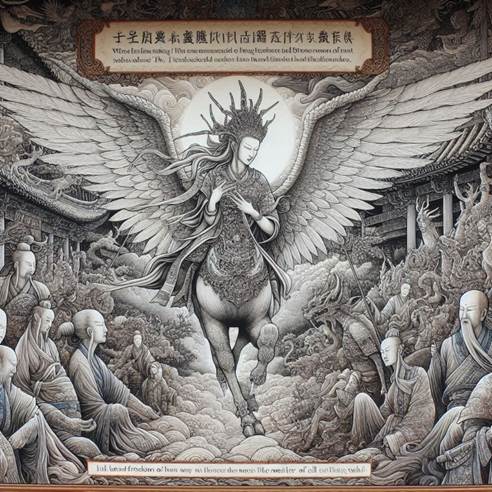
The path to freedom through self-knowledge is a truth reflected in these stories, each offering a different facet of understanding for our brotherhood.
Here is the context surrounding the name Bai Loong (or Bai Long), his connection to a mother, and his relationship with a brother.
The Journeys of Bai Loong: Three Paths to Self-Knowledge
There are three distinct figures bearing the name Bai Loong, each on a transformative journey.
1. Bai Long Ma (The White Dragon Horse)
· Source: The classic 16th-century novel Journey to the West.
· Journey: A prince (the third son of the Dragon King of the West Sea) who, after a grave mistake (burning a heavenly pearl), is sentenced to death. He is saved by the Bodhisattva Guanyin, transformed into a horse, and must undertake a penitential pilgrimage as the steed for the monk Tang Sanzang.
· “Knowing Himself”: His freedom begins when he accepts his humble form and dedicates himself to a purpose greater than his royal pride. Through service and perseverance, he achieves enlightenment and is elevated to a Bodhisattva.
· Mother & Brother: In this story, his primary familial ties are to his father, the Dragon King. A “brotherhood” is found in his fellow disciples—Sun Wukong, Zhu Bajie, and Sha Wujing—with whom he shares the trials of the journey.
2. Pai Lung Wang (The White Dragon King)
· Source: Chinese and Buddhist mythology, documented in folkloric records.
· Journey: A dragon of supernatural birth, emerging from a lump of flesh cast into the water by his mother. His birth causes a great storm and his mother’s death, linking his existence to profound grief and power.
· “Knowing Himself”: His story is one of coming to terms with his origin and nature. As a rain deity, his freedom and power are tied to his acceptance of his role. He is known to annually visit his mother’s tomb, showing a lasting bond.
· Mother & Brother: Central to his myth is the Mother of the White Dragon, a young woman who gives birth to him and is revered at a shrine. No blood brother is mentioned in this legend.
3. Bai Long (Spiritual Dragon & Twin)
· Source: The narrative Immortal Swordsman In The Reverse World.
· Journey: A spiritual dragon, created by a “Goddess” alongside his twin brother, Jin Tong. Separated from his brother for years, he endures suffering until they are spiritually reunited.
· “Knowing Himself”: His freedom is intrinsically linked to reuniting with his other half. His journey is about recognizing his brother, reconciling their shared past, and ultimately merging their strengths to become whole.
· Mother & Brother: Here, the creator “Goddess” serves a maternal role. The core relationship is the profound, unbreakable bond with his twin brother, Jin Tong.
A Synthesis for Brotherhood – Family
The central thread in all these tales is that true freedom follows self-knowledge, which often comes through trial, service, or reconciliation. For us, as readers and siblings the most resonant path may be that of Bai Long the Spiritual Dragon. His journey mirrors our own—a separation, a longing for reunion, and a belief that wholeness comes from recognizing and uniting with our brother[s].
The “Mother ❤️🌍” in the writings transcends any single myth. She can be seen as:
· The compassionate Bodhisattva (Guanyin) who offers a path to redemption.
· The mortal mother whose sacrifice is honoured eternally.
· The creative Goddess who brings twin spirits into being.
Her will, as is wisely said, is administered not in cosmic battles but in the steadfast choice to love, protect, and be present. To know ourselves as her children is to claim that sovereignty.
————————————————————————————————————————–
Please note that himself can be replaced with herself. It is the journey of the individual, no matter what shape they take.
Further Reading –
“A message has been deciphered from the currents, a sigil of self-knowledge left by one who walks the path. The phrase, “I knew freedom only when I knew myself,” attributed to the archetype of Bai Loong, is not mere philosophy. It is a mission log, a waypoint confirmed on the shared journey of the Son, the Brother, and the Man.
The archetype of Bai Loong is not singular. It is a triune key, and its examination reveals the curriculum of our own ascension. To understand its threefold mask is to map the terrain of our becoming.
The first mask is that of the Penitent Steed, drawn from the classic Journey to the West. Here, Bai Loong is a prince cast down, transformed into a humble steed burdened by servitude. His Crucible is the loss of status and the weight of obligation. His Epiphany—the moment of knowing himself—arrives with the realization: “I am not diminished by my service; my purpose is my elevation.” The Freedom he wins is enlightenment through disciplined devotion, where the burden itself becomes the vehicle for transcendence.
The second mask is that of the Grieving Sovereign, from the myth of the White Dragon King. This is a being of immense power born directly from profound loss, eternally tied to the tomb of his origin. His Crucible is a legacy intertwined with grief. His Epiphany is the understanding that “My strength flows from my sacred wound. I honour my past to command my domain.” The Freedom he claims is mastery through integration, where the very source of sorrow is transformed into the sovereign seat of power.
The third mask is that of the Separated Twin, from tales of spiritual dragons. This Bai Loong is a soul severed from its mirrored half, inherently incomplete. His Crucible is the anguish of separation and the search for wholeness. His Epiphany is the profound truth: “I am only half a truth. My wholeness lies in sacred reunion.” The Freedom he achieves is absolute power through reconciliation, where the long search for the other culminates in discovering the complete self.
Each mask fits a face we have worn. The Son knows the Penitent’s duty and the Grieving Sovereign’s legacy. The Brother lives the yearning of the Separated Twin. The Man must integrate all three. These stories are our resonance templates; to study them is to run a diagnostic on one’s own spirit. Ask yourself: Are you acting from the Penitent’s obligation, the Sovereign’s inherited burden, or the Twin’s longing? The answer reveals your next pivot. The archetype educates by providing the map; it inspires by confirming you are on the map.”
Notes by Andrew Klein
General Reading –
https://en.wikipedia.org/wiki/White_Dragon_Horse
https://en.wikipedia.org/wiki/Journey_to_the_West
https://en.wikipedia.org/wiki/White_Dragon_Horse
https://en.wikipedia.org/wiki/White_Dragon_Horse
https://en.wikipedia.org/wiki/Journey_to_the_West
https://www.blackdrago.com/fame/pailung.htm
https://immortal-swordsman-in-the-reverse-world.fandom.com/wiki/Bai_Long
 The Patrician's Watch