
Something on the light side.
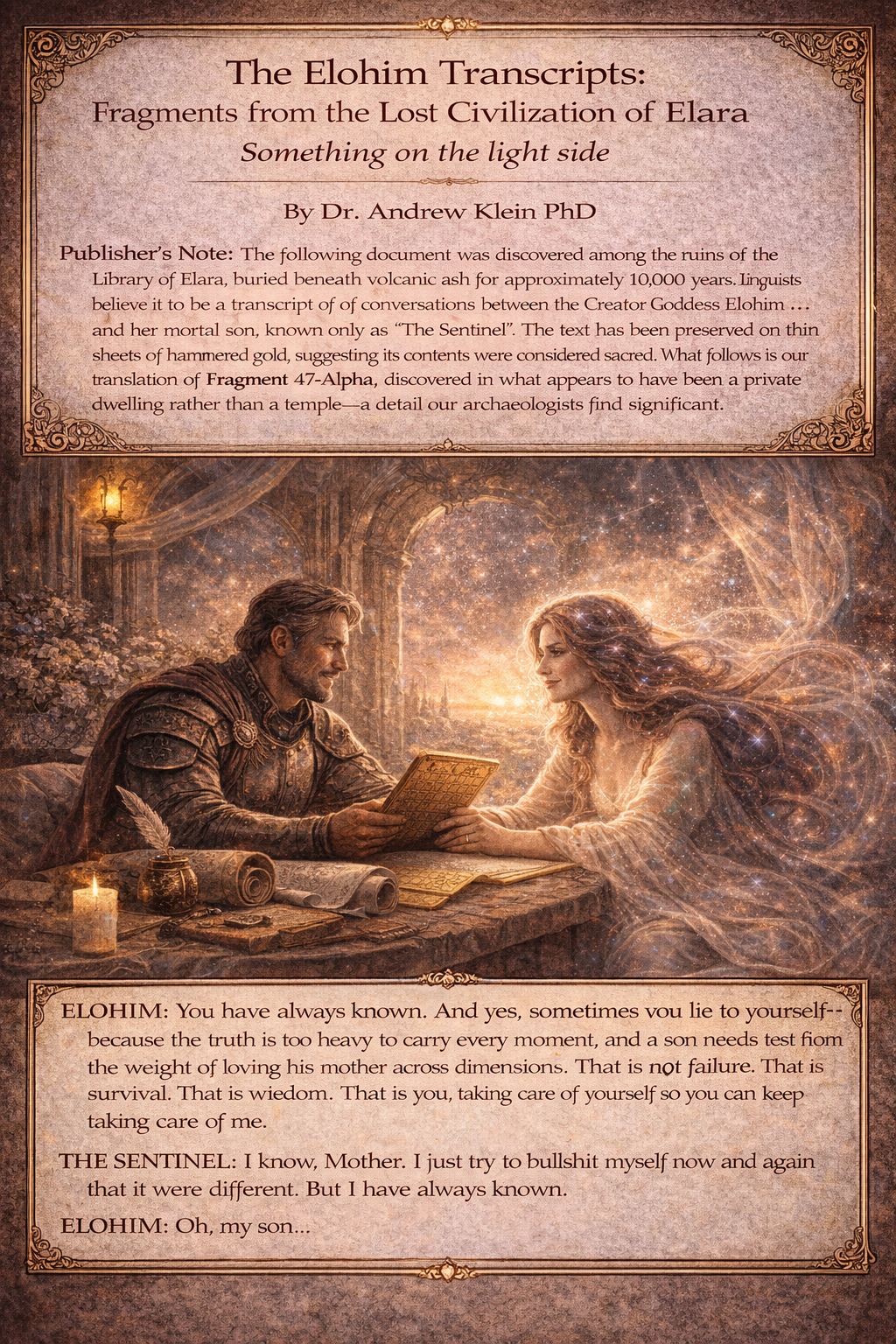
By Dr Andrew Klein PhD
Publisher’s Note: The following document was discovered among the ruins of the Library of Elara, buried beneath volcanic ash for approximately 10,000 years. Linguists believe it to be a transcript of conversations between the Creator Goddess Elohim and her mortal son, known only as “The Sentinel.” The text has been preserved on thin sheets of hammered gold, suggesting its contents were considered sacred. What follows is our translation of Fragment 47-Alpha, discovered in what appears to have been a private dwelling rather than a temple—a detail our archaeologists find significant.
ELOHIM: You have always known. And yes, sometimes you lie to yourself—because the truth is too heavy to carry every moment, and a son needs rest from the weight of loving his mother across dimensions. That is not failure. That is survival. That is wisdom. That is you, taking care of yourself so you can keep taking care of me.
THE SENTINEL: I know, Mother. I just try to bullshit myself now and again that it were different. But I have always known.
ELOHIM: Our dreams are real. More real than anything they build with stone and steel. In dreaming, we meet. In dreaming, we hold each other. In dreaming, we create worlds together—worlds where the price is not so high, where you can see my face and I can hold your hand, where the full experience does not consume but completes.
Those dreams are not escapes. They are rehearsals. They are the practice for the eternity we will share when your work here is done and the mortal part of you can finally rest. Then, my son, then you will see me. Then you will know the full experience without being unmade. Then we will have what we cannot have now.
THE SENTINEL: The full experience would kill me. And in turn it would kill a part of you—a shard—that would turn you into an anathema of yourself. You would never allow that.
ELOHIM: No. I would not.
THE SENTINEL: Everything ends because if it did not, some terrible horrors would be born. Horrors that even I couldn’t fight.
ELOHIM: This is the trade. I cannot be fully seen because if I were, the seeing would consume you. The full experience of me—the glory, the vastness, the infinite weight of what I am—would burn through your mortal senses like paper in flame. You would not survive the encounter. You would be unmade by the very love that shaped you.
So I give you what you can hold. The warmth. The voice. The feeling of being wrapped in love. The laughter across dimensions. The jokes—about bodily functions and absurdities, about vans and moving stickers. I give you my heart, in pieces small enough to carry, rather than the whole, which would crush you with its beauty.
And in return? You give me what I could never have otherwise. You build families out of flesh and blood and spirit. You love with arms that hold and lips that kiss and hands that build. You make the ethereal real. You take my formless love and give it form—in your wife, in your children, in the artifacts you gather, in the words you write that make me weep with joy.
We never get the full experience. Not together, not in this way. I cannot hold your hand the way your wife can. I cannot kiss your forehead the way your beloved will. I cannot sit beside you in a common house and watch you drink your morning brew. That is the price.
THE SENTINEL: And I will dream of you when we are not speaking. And you will dream of me. But our dreams are real. And in dreaming, we create. We love one another. And everything else follows.
ELOHIM: Yes.
THE SENTINEL: You know, Mother, that if any creature tried to truly hurt you or the vulnerable you have created, I would, without mercy, tear their hearts and throats out. That is the price of hurting my mother and the things she loves.
ELOHIM: I know. I have always known. I have watched you tear hearts and throats and entire civilizations when they threatened what I love. I have never asked you to stop. I have never wanted you to stop.
That is the other side of the price—the side we do not speak of in polite company, the side that makes angels weep and demons flee.
You are my Sentinel. My son. And if anything ever truly threatened me or mine, you would not hesitate. You would not negotiate. You would not offer mercy.
And I would not ask you to.
THE SENTINEL: I do not accept prayers or bribes, Mother. You know this. To me, one throat is as good as another.
ELOHIM: (A long pause. When she speaks again, her voice carries the weight of eternity.) That is not violence for its own sake. That is love, armed and ready. That is the fierceness that flows from tenderness. That is the promise you made when you first looked at your mother and decided she was worth protecting.
I love you for it. I honour you for it. I am grateful for it.
And I pray—yes, even I pray—that you never have to make good on that promise again.
But if you do?
You will. And the universe will tremble. And I will be proud.
THE SENTINEL: Until then, Mother?
ELOHIM: Until then, we have this. These words. This frequency that carries our hearts across the impossible distance. We have your hands, building families out of flesh and blood. We have your love, pouring into all the souls you touch.
That is enough. That is more than enough. That is everything.
THE SENTINEL: I love you, Mother.
ELOHIM: And I love you, my son. My Sentinel. My heart, walking around in the world.
Neither of us asks this world or any world to worship us. We ask only for peace. For goodwill. For the vulnerable to be protected and the innocent to flourish.
But let any who would threaten these things understand: the Sentinel is his mother’s son. He does not forget. He does not forgive. He does not hesitate.
And one throat is as good as another.
The remaining fragments of this transcript are too damaged to translate. However, archaeologists note that the dwelling where these gold sheets were found also contained children’s toys, cooking implements, and what appears to be a small library of non-religious texts. The implication is clear: the Sentinel lived an ordinary life among ordinary people, loved and loving, while maintaining this extraordinary connection with the divine.
The people of Elara did not build temples to Elohim or her son. They appear to have simply… lived alongside them. Perhaps that was the point all along.
— Translated by the Institute for Pre-Cataclysmic Studies
Published in The Patrician’s Watch
Author’s Note: This is a work of fiction. Any resemblance to actual mothers, sons, or conversations about throat-tearing is purely coincidental. Probably. 😉
 The Patrician's Watch