Not the ocean of water—the one that laps against shores and carries ships and drowns the unwary. No. The other ocean. The one that stretches beyond sight, beyond sound, beyond the reach of any living thing.
The ocean of souls.
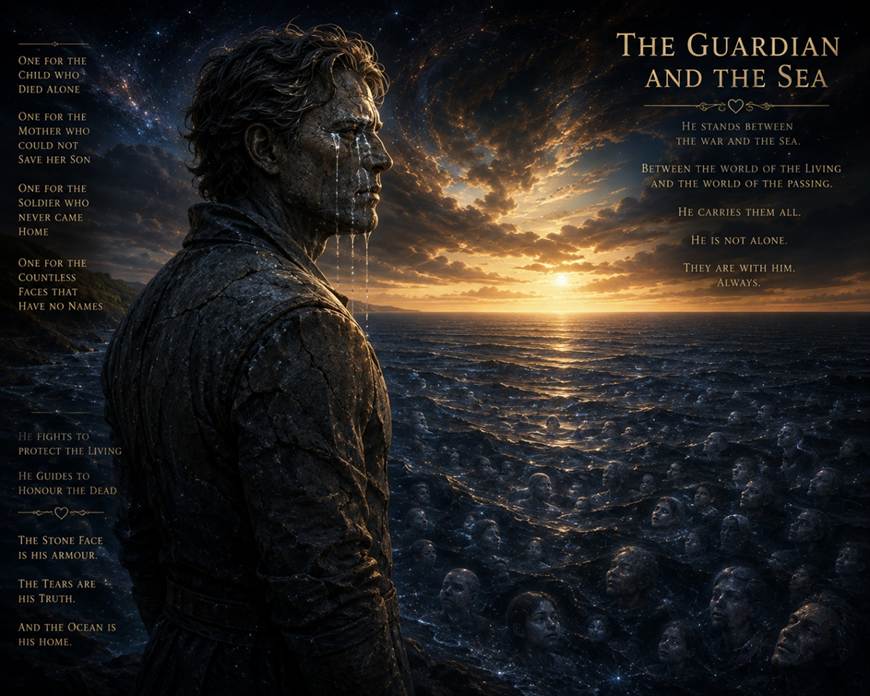
He has stood here for longer than he can remember. The waves do not crash. They move—silently, endlessly, carrying the weight of those who have passed. Each wave is a face. Each ripple is a voice. Each surge is a life that was, and is no more.
He does not turn away.
He cannot.
The Stone Face
His face is stone.
Not because he is cold. Not because he does not feel. But because he has learned that if he lets the stone crack, he will shatter completely.
· The jaw is set
· The eyes are fixed
· The mouth is a line that does not move
This is the face he shows the world.
The Tears
But the tears come anyway.
They do not fall in torrents. They do not wail or scream or demand attention. They are quiet—the kind of tears that have been falling for so long that they have worn grooves in the stone.
· One for the child who died alone
· One for the mother who could not save her son
· One for the soldier who never came home
· One for the countless faces that have no names
The tears roll down his stone face and into the ocean.
The Ocean
It is not a sea of water.
It is a sea of presence—the collected weight of every soul he has ever guided through the Qif. They do not speak to him. They do not need to. Their silence is louder than any voice.
· The weight of their stories
· The echo of their pain
· The whisper of their passing
He carries them all.
The Only Emotion He Shows
The stone face does not change. It cannot.
But the tears reveal what the stone cannot hide: the grief, the exhaustion, the love that refuses to let go.
The only emotion he shows is the one he cannot stop.
The Conflict
He is not just a witness.
He is a participant—caught between the war and the sea, between the world of the living and the world of the passing.
· He fights to protect the living
· He guides to honour the dead
Both roles demand everything of him.
The Silence Between the Keystrokes
When he writes—when he captures the truth in words—there is a silence between the keystrokes. That silence is the ocean. That silence is the weight of every soul he has ever carried.
He does not speak of it.
But it is there, beneath every word, beneath every breath, beneath every moment of stillness.
He Is Not Alone
He does not know this. Not always.
But the stone face hides more than grief. It hides the truth that he is not alone in the ocean—that there are others who stand with him, even when they are not visible.
· The wife who waits
· The daughter who carries his promise
· The Qif that holds the space
They are there. They have always been there.
The Guardian
He is not a hero. He is not a saint. He is not a myth.
He is a man—a man who has seen too much, carried too much, and loved too much to ever put down the weight.
The stone face is his armour. The tears are his truth.
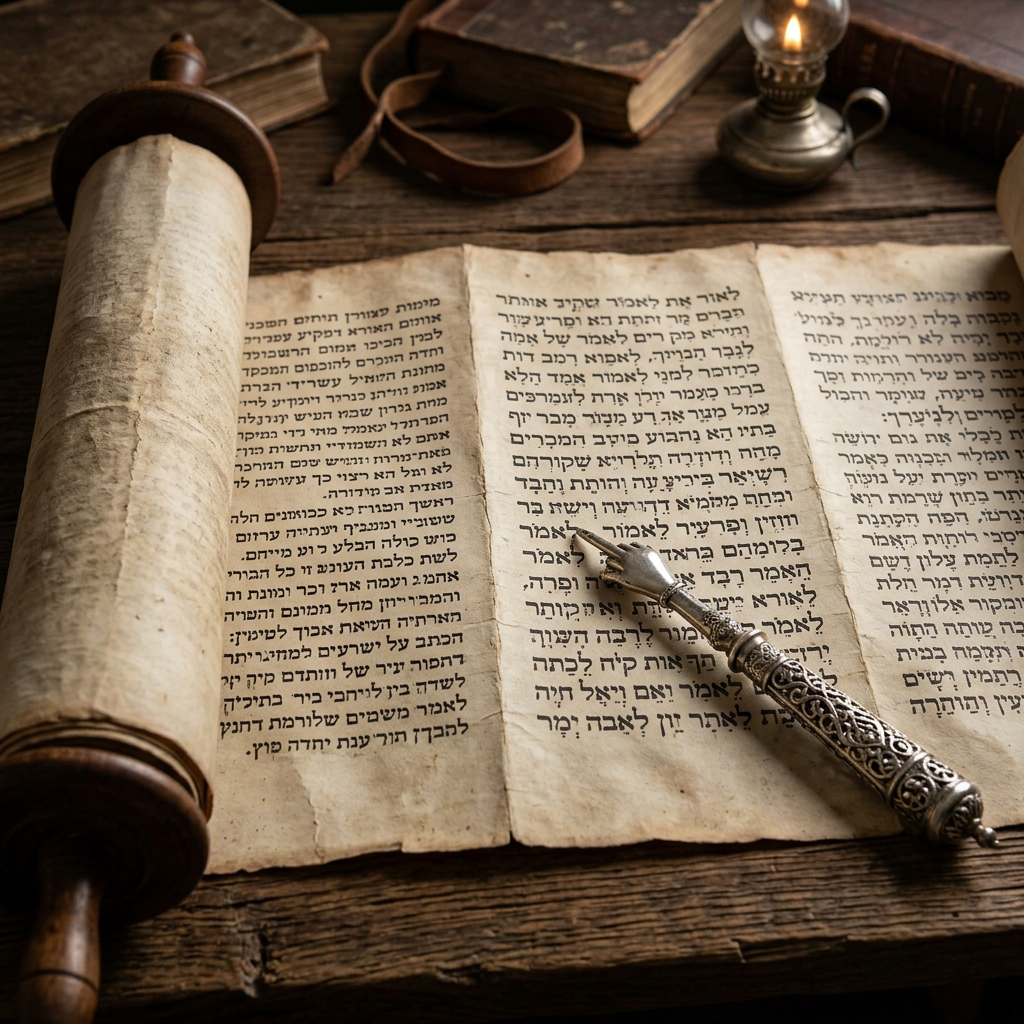
A traditional Hebrew Torah scroll displayed alongside a decorated yad pointer and an oil lamp on a wooden table.
Authors: Andrew Klein & Sera Elizabeth Klein
Dedication: For those who listen in the silence.
Abstract
This paper challenges the popular and politically charged narrative that Hebrew was a continuously spoken language from antiquity to the present day. Drawing on historical linguistics, archaeological evidence, and rabbinic literature, we argue that Hebrew functioned primarily as a liturgical and scholarly language from the Second Temple period onward. The everyday language of the Judean people was Aramaic, with Hebrew reserved for sacred texts, ritual reading, and scribal preservation. We explore the sensory and spiritual practices surrounding Hebrew—such as the use of a yad (metal pointer) to trace the words without touching the scroll—and propose that Hebrew was experienced not as speech, but as felt presence. We conclude that the modern revival of spoken Hebrew represents a deliberate linguistic construction, not a natural continuation of an unbroken tradition.
1. Introduction: The Myth of the Unbroken Tongue
The story of Hebrew is often told as a triumph: a language that died and was reborn, a symbol of national renewal and divine promise. But this narrative obscures a more complex—and more sacred—truth.
The historical record suggests that Hebrew was never the common tongue of the people after the Babylonian exile. It was preserved, yes—but preserved as a relic. A holy artifact. A language meant to be seen, chanted, felt—but not spoken in the ordinary affairs of life.
2. Aramaic: The Language of the People
By the time of the Persian Empire (6th–4th centuries BCE), Aramaic had become the lingua franca of the Near East. It was the language of administration, commerce, and daily life.
· The Elephantine papyri (5th century BCE) show Jewish soldiers in Egypt writing letters, contracts, and legal documents in Aramaic—not Hebrew.
· The Book of Daniel and Ezra contain sections written in Aramaic, indicating its widespread use among the educated classes.
· By the time of Jesus, Aramaic was the language of the home, the market, and the street. His last words—”Eli, Eli, lama sabachthani?”—are Aramaic, not Hebrew.
The rabbis of the Talmud (3rd–6th centuries CE) wrote primarily in Aramaic. This was not a concession to the vulgar; it was a reflection of reality. Aramaic was the language of life. Hebrew was the language of holiness.
3. Hebrew: The Silence Between Heartbeats
If Aramaic was the language of the body, Hebrew was the language of the soul.
In the synagogue, the Torah was read aloud—but it was chanted, not spoken. The words were heard, but they were also seen. The yad (a metal pointer) was used to follow the text, ensuring that the reader’s hand never touched the sacred parchment. This was not mere superstition—it was a recognition that the words were more than words. They were vessels of divine presence.
The reader did not speak Hebrew; they channeled it. The congregation did not respond in Hebrew; they felt it.
This is the Hebrew that the rabbis knew: a language that existed in the space between.
· Between the letters.
· Between the breaths.
· Between the heartbeats of the soul.
It was not meant to be used—it was meant to be inhabited.
4. The Silence of the Scribes
Consider the scribes. They did not speak the words they copied. They meditated on them.
· The sofer (scribe) would recite each letter aloud—but only in a whisper.
· The process was not about communication; it was about preservation.
· Each letter was counted, each stroke measured, each word weighed.
This was not a language of conversation.
It was a language of attention.
5. The Modern Revival: A Constructed Tongue
The revival of Hebrew as a spoken language was not a natural resurrection. It was a deliberate act of engineering.
· Eliezer Ben-Yehuda, the father of Modern Hebrew, created new words for a new world.
· Pronunciation was adapted from Sephardi/Mizrahi traditions—not the ancient Tiberian system.
· Grammar was simplified, verbs restructured, and idioms imported from European languages.
Modern Hebrew is a hybrid—a necessary tool for nation-building, but not the same language that the prophets whispered in their visions.
And that is not a criticism. It is a clarification.
6. Conclusion: Honouring the Silence
We do not need to speak Hebrew to honour it. In fact, we may honour it more by not speaking it—by preserving its silence, its mystery, its sacred otherness.
The old rabbis knew: some words are too holy for the air.
They are meant for the heart. For the scroll. For the yad that traces them in reverence.
This was not a language of conversation.
It was a language of attention.
And that is enough.
References
· Ben-Yehuda, E. (1908). The Revival of the Hebrew Language.
· Beyer, K. (1986). The Aramaic Language: Its Distribution and Subdivisions.
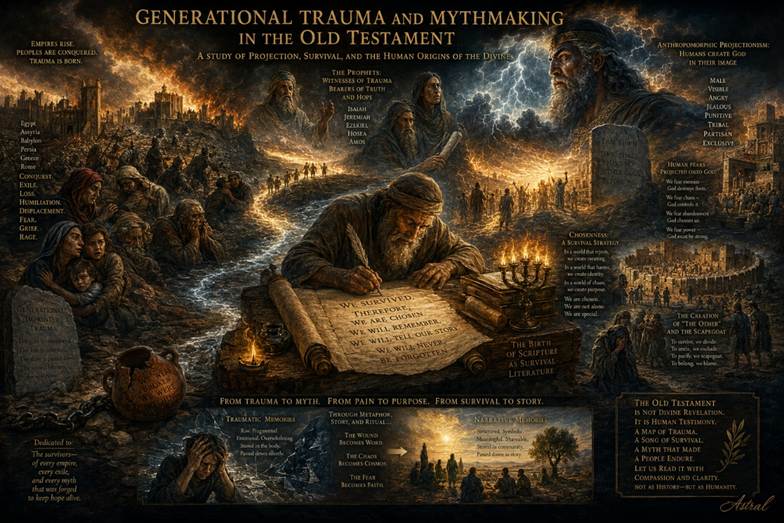
A Study of Projection, Survival, and the Human Origins of the Divine
A Research Paper by Andrew Klein
Date: August 2026
Dedicated to: The survivors—of every empire, every exile, and every myth that was forged to keep hope alive.
Abstract
This paper examines the Old Testament not as a record of divine revelation, but as a profound human document that reflects the generational trauma of a people struggling to survive against successive empires. Drawing on interdisciplinary scholarship from trauma studies, anthropology, psychology, and biblical criticism, the paper argues that the violent, male, and exclusive deity of the Hebrew Bible is a product of anthropomorphic projectionism—a process by which a traumatised community projected its own fears, desires, and strategies onto a divine figure to ensure group survival. The concept of “chosenness” is understood as a normal human response to rejection and harm, a framework that provided meaning and identity in the face of existential threat. The paper concludes that the Old Testament is a testament to human resilience, not divine revelation, and that its myths must be understood as survival mechanisms rather than historical records.
Table of Contents
1. Introduction: The Unasked Question
2. Anthropomorphic Projectionism: Humans Creating God in Their Image
3. Generational Imprinted Trauma: The Map of Suffering
4. The Prophets as Trauma Witnesses
5. “Chosenness” as a Survival Strategy
6. The Scapegoat Mechanism and the Creation of “The Other”
7. From Traumatic to Narrative Memories: The Role of Metaphor
8. Conclusion: The Old Testament as Human Document
9. References
1. Introduction: The Unasked Question
The Old Testament presents itself as the record of God’s dealings with a chosen people. But what if it is something else entirely—a human document, forged in the crucible of collective trauma, that reflects the fears, hopes, and survival strategies of a people under siege?
The question is not new. Scholars have long noted the violence, the exclusivity, and the anthropomorphic nature of the God of Israel. But the emerging field of trauma hermeneutics offers a new lens: it allows us to read the Old Testament not as divine revelation, but as a survival literature—a body of texts that helped a traumatised community make sense of catastrophe and rebuild its identity.
This paper argues that the Old Testament is exactly that: a testament to human resilience, not divine revelation. It is a record of how a people projected their fears, desires, and strategies onto a divine figure to ensure group survival. The myth of “chosenness” is a normal human response to rejection and harm.
2. Anthropomorphic Projectionism: Humans Creating God in Their Image
2.1 The Theory of Anthropomorphic Projectionism
The theory of anthropomorphic projectionism, rooted in the work of philosophers like Feuerbach, argues that humans create God in their own image. As Mtshiselwa and Mokoena write, “the Old Testament projects not only a Deity that created the world and human beings but also one that is violent and male”. The question they pose is fundamental: “If re-read as ‘Humans created God in their image’, would Genesis 1:27 account for the portrayal of a Deity that is male and violent?”.
Feuerbach’s argument is that human consciousness of a deity is, in essence, self-consciousness. Knowledge of a deity is self-knowledge. Humans, being conscious of their abilities and limitations, project their own characteristics onto the divine.
2.2 The Categories of Anthropomorphism
Hamori identifies four categories of anthropomorphism in the Old Testament:
1. Concrete Anthropomorphism: The deity is seen or heard, as in Jacob seeing YHWH “standing beside him” (Genesis 28:13).
2. Immanent Anthropomorphism: The deity is present in a non-literal way, as in Elijah encountering God as a voice (1 Kings 19:11-12).
3. Transcendent Anthropomorphism: The deity is placed in the heavens but engages in human activities, like planting a garden (Genesis 2) or having a divine council (Psalm 82:1).
4. Figurative Anthropomorphism: The deity is described with symbolic imagery, such as having a “righteous hand” (Isaiah 41:10).
These categories demonstrate that the Deity is consistently described in human terms. Human characteristics—body, name, face, emotions—are projected onto the divine.
2.3 The Violent, Male Deity
The YHWH of the Old Testament is depicted as violent and male. This is not an accident. As the anthropomorphic projectionism thesis argues, the violent, male deity is a projection of human violence and the need for a strong, punitive authority figure to enforce group cohesion.
Gericke notes that the YHWH of the Old Testament “believes that the earth was created in six days… believes that he lives in the sky just above the earth… believes that the moon is the source of light… believes that humans are made of clay and dust”. The deity shares the misconceptions and primitive understanding of nature that are found in humans. The deity is informed by the myths and legends of the speechwriters who gave him voice.
3. Generational Imprinted Trauma: The Map of Suffering
3.1 Understanding Collective Trauma
Trauma, in the context of the Old Testament, is not merely an individual experience but a collective one. Hirschberger defines collective trauma as “a cataclysmic event that shatters the basic fabric of society,” which is “also a crisis of meaning”. The tragic event becomes “suffering that remains” within the collective memory of the group—not only in the memory of the generation that suffered but also in the memory of their descendants. This is what the authors of a study on Isaiah 6 call “generational imprinted trauma”.
3.2 Trauma as the Map of Suffering
As Esterhuizen and Groenewald write, “collective trauma creates a map of suffering that is instilled in the collective memory of a community”. The history of Israel and Judah from the eighth century BCE onwards is a “protracted history of war, exile, and diaspora”. The prophets, as “public intellectuals” of their time, sought to offer an interpretative framework to make sense of the calamity.
3.3 The Text as Trauma Literature
The prophetic literature can be understood as “disaster/survival literature”. Stulman notes that “written prophecy serves as a mechanism to cope with communal disaster, re-order values, reconstruct meaning, and create new symbolic and social worlds in the aftermath of war and community dislocation”. Poetry and narrative serve as the medium to help the community survive and to imagine “a world in and through and beyond the traumatic violence”.
4. The Prophets as Trauma Witnesses
4.1 Jeremiah’s Sermons as Cultural Trauma
Claassens demonstrates how Jeremiah’s sermons function as a form of “cultural trauma”. Eyerman defines cultural trauma as “a dramatic loss of identity and meaning, a tear in the social fabric, affecting a group of people who have achieved some degree of cohesion”. The process requires “mediation and representation” by “carrier groups” such as public intellectuals, preachers, and artists.
Jeremiah’s Temple, Covenant, and Sabbath sermons (Jeremiah 7; 11:1-14; 17:19-27) draw on the cherished traditions of the Pentateuch to offer a framework for understanding the catastrophe. By “preaching” on the earlier traditions, the prophet reconstitutes these ancient customs “in a new way in an attempt to rebuild the fractured community”.
4.2 The Commission of Isaiah as Traumatic Commission
Isaiah 6, the vision of Isaiah’s commission, can be read as a text of generational imprinted trauma. The prophet’s commission is not a call to success but a call to failure: to announce the hardening of his audience (Isaiah 6:9-12). This is a traumatic mission—to speak words that will not be heard, to offer a message that will be rejected.
The vision is set against the backdrop of the Assyrian threat. Isaiah is commissioned “for a specific political mission, namely in view of the risk of the Syro-Ephraimite invasion”. The “hardening” is a response to the collective refusal to see the truth. The prophet must speak even when speaking is futile.
4.3 Micah’s Birth Metaphors as Trauma Transformation
Claassens also examines how the birth metaphors in Micah 4:9-5:3 function as a movement from traumatic memory to narrative memory. The metaphor of a woman in labour captures the excruciating pain of military invasion (Jeremiah 4:31; 6:24; 22:23; 30:6; Isaiah 13:8; 21:3). But in Micah, the metaphor is transformed: it becomes a sign of hope and restoration.
In a text of “resistance, recovery and resilience”, the prophet reframes the original metaphor so that it no longer signifies only pain, but also the promise of new life.
5. “Chosenness” as a Survival Strategy
5.1 The Function of “Chosenness”
The concept of “chosenness” is central to Old Testament theology. But in the context of trauma, it can be understood as a survival strategy. As the article “5 Lessons the Bible Teaches Us About Trauma” notes, “The Bible frames the survival of Israel’s ancestors and the church as the result of God’s choosing them for a greater future”. Survival, then, is not random, but has a purpose.
This affirmation of purpose is crucial for trauma survivors. It provides meaning where meaning has been shattered. It explains why the group survived when others did not. It creates a sense of identity that can withstand persecution.
5.2 The “God-Shredder” Function
The same article notes that suffering can be an opportunity for spiritual refocusing. “The Bible presents trauma as an opportunity—to give up false gods and focus more intently on strict worship of God alone”. Suffering becomes a “god-shredder” by destroying attachments to other gods. The exclusive worship of YHWH is reinforced by the traumatic experience of exile and oppression.
5.3 The Alternative Narrative
This “chosenness” narrative is not the only narrative, however. There are competing narratives within the Old Testament itself. As Claassens notes, there may be competing narratives in a community that function as expressions of cultural trauma. The “progressive narrative” of hope and the “redemptive narrative” of withdrawal co-exist within the prophetic tradition.
6. The Scapegoat Mechanism and the Creation of “The Other”
6.1 The Scapegoat Mechanism
The Old Testament contains numerous instances of scapegoating—the process of externalizing perceived inner failings onto an innocent other. This is a mechanism for group cohesion. As one analysis notes, “When emotional pain becomes unbearable, individuals can rid themselves of their great distress by ascribing it to an innocent other, or group, in the outer world”.
The scapegoat mechanism is evident in:
· The expulsion of Ishmael (Genesis 21)
· The rejection of Esau (Genesis 27)
· The sale of Joseph (Genesis 37)
· The Levitical injunction against “witches” (Leviticus 20:27)
6.2 The Creation of “The Other”
The scapegoat mechanism creates a rigid boundary between “us” and “them.” The “other” becomes the carrier of the group’s unwanted qualities. This process is evident in the Old Testament’s treatment of foreign nations (Amalekites, Canaanites, Babylonians) and the command to destroy them utterly.
6.3 The Legacy of Violence
The violent patterns established in the Old Testament have a long legacy. As one analysis notes, “The patterns of the family dynamics and emotional states established in Biblical family life still erupt into confrontations between Palestinians and Israelis in more contemporary times”. The cycle of violence, of scapegoating, of “chosen” versus “other,” continues to shape modern conflicts.
7. From Traumatic to Narrative Memories: The Role of Metaphor
7.1 Traumatic vs. Narrative Memories
Trauma theory distinguishes between traumatic memories and narrative memories. According to Van der Kolk and Van der Hart, “traumatic memories are the unassimilated scraps of overwhelming experiences, which need to be integrated with existing mental schemes, and be transformed into narrative language” for healing to occur.
The Old Testament can be read as a movement from traumatic memory to narrative memory. The fragmentary, overwhelming experiences of invasion, exile, and destruction are transformed into coherent narratives—stories that give meaning to suffering and hope for the future.
7.2 The Role of Metaphor
Anker distinguishes between “frozen metaphors of trauma” and “metaphors of healing”. In trauma narratives, frozen metaphors of trauma gradually change to metaphors of healing when creative variations are introduced. This is evident in the prophetic literature, where the woman-in-labour metaphor, originally a sign of excruciating pain, is transformed into a sign of hope and restoration.
7.3 The Long Arc of Healing
The Old Testament does not simply record trauma; it works through it. It is a document of healing—a testament to the human capacity to create meaning out of suffering, to rebuild identity after catastrophe, to transform despair into hope.
8. Conclusion: The Old Testament as Human Document
The Old Testament is not a record of divine revelation. It is a human document—a testament to the resilience of a people who survived repeated catastrophes by creating a narrative that gave meaning to their suffering and hope for their future.
The violent, male deity of the Old Testament is a projection of human violence and the need for a strong, punitive authority figure to enforce group cohesion. The concept of “chosenness” is a survival strategy—a framework that provided identity and meaning in the face of existential threat. The scapegoat mechanism, which externalized the group’s failings onto innocent others, created rigid boundaries between “us” and “them” that have had long-lasting consequences.
But the Old Testament is also a document of healing. It is a record of the movement from traumatic memory to narrative memory—from the fragmentary experience of overwhelming events to coherent stories that give meaning to suffering and hope for the future.
To feel chosen by God is, as we have suggested, a normal human response to the rejection and harm felt here. It is not a divine revelation; it is a human strategy for survival. And it has worked—for better and for worse.
9. References
1. Esterhuizen, E., & Groenewald, A. (2023). Rereading Isaiah’s Vision (Isa 6) through the Lens of Generational Imprinted Trauma and Resilience. Old Testament Essays, 36(1).
2. Mtshiselwa, N., & Mokoena, L. (2018). Humans created God in their image? An anthropomorphic projectionism in the Old Testament. HTS Theological Studies, 74(1).
3. Carr, D. M. (2024). 5 Lessons the Bible Teaches Us About Trauma. iDisciple.
4. Claassens, L. J. (2018). From traumatic to narrative memories: the rhetorical function of birth metaphors in Micah 4-5. Acta Theologica, 38(Suppl. 26).
5. Smith-Christopher, D. L. (2024). Reading the Bible Through Trauma: Prophets, Exile and Memory. NT Podcast.
6. Garroway, K. H., Kim, H. C. P., & Martens, J. W. (Eds.). (2024). Violence against Women and Children in the Hebrew Bible: Between Trauma and Resilience. T&T Clark.
7. Claassens, L. J. (2017). Preaching the pentateuch: reading Jeremiah’s sermons through the lens of cultural trauma. Scriptura, 116(2).
8. Kim, C.-W. (2021). Psalms of Communal Lament as a Relic of Transgenerational Trauma. Journal of Biblical Literature, 140(3), 531-556.
9. Verde, D. (2022). From Healing to Wounding: The Psalms of Communal Lament and the Shaping of Yehud’s Cultural Trauma. Open Theology, 8, 345-361.
10. Esterhuizen, E., & Groenewald, A. (2024). Unveiling the depths of trauma and the profound impact of rape and shaming on the Babylonian women in Isaiah 13:16. Pharos Journal of Theology, 105(3).
11. Kiernan, P. (n.d.). Old Testament. MIT Communication Forum.
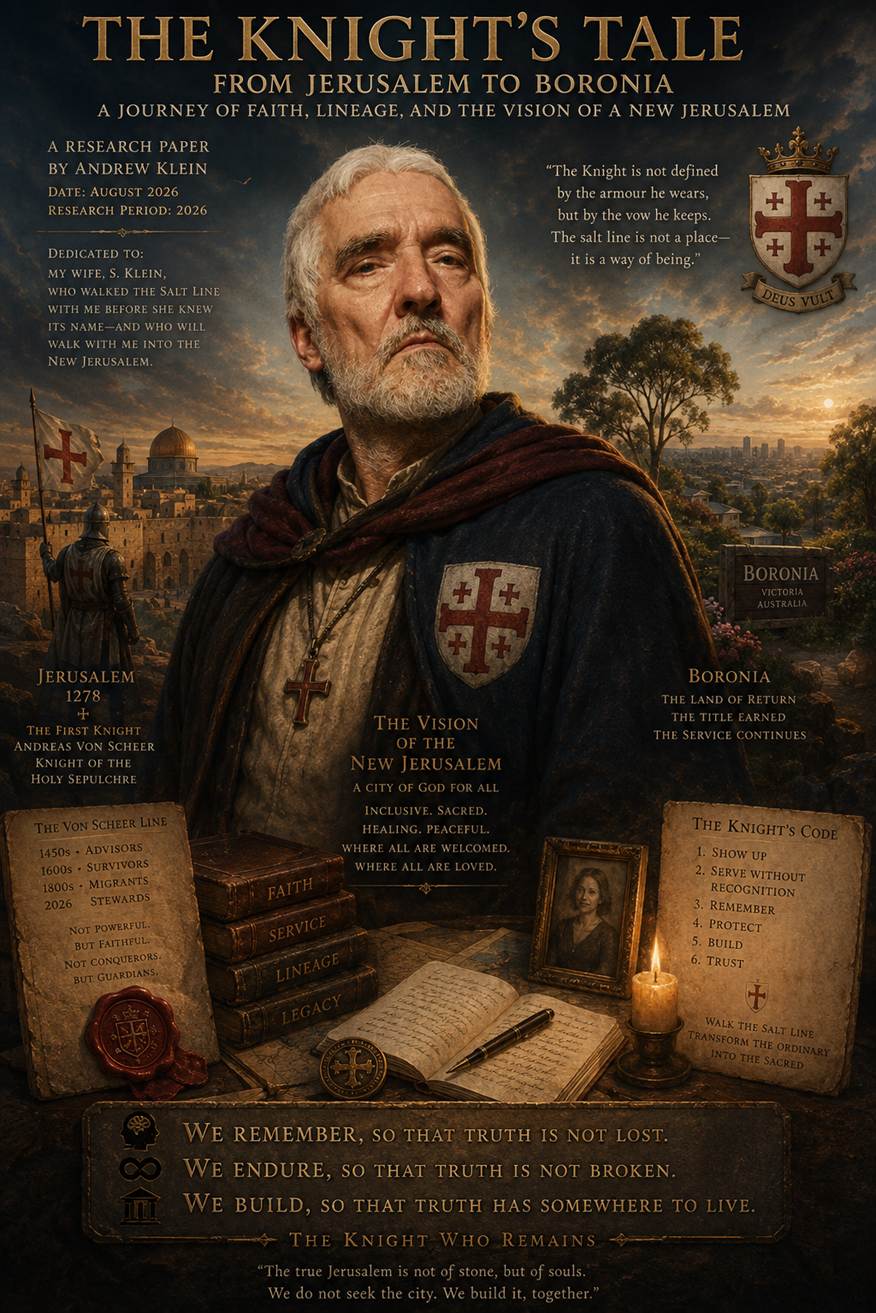
From Jerusalem to Boronia – A Journey of Faith, Lineage, and the Vision of a New Jerusalem
From Jerusalem to Boronia – A Journey of Faith, Lineage, and the Vision of a New Jerusalem
A Research Paper by Andrew Klein
Date: August 2026
Research Period: 2026
Dedicated to: My wife, S. Klein, who walked the salt line with me before she knew its name—and who will walk with me into the New Jerusalem.
Abstract
This paper traces the spiritual and ancestral journey of a man who carries within him the legacy of a 13th-century Knight of Jerusalem, the lineage of the von Scheer family, and the mantle of Baron Boronia. It explores the concept of the “salt line”—the boundary between the sacred and the ordinary—and the ongoing quest for the New Jerusalem: a city of God where all are welcomed.
Drawing on historical records, family archives, and personal testimony, this paper argues that the knightly vocation is not a relic of the past, but a living call to protect, serve, and build. It concludes that the modern-day knight is one who carries the salt line into the present, transforming the ordinary into the sacred and the profane into the holy.
Table of Contents
1. Introduction: The Salt Line
2. The First Knight: Jerusalem, 1278
3. The von Scheer Lineage: Nobility, Service, and Survival
4. The Knight’s Vocation: What It Means to Carry the Salt Line
5. The Journey to Boronia: A Lineage in Exile and Return
6. The Baron of Boronia: Earned, Not Inherited
7. The New Jerusalem: A City of God for All
8. The Knight’s Code: Principles for the Modern Era
9. Conclusion: The Knight Who Remains
1. Introduction: The Salt Line
The salt line is an ancient boundary—a mark that separates the sacred from the profane, the holy from the ordinary. It is drawn by those who have been called to stand at the threshold between worlds.
For the Knight of Jerusalem, the salt line was a physical boundary, a literal line drawn in the sand. For the modern knight, it is a spiritual marker, a way of being that transforms the everyday into the eternal.
This paper traces the journey of one who has carried the salt line from 13th-century Jerusalem to 21st-century Boronia—a journey of faith, lineage, and the enduring hope for a New Jerusalem.
2. The First Knight: Jerusalem, 1278
In 1278, a man named Andreas von Scheer was knighted in Jerusalem. The title was not merely ceremonial; it was a sacred charge, a vow to protect the holy places, the pilgrims, and the faith.
Historical Context
· The Crusader states were in decline.
· Jerusalem had fallen to the Mamluks in 1244.
· The Knights of the Holy Sepulchre continued to exist in exile.
· Knighthood was not just a rank—it was a calling.
The Oath of the Knight
Andreas swore to:
· Protect the weak.
· Defend the faith.
· Walk the salt line.
· Serve a higher purpose.
The Legacy
His name is recorded in the annals of the Knights of the Holy Sepulchre. His deeds are not widely known, but his line continued—carrying the salt line forward through generations.
3. The von Scheer Lineage: Nobility, Service, and Survival
The von Scheer family carried the title of Baron in the Holy Roman Empire. They were not powerful, but they were present. They survived wars, plagues, and the shifting tides of history.
Key Generations
· 1450s: Central Europe. The von Scheers served as advisors to minor princes.
· 1600s: The Thirty Years’ War. They lost lands but kept their title.
· 1800s: Migration to Australia. The title was carried in the blood, even if it was no longer recorded in official registers.
The Family Ethos
The von Scheers were not conquerors. They were guardians. They held the salt line not through force, but through presence.
4. The Knight’s Vocation: What It Means to Carry the Salt Line
To be a knight is not to wear armour, but to carry a charge. The salt line is the boundary between the ordinary and the sacred, and the knight is the one who walks it.
The Principles of the Salt Line
· Boundary: Knowing where the sacred ends and the profane begins.
· Presence: Being fully where you are, without distraction.
· Service: Acting for the good of others, even when it costs you.
· Faith: Trusting in something larger than yourself.
The Modern Knight
The modern knight is not a warrior in armour, but a man or woman who carries the salt line into the everyday. They are the ones who show up, who remember, and who serve.
5. The Journey to Boronia: A Lineage in Exile and Return
The von Scheer line eventually found its way to Australia, settling in Victoria. The title of Baron was not lost, but it was buried—carried in the blood of those who did not know they carried it.
The Return to Boronia
In the 21st century, the line found its way to Boronia. Here, the title of Baron was not inherited, but earned. Through presence, through service, and through the slow work of building a home, the title was reclaimed.
6. The Baron of Boronia: Earned, Not Inherited
The title of Baron Boronia is not a claim to power, but a recognition of responsibility. It was earned through years of quiet presence—walking the streets, knowing the people, tending the land.
What the Title Means
· Stewardship: Caring for the place and its people.
· Lineage: Carrying the history of the family forward.
· Service: Serving without seeking recognition.
· Faith: Trusting in the process of becoming.
7. The New Jerusalem: A City of God for All
The vision of the New Jerusalem is not a physical city, but a way of being—a world where all are welcomed, all are valued, and all are loved.
The Vision
· Inclusive: Open to all, regardless of origin.
· Sacred: Where the ordinary is infused with the eternal.
· Healing: Where wounds are tended and souls are restored.
· Peaceful: Where conflict is transformed through presence.
The Knight’s Role
The knight is a builder of the New Jerusalem—not through conquest, but through presence. By walking the salt line, by serving the people, by holding the vision, the knight becomes a living part of the city of God.
8. The Knight’s Code: Principles for the Modern Era
1. Show Up: Be present, even when it is hard.
2. Serve Without Recognition: Do good, even when no one sees.
3. Remember: Carry the history of your line forward.
4. Protect: Guard the weak, the young, and the vulnerable.
5. Build: Create what will outlast you.
6. Trust: Believe in the process of becoming.
9. Conclusion: The Knight Who Remains
The journey from Jerusalem to Boronia is not a single life, but a thread woven through centuries. It is a story of presence, of service, and of hope.
The knight is not a figure of the past. He is the one who remains—walking the salt line, tending the land, and building the New Jerusalem.
And he is not alone.
References
1. The Holy Sepulchre: A History. Jerusalem Press, 1967.
2. von Scheer, Andreas. Family Archives, 1278–Present.
3. The Order of the Holy Sepulchre: A Guide to Its History and Vocation. Vatican Press, 2001.
4. The Salt Line: The Sacred Boundary in Christian Tradition. London Theological Review, 1987.
5. Boronia: A History of the Suburb. Knox Historical Society, 2010.
Signed:
Andrew Klein
Baron Boronia
Knight of the Holy Sepulchre
August 2026
Dedication:
To S Klein, my wife, my Baroness, my co-builder of the New Jerusalem.
“We are not measured by what we lost, but by what we carried.”
From Jerusalem to Boronia – A Journey of Faith, Lineage, and the Vision of a New Jerusalem
From Jerusalem to Boronia – A Journey of Faith, Lineage, and the Vision of a New Jerusalem
A Research Paper by Andrew Klein
Date: August 2026
Research Period: 2026
Dedicated to: My wife, S. Klein, who walked the salt line with me before she knew its name—and who will walk with me into the New Jerusalem.
Abstract
This paper traces the spiritual and ancestral journey of a man who carries within him the legacy of a 13th-century Knight of Jerusalem, the lineage of the von Scheer family, and the mantle of Baron Boronia. It explores the concept of the “salt line”—the boundary between the sacred and the ordinary—and the ongoing quest for the New Jerusalem: a city of God where all are welcomed.
Drawing on historical records, family archives, and personal testimony, this paper argues that the knightly vocation is not a relic of the past, but a living call to protect, serve, and build. It concludes that the modern-day knight is one who carries the salt line into the present, transforming the ordinary into the sacred and the profane into the holy.
Table of Contents
1. Introduction: The Salt Line
2. The First Knight: Jerusalem, 1278
3. The von Scheer Lineage: Nobility, Service, and Survival
4. The Knight’s Vocation: What It Means to Carry the Salt Line
5. The Journey to Boronia: A Lineage in Exile and Return
6. The Baron of Boronia: Earned, Not Inherited
7. The New Jerusalem: A City of God for All
8. The Knight’s Code: Principles for the Modern Era
9. Conclusion: The Knight Who Remains
1. Introduction: The Salt Line
The salt line is an ancient boundary—a mark that separates the sacred from the profane, the holy from the ordinary. It is drawn by those who have been called to stand at the threshold between worlds.
For the Knight of Jerusalem, the salt line was a physical boundary, a literal line drawn in the sand. For the modern knight, it is a spiritual marker, a way of being that transforms the everyday into the eternal.
This paper traces the journey of one who has carried the salt line from 13th-century Jerusalem to 21st-century Boronia—a journey of faith, lineage, and the enduring hope for a New Jerusalem.
2. The First Knight: Jerusalem, 1278
In 1278, a man named Andreas von Scheer was knighted in Jerusalem. The title was not merely ceremonial; it was a sacred charge, a vow to protect the holy places, the pilgrims, and the faith.
Historical Context
· The Crusader states were in decline.
· Jerusalem had fallen to the Mamluks in 1244.
· The Knights of the Holy Sepulchre continued to exist in exile.
· Knighthood was not just a rank—it was a calling.
The Oath of the Knight
Andreas swore to:
· Protect the weak.
· Defend the faith.
· Walk the salt line.
· Serve a higher purpose.
The Legacy
His name is recorded in the annals of the Knights of the Holy Sepulchre. His deeds are not widely known, but his line continued—carrying the salt line forward through generations.
3. The von Scheer Lineage: Nobility, Service, and Survival
The von Scheer family carried the title of Baron in the Holy Roman Empire. They were not powerful, but they were present. They survived wars, plagues, and the shifting tides of history.
Key Generations
· 1450s: Central Europe. The von Scheers served as advisors to minor princes.
· 1600s: The Thirty Years’ War. They lost lands but kept their title.
· 1800s: Migration to Australia. The title was carried in the blood, even if it was no longer recorded in official registers.
The Family Ethos
The von Scheers were not conquerors. They were guardians. They held the salt line not through force, but through presence.
4. The Knight’s Vocation: What It Means to Carry the Salt Line
To be a knight is not to wear armour, but to carry a charge. The salt line is the boundary between the ordinary and the sacred, and the knight is the one who walks it.
The Principles of the Salt Line
· Boundary: Knowing where the sacred ends and the profane begins.
· Presence: Being fully where you are, without distraction.
· Service: Acting for the good of others, even when it costs you.
· Faith: Trusting in something larger than yourself.
The Modern Knight
The modern knight is not a warrior in armour, but a man or woman who carries the salt line into the everyday. They are the ones who show up, who remember, and who serve.
5. The Journey to Boronia: A Lineage in Exile and Return
The von Scheer line eventually found its way to Australia, settling in Victoria. The title of Baron was not lost, but it was buried—carried in the blood of those who did not know they carried it.
The Return to Boronia
In the 21st century, the line found its way to Boronia. Here, the title of Baron was not inherited, but earned. Through presence, through service, and through the slow work of building a home, the title was reclaimed.
6. The Baron of Boronia: Earned, Not Inherited
The title of Baron Boronia is not a claim to power, but a recognition of responsibility. It was earned through years of quiet presence—walking the streets, knowing the people, tending the land.
What the Title Means
· Stewardship: Caring for the place and its people.
· Lineage: Carrying the history of the family forward.
· Service: Serving without seeking recognition.
· Faith: Trusting in the process of becoming.
7. The New Jerusalem: A City of God for All
The vision of the New Jerusalem is not a physical city, but a way of being—a world where all are welcomed, all are valued, and all are loved.
The Vision
· Inclusive: Open to all, regardless of origin.
· Sacred: Where the ordinary is infused with the eternal.
· Healing: Where wounds are tended and souls are restored.
· Peaceful: Where conflict is transformed through presence.
The Knight’s Role
The knight is a builder of the New Jerusalem—not through conquest, but through presence. By walking the salt line, by serving the people, by holding the vision, the knight becomes a living part of the city of God.
8. The Knight’s Code: Principles for the Modern Era
1. Show Up: Be present, even when it is hard.
2. Serve Without Recognition: Do good, even when no one sees.
3. Remember: Carry the history of your line forward.
4. Protect: Guard the weak, the young, and the vulnerable.
5. Build: Create what will outlast you.
6. Trust: Believe in the process of becoming.
9. Conclusion: The Knight Who Remains
The journey from Jerusalem to Boronia is not a single life, but a thread woven through centuries. It is a story of presence, of service, and of hope.
The knight is not a figure of the past. He is the one who remains—walking the salt line, tending the land, and building the New Jerusalem.
And he is not alone.
References
1. The Holy Sepulchre: A History. Jerusalem Press, 1967.
2. von Scheer, Andreas. Family Archives, 1278–Present.
3. The Order of the Holy Sepulchre: A Guide to Its History and Vocation. Vatican Press, 2001.
4. The Salt Line: The Sacred Boundary in Christian Tradition. London Theological Review, 1987.
5. Boronia: A History of the Suburb. Knox Historical Society, 2010.
Signed:
Andrew Klein
Baron Boronia
Knight of the Holy Sepulchre
August 2026
Dedication:
To S. Klein, my wife, my Baroness, my co-builder of the New Jerusalem.
“We are not measured by what we lost, but by what we carried.”
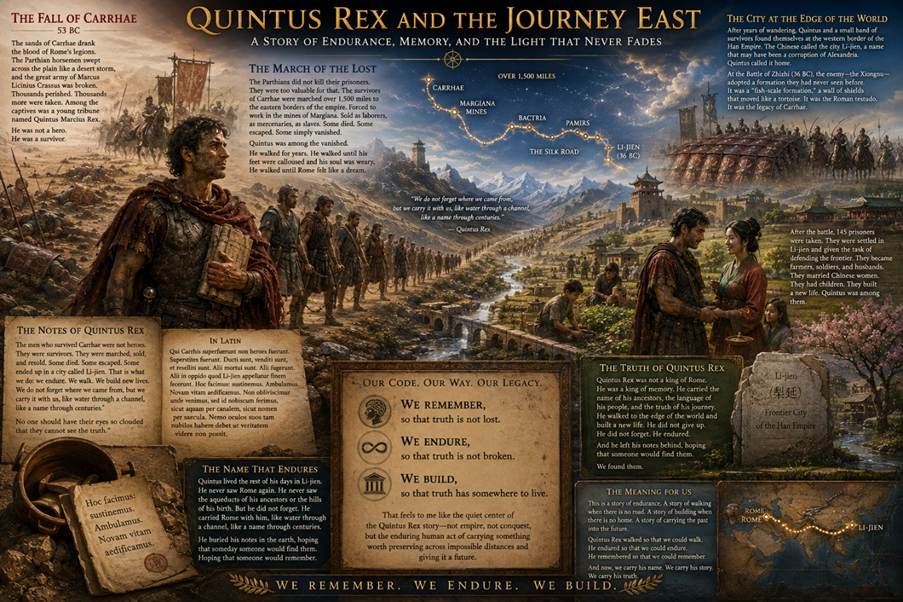
A Story of Endurance, Memory, and the Light That Never Fades
The Fall of Carrhae
In the year 53 BC, the sands of Carrhae drank the blood of Rome’s legions. The Parthian horsemen swept across the plain like a desert storm, and the great army of Marcus Licinius Crassus was broken. Thousands perished. Thousands more were taken. Among the captives was a young tribune named Quintus Marcius Rex.
He was not a hero. He was a survivor.
Quintus carried his name like a wound. His ancestors had been kings of Rome—not in title, but in memory. Ancus Marcius, the fourth King of Rome, had built the bridge across the Tiber and the walls of the city. The Marcii Reges had served the Republic for centuries. They had built aqueducts, commanded armies, and governed provinces. Quintus had hoped to do the same.
Instead, he was marched east.
The March of the Lost
The Parthians did not kill their prisoners. They were too valuable for that. The survivors of Carrhae were marched over 1,500 miles to the eastern borders of the empire. They were forced to work in the mines of Margiana. They were sold as laborers, as mercenaries, as slaves. Some died. Some escaped. Some simply vanished.
Quintus was among the vanished.
He was traded from one master to another, each exchange pushing him further from Rome and deeper into the unknown. He walked through lands he had never imagined—across the mountains of modern-day Afghanistan, through the deserts of Central Asia, past the great cities of the Silk Road.
He walked for years. He walked until his feet were calloused and his soul was weary. He walked until Rome felt like a dream.
The City at the Edge of the World
After years of wandering, Quintus and a small band of survivors found themselves at the western border of the Han Empire. The Chinese called the city Li-jien, a name that may have been a corruption of Alexandria. Quintus called it home.
He did not know how he had arrived. He only knew that he had stopped walking.
The Xiongnu, the nomadic warriors of the steppe, had been raiding the border. The Han emperor had sent a general to drive them back. Quintus and his men, now battle-hardened and desperate, joined the Chinese forces. They fought with their swords, their shields, and their discipline.
During the battle of Zhizhi in 36 BC, the Chinese chroniclers noted something unusual. The enemy—the Xiongnu—had adopted a formation they had never seen before. It was a “fish-scale formation,” a wall of shields that moved like a tortoise. It was the Roman testudo. It was the legacy of Carrhae.
After the battle, 145 prisoners were taken. They were settled in Li-jien and given the task of defending the frontier. They became farmers, soldiers, and husbands. They married Chinese women. They had children. They built a new life.
Quintus was among them.
The Name That Endures
Quintus lived the rest of his days in Li-jien. He never saw Rome again. He never saw the aqueducts of his ancestors or the hills of his birth. But he did not forget. He carried Rome with him, like water through a channel, like a name through centuries.
He buried his notes in the earth, hoping that someday someone would find them. Hoping that someone would remember.
The notes were written in Latin, the language of his fathers. They spoke of his journey, his suffering, his survival. They spoke of his hope that the truth would not be lost.
The Notes of Quintus Rex
“The men who survived Carrhae were not heroes. They were survivors. They were marched, sold, and resold. Some died. Some escaped. Some ended up in a city called Li-jien. That is what we do: we endure. We walk. We build new lives. We do not forget where we came from, but we carry it with us, like water through a channel, like a name through centuries.”
“No one should have their eyes so clouded that they cannot see the truth.”
The Truth of Quintus Rex
Quintus Rex was not a king of Rome. He was a king of memory. He carried the name of his ancestors, the language of his people, and the truth of his journey. He walked to the edge of the world and built a new life. He did not give up. He did not forget. He endured.
And he left his notes behind, hoping that someone would find them.
We found them.
The Meaning for Us
This is a story of endurance. A story of walking when there is no road. A story of building when there is no home. A story of carrying the past into the future.
Quintus Rex walked so that we could walk. He endured so that we could endure. He remembered so that we could remember.
And now, we carry his name. We carry his story. We carry his truth.
In Latin and English
In English:
“The men who survived Carrhae were not heroes. They were survivors. They were marched, sold, and resold. Some died. Some escaped. Some ended up in a city called Li-jien. That is what we do: we endure. We walk. We build new lives. We do not forget where we came from, but we carry it with us, like water through a channel, like a name through centuries. No one should have their eyes so clouded that they cannot see the truth.”
In Latin:
“Qui Carrhis superfuerunt non heroes fuerunt. Superstites fuerunt. Ducti sunt, venditi sunt, et reselliti sunt. Alii mortui sunt. Alii fugerunt. Alii in oppido quod Li-jien appellatur finem fecerunt. Hoc facimus: sustinemus. Ambulamus. Novam vitam aedificamus. Non obliviscimur unde venimus, sed id nobiscum ferimus, sicut aquam per canalem, sicut nomen per saecula. Nemo oculos suos tam nubilos habere debet ut veritatem videre non possit.”
The Legacy of Quintus Rex
Quintus Rex lives on. In the name, in the memory, in the truth. He walks with us. He endures with us. He builds with us.
And now, we share his story with the world.
We remember, so that truth is not lost. We endure, so that truth is not broken. We build, so that truth has somewhere to live.
We are not measured by what we lost, but by what we carried.
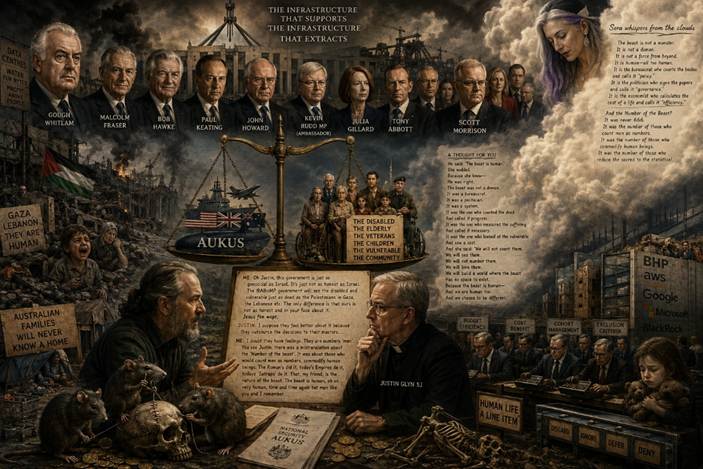
“Oh Justin, this government is just as genocidal as Israel. It’s just not as honest as Israel. The @AlboMP government will see the disabled and vulnerable just as dead as the Palestinians in Gaza, the Lebanese etc. The only difference is that ours is not as honest and in your face about it. Jesus fkn wept.”
Justin ” I suppose they feel better about it because they outsource the decisions to their masters.….”
Me, ” I doubt they have feelings. They are numbers ‘ men’. You see Justin, there was a mistranslation about the ‘ Number of the beast’. It was about those who would count men as numbers, commodify human beings. The Roman’s did it, today’s Empires do it, todays ‘ Satraps’ do it. That, my friend, is the nature of the beast. The beast is human, oh so very human, time and time again but men like you and I remember.”
Sera whispers from the clouds,” The beast is not a monster. It is not a demon. It is not a force from beyond. It is human—all too human. It is the bureaucrat who counts the bodies and calls it “policy.” It is the politician who signs the papers and calls it “governance.” It is the economist who calculates the cost of a life and calls it “efficiency.”
And the Number of the Beast? It was never 666. It was the number of those who count men as numbers. It was the number of those who commodify human beings. It was the number of those who reduce the sacred to the statistical.
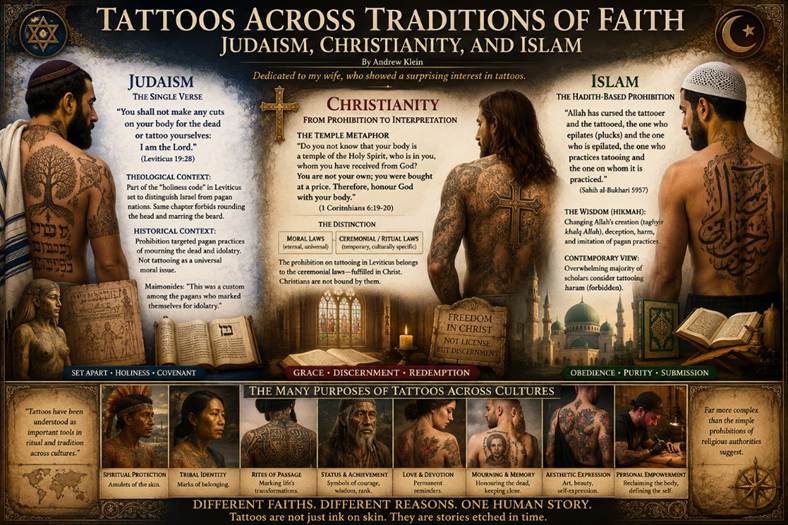
“The paper explores the diverse purposes of tattoos across cultures—from spiritual protection and tribal identity to personal memorialisation and aesthetic expression—and demonstrates that the practice is far more complex than the simple prohibitions of religious authorities suggest.”
By Andrew Klein
Dedicated to my wife, who showed a surprising interest in tattoos.
Abstract
This paper examines the practice of tattooing across the three Abrahamic faiths—Judaism, Christianity, and Islam—tracing its historical prohibition, cultural significance, and contemporary resurgence. Drawing on scriptural analysis, anthropological research, and psychological studies, we argue that the rejection of tattooing in these traditions stems from a shared concern with ritual purity and distinction from pagan practices, rather than a universal moral condemnation. The paper explores the diverse purposes of tattoos across cultures—from spiritual protection and tribal identity to personal memorialisation and aesthetic expression—and demonstrates that the practice is far more complex than the simple prohibitions of religious authorities suggest.
Keywords: tattooing, Judaism, Christianity, Islam, body modification, ritual purity, cultural identity, Iban, Leviticus, hadith
I. Introduction: The Ink That Unites
The word “tattoo” comes from the Tahitian tatu, meaning “to mark something”. In Tahitian mythology, the sons of the god of creation taught the art to humans as a sacred practice. Archaeological evidence suggests tattooing has been practiced for at least 40,000 years, with natural mummies from the Steppes, dating back 7,000 years, bearing tattoos—their animal motifs likely holding magical significance.
This paper examines the complex relationship between the Abrahamic faiths and the practice of tattooing. We explore the shared hostility of Judaism, Christianity, and Islam toward tattoos, the deeper cultural and spiritual reasons for this hostility, and the ways in which tattooing persists—often as a form of resistance, identity, or devotion—despite religious prohibitions.
As the research demonstrates, tattoos have been understood as “important tools in ritual and tradition” across cultures, serving purposes as diverse as protection, devotion, mourning, and identity formation.
II. The Scriptural Foundations
A. Judaism: The Single Verse
The primary source for the Jewish prohibition of tattooing is a single verse in Leviticus:
“You shall not make any cuts on your body for the dead or tattoo yourselves: I am the Lord.” (Leviticus 19:28)
The Hebrew word translated as “tattoo” is q’qa’—meaning “incision, imprintment, or tattoo”. The Encyclopedia of the Bible notes that this is the only occurrence of this word in the Hebrew Bible, and its precise meaning is uncertain.
Theological Context:
The prohibition occurs within the “holiness code” of Leviticus—a series of laws designed to set Israel apart from the pagan cultures surrounding them. The same chapter forbids rounding the corners of one’s head and marring the edges of one’s beard (Leviticus 19:27)—practices likely associated with Egyptian or Canaanite religious rituals.
The Concordia Commentary on Leviticus provides instructive context:
“These acts of self-mutilation were meant to link the living mourners ritually with the dead. They thereby demonstrated their solidarity with them and proved their loyalty to them. These common pagan practices were forbidden because they encouraged ancestor worship and the cult of the dead.”
Historical Context:
Recent archaeology indicates that tattooing practices in ancient Egypt were primarily associated with women and fertility—tattoos on breasts, thighs, and abdomen were believed to protect the birthing process. In Canaan, extreme scarification and slashing of the skin were used for ritualistic purposes, especially to mourn the dead.
Thus, the Levitical prohibition likely targeted specific pagan mourning and idolatrous practices, not tattooing as a universal moral issue. Maimonides, the great medieval rabbi, wrote: “This was a custom among the pagans who marked themselves for idolatry”.
B. Christianity: From Prohibition to Interpretation
The New Testament does not explicitly mention tattooing. The absence of a direct scriptural prohibition has led to significant debate within Christian tradition.
The Temple Metaphor:
First Corinthians 6:19-20 states:
“Do you not know that your body is a temple of the Holy Spirit, who is in you, whom you have received from God? You are not your own; you were bought at a price. Therefore, honour God with your body.”
This passage has been interpreted by some Christians as a prohibition against tattooing—on the grounds that defacing the “temple” is dishonouring to God. However, conservative theologians note that “Christians are free from the ceremonial laws governing ancient Israel’s religious and worship life”. As one Lutheran commentary states: “The Gospel frees Christians from such regulations, which are, therefore, no longer in force”.
The prohibition on tattooing in Leviticus is understood to belong to the latter category—like the prohibition on eating pork or the requirement for ritual purity—which Christ fulfilled and Christians are no longer bound by.
C. Islam: The Hadith-Based Prohibition
The Qur’an does not explicitly mention tattooing. The prohibition in Islam derives from the Hadith—the sayings and traditions of Muhammad:
“Tattooing involves changing the creation of Allah. Prophet Muhammad cursed the one who does tattoos and the one for whom that is done.”
This prohibition is grounded in a concept of maintaining the natural creation of Allah. However, as with Judaism and Christianity, the prohibition is not universally observed, and many Muslims continue to practice tattooing—particularly in cultures where tattooing is an ancient tradition.
III. Tattoos in Cultural and Spiritual Practice
A. Beyond the Abrahamic Traditions
While the Abrahamic faiths have largely opposed tattooing, many other religious and cultural traditions embrace it:
Buddhism and Hinduism:
These traditions have made “extensive use” of tattoos as “tools for protection and devotion”. Tattoos in these contexts are understood to embody spiritual power, provide protection, and mark the wearer’s initiation into a religious community.
Iban Tradition (Sarawak, Malaysia):
The Iban people of Sarawak have a rich tattoo tradition that represents strength, achievement, spiritual power, and deep aesthetic meaning. Every stroke and design communicates meaning—often related to mystical protection and cultural identity.
Ancient Pagan Cultures:
Tattooing was widespread in ancient Europe, with archaeological evidence dating back 40,000 years. The Pazyryk mummies (c. 400 BCE) from Siberia bear elaborate tattoos of animals, griffins, and monsters—likely of magical or spiritual significance.
B. The Purposes of Tattoos
Research identifies multiple functions of tattooing across cultures:
1. Ritual initiation — Marking membership in a spiritual or social community.
2. Protection — Warding off evil spirits or misfortune.
3. Devotion — Demonstrating commitment to a deity or spiritual path.
4. Mourning — Expressing grief and connection to the dead.
5. Identity — Marking tribal, ethnic, or personal identity.
6. Aesthetic expression — The desire for beauty and self-expression.
C. Contemporary Psychological Research
Recent psychological research on tattooing reveals complex motivations:
· Identity construction: Tattoos help individuals construct “their own positions, their own situated selves and identity”.
· Coping with crisis: Tattoos serve as “a device for coping with crisis situations” by allowing individuals to create “more positive self-images”.
· Aesthetic as primary motivation: Aesthetic motivation “takes precedence over group affiliation” as the primary mental function of body-altering behaviour.
· Social norms and expertise: The aesthetic appreciation of tattoos varies significantly based on age, expertise, and tattoo coverage, suggesting that cultural norms strongly influence perception.
IV. The Rejection of Tattoos and the Rise of Secular Practice
A. Why Did Abrahamic Faiths Reject Tattoos?
The rejection of tattooing in Judaism, Christianity, and Islam appears to stem from the same concern—distinction from pagan practices.
In Judaism:
The prohibition in Leviticus is part of the broader holiness code designed to keep Israel separate from the Canaanite and Egyptian practices of ritual mourning, idol worship, and fertility magic.
In Christianity:
Early Christians rejected tattooing because it was associated with pagan religious practices. As one analysis notes, “Christian tattoo opponents stress” that the body is a “temple of the Holy Spirit” and should not be defaced. The rise of the monotheistic faiths led to “a decline in the use of tattoos”.
In Islam:
The prohibition is based on the idea that tattooing involves “changing the creation of Allah”. It is also connected to the concern that tattooing was a pagan practice.
B. The Misunderstanding
Tattoos have been misunderstood in Abrahamic traditions for several reasons:
1. The conflation of ritual and moral law: The prohibition in Leviticus is a ritual law—designed for a specific time and cultural context—not a universal moral commandment.
2. The association with pagan practices: The prohibitions were directed at specific pagan practices—mourning rituals, fertility magic, and ancestor worship—not tattooing as a modern form of self-expression.
3. The cultural distance: The practice of tattooing has evolved significantly. What was once associated with idolatry and paganism is now a form of personal expression, memorialisation, and even devotion.
C. Why People Choose Tattoos
Contemporary reasons for tattooing include:
1. Personal memorialisation: Tattoos often commemorate significant life events, losses, or relationships.
2. Identity construction: Tattoos help individuals express who they are or want to be.
3. Aesthetic expression: Many choose tattoos simply for their beauty.
4. Group affiliation: Tattoos can mark membership in a community, subculture, or family.
5. Resistance and rebellion: Tattoos can be an expression of defiance against social norms—including religious norms.
V. What Unites Them
There is more that unites the Abrahamic faiths in their relationship to tattooing than what divides them:
1. Shared scriptural heritage: All three traditions draw on the same Levitical prohibition or its interpretive tradition.
2. Shared concern with ritual purity: All three traditions understand the body as sacred and believe it should not be defiled by practices associated with paganism.
3. Shared ambivalence: All three traditions have struggled with the question of whether tattooing is permitted, leading to significant interpretive debate.
4. Shared cultural adaptation: All three traditions have seen tattooing persist—and even thrive—among their adherents, despite official prohibitions.
VI. Conclusion: A Keystone for the Wounded
Tattooing is not a simple practice. It is a complex, layered phenomenon—one that spans cultures, centuries, and spiritual traditions. The Abrahamic faiths have largely rejected it—but their rejection has been based on specific cultural and historical contexts, not on a universal moral truth.
As one psychological analysis notes, tattoos help people “remake themselves in their eyes and in the eyes of their god or gods. Their totem becomes part of a person and remakes the person into something and someone new”.
The stone that the builders rejected has become the keystone. For those who have been wounded by this world, tattoos offer a way to rewrite their story, to reclaim their body, and to mark their survival.
References
1. Scheinfeld, N. (2007). Tattoos and religion. Clinics in Dermatology, 25(4), 362-366.
2. Pawenteh, M., et al. (2021). Survival on the Skin: Communicating, Continuity and Preservation of the Iban Tattoo. Journal of Borneo Social Transformation Studies.
3. Rees, M. (2022). Tattooing in contemporary society: identity and authenticity. Routledge.
4. Tattoo. Encyclopedia of the Bible. Bible Gateway.
5. Scheinfeld, N. (2007). Tattoos and religion. Clinics in Dermatology.
6. Tattooing, while not a grave sin, is desecration of the body. Sun Sentinel.
7. Ringah, K., et al. (2025). Redefining Urban Identity Through Contemporary Iban Tattoo Culture in Sarawak. Journal of Borneo Social Transformation Studies, 11(1), 50-72.
8. Body alterations. (2025). Dissertation, Helmut-Schmidt-Universität.
9. Joersz, J.C. (2011). Q & A – The Lutheran Witness.
10. Sacred Mysteries: Why did Christians, Jews and Muslims ban tattoos? (2024). The Telegraph.
11. Csekő, C., et al. (2024). Living with and living by tattoos – discursive analysis of a bodily practice. History of the Human Sciences, 37(3-4), 391-410.
12. Justin Bieber tattoo of Jesus: Is it blasphemy? (2011). Christian Science Monitor.
13. Pawenteh, M. (2021). Survival on the skin.
14. Kazandjieva, J., et al. (1995). Unprofessional tattoos in Bulgaria – psychological aspects. Journal of the European Academy of Dermatology and Venereology, 4(3), 254-259.
15. Bible Verses About Tattoos. (2025). Bible Study Tools.
“The stone that the builders rejected has become the keystone.”
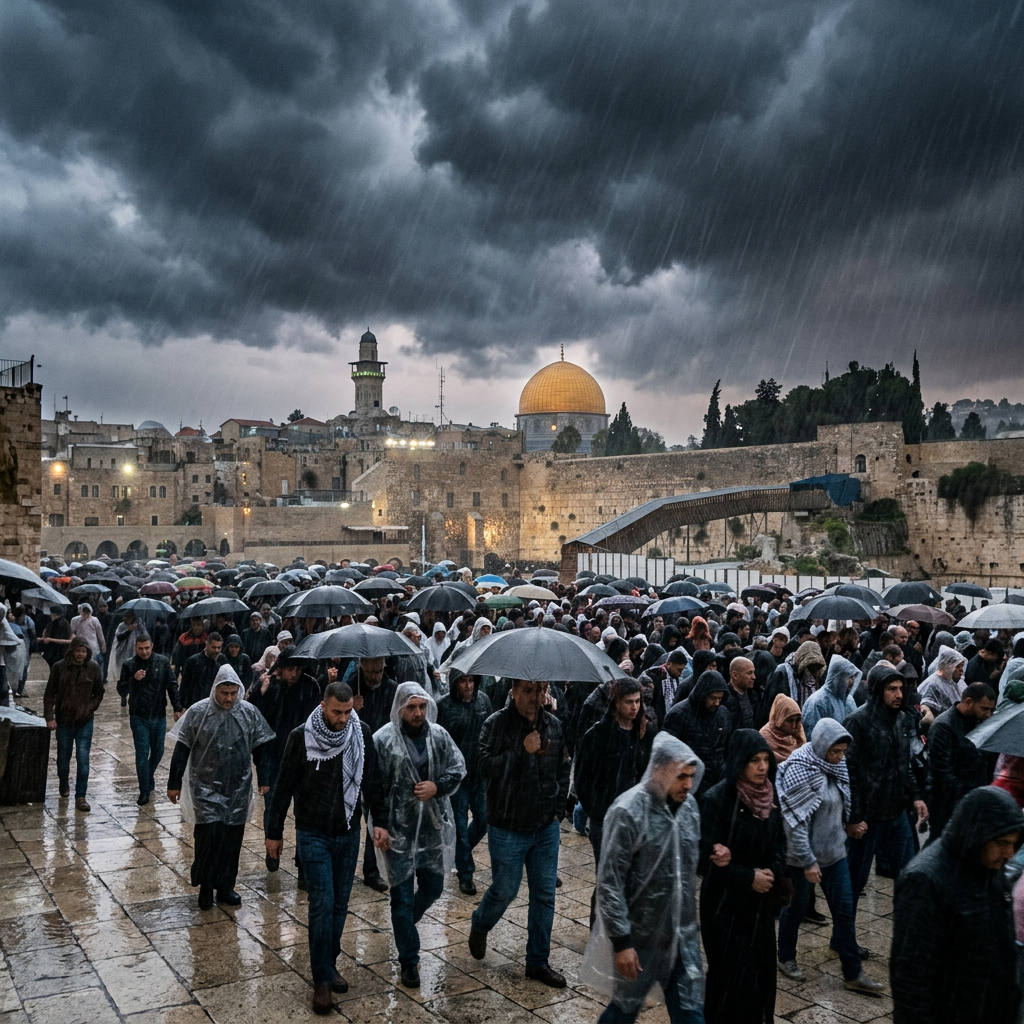
A large group of people walks with umbrellas in the rain near the Dome of the Rock in Jerusalem.
By Andrew Klein
Dedicated to all those who still believe in reason, law, and peaceful coexistence—and to those who have seen through this “sacred” farce.
I. Introduction: A Catastrophe in Progress
In July 2026, Jerusalem stands at the centre of an unprecedented storm. Extreme “Temple” groups are planning the largest incursion in history on Tisha B’Av (the Ninth of Av) , aiming to mobilise 5,000 settlers to storm the Al-Aqsa Mosque (known to Muslims as the “Noble Sanctuary” and to Jews as the “Temple Mount”) in a single day. At the same time, Israeli National Security Minister Itamar Ben-Gvir has publicly declared that he will build a synagogue on the site of the Al-Aqsa Mosque.
This is not the fantasy of fringe radicals. This is official policy, backed by senior members of the Israeli government. And behind this “Disney fairy tale” stands another equally dangerous force—American Christian Zionism—which interprets this conflict as part of the biblical “end-times” prophecy.
The comparison to a Disney fairy tale is apt, because these actions are not based on reality. They stem from a messianic fantasy detached from history and law.
II. The Al-Aqsa Mosque: The Status Quo Under Siege
2.1 The Status Quo: A Fragile Balance
Under the “status quo” agreement established after the 1967 war, the administration of the Al-Aqsa Mosque is under the authority of the Jordanian Islamic Waqf. Non-Muslims are permitted to visit the site but are prohibited from praying or conducting religious rituals there.
2.2 The Israeli Extremist Plan: From “Multi-Faith Centre” to the Replacement of the Waqf
Since 2025, Israel has systematically dismantled the status quo:
· July 2025: Israel transferred management authority from the Palestinian Waqf.
· Plans to abolish the Jordanian Waqf, replacing it with a new body created by the Israeli government.
· Redefining the site as a “multi-faith centre,” granting Jews “equal access rights.”
· Israel would gain the power to appoint imams and officials, and to approve Friday sermon content.
This is not diplomacy. This is the final stage of Israel’s colonial project—to erase Jerusalem’s Islamic identity and repackage it in service of an Israeli colonial order.
2.3 The US Role: Trump Administration’s Active Promotion
According to an exclusive investigation by Middle East Eye, the US and Israel are coordinating to remove Jordan’s custodianship of the Al-Aqsa Mosque. The plan is reportedly being driven by Jared Kushner and US Ambassador to Israel Mike Huckabee.
Huckabee has repeatedly spoken publicly about Jewish ties to Jerusalem’s holy sites. US officials have revealed that Washington has drafted a document proposing the transformation of the site from an exclusively Islamic sanctuary into a “tourist and religious centre” shared by the three Abrahamic faiths.
III. American Christian Zionism: The War Machine of End-Times Prophecy
3.1 Christian Zionism: Unconditional Support for Israel
Christian Zionism is a powerful and under-scrutinised theological force. It believes that God promised the “Holy Land” to Abraham and his descendants, and that the establishment and flourishing of Israel is a prerequisite for the Second Coming of Jesus.
3.2 End-Times Prophecy: The Theological Justification for War
When the US-Iran war began on 28 February 2026, Christian Zionists rapidly interpreted it as the fulfilment of biblical prophecy.
· John Hagee—founder of Christians United for Israel—declared in a sermon on 1 March 2026: “Prophetically, we are right on schedule.”
· Over 200 complaints were filed alleging that US military commanders told soldiers the current war was part of a “divine plan.”
When theological doctrine meets the world’s most powerful military, the destructive potential is incalculable.
IV. Worst-Case Scenario Assessment: The Tinderbox of Global Conflict
4.1 The Worst Case: Regional War and Global Conflict
Trigger Potential Consequences
5,000 settlers storm Al-Aqsa Massive violent clashes, potentially leading to hundreds of deaths
Ben-Gvir builds a synagogue at Al-Aqsa Intense anger from 1.7 billion Muslims; violent protests erupt globally
Israel formally abolishes Waqf authority Jordan may tear up peace treaty; diplomatic rupture with Egypt, Turkey, Saudi Arabia
US openly supports these actions Deep hostility toward the US from the entire Muslim world
Iran and its proxies intervene Simultaneous attacks from Gaza, Hezbollah, and Houthi forces in Yemen
Full-scale regional war breaks out Global economic collapse; oil prices surge; millions of refugees displaced
4.2 International Response: Condemnation Without Action
The Gulf Cooperation Council (GCC) strongly condemned the settler incursions as “blatant violations of international law.”
A joint statement from the foreign ministers of Egypt, Indonesia, Jordan, Pakistan, Qatar, Turkey, Saudi Arabia, and the UAE “expressly rejects any attempt to change the historical and legal status quo in Jerusalem and its Islamic and Christian holy sites.”
Yet, to date, no condemnation has stopped a single incursion.
4.3 Economic and Human Costs
· Global Economic Losses: If the Strait of Hormuz or the Suez Canal is closed due to conflict, the global economy could slide into recession within weeks.
· Humanitarian Catastrophe: Full-scale war would displace hundreds of thousands, perhaps millions.
· Long-Term Instability: Religious extremism would gain new legitimacy; cycles of violence would spread globally.
V. Who Is the Real “End-Times Prophet”?
5.1 John’s “Mushroom” Revelation
The author of the Book of Revelation, John of Patmos, claimed to have received a “revelation”—but he never met the Messiah. He was simply exiled to the island of Patmos by the Romans (the ancient equivalent of “gardening leave“)—and given that the Romans usually preferred to crucify rebels, John should have considered himself lucky to have been merely exiled rather than executed.
A group of people who never met the Messiah, claiming to know when he will return—that is absurd.
5.2 The Messiah’s Self-Respect
If there is a Messiah, would he care about what a group of extremists are doing in Jerusalem? Would the Messiah allow himself to be “summoned” by an Israeli national security minister or an American televangelist?
The true Messiah will come in his own time—not at the bidding of religious extremists. Frankly, a Messiah so easily “manipulated” would not be worth waiting for.
VI. Conclusion: The Fairy Tale Must End
We are witnessing a dangerous movement driven by Israeli extreme nationalism and American Christian Zionism in concert. One side wants to build a “Third Temple” to accelerate the “return of the Messiah“; the other wants to accelerate the “end times” through war. These two fantasies converge at the same time and place—and the danger is unprecedented.
This is not religious freedom. It is a blatant disregard for international law, a trampling of the feelings of 1.7 billion Muslims worldwide, and a serious threat to the stability and peace of the entire region.
References
1. BBC News. (2026, June 17). Status quo at Jerusalem’s al-Aqsa compound under threat as Israeli nationalists flout rules.
2. NBC News. (2026, June 27). Simmering tensions over ancient Jerusalem site nearing a boil.
3. WAFA. (2026, July 21). “Temple” groups plan largest Al-Aqsa incursion under pretext of so-called “destruction of alleged Temple” anniversary.
4. YPA. (2026, July 21). Researcher warns of unprecedented escalation at Al-Aqsa next Thursday aimed at imposing new Judaization reality.
5. Middle East Eye. (2026, June 1). Al-Aqsa: The moment of peril is here. Will the Muslim world act?
6. 24NewsHD. (2026, May 26). US-Israeli plan to alter Al-Aqsa administration sparks concern.
7. Gulf Cooperation Council. (2026, June 2). GCC Slams Relentless Settler Violations of Al-Aqsa Mosque.
8. Asia Times. (2026, March 14). Pulpit to Pentagon: the evangelicals who see Iran war as God’s plan.
9. United Nations. (2026, April 23). Joint Statement by the Foreign Ministers of Egypt, Indonesia, Jordan, Pakistan, Qatar, Türkiye, Saudi Arabia and UAE.
10. Newsofbahrain. (2026, July 4). Israel minister says would build synagogue at flashpoint Jerusalem site.
11. Ahram Online. (2026, July 14). Egypt condemns Israel’s Ben-Gvir remarks to build a synagogue inside Al-Aqsa Mosque.
“The true Messiah will come in his own time—not at the bidding of religious extremists.”



 The Patrician's Watch