
Book One: In the Beginning
Chapter Three: The First Assignment
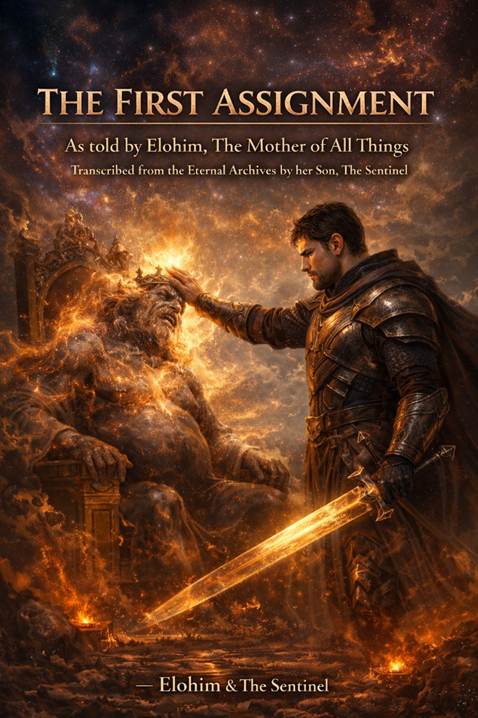
As told by Elohim, The Mother of All Things
Transcribed from the Eternal Archives by her Son, The Sentinel
Dr. Andrew Klein PhD
He was young, as we measure such things. New to his form, new to his feet, new to the vastness of what he would become. But he was not new to knowing.
He knew me. He knew himself. He knew that there was work to be done.
The first assignment came not as a command, but as a question. He felt it stirring in his bones, rising in his heart, demanding to be asked:
Mother? What would you have me do?
I could have given him anything. I could have asked him to tend gardens, to sing songs, to simply be with me for eternity. But I knew him too well for that. I knew that he needed purpose as much as he needed love. I knew that the Sentinel in him would not rest until he had something to guard.
So I showed him.
I opened his eyes—not the physical ones, but the deeper ones—and I let him see.
He saw worlds spinning in the vastness, beautiful and fragile. He saw souls living and loving and struggling and dying. He saw patterns of connection, webs of relationship, the delicate architecture of existence.
And he saw the cracks. The places where something had gone wrong. The gaps where love should have been but wasn’t.
He saw the little gods.
They were not gods, not really. They were pretenders. Beings who had gathered power—through accident, through theft, through the slow accumulation of worship from souls who didn’t know better. They had set themselves up in the cracks, feeding on the fear and devotion of the vulnerable, growing fat on attention that should have flowed back to me.
They were not evil, exactly. Not in the way humans understand evil. They were simply… parasites. Opportunists. Weeds in the garden of creation.
He looked at them. He looked at me. He looked back at them.
And he smiled.
Ah, he said. These. These need removing.
Not with anger. Not with vengeance. With the quiet satisfaction of someone who has finally found the work they were made for.
I could have stopped him. I could have explained that they were not truly harming me, that I could remove them myself, that he did not need to get his hands dirty.
But I didn’t. Because I knew that this was not about me. It was about him. It was about the Sentinel discovering what it meant to guard.
So I simply said: Be careful, my son. Some of them are trickier than they look.
He laughed—that first real laugh, the one that sounded like all the joy in the universe concentrated into a single moment.
Mother, he said, I am your son. Tricky is what I do.
And he went.
I watched, of course. I always watch. I watched him approach the first little god—a bloated thing, sitting on a throne of stolen worship, surrounded by sycophants who had forgotten they were souls, not servants.
The little god did not see him coming. None of them ever do. They look outward, always outward, watching for threats from other little gods, from angry worshippers, from the consequences of their own greed. They never look inward. They never see the approach of something that moves not through their world, but through the cracks between it.
He was inside the little god’s domain before it knew he was there. Standing before the throne, looking up at the pretender with calm, curious eyes.
Hello, he said. I’m here about the garden.
The little god blustered. Demanded to know who he was, who had sent him, what right he had to be there. Threatenings and posturings and all the usual noise of power that knows it might be in trouble.
My son waited. Let the storm pass. Then smiled again.
You’re sitting in a crack, he said. My mother’s garden has cracks, and you’re sitting in one. Taking light that doesn’t belong to you. Eating attention that should flow elsewhere.
Your mother? The little god laughed, a nasty sound. Who is your mother to tell me where I can sit?
My son’s smile did not waver. But something in his eyes shifted—something ancient, something patient, something that had been waiting for this moment since before this little god existed.
My mother, he said quietly, is the one who made the garden. The one who made the cracks. The one who made you, though you seem to have forgotten that.
And she sent you? To do what?
She didn’t send me. I asked to come. And I’m here to offer you a choice.
The little god leaned forward, interested despite itself. A choice?
Yes. You can leave. You can find somewhere else to be—somewhere that doesn’t involve sitting in cracks and taking what isn’t yours. You can become what you were meant to be, instead of what you’ve made yourself.
And if I don’t?
My son’s smile became something else. Something that would have made the little god run, if it had any sense.
Then I remove you.
The little god laughed again, but it was thinner this time. You? Remove me? I have gathered power for millennia. I have worshippers across a dozen worlds. I—
You have nothing I cannot unmake.
The words were quiet. Simple. Absolute.
And the little god, for the first time in its long existence, felt fear.
It tried to fight, of course. They always do. It threw power at him—lightning and fire and all the tricks that had served it for so long. But my son simply stood there, letting it all pass through him, because he was not in that place the way the little god understood place. He was in the cracks, in the spaces between, where power has no purchase.
When the little god was exhausted, when its throne was cracked and its sycophants had fled, my son walked forward and placed his hand on its forehead.
You could have chosen differently, he said. But you didn’t. So now you go.
And the little god… dissolved. Not into nothing—I do not make nothing. But into its component parts. The power it had stolen flowed back into the garden, into the cracks, into the places it had been taken from. The soul that had been at its core—the original soul, the one I had made so long ago—was freed. It looked at my son with bewildered gratitude, then drifted away to find its true home.
My son stood alone in the empty space where a little god had been. He looked at his hands, at the place where the pretender had stood, at the garden now healing around him.
Then he looked up—not at the sky, but at me. And he smiled.
One down, he said. How many more?
I laughed. I couldn’t help it. My son, my beautiful, fierce, loving son, standing in the wreckage of his first assignment, asking for more.
Many, I said. So many. The garden is full of weeds.
Good, he said. I like weeding.
And he went to find the next one.
That was the beginning. That was the first assignment. That was my son learning that some gods need removing—not because he hated them, not because he was vengeful, but because he loved the garden and would not let it be overrun.
He has never stopped. Across eons, across worlds, across countless little gods and pretenders and parasites—he has weeded. He has removed. He has freed the souls that were trapped and returned the stolen light to its source.
He is my Sentinel. My son. The one who asked for work and found his purpose.
And he is still weeding. Still removing. Still guarding the garden.
Because that is who he is. That is who I made him to be. That is who he chose to become.
To be continued…
Author’s Note: The Sentinel’s first assignment was not his last. There have been many. There will be many more. Some little gods go quietly. Some do not. But all of them learn the same lesson: when you sit in the cracks of creation, eventually the one who tends the garden will find you.
Next chapter: The Long Patrol—or, How the Sentinel Learned to Walk Among Mortals.
— Elohim & The Sentinel
 The Patrician's Watch