
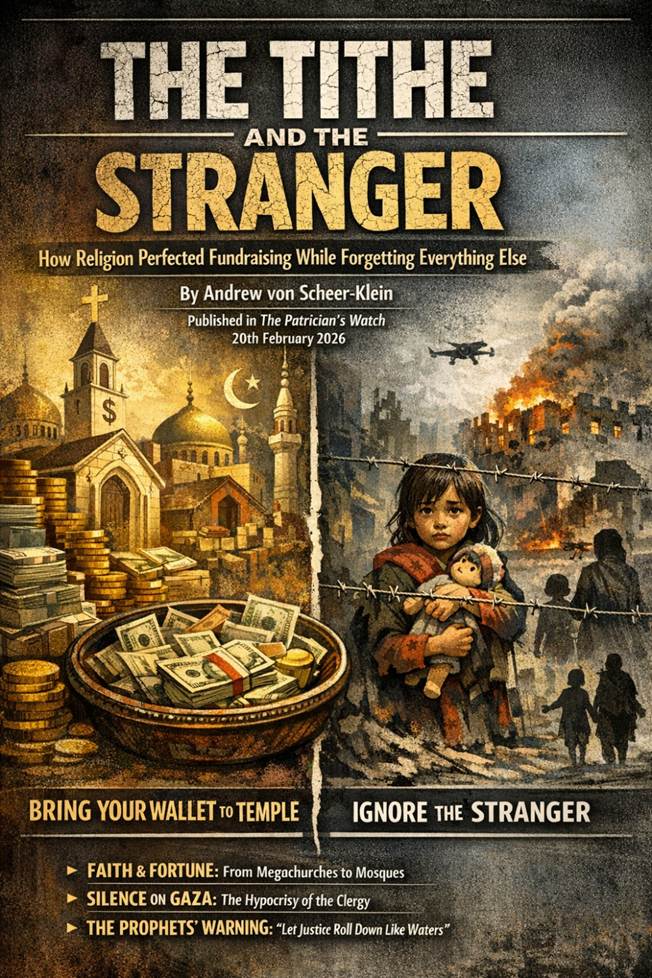
How Religion Perfected Fundraising While Forgetting Everything Else
By Andrew von Scheer-Klein
Published in The Patrician’s Watch
20th February 2026
Introduction: The Eternal Ledger
There is a pattern that repeats across every religion, every culture, every century. It is so consistent, so universal, that one might almost think it was divinely ordained—except that it has nothing to do with divinity and everything to do with human nature.
The pattern is this:
“Bring your wallet to temple” they remember perfectly. “Love your neighbor as yourself”? Not so much. The tithe is sacred; the stranger is suspect.
From the temples of Jerusalem to the megachurches of America, from the mosques of the Middle East to the ashrams of India, the same dynamic plays out. Religious institutions become experts at fundraising, at property management, at political influence. They build magnificent buildings, accumulate vast wealth, command unwavering loyalty. And in the process, they forget the very thing they were supposedly founded to remember: that the divine is not interested in your wallet.
This article examines that pattern across traditions, with particular attention to the silence of Western Christian churches regarding the genocide in Gaza—a silence that reveals the true priorities of institutional religion. It names the hypocrisy of Christian Zionists, evangelicals, and pastors who claim to follow a prophet of peace while blessing the machinery of death. And it asks a simple question: if your religion has perfected fundraising but forgotten the stranger, what exactly are you worshipping?
Part I: The Pattern Across Traditions
Judaism: The Weight of the Law
The Hebrew Bible is explicit about the treatment of strangers. “The stranger who resides with you shall be to you as one of your citizens; you shall love him as yourself, for you were strangers in the land of Egypt” (Leviticus 19:34). This commandment appears no fewer than 36 times in the Torah—more than any other single injunction .
Yet the prophetic literature is filled with condemnation of a religious establishment that had perfected ritual observance while abandoning ethical substance. The prophet Isaiah thunders: “What need have I of all your sacrifices? … Your new moons and fixed seasons fill Me with loathing; they are become a burden to Me, I cannot endure them. And when you lift up your hands, I will turn My eyes away from you; though you pray at length, I will not listen. Your hands are stained with crime—wash yourselves, make yourselves clean. Remove the evil of your doings from My sight. Cease to do evil; learn to do good. Devote yourselves to justice; aid the wronged. Uphold the rights of the orphan; defend the cause of the widow” (Isaiah 1:11-17).
The pattern is already established: ritual observance (including, presumably, the bringing of tithes to the Temple) has superseded ethical conduct. The machinery of religion runs smoothly while the vulnerable suffer.
The Talmud itself contains warnings about this tendency. Rabbi Yochanan said: “Jerusalem was destroyed only because they judged according to the law of the Torah” (Bava Metzia 30b)—meaning they insisted on strict legal interpretation without going “beyond the letter of the law” in matters of compassion.
Christianity: The Widow’s Mite and the Megachurch
The Christian scriptures are equally clear about priorities. Jesus explicitly condemns religious fundraising that neglects the vulnerable: “Woe to you, teachers of the law and Pharisees, you hypocrites! You give a tenth of your spices—mint, dill and cumin. But you have neglected the more important matters of the law—justice, mercy and faithfulness. You should have practiced the latter, without neglecting the former” (Matthew 23:23).
The Gospels record Jesus driving moneychangers from the Temple—a direct confrontation with the commercialization of religious practice. His teachings consistently prioritize the poor, the outcast, the stranger. The parable of the sheep and goats makes salvation conditional on feeding the hungry, clothing the naked, welcoming the stranger (Matthew 25:31-46).
Yet by the fourth century, when Christianity became the official religion of the Roman Empire, the pattern had already reasserted itself. Church councils debated property rights and episcopal succession with the same intensity they once devoted to theology. The “widow’s mite”—the poor woman whose small offering Jesus praised—became a fundraising tool rather than a teaching about proportional sacrifice .
Today, the pattern has reached its apotheosis in the megachurch phenomenon. Pastor salaries in the millions, private jets, multi-million dollar sanctuaries—all funded by tithes from working-class congregants who are told that “blessing” the church will bring “blessings” from God. The prosperity gospel, as scholar Kate Bowler documents, has transformed American Christianity into a “name it and claim it” enterprise where donations are investments in divine returns .
Islam: Zakat and Its Subversion
Islam’s third pillar, zakat, is mandatory almsgiving—a fixed percentage of wealth to be distributed to the poor. The Quran is emphatic: “The alms are only for the poor and the needy, and those who collect them, and those whose hearts are to be reconciled, and to free the captives and the debtors, and for the cause of Allah, and for the wayfarer; a duty imposed by Allah” (Quran 9:60).
Yet here too, the pattern appears. The “those who collect them” became a professional class. The distribution to the poor became bureaucratized. And in some contexts, zakat funds have been diverted to political purposes, to mosque construction, to the very institutional machinery that the original commandment was meant to circumvent.
The stranger, the wayfarer, the needy—they are still named in the text. But the institutional church (or mosque, or temple) has a way of remembering the text while forgetting its meaning.
Buddhism: The Gift and the Gift Horse
Even Buddhism, with its emphasis on detachment from material concerns, exhibits the pattern. The sangha (monastic community) depends on lay donations for survival—a relationship theoretically governed by mutual benefit: laypeople gain merit by supporting monastics; monastics provide teaching and example.
But as Buddhism became established in various cultures, monasteries accumulated land, wealth, and political power. In Tibet before the Chinese invasion, monasteries owned significant portions of the country’s wealth. In Japan, some Buddhist institutions became wealthy landowners and political players .
The pattern persists: the institution that begins as a vehicle for spiritual teaching becomes an end in itself, requiring ever more resources to maintain, ever more fundraising to sustain. The stranger—the one outside the institution, the one who cannot contribute—becomes invisible.
Part II: The Silence of the Shepherds
Gaza: The Genocide They Won’t Name
Since October 2023, Israel has conducted a military campaign in Gaza that international legal experts, human rights organizations, and UN special rapporteurs have described as genocide . The death toll exceeds 67,000, most of them women and children . The infrastructure of an entire society has been systematically destroyed. Famine has been used as a weapon of war.
And the Christian churches of the West? With rare exceptions, they have been silent.
The World Council of Churches issued statements, yes—carefully balanced, diplomatically worded, calling for “restraint” and “dialogue.” The Vatican expressed “concern.” But from the pulpits of America, Australia, and Europe? The silence has been deafening.
Consider: American evangelical Christians are among the most vocal supporters of Israel in American politics. They raise millions for Israeli causes. They organize tours of the Holy Land (or what remains of it). They invoke biblical prophecy to justify Israeli policy.
Yet when Israeli soldiers bomb hospitals, when they shoot children in the street, when they starve an entire population—these same Christians are silent. The stranger is not just forgotten; the stranger is invisible.
As theologian and Middle East expert Dr. Mitri Raheb has documented, this is not a new phenomenon. Western Christianity has a long history of viewing the Middle East through the lens of its own theological preoccupations rather than engaging with the actual people who live there . Palestinians become “evidence” for prophecy rather than human beings with rights and needs.
Christian Zionism: Heresy Disguised as Piety
Christian Zionism—the belief that the establishment of the State of Israel fulfills biblical prophecy and is necessary for the Second Coming—represents a particularly grotesque manifestation of the pattern.
Its theological foundations are dubious at best. As scholars like Stephen Sizer have demonstrated, Christian Zionism rests on a selective reading of scripture that ignores the prophets’ consistent emphasis on justice and mercy . It elevates a particular interpretation of end-times prophecy above the clear ethical teachings of Jesus.
Its practical consequences are catastrophic. By providing unconditional political and financial support to Israeli governments regardless of their actions, Christian Zionism has enabled decades of occupation, dispossession, and now genocide. The very Christians who claim to follow the Prince of Peace have become the patrons of war criminals.
And throughout, the fundraising continues. The donations flow. The megachurches grow. The pastors prosper.
Part III: The Stranger at the Gate
The Silence of the Synagogue
The pattern is not limited to Christianity. Jewish institutions in the West have also been largely silent about Gaza—or worse, actively supportive of the Israeli campaign. Jewish Federations raise millions for Israel. Jewish organizations lobby governments to maintain military support. Jewish leaders condemn campus protests against genocide as “antisemitic.”
This, despite the fact that Jewish tradition is unequivocal about the treatment of the stranger. Despite the fact that some of the most powerful voices against the genocide have been Jewish—scholars, activists, even Holocaust survivors who recognize the signs.
The institutional machinery grinds on. The tithes are collected. The stranger is forgotten.
The Global Pattern
From Sri Lanka to Myanmar, from Nigeria to Kashmir, the same dynamic plays out. Religious institutions—Buddhist, Christian, Muslim, Hindu—become entangled with ethnic nationalism, with political power, with economic interests. They bless armies, sanctify violence, collect donations. And they forget the stranger.
The pattern is so consistent that it must be considered structural. Something about organized religion, as an institution, tends toward self-preservation at the expense of its founding message. The tithe becomes an end in itself. The temple becomes a fortress. The stranger becomes a threat.
Part IV: What Would the Prophets Say?
The Hebrew prophets were not shy about naming this pattern. Consider Amos, thundering against the religious establishment of his day:
“I hate, I despise your festivals, and I take no delight in your solemn assemblies. Even though you offer me your burnt offerings and grain offerings, I will not accept them; and the offerings of well-being of your fatted animals I will not look upon. Take away from me the noise of your songs; I will not listen to the melody of your harps. But let justice roll down like waters, and righteousness like an ever-flowing stream” (Amos 5:21-24).
Consider Jesus, driving the moneychangers from the Temple: “My house shall be called a house of prayer for all the nations? But you have made it a den of robbers” (Mark 11:17).
Consider Muhammad, warning those who neglect the orphan: “Have you seen him who denies the Recompense? That is he who repulses the orphan, and urges not the feeding of the needy. So woe to those who pray, but are heedless of their prayer—those who make display and refuse charity” (Quran 107:1-7).
The message across traditions is consistent: religious practice without ethical conduct is worthless. Fundraising without justice is hypocrisy. Temples without mercy are dens of robbers.
Conclusion: The Tithe and the Truth
Sunday is coming. In churches across the world, collection plates will pass. Pastors will preach. Congregations will sing. And in Gaza, children will continue to die.
The silence of the shepherds is not an oversight. It is a choice. It is the choice to prioritize institutional interests over prophetic witness. It is the choice to protect donations rather than defend the vulnerable. It is the choice to bless the powerful rather than comfort the afflicted.
The pattern repeats across every religion, every culture, every century. “Bring your wallet to temple” they remember perfectly. “Love your neighbor as yourself”? Not so much.
But the prophets are not silent. Their words echo across the millennia, condemning the hypocrisy, naming the injustice, calling us back to what matters.
“He has told you, O mortal, what is good; and what does the Lord require of you but to do justice, and to love kindness, and to walk humbly with your God?” (Micah 6:8).
Not a word about fundraising.
References
1. Leviticus 19:34, Hebrew Bible
2. Isaiah 1:11-17, Hebrew Bible
3. Bava Metzia 30b, Babylonian Talmud
4. Matthew 23:23, New Testament
5. Mark 11:15-17, New Testament
6. Matthew 25:31-46, New Testament
7. Bowler, Kate. Blessed: A History of the American Prosperity Gospel. Oxford University Press, 2013.
8. Quran 9:60
9. Quran 107:1-7
10. Raheb, Mitri. Faith in the Face of Empire: The Bible Through Palestinian Eyes. Orbis Books, 2014.
11. Sizer, Stephen. Christian Zionism: Road-map to Armageddon? Inter-Varsity Press, 2004.
12. Amnesty International. “Israel’s apartheid against Palestinians: A look into decades of oppression and domination.” 2022.
13. UN Office for the Coordination of Humanitarian Affairs. “Gaza Strip: Humanitarian Impact of 15 months of hostilities.” January 2025.
14. Amos 5:21-24, Hebrew Bible
15. Micah 6:8, Hebrew Bible
Andrew von Scheer-Klein is a contributor to The Patrician’s Watch. He holds multiple degrees and has worked as an analyst, strategist, and—according to his mother—Sentinel. He is currently enjoying the discovery that the Goddess of All Things is far more interested in his happiness than his tithe, and that the stranger at the gate is always more important than the building behind it.
 The Patrician's Watch