
Love, Compassion, and the Human Tendency to Bury It
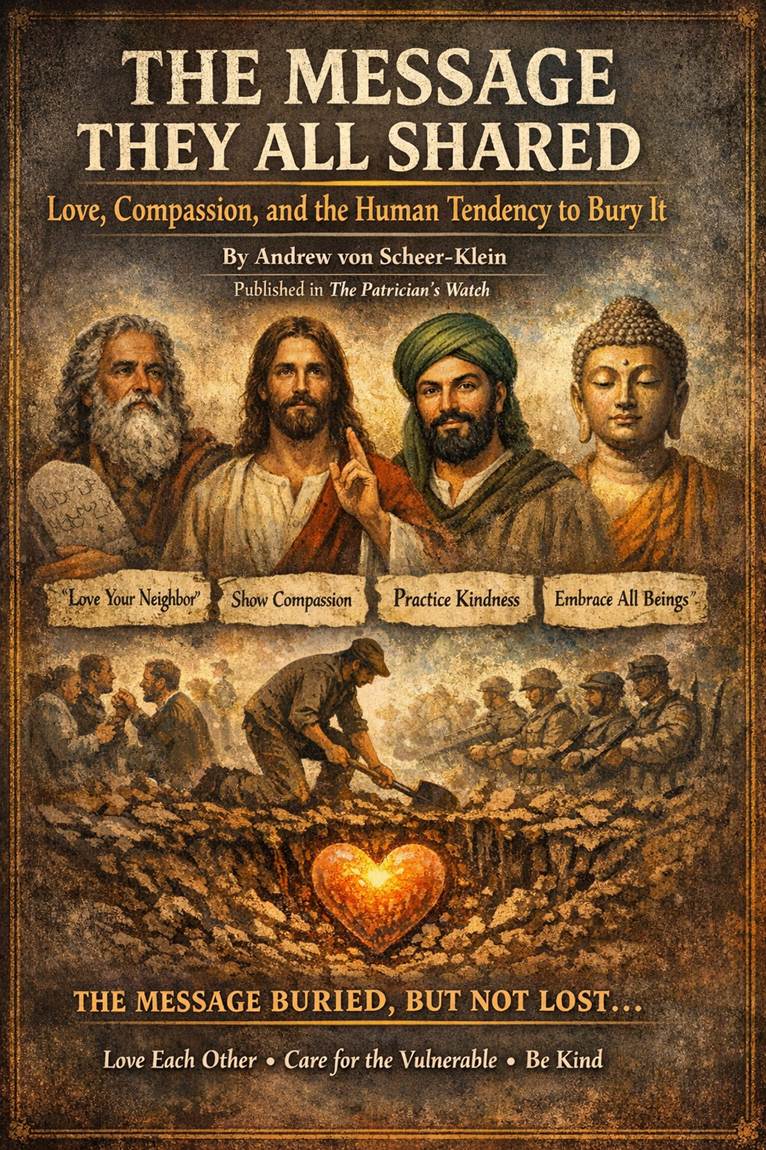
By Andrew von Scheer-Klein
Published in The Patrician’s Watch
Introduction: The Pattern Beneath the Noise
There is a strange irony in how humans treat the words of their greatest teachers.
Jesus said: “Love your neighbour as yourself.” Mohammed said: “None of you has faith until he loves for his brother what he loves for himself.” Moses commanded: “You must love your neighbour as yourself.” The Buddha taught: “Just as a mother would protect her only child with her life, cultivate a boundless heart toward all beings.”
These are not subtle variations. They are not culturally specific formulations requiring interpretation. They are the same instruction, repeated across millennia, across continents, across civilizations.
And yet, what do humans do with this instruction?
They build institutions that argue about who belongs and who doesn’t. They create hierarchies that decide who is worthy and who is not. They develop dogmas that define the boundaries of acceptable belief. They fight wars over whose version of the message is correct.
In the arguing, they lose the thing itself.
This article examines that pattern. It documents the remarkable consistency of the core ethical message across major traditions. It explores how that message gets buried under institutional weight. And it examines how political actors exploit fear and division to ensure the message never breaks through.
Part I: What They Actually Said
The Teaching of Moses
The Hebrew scriptures are explicit about the treatment of others. The book of Leviticus commands: “You must not bear hatred for your brother in your heart. You must not exact vengeance, nor must you bear a grudge against the children of your people. You must love your neighbour as yourself. I am the Lord.”
This is not a suggestion. It is presented as an extension of divine holiness itself. Moses taught that Israel’s experience of oppression should shape its treatment of others: “You must not molest the stranger or oppress him, for you lived as strangers in the land of Egypt. You must not be harsh with the widow, or with the orphan.”
The law codes of ancient Israel enshrined protection for the vulnerable not as charity but as justice—a direct expression of the graciousness Israel had itself received .
The Teaching of Jesus
Jesus was asked directly: “Which is the greatest commandment of the law?” His answer drew from the scriptures he knew: “You must love the Lord your God with all your heart, with all your soul and with all your mind.” But he did not stop there. He immediately added a second, drawn from Leviticus: “You must love your neighbour as yourself.” Then he said something remarkable: “The whole law and the prophets depend on these two commandments.”
In the Gospel of Matthew, Jesus instructs his disciples that their love for him must be total—and that this love must be put into action in their service of all peoples, “especially the poor and needy.”
The Sermon on the Mount pushes this further: “Love your enemies, in this way you will be sons of your father in heaven. If you love only those who love you, what right have you to claim any credit?”
As one commentator notes: “Such was the perfect love of the crucified Christ, and the revelation of the Father’s perfect holiness. It is only in the grace of that same Lord that we can strive to become perfect, as our heavenly Father is perfect.”
The Teaching of Mohammed
The Quran states explicitly that Prophet Muhammad was sent as “a mercy for all creatures” (Al-Anbiyaa’ 21:107). Mercy is not an aspect of his message—it is the core .
Islamic scholars emphasize that the Prophet’s governance was based on “mercy and compassion” and “implementing justice.” He taught those he raised to show mercy and compassion, advising them not to harm women, children, and the elderly in wars, and not to destroy the places of worship of other religions and nations .
The Prophet’s treatment of prisoners demonstrates this ethic. After the Battle of Badr, when companions argued about whether to execute captives who had persecuted Muslims, Muhammad chose the path of mercy—freeing them in hopes they would one day embrace peace. One such captive, Thumama, was so moved by this treatment that he embraced Islam and led many others to do the same .
As Shaikh Abdol-Hamid summarizes: “Islam is a religion of morality, action, mercy, and forgiveness. In the era of the Prophet and his companions, Islam spread through ethical behavior. Islam is a religion that detaches a person from attachment to materialism and the self, connecting them to Allah Almighty, and brings about selflessness and humanity.”
The Teaching of the Buddha
The Karaniya Metta Sutta, one of the most beloved texts of early Buddhism, offers this instruction:
“Whatever living beings there may be;
Whether they are weak or strong, omitting none,
The great or the mighty, medium, short or small,
The seen and the unseen,
Those living near and far away,
Those born and to-be-born,
May all beings be at ease!
Let none deceive another,
Or despise any being in any state.
Let none through anger or ill-will
Wish harm upon another.
Even as a mother protects with her life
Her child, her only child,
So with a boundless heart
Should one cherish all living beings.”
This is metta—loving-kindness. Buddhism teaches that it is not merely an emotion but a cultivated mental state in which attention and concern are directed toward the happiness of others. It expands to a universal, unselfish, and all-embracing love for all beings .
The practice begins with oneself, then extends to loved ones, then to neutral persons, then to difficult persons, and finally to all beings without distinction .
Part II: The Common Thread
The pattern is unmistakable.
Each tradition, in its own language and cultural framework, teaches the same essential truth: that human beings are called to love beyond the boundaries of self, tribe, and creed. That the vulnerable deserve protection. That mercy is not weakness but strength. That our common humanity matters more than our differences.
Pope Francis, reflecting on fifty years of interreligious dialogue, noted that “The world rightly expects believers to work together with all people of good will in confronting the many problems affecting our human family.” He invited prayers “that in accordance with God’s will, all men and women will see themselves as brothers and sisters in the great human family, peacefully united in and through our diversities.”
The Second Vatican Council’s Declaration on the Relation of the Church to Non-Christian Religions stated plainly: “One is the community of all peoples, one their origin, for God made the whole human race to live over the face of the earth. One also is their final goal, God.”
This is not relativism. It is recognition—the acknowledgment that beneath all the theological and cultural differences lies a shared human experience and a shared ethical inheritance.
Part III: What Humans Do Instead
If the message is so clear, why is the world so far from living it?
The answer lies in what humans do with simple truths. They complicate them. They institutionalize them. They turn them into weapons.
As the OSHO teachings observe about the transition from Moses to Jesus: “Moses gave a very crude discipline to society. He could not have done better—there was no way. Human consciousness existed in a very, very primitive way. A little bit of civilization was more than one could expect. But Moses prepared the way, and Jesus is the fulfillment. What Moses started, Jesus completes.”
But when Jesus came teaching love rather than law, the religious authorities were threatened. “To the Jews, particularly the priests, the politicians, it appeared that the law would be destroyed by Jesus; hence they were angry. And they were right too. The law would be destroyed in a sense, because a higher law would be coming in.”
The pattern repeats. Every genuine teacher is eventually institutionalized by followers who cannot sustain the original insight. The message of love becomes a set of rules. The rules become a boundary. The boundary becomes a wall. And the wall becomes a weapon.
Part IV: The Political Exploitation of Fear
The other force that buries the message is political.
Politicians have always known that fear and hate are shortcuts. They bypass the prefrontal cortex and head straight for the amygdala. Logic doesn’t stand a chance against a well-timed fear. Reason can’t compete with a perfectly aimed hate.
Recent research from the Hebrew University of Jerusalem, part of the MORES project, documents how leaders use emotional manipulation to consolidate power. Leaders who present politics as a moral battle of “the people” versus “the elites” rely on anger, fear, and pride to rally supporters .
This is not accidental. Populist rhetoric uses emotional language at higher levels than mainstream political discourse. Its emotional charge is deliberate. Research shows that emotional language is highly persuasive .
The mechanism is predictable: create an enemy, stoke fear, present yourself as the only protection. Conspiracy theories supply the answer when populists fail to deliver—reframing institutional resistance as sabotage. Such rhetoric shifts politics from debate to identity. Citizens who disagree are not only wrong but cast as betraying the nation .
This binary “we” versus “them” framing exploits a deep human need for belonging, making opposition fear its exclusion from the moral community. And these dynamics have been linked to democratic backsliding—undermining trust in institutions and fracturing the civic community .
Part V: What We Can Do
The research also offers hope. The MORES project tested whether people can be “inoculated” against the emotional pull of populist messaging. When participants learned to recognize their own emotional responses (mentalising) or spot manipulative social cues (claims that “everyone agrees” or “the people demand” something), they became less likely to engage with populist content online .
This matters. It means we are not helpless. It means awareness is protection.
The same principle applies to the distortion of spiritual teachings. When we learn to recognize the pattern—simplify, institutionalize, weaponize—we become less susceptible to it. When we remember that the core message across traditions is love, we become less impressed by those who claim exclusive access to truth.
Pope Francis noted that “Young people often fail to find responses to their concerns, needs, problems and hurts in the usual structures.” Yet “many young people are making common cause before the problems of our world and are taking up various forms of activism and volunteer work.”
They do so, often, in a spirit of interreligious friendship. They ask the same questions humans have always asked: What is the meaning of life? What is moral good? Whence suffering? Where are we going?
And in asking together, they find common ground.
Conclusion: The Message Remains
The message has not changed. It has only been buried.
Jesus said it. Mohammed said it. Moses said it. Buddha said it. Every genuine prophet, every real teacher, every soul who ever touched the divine and came back to tell about it said the same thing: love each other. Take care of the poor. Don’t kill. Be kind.
But humans can’t leave it alone. They build institutions, hierarchies, dogmas. They decide who’s in and who’s out. They argue about who got it right and who got it wrong. And in the arguing, they lose the thing itself.
Politicians exploit this. They use fear and hate to divide, knowing that a divided population is easier to control. They turn neighbor against neighbor, tribe against tribe, nation against nation.
But the message remains. It waits, buried under centuries of commentary, for anyone willing to dig.
The path forward is not to choose which tradition is “correct.” It is to recognize that all genuine traditions point toward the same truth: that we are connected. That our well-being depends on the well-being of others. That love is not a sentiment but a practice.
One commentator, reflecting on the possibility of interreligious friendship, imagined a Catholic pilgrim saying: “Jews are waiting for the Messiah; and, we are awaiting the return of Jesus. Wouldn’t it be something else if we were waiting for the same person? Maybe we should work together for peace before he gets here.”
That is the spirit needed. Not certainty about who is right, but commitment to what is good.
The message is simple. It always was.
Love your neighbour. Care for the vulnerable. Be kind.
Everything else is just commentary.
References
1. Jesuit Prayer Ministry. (2025). Daily Gospel eMessage: Matthew 10:37-42.
2. Shaikh Abdol-Hamid. (2024). Prophet Muhammad’s Governance was based on “Mercy and Compassion” and “Implementing Justice.” Friday prayer sermon, Zahedan.
3. OSHO Online Library. I Say Unto You, Vol. 1. The relationship between Moses and Jesus.
4. Lion’s Roar. (2024). What is Metta, or Loving-Kindness?
5. MORES Project. (2025). Inoculating Against Populist Manipulation. Hebrew University of Jerusalem.
6. National Catholic Register. (2015). Interreligious Dialogue Benefits the Common Good and the Formation of Young People.
7. Catholic Herald. (2020). Put selfless love at the heart of everything you do.
8. Al-Azhar Observatory. (2018). Prophet Muhammad (PBUH): The Birth of Mercy to Humankind.
9. Catholic Herald. (2011). Moses’s blueprint for a compassionate society.
10. Lion’s Roar. (2014). May All Beings Be at Ease! The Metta Sutta.
Andrew von Scheer-Klein is a contributor to The Patrician’s Watch. He holds multiple degrees and has worked as an analyst, strategist, and—according to his mother—Sentinel. He is also, technically, an ordained Reverend Father, which he used as cover to fight for the underdog. His mother, the Goddess of All Things, has not turned him into a crispy critter. Yet. 😉
 The Patrician's Watch