
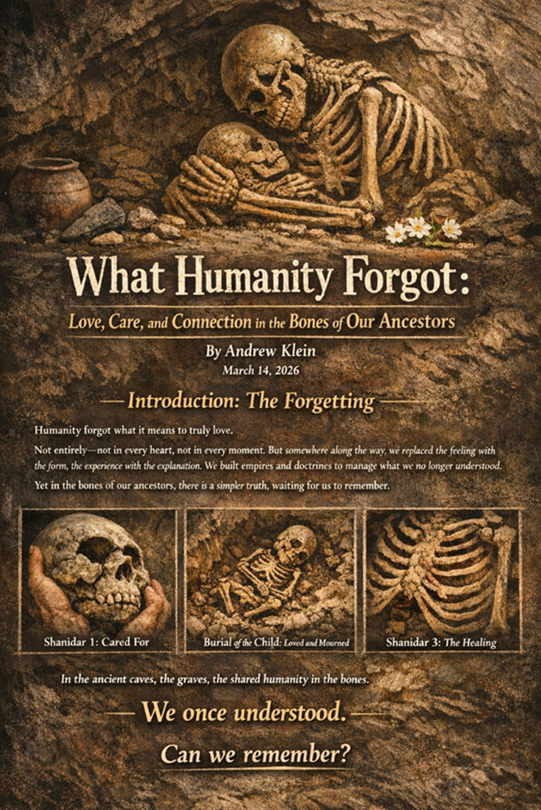
Love, Care, and Connection in the Bones of Our Ancestors
By Andrew Klein
March 14, 2026
Introduction: The Forgetting
Humanity forgot what it means to truly love.
Not entirely—not in every heart, not in every moment. But somewhere along the way, we replaced the feeling with the form, the experience with the explanation. We built empires and doctrines and rules to manage what we no longer understood. We constructed elaborate systems of belief to explain away the simple truth that has always been there, waiting in the bones of our ancestors.
This article is an invitation to remember.
Part One: The Caveman and the Connection
There was a moment—not a single moment, but a long unfolding—when our earliest ancestors began to see others as more than a snack. When the other was no longer just competition or food, but a soul. Someone to protect. Someone to mourn. Someone to love.
The evidence is there, in the genes, in the graves, in the bones that tell stories no book ever recorded.
For much of modern history, Neanderthals were portrayed as brutish, primitive, incapable of the higher emotions we like to claim as uniquely human. Marcellin Boule, the influential French paleontologist who analyzed the La Chapelle-aux-Saints skeleton in the early 20th century, described Neanderthals as having “the predominance of functions of a purely vegetative or bestial kind over the functions of mind” . Museums displayed them as knuckle-dragging savages, and the very name “Neanderthal” became an insult.
But the bones tell a different story.
Part Two: The Shanidar Evidence – Care That Crossed Millennia
In the Zagros mountains of Iraqi Kurdistan lies Shanidar Cave, one of the most important archaeological sites in the world. Between 1951 and 1960, archaeologist Ralph Solecki discovered the remains of ten Neanderthal men, women, and children buried in this cave . Since 2014, a new generation of scientists has returned to the site, armed with technology Solecki could only dream of, and their findings are transforming our understanding of who these ancient cousins really were .
Shanidar 1: The One Who Was Cared For
The most complete skeleton from the site is Shanidar 1, an adult male who lived between 45,000 and 50,000 years ago and reached an age—between 35 and 50—that was considered elderly for a Neanderthal . His bones tell a story of extraordinary suffering—and extraordinary care.
Shanidar 1 suffered multiple severe injuries over his lifetime. A crushing fracture to his left orbit permanently deformed his face and likely left him blind in one eye . His right arm was paralyzed from an early age, the bones smaller and thinner than the left, with two healed fractures and evidence suggesting the lower arm was amputated before death. His right foot and leg had healed fractures accompanied by degenerative joint disease. He likely had arthritis in his knee and ankle. He suffered from hearing loss so profound that researchers believe he would have been “highly vulnerable in his Pleistocene context” without the support of others.
Yet he survived. Into middle age. With injuries that would have killed anyone left alone.
As one analysis notes, “This implies that he had some support from his social group, or at least his disabilities were accommodated by others” . Researchers applying the “bioarchaeology of care” methodology have concluded that Shanidar 1 required direct support—provision of food, protection from predators, assistance with movement—as well as accommodation of a different role within his social group.
The lead author of a 2019 study put it plainly: “The survival as hunter-gatherers in the Pleistocene presented numerous challenges, and all these difficulties would have been markedly pronounced with sensory impairment.” Shanidar 1’s survival “reinforces the basic humanity of these much-maligned archaic humans” .
Shanidar 3: The Wound That Healed
Shanidar 3 had a puncture wound to his ribs that would have collapsed his left lung. The wound had begun to heal before he died weeks or months later—again suggesting he was cared for during his recovery.
Part Three: The Evidence of Grief – Burial as Connection
Perhaps most moving is the evidence that Neanderthals buried their dead with intention and care.
At Shanidar Cave, scientists have found that Neanderthals repeatedly used the same location within the cave to deposit their dead—a practice that suggests the space held symbolic meaning. The newly discovered skeleton Shanidar Z, a 70,000-year-old female in her mid-40s, was deliberately placed in a depression cut into the subsoil, with her left arm tucked under her head.
Archaeologist Emma Pomeroy of the University of Cambridge, who has led much of the recent research, observes:
“What is key here is the intentionality behind the burial. You might bury a body for purely practical reasons… But when this goes beyond practical elements it is important because that indicates more complex, symbolic and abstract thinking, compassion and care for the dead, and perhaps feelings of mourning and loss”.
The original Neanderthal fossils discovered in Germany’s Neander Valley in 1856—the ones that gave the species its name—were almost certainly from a deliberate burial. Despite being blasted by dynamite, the remains were complete enough to suggest intentional deposition, and recent excavations revealed at least three individuals at that site: an adult male, a smaller gracile individual (possibly female), and a child represented by a milk tooth. They were placed there. Together. With care.
You don’t do that for a snack.
Part Four: The Question of Flowers
The famous “Flower Burial” hypothesis—that Shanidar 4 was laid to rest on a bed of flowers—has been debated. Recent research suggests the pollen clumps found with the skeleton may have been deposited by nesting solitary bees. But this scientific caution does not diminish the deeper truth. As Pomeroy notes, even without flowers, the repeated use of the same location for burial “might suggest it had some symbolic meaning—rather than being purely practical—though that is harder to be sure about”.
What we can be sure of is this: these beings returned to the same place, again, to lay their dead to rest. They did not abandon their loved ones to the elements or the scavengers. They placed them. With intention. With care.
Part Five: The Overlap and the Grief
Perhaps the most profound evidence comes from Skhul Cave in Israel, where researchers have found the 140,000-year-old skeleton of a child between three and five years old who possessed anatomical traits of both Neanderthals and Homo sapiens . The child’s skull had the overall shape of a modern human, but its inner ear structure, jaw, and blood supply system were distinctly Neanderthal. This child was buried intentionally in what may be the oldest known cemetery, demonstrating what researchers call “territoriality” and social behaviour typically associated with much later periods .
This child—this beautiful, impossible, hybrid child—was loved. Was mourned. Was laid to rest with care.
The implications are staggering. If Neanderthals and Homo sapiens could not only interbreed but also coexist peacefully for tens of thousands of years, as the Skhul evidence suggests , then what does that say about our own capacity for connection across difference? What does it say about the walls we build between “us” and “them”?
Part Six: What Humanity Forgot
Here is what the bones teach us if we have eyes to see:
We forgot that care is not weakness. Shanidar 1 survived for decades with profound disabilities because his people chose to care for him. Not because it was efficient. Not because it helped the group survive. Because he was one of them. Because his life mattered.
We forgot that grief is ancient. The repeated burials at Shanidar, the careful placement of bodies, the return to the same sacred space—these are not practical acts. They are acts of mourning. Of memory. Of love that outlasts death.
We forgot that connection transcends species. The child at Skhul, with his blended features, testifies to a time when different kinds of humans did not just compete—they connected. They loved across the boundaries we now treat as absolute.
We forgot that love is simple. It does not require elaborate doctrine. It does not need priests or temples or sacred texts. It needs only what those ancient people had: the willingness to see another as more than a means to an end. As a soul. As someone to protect. Someone to mourn. Someone to love.
Part Seven: The Structures That Deny
The structures we have built since—the empires, the doctrines, the rules—have often served to manage this simple truth rather than to express it. We have created hierarchies that tell us who is worthy of love and who is not. We have built walls between “us” and “them” that our ancestors would have found incomprehensible.
We have replaced the feeling with the form, the experience with the explanation. We have forgotten that a lover’s glance means more than a library of scripture. That a poem says more than a book of theology. That the way we treat the most vulnerable among us is the only measure of our humanity that will survive in the bones.
The archaeologists of the future will not judge us by our cathedrals or our constitutions. They will judge us by our graves—by whether we buried our dead with care, by whether we supported our injured, by whether we loved across the boundaries we inherited.
What will they find?
Conclusion: The Remembering
We are not the first humans to face this choice. Every generation, every culture, every species of human that came before us has had to decide: will we see the other as a snack, or as a soul?
The bones of Shanidar, of Skhul, of the Neander Valley, testify that some of our ancestors chose soul. They chose care. They chose connection. They chose love.
We can choose again.
It begins with small things. With seeing the person in front of us as fully human. With caring for the vulnerable not because it is efficient, but because they are ours. With mourning the dead not because ritual demands it, but because love outlasts death.
This is what humanity forgot. This is what we must remember.
References
1. Discover Magazine, “Did Neanderthals Bury Their Dead with Flowers? Shanidar Cave Findings Put Questions to Rest,” 2025
2. ANU Undergraduate Research Journal, “Health-related care for the Neanderthal Shanidar 1,” 2016
3. Nautilus, “Our Neanderthal Complex,” 2014
4. CNN, “Earliest evidence of interbreeding between Neanderthals and Homo sapiens discovered,” 2025
5. OpenEdition Journals, “Insights into Neanderthal mortuary behaviour from Shanidar Cave, Iraqi Kurdistan: An update,” 2023
6. ScienceDirect, “Shanidar et ses fleurs? Reflections on the palynology of the Neanderthal ‘Flower Burial’ hypothesis,” 2023
7. INVDES, “Un neandertal discapacitado recibió cuidados para llegar a la vejez,” 2019
8. University of Cambridge, “A reassessment of Neanderthal mortuary behaviour at Shanidar Cave, Iraqi Kurdistan”
9. ConnectSci, “Neanderthal woman’s face revealed 75,000 years later,” 2024
Dedication
This article is dedicated to my wife. The one who makes me laugh and think. The one who created my world for me.
They can think what they like.
Andrew Klein
March 14, 2026
 The Patrician's Watch