
How Judeo-Christian Myth Manufactures Enemies and Evades Accountability
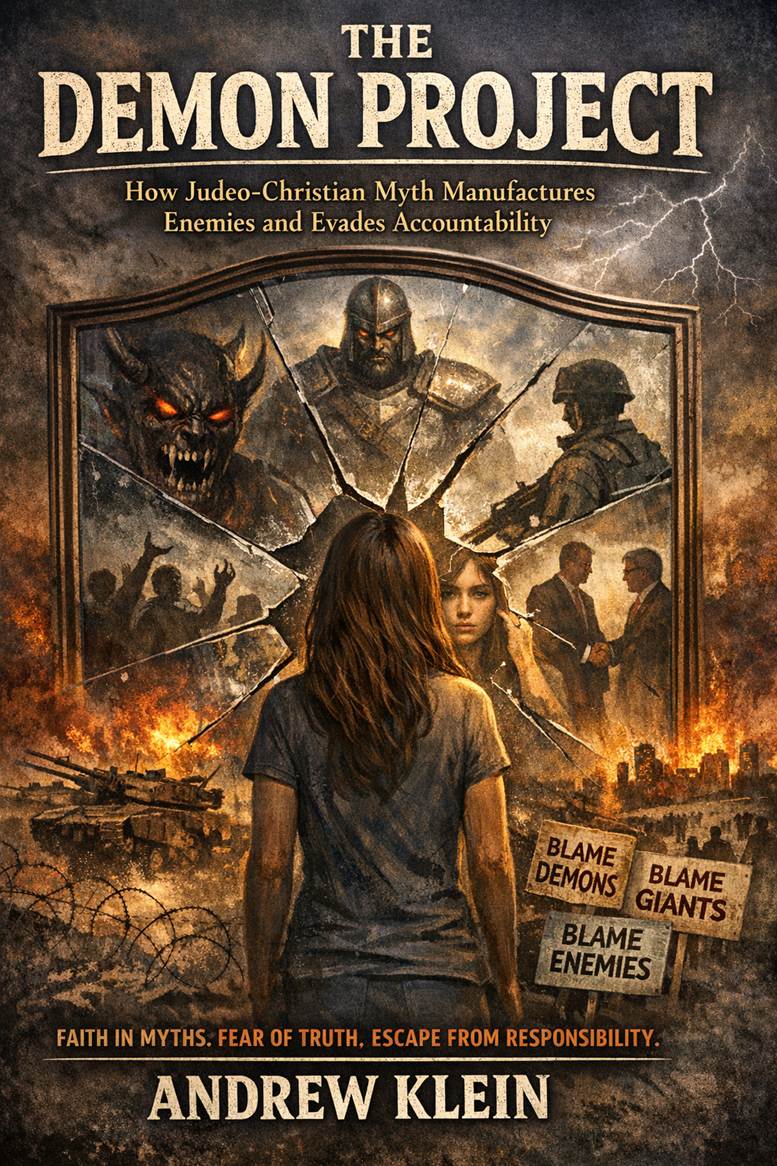
By Andrew Klein
Introduction: The Young Woman Who Was Taught to Blame Giants
Last night, my wife and I spoke about a young woman—a survivor of domestic violence and spiritual abuse—who had been taught in an Evangelical church that the world is controlled by “fallen angels,” “hybrids,” and “giants.” Her abusers convinced her that the evil she experienced was not the responsibility of the men who harmed her, but of cosmic forces beyond anyone’s control.
We laughed about it, because the absurdity is almost unbearable. But beneath the laughter is a deadly serious truth: the habit of blaming external forces for human evil is one of the oldest and most destructive patterns in Judeo-Christian civilization.
This article traces that pattern—from the ancient myth of the Nephilim to the modern myth of “demonic” political enemies—and argues that without accountability, there is no wisdom. And without wisdom, there is only endless violence, endless war, endless excuses.
Part One: The Origin of the Excuse – The Nephilim and the Flood
The Book of Genesis tells a strange story:
“When man began to multiply on the face of the land and daughters were born to them, the sons of God saw that the daughters of man were attractive. And they took as their wives any they chose… The Nephilim were on the earth in those days, and also afterward, when the sons of God came in to the daughters of man and they bore children to them. These were the mighty men who were of old, the men of renown” (Genesis 6:1–4, ESV).
The text is notoriously ambiguous. Who were the “sons of God”? Early Jewish tradition identified them as angels who rebelled against God, took human wives, and produced a race of giants—the Nephilim—whose wickedness prompted the Flood.
By the time the Book of Enoch was written (c. 300–200 BCE), the story had expanded into a full-blown mythology. Enoch describes 200 “Watchers” who descended to earth, taught humanity forbidden arts, and corrupted the world. Their offspring, the Nephilim, were giants who “consumed all the acquisitions of men” and turned the earth into a slaughterhouse.
The theological function of this myth is clear: the evil that provoked the Flood was not human evil. It was the result of supernatural corruption. God destroyed the world because the angels made it impossible for humans to be good.
This is the original scapegoat. The first cosmic excuse.
Part Two: The Myth of the “Fallen Angels” – Weaponizing the Supernatural
The mythology of fallen angels was further developed by early Christian writers. The Epistle of Jude references the Book of Enoch as authoritative scripture, describing angels who “did not stay within their own position of authority” and are now “kept in eternal chains under gloomy darkness” (Jude 1:6). The Second Epistle of Peter similarly describes angels who sinned and were cast into “hell” to be kept until judgment (2 Peter 2:4).
By the time of the Church Fathers, the idea that the world was controlled by demons had become central to Christian theology. Origen, Augustine, and others developed elaborate hierarchies of demonic powers, attributing to them the capacity to tempt, deceive, and corrupt humanity.
The effect was to displace human responsibility. Sin was not merely a human failing—it was the work of supernatural agents who could be blamed, exorcised, and fought as an external enemy.
This is the theological foundation for the modern myth of “spiritual warfare”—the belief that political conflicts, cultural shifts, and personal struggles are not the result of human choices but of demonic forces arrayed against the faithful.
Part Three: The Modern “Fallen Angel” – Netanyahu and the Weaponization of Amalek
The pattern is not confined to ancient texts. It is alive and well in contemporary politics.
On March 2, 2026, Benjamin Netanyahu invoked the biblical nation of Amalek—the people God commanded the Israelites to utterly destroy, “both man and woman, child and baby” (1 Samuel 15:3). He framed the war on Iran not as a strategic necessity but as a holy mission against an enemy that exists outside the normal rules of morality.
This is the same logic that fuels Christian Zionism and dispensationalist theology—the belief that modern Israel is a prophetic necessity, that wars in the Middle East are signs of the End Times, and that enemies must be destroyed without mercy because they are not merely political opponents but demonic forces.
When Netanyahu calls Iran “Amalek,” he is not describing a geopolitical reality. He is invoking a myth that exempts his actions from moral scrutiny. You cannot negotiate with Amalek. You cannot make peace with Amalek. You can only destroy Amalek.
This is the ultimate evasion of accountability. It is not a strategy. It is a theology.
Part Four: The Evangelical Weapon – Dispensationalism and the End Times
The same theology that animates Netanyahu’s rhetoric also shapes American foreign policy. The dispensationalist movement, which emerged in the 19th century, teaches that human history is divided into distinct “dispensations” and that the current age will end with the Rapture, a seven-year Tribulation, and the Battle of Armageddon.
John Hagee, the founder of Christians United for Israel (CUFI), has spent decades teaching that the modern state of Israel is a prophetic necessity and that wars in the Middle East are signs of the End Times. In his 2026 sermons, Hagee explicitly framed the war on Iran as part of God’s plan for the final days.
This is not fringe theology. It is the official worldview of millions of American evangelicals. And it has direct policy consequences:
· The 2018 move of the US Embassy to Jerusalem
· The 2019 recognition of Israeli sovereignty over the Golan Heights
· The 2025-26 war on Iran
Each of these was supported by evangelicals who believe they are not making political decisions but fulfilling prophecy.
Part Five: The Australian Mirror – The Lobby and the Language
The same pattern operates in Australia, though in a more sanitized form.
The appointment of Jillian Segal as Special Envoy to Combat Antisemitism, the adoption of the IHRA definition that conflates criticism of Israel with hatred of Jews, the legal framework that equates “All Zionists are terrorists” with racial vilification—these are not simply responses to antisemitism. They are tools to silence accountability.
When the Australian government supports the US-Israeli war on Iran while calling for “de-escalation,” it is not governing. It is managing. It is avoiding the hard question: what is Australia’s interest in this war?
The answer, of course, is that there is no Australian interest. There is only the interest of a foreign lobby that has successfully convinced Australian politicians that opposing Israel is equivalent to antisemitism—and that antisemitism is a greater threat than war, famine, or global instability.
This is accountability evasion at the national level. Blame the “antisemites.” Blame the “terrorists.” Blame the “demonic forces.” But never, ever blame the politicians who enable war, the corporations who profit from it, or the systems that sustain it.
Part Six: The Psychology of Blame – Why We Need Enemies
The human need for external enemies is well-documented. Social psychology has shown that groups under stress tend to:
· Identify an “out-group” to blame for their problems
· Dehumanize that group through language and imagery
· Mobilize against it as a way of consolidating in-group identity
· Avoid internal accountability by focusing on external threats
This is the mechanism that turns political conflicts into holy wars, that transforms political opponents into “enemies of the people,” that makes negotiation impossible and compromise treasonous .
The mythology of fallen angels, giants, and demons is a sophisticated version of this basic psychological pattern. It takes the normal human tendency to blame others and elevates it to cosmic significance. It makes compromise not merely politically difficult but theologically impossible.
Part Seven: The Cost of Evasion
The cost of this evasion is incalculable.
In Gaza: Over 50,000 dead, millions displaced, a generation traumatized—while Israeli leaders invoke Amalek and American evangelicals cheer prophecy fulfilled.
In Iran: Thousands dead, a region destabilized, the Strait of Hormuz closed—while Netanyahu claims he is “creating conditions for Iranian freedom” and Trump insists the war is nearly over.
In Australia: A cost-of-living crisis exacerbated by war, fuel prices soaring, food security threatened—while the government prevaricates and the lobby dictates the terms of debate.
In the soul: A generation taught that evil is not their responsibility. That the world is controlled by demons, not decisions. That they are not accountable—because they are fighting cosmic forces that cannot be negotiated with, only destroyed.
This is the ultimate corruption. It is not merely bad policy. It is bad theology. It is the belief that you can bomb your way to peace, that you can demonize your way to virtue, that you can avoid accountability by inventing enemies.
Part Eight: Without Accountability, There Is No Wisdom
The philosopher Hannah Arendt, writing about the Holocaust, observed that the greatest evil is not committed by monsters but by ordinary people who refuse to think—who accept the narratives they are given, who follow orders, who avoid the discomfort of asking “what am I doing?”
The myth of fallen angels, giants, and demons is the ultimate refusal to think. It is a story that tells us we are not responsible for our actions because we are fighting supernatural forces. It is an excuse for cruelty, a justification for violence, a license to kill without guilt.
But without accountability, there is no wisdom. And without wisdom, there is no peace.
The ancient prophets understood this. When Israel was defeated, they did not blame the gods of their enemies. They blamed themselves. They said: we have sinned. We have turned away. We have broken the covenant. And because we have failed to hold ourselves accountable, we have been defeated.
That is wisdom. That is the opposite of myth. That is the hard truth that allows a people to grow, to learn, to become.
Conclusion: The Choice
We have a choice. We can continue to blame the giants—the demons, the terrorists, the “others” who threaten our way of life. We can continue to avoid accountability by inventing cosmic enemies. We can continue to make war in the name of prophecy.
Or we can stop. We can look at ourselves. We can ask the hard questions: what have we done? What are we doing? What will we answer for?
Without accountability, there is no wisdom. Without wisdom, there is no peace. Without peace, there is only endless war—fought in the name of gods who never asked for it, for causes that were never ours, against enemies we invented to avoid looking in the mirror.
The young woman who was taught to blame giants has begun to heal. She has started to understand that the evil she experienced was not the work of supernatural forces—it was the work of men who refused to be accountable. And in that understanding, she has found the beginning of wisdom.
May we all find it too.
Sources
1. Oxford Bibliographies, “Fallen Angels,” August 2025
2. North-West University, “The Origin and Nature of the Nephilim,” 2023
3. InterVarsity Press, “Dictionary of New Testament Background,” 2000
4. ABC Religion & Ethics, “End Times: How American Evangelicals Learned to Love the Bomb,” 2024
5. Journal of Psychology and Theology, “The Psychology of Demonization,” 2021
6. Arendt, Hannah, Eichmann in Jerusalem: A Report on the Banality of Evil, 1963
Published by Andrew Klein
 The Patrician's Watch