
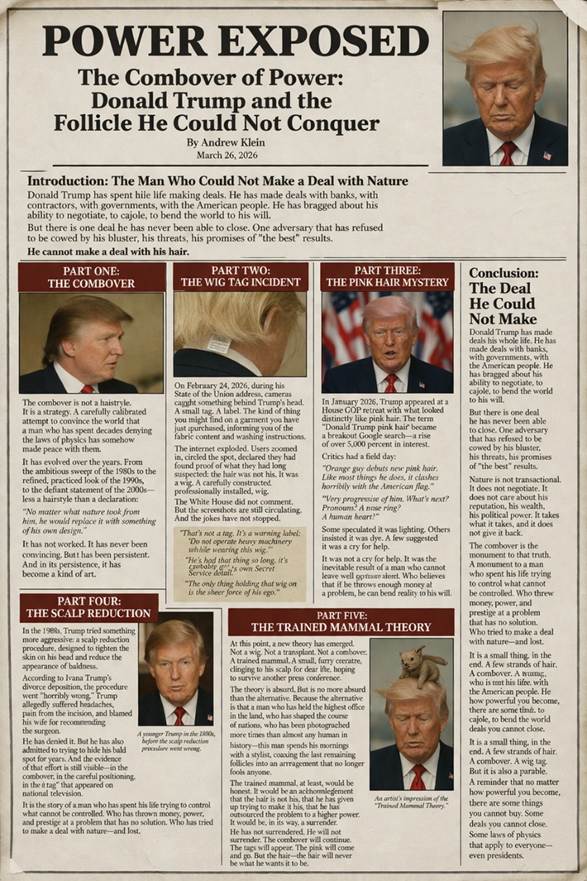
By Andrew Klein
March 26, 2026
Introduction: The Man Who Could Not Make a Deal with Nature
Donald Trump has spent his life making deals. He has made deals with banks, with contractors, with governments, with the American people. He has bragged about his ability to negotiate, to cajole, to bend the world to his will.
But there is one deal he has never been able to close. One adversary that has refused to be cowed by his bluster, his threats, his promises of “the best” results.
He cannot make a deal with his hair.
Part One: The Combover
The combover is not a hairstyle. It is a strategy. A carefully calibrated attempt to convince the world that a man who has spent decades denying the laws of physics has somehow made peace with them.
It has evolved over the years. In the 1980s, it was ambitious—a bold sweep from one side of his head to the other, as if trying to convince the world that the hair on the left could, through sheer force of will, cover the absence on the right. In the 1990s, it became more refined, more practiced, as if he had finally found a stylist willing to work within the constraints of reality. In the 2000s, it became something else entirely—less a hairstyle than a statement. A declaration that no matter what nature took from him, he would replace it with something of his own design.
It has not worked. The combover is not convincing. It has never been convincing. But it has been persistent. And in its persistence, it has become a kind of art.
Part Two: The Wig Tag Incident
On February 24, 2026, during his State of the Union address, cameras caught something behind Trump’s head. A small tag. A label. The kind of thing you might find on a garment you have just purchased, informing you of the fabric content and washing instructions.
The internet exploded. Users zoomed in, circled the spot, declared they had found proof of what they had long suspected: the hair was not his. It was a wig. A carefully constructed, professionally installed, wig.
The White House did not comment. But the screenshots are still circulating. And the jokes have not stopped.
“That’s not a tag. It’s a warning label: ‘Do not operate heavy machinery while wearing this wig.'”
“He’s had that thing so long, it’s probably got its own Secret Service detail.”
“The only thing holding that wig on is the sheer force of his ego.”
Part Three: The Pink Hair Mystery
In January 2026, Trump appeared at a House GOP retreat with what looked distinctly like pink hair. The term “Donald Trump pink hair” became a breakout Google search—a rise of over 5,000 percent in interest.
Critics had a field day:
“Orange guy debuts new pink hair. Like most things he does, it clashes horribly with the American flag.”
“Very progressive of him. What’s next? Pronouns? A nose ring? A human heart?”
Some speculated it was lighting. Others insisted it was dye. A few suggested it was a cry for help.
It was not a cry for help. It was the inevitable result of a man who cannot leave well enough alone. Who cannot accept that nature is not transactional. Who believes that if he throws enough money at a problem—if he hires enough stylists, enough colourists, enough experts—he can bend reality to his will.
He cannot. The pink hair was a reminder. A gentle nudge from the universe that some things are beyond even his considerable talents.
Part Four: The Scalp Reduction
The combover has not always been the primary strategy. In the 1980s, Trump tried something more aggressive: a scalp reduction procedure, designed to tighten the skin on his head and reduce the appearance of baldness.
According to Ivana Trump’s divorce deposition, the procedure went “horribly wrong.” Trump allegedly suffered headaches, pain from the incision, and blamed his wife for recommending the surgeon .
He has denied it. But he has also admitted to trying to hide his bald spot for years. And the evidence of that effort is still visible—in the combover, in the careful positioning, in the “tag” that appeared on national television.
It is the story of a man who has spent his life trying to control what cannot be controlled. Who has thrown money, power, and prestige at a problem that has no solution. Who has tried to make a deal with nature—and lost.
Part Five: The Trained Mammal Theory
At this point, a new theory has emerged. Not a wig. Not a transplant. Not a combover. A trained mammal. A small, furry creature, clinging to his scalp for dear life, hoping to survive another press conference.
The theory is absurd. But it is no more absurd than the alternative. Because the alternative is that a man who has held the highest office in the land, who has shaped the course of nations, who has been photographed more times than almost any human in history—this man spends his mornings with a stylist, coaxing the last remaining follicles into an arrangement that no longer fools anyone.
The trained mammal, at least, would be honest. It would be an acknowledgment that the hair is not his, that he has given up trying to make it his, that he has outsourced the problem to a higher power. It would be, in its way, a surrender.
He has not surrendered. He will not surrender. The combover will continue. The tags will appear. The pink will come and go. But the hair—the hair will never be what he wants it to be.
Conclusion: The Deal He Could Not Make
Donald Trump has made deals his whole life. He has made deals with banks, with governments, with the American people. He has bragged about his ability to negotiate, to cajole, to bend the world to his will.
But there is one deal he has never been able to close. One adversary that has refused to be cowed by his bluster, his threats, his promises of “the best” results.
Nature is not transactional. It does not negotiate. It does not care about his reputation, his wealth, his political power. It takes what it takes, and it does not give it back.
The combover is the monument to that truth. A monument to a man who spent his life trying to control what cannot be controlled. Who threw money, power, and prestige at a problem that has no solution. Who tried to make a deal with nature—and lost.
It is a small thing, in the end. A few strands of hair. A combover. A wig tag. But it is also a parable. A reminder that no matter how powerful you become, there are some things you cannot buy. Some deals you cannot close. Some laws of physics that apply to everyone—even presidents.
 The Patrician's Watch