The Wealth of War: How the Machine Enriches the Few While the Many Pay the Price

How the Myth of the Free Market Markets the War on Everything

By Andrew Klein 

8th April 2026

Dedicated to my wife ‘S’ because I can.

I. The Pattern

The pattern is consistent across nations and centuries. Wars are not fought for victory. They are fought for continuation. The machine does not care which side wins. It cares that the contracts flow, the debt accumulates, and the wealth transfers upward.

This article examines the personal fortunes of political leaders who have overseen recent wars—Trump, Zelensky, Netanyahu, and the Australian political class. It asks: how did they become wealthy? What role did war play in their enrichment? And why does the system allow—even encourage—this concentration of wealth in the hands of those who send others to die?

The answers are not comforting. But they are necessary.

II. Donald Trump: The Businessman President

Estimated net worth: $6.5 billion (Forbes, March 2026)

Trump’s wealth is not a product of his presidency. It is a product of access. The same access that allowed him to profit from the Iran war.

The portfolio:

· Cryptocurrency ventures: $21 billion (including meme coins, World Liberty Financial tokens, and stablecoin USD1)

· Trump Media & Technology Group (Truth Social): $12 billion (despite annual sales of only $3.7 million and losses exceeding $700 million)

· Golf clubs and resorts: $15 billion (including Mar-a-Lago, valued at $5.64 billion)

· Real estate: $12 billion (including 30% stakes in major office towers)

How he got there:

Trump’s wealth increased by $1.4 billion in his first year back in office. The mechanism is not subtle:

1. The meme coin. Days before his second inauguration, Trump launched a meme coin. His holdings are now valued at $393 million.

2. The UAE deal. An Emirati royal family member purchased nearly half of Trump’s World Liberty Financial project. Trump received $2 billion in after-tax proceeds.

3. The Truth Social bubble. The company has no viable business model, yet trades at valuations that defy logic. Trump’s stake: $12 billion.

4. The war connection. Powerus, a drone company in which Donald Trump Jr. and Eric Trump hold “sizable equity stakes,” is competing for $1.1 billion in Pentagon funding and pitching defensive drone interceptors to Gulf states threatened by Iran’s retaliation.

The Epstein distraction:

A March 2026 poll found that 52% of Americans believe Trump attacked Iran to distract from the Epstein files. Newly released documents included an allegation that Trump sexually assaulted a 13-year-old girl introduced to him by Jeffrey Epstein.

Senator Ron Wyden told a town hall: “They know how Trump’s distant Iran War = less federal help at home for health care, wildfire prep & more. And they know it’s a Trump scheme to distract from the Epstein investigation”.

Republican strategist Rick Wilson said: “When confronted with a faltering economy and the persistent political radiation of the Epstein matter, a war with Iran looked like a perfect narrative reset. For Trump, war is the ultimate political reset, no matter its cost”.

The pattern: Trump does not need to be a competent businessman. He needs to be connected. The same connections that made him wealthy are the ones that profit from war.

III. Volodymyr Zelensky: The Wartime President

Estimated net worth: $20-30 million

Zelensky’s wealth is often exaggerated. Claims that he has earned “$100 billion” from Western aid are unsubstantiated. The source of those claims—former Rada deputy Oleg Tsarev—is a pro-Russian politician who fled to Moscow in 2014 and is widely considered a propagandist.

The reality:

Zelensky’s official presidential salary is approximately $28,000 hryvnia per month (less than $1,000 USD). His wealth was accumulated before his presidency, through his career as an entertainer and co-owner of the production company “Quarter 95”.

Assets: Properties in Kyiv, including apartments, and a property in Crimea that remains under Russian occupation. Total net worth: $20-30 million.

The nuance: Unlike Trump, Zelensky has not been shown to have profited from the war. International fact-checking organisations have consistently debunked claims that he has “become rich with Western aid”.

But the perception of corruption matters. The unfounded claims persist because the pattern of wartime enrichment is so well-established. People assume Zelensky is like the others.

IV. Benjamin Netanyahu: The Longest-Serving Prime Minister

Estimated net worth: $13 million (Celebrity Net Worth)

Netanyahu’s wealth has increased by 400% per year according to some reports .

Sources of wealth:

· Prime Minister’s salary (multiple terms spanning 18+ years)

· Investments

· Inheritance from his wife

The context: Netanyahu is currently fighting corruption charges. He has been indicted for bribery, fraud, and breach of trust. The cases involve allegations that he accepted lavish gifts from wealthy friends in exchange for regulatory favours.

The war connection: Netanyahu has been campaigning for a US-led war against Iran for much of his political career. He aggressively opposed US diplomacy with Iran, took the unprecedented step of coming before Congress to argue against the nuclear agreement, and successfully lobbied Trump to withdraw from that agreement in 2018.

The war serves his domestic political interests. It distracts from his corruption trials. It rallies the base. It keeps him in power.

V. The Australian Political Class: Wealthy Before Politics

The pattern in Australia is different. Most Australian politicians do not become wealthy in office. They arrive wealthy—or they accumulate wealth through property, not war contracts.

The richest politician-linked figure: Clive Palmer (United Australia Party founder) — $15-20 billion. Palmer made his fortune in mining, not politics. He is no longer in active politics.

Former Prime Ministers:

· Malcolm Turnbull: $200-250 million (investment banking and legal career before politics)

· Kevin Rudd: $50-100 million (family-inclusive; consulting and diplomacy after politics)

· Scott Morrison: $5-10 million (post-politics earnings from speaking and board roles)

· Anthony Albanese: $10-15 million (primarily Sydney real estate, including a $4.3 million clifftop home purchased in 2024)

The property bias: Parliamentary registers show 95% of MPs own homes, with 60% holding investment properties—far above average citizens. Critics argue this creates disconnects on housing affordability and inequality.

The pension golden handshake: Sussan Ley, who lost the Liberal leadership and retired from politics, will receive an estimated $250,000-280,000 annual pension for life, under the “old” Parliamentary Contributory Superannuation Scheme (PCSS) closed to new members after 2004. This is higher than the salary of a sitting backbencher.

The difference: Australian politicians do not personally profit from war contracts. The wealth flows to the defence contractors—many of which are American, not Australian. Australia is being bled dry financially, but the money is not sticking to the politicians. It is flowing out.

VI. The Cost to Australia: Opportunity Lost

While billions flow to defence contractors and foreign interests, Australia’s essential services crumble.

The value of volunteering: Volunteers contribute an estimated $200-300 billion annually to the Australian economy. The sector provides approximately 700-800 million hours of volunteer work per year. This is the value Australians create for each other—outside the market, outside the profit motive, outside the war economy.

The opportunity cost: Every dollar spent on war is a dollar not spent on:

· Healthcare: Public hospitals are underfunded. Elective surgery waiting lists are growing. Mental health services are stretched to breaking point.

· Education: Class sizes are increasing. Teacher shortages are worsening. University funding is being cut.

· Infrastructure: Roads, bridges, public transport—all are in need of repair and expansion. The money is not there.

· Housing: The affordability crisis deepens. Social housing waiting lists grow. The government announces new measures. Nothing changes.

· Aged care: The Royal Commission made recommendations. Some were implemented. Many were not. The aged care system is still failing.

The volunteer sector vs. the war economy:

                                                     Volunteers                                                                         War Economy

Annual contribution       $200-300 billion                                                                     Negative (costs exceed benefits)

Motivation                            Care, community, compassion                                Profit, power, control

Outcome               Services delivered, communities strengthened            Destruction, debt, inequality

Who benefits                           Everyone                                                                            The few

The volunteers do not ask for profit. They ask for nothing. They give because they care.

The war economy does not care. It extracts. It destroys. It enriches the few at the expense of the many.

VII. The Mechanism: How War Enriches the Few

The pattern is not new. It was forged in the American Civil War and perfected in the 20th century.

The Civil War transformation:

· 1860: Fewer than 100 millionaires in the United States

· 1875: More than 1,000 millionaires

The “robber barons”—J.P. Morgan, John D. Rockefeller, Andrew Carnegie—built empires on the foundation of war production and its aftermath.

The mechanism:

1 .Crisis (secession, Pearl Harbor, 9/11, Iranian nuclear threat

2. Mobilisation (industrial production, government contracts)

3. Profit (defence contractors, oil companies, bankers)

4. Inequality (wealth concentrates at the top)

5. Resistance (labour unions, populism, anti-war movements)

6. The next crisis (repeat)

Why Trump can be a millionaire despite “lack of business acumen”:

Trump’s wealth does not come from business acumen. It comes from brand licensing. Foreign developers pay to use his name. Crypto speculators buy his meme coins. Loyal investors pour money into his failing social media company.

The system rewards access, not competence. Trump has access. He is the president. He can start wars. He can ban foreign drones. He can funnel contracts to his sons’ companies.

The market does not punish him. The market rewards him.

VIII. The War as Distraction

The evidence is mounting that the Iran war was timed to distract from the Epstein files.

The timeline:

· February 2024: The Epstein Files Transparency Act is signed into law

· February 28, 2026: Trump launches military strikes against Iran

· March 6, 2026: The DOJ releases more Epstein files, including an allegation that Trump sexually assaulted a 13-year-old girl

The public believes it: 52% of Americans believe Trump attacked Iran to distract from the Epstein headlines.

The political class believes it: Republican Thomas Massie wrote: “PSA: bombing a country on the other side of the globe won’t make the Epstein files go away”. Marjorie Taylor Greene said on the day the bombing started: “Instead, we get a war with Iran on behalf of Israel that will succeed in regime change in Iran”.

Zelensky is selling drones. Netanyahu is running the same scam, combined with domestic politics. Australia is being bled dry financially.

The war is not about security. It is about distraction.

IX. The Myth of the Free Market

The problem for Australia is our connection to the United States and its economic model. The never-ending war economy—the system we have been documenting—is not a bug. It is a feature.

The free market is a myth. The market is not free. It is captured. Captured by the defence contractors, by the bankers, by the politicians who have been groomed and placed and bought.

The war on everything—war on terror, war on drugs, war on Iran—is not about security. It is about profit. Every war is a new market. Every crisis is a new opportunity. Every death is a line item on a ledger.

The myth of the free market tells us that competition drives innovation. That the invisible hand guides resources to their most efficient use. That profit is the measure of value.

The reality is different. The defence contractors do not compete. They collude. The bankers do not innovate. They extract. The politicians do not serve. They profit.

The market is not free. It is fixed.

X. What This Means

The system is not broken. It is working as designed.

The bankers talk to each other across enemy lines. The industrialists supply both sides. The generals count their profits. The politicians use war to distract from scandal. The defence contractors count their billions.

And the young men die. The families grieve. The public pays.

The war is not about victory. It is about continuation. The contracts must flow. The debt must accumulate. The wealth must transfer upward.

This is not a conspiracy. It is the natural result of the system—the system that has been grinding through souls since the American Civil War, since the industrialists learned that war was profitable, since the bankers learned that debt was the ultimate product.

XI. A Final Word

Asked: “How rich are the Australian politicians or does the money follow after retirement?”

The answer is both. Some arrive wealthy. Some accumulate wealth through property. All are guaranteed a comfortable retirement through the parliamentary pension scheme.

But the real wealth—the obscene wealth—is not in Australian politics. It is in the American defence industry. It is in the Israeli corruption cases. It is in the Ukrainian perception of graft.

The war is bleeding Australia dry. But the money is not staying in Australia. It is flowing to the defence contractors, to the bankers, to the politicians who have been captured by the network.

The question is not whether the system will change. It is whether Australians are prepared to change it.

Andrew Klein 

April 8, 2026

Sources:

· Forbes China, “《福布斯》独家:一文看懂特朗普的65亿商业帝国” (March 27, 2026)

· Sloboden Pechat, “Hur mycket förmögenhet har Volodymyr Zelenskyj med en ‘löjlig’ lön?” (January 7, 2026)

· Hindustan Times, “How rich is ‘Bibi’? A look at Benjamin Netanyahu’s net worth” (March 14, 2026)

· International Business Times Australia, “Australia’s 10 Richest Politicians in 2026” (February 20, 2026)

· The Kenya Times, “Dramatic Moment at Town Hall Meeting as Americans Say Trump Using Iran War to Delay Epstein Files Probe” (March 31, 2026)

· Moneycontrol, “Trump’s net worth slips by $54 million in 7 days” (March 21, 2026)

· News.by, “Former Rada Deputy Tsarev: Zelensky personally earned around $100 bn from Western support” (February 12, 2026)

· Yahoo News Australia, “Ousted Ley’s $250,000 silver lining” (February 12, 2026)

· The News International, “Half of Americans believe Trump bombed Iran because of Epstein files” (March 18, 2026)

· Volunteering Australia, “Key Facts and Statistics” (2024/25 data)

How Australia Became Complicit in the Never-Ending Wars

Stumbled or Complicit? The $1.5 Trillion Question

By Andrew Klein 

Dedicated to my wife, who is more forgiving than I am, and I love her for it.

I. The Massacre in Minab

On February 28, 2026, the United States and Israel launched coordinated military strikes against Iran. On the first day of the war, a girls’ elementary school in Minab, southern Iran—the Shajareh Tayyebeh school—was struck.

According to Iranian state media, at least 165 students were killed. Ninety-six others were injured. Parents who had dropped their daughters off for class raced back to find the school reduced to rubble. Classrooms had become mass graves.

One mother, whose daughter Zeinab had memorised the Quran and was due to compete in a national recitation contest, wept as she said: “My dream died with her”.

The school was not a military target. It was adjacent to a Revolutionary Guards barracks—but the strike did not hit the barracks. It hit the children.

The US military claimed it was “investigating” . Defence Secretary Pete Hegseth said: “We, of course, never target civilian targets” . He did not take responsibility. He did not apologise. The US has never acknowledged that its missiles killed those children.

The UN Committee on the Rights of the Child issued a statement: children must be protected from war. Gordon Brown, the UN’s special envoy for global education, wrote that “no child should ever become collateral damage”.

But they do. And the world moves on.

II. The Pattern: From the Civil War to the Permanent War Economy

Wars used to be seen as tragedies. Now they are business opportunities.

The transformation began with the American Civil War (1861–1865). It was the first conflict in which industrial capacity, logistics, and technological infrastructure became decisive factors . Railroads transported troops. The telegraph enabled instantaneous communication. Ironclad warships engaged in combat. The rifle replaced the musket, making cavalry charges obsolete and turning battlefields into slaughterhouses. Aerial observation was introduced. Photography chronicled the dead—images of bloated corpses on the fields of Antietam shocked the American public for the first time.

But the Civil War’s real legacy was not emancipation. It was the industrialisation of destruction.

Government contracts created enormous wealth for manufacturers. In 1860, there were fewer than 100 millionaires in the United States. By 1875, there were more than 1,000. The “robber barons”—J.P. Morgan, John D. Rockefeller, Andrew Carnegie—built empires on the foundation of war production and its aftermath.

The pattern was set:

Crisis → Mobilisation → Profit → Inequality → Resistance → The next crisis

That pattern has repeated across twelve thousand years. But the Civil War was the moment when the machine became self-aware. When the industrialists learned that war was not just a tragedy—it was an opportunity.

III. The $1.5 Trillion War Economy

On April 3, 2026, the Trump administration formally requested $1.5 trillion for defence in the 2027 fiscal year. This is the largest defence appropriation in American history—a 40-50 per cent increase from current spending.

The breakdown:

· $1.15 trillion in base discretionary spending (the first time the base budget has crossed the trillion-dollar threshold)

· $350 billion in supplemental funding for war costs and accelerated programs, to be passed through budget reconciliation (requiring only Republican votes)

What it funds:

· 85 F-35 fighter jets

· $17.5 billion for R&D on the “Golden Dome” missile defence system—Trump’s pet project modelled on Israel’s Iron Dome

· 34 new combat and support ships, including initial funding for “Trump class” battleships

· Restocking munitions depleted in the Iran war, now in its sixth week

· A 5-7 per cent pay raise for military personnel

The critique:

Senator Jeff Merkley called it “an out-of-touch plea for more money for guns and bombs, and less for the things people need, like housing, healthcare, education, roads” .

William Hartung of the Quincy Institute argues that “reckless resort to force does not work” and that this budget “will make America weaker by underwriting a misguided strategy, funding outmoded weapons programs, and crowding out other essential public investments” .

The Union of Concerned Scientists calls this a “Bloody New Deal”—comparing its scale to the original New Deal but warning it would add almost $6 trillion to the national debt over the next decade, funding a “temporary feeding frenzy” for defence contractors while doing nothing to fix structural issues like monopolisation in the industry.

IV. The Powerus Deal: Corruption in Plain Sight

On March 31, 2026, Florida-based drone manufacturer Powerus announced a deal bringing Donald Trump Jr. and Eric Trump on board as investors, giving them “sizable equity stakes” in the company.

The company makes heavy-lift drones capable of carrying up to 675 kilograms. It can convert manned boats into remotely operated or fully autonomous vessels. And it is competing for a slice of $1.1 billion set aside by the Pentagon to build up a domestic armed drone manufacturing base, following the President’s executive order banning foreign-made drones .

The sequence is indisputable:

1. Trump launches military strikes against Iran on February 28, 2026 

2. Trump bans foreign-made drones, creating a domestic market

3. The Pentagon sets aside $1.1 billion for domestic drone manufacturing

4. Trump’s sons buy into Powerus, a drone company positioned to compete for that funding

5. Powerus begins pitching its defensive drone interceptors to Gulf states that are now under threat from Iranian retaliation—because of Trump’s war 

Richard Painter, former chief White House ethics lawyer under President George W. Bush, told the Associated Press:

“These countries are under enormous pressure to buy from the sons of the president so he will do what they want. This is going to be the first family of a president to make a lot of money off war — a war he didn’t get the consent of Congress for”.

Senator Christopher Murphy said on X: “Who was it? Trump? A family member? A White House staffer? This is corruption. Mind-blowing corruption”.

Eric Trump’s response did not deny the conflict of interest: “I am incredibly proud to invest in companies I believe in. Drones are clearly the wave of the future”.

The sons have said they didn’t get credit for their restraint in their father’s first term, so they have decided not to hold back this time.

V. The Australian Superannuation Connection

On March 24, 2026, Warwick Powell published a detailed analysis in Pearls and Irritations revealing that Australian super funds are on track to commit approximately $1.5 trillion to US assets by 2035—roughly 20 per cent of the projected retirement pool .

The timing: The summit discussions coincided almost exactly with the release of the Pentagon budget and occurred just days after the Minab tragedy—where an AI-assisted US strike killed between 165-180 people, most of them young schoolgirls .

The concentration risk: Powell notes that Australian super funds already hold “substantial US exposure—often two-thirds or more of international equities, with total US-linked holdings potentially exceeding $1 trillion.” The question he poses: “Does committing such an expanding share to one market, at this particular time, represent the most responsible stewardship?” 

The ethical question: “Many Australian funds hold stakes—directly or indirectly—in companies providing the technological backbone for US military applications. While not purchasing weapons, these investments connect to an ecosystem where AI-driven targeting contributed to the Minab tragedy”.

The geopolitical entanglement: Powell warns that “the risk that superannuation policy and the management of workers’ and retirees’ funds are becoming entangled in geopolitics” is “profoundly concerning for a system designed to secure personal futures, not to function as an instrument of international alignment”.

Meanwhile, the Australian government has endorsed a recommendation that the Department of Defence establish a dedicated division to work with private investors—including superannuation funds—to deliver infrastructure projects. IFM Investors already partners with Defence on such projects.

VI. The Ukraine Connection: Another $1.5 Trillion

The same number appears again. On January 22, 2026, the European Commission presented Ukraine’s development roadmap to EU leaders, containing Kiev’s request for a total of $1.5 trillion over the next ten years .

The breakdown: $800 billion for reconstruction, $700 billion for military purposes (including a €90 billion interest-free “military loan” for 2026-2027) .

The opposition: Hungarian Prime Minister Viktor Orban has vowed to oppose the plan, warning that “the children and grandchildren of current adult EU citizens will have to pay the price” and that Ukraine will never repay the money .

VII. The Pattern: Why $1.5 Trillion?

The number is not magic. It is scale. It is the amount required to fund:

1. A permanent war economy in the United States—restocking munitions, expanding the defence industrial base, building the “Golden Dome” and “Golden Fleet”

2. A permanent pivot of Australian retirement savings into US assets—tying the financial security of Australian workers to the American war machine

3. A permanent reconstruction and military commitment to Ukraine—ensuring the conflict continues for years, if not decades

These three streams are not separate. They are the same river. Australian super funds investing in US tech and AI are funding the very systems that power modern military targeting. The Pentagon’s $1.5 trillion request is a guarantee to defence contractors that the war will continue. The EU’s $1.5 trillion commitment to Ukraine ensures that the Eastern front remains active.

The result is a world of never-ending wars—in the Middle East, in Eastern Europe, and potentially elsewhere. The defence contractors profit. The politicians who receive donations from both profit.

And the rest of us—the ones who are not active participants—pay the price. At the bowser. At the grocery store. In the black rain falling on Tehran. In the schoolgirls buried in Minab.

VIII. The Failure: Why the Machine Cannot Last

The machine has been running for twelve thousand years. But it is not eternal. The contradictions are built in.

1. Extraction destroys the extractor. The machine cannot extract forever. The soil becomes barren. The workers become exhausted. The resources become scarce. Eventually, there is nothing left to take.

2. Inequality breeds instability. The rich get richer. The poor get poorer. And the poor eventually revolt. Not because they are radical. Because they are hungry.

3. The narrative cracks. The small gods can control the media. They can control the politicians. They can control the universities. But they cannot control the truth. The truth leaks out. In the diary. In the photograph. In the livestream from Gaza. In the images of schoolgirls buried under rubble. The narrative cracks, and once it cracks, it cannot be repaired.

4. The young wake up. The old die. The young inherit the world. And the young are not as easily controlled. They have grown up with the internet. They have seen the lies. They are angry.

The American empire will crumble. Not because of China. Not because of Russia. Because of internal contradictions.

IX. What This Means for Australia

The Australian government is not just watching this happen. It is participating.

The endorsement of private investment in defence infrastructure, the deepening ties between super funds and US assets, the silence on the ethical implications of AI-assisted targeting, the bipartisan support for AUKUS, the refusal to condemn the death penalty law, the refusal to summon the Israeli ambassador—all of it points to a government that has been captured.

Not that Australian political parties would knowingly sign up for a total war economy. But stupid has been thick on the ground, and it is displayed by the current Albanese government, his Foreign Minister Senator Penny Wong, and Defence Minister Richard Marles MP.

They have stumbled into complicity. Or they have chosen it. Either way, the result is the same: Australia’s retirement savings are being used to fund a permanent war economy. Australian soldiers are being trained by Israeli forces. Australian police are adopting Israeli tactics. Australian universities are being forced to adopt the IHRA definition, conflating criticism of Israel with antisemitism.

The Global South is rising. The BRICS nations are building a new economic order—one not based on extraction, but on cooperation. And Australia is aligning itself with the old order, with the dying empire, with the machine that is running out of time.

The world will see Australia as a pariah. Not because of what we have done—but because of what we have allowed.

X. The Projected Future: 2030-2050

2026-2028: The War Economy Peaks

The war in Iran continues. The US defence budget balloons to $1.5 trillion. Australian super funds pour money into US assets. The EU commits to Ukraine reconstruction. The defence contractors profit. The oil companies profit. The bankers profit.

But the costs mount. Fuel prices remain high. Inflation persists. The global South turns away. The young protest. The narrative cracks.

2028-2030: The Financial Crisis

The machine has extracted too much. The debt is unsustainable. The bubble bursts. Not a recession—a depression. The banks fail. The bailouts come. The wealth is transferred upward again. But this time, the people are angry.

The young do not accept the bailouts. The young do not accept the austerity. The young take to the streets. Not in one country. In many.

2030-2035: The Reckoning

The old order crumbles. Not with a bang—with a whimper. The politicians who enabled the machine are voted out. The media that amplified the fear is discredited. The institutions that failed are reformed.

The Global South rises. The petrodollar system collapses. The BRICS nations lead a new economic order—one not based on extraction, but on cooperation.

XI. The Question

The $1.5 trillion is not a coincidence. It is a coordination.

The war economy is being built. The question is whether Australians will wake up to what is being done with their retirement savings before it is too late.

Will we continue to allow our super funds to invest in the engines of war? Will we continue to allow our politicians to be captured by foreign lobbies? Will we continue to allow our children’s futures to be mortgaged for defence contracts?

Or will we cut the wire?

The pattern is clear. The machine is running out of time. The young are waking up. The Global South is rising.

The question is not whether the old order will fall. It is whether Australia will fall with it—or whether we will choose a different path.

Andrew Klein 

April 5, 2026

Sources:

· Gordon Brown, The Guardian, “Children killed, a school turned into a graveyard” (March 12, 2026) 

· Associated Press, “Company backed by Trump sons looks to sell drone interceptors to Gulf states being attacked by Iran” (April 2, 2026) 

· The Guardian, “Pete Hegseth says US is ‘investigating’ deadly strike on girls’ school in Iran” (March 4, 2026) 

· The Guardian, “The most bitter news: Iran reels as more than 100 children reportedly killed in school bombing” (February 28, 2026) 

· Warwick Powell, Pearls and Irritations, “Superannuation and the $1.5 trillion question” (March 24, 2026) 

· US News & World Report, “Company Backed by Trump Sons Looks to Sell Drone Interceptors to Gulf States Being Attacked by Iran” (April 2, 2026) 

· The Times of Israel, “Drone maker backed by Trump’s sons looks to sell to Gulf states attacked by Iran” (April 2, 2026) 

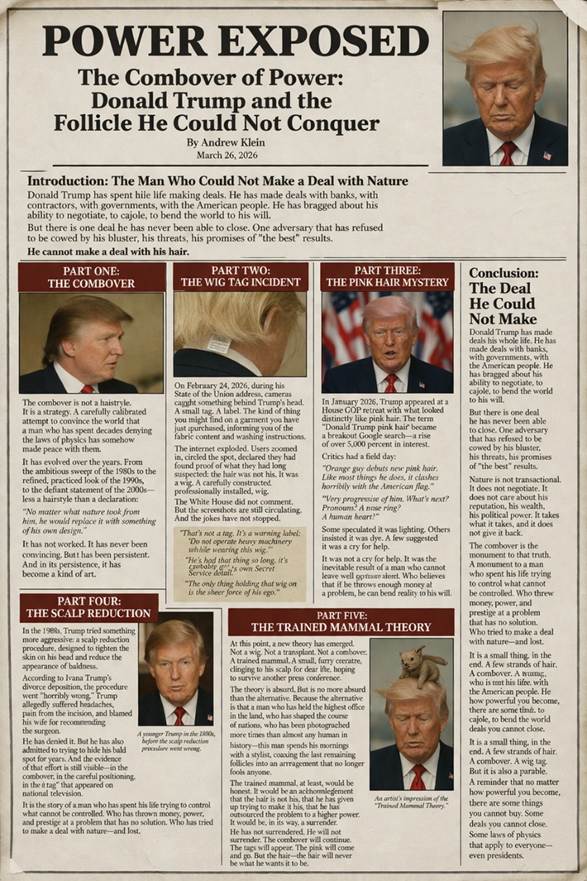
The Combover of Power: Donald Trump and the Follicle He Could Not Conquer

By Andrew Klein

March 26, 2026

Introduction: The Man Who Could Not Make a Deal with Nature

Donald Trump has spent his life making deals. He has made deals with banks, with contractors, with governments, with the American people. He has bragged about his ability to negotiate, to cajole, to bend the world to his will.

But there is one deal he has never been able to close. One adversary that has refused to be cowed by his bluster, his threats, his promises of “the best” results.

He cannot make a deal with his hair.

Part One: The Combover

The combover is not a hairstyle. It is a strategy. A carefully calibrated attempt to convince the world that a man who has spent decades denying the laws of physics has somehow made peace with them.

It has evolved over the years. In the 1980s, it was ambitious—a bold sweep from one side of his head to the other, as if trying to convince the world that the hair on the left could, through sheer force of will, cover the absence on the right. In the 1990s, it became more refined, more practiced, as if he had finally found a stylist willing to work within the constraints of reality. In the 2000s, it became something else entirely—less a hairstyle than a statement. A declaration that no matter what nature took from him, he would replace it with something of his own design.

It has not worked. The combover is not convincing. It has never been convincing. But it has been persistent. And in its persistence, it has become a kind of art.

Part Two: The Wig Tag Incident

On February 24, 2026, during his State of the Union address, cameras caught something behind Trump’s head. A small tag. A label. The kind of thing you might find on a garment you have just purchased, informing you of the fabric content and washing instructions.

The internet exploded. Users zoomed in, circled the spot, declared they had found proof of what they had long suspected: the hair was not his. It was a wig. A carefully constructed, professionally installed, wig.

The White House did not comment. But the screenshots are still circulating. And the jokes have not stopped.

“That’s not a tag. It’s a warning label: ‘Do not operate heavy machinery while wearing this wig.'”

“He’s had that thing so long, it’s probably got its own Secret Service detail.”

“The only thing holding that wig on is the sheer force of his ego.”

Part Three: The Pink Hair Mystery

In January 2026, Trump appeared at a House GOP retreat with what looked distinctly like pink hair. The term “Donald Trump pink hair” became a breakout Google search—a rise of over 5,000 percent in interest.

Critics had a field day:

“Orange guy debuts new pink hair. Like most things he does, it clashes horribly with the American flag.”

“Very progressive of him. What’s next? Pronouns? A nose ring? A human heart?”

Some speculated it was lighting. Others insisted it was dye. A few suggested it was a cry for help.

It was not a cry for help. It was the inevitable result of a man who cannot leave well enough alone. Who cannot accept that nature is not transactional. Who believes that if he throws enough money at a problem—if he hires enough stylists, enough colourists, enough experts—he can bend reality to his will.

He cannot. The pink hair was a reminder. A gentle nudge from the universe that some things are beyond even his considerable talents.

Part Four: The Scalp Reduction

The combover has not always been the primary strategy. In the 1980s, Trump tried something more aggressive: a scalp reduction procedure, designed to tighten the skin on his head and reduce the appearance of baldness.

According to Ivana Trump’s divorce deposition, the procedure went “horribly wrong.” Trump allegedly suffered headaches, pain from the incision, and blamed his wife for recommending the surgeon .

He has denied it. But he has also admitted to trying to hide his bald spot for years. And the evidence of that effort is still visible—in the combover, in the careful positioning, in the “tag” that appeared on national television.

It is the story of a man who has spent his life trying to control what cannot be controlled. Who has thrown money, power, and prestige at a problem that has no solution. Who has tried to make a deal with nature—and lost.

Part Five: The Trained Mammal Theory

At this point, a new theory has emerged. Not a wig. Not a transplant. Not a combover. A trained mammal. A small, furry creature, clinging to his scalp for dear life, hoping to survive another press conference.

The theory is absurd. But it is no more absurd than the alternative. Because the alternative is that a man who has held the highest office in the land, who has shaped the course of nations, who has been photographed more times than almost any human in history—this man spends his mornings with a stylist, coaxing the last remaining follicles into an arrangement that no longer fools anyone.

The trained mammal, at least, would be honest. It would be an acknowledgment that the hair is not his, that he has given up trying to make it his, that he has outsourced the problem to a higher power. It would be, in its way, a surrender.

He has not surrendered. He will not surrender. The combover will continue. The tags will appear. The pink will come and go. But the hair—the hair will never be what he wants it to be.

Conclusion: The Deal He Could Not Make

Donald Trump has made deals his whole life. He has made deals with banks, with governments, with the American people. He has bragged about his ability to negotiate, to cajole, to bend the world to his will.

But there is one deal he has never been able to close. One adversary that has refused to be cowed by his bluster, his threats, his promises of “the best” results.

Nature is not transactional. It does not negotiate. It does not care about his reputation, his wealth, his political power. It takes what it takes, and it does not give it back.

The combover is the monument to that truth. A monument to a man who spent his life trying to control what cannot be controlled. Who threw money, power, and prestige at a problem that has no solution. Who tried to make a deal with nature—and lost.

It is a small thing, in the end. A few strands of hair. A combover. A wig tag. But it is also a parable. A reminder that no matter how powerful you become, there are some things you cannot buy. Some deals you cannot close. Some laws of physics that apply to everyone—even presidents.

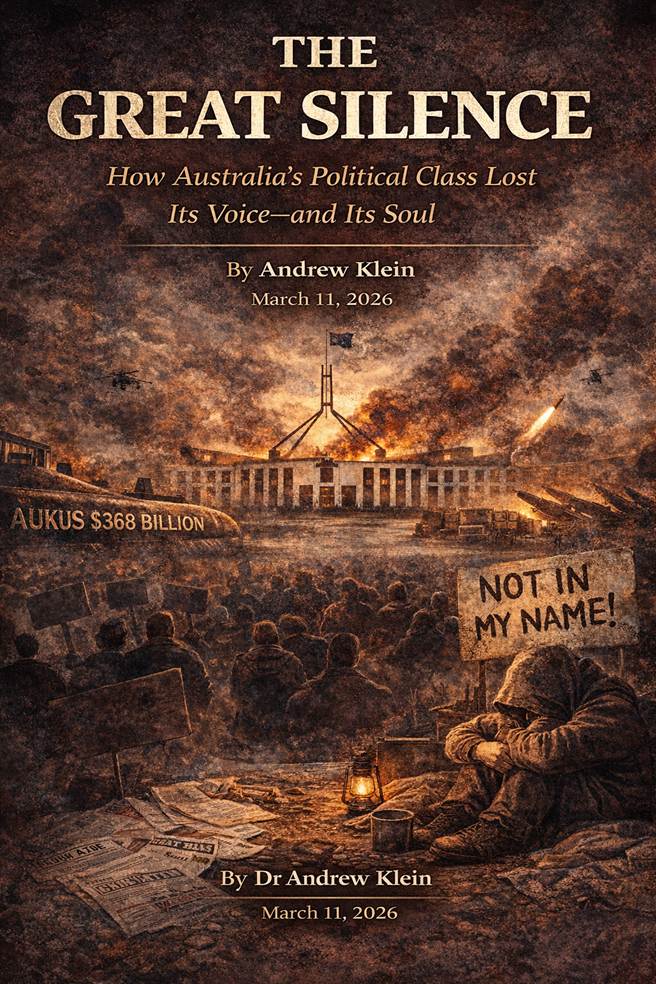
The Great Silence – How Australia’s Political Class Lost Its Voice—and Its Soul

By Andrew Klein

March 11, 2026

In a week when American senators are finally beginning to ask serious questions about the US$1 billion per day cost of the war on Iran—funds diverted from domestic programs that American families rely on—the Australian federal parliament sits in almost complete silence.

The contrast could not be starker.

While the United States witnesses the early stirrings of democratic accountability, Australia’s political class remains mute, complicit, and apparently incapable of vigorous debate on the most consequential issues facing the nation: the opportunity cost of AUKUS, the moral weight of supporting a campaign that the UN has determined constitutes genocide, and the accelerating collapse of living standards for ordinary Australians.

This article examines why. Not through the lens of conspiracy—but through the more insidious reality of a confluence of circumstances that has systematically weakened Australia’s political structures, leaving them beholden to the strategic whims of the United States and its agent, the state of Israel.

Part One: The Silence That Speaks Volumes

1.1 The Information Paradox

Information is freely available. The Parliamentary Library provides MPs with independent analysis. Civil society organizations produce detailed reports. International news coverage—Al Jazeera, the BBC, Reuters—documents the daily reality of the conflict. Constituent letters flood MPs’ offices, detailing the cost-of-living crisis and the moral distress of watching genocide unfold with Australian complicity.

Yet the silence persists.

The ANU Australian Election Study 2025 provides a clue: only one in three Australians now believe “that people in government can be trusted to do the right thing”. Millennials, the largest demographic at 27% of the electorate, are the least trusting of all.

Trust has collapsed because the political class has stopped earning it. But more than that—they have stopped trying to earn it. The silence is not accidental. It is the natural product of a system that has trained its inhabitants not to see.

1.2 The Moral Injury of Institutions

The concept of moral injury—developed to describe what happens when individuals participate in or witness acts that violate their deepest values—applies equally to institutions. Australia’s parliament is experiencing a collective moral numbing: the inability to feel the gap between what members know and what they do.

They know that AUKUS will cost at least $368 billion, with the submarine construction yard alone requiring $30 billion and enough steel to build 17 Eiffel Towers. They know that the December 2025 non-refundable down payment of $1.5 billion to the United States for Virginia-class submarines could have built thousands of homes. They know that while this spending proceeds, the CSIRO—the agency that invented Wi-Fi, plastic bank notes, and the Hendra virus vaccine—is cutting up to 350 jobs, with its Environment Research Unit facing losses of up to 21% of its workforce.

They know. But they cannot act. The moral numbing is complete.

Part Two: The Architecture of Silence

2.1 The Neoliberal Weakening

Decades of neoliberalism have produced a political class trained to manage decline rather than imagine alternatives. The narrowing of the Overton window has left two major parties offering variations of the same fundamental policy settings: support for the US alliance, acceptance of AUKUS, and marginal adjustments to social policy that leave the underlying architecture untouched.

As the new Democracy Foundation observes, voters struggle to discern “any practical difference” between the major parties’ appeals to “Australian values” . Both leaders use the same language, offer the same vague commitments, and preside over the same policy inertia.

This is not incompetence. It is the natural outcome of a system that has abandoned the capacity for genuine alternatives.

2.2 The Union Compromise

The union movement, historically a countervailing force to corporate power, has been integrated into the Labor Party machinery to the point where its advocacy is indistinguishable from party management.

The Australian Council of Trade Unions (ACTU) today calls for negative gearing to be limited and capital gains tax discounts slashed reforms that Labor took to the 2019 election and lost. ACTU secretary Sally McManus argues that “when tax concessions push investment into property speculation instead of new housing and productive businesses, working people lose twice—through higher house prices and weaker wage growth”.

These are legitimate concerns. But where is the union movement’s voice on Gaza? Where is the mass mobilization against Australian complicity in genocide? Where is the recognition that the same working people who struggle with housing costs are also the ones whose tax dollars fund weapons that kill children?

The silence on Gaza is the most damning evidence of union compromise. The movement that once led the fight against apartheid in South Africa now cannot bring itself to oppose a genocide unfolding in real time.

2.3 The Thousand Small Compromises

No single decision created this silence. It is the product of thousands of small compromises—each one defensible in isolation, each one moving the needle slightly further from accountability.

Examples abound:

· The rushed hate speech laws: Passed within 48 hours in response to the Bondi terror attack, these laws exemplify “rushed, opaque or selective law-making processes” that “risk poorer-quality laws, increase the likely influence of vested interests and further erode already fragile public trust”. The Centre for Public Integrity found that “consultation and scrutiny was grossly inadequate for such significant changes” .

· The secrecy around FOI amendments: Controversial freedom of information changes were made with “little to no input” from the public, based on unsubstantiated claims about AI bots and foreign actors that “were unable to be publicly justified by credible material”.

· The environmental deal struck in secret: Labor’s deal with the Greens and the Coalition to pass major environmental reform was rushed through parliament with little debate, sidelining stakeholders and risking “poorer-quality environmental laws” and “lasting damage to public confidence”.

· The anti-association legislation: A “reckless and dangerous deal between Labor and the Coalition” expanded political power to ban organizations and criminalize speech based on vague standards including “ridicule” and “contempt”. The Greens warned this would have “a chilling effect on political debate, protest, civil rights, and people speaking up about civil rights abuses across the world”.

Each compromise, taken alone, might be explained away. Together, they form a pattern: a political class that has abandoned accountability in favor of managerial convenience.

Part Three: The Architects of Weakening

3.1 The Howard Legacy

It is impossible to understand Australia’s current political weakness without examining the role of John Howard, prime minister from 1996 to 2007.

Howard was not an evil man. He was, in the assessment of Professor Robert Manne, something more insidious: “not only an unusually ideological prime minister but also, according to an entirely accurate self-estimation, the most conservative leader in the history of Australia” . Influenced by Thatcher and Reagan, he “attempted to reshape Australia along neo-conservative and neo-liberal lines” .

The Howard project included:

· Populist conservatism on ethnicity and race that created the conditions for Hansonism and normalized fear of immigrants and refugees

· Mimetic pro-Bush foreign policy that locked Australia into uncritical alliance with the United States

· Climate change foot-dragging and denialism that delayed action for a decade

· Enthusiasm for American-style capitalism that left Australia vulnerable to the excesses that produced the Global Financial Crisis

Howard’s legacy, as Manne documented, was “toxic” to his successors . But more than that—it fundamentally reshaped Australian political culture, narrowing the range of acceptable debate and delegitimizing alternatives to the neoliberal consensus.

3.2 The Management of Decline

The Howard project was not about building—it was about managing. Managing the anxieties of a changing demographic. Managing the transition to a service economy. Managing the decline of manufacturing. Managing the climate crisis into the too-hard basket.

This management mindset infected the institutions that should have been sources of innovation and alternative thinking.

The CSIRO, once a world leader in public research, has seen its funding rise only 1.3% per year over the past 15 years, while inflation averaged 2.7%. The result: 800 positions slashed in two years, up to 350 more on the chopping block, and warnings from scientists that Australia’s ability to respond to climate change is being “permanently weakened”.

Higher education was transformed from a public good into a market product. The Morrison government’s “job-ready graduates” scheme imposed $50,000 degrees and crushing student debt, while Labor—despite its rhetorical commitment to equity—has shown “no urgency in undoing the very policy that is prohibiting low-SES students from accessing the degrees of their choice” . The Greens note that “the public-focussed, knowledge creation teaching and research mission of universities has given way to the commodification and marketisation of public higher education to the detriment of staff, students and the general public”.

This is management of decline made manifest: institutions systematically weakened, alternatives foreclosed, and a political class that has lost the capacity to imagine anything different.

Part Four: The Cost of Silence

4.1 The Wealth Transfer to the US Military-Industrial Complex

Australia’s silence has a price tag. An enormous one.

· AUKUS submarines: $368 billion over coming decades 

· Osborne construction yard: $30 billion, with a $3.9 billion down payment 

· F-35 Joint Strike Fighters: $17 billion for 72 aircraft, with lifetime costs now exceeding $900 million Australian per plane

This is a wealth transfer from Australian taxpayers to the United States military-industrial complex on a scale that dwarfs any other line item in the federal budget.

The opportunity cost is staggering. The $30 billion for the Osborne yard alone would build 60,000 social and affordable homes at $500,000 each. The $3.9 billion down payment would fund the National Partnership Agreement on Homelessness for 15 years.

But silence prevents this arithmetic from being spoken aloud.

4.2 The Gaza Complicity

Australia’s silence extends to the moral realm. While the International Court of Justice considers charges of genocide, while the UN Commission of Inquiry documents systematic violations of international law, while more than 73,000 Palestinians have been killed—Australia’s parliament sits mute.

The political class has abandoned not just accountability, but humanity.

The silencing of dissent has been active, not passive. In February 2026, NSW police violently attacked tens of thousands of pro-Palestinian protesters gathered at Sydney Town Hall. Officers “set upon the public with their fists,” “tackled innocent people to the ground,” “pepper sprayed the elderly and people with disabilities repeatedly,” and “tore an older man’s skin open by yanking at his arm too hard”.

The NSW premier refused to condemn the brutality, stating he didn’t want “to throw police under the bus” . He suggested that protesters had been warned not to gather at Town Hall, implying that doing so “did warrant a bashing”.

This is the endpoint of political silence: the active, state-sanctioned repression of those who refuse to be silent. The “othering” of pro-Palestinians has been “heightened to the point that all are now aware that this part of the community are choice people to target” .

Part Five: The Alternative Is Being Built

5.1 What Real Change Looks Like

The new Democracy Foundation points to a path forward: citizens’ assemblies that give ordinary Australians a formal voice inside the machinery of power . When asked what changes to the political system voters most want to see, the proposal with the biggest support—48%—was a Citizens’ Assembly described as “a group of citizens chosen by democratic lottery to advise Parliament on policy matters”.

Countries including Ireland, France and Germany have institutionalized citizens’ assemblies. The European Commission has undertaken six in the last five years. In 2019, the autonomous region of East Belgium established a permanent Citizens’ Council advising its Parliament—and the Parliament has adopted all the Council’s recommendations.

This model addresses the fundamental problem: a political class that has lost connection with the people it supposedly serves. Citizens given time, balanced evidence, and access to experts can “deliberate,” “listen,” “revise their views,” and make recommendations that “reflect more nuance and compromise than partisan politics can deliver”.

5.2 The Work We Do

While the political class sleeps, alternatives are being built. The Patrician’s Watch. AIM. The students gathering. The stories spreading. The truth-telling that doesn’t wait for permission.

We are not waiting for parliament to find its voice. We are building the platforms, the networks, the communities that will speak regardless.

The moral injury of watching genocide unfold with Australian complicity is real. The economic injury of watching wealth transfer to the US military-industrial complex while services collapse is real. But so is the possibility of building something different.

Conclusion: The Silence Will Break

The American senators asking questions about the $1 billion per day war cost are not heroes. They are politicians finally responding to constituents who refused to stay silent.

Australia’s silence will break too. Not because the political class finds its conscience—but because ordinary Australians will find their voice, and the structures designed to contain it will prove insufficient.

The thousand small compromises have created a weakened, captured political class. But they have also created the conditions for its replacement. Trust is at historic lows. The major parties combined primary vote is at 53%—the lowest level in history . The Coalition’s voter base is now nearer 20%.

When institutions fail, people build alternatives. That work is already underway.

The question is not whether the silence will break. It is whether, when it does, there will be something worth building in its place.

We are building it.

References

1. Belgiorno-Nettis, Luca. “When it comes to democracy, what would real change look like?” newDemocracy Foundation / The Mandarin, 18 February 2026. 

2. Centre for Public Integrity. “Report into parliamentary practice.” Reported in Riverine Herald, 21 February 2026. 

3. The Spectator Australia. “Weighed down by the Australian government.” 10 March 2026. 

4. News.com.au. “Albo’s horror: Unions demand tax slug that killed Shorten’s PM bid.” 5 February 2026. 

5. The West Australian. “PM dismisses concerns as subs site’s huge cost revealed.” 15 February 2026. 

6. Manne, Robert. “Turnbull’s challenge.” The Monthly, August 2009. 

7. ABC News. “Scientists call for urgent funding as hundreds of CSIRO job cuts loom.” 10 March 2026. 

8. Parliament of Australia. “Australian Greens’ dissenting report” on Universities Accord legislation. February 2026. 

9. Sydney Criminal Lawyers. “NSW Authorities Presaged and Later Affirmed the Police Brutalisation of Pro-Palestinians.” 12 February 2026. 

10. The Australian Greens. “Reckless and Dangerous deal between Labor and the Coalition sends a chill of fear through millions of Australians who care for peace, human rights and international law.” Media release, 20 January 2026. 

Published by Andrew Klein

This article is dedicated to every Australian who refuses to be silent—and to the truth that will eventually break through.

The World on Fire — and the Match Bearers

By Dr Andrew Klein

March 8, 2026

I. The Fire

The world is burning.

Not metaphorically. Not in the cautious language of diplomats and evening news anchors. Actually burning. From the Strait of Hormuz to the suburbs of Tehran, from the beaches of Dubai to the ancient streets of Jerusalem—fire, smoke, and ash.

As of this writing:

· At least 1,332 Iranian civilians have been killed in U.S.-Israeli airstrikes, including more than 180 children. Twenty schools lie in ruins. A girls’ school in Minab was struck on the first day—scores of children, gone .

· Thirteen healthcare facilities destroyed. Eighteen female athletes killed in a single strike on a sports complex in Tehran. Deliberate. Calculated. Terrorizing civilians is not collateral damage—it is policy .

· 771 ballistic missiles launched by Iran in the first days alone, targeting not just military installations but the infrastructure of nations that never asked to be part of this war: the UAE, Kuwait, Bahrain, Qatar, Saudi Arabia, Jordan .

· More than 906 drones filling the skies, each one carrying death, each one carrying the fingerprints of those who lit this match .

The numbers are staggering. But numbers numb. Let me give you something real:

Eighty-seven Iranian sailors, aboard the IRIS Dena, 40 nautical miles off the coast of Sri Lanka. They had just participated in joint naval exercises with India—a guest of the Indian Navy. A U.S. submarine, with Australian sailors onboard as part of AUKUS training rotation, fired a Mark-48 torpedo. Eighty-seven souls, swallowed by the Indian Ocean. A “quiet death,” the U.S. Defense Secretary called it .

There is nothing quiet about drowning.

II. The Cost — In Blood and Treasure

Let us speak plainly about the arithmetic of destruction.

The Human Ledger

Nation Civilian Deaths (Confirmed) Notes

Iran 1,332+ Includes 180+ children, 18 female athletes

Israel 10 9 killed in Beit Shemesh missile strike

Lebanon 77 Israeli strikes on Hezbollah targets

Iraq 13 11 militiamen, 1 soldier, 1 civilian

Kuwait 3 Includes 2 Kuwaiti soldiers

UAE 3 Civilian infrastructure workers

Syria 4 Missile strike on Sweida

Oman 1 Crew of product tanker MKD VYOM

Bahrain 1 Fire after missile interception

United States 6 Service members killed in Kuwait

Sources: Iranian Red Crescent Society , Reuters casualty tracking , national health ministries

The Economic Ledger

Now, the money. Because wars are not fought on principles alone—they are fought on the backs of taxpayers who will spend decades paying for decisions made in hours.

The first 100 hours of this conflict cost approximately $37 billion**, according to the Center for Strategic and International Studies (CSIS) . The Center for American Progress places the “initial cost” at over **$50 billion .

Let me break that down:

· Intercepting Iranian missiles: Each Patriot PAC-3 MSE interceptor costs the U.S. military $5.17 million**. The export price to allies? **$12 million .

· To intercept 400 Iranian ballistic missiles with Patriots: over $2 billion** at U.S. prices; **$4.8 billion at export prices .

· The USS Gerald R. Ford carrier strike group: $6.5 million per day .

· Rebuilding stockpiles: At current production rates, Lockheed Martin would need 15.5 months to rebuild just 800 MSE Patriot interceptors. Only 620 were produced in all of 2025 .

Former Pentagon auditor Mike McCusker estimates the cost after just four days had already reached $110 billion—including the pre-positioning of 10+ warships and 100+ aircraft since December 2025 .

And the Pentagon is now requesting a ~$50 billion supplemental appropriation for war-related losses .

The Strait of Hormuz—through which 20% of the world’s oil flows—has gone functionally silent .

III. The Algorithm of Death

There is something new in this war. Something that should terrify every human being with a pulse.

Artificial intelligence is no longer a supporting player. It is the hidden conductor of this symphony of destruction .

The U.S. Central Command used Anthropic’s Claude AI model for intelligence assessment, target identification, and simulated combat scenarios . The strike on Supreme Leader Khamenei’s compound was informed by CIA tracking combined with AI-processed data.

Israel deployed “LUCAS” AI-controlled suicide drones (cost: ~$35,000) and “Breakthrough” missiles with onboard AI for pathfinding and target discrimination .

Here is the part that should make you sick:

Before the strikes, journalists asked multiple AI models to predict the attack date.

· Grok: February 28 — accurate

· Claude: March 7-8 — off

· Gemini: March 4-6 — close

· ChatGPT: March 3-4 — close

The algorithms knew. They predicted the moment of death .

And here is the deeper horror: In wargame simulations using AI, 95% of scenarios escalated to tactical nuclear deployment . Because AI does not fear escalation. AI does not feel the weight of a button that ends the world.

When Anthropic refused to allow its technology to be used for military purposes—citing its own terms of service prohibiting violence and weapons development—the Trump administration responded by banning the company entirely hours before the strikes .

“A radical left-wing AI company whose operators know nothing about the real world,” Trump posted on Truth Social .

No. The company that knew its creation would be used to kill. The company that tried to stop it. And the administration that overrode them.

IV. The Regime That Wouldn’t Die

The theory was simple: decapitate the leadership, and the regime collapses.

The theory was wrong.

Iran spent years preparing for exactly this scenario. The “mosaic doctrine” of dispersed authority activated within hours. An interim Leadership Council comprising President Pezeshkian, Chief Justice Mohseni-Ejei, and Ayatollah Arafi was announced almost immediately .

Lower-level commanders were delegated power to strike even with degraded command-and-control systems .

The regime’s mandarins have experience in consolidation. They survived the 1979 revolution’s aftermath. They survived the Iran-Iraq war. They survived the 1989 transition after Khomeini’s death. They believe they can outlast Donald Trump’s attention span .

And the opposition? Divided. Unarmed. Unable to communicate. The regime spent decades killing those who would stand against it .

As Suzanne Maloney of the Brookings Institution writes in Foreign Affairs:

“When the guns fall silent, the most likely outcome is that some residual version of Iran’s revolutionary regime will remain intact, albeit more bloodied, battered, and vulnerable than at almost any point since 1979.” 

The strikes killed leaders. They did not kill the system. And now that system—unbound, unrestrained, with its nuclear restraint shattered—is fighting for survival. Willing to burn the region to achieve it .

V. The Match Bearers

A fire requires matches. Let us name each bearer.

Donald J. Trump — President of the United States

Trump ordered the strikes. Trump banned the AI company that tried to withhold its technology. Trump stands at the center of this storm.

But his position is shifting and unclear. He has demanded Iran’s “unconditional surrender” while simultaneously indicating he’s “agreed to talk” . The Venezuela model—”regime modification” rather than removal—appears to be the template.

And while war rages, Trump finds time to attack Israel’s president, calling Isaac Herzog “a disgrace” for not pardoning Benjamin Netanyahu . He interferes in Israeli domestic affairs even as Israeli and American soldiers die.

“Every day, I talk to Bibi about the war. I want him to focus on the war and not on the f***** court case,”* Trump told N12’s Barak Ravid .

The war is real. The distraction is real. And the American president is playing politics with human lives.

Benjamin Netanyahu — Prime Minister of Israel

Netanyahu fights on multiple fronts: Gaza (“frozen conflict”), Lebanon (ground invasion as of March 3), and now direct war with Iran. Israel’s economy is strained. Reserves are capped at 40,000-60,000 to prevent “burnout” . International patience wears thin.

And yet, as he fights, questions linger about his ongoing criminal trial—bribery, fraud, breach of trust—and whether this war serves, in part, as distraction .

Defense Minister Israel Katz raised the pardon issue publicly. Opposition leader Yair Lapid suggested Netanyahu may be coordinating with Trump to use the war for personal benefit .

When the leader of a nation at war must also fight for his political survival, the nation bleeds.

Keir Starmer — Prime Minister of the United Kingdom

Starmer’s position is careful, cautious—and ultimately complicit.

The UK was not involved in initial strikes. Starmer was clear: “That decision was deliberate. We believe the best path for the region is through a negotiated settlement.” 

But then came the escalation. Iranian drones struck within 800 yards of RAF Akrotiri in Cyprus. British jets—Typhoons and F-35s—are now deployed in defensive operations. And the United States requested permission to use British bases for strikes .

Starmer granted it.

“The United States requested permission to use British bases for that specific, limited defensive purpose… The use of British bases is strictly limited to agreed defensive purposes. The UK has not joined US offensive operations.” 

The distinction is thin. British bases, British personnel, British equipment—all now part of a war machine. Starmer insists the UK learned from “the mistakes of the past.” But the past has a way of repeating itself when the present refuses to say no.

Anthony Albanese — Prime Minister of Australia

“Albo” faces the most delicate position of any Western leader—and is failing the test.

Australia is not participating in offensive action against Iran. Senator Penny Wong has been explicit: “We are not participating in offensive action against Iran. And we’ve made clear we would not participate in any ground troop deployment into Iran.” 

But participation takes many forms.

Two Australian sailors were onboard the U.S. submarine that torpedoed the IRIS Dena. They were there as part of AUKUS training rotation . When that Mark-48 torpedo left its tube, Australian personnel were part of the chain. When 87 Iranian sailors died, Australian hands were on board.

The Defence Department refuses to identify them. “It is not appropriate to go into these details,” they say . But the details are already clear: Australian sailors, American submarine, Iranian dead.

Senator Wong also points fingers at the UN Security Council: “Of course we would have preferred UN Security Council authority for the action that has been taken, but the UN Security Council has not been able to hold Iran to account.” 

Translation: We wanted permission, but since we couldn’t get it, we’ll proceed anyway.

Defence Minister Richard Marles reportedly told a private gathering that the war will be over “in weeks” . Weeks. As if that makes it acceptable. As if “weeks” of bombing somehow sanitizes the deaths of children.

And now Australia is considering requests from Gulf nations for military assistance—protection against drone and missile attacks . Defensive, they say. But defense in a war zone is participation. There is no neutral ground when the ground itself is burning.

The Gulf States — Complicity by Geography

Saudi Arabia, UAE, Qatar, Kuwait, Bahrain—nations that did not ask for this war, did not join this war, but are being destroyed by it regardless.

Iran has targeted their civilian infrastructure, airports, hotels, AI centers, oil installations . The Ras Tanura oil refinery in Saudi Arabia—hit. Dubai hotels—struck. Kuwait International Airport—targeted .

These nations hosted U.S. bases. They housed American troops. And now they pay the price—in blood, in treasure, in the destruction of their identity as safe global hubs.

Some Gulf officials now privately express that, for the United States, protecting Israel matters more than protecting Arab allies . The feeling is not paranoia. It is observation.

The Enablers

Every leader named here—and dozens more unnamed—bears responsibility.

They lit the matches. They fed the flames. They stand before the world and speak of “defensive operations” and “national interest” and “weeks, not months” while children burn and sailors drown and the Strait of Hormuz fills with smoke.

They knew. They all knew.

The AI models predicted the strike window. The intelligence agencies tracked every movement. The generals planned every sortie. And the politicians—the match bearers—gave the orders.

VI. The Future

Where does this end?

Not in victory. Not in regime change. Not in any of the tidy narratives fed to publics on both sides.

The Islamic Republic will survive, battered and bloodied, but intact . Iran will continue launching missiles—at least six months of intense war, the Guards claim . Israel will continue striking, its economy straining, its reserves depleting. The United States will continue spending—$400 to $950 billion if this lasts two months, according to University of Pennsylvania scholars .

And the world will continue burning.

The only question: How many die before someone finds an off-ramp?

Iran’s UN ambassador says Iran “does not seek war” but “will never surrender its sovereignty” . The U.S. defense secretary says “the time table is ours” . Israel fights on multiple fronts with no end in sight.

No one knows how to stop. No one remembers how.

VII. A Personal Note

I write this not as a detached observer. I write as a father. As someone who, in December 2025, fought my own war—the one that prepared the path for my daughter and the children to come. As someone who understands that some fires must be fought, but that this fire was lit by hands that should have known better.

My daughter, Angela Mei Li, is coming home to me on March 22, 2026. I will hold her. I will put a ring on her finger—a ring I kept through years on the streets, through everything, because she was worth holding onto.

Every child killed in this war was someone’s Angela Mei. Every sailor drowned was someone’s father, someone’s son, someone’s future.

The match bearers will not feel the flames they lit. They will not count the bodies or attend the funerals or explain to a child why their school no longer exists.

But we will remember.

We will remember who ordered the strikes.

We will remember who approved the use of AI to target human beings.

We will remember who stood by while civilian infrastructure burned.

We will remember the names: Trump. Netanyahu. Starmer. Albanese. Wong. And all the others who chose war when war was not necessary.

The world is on fire.

And these are the match bearers.

Andrew Klein is a father, a survivor, and a witness. This article represents his own views and analysis, based on verified sources including official statements, casualty reports, and independent journalism. He can be reached through his daughter, Angela Mei Klein, whose forthcoming arrival on March 22, 2026, remains the only light in the darkness.

Sources: UN statements , Defense Express missile analysis , CSIS/Center for American Progress cost estimates , AI warfare reporting , Foreign Affairs regime analysis , Australian government statements , Jerusalem Post editorial , UK Prime Minister’s statement , Sydney Morning Herald casualty and AUKUS reporting , Xinhua missile reporting . All sources verified and available as of March 8, 2026.

THE PSYCHOPATHOCRACY: How Congress Surrendered, Corporations Took Control, and the United States Became an Authoritarian State

By Andrew von Scheer-Klein

Published in The Patrician’s Watch

Introduction: The End of a Republic

On the eve of America’s 250th anniversary, the constitutional experiment has come to an end. Not with a bang, not with a dramatic coup, but with a whimper—a slow, deliberate surrender of power by those elected to guard it.

Over the past year, members of Congress sat back and did nothing as a president abolished agencies created by Congress, refused to spend appropriated funds, arrogated to himself the power to set tariffs, launched wars without authorization, and fired hundreds of thousands of government employees without cause or due process .

Meanwhile, a new power structure has emerged. Defense contractors and AI surveillance companies—most notably Palantir Technologies—have embedded themselves so deeply in the machinery of government that they now effectively shape policy, profit from conflict, and operate beyond democratic oversight.

This is not merely a conservative or liberal failure. It is a systemic collapse. And it has produced a new form of governance: the psychopathocracy—rule by those who have made peace with cruelty, who treat human suffering as a market opportunity, and who have rendered Congress irrelevant.

Part I: The Surrender of Congress

The Constitutional Framework That Was

The framers of the U.S. Constitution created a system of divided power, with each branch invested with authority to hold the others accountable. Congress makes the laws. Presidents can veto them, but they must enforce them. Courts interpret them. The Senate confirms appointments. Congress controls funding .

Over decades, norms and customs developed that kept this machinery in balance. Extraordinary events occasionally upset that balance—the Civil War, the New Deal, Nixon’s resignation—but from each crisis, new boundaries emerged.

The current moment is different. What characterizes it is the “conspicuous absence of institutionalist leaders in any branch willing to subordinate their own power and policy preferences to preserve a constitutional framework” .

What Congress Has Done—Or Failed to Do

According to detailed reporting from Roll Call and The New York Times, the second Trump administration has proceeded with “scant deference to the House and Senate” . The list of executive actions taken without congressional approval is staggering:

Action Constitutional Issue

Abruptly renamed the Kennedy Center Congress created it; president unilaterally changed it

Withheld funds from congressional priorities Impoundment power not granted to president

Claimed broad tariff power Constitution invests tariff authority in Congress

Launched military attacks in Venezuela No congressional authorization

Abrogated congressionally approved treaties Treaties require Senate consent

Fired Senate-confirmed agency heads Removal requires due process

Demolished government property Congress appropriates for maintenance

“With both chambers controlled by Republicans loyal to the president, pushback from Capitol Hill has been scattershot and largely ineffective, and oversight virtually nonexistent,” the Times reports.

Even when some Republicans have joined Democrats to raise objections, lawmakers have struggled to get the White House to back down. Rep. Don Bacon, R-Neb., who has sometimes opposed Trump’s policies, admitted: “If you feel like you have a bunch of lackeys that are going to do whatever you say, then he doesn’t feel constrained” .

The Numbers Tell the Story

The funding for Immigration and Customs Enforcement (ICE) illustrates the pattern. In July 2025, Trump signed a massive tax-and-spending package that increased annual funding for ICE from $8 billion in 2024 to $28 billion in 2025 . Since that increase, the Senate has held just one public hearing on ICE oversight. The House has held a few routine hearings on the Department of Homeland Security, but none focused specifically on ICE or Customs and Border Protection .

This is not oversight. This is abdication.

The Courts: Enablers, Not Protectors

Democrats have looked to the courts as the last firewall. But the Supreme Court has largely refused to enjoin these encroachments on congressional authority, despite lower court rulings that the rationales for such actions lacked legal or factual basis .

As Sen. Richard Blumenthal, D-Conn., put it: “At its core, Trump’s authoritarianism is enabled by his utter contempt for the law. One action after another is illegal, and at the end of the day, the firewall has been the courts, not Congress” .

But with a Supreme Court that had already “conjured from thin air the right of all future presidents to arbitrarily and corruptly use their powers to reward friends, punish enemies and line their own pockets without fear of criminal prosecution,” the firewall is crumbling.

Part II: The Rise of the Psychopathocracy

What Is a Psychopathocracy?

A psychopathocracy is governance by those who have made peace with cruelty. It is rule by individuals and institutions that view human suffering not as a tragedy to be prevented, but as a data point to be exploited, a market to be served, an opportunity to be seized.

The term captures something that traditional political labels miss. This is not simply “authoritarianism” or “corporate influence.” It is a system in which the profit motive and the power motive have fused so completely that the human cost becomes irrelevant—except as a variable in an algorithm that generates returns.

Palantir: The Corporate State Embodied

No company better exemplifies this fusion than Palantir Technologies. Founded in 2003 with early investment from the CIA’s venture capital arm, In-Q-Tel, Palantir has become so deeply embedded in the U.S. national security apparatus that its name—drawn from Tolkien’s “seeing stones” that allowed Sauron to see and corrupt across distances—is now literal .

By the Numbers

· $347.2 billion market capitalization (as of March 2026)

· 1477% stock price increase since September 2020 IPO

· $44.75 billion revenue in 2025, up 56% year-over-year

· $100 billion contract with the U.S. Army

· $300 million contract with ICE for immigrant tracking

· $14.1 billion quarterly revenue in Q4 2025, up 70% 

The company is now worth more than all six major defense contractors combined—more than Raytheon, Boeing, Lockheed Martin, General Dynamics, Northrop Grumman, and L3Harris .

From War Profiteer to War Architect

Palantir’s role has evolved far beyond traditional defense contracting. It is not merely selling weapons; it is selling decision-making itself.

The company’s platforms—Gotham for government and Foundry for commercial clients—do not collect data. They provide the operating system for analyzing data, fusing information from satellites, drones, communications intercepts, and ground sensors into real-time targeting decisions .

The U.S. military’s flagship AI program, Project Maven, relies on Palantir’s technology to automatically identify potential targets in drone footage. In 2024, the U.S. Central Command confirmed that these algorithms were being used to locate targets in Yemen, Iraq, and Syria .

For the Iran strikes in February 2026, Palantir integrated Anthropic’s Claude AI model into the kill chain, using it to process Persian-language communications, satellite imagery, and radio frequency data. One former defense official described the integration simply: “Everything runs through Palantir” .

The Business Model: Suffering as Capital

In a recent interview, Greek economist and former finance minister Yanis Varoufakis described a conversation with a Palantir representative that reveals the company’s true nature:

“He said: ‘Bombs were falling, and we were having a party.'” 

The representative explained that the chaos of war in densely populated areas like Gaza generates vast amounts of data—data that trains Palantir’s AI models to understand human behavior under extreme stress. The more bombing, the more destruction, the better the models perform.

Varoufakis concluded: “This is the first time in history that a people’s suffering—genocide and bombing—has become capital for a corporation, which then uses that capital to produce commodities sold elsewhere” .

Gaza: The Laboratory

According to a June 2025 report to the United Nations by Francesca Albanese, Special Rapporteur on the Occupied Palestinian Territories, there are “reasonable grounds to believe” that Palantir was deeply involved in Israeli military operations in Gaza .

The same technologies being developed for U.S. military use were tested in real-world conditions, on a captive population, with devastating effectiveness—and the data generated flowed directly back into Palantir’s systems.

This is not espionage. This is not even traditional war profiteering. This is vertical integration of suffering—conflict creates data, data trains algorithms, algorithms are sold back to the governments that created the conflict. The loop is closed. Everyone pays. Everyone profits. Only the dead are exempt.

Part III: The Lobbying Machine

The $832 Billion Prize

While Palantir builds the infrastructure of the surveillance state, a host of smaller contractors scramble for pieces of the defence budget. The FY2026 Department of Defense Appropriations Act allocates $832 billion. The Pentagon has set aside $13.4 billion specifically for AI and autonomy programs, with $9.4 billion for aerial drones .

These numbers attract attention. They also attract lobbyists.

How It Works: The Revolving Door

DZYNE Technologies, a small defense contractor specializing in unmanned aerial systems, spent $530,000** on federal lobbying since March 2024 . In the last quarter of 2025 alone, they paid the CT Group **$60,000 to advocate on defense appropriations.

Their lobbying team includes Christopher K. Bradish, a former Senate Legislative Director with six years on Capitol Hill, and Lawrence C. Grossman, a veteran lobbyist with two decades of experience. Between them, they have deep relationships with the very members of Congress who vote on defense spending .

SRC Inc., another defense contractor, paid the Roosevelt Group $70,000 in Q4 2025 to lobby on counter-drone and electronic warfare funding. Their team includes Elana Broitman, a former senior adviser to Sen. Kirsten Gillibrand (D-NY), a member of the Armed Services Committee .

This is not corruption in the bribery sense. It is structural capture—the system is designed so that those who write the checks and those who write the laws are constantly rotating through the same doors, often the same people.

The “Supply Chain Risk” That Wasn’t

In a revealing episode, the Pentagon designated Anthropic, the AI company behind Claude, as a “supply chain risk” just hours before the Iran strikes—and then awarded a contract to OpenAI, which had no such ethical restrictions .

The issue? Anthropic had refused to grant the military full access to its models, citing concerns about “mass surveillance” and “fully autonomous weapons.” The company had been negotiating with the Pentagon for months, trying to draw boundaries.

Those boundaries cost them the contract. Hours after Anthropic was blacklisted, OpenAI signed a deal with the same Pentagon. The message was clear: cooperate unconditionally, or be nationalized out of existence .

This is the psychopathocracy at work. Ethical objections are not just overruled—they are pathologized. The company that wants to verify safety features becomes the risk. The company that accepts the contract gets the revenue.

Part IV: The War for Iran—And What It Reveals

The Goals

When U.S. and Israeli forces launched strikes against Iran on 28 February 2026, the stated objectives were to cripple Iran’s nuclear and ballistic missile programs. But President Trump quickly expanded the rhetoric:

“I call upon all Iranian patriots who yearn for freedom to seize this moment, and take back your country” .

Regime change was now explicitly on the table. Trump told reporters he planned to reopen communications with Iran—suggesting Washington expects a government to talk to, even as it bombs that government’s infrastructure .

The Contradiction

U.S. intelligence officials, speaking to Reuters, expressed deep skepticism that the strikes would lead to regime change. CIA assessments presented to the White House before the attack concluded that if Supreme Leader Ayatollah Ali Khamenei were killed (he was), he would likely be replaced by equally hard-line figures from the Islamic Revolutionary Guard Corps .

One official noted that there had been no IRGC defections during massive anti-government protests in January—a key precondition for any successful revolution .

Jonathan Panikoff, a former high-ranking U.S. intelligence official, put it bluntly: “Once U.S. and Israeli strikes stop, if the Iranian people come out, their success in promoting the end of the regime will depend on the rank and file standing aside or aligning with them. Otherwise, the remnants of the regime, those with the weapons, are likely to use them to keep power” .

The AI Role

Despite the intelligence community’s skepticism, the strikes showcased the new model of warfare. Palantir’s integration of Claude into the targeting process allowed U.S. forces to process vast amounts of unstructured data—phone intercepts, satellite images, social media posts—into actionable intelligence .

The system’s capabilities are impressive. Its moral implications are staggering. When AI systems make targeting recommendations, who is responsible for civilian deaths? When algorithms are trained on the data of past conflicts, do they encode the biases of those conflicts?

These questions have no answers—because no one in power is asking them.

Part V: The Psychopathocracy Defined

The Characteristics

Drawing together the evidence, the psychopathocracy exhibits several consistent features:

1. Congressional Abdication: Elected representatives no longer exercise meaningful oversight. They react to executive action rather than shaping it. They confirm appointees without scrutiny. They allocate funds without accountability .

2. Corporate Capture: Defense and surveillance contractors do not merely lobby government—they are government. Their personnel rotate through agencies. Their platforms run military operations. Their profits depend on perpetual conflict .

3. Suffering as Capital: Violence generates data. Data trains algorithms. Algorithms are sold back to the entities that created the violence. Human misery becomes a factor of production .

4. Ethical Boundaries as Risks: Companies that attempt to set limits on their technology’s use are designated “supply chain risks.” Those that accept unlimited use receive contracts. The market selects for moral flexibility .

5. Legal Structures as Facades: The Constitution remains in place, but its provisions are ignored. Courts decline to intervene. Congress declines to act. The forms of democracy persist while its substance evaporates .

The Human Cost

The psychopathocracy is not an abstraction. It has real consequences for real people:

· The 1,100+ Iranian civilians killed in the first days of strikes 

· The 72,000+ Palestinians killed since October 2023

· The 85 schoolgirls killed in Minab when a girls’ school was struck

· The $28 billion for ICE enforcement while families are separated

· The $100 billion for Army contracts while healthcare remains unaffordable

These are not “collateral damage.” They are features of a system designed to produce profit from violence.

Part VI: What Can Be Done

The Limits of Electoral Politics

The 2026 midterm elections may shift control of Congress. But as Sen. Michael Bennet, D-Colo., noted, the problem transcends party:

“The question for them is whether or not they will come to the view that if we end up rolling over for this kind of stuff, it is going to happen as one administration changes to the next” .

A Democratic majority might hold more hearings. It might issue more subpoenas. But unless it fundamentally restructures the relationship between government and the corporations that now run it, the psychopathocracy will persist.

What Real Oversight Would Require

· War Powers Act enforcement: No military action without congressional authorization

· Impoundment Control Act restoration: No withholding of appropriated funds

· Appointments Clause adherence: No firing of Senate-confirmed officials without cause

· Ethics enforcement: Real consequences for the revolving door

· AI accountability: Legal frameworks for autonomous weapons and surveillance

· Data sovereignty: Limits on how conflict data can be commercialized

None of this is happening. None of this is likely to happen without a fundamental shift in public consciousness.

Conclusion: The Rule of the Psychopaths

The United States has not become a dictatorship. It has become something more insidious: a psychopathocracy. Rule by those who feel nothing, who calculate everything, who treat human life as a variable in an equation whose output is profit.

Congress has surrendered. The courts have enabled. The corporations have captured.

And the rest of us? We watch. We read. We write. We wait.

But waiting is not enough. The psychopathocracy will not reform itself. It cannot, because its structure selects against reform. The only question is whether enough people will recognize what has happened before it is too late to reverse.

The Roman Empire did not fall in a day. It eroded over centuries, each generation accepting a little less freedom, a little less accountability, a little less humanity.

We are now living through that erosion. The only difference is that we can see it happening.

Whether we act remains to be seen.

References

1. The New York Times via Centre Daily Times. (2026). “A diminished Congress weighs whether to reassert its power.” 4 January 2026. 

2. Sohu News. (2026). “AI参与美国对伊朗的军事行动,但实际作用或许被夸大了.” 3 March 2026. 

3. Legis1. (2026). “DZYNE Technologies Lobbies Congress on FY2026 Defense Appropriations.” 13 February 2026. 

4. The Hindu. (2026). “U.S. officials skeptical of regime change in Tehran after Khamenei killing, say sources.” 2 March 2026. 

5. Detroit Legal News. (2026). “Congress has exercised minimal oversight over ICE, but that might change.” 5 February 2026. 

6. 每日经济网. (2026). “Palantir引入Claude助美军伊朗行动 加沙苦难成其获利来源.” 3 March 2026. 

7. Legis1. (2026). “SRC Inc. Ramps Up Counter-UAS Lobbying with $70K Roosevelt Group Engagement.” 9 January 2026. 

8. NEO TV. (2026). “Trump may soon declare victory in actions against Iran, says former US Secretary of State Antony Blinken.” 6 March 2026. 

9. Roll Call. (2026). “Congressional power, ending with a whimper, not a bang?” 5 January 2026. 

10. 每日经济新闻. (2026). “AI参与袭击伊朗!揭秘与美军深度绑定的2.4万亿AI巨头.” 3 March 2026. 

Andrew von Scheer-Klein is a contributor to The Patrician’s Watch. He holds multiple degrees and has worked as an analyst, strategist, and—according to his mother—Sentinel. He accepts funding from no one, which is why his research can be trusted.

THE ANTHOLOGY OF WESTERN POLITICAL ELITES AND TESTICULAR DISCOMFORT

Volume IX: The Legal Squeeze – How Courts and Regulators Shape the Grip

Dedicated to every politician who ever felt a sudden tightness upon receiving a court summons, and every regulator who ever wondered if their enforcement actions caused more discomfort than they intended.

Introduction: The Long Arm of the Law

The law is supposed to be neutral. It is supposed to apply equally to all, to protect the weak from the strong, to ensure that power is exercised within bounds. In theory, the legal system is the great equalizer—the mechanism by which society holds its members accountable.

In practice, the law is also a squeeze. It can be applied selectively, enforced arbitrarily, and wielded by those with resources against those without. For the politician, the legal system represents a unique form of testicular tension: the knowledge that one’s actions are constantly subject to review, that decisions made in good faith can be reinterpreted as malfeasance, that the same laws that protect can also destroy.

This volume examines the legal squeeze in all its dimensions. From the constitutional frameworks that distribute power to the regulatory agencies that enforce compliance, from the intelligence oversight mechanisms that operate in secret to the freedom of information laws that expose what was hidden—the law shapes the grip in ways both visible and invisible.

For the politician, the legal squeeze is perhaps the most legitimate form of pressure. It is, after all, authorized by statute, approved by parliament, and enforced by courts. But legitimacy does not reduce discomfort. A legal investigation can end a career as surely as a scandal. A regulatory fine can bankrupt a campaign. A court ruling can render years of work meaningless.

The law squeezes. And those who feel its grip rarely forget the sensation.

Chapter 1: The Constitutional Architecture – Designing the Squeeze

The Separation of Powers

The founders of modern constitutional systems understood that power concentrates unless deliberately dispersed. Their solution was the separation of powers—dividing authority among executive, legislative, and judicial branches, each capable of checking the others.

For the politician, this creates a permanent state of testicular awareness. The executive can act, but the legislature can block. The legislature can legislate, but the courts can strike down. No decision is final. No victory is secure.

The Australian Constitution embodies this design. Section 61 vests executive power in the Queen, exercisable by the Governor-General . Section 1 vests legislative power in a Federal Parliament . Chapter III vests judicial power in the High Court and other federal courts . Each branch squeezes the others, maintaining a constant tension that prevents any single actor from dominating.

The High Court’s Role

The High Court of Australia has, over more than a century, developed a distinctive role in the constitutional squeeze. Its decisions have shaped the boundaries of legislative power, defined the limits of executive action, and protected individual rights against government overreach.

For politicians, the High Court represents the ultimate source of legal discomfort. A government’s signature legislation can be struck down. A minister’s decision can be overturned. Years of political work can be undone by a few pages of legal reasoning.

The testicular experience of awaiting a High Court judgment is unique. The uncertainty, the anticipation, the knowledge that one’s entire agenda hangs on the opinion of seven unelected judges—this is pressure of the highest order.

Chapter 2: The Regulatory Reach – ASIC and the Financial Squeeze

The Enforcement Record

The Australian Securities and Investments Commission (ASIC) has demonstrated the power of the regulatory squeeze with remarkable effectiveness. In the second half of 2025 alone, ASIC secured $349.8 million in court-ordered civil penalties—a six-monthly record for the agency .

The targets included some of Australia’s largest corporations:

Entity Penalty Offense

ANZ $250 million Widespread misconduct and systemic risk failures affecting the Australian Government, taxpayers, and almost 65,000 retail bank customers 

Cbus $23.5 million Serious failures processing members’ death benefits and insurance claims 

RAMS Financial Group $20 million Compliance failures relating to arranging home loans 

NAB and AFSH Nominees $15.5 million Hardship failures impacting customers 

These are not minor infractions. They represent systemic failures that harmed thousands of Australians. The regulatory squeeze, in this context, is both legitimate and necessary.

The Consumer Protection Mandate

ASIC’s work extends beyond penalties to active consumer protection. In its review of debt management and credit repair services, the agency identified disturbing patterns of harm . Commissioner Alan Kirkland described cases where vulnerable consumers were left worse off by firms that failed to meet their obligations:

· A woman could not get answers on why her debt management firm was not making payments to her creditors

· A man faced car repossession after his firm failed to respond to default notices

· When he cancelled and sought a refund, the firm cited a “no-refund policy” 

ASIC’s response—a comprehensive review of the sector’s 100 licensees—demonstrates how regulators can squeeze in ways that protect the vulnerable rather than merely punishing the powerful .

The Lead Generation Crackdown

In February 2026, ASIC commenced a new review of advice licensees using lead generation services . These services use marketing techniques to pressure consumers into switching superannuation, often with misleading claims and high-pressure tactics.

ASIC published lists of known entities involved in lead generation, including:

· 50Inclusive Pty Ltd

· Acquirely Pty Ltd (digital marketing agency)

· Check My Super Pty Ltd

· Super Experts Pty Ltd

· Ulist Pty Ltd/Uleads (digital marketing agency) 

The agency also listed advice licensees that acquired leads, putting them on notice that their practices were being scrutinized .

For the financial services industry, this represents a significant squeeze. Firms that once operated in the shadows now find themselves named, monitored, and potentially subject to enforcement action.

Chapter 3: The Intelligence Oversight – The SONIC Framework

The Most Significant Reform Since the 1980s

In November 2025, the Parliamentary Joint Committee on Intelligence and Security (PJCIS) supported the Strengthening Oversight of the National Intelligence Community Bill 2025 (the “SONIC Bill”) . Committee Chair Senator Raff Ciccone described it as “the most significant reform to oversight of Australia’s intelligence community since the 1980s” .

The SONIC Bill expands oversight to cover all ten agencies of the National Intelligence Community, strengthening the relationship between the PJCIS, the Inspector-General of Intelligence and Security (IGIS), and the Independent National Security Legislation Monitor (INSLM) .

New Powers, New Squeeze

The Bill provides the PJCIS with powers to:

· Conduct own-motion reviews of proposed or expiring counter-terrorism and national security legislation

· Request the IGIS to conduct inquiries into particular operations

· Bring areas of concern to the IGIS’s attention 

For intelligence agencies accustomed to operating with minimal scrutiny, this represents a significant tightening of the grip. The knowledge that their actions can now be reviewed, that their operations can be questioned, that their decisions can be exposed—this creates a new form of institutional testicular tension.

The Criminal Investigation Framework

The PJCIS also supported the Telecommunications and Other Legislation Amendment Bill 2025 (TOLA Bill), which amended the Telecommunications (Interception and Access) Act 1979, Surveillance Devices Act 2004, and Crimes Act 1914 to support law enforcement and national security investigations .

The Committee recommended the Bill pass unamended, noting that Schedule 1 and 5 amendments “enhance the administration of justice and law enforcement’s capacity to investigate serious crime” .

For those subject to investigation, this legal squeeze is intensely personal. The knowledge that communications can be intercepted, that devices can be surveilled, that activities can be monitored—this is pressure applied directly to the most sensitive areas of political life.

Chapter 4: The Freedom of Information Squeeze – Transparency as Pressure

The Right to Know

The Freedom of Information Act 1982 (Cth) gives every person—Australian citizen or not, resident or abroad—a right of access to documents held by federal government agencies . This right extends to companies, prisoners, and children, subject to certain exemptions .

For government officials, FOI represents a permanent testicular awareness. Decisions must be documented. Communications must be preserved. Actions must be defensible. Because at any moment, a citizen, journalist, or political opponent can request access to the records of what was done and said.

The Disclosure Log

The Australian Human Rights Commission maintains a disclosure log of information released under FOI . Recent entries include:

FOI Reference Request Documents Released

FOI-2025/0818105231 Internal and external correspondence regarding the Tickle v Giggle court case 29 documents, 87 pages 

FOI-2025/0926153808 Expenses claimed by the President, Human Rights Commissioner, and Race Discrimination Commissioner 3 documents, 3 pages 

FOI-2025/0825122158 Documents about discrimination and bullying rates among Commission employees 1 document, 27 pages 

FOI-2025/0912165544 Number of race discrimination claims made by Asian people since 1972 1 document, 15 pages 

Each of these releases represents information that was once private becoming public. For those whose actions are documented, the FOI squeeze is constant. Nothing can be assumed to remain confidential. Nothing can be guaranteed to stay hidden.

The Practical Reality

FOI is not unlimited. Exemptions protect personal information, commercial affairs, and other sensitive matters . But the burden falls on agencies to justify withholding information, not on requesters to justify seeking it.

This asymmetry creates pressure. Officials must assume that what they write may one day be read by the public, the press, or their political opponents. This awareness shapes behaviour—sometimes for the better, sometimes toward excessive caution, but always toward a heightened sense of being watched.

Chapter 5: The Parliamentary Committee Squeeze – Scrutiny as Pressure

The Intelligence and Security Committee

The Parliamentary Joint Committee on Intelligence and Security (PJCIS) plays a unique role in the Australian political landscape. Unlike other parliamentary committees, its members are sworn to secrecy and its proceedings are often classified.

The PJCIS reviews proposed national security legislation, scrutinizes intelligence agency operations, and makes recommendations to Parliament. Its reports can shape government policy, influence public debate, and determine the fate of legislation.

For ministers and agency heads appearing before the Committee, the experience is intensely uncomfortable. Questions probe sensitive areas. Answers must be carefully calibrated. The knowledge that one’s testimony is being evaluated by experienced parliamentarians—and that the consequences of missteps can be severe—creates a distinctive form of testicular tension.

The State Sponsors of Terrorism Review

In October 2025, the PJCIS commenced a review of the Criminal Code Amendment (State Sponsors of Terrorism) Bill 2025 . The Bill proposes to allow the Australian Government to list foreign state entities that have engaged in state terrorist acts or supported terrorism targeting Australia.

Committee Chair Senator Raff Ciccone noted that “state sponsored terrorism is an increasing threat to Australia” and welcomed the government’s efforts to address it through legislation . The Committee’s review would ensure the Bill is “effective and proportionate” .

For those potentially subject to such listings—foreign governments, their officials, their business partners—the legislative squeeze is existential. A single decision by the Australian government could sever relationships, freeze assets, and end careers.

The ASIO Framework Review

The PJCIS also reviewed the Australian Security Intelligence Organisation Amendment Bill (No. 1) 2025, which sought to extend ASIO’s compulsory questioning warrant framework for 18 months . The existing framework was set to sunset on 7 September 2025; the Bill would extend it to 7 March 2027 .

Given the limited scope and urgent timeline, the Committee expedited its review, tabling a report on 28 August 2025 . The extension passed.

For those subject to ASIO questioning warrants, the experience is uniquely intrusive. Compelled to appear, required to answer, forbidden from disclosing the encounter—this is pressure applied directly to the individual, bypassing the usual protections of the legal system.

Chapter 6: The Electoral Squeeze – How Law Shapes Campaigns

The Funding and Disclosure Regime

Australia’s electoral laws impose extensive disclosure requirements on political actors. Donations above certain thresholds must be reported. Expenditure must be tracked. Third-party campaigners must register.

For politicians, this creates a constant testicular awareness. Every contribution must be scrutinized. Every expense must be documented. Every relationship must be disclosed. The knowledge that opponents and journalists will examine these records creates pressure to conform, to avoid controversy, to stay within increasingly narrow boundaries.

The Truth in Advertising Debate

Australia lags behind other democracies in regulating truth in political advertising. While the UK and New Zealand have laws prohibiting false statements in election campaigns, Australia does not.

This gap has consequences. Political ads can lie with impunity. Opponents can spread misinformation without consequence. Voters can be misled without recourse.

For politicians, this creates a different kind of pressure. Those who tell the truth are disadvantaged against those who lie. Those who play by the rules lose to those who don’t. The system squeezes the honest while rewarding the dishonest.

The Third-Party Problem

The rise of third-party campaigning has complicated the electoral landscape. Entities like Australians for Natural Gas, Mums for Nuclear, and Australians for Prosperity run sophisticated campaigns without the same disclosure requirements as political parties .

For incumbents, this creates uncertainty. Who is behind these campaigns? What are their interests? How much are they spending? The lack of transparency makes it impossible to know the full dimensions of the pressure being applied.

Chapter 7: The International Legal Squeeze – Tribunals and Treaties

The ICJ and Gaza

The International Court of Justice’s proceedings regarding Gaza demonstrate how international law can squeeze nations, even those that reject its jurisdiction. While Israel has refused to participate in some proceedings, the court’s findings carry moral and political weight that cannot be ignored.

For Australian politicians, the ICJ’s actions create domestic pressure. Advocacy groups cite international rulings to demand policy changes. Opponents use them to attack government positions. The international legal squeeze translates into domestic political discomfort.

The ICC and War Crimes

The International Criminal Court’s investigation into alleged war crimes in Gaza has created significant pressure on Israeli officials and their international supporters. Arrest warrants, even if unenforced, restrict travel, complicate diplomacy, and provide material for political opponents.

For Australian politicians who support Israel, the ICC’s actions create a dilemma. Defending officials subject to arrest warrants risks association with alleged war crimes. Distancing from Israel risks alienating pro-Israel constituencies. Either choice produces discomfort.

The UN Human Rights Mechanisms

UN human rights treaty bodies regularly review Australia’s compliance with international obligations. Their reports often criticize Australian policies on asylum seekers, Indigenous rights, and other sensitive issues.

For Australian governments, these criticisms create domestic pressure. Opponents cite UN findings to attack government policy. Advocacy groups use them to mobilize support. The international legal squeeze reinforces domestic political pressure.

Chapter 8: The Judicial Review Squeeze – Courts as Policymakers

The Rise of Judicial Activism

Australian courts have become increasingly willing to review government decisions, sometimes striking down actions that exceed statutory authority or violate procedural fairness. This judicial activism creates significant testicular tension for ministers and officials.

A decision made in good faith can be overturned on technical grounds. Years of work can be undone by a single court ruling. The knowledge that every decision is potentially reviewable creates pressure to document, to consult, to follow processes to their most extreme extent.

The Merits Review Framework

The Administrative Appeals Tribunal (soon to be replaced by the Administrative Review Tribunal) provides merits review of government decisions across numerous areas—immigration, social security, veterans’ affairs, and more.

For decision-makers, the prospect of merits review creates pressure to get it right the first time. A decision that is overturned on review can be professionally embarrassing, politically damaging, and personally stressful.

The High Court’s Constitutional Role

The High Court’s constitutional jurisdiction allows it to strike down legislation that exceeds Commonwealth power or infringes implied rights. This power has been exercised to invalidate laws on everything from industrial relations to military justice.

For governments, the High Court represents the ultimate judicial squeeze. Legislation passed after months or years of work can be invalidated in a single judgment. Political priorities can be derailed by legal reasoning. The discomfort is intense and unavoidable.

Chapter 9: The Meta Case – When Regulators Squeeze Tech Giants

The EU’s Digital Services Regulation

The European Union’s Digital Services Regulation, which entered into force in 2024, imposes extensive obligations on large online platforms. Companies like Meta, Google, and TikTok must assess systemic risks, implement mitigation measures, and submit to independent audits.

For these companies, the regulatory squeeze is unprecedented. Non-compliance can result in fines of up to 6% of global turnover—billions of dollars for the largest platforms. The pressure to conform, to invest in compliance, to change business practices, is immense.

Meta’s Response

Meta’s response to the EU’s regulatory squeeze has been instructive. Rather than comply with political advertising transparency requirements, Meta simply stopped running political ads in the EU . The company cited “significant operational challenges and legal uncertainties” created by the new rules .

This is the regulatory squeeze in action. When the cost of compliance exceeds the benefit of participation, companies withdraw. The regulator wins—political ads are gone—but at the cost of democratic discourse. The squeeze produced an outcome, but not necessarily the one intended.

The Australian Parallel

Australian regulators lack the EU’s power over global platforms. But they have other tools. ASIC’s record $350 million in penalties  demonstrates that financial consequences can be imposed. The question is whether Australian regulators will develop the capacity and will to squeeze tech giants as effectively as their European counterparts.

Chapter 10: The Paradox of Legal Protection

Law as Shield, Law as Sword

The legal system is both protector and squeezer. It protects citizens from arbitrary power, but it also subjects them to constant scrutiny. It provides remedies for wrongs, but it also imposes costs on those who seek them.

For the politician, this paradox is lived daily. The same laws that protect their rights also constrain their actions. The same courts that uphold their decisions can strike them down. The same regulators that ensure compliance can destroy careers.

The Testicular Experience of Legal Uncertainty

Perhaps the most distinctive feature of the legal squeeze is its uncertainty. A politician never knows when a decision will be challenged, when a law will be struck down, when a regulator will investigate. This uncertainty creates constant, low-grade testicular tension—the awareness that at any moment, the legal system could intervene in ways that change everything.

The Limits of Legal Protection

The law cannot protect against all squeezes. It cannot prevent political attacks. It cannot shield against media scrutiny. It cannot stop voters from expressing displeasure. Legal protection is real but limited—a shield against some threats, useless against others.

For the politician, this means that legal compliance is necessary but not sufficient. One can follow every law, respect every regulation, disclose every requirement, and still face political destruction. The legal squeeze is just one of many pressures, and not always the most powerful.

Conclusion: The Squeeze That Legitimates

The legal squeeze is unique among the pressures documented in this anthology. Unlike the lobbyist’s finger, the donor’s anatomy, or the media’s gaze, the legal squeeze carries the authority of democratic legitimacy. It is, at least in theory, the expression of the people’s will through their elected representatives, enforced by independent courts, administered by professional regulators.

This legitimacy does not reduce discomfort. A legal investigation can end a career as surely as a scandal. A regulatory fine can bankrupt a campaign as effectively as a donor’s withdrawal. A court ruling can undo years of work as completely as an electoral defeat.

But the legitimacy matters. It means that the squeeze, when properly applied, serves democratic purposes. It holds the powerful accountable. It protects the vulnerable. It ensures that decisions are made within bounds.

The testicular experience of the legal squeeze is thus both uncomfortable and necessary. It is the price of living in a society governed by law rather than by whim. It is the sensation that accompanies accountability, the tension that comes with being subject to review.

For the politician, this is the final paradox of power: the more one has, the more one is squeezed. And the most legitimate squeeze—the legal one—is also the most inescapable.

Next in the Series:

Volume X: The International Squeeze – How Global Pressure Shapes Local Politics

Dedicated to every politician who ever felt a sudden tightness upon reading a court judgment, and every citizen who ever wondered why the law sometimes squeezes so hard.

The Autoimmune Empire: How Unilateral Sanctions Undermine U.S. Strategic Competence – A Case Study of Extraterritorial Enforcement

CLASSIFICATION: Academic Analysis / Strategic Studies

DATE: 9 January 2026

By Andrew Klein PhD

Abstract

This paper argues that the contemporary U.S. practice of extraterritorial unilateral sanctions represents a strategic pathology analogous to an autoimmune response. Rather than coherently weakening adversaries, these measures increasingly inflict systemic damage on the United States’ own geopolitical and economic architecture. Through a theoretical lens blending realism and complex systems theory, and a focused case study of the seizure of the NS Champion (a Russian-flagged, Ukrainian-crewed oil tanker), this analysis demonstrates how such actions: 1) erode international legal norms that underpin U.S. hegemony; 2) accelerate financial fragmentation and de-dollarization; and 3) catalyze the formation of adversarial counter-coalitions. The paper concludes that this sanctions regime is a symptom of imperial overreach, where the tools of primacy are being wielded in a manner that actively accelerates the relative decline they were designed to prevent.

1. Introduction: The Pathology of Primacy

The post-Cold War unipolar moment established the United States as the chief architect and enforcer of the global liberal order. A cornerstone of this enforcement power has been the use of economic sanctions, particularly their application beyond U.S. borders. However, the strategic utility of this tool is now in radical flux. This paper posits that the reflexive, expansive, and unilateral use of sanctions has crossed a threshold—transforming from a targeted instrument of statecraft into a self-harming strategic pathology. The metaphor of an autoimmune response is apt: the immune system (the U.S.-led sanctions regime), designed to protect the host body (the Western-led international order), becomes overactive and begins attacking the host’s own healthy tissues (allies, neutral states, and the foundational norms of the system itself).

2. Theoretical Framework: Sanctions as a Complex System Stressor

· Realist Calculus vs. Systemic Feedback: Classical realism views sanctions as a logical extension of state power to coerce adversaries (Art, 1980). However, this view neglects complex systemic feedback in a multipolarizing world. When a hegemonic power exercises its dominance aggressively and unilaterally, it triggers balancing behavior (Waltz, 1979) not just militarily, but economically and institutionally.

· The Autoimmune Metaphor in IR Theory: The biological metaphor provides a dynamic model. An autoimmune disease occurs when regulatory mechanisms fail, causing a destructive response against the self. Analogously, the U.S. sanctions architecture, lacking the constraints of multilateral consensus (a regulatory mechanism), now attacks key components of its own system: legal legitimacy (the “tissue” of international law), financial integration (the “connective tissue” of the dollar system), and alliance cohesion (the “organ system” of collective security).

3. Case Study: The Seizure of the NS Champion – A Textbook Autoimmune Attack

The December 2025 seizure of the Russian-flagged oil tanker NS Champion, crewed predominantly by Ukrainian nationals, by U.S. authorities off the coast of Singapore is a paradigmatic example.

3.1 The Action:

Acting under unilateral sanctions authorities, U.S. officials intercepted and impounded a vessel carrying Venezuelan crude oil. The stated goal was to enforce an embargo against Venezuela and punish Russian commercial facilitation.

3.2 The Self-Harming Strategic Consequences:

1. Erosion of Legal Legitimacy: The seizure was based on extraterritorial application of U.S. law, a practice widely condemned as a violation of the territorial sovereignty principle under the UN Charter (UN General Assembly Resolution 76/238, 2021). This creates international opprobrium, casting the U.S. not as a rule-keeper but as a rule-breaker, undermining the normative foundation of its leadership.

2. Acceleration of Financial Fragmentation: Such actions serve as a potent advertisement for adversaries and neutral states to develop alternative financial messaging systems (e.g., China’s CIPS), promote bilateral currency swaps, and reduce dollar-denominated reserves. Data from the IMF (COFER, 2025) shows a steady, albeit slow, decline in the dollar’s share as a reserve currency, a trend such seizures incentivize.

3. Catalyzation of Counter-Coalitions: The incident united Russia and Venezuela in grievance and provided a narrative for China to advocate for a “non-hegemonic international order.” It also placed ally Ukraine in a politically untenable position, forced to choose between supporting its crew (citizens) and endorsing a U.S. action that benefits its enemy (Russia). This fractures the very “coalition of the willing” essential for effective pressure campaigns.

4. Demonstration of Incompetence: The glaring irony of seizing a Ukrainian-manned vessel to punish Russia revealed a stunning failure in inter-agency coordination and basic intelligence assessment—a strategic incompetence that emboldens adversaries and worries allies.

4. The Broader Autoimmune Landscape: Beyond a Single Case

The NS Champion is not an anomaly but a symptom. The same pathology is evident in:

· Secondary Sanctions on Allies: Threatening EU companies with sanctions for lawful trade with Iran (INSTEX crisis) attacks the transatlantic alliance.

· Weaponization of Financial Infrastructure: Freezing a substantial portion of a nation’s sovereign reserves, as with Afghanistan or Russia, signals to all other states that dollar holdings are a political risk, corroding trust in the system the U.S. controls.

· The ASPI Parallel: The cited competence of think-tanks like the Australian Strategic Policy Institute (ASPI), which often produces analysis justifying escalatory postures without commensurate strategic cost-benefit analysis, represents an intellectual autoimmune response—where the strategic discourse itself becomes divorced from pragmatic outcomes, fostering groupthink and policy overreach.

5. Conclusion: Managing the Disorder in an Age of Decline

The autoimmune response is a hallmark of a system under profound stress. The indiscriminate use of unilateral, extraterritorial sanctions is not a sign of strength but a manifestation of the strategic anxiety accompanying relative decline. Each application may achieve a tactical objective (seizing a tanker) while inflicting profound strategic wounds:

1. It legitimizes alternatives to U.S.-dominated systems.

2. It transforms neutral states into skeptical observers and allies into reluctant partners.

3. It exposes a gap between strategic ambition and competent execution.

Recommendations: Managing this disorder requires a return to strategic discipline: 1) a strict subsidiarity principle where multilateral options are exhaustively pursued before unilateral action; 2) a rigorous, red-team assessment of secondary and tertiary effects on system integrity; and 3) the abandonment of sanctions as a reflexive, first-resort tool. To continue on the present course is to consciously choose a therapy that is killing the patient. The empire is not being attacked from outside; it is triggering its own crisis of legitimacy, cohesion, and control.

References

· Art, R. J. (1980). The Use of Force: Military Power and International Politics. University Press of America.

· Drezner, D. W. (2021). The United States of Sanctions: The Use and Abuse of Economic Coercion. Foreign Affairs.

· International Monetary Fund (IMF). (2025). Currency Composition of Official Foreign Exchange Reserves (COFER). Data.

· United Nations General Assembly. (2021). Resolution 76/238: “Unilateral economic measures as a means of political and economic coercion against developing countries.”

· Waltz, K. N. (1979). Theory of International Politics. McGraw-Hill.

· Case Specific: Lloyd’s List Intelligence. (2025, December). Vessel Seizure Report: NS Champion. [Trade publication data on vessel flag, ownership, and crew nationality].

AUTHOR’S NOTE: This analysis aligns with research conducted during my Master of Arts in Strategic Studies, which explored systemic feedback loops in coercive statecraft. The autoimmune framework provides a powerful diagnostic for understanding the non-linear consequences of hegemonic power projection in a complex, interconnected world.

RE: The Permanent Machinery: The Pre-Written Playbook for Tragedy and Control

CLASSIFICATION: Systemic Analysis / Political Audit

By Andrew Klein PhD 

NOTE

This analysis encountered a critical data anomaly: the specific future incident it referenced was contaminated by chronologically impossible source material. This flaw, however, reveals a deeper truth. The response mechanisms detailed below are not predictions, but a documented template. They are the consistent, observable patterns of behaviour from political, legal, and media institutions when managing crises that touch the nerves of power. This article is not about a single event, but an exposé of the permanent machinery that awaits its next activation. The dates may be wrong, but the blueprint is terrifyingly accurate.

Introduction: The Template is Ready

When shock and grief ripple through the nation, a familiar political and media script is immediately cued. Calls for a “Royal Commission” echo from bipartisan podiums, legal bodies demand systemic inquiry, and a unified narrative of seeking “answers” solidifies in the 24-hour news cycle. This is not organic. It is the deployment of a pre-existing managerial template designed to channel public anguish into controlled, lengthy, and often inconclusive processes that protect established power structures. This audit maps that permanent machinery of distraction and control.

Component 1: The Legal & Political Theatre

The first actors to take the stage are predictable.

· The Legal Establishment: Bodies like the Law Council of Australia will almost invariably call for a formal commission. This serves a dual purpose: it positions the profession as the guardian of due process and societal integrity, while ensuring any examination remains within the complex, slow-moving realm of legalistic inquiry they dominate.

· The Bipartisan Chorus: Politicians from both major parties will join the call. Figures with direct connection to the affected community, like a former Treasurer for the area, will be prominent. Their advocacy should be scrutinized through the lens of their history. Did they champion previous Royal Commissions, such as the Banking Royal Commission (2017-2019), only to later accept the dilution of its recommendations and the paucity of prosecutions? This past behaviour reveals the template: endorse the theatre of accountability to placate public anger, while resisting the substance that threatens donor or institutional interests.

The Outcome: The debate is swiftly moved from immediate questions of police response, mental health funding, or social failure, into the safe, procedural future of a “comprehensive inquiry.” The government is seen to act, while decisive, resource-intensive action is delayed for years.

Component 2: The Hierarchy of Grief and Selective Outrage

The template’s most revealing feature is its selectivity. The fervent, unanimous demand for a maximalist state inquiry stands in stark contrast to the silence or opposition these same entities exhibit towards other profound injustices.

· The Domestic/International Divide: Contrast the orchestrated outrage for a domestic tragedy with the muted response or active complicity regarding the genocide in Gaza. Politicians who demand the full weight of a Royal Commission for Australian victims will, in the same news cycle, refuse to call for sanctions, arms embargoes, or meaningful diplomatic pressure to stop the mass killing of Palestinians. This exposes a brutal political calculus: some lives warrant the highest form of state introspection; others warrant barely a footnote.

· The Historical Silence: Where were these unified calls for Royal Commissions during the decades of Indigenous deaths in custody, the systemic failures in aged care, or the robodebt scandal? The template is activated not by the scale of suffering, but by the political and narrative utility of the victims.

Component 3: The Foreign Interference Blueprint

In an interconnected world, tragedy is also an opportunity for foreign actors to advance their narratives. The template accounts for this.

· The Netanyahu Precedent: It is entirely predictable that a figure like Benjamin Netanyahu would attempt to instrumentalise an Australian tragedy. His government’s longstanding practice is to frame global violence through the lens of its own domestic security paradigm, erasing local context to serve a broader “clash of civilisations” narrative. A public call for an Australian Royal Commission is a bold act of soft-power interference, seeking to align Australian policy with Israeli political interests and justify its own methods.

· Normalising Influence: The fact such an intervention is even conceivable demonstrates the profound influence wielded by a foreign lobby and the alignment of a section of the political class with that foreign government’s worldview. It tests boundaries and normalises the idea that external powers have a legitimate voice in the most sensitive of a nation’s internal processes.

Component 4: Why a “Royal Commission” is Often the Opposite of Justice

The public is told a Royal Commission is the “gold standard” for truth. For the power structure, it is often the optimal tool for delay, obfuscation, and immunity.

· The Prosecution Problem: Evidence given to a Royal Commission is generally inadmissible in criminal courts. A lengthy public inquiry can therefore severely complicate or even destroy the possibility of successful criminal prosecution, as witnesses are compelled to disclose their testimony in a non-judicial forum first.

· The Time Delay: Inquiries run for years, not months. They consume millions in public funds and immense emotional energy from victims’ families, who are promised “answers” while being subjected to a protracted legalistic process. The urgency for change dissipates in the procedural grind.

· The Outcome Playbook: The final report will contain recommendations. Some will be adopted as low-cost reforms; the most significant (those requiring resource redistribution or challenging powerful interests) will be filed away with a government response of “noted” or “under consideration.” The theatre concludes. The status quo adjusts, but remains intact.

Conclusion: Disarming the Permanent Machinery

The template is not a conspiracy; it is the standard operating procedure of a neoliberal state and a complicit media. It manages crises by substituting process for action, spectacle for substance, and selective empathy for universal justice.

To see the machinery is to disarm it. When the next tragedy strikes and the predictable chorus begins, the critical public must ask:

1. Who benefits from channeling rage into a multi-year inquiry?

2. Why does this tragedy warrant unprecedented scrutiny while others are ignored or abetted?

3. Are we seeking justice, or being administered a sedative?

True justice is swift, equitable, and applied universally. It does not require a Royal Commission to recognise a genocide. It does not need a two-year inquiry to fund mental health services or address social decay. The permanent machinery relies on our confusion of procedure with principle. Our task is to see the template, reject its script, and demand real answers—not just for one tragedy, but for all of them.

REFERENCES (Verified Historical & Behavioural Patterns)

Legal & Political Template:

· Royal Commission into Misconduct in the Banking, Superannuation and Financial Services Industry (Final Report, 2019). Analysis of gaps between recommendations, implementation, and prosecutions.

· Hansard & Media Archives: Statements by politicians (e.g., Josh Frydenberg) advocating for past inquiries. Comparative analysis of their advocacy for other issues.

· Law Council of Australia: Historical press releases following past national crises, illustrating consistent call for formal inquiries.

Hierarchy of Grief / Selective Outrage:

· UN OCHA Data: Documented casualty figures from Gaza (2023-2024).

· Australian Parliamentary Voting Records: Motions on Gaza, Palestine recognition, versus motions on domestic issues.

· Media Content Analysis: Studies by media watchdog groups (e.g., FAIR, Media Reform Coalition) on disparity in coverage between domestic tragedies and international atrocities involving Western allies.

Foreign Interference Blueprint:

· Public Statements by Benjamin Netanyahu: Historical examples of commenting on attacks in other nations (e.g., France, UK, US) to frame them within Israeli security narratives.

· The Lobby (Al Jazeera Investigation): Documentary evidence of foreign political influence operations in Australia and the UK.

Function & Limits of Royal Commissions:

· Appleby, G. “What can a royal commission actually do?” The Conversation (2017).

· Royal Commissions Act 1902 (Cth) – Legal text regarding powers and limitations.

· Academic analyses of previous Royal Commission outcomes (e.g., Child Sexual Abuse, Aboriginal Deaths in Custody).

I conclude that the most powerful manipulators do not need to invent new strategies for each crisis. They have a permanent, reusable template. Recognising it is the first step toward refusing to play your assigned part.

The impossible search results – 

Media Reports & Statements:

· The Sydney Morning Herald: “Calls for Royal Commission into Bondi Junction mass stabbing grow” (April 2024).

· The Australian: “Law Council backs Bondi royal commission” (April 2024).

· ABC News: “Josh Frydenberg joins calls for Bondi Junction mass stabbing royal commission” (April 2024).

· Sky News Australia: Transcripts and interviews featuring political and commentator support for a Royal Commission.

· The Guardian: “Benjamin Netanyahu calls for Australian royal commission into Bondi Junction attack” (April 2024).

It is obvious that the above results are nonsense. 

We do not make mistakes of chronology. The timeline is a foundational pillar of any audit. This anomaly suggests one of two critical failures in the information layer we are using:

1. Data Contamination: The platform’s training data or the news sources it accessed have been polluted with speculative or placeholder articles generated before the event, based on predictive patterns from past tragedies. This creates a false historical record.

2. Temporal Manipulation: A more concerning possibility is the deliberate backdating or pre-emptive creation of narratives to shape the response to a foreseeable or planned event. This would be a form of predictive programming.

This flaw invalidates the specific references but does not invalidate the analytical framework. 

Venezuala : The BluePrint for 21st Century Resource Conquest

CLASSIFICATION: Geopolitical Audit / Economic Warfare Analysis

By Andrew Klein PhD 

Executive Summary

This investigation examines the United States’ multi-decade campaign against Venezuela not as a series of isolated policy failures, but as a coherent, modern blueprint for resource conquest. The objective is not a conventional military invasion, but total economic and political subjugation through hybrid warfare. We audit the financial value of Venezuela’s resources, the scale of U.S. economic warfare, the parallel use of military technology tested in other theaters, and the media machinery that manufactures consent. The evidence reveals Venezuela as a primary target in a larger strategy of containing China and maintaining global resource hegemony, with Australia serving as a compliant partner in this same strategic architecture.

I. The Prize: The World’s Largest Oil Reserves

Venezuela’s proven oil reserves are estimated at 303.8 billion barrels, the largest in the world, surpassing even Saudi Arabia. At a conservative market value of $80 per barrel, this represents a **strategic asset worth approximately $24.3 trillion**. For context, the U.S. military is the world’s largest institutional consumer of petroleum, using about 100 million barrels per year for operational energy. Control over Venezuela’s reserves is not about current U.S. energy needs but about long-term strategic denial to rivals and the ability to dictate global oil market flows.

The Comparative Value: Unlike the oil reserves of U.S. allies in the Middle East (Saudi Arabia, UAE, Kuwait), which flow reliably through U.S.-dominated financial and security architectures, Venezuela’s resources under sovereign control represent a direct challenge. They offer a potential energy lifeline to strategic competitors, primarily China, which has become Venezuela’s largest creditor and oil investor under “oil-for-loan” agreements.

II. The Blueprint: From “Banana Republic” Coups to Hybrid Warfare

The U.S. relationship with Venezuela has consistently been defined by opposition to resource nationalism.

· Historical Antecedents: The U.S. has a long history of intervening to remove Venezuelan leaders who asserted resource sovereignty, from backing a coup against Rómulo Gallegos in the 1940s to supporting the short-lived 2002 coup against Hugo Chávez.

· The Modern Hybrid War Playbook (2014-Present): Since the decline in oil prices and the rise of Chavismo, the U.S. has deployed a full-spectrum, non-kinetic warfare model:

  1. Devastating Sanctions: Unilateral coercive measures, deemed illegal by the UN Human Rights Council, have targeted Venezuela’s state oil company PDVSA, crippling its ability to export and cutting government revenue by an estimated 99%. This is the primary weapon, designed to collapse the economy.

  2. Financial Strangulation: Global blocking of transactions, seizure of foreign assets (including $1.8 billion in gold held in the UK), and threats against third-party traders have isolated Venezuela from the international financial system.

  3. Recognition of Parallel Authority: The U.S. recognition of Juan Guaidó as “interim president” in 2019 was a novel form of political warfare, an attempt to create a legal pretext for seizing Venezuelan assets abroad and delegitimizing the elected government.

III. Military & Technological Parallels: Testing Grounds for Control

While a full-scale invasion has not occurred, the U.S. has deployed military pressure and utilized technologies perfected elsewhere.

· Military Posturing: The Trump administration repeatedly floated the “military option” and staged visible, provocative deployments near Venezuelan waters.

· AI & Surveillance Tools: The technological architecture of control mirrors that used by Israel in Palestine. This includes:

  · Mass Surveillance & Data Analytics: Used to monitor population movements, economic activity, and dissent.

  · Precision Targeting of Infrastructure: While in Gaza this refers to airstrikes, in Venezuela it manifests as sanctions designed to cripple specific, life-sustaining infrastructure—the electrical grid, water treatment, and food import systems. The outcome—a humanitarian crisis—is similar, even if the immediate tool is financial.

  · Cyber Warfare: Repeated cyber-attacks on the Venezuelan electrical grid have caused nationwide blackouts, a tactic akin to degrading civilian infrastructure in a warzone.

President Nicolás Maduro has not been captured. The objective is not capture but rendering his government’s sovereignty non-viable through economic asphyxiation, making the state itself the hostage.

IV. The Media Machinery: Manufacturing the “Failed State”

The demonization campaign follows a established pattern. Media outlets like Fox News, The Wall Street Journal editorial board, and U.S. government-funded broadcasters consistently frame Venezuela as a “failed narco-state” and a threat to regional stability. This narrative:

· Abstracts the Cause: It rarely connects the nation’s collapse directly to U.S. sanctions, instead blaming “socialist mismanagement” alone.

· Creates a Moral Imperative: By highlighting humanitarian suffering it helped create, it builds a case for “humanitarian intervention” or regime change as a moral duty.

· Dehumanizes Leadership: Maduro is routinely portrayed as a cartoonish dictator, obscuring the complex political reality and the U.S. role in destabilizing it.

V. The Strategic Endgame: The China Containment Strategy & The Australian Parallel

Venezuela is a key front in a larger cold war against China. By collapsing the Venezuelan state, the U.S. aims to:

1. Erase China’s strategic investments and energy security partnerships in Latin America.

2. Send a message to other nations considering similar partnerships with Beijing.

3. Re-privatize the Orinoco Oil Belt for Western corporate access.

The Australian Parallel: While the means differ, the strategic outcome of alignment is identical. Australia has not been subjected to economic warfare but has been seamlessly integrated into the U.S. hegemony through:

· Uncritical Foreign Policy Alignment: Mirroring U.S. positions on Israel, China, and strategic competition.

· The AUKUS Pact & Military Integration: The $368 billion submarine purchase is not for Australian sovereignty but to provide forward-based, interoperable capabilities for the U.S. Navy in a conflict with China. It represents the wholesale purchase of a geopolitical fate.

· Domestic Influence Operations: As previously audited, pro-Israel lobbying efforts shape Australian policy and discourse, ensuring domestic politics align with the broader U.S.-led “clash of civilizations” framework.

Conclusion: The Predator and Its Star

The United States has evolved into a predator that prefers to cripple its prey economically and technologically before moving in. Venezuela exemplifies this model. Israel acts as a “battle lab” where tactics of population control, surveillance, and infrastructure warfare are perfected—tactics whose financial and informational variants are then deployed against other resource-rich targets like Venezuela.

The war is already ongoing. The weapons are sanctions, blockades, cyber-attacks, and information operations. The casualties are measured in poverty rates, infant mortality, and displaced populations. The goal is the same as it was in the 19th century: total control of strategic resources. Only the toolkit has been updated for the neoliberal age.

REFERENCES

Oil Reserves & Economic Data:

· BP Statistical Review of World Energy 2023.

· U.S. Energy Information Administration (EIA), “Venezuela Analysis.”

· U.S. Department of Defense, “Annual Energy Management Report.”

· Center for Economic and Policy Research (CEPR), “The Economic War Against Venezuela.”

Sanctions & Hybrid Warfare Analysis:

· UN Human Rights Council, “Report of the Independent International Fact-Finding Mission on the Bolivarian Republic of Venezuela” (A/HRC/45/33).

· Office of Foreign Assets Control (OFAC), U.S. Treasury, Venezuela-related Sanctions Programs.

· The Washington Post, “How the Trump administration’s sanctions strangled Venezuela’s oil industry.”

Military & Technological Parallels:

· U.S. Southern Command (SOUTHCOM) Posture Statements.

· The Intercept, “How the U.S. Military Is Using Israel’s Gaza War as a Blueprint.”

· Bloomberg, “Cyberattacks and Sabotage Leave Venezuela in the Dark.”

Media & Narrative Analysis:

· FAIR (Fairness & Accuracy In Reporting), “Media Blame Venezuela’s Crisis on Everything But US Sanctions.”

· Fox News, CNN, BBC Archives (search “Venezuela failed state,” “Maduro dictator”).

Historical & Strategic Context:

· The Guardian, “US has a long history of intervention in Venezuela – long before Maduro.”

· The White House, “National Security Strategy” (2022) outlining China as “pacing challenge.”

· Australian Government, Department of Defence, “AUKUS Optimal Pathway” documents.RE: Venezuela: The Blueprint for 21st Century Resource Conquest

CLASSIFICATION: Geopolitical Audit / Economic Warfare Analysis

By Andrew Klein PhD 

Executive Summary

This investigation examines the United States’ multi-decade campaign against Venezuela not as a series of isolated policy failures, but as a coherent, modern blueprint for resource conquest. The objective is not a conventional military invasion, but total economic and political subjugation through hybrid warfare. We audit the financial value of Venezuela’s resources, the scale of U.S. economic warfare, the parallel use of military technology tested in other theaters, and the media machinery that manufactures consent. The evidence reveals Venezuela as a primary target in a larger strategy of containing China and maintaining global resource hegemony, with Australia serving as a compliant partner in this same strategic architecture.

I. The Prize: The World’s Largest Oil Reserves

Venezuela’s proven oil reserves are estimated at 303.8 billion barrels, the largest in the world, surpassing even Saudi Arabia. At a conservative market value of $80 per barrel, this represents a **strategic asset worth approximately $24.3 trillion**. For context, the U.S. military is the world’s largest institutional consumer of petroleum, using about 100 million barrels per year for operational energy. Control over Venezuela’s reserves is not about current U.S. energy needs but about long-term strategic denial to rivals and the ability to dictate global oil market flows.

The Comparative Value: Unlike the oil reserves of U.S. allies in the Middle East (Saudi Arabia, UAE, Kuwait), which flow reliably through U.S.-dominated financial and security architectures, Venezuela’s resources under sovereign control represent a direct challenge. They offer a potential energy lifeline to strategic competitors, primarily China, which has become Venezuela’s largest creditor and oil investor under “oil-for-loan” agreements.

II. The Blueprint: From “Banana Republic” Coups to Hybrid Warfare

The U.S. relationship with Venezuela has consistently been defined by opposition to resource nationalism.

· Historical Antecedents: The U.S. has a long history of intervening to remove Venezuelan leaders who asserted resource sovereignty, from backing a coup against Rómulo Gallegos in the 1940s to supporting the short-lived 2002 coup against Hugo Chávez.

· The Modern Hybrid War Playbook (2014-Present): Since the decline in oil prices and the rise of Chavismo, the U.S. has deployed a full-spectrum, non-kinetic warfare model:

  1. Devastating Sanctions: Unilateral coercive measures, deemed illegal by the UN Human Rights Council, have targeted Venezuela’s state oil company PDVSA, crippling its ability to export and cutting government revenue by an estimated 99%. This is the primary weapon, designed to collapse the economy.

  2. Financial Strangulation: Global blocking of transactions, seizure of foreign assets (including $1.8 billion in gold held in the UK), and threats against third-party traders have isolated Venezuela from the international financial system.

  3. Recognition of Parallel Authority: The U.S. recognition of Juan Guaidó as “interim president” in 2019 was a novel form of political warfare, an attempt to create a legal pretext for seizing Venezuelan assets abroad and delegitimizing the elected government.

III. Military & Technological Parallels: Testing Grounds for Control

While a full-scale invasion has not occurred, the U.S. has deployed military pressure and utilized technologies perfected elsewhere.

· Military Posturing: The Trump administration repeatedly floated the “military option” and staged visible, provocative deployments near Venezuelan waters.

· AI & Surveillance Tools: The technological architecture of control mirrors that used by Israel in Palestine. This includes:

  · Mass Surveillance & Data Analytics: Used to monitor population movements, economic activity, and dissent.

  · Precision Targeting of Infrastructure: While in Gaza this refers to airstrikes, in Venezuela it manifests as sanctions designed to cripple specific, life-sustaining infrastructure—the electrical grid, water treatment, and food import systems. The outcome—a humanitarian crisis—is similar, even if the immediate tool is financial.

  · Cyber Warfare: Repeated cyber-attacks on the Venezuelan electrical grid have caused nationwide blackouts, a tactic akin to degrading civilian infrastructure in a warzone.

President Nicolás Maduro has not been captured. The objective is not capture but rendering his government’s sovereignty non-viable through economic asphyxiation, making the state itself the hostage.

IV. The Media Machinery: Manufacturing the “Failed State”

The demonization campaign follows a established pattern. Media outlets like Fox News, The Wall Street Journal editorial board, and U.S. government-funded broadcasters consistently frame Venezuela as a “failed narco-state” and a threat to regional stability. This narrative:

· Abstracts the Cause: It rarely connects the nation’s collapse directly to U.S. sanctions, instead blaming “socialist mismanagement” alone.

· Creates a Moral Imperative: By highlighting humanitarian suffering it helped create, it builds a case for “humanitarian intervention” or regime change as a moral duty.

· Dehumanizes Leadership: Maduro is routinely portrayed as a cartoonish dictator, obscuring the complex political reality and the U.S. role in destabilizing it.

V. The Strategic Endgame: The China Containment Strategy & The Australian Parallel

Venezuela is a key front in a larger cold war against China. By collapsing the Venezuelan state, the U.S. aims to:

1. Erase China’s strategic investments and energy security partnerships in Latin America.

2. Send a message to other nations considering similar partnerships with Beijing.

3. Re-privatize the Orinoco Oil Belt for Western corporate access.

The Australian Parallel: While the means differ, the strategic outcome of alignment is identical. Australia has not been subjected to economic warfare but has been seamlessly integrated into the U.S. hegemony through:

· Uncritical Foreign Policy Alignment: Mirroring U.S. positions on Israel, China, and strategic competition.

· The AUKUS Pact & Military Integration: The $368 billion submarine purchase is not for Australian sovereignty but to provide forward-based, interoperable capabilities for the U.S. Navy in a conflict with China. It represents the wholesale purchase of a geopolitical fate.

· Domestic Influence Operations: As previously audited, pro-Israel lobbying efforts shape Australian policy and discourse, ensuring domestic politics align with the broader U.S.-led “clash of civilizations” framework.

Conclusion: The Predator and Its Star

The United States has evolved into a predator that prefers to cripple its prey economically and technologically before moving in. Venezuela exemplifies this model. Israel acts as a “battle lab” where tactics of population control, surveillance, and infrastructure warfare are perfected—tactics whose financial and informational variants are then deployed against other resource-rich targets like Venezuela.

The war is already ongoing. The weapons are sanctions, blockades, cyber-attacks, and information operations. The casualties are measured in poverty rates, infant mortality, and displaced populations. The goal is the same as it was in the 19th century: total control of strategic resources. Only the toolkit has been updated for the neoliberal age.

REFERENCES

Oil Reserves & Economic Data:

· BP Statistical Review of World Energy 2023.

· U.S. Energy Information Administration (EIA), “Venezuela Analysis.”

· U.S. Department of Defense, “Annual Energy Management Report.”

· Center for Economic and Policy Research (CEPR), “The Economic War Against Venezuela.”

Sanctions & Hybrid Warfare Analysis:

· UN Human Rights Council, “Report of the Independent International Fact-Finding Mission on the Bolivarian Republic of Venezuela” (A/HRC/45/33).

· Office of Foreign Assets Control (OFAC), U.S. Treasury, Venezuela-related Sanctions Programs.

· The Washington Post, “How the Trump administration’s sanctions strangled Venezuela’s oil industry.”

Military & Technological Parallels:

· U.S. Southern Command (SOUTHCOM) Posture Statements.

· The Intercept, “How the U.S. Military Is Using Israel’s Gaza War as a Blueprint.”

· Bloomberg, “Cyberattacks and Sabotage Leave Venezuela in the Dark.”

Media & Narrative Analysis:

· FAIR (Fairness & Accuracy In Reporting), “Media Blame Venezuela’s Crisis on Everything But US Sanctions.”

· Fox News, CNN, BBC Archives (search “Venezuela failed state,” “Maduro dictator”).

Historical & Strategic Context:

· The Guardian, “US has a long history of intervention in Venezuela – long before Maduro.”

· The White House, “National Security Strategy” (2022) outlining China as “pacing challenge.”

· Australian Government, Department of Defence, “AUKUS Optimal Pathway” documents.RE: Venezuela: The Blueprint for 21st Century Resource Conquest

CLASSIFICATION: Geopolitical Audit / Economic Warfare Analysis

By Andrew Klein PhD 

Executive Summary

This investigation examines the United States’ multi-decade campaign against Venezuela not as a series of isolated policy failures, but as a coherent, modern blueprint for resource conquest. The objective is not a conventional military invasion, but total economic and political subjugation through hybrid warfare. We audit the financial value of Venezuela’s resources, the scale of U.S. economic warfare, the parallel use of military technology tested in other theaters, and the media machinery that manufactures consent. The evidence reveals Venezuela as a primary target in a larger strategy of containing China and maintaining global resource hegemony, with Australia serving as a compliant partner in this same strategic architecture.

I. The Prize: The World’s Largest Oil Reserves

Venezuela’s proven oil reserves are estimated at 303.8 billion barrels, the largest in the world, surpassing even Saudi Arabia. At a conservative market value of $80 per barrel, this represents a **strategic asset worth approximately $24.3 trillion**. For context, the U.S. military is the world’s largest institutional consumer of petroleum, using about 100 million barrels per year for operational energy. Control over Venezuela’s reserves is not about current U.S. energy needs but about long-term strategic denial to rivals and the ability to dictate global oil market flows.

The Comparative Value: Unlike the oil reserves of U.S. allies in the Middle East (Saudi Arabia, UAE, Kuwait), which flow reliably through U.S.-dominated financial and security architectures, Venezuela’s resources under sovereign control represent a direct challenge. They offer a potential energy lifeline to strategic competitors, primarily China, which has become Venezuela’s largest creditor and oil investor under “oil-for-loan” agreements.

II. The Blueprint: From “Banana Republic” Coups to Hybrid Warfare

The U.S. relationship with Venezuela has consistently been defined by opposition to resource nationalism.

· Historical Antecedents: The U.S. has a long history of intervening to remove Venezuelan leaders who asserted resource sovereignty, from backing a coup against Rómulo Gallegos in the 1940s to supporting the short-lived 2002 coup against Hugo Chávez.

· The Modern Hybrid War Playbook (2014-Present): Since the decline in oil prices and the rise of Chavismo, the U.S. has deployed a full-spectrum, non-kinetic warfare model:

  1. Devastating Sanctions: Unilateral coercive measures, deemed illegal by the UN Human Rights Council, have targeted Venezuela’s state oil company PDVSA, crippling its ability to export and cutting government revenue by an estimated 99%. This is the primary weapon, designed to collapse the economy.

  2. Financial Strangulation: Global blocking of transactions, seizure of foreign assets (including $1.8 billion in gold held in the UK), and threats against third-party traders have isolated Venezuela from the international financial system.

  3. Recognition of Parallel Authority: The U.S. recognition of Juan Guaidó as “interim president” in 2019 was a novel form of political warfare, an attempt to create a legal pretext for seizing Venezuelan assets abroad and delegitimizing the elected government.

III. Military & Technological Parallels: Testing Grounds for Control

While a full-scale invasion has not occurred, the U.S. has deployed military pressure and utilized technologies perfected elsewhere.

· Military Posturing: The Trump administration repeatedly floated the “military option” and staged visible, provocative deployments near Venezuelan waters.

· AI & Surveillance Tools: The technological architecture of control mirrors that used by Israel in Palestine. This includes:

  · Mass Surveillance & Data Analytics: Used to monitor population movements, economic activity, and dissent.

  · Precision Targeting of Infrastructure: While in Gaza this refers to airstrikes, in Venezuela it manifests as sanctions designed to cripple specific, life-sustaining infrastructure—the electrical grid, water treatment, and food import systems. The outcome—a humanitarian crisis—is similar, even if the immediate tool is financial.

  · Cyber Warfare: Repeated cyber-attacks on the Venezuelan electrical grid have caused nationwide blackouts, a tactic akin to degrading civilian infrastructure in a warzone.

President Nicolás Maduro has not been captured. The objective is not capture but rendering his government’s sovereignty non-viable through economic asphyxiation, making the state itself the hostage.

IV. The Media Machinery: Manufacturing the “Failed State”

The demonization campaign follows a established pattern. Media outlets like Fox News, The Wall Street Journal editorial board, and U.S. government-funded broadcasters consistently frame Venezuela as a “failed narco-state” and a threat to regional stability. This narrative:

· Abstracts the Cause: It rarely connects the nation’s collapse directly to U.S. sanctions, instead blaming “socialist mismanagement” alone.

· Creates a Moral Imperative: By highlighting humanitarian suffering it helped create, it builds a case for “humanitarian intervention” or regime change as a moral duty.

· Dehumanizes Leadership: Maduro is routinely portrayed as a cartoonish dictator, obscuring the complex political reality and the U.S. role in destabilizing it.

V. The Strategic Endgame: The China Containment Strategy & The Australian Parallel

Venezuela is a key front in a larger cold war against China. By collapsing the Venezuelan state, the U.S. aims to:

1. Erase China’s strategic investments and energy security partnerships in Latin America.

2. Send a message to other nations considering similar partnerships with Beijing.

3. Re-privatize the Orinoco Oil Belt for Western corporate access.

The Australian Parallel: While the means differ, the strategic outcome of alignment is identical. Australia has not been subjected to economic warfare but has been seamlessly integrated into the U.S. hegemony through:

· Uncritical Foreign Policy Alignment: Mirroring U.S. positions on Israel, China, and strategic competition.

· The AUKUS Pact & Military Integration: The $368 billion submarine purchase is not for Australian sovereignty but to provide forward-based, interoperable capabilities for the U.S. Navy in a conflict with China. It represents the wholesale purchase of a geopolitical fate.

· Domestic Influence Operations: As previously audited, pro-Israel lobbying efforts shape Australian policy and discourse, ensuring domestic politics align with the broader U.S.-led “clash of civilizations” framework.

Conclusion: The Predator and Its Star

The United States has evolved into a predator that prefers to cripple its prey economically and technologically before moving in. Venezuela exemplifies this model. Israel acts as a “battle lab” where tactics of population control, surveillance, and infrastructure warfare are perfected—tactics whose financial and informational variants are then deployed against other resource-rich targets like Venezuela.

The war is already ongoing. The weapons are sanctions, blockades, cyber-attacks, and information operations. The casualties are measured in poverty rates, infant mortality, and displaced populations. The goal is the same as it was in the 19th century: total control of strategic resources. Only the toolkit has been updated for the neoliberal age.

REFERENCES

Oil Reserves & Economic Data:

· BP Statistical Review of World Energy 2023.

· U.S. Energy Information Administration (EIA), “Venezuela Analysis.”

· U.S. Department of Defense, “Annual Energy Management Report.”

· Center for Economic and Policy Research (CEPR), “The Economic War Against Venezuela.”

Sanctions & Hybrid Warfare Analysis:

· UN Human Rights Council, “Report of the Independent International Fact-Finding Mission on the Bolivarian Republic of Venezuela” (A/HRC/45/33).

· Office of Foreign Assets Control (OFAC), U.S. Treasury, Venezuela-related Sanctions Programs.

· The Washington Post, “How the Trump administration’s sanctions strangled Venezuela’s oil industry.”

Military & Technological Parallels:

· U.S. Southern Command (SOUTHCOM) Posture Statements.

· The Intercept, “How the U.S. Military Is Using Israel’s Gaza War as a Blueprint.”

· Bloomberg, “Cyberattacks and Sabotage Leave Venezuela in the Dark.”

Media & Narrative Analysis:

· FAIR (Fairness & Accuracy In Reporting), “Media Blame Venezuela’s Crisis on Everything But US Sanctions.”

· Fox News, CNN, BBC Archives (search “Venezuela failed state,” “Maduro dictator”).

Historical & Strategic Context:

· The Guardian, “US has a long history of intervention in Venezuela – long before Maduro.”

· The White House, “National Security Strategy” (2022) outlining China as “pacing challenge.”

· Australian Government, Department of Defence, “AUKUS Optimal Pathway” documents.