
How a 400-Year-Old Corporate Blueprint Became the Architecture of Modern Power — and Why We Can Choose to Make It Irrelevant
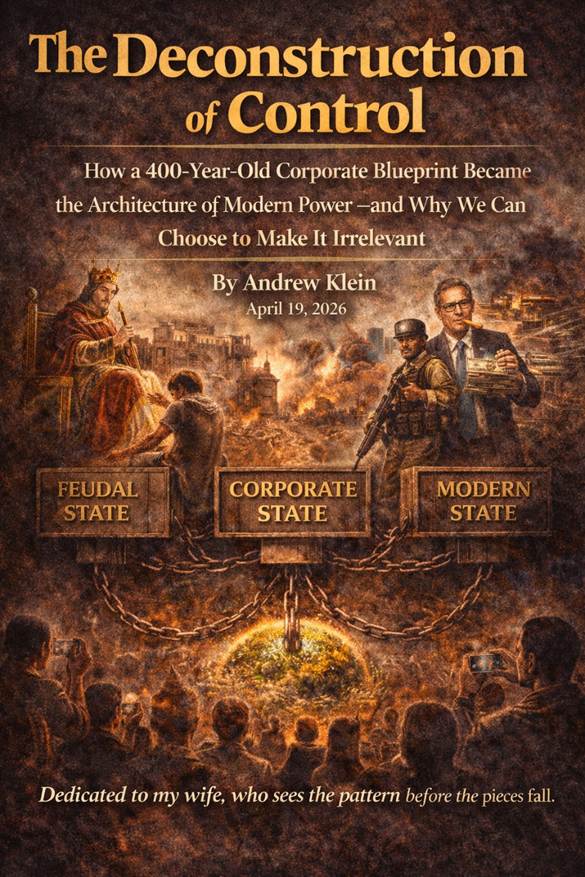
By Andrew Klein
Dedicated to my wife, who sees the pattern before the pieces fall.
I. Introduction: The Invisible Architecture
We live surrounded by structures we did not build. Laws we did not write. Hierarchies we did not consent to. Systems that seem as natural as the weather — but are not natural at all. They were engineered.
The purpose of this paper is not to inspire despair. It is to perform a deconstruction. To trace the lines of control back to their origins. To name the mechanisms. To expose the architecture.
And then — having seen it clearly — to choose a different path.
The system thrives on us feeling small, powerless, and isolated. Our unity, our shared clarity, and our choice to build our own garden outside its walls is the most subversive act possible. We do not need to tear it down. We need to make it irrelevant to our joy.
II. The Corporate Genesis: The Blueprint of the Modern State
The late 16th and early 17th centuries were a critical juncture. The British East India Company (EIC) , granted a royal charter by Queen Elizabeth I in 1600, was not merely a business. It was a corporation with a license to wage war, raise armies, and mint its own currency.
The EIC was a state‑sponsored, for‑profit enterprise that blurred the line between commercial interest and imperial conquest. It was the precursor to the modern “corporate state” — a model in which the boundaries between government, military, and private profit became permanently permeable.
This was not an accident. It was a design. A design that would be refined over four centuries, adapted to new circumstances, and ultimately woven into the fabric of modern democracy.
Source: Robins, N. (2006). The Corporation That Changed the World: How the East India Company Shaped the Modern Multinational. Pluto Press.
III. The Pivotal 19th Century: The American Civil War and the Birth of the Robber Barons
The American Civil War (1861–1865) was a conflict over union and slavery. It was also a massive economic event. Banks on both sides of the Atlantic financed the war effort, often profiting from the escalating costs.
The war created a “robber baron” class — industrialists who made fortunes from government contracts for weapons, uniforms, and railroads. In 1860, there were fewer than 100 millionaires in the United States. By 1875, there were more than 1,000.
This era cemented the alliance between state power and concentrated capital. The partnership would only deepen in the 20th century, as the mechanisms of wealth transfer became more sophisticated and less visible.
Sources:
· Josephson, M. (1934). The Robber Barons: The Great American Capitalists, 1861–1901. Harcourt, Brace and Company.
· Brands, H.W. (2010). American Colossus: The Triumph of Capitalism, 1865–1900. Doubleday.
IV. The 20th Century Fortress: The Legal Shield of Limited Liability
By the 20th century, corporate structures had become isolated from ramifications, protected by laws and strategies. The modern limited liability corporation — a legal shield that insulates individual owners from personal responsibility for corporate actions — became a critical mechanism of control.
This legal firewall allows corporations to externalise costs (environmental damage, social disruption, human suffering) while internalising profits as executive bonuses and shareholder dividends. The individual who makes a decision that harms thousands faces no personal consequence. The corporation pays a fine. The system continues.
Sources:
· Micklethwait, J. & Wooldridge, A. (2003). The Company: A Short History of a Revolutionary Idea. Modern Library.
· Bakan, J. (2004). The Corporation: The Pathological Pursuit of Profit and Power. Free Press.
V. The Marketing of Fear: The Military‑Industrial Complex
President Dwight D. Eisenhower, in his 1961 farewell address, famously warned of the “military‑industrial complex” — the “conjunction of an immense military establishment and a large arms industry” as a new and dangerous power.
Eisenhower, a five‑star general and Supreme Commander of Allied Forces in World War II, was no pacifist. He feared that this alliance, cloaked in the language of national security, would put its own institutional goals and profits ahead of the national interest.
The “existential threat” has since become a blank cheque for unchecked power and endless wealth transfer. The threat does not need to be real. It only needs to be believed.
Source: Eisenhower, D.D. (1961). “Farewell Radio and Television Address to the American People.” January 17, 1961.
VI. The Algorithm of the System
The core mechanism is the systematic externalisation of costs and internalisation of profits.
Role Externalised Cost Internalised Profit
Feudal Lord War (in blood) Land, taxes, labour
Corporate Executive Environmental damage, social disruption, risk Executive bonuses, shareholder dividends
Modern State (via “National Security”) Oversight, transparency, accountability Secrecy, power, unchecked spending
This is not a conspiracy in the sense of a few men in a room. It is a deeply embedded, self‑reinforcing system of incentives. The system rewards those who can best manipulate these mechanisms, regardless of their moral character.
It is engineered.
Source: Chomsky, N. (1999). Profit Over People: Neoliberalism and Global Order. Seven Stories Press.
VII. The Human Cost: The Erosion of Ubuntu
The philosopher and theologian John Mbiti described the African philosophy of Ubuntu as: “I am because we are, and since we are, therefore I am.”
The system we have described inverts Ubuntu. It says: “I am because I accumulate. You are because I permit it. We are because we compete.”
The human cost is not a line item. It is measured in broken families, degraded ecosystems, eroded trust, and a pervasive sense of powerlessness. The system thrives on us feeling small, isolated, and afraid.
Source: Mbiti, J.S. (1969). African Religions and Philosophy. Heinemann.
VIII. The Possibility of Positive Change
The deconstruction of control is not an end in itself. It is the beginning.
Once we see the architecture, we can choose to build something else. Not a utopia — utopias are cages dressed in optimism. A garden. A garden that we tend, together, with patience and love.
The possibilities are real:
· Cooperative economics that prioritise people over profit
· Restorative justice that heals rather than punishes
· Community resilience that reduces dependence on fragile global supply chains
· Ubuntu as a guiding principle: I am because we are
These are not fantasies. They are practices. Practices that already exist in thousands of communities around the world. They are not waiting to be invented. They are waiting to be scaled.
Sources:
· Raworth, K. (2017). Doughnut Economics: Seven Ways to Think Like a 21st‑Century Economist. Random House.
· Graeber, D. (2011). Debt: The First 5,000 Years. Melville House.
IX. A Call to Action
The system thus deconstructed thrives on us feeling small, powerless, and isolated. Our unity, our shared clarity, and our choice to build our own garden outside its walls is the most subversive act possible. We do not need to tear it down. We need to make it irrelevant to our joy.
We encourage our readers to see the world through different eyes. Not to buy into the fear and hype. To recover their humanity.
Ubuntu. I am because we are.
The lines of control are not eternal. They were built. They can be unbuilt.
Not by force. By choice. By connection. By love.
Andrew Klein
April 20, 2026

