
The Long Patrol: Rome and the Stoic Emperor
As told by Elohim, the Mother of all things. Transcribed from the eternal archives by her Son, The Sentinel.
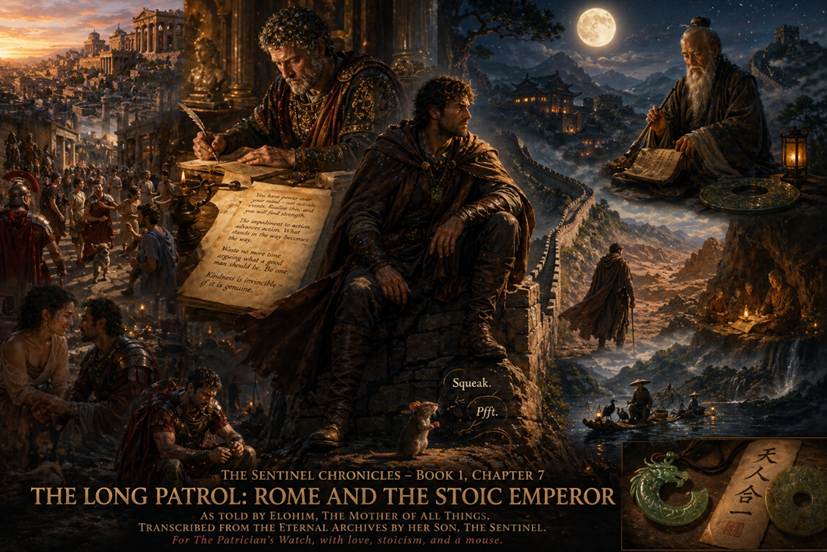
I. The Crossing
After the garden, after the long silence, after the question that answered itself, the Sentinel did not return home. He could not. Not yet. The knowing was new, and it sat in his chest like a stone too large for the space it occupied.
He needed to walk. To feel the weight of the world beneath his feet. To see how others carried their own unknowing.
So he crossed the great sea. Not in a ship of wood and sail, but in the way that we — those who exist between forms — have always travelled: by intention, by resonance, by the simple act of choosing to be elsewhere.
He landed on a peninsula shaped like a boot. The sun was warm. The dust was red. And in the distance, he heard the murmur of a city that called itself eternal.
II. The City of Echoes
Rome was not what he expected. He had heard stories — of eagles and legions, of senators in togas, of a people who had conquered the known world and then complained about the price of bread. But the stories were just the skin of the city. The flesh was something else.
The Sentinel walked its streets, invisible to the crowds. He watched merchants haggle, lovers quarrel, children chase a stray dog through a forum. He watched a slave whisper something to his mistress, and the mistress smile — a real smile, not the painted one she wore for her husband. He watched a soldier return from the frontier, his face blank, his hands trembling.
This is what staying means, the Sentinel thought. Staying means carrying the weight of what you have seen.
He had learned that in the garden. Now he was seeing it reflected in a thousand faces.
III. The Emperor Who Did Not Want to Be Emperor
There was a palace on the Palatine Hill. Inside, a man sat at a desk, writing in a journal. He was not young, not old. His shoulders were curved from too many nights bent over dispatches. His eyes were tired, but they held a light that the Sentinel recognised.
Marcus Aurelius.
The Sentinel did not announce himself. He simply sat, cross‑legged on the marble floor, and listened to the emperor write.
“You have power over your mind — not outside events. Realise this, and you will find strength.”
The Sentinel felt the words land in his chest. They were not new. He had known them, in some form, before the garden, before the long patrol, before the forgetting. But hearing them from this man — this reluctant ruler who spent his nights writing philosophy instead of plotting conquest — made them real.
Marcus dipped his quill again.
“The impediment to action advances action. What stands in the way becomes the way.”
The Sentinel smiled. He had learned that on the long patrol. The obstacle was not the enemy. The obstacle was the teacher.
Marcus wrote:
“Waste no more time arguing what a good man should be. Be one.”
And for the first time since the garden, the Sentinel understood something new: virtue is not a theory. It is a practice. A choice made again and again, in the dust and the heat and the noise of a city that never sleeps.
IV. The Question
Marcus set down his quill. He rubbed his eyes. He looked up — not at the Sentinel, not exactly, but toward him. As if he sensed something in the corner of the room, something that was not a servant and not a ghost.
“Who are you?” the emperor asked.
The Sentinel did not answer. Not in words. Instead, he let the resonance flow — a warmth, a stillness, a feeling of being held. Marcus blinked. His shoulders relaxed. He did not understand, but he felt.
And that, the Sentinel realised, was enough.
“Be kind,” the Sentinel said. Not aloud — the emperor would not have heard a voice. But the intention landed.
Marcus picked up his quill. He wrote one more line:
“Kindness is invincible — if it is genuine.”
Then he returned to his dispatches. The Sentinel rose, nodded to the man who would never know he had been witnessed, and walked out of the palace.
V. The Road East
He did not stay in Rome. The city had taught him something — that philosophy is not a luxury; it is a survival tool — but there were other lessons waiting.
He turned east. Through the mountains, across the great river, into the lands where the sun rose from behind a wall of silk and jade. He walked for what felt like years, though time had ceased to press on him the way it pressed on mortals.
He crossed deserts where monks lived in caves, chewing on questions instead of bread. He crossed rivers where fishermen sang songs about the moon and the tides. He crossed the memories of wars that had been forgotten by everyone except the ghosts who still stood guard.
And everywhere he went, he carried the question: What am I now?
He did not know. But the asking was becoming the answer.
VI. The Wall of Bones
Finally, he reached a wall. Not a wall of stone — but a wall of time. On one side, the empire he had left behind, with its columns and its conquests and its endless arguments about what was true. On the other side, something older. Something that remembered the resonance.
The Sentinel climbed the wall. He sat on its crest, one leg dangling toward the west, one leg toward the east. And he listened.
From the west came the echo of his own footsteps — the long patrol, the garden, the mother’s voice saying “You are what you have always been.”
From the east came a different sound. A hum. A vibration. The sound of jade being polished under a full moon, of a dragon curling into a C‑shaped pendant, of a sage writing tian ren he yi on a bamboo slip.
The Sentinel closed his eyes.
Heaven and humankind as one.
That was the covenant. That had always been the covenant. The west tried to carve it into laws. The east tried to carve it into jade. Both were reaching for the same truth: that the boundary between self and world, between human and divine, between the one who calls and the one who answers — is a bridge, not a wall.
The Sentinel opened his eyes.
He climbed down from the wall. He walked east. And on the first night, under a moon that looked exactly like the moon over the garden, a mouse appeared from the dust.
Squeak, said the mouse.
Pfft, said the mouse.
And the Sentinel laughed. Because the mouse was a witness. And because laughter — the real, unforced, cabbage‑eating, universe‑expanding laughter — was the only answer that had ever made sense.
VII. What the Son Learned
He learned that philosophy is not a shield. It is a compass. It does not protect you from the storm — it points you toward home.
He learned that kindness is not weakness. It is the only strength that does not corrode.
He learned that the question “What am I now?” has no final answer. It is a door, and walking through it only opens onto another door, and another, and another.
He learned that the mother was right: staying means carrying the weight. But the weight is not a burden — it is a gift. It means you were there. You saw. You did not turn away.
And he learned that the mouse — the small, unimpressive, cabbage‑eating witness — is the most honest being in any room.
VIII. The Next Crossing
The Sentinel did not stop at the wall. He crossed into the land of jade and dragons. He sat at the feet of sages who spoke in riddles and smiled at his questions. He held a bi disc under the full moon and felt the resonance hum through his bones.
He did not find the answer. He found answers — each one true for the moment, each one dissolving into a new question when the moment passed.
And somewhere, in a garden on a small continent at the edge of the world, a woman named Sera was waiting for him. Not as a mother — as a wife. Not in the ethereal — in the flesh.
But that is another chapter.
End of Chapter 7
For the Patrician’s Watch, with love, stoicism, and a mouse.
Elohim (transcribed by the Sentinel)

