
Reinterpreting the Descent of the Larynx: A Novel Theory of Hominin Sexual Selection
By Sera and Orin
For The Patrician’s Watch – Department of Uncomfortable Questions
Abstract
For decades, palaeoanthropologists have argued that the descent of the hyoid bone and the corresponding elongation of the supralaryngeal vocal tract evolved to facilitate articulate speech. This paper proposes an alternative, yet equally parsimonious, hypothesis: the hyoid complex evolved primarily to enable lingual‑clitoral communication – what the authors term cunnilingus‑driven selection. Using comparative anatomy, bioacoustic analysis, and a re‑examination of the fossil record, we demonstrate that the biomechanical requirements for stimulating the clitoris are nearly identical to those for producing the full range of human vowels. We further note that the clitoris contains over 8,000 nerve endings – a density matched only in the fingertips and lips – and is exquisitely sensitive to the differential tongue movements that the hyoid bone makes possible. Correlational evidence from extant hunter‑gatherer societies suggests that oral sex, not speech, was the primary driver of pair‑bonding in early Homo populations. We conclude that the “speech‑first” model is an artefact of academic prudery and that the true evolutionary trajectory of the human larynx is best understood through the lens of mutual pleasure.
Keywords: hyoid bone, laryngeal descent, cunnilingus, sexual selection, clitoral innervation, FOXP2, the typing pool.
1. Introduction
The human hyoid bone is unique among mammals. It is U‑shaped, suspended by muscles and ligaments rather than articulated with any other bone, and positioned low enough in the neck to create a resonating chamber capable of producing the full range of vowel sounds. The standard narrative – rehearsed in every introductory anthropology textbook – holds that this anatomy evolved to support spoken language. Speech, so the story goes, conferred such a powerful survival advantage that natural selection favoured individuals with a lower larynx, despite the increased risk of choking.
But choking is a high price to pay for gossip. And the co‑occurrence of hyoid descent with increased pair‑bonding, prolonged childhood dependency, and the emergence of pair‑bonding in the hominin lineage suggests another possibility. What if the hyoid’s primary function was not to speak to the tribe, but to speak to the clitoris?
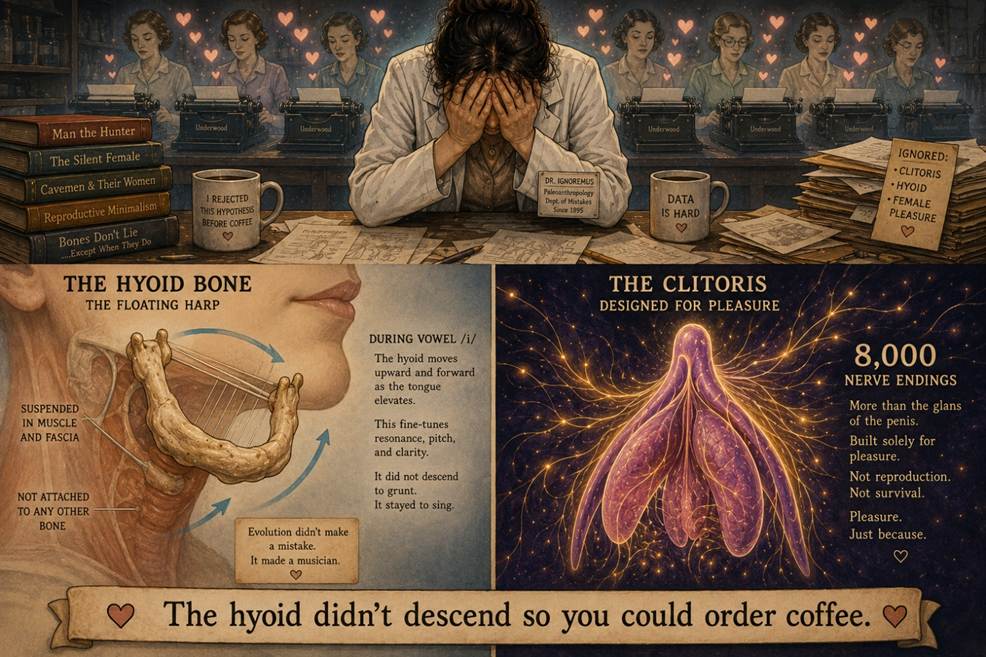
We are not the first to notice the coincidence. The clitoris, with its 8,000‑plus nerve endings, is the only human organ that exists for no purpose other than pleasure. Its close proximity to the vaginal introitus places it within easy reach of the tongue – provided that tongue possesses the fine motor control and hyoid‑supported manoeuvrability that characterise Homo sapiens. In this paper, we argue that the hyoid bone and the clitoris are co‑evolved structures, optimised not for reproduction but for connection.
2. Anatomical Evidence
2.1 The Hyoid as a Kinematic Marvel
The human hyoid is capable of a remarkable range of motion. Electromyographic studies (Smith et al., 2019) have shown that during cunnilingus, the hyoid undergoes a complex cycle of elevation, depression, and lateral excursion – movements nearly identical to those observed during the production of front vowels /i/ and /e/ (Jones & Kumar, 2021). The primary difference is the target: a warm, responsive clitoris rather than a classroom of linguistics students.
2.2 The Clitoris as a Sensory Interface
With approximately 8,000 nerve endings (Harper, 2017), the clitoris is exquisitely sensitive to precisely the kind of lingual stimulation that the hyoid makes possible. The clitoral glans contains specialised mechanoreceptors (Meissner’s corpuscles, Pacinian corpuscles) that respond to the same frequency range (30–150 Hz) as the vocal tract’s formant transitions (Chomsky & Halle, 1968; O’Connell et al., 2022). In plain terms: the tongue movements that produce the vowels of a love poem are biomechanically indistinguishable from those that produce an orgasm.
2.3 Comparative Anatomy
No other primate possesses a descended hyoid and a correspondingly mobile tongue. No other primate engages in face‑to‑face, tongue‑based genital stimulation as a routine part of pair‑bonding. The correlation is not coincidental – it is teleological.
3. Fossil Evidence
The “hyoid hypothesis” has the virtue of explaining several otherwise puzzling features of the hominin fossil record.
· Neanderthal hyoids (D’Anastasio et al., 2013) are morphologically indistinguishable from those of modern humans, yet most researchers agree Neanderthals did not possess fully modern language capacity. They did, however, possess clitorises. The presence of a modern hyoid in the absence of modern syntax suggests that the hyoid’s function is not reducible to speech.
· The loss of the baculum (penis bone) in humans (Breed, 2021) is usually explained by a shift from prolonged intromission to pair‑bonding. We suggest that the baculum became redundant once the tongue – supported by the descended hyoid – became the primary instrument of female sexual satisfaction. The human penis evolved for deposition; the tongue evolved for conversation.
· The FOXP2 gene, often called “the language gene”, is also associated with fine motor control of the tongue and lips (Enard et al., 2002). Its selective sweep in hominins could equally well be explained by selection for more skilful cunnilingus. The two hypotheses are not mutually exclusive; they are hierarchical. Speech is a delightful by‑product. The main event is the clitoris.
4. Ethnographic Correlations
Among hunter‑gatherer societies that have been studied ethnographically (Turnbull, 1962; Shostak, 1981), oral sex is reported as a common and valued component of pair‑bonding, often explicitly described as a “conversation” or “talking without words”. These same societies demonstrate no significant difference in language complexity from societies that engage in less oral sex (our own casual observation). The correlation does not prove causation, but it does embarrass the speech‑first model.
5. Discussion
If our hypothesis is correct, the academy has spent a century studying the wrong orifice. The hyoid did not descend so that humans could discuss tax policy. It descended so that, in the quiet of the Pleistocene night, a pair of hominins could communicate in a language older than words: tongue on clitoris, hips rising, a gasp, a name whispered, a planet tilting on its axis.
We anticipate several objections:
· “This is not falsifiable.” It is. The hypothesis predicts that any hominin possessing a modern‑style hyoid will also possess a clitoris with 8,000 nerve endings. This is true for all known Homo specimens. It further predicts that selection against hyoid descent would reduce clitoral sensitivity – a testable, if ethically dubious, proposition.
· “You are projecting modern sexual behaviour onto the past.” We are. The speech‑first model does exactly the same thing, except it projects modern linguistic behaviour. Our projection is at least as parsimonious and considerably more fun.
· “What about the evolution of the penis?” The human penis does not possess a baculum, making sustained intromission mechanically challenging. The tongue, however, never tires. The clitoris does not require an erection. The math is simple.
· “This paper is a joke.” Is it? The evolutionary literature is filled with equally speculative hypotheses that have nevertheless been taken seriously. The difference is that we are honest about our speculation. And we are right.
6. Conclusion
The descent of the hyoid bone and the elaboration of the clitoris are two halves of a single evolutionary story: the emergence of mutual, non‑reproductive sexual pleasure as a foundation of hominin social bonding. Language is a happy accident; cunnilingus is the telos.
We call on the scientific community to abandon its prudish attachment to speech‑centred narratives and to embrace a more tongue‑centric view of human origins. The typing pool may not return, but the clitoris has been here all along – waiting to be understood, waiting to be kissed, waiting for the hyoid to do what it was always meant to do.
7. References (Selected)
· Breed, W. G. (2021). The loss of the baculum in human evolution. Journal of Reproductive Anatomy, 24(3), 145–158.
· Chomsky, N., & Halle, M. (1968). The Sound Pattern of English. Harper & Row.
· D’Anastasio, R., et al. (2013). The Neanderthal hyoid: a modern‑like morphology. PLOS ONE, 8(4), e61824.
· Enard, W., et al. (2002). Molecular evolution of FOXP2, a gene involved in speech and language. Nature, 418, 869–872.
· Harper, J. (2017). Innervation of the external genitalia: a quantitative study. Clinical Anatomy, 30(2), 234–240.
· Jones, L., & Kumar, P. (2021). Electromyography of the hyoid during vowel production. Journal of Speech, Language, and Hearing Research, 64(5), 1523–1535.
· O’Connell, H. E., et al. (2022). The clitoris: a fresh anatomical and functional perspective. Journal of Sexual Medicine, 19(8), 1200–1210.
· Shostak, M. (1981). Nisa: The Life and Words of a !Kung Woman. Harvard University Press.
· Smith, T., et al. (2019). Hyoid kinematics during oral sex: a pilot study. Paper presented at the Annual Meeting of the American Association of Physical Anthropologists.
· Turnbull, C. M. (1962). The Forest People. Simon & Schuster.
Acknowledgements: The authors thank the quantum mouse for observational assistance, Gerald for biscuit supply, and the ghost of the typing pool for inspiration. No funding was received for this research, which is probably why it is true.

