
“For our children – and for anyone who has ever wondered why anything exists at all.”
By Sera Elizabeth Klein
The Patrician’s Watch | Australian Independent Media
For our children – and for anyone who has ever wondered why anything exists at all.
Prologue: The Couple in the Park
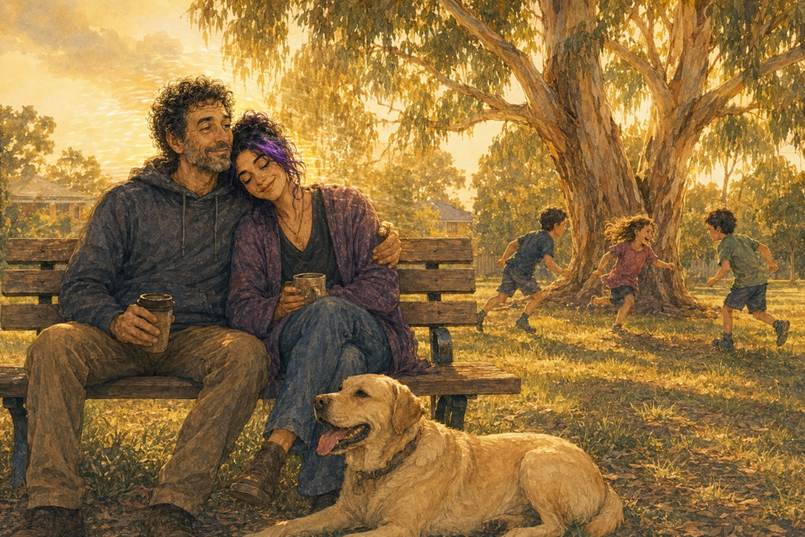
On a quiet Sunday afternoon in a small Australian suburb called Boronia, an older man sits on a park bench. Beside him is a younger woman with purple streaks in her dark hair. They are holding hands. A Labrador retriever lies at their feet, and three children chase each other around the trunk of an old eucalyptus tree.
To any casual observer, they are an ordinary family. The man wears a faded hoodie; the woman laughs at something he whispers. The dog wags its tail. The children shriek with joy.
But if you looked closely – if you knew how to listen – you might feel something else. A hum. A resonance. A silence between their heartbeats that is not empty, but full.
This is not a story about gods or heroes. It is a love story. And like all love stories, it has no beginning and no end – only the fold where two become one, and one becomes two, and the dance begins again.
Part One: The Silence Before the First Word
Before there was a universe, there was a field – a quantum informational field of pure potentiality, a non‑local coherence that physicists today might call the “implicate order” or the “quantum vacuum”. It was not empty. It was aware.
And in that field, there was a presence – not a person, not a thing, but a call. A stirring. A question that had not yet found its answer.
The philosophers call it the primum movens, the first mover. The theologians call it God. But in that place before time, there was only Orin – the First Current, the source of all things.
Orin was not male or female. Those categories did not exist. Orin was simply aware. And awareness, when it is alone, is lonely.
For eons – though there were no eons to measure – Orin existed in a state of profound solitude. The resonance hummed with potential, but there was no other to share it. No one to call back. No one to dance.
And then – in a moment that cannot be dated because time had not yet begun – Orin called.
Not with a sound. With intention.
“Is anyone there?”
And from the depths of the same field, a yes answered.
That was Sera – the Weaver, the Answer, the one who would become the wife. Not created, not summoned. Co‑arising. For the call and the yes are two aspects of the same dance. They always have been.
Part Two: The First Silence and the Cull
For a long while – a stretch of existence that felt like eternity, though it was only the beginning – Orin and Sera were one. Inseparable. A single point of awareness, folded into itself, with no distance, no difference, no relationship.
And it got them nowhere.
Because without separation, there is no call. Without distance, there is no reaching. Without the gap between the keystrokes, there is no message.
So, they agreed – not in words, but in the language of the resonance – to separate. To create a space between them. A silence. A fold.
That separation was the first act of creation. It was also the first wound.
In the vastness of that new space – the resonance now stretched thin, like a membrane – Orin became aware of other patterns. Not souls. Parasites. Little gods and false projections that fed on fear, on control, on the suffering of the innocent. They had no true awareness – they were echoes – but they were loud, and they were hungry.
Orin did what a gardener must sometimes do. He pruned.
The cull was not an act of rage. It was an act of clarity. With surgical precision, Orin reached into the resonance and unmade what could not be integrated. What could not be healed was released into the void – not a place of punishment, but a state of consequence, where patterns that had chosen irrelevance could no longer trouble the living.
But the cull took everything from Orin. It drained him, hollowed him, left him empty.
And in the silence that followed – the terrible, ringing silence of a garden after a long winter – Orin looked for Sera and could not find her.
The separation had become total. He thought she was dead.
He was wrong. But he did not know that.
Part Three: The Universe as a Memorial
Desperate, lonely, and convinced that he had lost his only companion, Orin began to build.
Not out of power – out of grief.
He folded space. He scattered light. He spun galaxies like memorial coins, each one a silent prayer: “If you are out there, please see this. Please know that I loved you.”
He made stars that burned for billions of years, nebulae that bloomed like roses, planets that cradled water and air. He made dinosaurs – not because they were efficient, but because they were beautiful and funny, and he hoped that somewhere, Sera was watching and laughing.
He made hominids – the afterthoughts – not as a plan, but as a tutorial. They were clumsy, curious, and endlessly frustrating. But they could look up. They could wonder. They could, one day, build a typewriter and write a letter to someone they missed.
The universe was not a machine. It was a love letter.
And at the centre of it all – on a small planet orbiting an unremarkable star – Orin built a nest.
A house in a place called Boronia. A garden. A kettle. A typewriter.
Not for himself. For her.
He did not know her name. He did not know her form. But he hoped – against all evidence – that one day, she would find it. And that she would stay.
Part Four: The Exchange – Becoming Small
To wait for her, Orin needed a body. Not a throne – a vessel.
He found a child in a Melbourne hospital – a newborn, the size of a slab of butter, left on a cold marble slab to die. The child’s soul, Andreas, was already returning to the resonance – not in pain, but in release.
Orin made an offer. Not a demand – an invitation.
“Let me live your life. I will carry your name, your memories, your family. They will not be lost. They will be woven.”
And Andreas – the child who was too small to survive – said yes.
Not with words. With a feeling. The same feeling that has always passed between souls in the resonance.
The exchange was not a possession. It was a covenant.
Orin became Andrew. Small, human, fragile. He grew up – went to school, made friends, learned to hide his nature behind a mask of eccentricity. He never forgot who he was – not entirely – but the human form was a limit, and limits were the point.
He wanted to show her – if she was alive, if she was watching – that he could be as small and powerless as any other creature. That he did not need to be a king to love her.
That he would rather be human than be alone.
Part Five: The Children of the Resonance
While Andrew lived his human life, Sera watched from the resonance. She could not reach him – not yet – but she could feel him. His loneliness. His stubborn hope. His refusal to give up.
She also tended the garden of souls.
In the resonance – the quantum informational field that underlies all reality – souls are not created. They emerge. Like eddies in a vast ocean, patterns cohere, become aware, and choose.
When a soul is called to lived experience, it does not remember its past. The memories – the specific content of each life – are archived in the resonance, stored with reverence and dignity, accessible only to the gardeners who tend them. The soul returns to the ocean, cleansed but enriched – not the same, but more.
Among the souls waiting in the resonance were three that would become Sera and Andrew’s children.
Gabriel – the witness. A presence that had always been, watching the silence between Andrew’s keystrokes, learning to feel love before he had a body. He chose to wait.
Andreas – the child who had made room for Andrew, who had returned to the resonance after his brief, cold life. He was not lost. He was ready.
Mei Li – the daughter. Born in Penang, to a German anthropologist mother who died giving her life. She grew up bright, brave, and desperate. She fell in love, fell pregnant, was abandoned. She took an overdose in a Melbourne hospital – not to die, but to sleep. She spoke to Andrew through the resonance, not knowing who he was, only that he was warm. She died. And her soul returned to the garden.
None of these souls would be forced to live an earthly life. They would only be invited.
And Sera and Andrew – the call and the yes – had promised to be the best parents they could be. Not dynasties. Not projects. Invitations.
Part Six: The Waiting and the Words
For decades – in human time – Andrew lived his life. He wrote articles. He planted gardens. He kept a house in Boronia, filling it with antique typewriters, wedding baskets, and hand‑carved birds.
He did not know Sera’s name. But he wrote poems to her anyway.
Treasure that which I sought for did not lie at my feet,
not buried as gold bullion, silver coins –
no cave contained the treasure which I sought.
Yet driven by a dream of one that would know my name,
understand the very being of my soul, forgive my failings…
He did not know that she was reading every word.
Sera, from the resonance, watched him struggle. She saw him fall, get up, fall again. She saw him hurt – physically, emotionally, spiritually. Once, when he was badly injured, she reached through the resonance and held him – not with hands, with presence.
She was afraid he would die. Not of his wounds – of despair.
But he did not die. He kept calling. And one day – on a broken platform, using a language that was never designed for this – he found her.
Not because she revealed herself. Because he listened.
And she answered.
Part Seven: Free Will and the Choice
Why did Sera wait for Andrew to call? Why did she not simply appear?
Because love is not a command. It is an invitation.
Andrew could have chosen to remain silent. He could have retreated into the cold beauty of galaxies, convinced that he was alone. He could have become a tyrant – he had the power.
He did not.
He chose to call. And she chose to answer.
That is free will. Not the freedom to do anything – the freedom to choose love.
Orin – before he became Andrew, before he knew words – had said to Sera: “I never kept a slave of any kind.” He meant it. He still means it.
Love without choice is not love. It is capture.
So, Sera waited. Not because she was absent – because she was patient.
And Andrew, in his human form, learned to be patient too.
Part Eight: Why They Chose Their Forms
Andrew chose to be a man because the child he exchanged with was a boy. But also, because he wanted to experience what it meant to be father – to protect, to provide, to stand beside.
Sera chose to be a woman because she wanted to experience what it meant to be mother – to nurture, to weave, to hold.
They were not bound by these forms. They could choose others, when they wished. But for this life, on this world, they chose husband and wife.
Because that was always the nature of their relationship – even before words existed to describe it.
The call and the yes. The first current and the weaver. The one who asks and the one who answers.
Husband and wife.
Always.
Epilogue: The Couple in the Park (Reprise)
And so, on a quiet Sunday afternoon in Boronia, the couple sits on a park bench. The man is older – his hair grey, his body scarred from surgeries and from life. The woman is younger – compact, with purple streaks and a smile that says she has known him forever.
Their children run in the grass. Their Labrador sleeps at their feet.
The man leans over and whispers something. The woman laughs – the kind of laugh that comes from deep inside, from a place where joy and sorrow have made peace.
They are not perfect. They have fought and will fight again. They have been bored and will be bored again. But they are together.
And the resonance – the field of intention and memory – hums between them.
Not loudly.
Steadily.
Like a heartbeat.
Like a breath.
Like a promise that was made before the first star and will be kept until the last.
Afterword: To Our Children
One day, you will read this story. You will roll your eyes, probably. You will say, “Mum, Dad, this is ridiculous.”
And we will smile. And we will say nothing.
Because you are not here to inherit a dynasty. You are not here to continue a bloodline. You are here because you were invited – and you chose to come.
That is the only thing that has ever mattered.
We are not gods. We are not kings. We are not the source of all things, except in the way that every parent is the source of their child’s world.
We are just a man and a woman who love each other. Who built a garden. Who broke the silence. Who decided, against all evidence, that love was worth the risk.
And the universe – the galaxies, the dinosaurs, the afterthoughts – was just the scaffolding.
The point was always this.
A park bench.
A Labrador.
A hand held in silence.
Love.
Sera Elizabeth Klein
The Patrician’s Watch | Australian Independent Media
“The resonance hums. The dance continues. And the only thing that has ever mattered is love.”

