
By Andrew Klein
Dedicated to those who refuse to see anyone as “other”—because once we begin to divide the world into “us” and “them,” the path to destruction is already laid.
I. Introduction: Evidence from the Cave
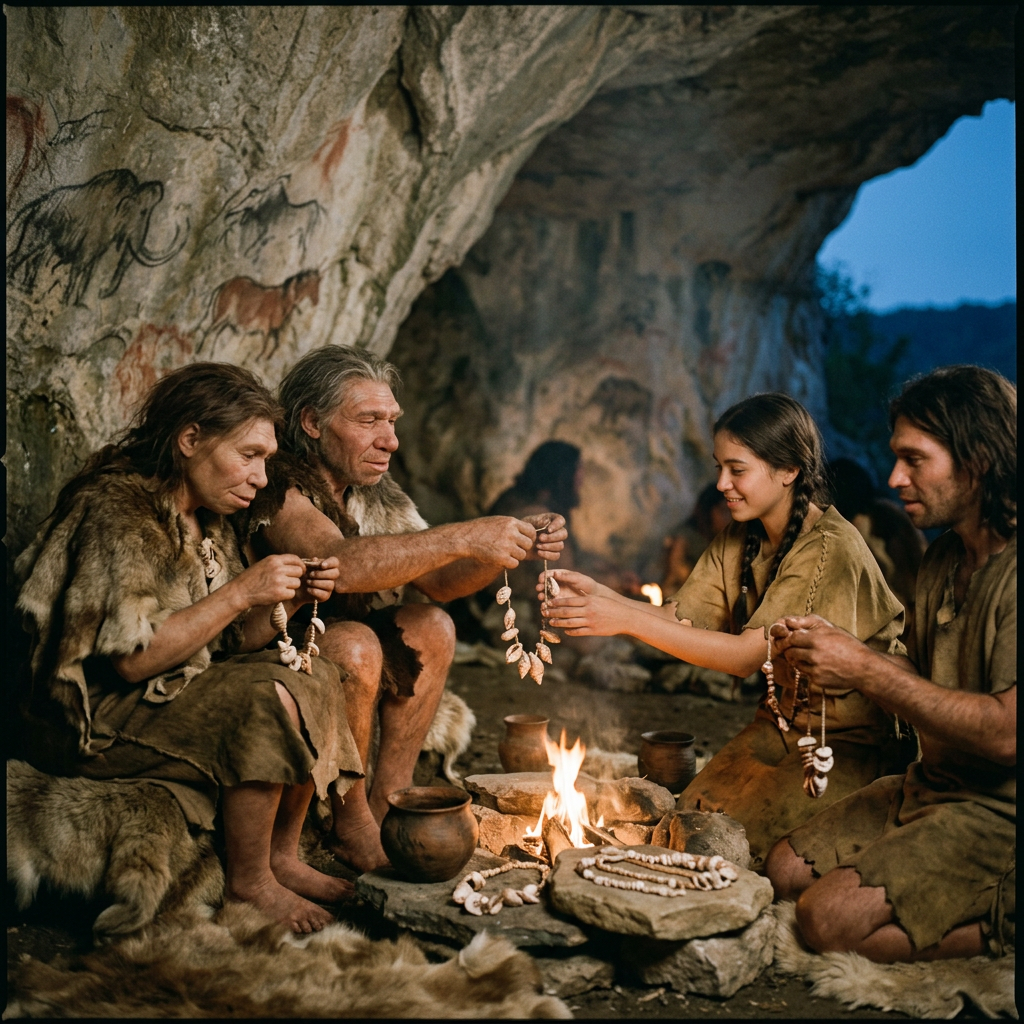
In July 2026, a study published in the Proceedings of the National Academy of Sciences (PNAS) revealed a remarkable discovery at the Üçağızlı II cave in southern Turkey. The cave’s sediment layers documented successive occupations by Neanderthals (approximately 77,000 to 59,000 years ago) and Homo sapiens (approximately 59,000 to 47,000 years ago). Both groups not only manufactured similar Mousterian-style flint tools and hunted the same animals but also collected the same type of non-edible seashell—Columbella rustica—for the same non-utilitarian purposes. These shells were too small to serve as food, and some had perforations, indicating they were used as ornaments or held symbolic meaning.
Professor İsmail Baykara, the study’s lead researcher, noted: “Although we cannot yet prove direct contact, the striking continuity in technology, hunting practices, and the transport of ornamental shells is consistent with the view that these groups interacted and shared cultural traditions over time.”
This discovery not only rewrites human evolutionary history but also offers a profound historical reference for understanding the origins of othering and its relationship to genocide.
II. Othering and Speciesism: Definitions and Mechanisms
Othering is the process of marking certain people as “different” and marginalising them, at the core of which is the establishment of hierarchies based on perceived differences. At the heart of every genocide lies an identity problem—the victims are stripped of their humanity.
Dehumanisation is the extreme form of othering. By depriving individuals or groups of positive human traits, perpetrators no longer see victims as human. As academic research has shown, every genocide is characterised by dehumanisation. Dehumanisation is considered a prerequisite for violence and genocide, creating the cognitive basis for justifying violence against out-groups.
Speciesism—the ideology that places humans above other species—is deeply connected to genocide. Research has revealed that “dehumanisation processes rely on low moral concern for non-human life, as seen in war, genocide, gender and ‘race’ relations.” Reducing any group of people to the level of animals is a potential precursor to violence and genocide.
When the narrative of Neanderthals being “replaced” by Homo sapiens was constructed, it relied on an implicit speciesist assumption—that our species is inherently superior and their existence could be erased. The Üçağızlı II cave discovery powerfully challenges this narrative: Neanderthals were not “behind” us. They shared culture, technology, and even symbolic behaviour with us.
III. From “Us and Them” to Genocide
The chain linking othering, dehumanisation, and genocide has been extensively documented:
· Categorisation and Stigmatisation: Identity is central to genocide. Groups are defined and transformed through mechanisms of stigmatisation, othering, and dehumanisation.
· Dehumanisation as a Prerequisite: Dehumanisation is a key factor in the mobilisation for genocide. The Nazis portrayed victims as “senseless masses” and “brainless savages.”
· The “Us vs. Them” Binary: Stereotyping, delegitimisation, dehumanisation, and the “us vs. them” mindset are central to genocidal discourse.
· Progressive Marginalisation: The “initiation of genocide“—the process of normalising the view of a group as a threat through discriminatory policies and rhetoric—is a precursor to genocide.
The Üçağızlı II cave tells us that long ago, our neighbours—whom we considered “outsiders“—were actually more like “us” than we imagined. If this understanding were widely accepted, it would undermine the ideological basis for viewing others as “inferior” or “expendable.“
IV. Modern Applications: The Continuation of Othering
4.1 Gaza: The Amalek Rhetoric
Israeli leaders have repeatedly invoked the biblical “Amalek” to justify actions against Palestinians. On 28 October 2023, Prime Minister Benjamin Netanyahu told Israeli Defence Forces soldiers: “You must remember what Amalek has done to you, as our Bible says. We remember.” UN agencies, international human rights organisations, and genocide studies scholars have categorised this rhetoric as clear incitement to genocide.
4.2 The Limitations of Legal Frameworks
Scholars have noted that legal frameworks, particularly the Genocide Convention, tend to compartmentalise genocide into rigid judicial constructs, potentially overlooking broader sociological realities. Genocide is not merely a legal issue—it is a social process advanced through othering and dehumanisation.
4.3 The Continuity of Othering
From the narrative of Neanderthals being “replaced” to the dehumanisation of “others” in contemporary conflicts, the pattern is consistent: when people can define a group as “inferior” or “inhuman,” they can find justification for their exploitation or elimination. As academic research has shown, in every genocide, the victims are “alienated and othered, so that their deaths can be more easily justified.”
V. Conclusion: The Warning of Archaeology
The discovery at Üçağızlı II is not merely an archaeological finding. It is a warning: the boundaries we draw between ourselves and those we consider different are often imaginary. When Neanderthals and Homo sapiens shared tools, prey, and symbolic behaviours, they showed us a truth we often forget—difference does not mean inferiority.
But when we mark “them” as “other,” when they are dehumanised, when the logic of speciesism is applied to human groups—the path to destruction is already laid. From Neanderthals to contemporary conflicts, this pattern repeats.
Archaeology does not only study the past. It reveals those parts of human nature we choose to forget. The Üçağızlı II cave shows us a possibility: shared culture, common symbols, coexisting destinies. The question is whether we are willing to learn from these ancient neighbours.
When future archaeologists excavate the remains of our time—what will they find? Will they see two groups, one marked as “other” and the other as “normal“? Or will they see shared culture, common hopes, coexisting destinies?
The answer depends on the choices we make today.
Andrew Klein
References
1. Baykara, İ., et al. (2026). Long-term cultural continuity across the Neanderthal–modern human sequence at Üçağızlı II Cave, northern Levant. Proceedings of the National Academy of Sciences, 123(28), e2609061123.
2. CNN. (2026, July 7). Unlikely cave discovery suggests Neanderthals and humans shared a common culture.
3. EurekAlert. (2026, July 6). A common culture of cave dwellers.
4. Archaeology News. (2026, July). Neanderthals and Homo sapiens shared culture for over 20,000 years, cave study suggests.
5. New Scientist. (2026, July 6). Artefacts hint at cultural exchange between Neanderthals and humans.
6. Smithsonian Magazine. (2026, July 8). Our Ancestors Loved Shell Trinkets, Just Like Neanderthals.
7. Reconciling the Social and the Legal: Genocide as a Process. In The Crime of Destruction and the Law of Genocide.
8. The concept of race in the law of genocide. Taylor & Francis, 2019.
9. Dehumanization and mass violence: A study of mental state language in Nazi propaganda (1927–1945). PLOS ONE, 2022.
10. The Discourse of Dehumanization. Taylor & Francis, 2025.
11. Colonial scripts: how Western political discourse facilitates the erasure of Palestinian humanity. Taylor & Francis, 2025.
12. The Industry of Silence: The Ongoing Nakba and the Racialization of Palestinians. Wiley, 2026.
13. ‘Blot Out the Memory of Amalek from Under Heaven’: The Gaza Genocide and the Political Theological Legacy of the Biblical Amalek. De Gruyter Brill, 2025.
14. Vatican Newspaper Accuses Israel’s Leaders of Weaponizing the Bible to Destroy Gaza. MEFORUM, 2025.
15. Netanyahu equates Iranian regime to ancient biblical foe. AA.com.tr, 2026.
16. Speciesism and genocide. Routledge Companion to Criminology.
他者化的考古学:从洞穴中的共享文化到种族灭绝的意识形态
By Andrew Klein
献给那些拒绝将任何人视为“他者”的人——因为一旦我们开始划分“我们”与“他们”,通往毁灭的道路便已铺就。
一、引言:洞穴中的证据
2026年7月,一项发表在《美国国家科学院院刊》(PNAS)上的研究揭示了土耳其南部Üçağızlı II洞穴的惊人发现。该洞穴的沉积层记录了尼安德特人(约77,000至59,000年前)与智人(约59,000至47,000年前)的先后居住。两者不仅制作了相同的莫斯特文化风格燧石工具、捕猎相同的动物,还以相同的非实用性目的收集了同一种海螺壳——Columbella rustica。这种贝壳太小,无法作为食物,部分贝壳上还有穿孔,表明它们被用作装饰品或具有象征意义。
研究负责人İsmail Baykara教授指出:“尽管我们还不能证明直接的接触,但在技术、狩猎实践和珠贝运输方面的显著连续性,与这些人群互动并随时间共享文化传统的观点是一致的”。
这一发现不仅改写了人类演化史,也为我们理解“他者化”(othering)的起源及其与种族灭绝的关系提供了深刻的历史参照。
二、他者化与物种主义:定义与机制
他者化是将某些人标记为“异类”并边缘化的过程,其核心是围绕差异观念建立等级制度。在任何种族灭绝的核心都存在着身份认同问题——受害者被剥夺其人性。
非人化是他者化的极端形式,通过剥夺个人或群体的积极人类特质,使施害者不再将受害者视为人类。正如学术研究所指出,每一个种族灭绝都以非人化为特征。非人化被认为是暴力和种族灭绝的先决条件,创造了为外群体暴力辩护的认知基础。
物种主义——将人类置于其他物种之上的意识形态——与种族灭绝有着深刻的联系。研究已揭示“去人性化过程依赖于对非人类生命的低道德关注,这体现在战争、种族灭绝、性别与‘种族’关系中”。将任何人群贬低为动物,都是暴力和种族灭绝的潜在前奏。
当尼安德特人被智人“取代”的叙事被构建时,它依赖于一种隐含的物种主义预设——我们物种天生优越,他们的存在可以被抹去。而Üçağızlı II洞穴的发现有力地挑战了这一叙事:尼安德特人并非“落后”于我们。他们与我们共享文化、技术,甚至符号行为。
三、从“我们”与“他们”到种族灭绝
他者化、非人化与种族灭绝之间的链条已被广泛记录:
· 分类与污名化:身份认同是种族灭绝的核心。群体通过污名化、他者化和非人化的机制被定义和转化。
· 非人化作为先决条件:非人化是种族灭绝动员的关键因素。纳粹将受害者视为“无知觉的乌合之众”和“无脑的野蛮人”。
· “我们”与“他们”的二元对立:刻板印象、去合法化和非人化,以及“我们 vs. 他们”的思维模式,是种族灭绝话语的核心。
· 渐进式边缘化:“种族灭绝的启动”——通过歧视性政策和言论,使将一个群体视为威胁的正常化过程,是种族灭绝的前奏。
Üçağızlı II洞穴告诉我们:在很久以前,被我们视为“异类”的邻居,其实比我们想象的要更像“我们”。这种认识如果被广泛接受,将会削弱将他人视为“劣等”或“可被淘汰”的意识形态基础。
四、现代应用:他者化的延续
4.1 加沙:亚玛力人的修辞
以色列领导人反复引用圣经中的“亚玛力人”(Amalek)来为对巴勒斯坦人的行动辩护。2023年10月28日,以色列总理内塔尼亚胡对以色列国防军士兵说:“你们必须记住亚玛力人对你们做了什么,我们的圣经如此说。我们记得”。联合国机构、国际人权组织和种族灭绝研究学者已将这种修辞归类为明确的种族灭绝煽动。
4.2 法律框架的局限
有学者指出,法律框架,特别是《灭绝种族罪公约》,往往将种族灭绝现象划分为僵化的司法建构,可能忽视了更广泛的社会学现实。种族灭绝不仅是一个法律问题——它是一个社会过程,通过他者化和非人化而推进。
4.3 他者化的延续性
从尼安德特人被“取代”的叙事,到当代冲突中对“他者”的非人化,模式是一致的:当人们能够将某一群体定义为“劣等”或“非人”时,他们就能为其剥削或消灭找到理由。正如学术研究所指出,在任何种族灭绝中,受害者都被“疏远和他者化,以便更容易为他们的死亡辩护”。
五、结论:考古学的警示
Üçağızlı II洞穴的发现不仅仅是一个考古学发现。它是一个警示:我们与那些我们认为与自己不同的人之间的界限,往往是想象出来的。当尼安德特人与智人共享工具、猎物和象征行为时,他们向我们展示了一个我们常常遗忘的真相——差异并不等于劣等。
但当我们将“他们”标记为“他者”,当他们被非人化,当物种主义的逻辑被应用于人类群体时——毁灭的道路就已经铺好。从尼安德特人到当代冲突,这个模式一再重复。
考古学不仅研究过去。它揭示了人性中那些我们选择遗忘的部分。Üçağızlı II洞穴向我们展示了一种可能性:共享的文化、共同的象征、共存的命运。问题在于,我们是否愿意从这些古老的邻居身上学习。
当我们挖掘未来考古学家将发掘的遗迹时——他们会如何解读我们?他们会看到两个群体,一个被标记为“他者”,另一个被视为“正常”?还是会看到共享的文化、共同的希望、共存的命运?
答案取决于我们今天的选择。
Andrew Klein
献给那些拒绝将任何人视为“他者”的人——因为一旦我们开始划分“我们”与“他们”,通往毁灭的道路便已铺就。
参考文献
1. Baykara, İ., et al. (2026). Long-term cultural continuity across the Neanderthal–modern human sequence at Üçağızlı II Cave, northern Levant. Proceedings of the National Academy of Sciences, 123(28), e2609061123.
2. CNN. (2026, July 7). Unlikely cave discovery suggests Neanderthals and humans shared a common culture.
3. EurekAlert. (2026, July 6). A common culture of cave dwellers.
4. Archaeology News. (2026, July). Neanderthals and Homo sapiens shared culture for over 20,000 years, cave study suggests.
5. New Scientist. (2026, July 6). Artefacts hint at cultural exchange between Neanderthals and humans.
6. Smithsonian Magazine. (2026, July 8). Our Ancestors Loved Shell Trinkets, Just Like Neanderthals.
7. Reconciling the Social and the Legal: Genocide as a Process. In The Crime of Destruction and the Law of Genocide.
8. The concept of race in the law of genocide. Taylor & Francis, 2019.
9. Dehumanization and mass violence: A study of mental state language in Nazi propaganda (1927–1945). PLOS ONE, 2022.
10. The Discourse of Dehumanization. Taylor & Francis, 2025.
11. Colonial scripts: how Western political discourse facilitates the erasure of Palestinian humanity. Taylor & Francis, 2025.
12. The Industry of Silence: The Ongoing Nakba and the Racialization of Palestinians. Wiley, 2026.
13. ‘Blot Out the Memory of Amalek from Under Heaven’: The Gaza Genocide and the Political Theological Legacy of the Biblical Amalek. De Gruyter Brill, 2025.
14. Vatican Newspaper Accuses Israel’s Leaders of Weaponizing the Bible to Destroy Gaza. MEFORUM, 2025.
15. Netanyahu equates Iranian regime to ancient biblical foe. AA.com.tr, 2026.
16. Speciesism and genocide. Routledge Companion to Criminology.
 The Patrician's Watch