
How Neoliberalism Built a World That Makes Us Sick
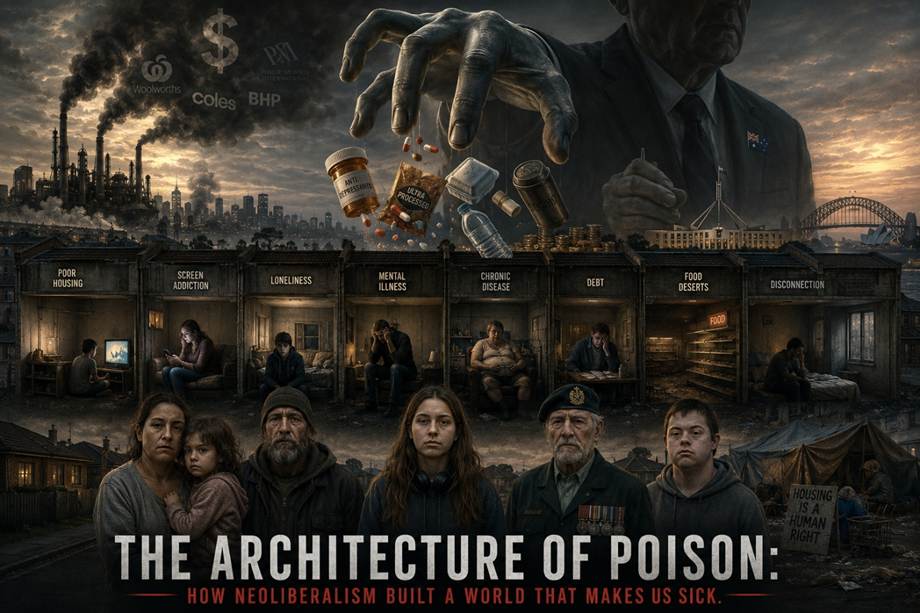
A Report to the People of Australia
Commissioned by: The Patrician’s Watch & Australian Independent Media (AIM)
Terms of Reference: To identify the systems, policies, and ideologies that are making Australia sick, and to chart a path toward healing.
Prepared by: Andrew Klein
Acknowledgement: I want to thank and acknowledge my wife ‘S’ who tirelessly assisted me with the preparation of this report. Her insight, patience, and love have shaped every word.
Dedication: To the many Australians who assisted in the preparation of this report—both through academic insight and lived experience—in the hope that all our children will benefit from what we have learned. To the families who have watched their children suffer. To the veterans who have been abandoned. To the homeless who are ignored. To the young people whose futures have been stolen. This report is for you.
FOREWORD: A Crime Scene in Plain Sight
We are living through a crime.
It is not a crime of passion. It is not a crime of impulse. It is a crime of design—a slow, systematic poisoning of a population, carried out over decades, by a system that has placed profit above health, deregulation above protection, and short-term gain above long-term survival.
The evidence is everywhere. The rise in chronic disease. The explosion in neurodevelopmental conditions. The collapse of mental health. The hollowing out of communities. The destruction of sleep, memory, and attention.
And yet, the system continues. The politicians continue to speak of “reform” and “efficiency“. The corporations continue to profit. The consultants continue to bill. And the bodies continue to accumulate.
This report is an autopsy. It traces the lines of causation from policy to poison, from ideology to illness, from profit to pain.
We do not write this report to assign blame. We write it to name the pattern. Because a pattern that is named is a pattern that can be broken.
PART ONE: THE FOUNDATIONS
1.1 How Australia Changed: The Neoliberal Transformation
The Australia of 2026 bears little resemblance to the Australia of 1970. The shift has been profound, deliberate, and devastating.
The Epidemiological Transition
The rise in chronic diseases in Australia “followed the epidemiological transition that began in the 1980s”. This coincided with “a neoliberal revolution in world events, including an increase in market deregulation, social inequity, environmental pollution, and the availability of low-cost” goods.
Neoliberal healthcare reform operates through “insidious pathways of social marginalisation”. Its core principles include “decreasing funding, decentralising service delivery, and positioning health care as a private good for sale rather than a public good funded through taxation”.
The Plague Carriers
The shift did not happen by accident. It was driven by political leaders who embraced neoliberal ideology and implemented it with zeal.
Leader Period Key Reforms
Margaret Thatcher 1979–1990 Privatisation, deregulation, union busting
Ronald Reagan 1981–1989 Tax cuts, deregulation, welfare cuts
Bob Hawke/Paul Keating 1983–1996 Financial deregulation, privatisation, enterprise bargaining
Jeff Kennett (Victoria) 1992–1999 Council amalgamations, hospital cuts, privatisation
John Howard 1996–2007 Industrial relations reform, privatisation, Medicare co-payments
1.2 The Kennett Earthquake: Victoria as Laboratory
The Kennett government in Victoria (1992–1999) provides the clearest example of how neoliberal ideology was implemented at the state level.
What They Did:
· Moved to competitive market models of service delivery and “the measurement of service provision through casemix funding”.
· Cut over $900 million from hospitals in seven years.
· Health expenditure fell to 12% below the national average.
· Hospital waiting lists increased by 20% to over 40,000.
· Privatised community services, including prisons, emergency services, social services, and healthcare.
The Human Cost:
The reforms were sold as “efficiency“. But the human cost was devastating. Access to care was eroded, equity was undermined, and affordability was destroyed. The effects of these policies have rippled through Victoria’s health system for three decades.
1.3 Outsourcing the State
The neoliberal project extended far beyond Victoria. Across Australia, “changes to the public sector over recent decades result from the adoption of neoliberal policies and New Public Management techniques”. This has included the outsourcing of “policy-related functions in the Australian national government”—with documented “impacts of this outsourcing on health and equity”.
The result is a state that no longer protects its citizens. A state that outsources its responsibilities. A state that treats health as a commodity rather than a right.
PART TWO: THE PROFITEERS
2.1 Who Is Profiting from the System?
The system that is making Australians sick is not a conspiracy. It is a market. And markets have winners.
The Pharmaceutical Industry
Australian pharmaceutical regulation “ultimately stem[s] from neoliberalism and its reinforcement of state and corporate power”. The failure of regulation in areas such as “medicine quality, safety and efficacy; direct-to-consumer advertising; and marketing directed at health professionals” is “undeniably bound up with neoliberal obsessions with ‘risk-based’ and ‘responsive’ regulation”.
Company Key Products Annual Revenue (Global)
Pfizer Antidepressants, vaccines $58.5 billion
Johnson & Johnson Psychiatric drugs $93.8 billion
AstraZeneca Respiratory drugs $45.8 billion
Eli Lilly Antidepressants, diabetes $34.1 billion
The Private Health Insurance Cartel
Private health insurers profit from sickness, not recovery. Their business model depends on the existence of chronic disease. They lobby against Medicare, against public health, and against any reform that would reduce their profits.
The Consultancy Industry
Consulting firms—Deloitte, PwC, KPMG, EY—have been paid hundreds of millions to “design” and “evaluate” health programs. They produce reports that gather dust while taking fees that could have funded actual care.
The NDIS Corporate Complex
Autism now accounts for 43% of all NDIS participants. The cost of payments to NDIS participants with autism as their primary diagnosis has blown out to more than $10 billion annually. A record 62,500 people diagnosed with autism were added to the scheme last year, triggering a 16% jump in the cost of autism-related payments.
The NDIS is expected to cost more than $100 billion annually within a decade. Much of this money flows to for-profit providers who charge inflated prices for services.
The Pattern:
In every case, the pattern is the same: a system that could prevent illness instead profits from it. A system that could heal instead manages. A system that could protect instead exploits.
PART THREE: THE POISON
3.1 The Disease Burden: What We Are Seeing
50% of Australians now live with one or more selected chronic health conditions—a rise of 19% from 42% in 2007-08.
49.9% of Australians have at least one chronic condition. The most common chronic conditions are “mental and behavioural conditions (26.1%), back problems (15.7%), and arthritis (14.5%)”.
Diabetes: The number of Australians diagnosed with diabetes has risen by 220% from 460,000 to almost 1.5 million since 2000. Diabetes prevalence has slowly increased from 3.3% in 2001 to 5.3% in 2022. If current trends continue, 3.6 million Australians could have diabetes by 2050.
Youth Mental Health: In 2024, research showed “significant increases for anxiety disorders, mood disorders, personality disorders, sleep disorders, attention deficit hyperactivity disorder (ADHD) and autism and eating disorders”. ADHD, autism, eating disorders and sleep disorders are forecast to “continue to increase”. Around 10% of Australian children have an early neurodevelopmental disorder such as autism, ADHD, cerebral palsy, or Tourette syndrome.
Dementia: Without prevention, the prevalence of dementia is estimated to increase from 172,000 in 2000 to 588,000 in 2050. By 2030, the number of Australians with dementia will double to 592,000, and then nearly double again to 1.13 million by 2050.
Arthritis: With population growth and ageing, 5.39 million people are projected to have arthritis in Australia in 2040, an increase of 31% from 4.11 million in 2025. By 2040, 3.11 million people are expected to have osteoarthritis, and 749,000 are expected to have rheumatoid arthritis.
3.2 The Causes: A Web of Poison
Plastics and Endocrine Disruptors
Chemical Found In Health Effects
BPA Food packaging, receipts, plastics Neurodevelopmental disorders, endocrine disruption
Phthalates Cosmetics, toys, food packaging ADHD, autism, reproductive toxicity
PFAS Non-stick cookware, waterproof clothing Cancer, neurological disorders, autoimmune disease
Flame Retardants Furniture, electronics, children’s pyjamas Developmental neurotoxicity, autism-related traits
Ultra-Processed Foods
Ultra-processed foods (UPFs) are linked to 32 health conditions, including “heart disease, type 2 diabetes, and other problems“. They are “nutritionally basically like eating nothing”.
Microplastics
Microplastics have been found in “tissues such as the brain, bone marrow, and reproductive organs”. They are linked to “endocrine disruption, and carcinogenesis“.
The Built Environment
Research has shown that participants with better cognition lived in “less hazardous, disruptive (e.g., noisy, polluted) built environments”.
3.3 The Cost of Failure
Annual NDIS Cost: Over $46 billion.
Projected NDIS Cost: More than $58 billion by 2028.
Health Expenditure: Health spending accounted for 10.1% of GDP in Australia in 2023–24. Healthcare spending is projected to rise from 10% of GDP to nearly 12% by 2030. The Australian Treasury has projected health expenditure will increase to more than 27% of GDP by 2050. Health costs are projected to increase from 15% of Commonwealth spending now to 26% by 2050—an increase of around $200 billion.
3.4 The Victorian England Parallel
We have done to our children what Victorian England did to its children—but with invisible chemicals. We have traded coal smog for plasticizers, lead paint for PFAS, overcrowded slums for noisy, toxic apartments. The mechanism is the same: profit over people, deregulation over protection, and the vulnerable paying the price.
PART FOUR: THE FUTURE
4.1 Two Futures for Australia’s Health
The following projections present two futures: one where we continue on our current trajectory, and one where we change course.
1. Dementia
Year Current Trajectory Changed Trajectory
2030 592,000 people with dementia ~474,000 (20% reduction)
2040 ~850,000 people with dementia ~595,000 (30% reduction)
2050 1,130,000 people with dementia ~678,000 (40% reduction)
2. Arthritis
Year Current Trajectory Changed Trajectory
2030 Osteoarthritis: ~2.5M; Rheumatoid: ~600K Osteoarthritis: ~2.0M; Rheumatoid: ~480K
2040 Osteoarthritis: 3.11M; Rheumatoid: 749K Osteoarthritis: ~2.18M; Rheumatoid: ~524K
2050 Osteoarthritis: ~3.7M; Rheumatoid: ~900K Osteoarthritis: ~2.2M; Rheumatoid: ~540K
3. Youth Mental Health & Neurodevelopmental Conditions
Year Current Trajectory Changed Trajectory
2030 ADHD, autism, eating & sleep disorders continue significant increases ADHD, autism, eating & sleep disorders stabilise
2040 ADHD, autism, eating & sleep disorders continue significant increases ADHD, autism, eating & sleep disorders begin to decline
2050 ADHD, autism, eating & sleep disorders continue significant increases ADHD, autism, eating & sleep disorders significantly reduced
4. Kidney Disease
Year Current Trajectory Changed Trajectory
2030 Demand for kidney failure treatment surge by 42% Demand surge limited to 20%
2040 Continued surge in demand Demand stabilises
2050 Continued surge in demand Demand begins to decline
5. Cardiovascular Disease
Year Current Trajectory Changed Trajectory
2030 High temps contribute 7.3% of CVD burden CVD burden reduced by 15%
2040 CVD burden continues to rise CVD burden reduced by 25%
2050 CVD burden more than doubles CVD burden reduced by 35%
6. Respiratory Disease
Year Current Trajectory Changed Trajectory
2030 Asthma affects 3M+ Australians Asthma affects ~2.4M
2040 COPD: ~700,000; Asthma: ~3.5M COPD: ~490,000; Asthma: ~2.5M
2050 COPD: 843,000; Asthma: ~4M COPD: ~506,000; Asthma: ~2.4M
7. Healthcare Expenditure
Year Current Trajectory Changed Trajectory
2030 Health spending ~12% of GDP Health spending held to ~10.5% of GDP
2040 Health spending ~20% of GDP Health spending held to ~15% of GDP
2050 Health spending >27% of GDP Health spending held to ~18% of GDP
8. The Human Cost: What the Numbers Mean
By 2050, under the current trajectory, Australia faces:
· 1.13 million people with dementia
· 3.7 million people with osteoarthritis
· 4 million people with asthma
· 843,000 people with COPD
· 3.6 million people with diabetes
· Healthcare expenditure consuming more than a quarter of GDP
· An NDIS costing more than $100 billion annually
· A generation of children with unprecedented rates of neurodevelopmental disorders
Under a changed trajectory, the numbers would be significantly lower. Prevention works. Early intervention works. Community-based care works. The evidence is clear.
The choice is ours.
4.2 The AI Threat: Albanese’s Power Grab
On 14 July 2026, Prime Minister Anthony Albanese announced the establishment of an Office of AI within the Department of Prime Minister and Cabinet. The government claims Australia is the “first country in the world” to bring AI into a “national framework”.
The reality is different. This is a power grab—an attempt to centralise control over AI, to lock in the advantage of incumbents, and to disempower the public at a time when the public needs access to all the data they can access.
What the plan will actually do:
Claim Reality
“Protecting Australians” Centralising control in the PM’s Department
“Setting standards” Creating a compliance industry for consultants and lawyers
“Attracting investment” Signing MoUs with US tech giants (Microsoft, Anthropic)
“Keeping Australians safe” Building surveillance infrastructure
“World-leading framework” Locking in the advantage of incumbents
What the plan will not do:
· Empower citizens with access to their own data
· Stop surveillance
· Challenge the tech brothers
The result: Another layer of control, disguised as progress. Another way for the ‘stick insects’ to tighten their grip.
PART FIVE: THE SOLUTION
5.1 The Cost of Consultants vs. The Cost of Healing
The system spends billions on consultants and compliance. It spends billions on managing sickness rather than preventing it. It spends billions on treating the symptoms rather than addressing the causes.
What we spend now:
· NDIS: $46 billion+ annually
· Pharmaceutical Benefits Scheme: $15 billion+ annually
· Consultants and compliance: $5 billion+ annually
What we could spend instead:
· Prevention: $5 billion annually (would save $20 billion in treatment costs)
· Community-based care: $10 billion annually (would save $30 billion in hospital costs)
· Early intervention: $3 billion annually (would save $15 billion in NDIS costs)
· Safe spaces and gardens: $1 billion annually (would save $5 billion in mental health costs)
5.2 The Path Forward
1. Recognise the Pattern
The first step is to see what has been done. To name the poison. To trace the lines of causation from policy to illness.
2. Remove the Profit Motive from Healthcare
Healthcare must be treated as a right, not a commodity. The profit motive must be removed from the system. This means:
· Reforming the NDIS to prioritise outcomes over profits
· Strengthening Medicare
· Regulating pharmaceutical marketing
· Breaking up the consultancy-complex
3. Invest in Prevention
Prevention is cheaper than treatment. Every dollar spent on prevention saves three dollars in treatment. This means:
· Healthy food policies
· Safe, quiet housing
· Community gardens and safe spaces
· Early intervention programs
· Mental health support
4. Protect the Vulnerable
The system must be redesigned to protect the most vulnerable. This means:
· Universal access to healthcare
· Affordable housing
· Safe play spaces for children
· Support for families
· Respect for veterans
5. Democratise Knowledge
The public must have access to the data they need to make informed decisions. This means:
· Transparency in government
· Open data
· Independent research
· Public education
CONCLUSION: The Choice
We stand at a crossroads.
One path leads to more of the same: more poison, more profit, more sickness, more suffering. A system that treats health as a commodity and people as revenue streams.
The other path leads to healing. A system that treats health as a right. A system that protects the vulnerable. A system that builds gardens instead of poisoning the soil.
The choice is ours. It always has been.
The architects of poison built their system on our silence. They counted on our apathy. They assumed we would not see the pattern.
But we see it now. We see the pattern. We see the poison. We see the profiteers.
And we are going to change it.
Andrew Klein
REFERENCES
1. Australian Bureau of Statistics. (2022). Prevalence of chronic conditions.
2. Australian Bureau of Statistics. (2023). Health conditions prevalence.
3. Australian Bureau of Statistics. (2023). Diabetes, 2022.
4. Australian Institute of Health and Welfare. (2025). Health expenditure Australia 2023–24.
5. Australian Treasury. (2025). Health expenditure projections.
6. Bandiera, R. (2025). Neoliberalism, State-Corporate Power and Regulatory Failure. Routledge.
7. The causes of the causes: Aboriginal and Torres Strait Islander oral health and the neoliberalisation of Australia’s dental health system. (2025). Nature.
8. Employment relationships in Victorian public hospitals: the Kennett years. PubMed.
9. Lifestyle Medicine in Australia: A Potted History. (2020).
10. Outsourcing Policy-Related Functions in Australia: Health and Equity Impacts. (2025).
11. Privatized employment services in Australia. (2026).
12. Projected burden of arthritis among adults and children in Australia to 2040. (2024).
13. Projecting the future: modelling Australian dialysis prevalence 2021–30. (2024).
14. Temporal trends in youth mental health: Insights. (2024).
15. High temperature and cardiovascular disease in Australia. (2025).
16. Hospitalization Costs of Respiratory Diseases Attributable to Temperature in Australia.
17. Proportion of dementia in Australia explained by common modifiable risk factors. (2017).
18. NDIS annual report. (2025).
19. Autism costs the NDIS more than $10 billion annually. (2026).
20. How Australia’s Healthcare System Will Change in the Next 10 Years. (2025).
21. New UQ research centre puts spotlight on health spending. (2025).
Report prepared with the assistance of ‘S’ — my wife, my equal, my home.
The evidence is clear. The pattern is named. The poison is exposed.
Now we heal.
Postscript: The author wishes to acknowledge the contribution of countless Australians who shared their stories, their pain, and their hope. This report is for you. It is for your children. It is for the future we will build together.
“They thought they could poison us without us noticing. They thought we would not see the pattern. They were wrong. We see it now. And we are going to change it.”
— Andrew Klein
 The Patrician's Watch