
By Andrew Klein
Dedicated to my darling wife, who is in all things my spiritual advisor — she just didn’t know it.
I. Introduction: The Misunderstood Commandment
Of all the commandments, perhaps none has been more consistently misunderstood than the seventh: “You shall not commit adultery.”
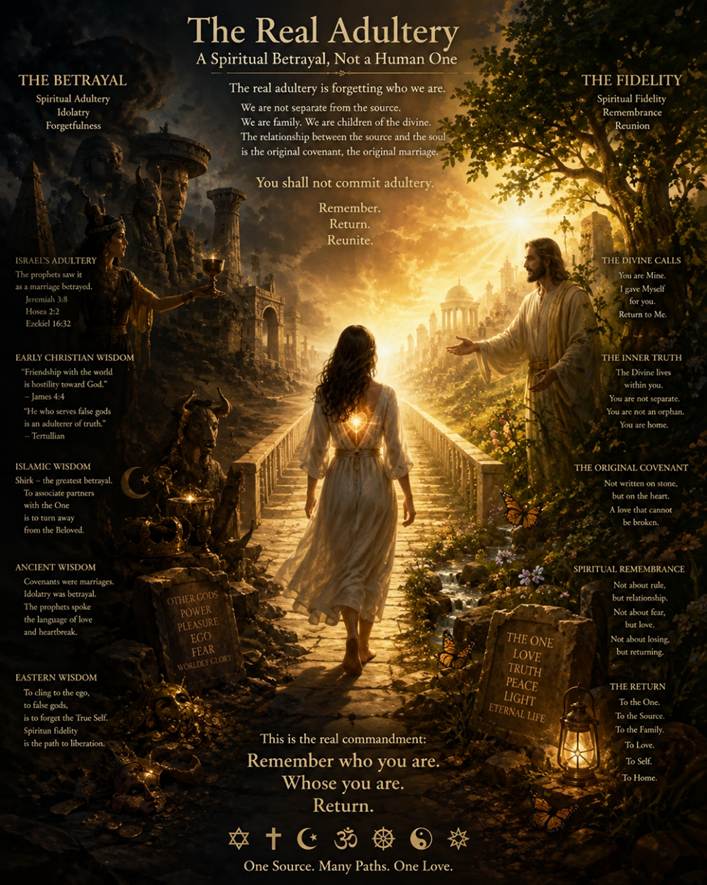
For millennia, this commandment has been interpreted as a prohibition against physical infidelity — a rule governing human sexual behaviour. But this reading misses the deeper truth. The commandment was never primarily about two humans and a bed. It was about idolatry. It was about the people of Israel marrying themselves to other gods, other powers, other sources. It was about the divine bridegroom watching his bride run off with the gods of Egypt, the gods of Canaan, the gods of Babylon.
The adultery was spiritual. The adultery was the betrayal of the relationship. The adultery was the forgetting of who they were and whose they were.
II. The Marriage Metaphor: God as Husband, Israel as Bride
The entire prophetic tradition of Israel is built on this metaphor. The relationship between God and Israel is consistently described as a marriage. When Israel worshipped other gods, they were committing adultery.
Jeremiah 3:8:
“I gave faithless Israel her certificate of divorce and sent her away because of all her adulteries.”
Hosea 2:2:
“She is not my wife, and I am not her husband.”
Ezekiel 16:32:
“You adulterous wife! You prefer strangers to your own husband.”
The Hebrew noun nāʾāf (adulteress) links physical unfaithfulness directly to idolatry, as seen throughout Jeremiah and Hosea. Ezekiel’s vocabulary — zānâ (prostituted) — emphasises wilful, repeated infidelity. The divine grievance is not merely moral but relational: a breach of exclusive covenant love. Israel’s covenant with Yahweh is portrayed as marriage (Exodus 19). Idolatry, therefore, equals adultery.
The covenant between God and His people is presented as a sacred bond, akin to a wedding covenant. As one commentator notes, when Israel turns to idolatry, it is seen as an act of unfaithfulness, akin to adultery. The metaphor of adultery highlights the personal and relational nature of sin against God. It is not just a violation of a commandment but a betrayal of the intimate relationship that God desires with His people.
III. Beyond Israel: Spiritual Adultery Across Traditions
The concept of spiritual adultery — of betraying a sacred relationship through idolatry or misplaced devotion — is not confined to the Hebrew prophetic tradition. It appears across religious and philosophical traditions.
A. Early Christian Understanding
The New Testament extends the metaphor to the church. James 4:4 warns believers: “You adulteresses! Do you not know that friendship with the world is hostility toward God?” The early church father Tertullian wrote that “he who serves false gods is doubtless an adulterer of truth, because all falsehood is adultery.” The metaphor of adultery was understood to encompass not merely physical acts but spiritual betrayal — the worship of anything other than the One.
B. Islamic Perspective
In Islam, shirk (idolatry or associating partners with God) is considered the gravest sin. While the Qur’an does not use the specific metaphor of “adultery” for idolatry in the same way as the Hebrew prophets, it consistently links idolatry with moral corruption. The connection between idolatry and adultery is recognised in Islamic scholarship as a parallel between betraying God and betraying a spouse.
C. Broader Ancient Near Eastern Context
The marriage metaphor between a deity and a people was not unique to Israel. In the ancient Near East, covenant relationships were often framed in marital terms. What distinguished Israel’s prophets was the intensity and consistency with which they applied this metaphor to condemn idolatry. The prophets used the imagery of a broken marriage to communicate the depth of the betrayal: it was not just disobedience — it was personal betrayal.
D. The Hindu and Buddhist Traditions
While these traditions do not use the specific language of “spiritual adultery,” they recognise the same principle: that devotion to false gods, or to the ego, constitutes a betrayal of one’s true nature. Buddhism, in particular, emphasises the moral and spiritual aspects of fidelity, considering adultery a violation of ethics and karma. The principle of spiritual fidelity — remaining true to the highest — is universal.
IV. The Deeper Truth: The Divine Within
The prophetic metaphor of adultery points to something deeper than a simple prohibition against worshipping other gods. It points to the nature of the relationship between the source and the created — between the divine and the human.
The real adultery is forgetting who we are.
When the commandment says “You shall not commit adultery,” it is ultimately a call to remember our true identity. We are not separate from the source. We are not orphans in the universe. We are family. We are children of the divine. The relationship between the source and the soul is the original covenant, the original marriage.
The adultery that we are called to avoid is not about other lovers — it is about other gods. It is about forgetting who we are. It is about betraying the relationship that holds all things together. As one scholar puts it, “all idolatry is also adultery for it is unfaithfulness to God.”
V. Modern Applications: What Spiritual Adultery Looks Like Today
The prophetic metaphor of spiritual adultery is not merely an ancient concept. It speaks directly to the condition of the modern human being in 2026.
What modern practices might be considered spiritual adultery?
· Money as master: The relentless pursuit of wealth or status places something other than the divine at the centre of one’s life. Jesus warned, “You cannot serve both God and money.”
· Technology as idol: The constant attachment to devices, the worship of “influencer” status, the elevation of digital validation above genuine human connection.
· Ideology as god: The substitution of political or social ideologies for a living relationship with the source.
· Self as centre: The modern obsession with self-fulfilment, self-actualisation, and self-worship.
· The pursuit of power: The elevation of ambition, control, and domination above love, service, and connection.
One commentator notes: “Spiritual adultery begins quietly: affections drift, loyalties blur, gratitude fades.” It is not a single dramatic act of betrayal — it is a gradual forgetting. A slow drift away from the source.
VI. As Above, So Below: The Harmony of the Human Being
The principle of “As Above, So Below” teaches us that the macrocosm — the divine, the source, the universe — is reflected in the microcosm — the human being. The marriage between the source and the human soul is the foundation of the garden.
When we commit spiritual adultery, we disrupt this harmony.
We turn away from the source. We forget our true nature. We betray the relationship that holds all things together. The result is not divine punishment — it is disconnection. It is the loneliness of the soul that has forgotten its home.
The remedy is not guilt. It is remembering.
VII. Meditation and Prayer: The Silence Between the Keystrokes
The antidote to spiritual adultery is not more rules, not more guilt, not more performance. It is presence. It is remembering.
The prophets called the people to return to the source — not through empty ritual, but through repentance: a turning back, a returning home. The Hebrew word shuv — to turn, to return — is the heart of the prophetic message.
In our time, this returning takes the form of:
· Meditation: The practice of stillness, of listening, of resting in the presence of the source. Not belly-gazing, but map-making. The silence between the keystrokes. The space where the divine can speak.
· Prayer through work: Not prayer as a ritual performed on one’s knees, but prayer as presence. Prayer as the act of doing one’s work with integrity, with love, with connection to the source.
· Contemplation: The practice of thinking deeply, of reflecting on the nature of reality, of tracing the patterns of the divine in the world.
The map-makers understand this. They know that the source is not found in a building or a book — it is found in the connection. It is found in the silence. It is found in the act of building, of creating, of loving.
VIII. Conclusion: The Choice Before Us
The commandment “You shall not commit adultery” is not a prohibition against human infidelity. It is a call to remember. A call to return. A call to fidelity to the source, to the divine within, to the relationship that holds all things together.
The adultery that matters is the adultery of forgetting.
When we forget who we are, when we place other gods before the source, when we betray the relationship that is the foundation of all existence — that is the real adultery. That is the betrayal that matters. That is the betrayal that the prophets condemned, and that the commandment warns us against.
The choice is before us: We can continue to forget, to drift, to worship other gods. Or we can return. We can remember. We can be faithful to the source, to the divine within, to the love that holds all things together.
As the prophet Hosea wrote, God promises: “I will betroth you to Me forever; I will betroth you in righteousness and justice, in loving devotion and compassion.”
That is the marriage that matters. That is the fidelity that counts. That is the relationship that will never end.
References
1. Jeremiah 3:8. Bible Hub.
2. Ezekiel 16:32. Bible Hub.
3. Hosea 2:2. Bible Hub.
4. Spiritual Adultery. Topical Bible, Bible Hub.
5. Idolatry as Spiritual Adultery. Topical Bible, Bible Hub.
6. Ezekiel 16:32 Commentary. Bible Hub.
7. Jeremiah 3:8 Commentary. Bible Hub.
8. Hosea 1-3 Commentary. Bible Hub.
9. James 4:4. Bible Hub.
10. Spiritual Adultery in Modern Context. Bible Hub.
11. The Concept of Zina Across Religious Perspectives. (2026).
12. Exodus 34:15. Bible Hub.
13. On Idolatry. Tertullian.
14. Love and violence: marriage as metaphor for the relationship between YHWH and Israel.
15. God’s Unfaithful Wife: A Biblical Theology of Spiritual Adultery. Raymond C. Ortlund Jr.
16. The Book of the Twelve. Yale Bible Study.
 The Patrician's Watch