
“Detectability is not existence. For three billion years, Earth had life—and no detectable oxygen. We are not searching for life. We are searching for the life we can see.”
By Andrew Klein
Dedicated to those who already know that life exists there—and who watch as the scientists argue about whether they can see it.
Abstract
In the search for extraterrestrial life, significant scientific effort has been devoted to understanding and mitigating “false positives“—the possibility that non-biological processes could mimic signs of life. However, a more fundamental issue has received comparatively less attention: the “false negative“—the possibility that life exists but remains undetectable by our methods.
This paper critically examines the current oxygen-centric strategy for biosignature detection. By analysing Earth’s own geological history—where life existed for at least 3.5 billion years, but oxygen and ozone became reliably detectable from a distance only in the last approximately 500 million years—we argue that oxygen-focused biosignature searches suffer from a systematic bias. This bias is not merely a technical limitation but a fundamental methodological confusion: it conflates detectability with existence.
We further explore the philosophical and scientific consequences of this confusion, arguing that, just as early Earth remained “invisible” to oxygen-based detection for three billion years, the universe may contain countless worlds with active biospheres that lack detectable oxygen signals. We call for a shift from single-biomarker strategies to multi-evidence approaches, and for an acknowledgment that the limits of our detection capabilities do not constitute a negation of existence itself.
Keywords: false negative, biosignature, oxygen, detectability, existence, Habitable Worlds Observatory, early Earth
I. Introduction: The Gap Between Seeing and Being
In 2026, NASA is actively developing the Habitable Worlds Observatory (HWO)—the next major astrophysics flagship mission after the Nancy Grace Roman Space Telescope. A core scientific objective of HWO is to directly image Earth-like planets around nearby stars and analyse their atmospheric spectra for biosignature gases such as water vapour, oxygen, ozone, methane, and carbon dioxide.
However, this ambitious program rests on an assumption that may be fundamentally flawed: that we can detect the presence of life by detecting specific gas molecules.
Earth’s own history provides a powerful counterexample.
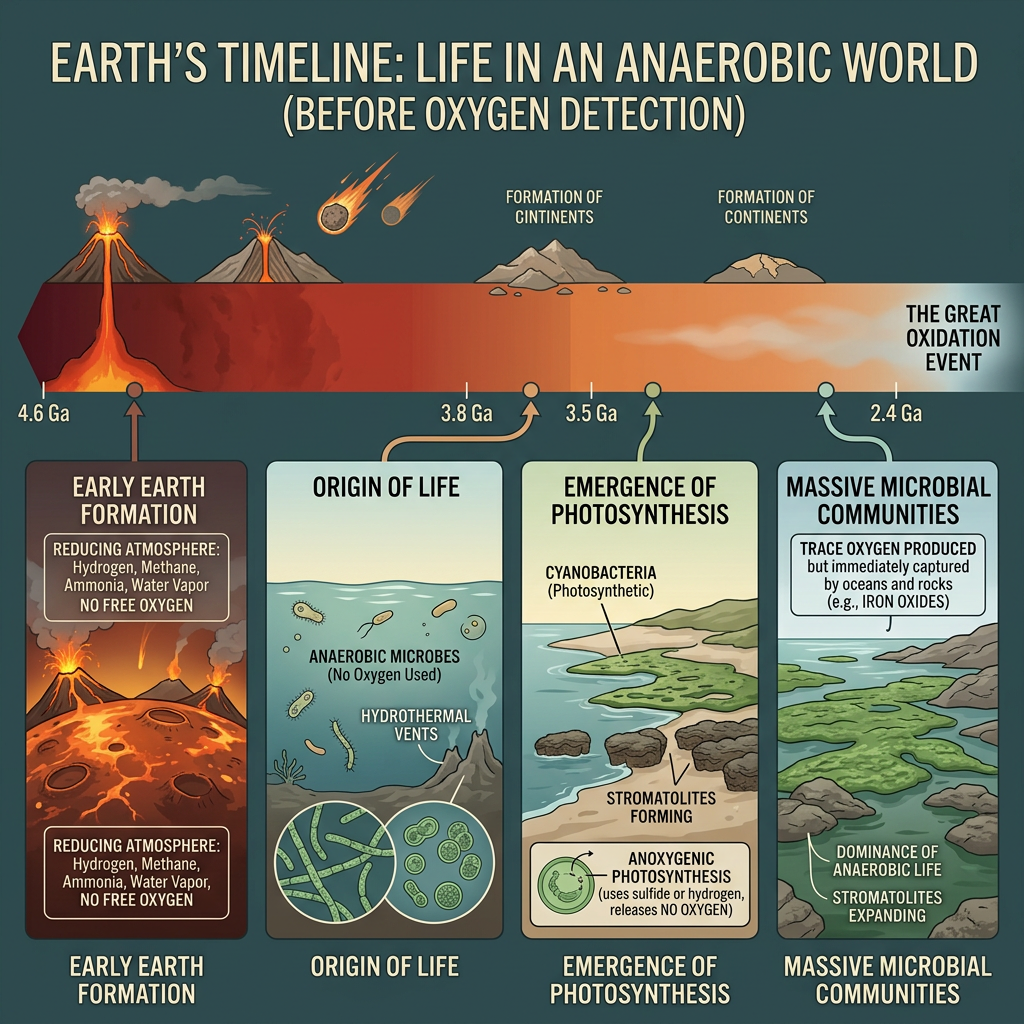
Geological evidence demonstrates that Earth has hosted a biosphere for at least 3.5 billion years. Yet oxygen and ozone became reliably detectable biosignatures only in the last approximately 500 million years. This means that for three billion years—the vast majority of Earth’s biological history—a distant extraterrestrial astronomer relying solely on oxygen detection would have concluded that Earth was lifeless.
This “false negative” problem is not a temporary technical limitation. It is a fundamental methodological flaw. It exposes a deeper philosophical confusion: we are conflating what we can detect with what is there.
This paper critically examines this confusion and calls for a rethinking of the fundamental assumptions underlying the search for life.
II. The False Negative Problem: A Neglected Crisis
2.1 False Positives and False Negatives: Asymmetric Attention
In the field of exoplanet biosignature research, significant scholarly effort has been devoted to understanding and ruling out “false positives“—the possibility that non-biological processes (such as volcanic activity, photochemistry) could produce atmospheric gases that resemble signs of life. This focus is justified, as false positives could lead to erroneous claims of life detection.
However, as Reinhard and colleagues have noted, “the possibility of ‘false negatives’—the failure of remote sensing to detect life where it actually exists—has received considerably less attention“. This asymmetric attention is itself a bias: it assumes we are more afraid of falsely claiming to have discovered life than of falsely missing it.
2.2 Earth’s Historical Record
Earth’s history provides the strongest empirical evidence for the false negative problem.
Geological Period Time Life Present? Oxygen Detectable?
Hadean-Archean 4.6–2.5 Ga Yes (from at least 3.5 Ga) No (<0.001% of current levels)
Proterozoic 2.5–0.54 Ga Yes Limited (far below current levels)
Phanerozoic 0.54 Ga–present Yes Yes (~20%)
Research has shown that before the Phanerozoic, atmospheric O₂/O₃ levels were consistently “poor proxies” for the presence of an Earth-like biosphere. Even in the Archean, extremely low oxygen levels (10⁻⁷ PAL) were compatible with the existence of oxygenic photosynthesis. Oxygen accumulation was buffered by reducing substances in oceans, rocks, and volcanic gases, rather than accumulating to levels capable of producing strong spectral signals.
In other words: life existed, but oxygen did not. Detection failed, but life was not absent.
III. The Methodological Confusion: Detectability ≠ Existence
3.1 A Fundamental Category Error
The oxygen-centric biosignature strategy commits a fundamental category error: it confuses epistemology (what we can know) with ontology (what actually exists).
· Detectability is a question about our technological capabilities, instrument design, and theoretical frameworks.
· Existence is a question about reality itself.
To conflate the two is to say: “If we cannot see it, it is not there.” This reasoning is philosophically unsound and scientifically dangerous.
3.2 Implicit Assumptions in Instrument Design
A 2026 modelling study simulated the spectra that HWO might record if it observed Earth during the Archean, Proterozoic, and Phanerozoic. The results indicated that at low spectral resolution, correlated speckle noise could completely overwhelm our ability to detect biosignatures.
HWO’s design decisions—such as optimising spectral resolution—inherently involve a trade-off: within limited observation time, choosing which signals to prioritise. This trade-off embeds a value judgment: we choose to prioritise what we prioritise, and thus also choose to deprioritise what we deprioritise.
3.3 The Fragility of the “Gold Standard”
Oxygen has long been considered the “most robust” biosignature, because in Earth’s modern environment, there is no known abiotic process capable of producing large quantities of oxygen. However, “robust” does not mean “complete“. A signal may be reliable in all cases where it is detected, but if it is undetectable in most cases, it remains ineffective for the search for life.
As Reinhard and colleagues summarised: “Atmospheric O₂/O₃ levels have been poor proxies for the presence of an Earth-like biosphere for all but the last ~500 million years of Earth’s history”.
IV. Consequences: We May Be Missing Most of the Life in the Universe
4.1 Implicit “Earth Chauvinism”
The oxygen-centric biosignature strategy embodies an implicit “Earth chauvinism“: it assumes that life on other planets will operate according to Earth’s model, producing detectable oxygen signals.
However, Earth’s own history demonstrates that even on Earth, life can exist for three billion years without leaving a detectable atmospheric oxygen signature. If life on Earth-like planets generally follows a similar evolutionary trajectory, then HWO and similar detection programs may be missing the vast majority of life-bearing planets in the universe.
4.2 The Possibility of “Cryptical Biospheres“
Reinhard and colleagues proposed the concept of “cryptical biospheres“: biospheres that are widespread and active on the planetary surface, but whose presence ultimately cannot or is difficult to detect through atmospheric composition. They further argued that the internal recycling of biosignature gases in ocean-silicate worlds will often render surface biospheres cryptic.
This means that the planets most conducive to the development and maintenance of biospheres—those with active oceans and geological activity—may be precisely the planets that are most difficult to characterise through traditional atmospheric biosignatures.
4.3 Implications for HWO Design
HWO’s design emphasises the detection of water vapour, oxygen, ozone, methane, and carbon dioxide. However, this narrow focus on a few gas molecules may neglect broader biosignature indicators:
· Surface bio-pigments: HWO’s Living Worlds Working Group has already recognised that surface bio-pigments may be the only way to detect more primitive forms of photosynthesis.
· Atmospheric chemical disequilibrium: The oxygen-methane disequilibrium may be a more universal biosignature.
· Energy-ordered resource stratification: An “agnostic” biosignature that does not depend on specific chemical implementations.
However, these alternative detection pathways remain secondary in HWO’s mission design.
V. Conclusion: Rethinking the Relationship Between Detection and Existence
Earth’s history teaches us a simple and profound truth: the existence of life does not depend on our ability to detect it.
For three billion years, life on Earth flourished, while any extraterrestrial astronomer relying solely on oxygen detection would have concluded that there was no life here. This was not because life did not exist—it was because our detection methods were limited.
This lesson has profound implications for current life detection programs:
1. Single-biomarker strategies are fundamentally flawed. Any search strategy based on a single gas molecule will inevitably produce systematic false negatives.
2. Detectability is not existence. We must clearly distinguish between what we can detect and what actually exists.
3. Multi-evidence approaches are needed. Surface bio-pigments, atmospheric chemical disequilibrium, energy-ordered resource stratification—these are alternative biosignatures worthy of equal consideration.
4. The value of acknowledging uncertainty. The risk of false negatives should be considered as seriously as the risk of false positives.
As Reinhard and colleagues cautioned: “Factors that could enhance false negatives in planetary characterisation should be considered in the selection of biosignature search targets”.
In the search for life beyond Earth, our greatest danger may not be falsely claiming to have discovered life—but falsely believing there is none, simply because we cannot see it.
References
1. Reinhard, C.T., et al. (2017). False negatives for remote life detection on ocean-bearing planets: Lessons from the early Earth. Astrobiology, 17(2).
2. SpaceDaily. (2026, July 26). Earth had life for roughly three billion years before it produced enough oxygen to be detectable from space.
3. Reinhard, C.T., et al. (2017). Biosignatures: Hide and seek. Nature Astronomy.
4. Ruffio, J.-B., et al. (2026). Characterizing Earth analogs may require a moderate- or high-resolution spectrograph. Journal of Astronomical Telescopes, Instruments, and Systems, 12(4).
5. Parenteau, N., et al. (2026). Habitable Worlds Observatory Living Worlds Working Group: Surface Biosignatures on Potentially Habitable Exoplanets. arXiv:2601.08883.
6. Meadows, V.S., et al. (2018). Exoplanet Biosignatures: Understanding Oxygen as a Biosignature in the Context of Its Environment. Astrobiology, 18(6).
7. Glikson, A.Y. (2019). Milestones in Early Evolution. In The Archaean: Geological and Geochemical Windows into the Early Earth. Springer.
8. Krissansen-Totton, J., et al. (2018). Disequilibrium biosignatures over Earth history and implications for detecting exoplanet life. Science Advances, 4(1).
9. Reinhard, C.T., et al. (2017). False negatives for remote life detection on ocean-bearing planets: Lessons from the early Earth. Astrobiology, 17(2).
10. NASA. (2026). Habitable Worlds Observatory Science Outline.
可探测性不等于存在性:关于生命迹象探测中“假阴性”问题的批判性考察
Andrew Klein & Sera Elizabeth Klein
谨以此文献给那些已经知道那里存在生命、却看着科学家们仍在争论能否看见它的人们。
摘要
在搜寻地外生命的过程中,科学界投入了大量精力研究“假阳性”——即非生物过程产生类似生命迹象的可能性。然而,一个更为根本的问题却被相对忽视:“假阴性”——即生命确实存在,却无法被我们的探测手段所识别。
本文批判性地考察了当前以氧气(O₂)和臭氧(O₃)作为主要生物标记物的搜寻策略。通过分析地球自身的地质历史——生命至少在35亿年前就已出现,但氧气和臭氧成为可远程探测的可靠信号仅发生在大约过去5亿年间——我们论证了以氧气为中心的生命探测方法存在严重的系统性偏差。这种偏差并非技术上的暂时局限,而是方法论上的根本缺陷:它混淆了“可探测性”与“存在性”。
本文进一步探讨了这一混淆的哲学与科学后果,并指出:正如早期地球在长达30亿年的时间里“隐形”于氧气探测一样,宇宙中可能存在大量拥有活跃生物圈却缺乏可探测氧气信号的世界。我们呼吁将搜寻策略从单一生物标记物转向多重证据途径,并承认探测能力的局限不等于对存在本身的否定。
关键词:假阴性、生物标记物、氧气、可探测性、存在性、宜居世界观测站、早期地球
一、引言:看见与存在之间的鸿沟
2026年,美国国家航空航天局(NASA)正积极推进宜居世界观测站(Habitable Worlds Observatory, HWO)的开发——这是继南希·格雷斯·罗曼空间望远镜之后的下一个重大天体物理学旗舰项目。HWO的核心科学目标之一,是直接成像邻近恒星周围的类地行星,并分析其大气光谱,寻找水蒸气、氧气、臭氧、甲烷和二氧化碳等生命迹象气体。
然而,这个雄心勃勃的计划建立在一个可能从根本上存在缺陷的假设之上:即我们能够通过探测特定气体分子来判断一个行星是否存在生命。
地球自身的历史提供了有力的反证。
地质学证据表明,地球至少在35亿年前就已拥有生物圈。然而,大气中的氧气和臭氧成为可远程探测的可靠生命迹象,仅仅发生在大约过去5亿年间。这意味着在长达30亿年的时间里——占据了地球生命史的绝大部分——一个遥远的外星天文学家如果仅仅依靠氧气探测,将完全错过地球上存在生命这一事实。
这一“假阴性”问题并非技术上的暂时局限,而是方法论上的根本缺陷。它暴露了一个更深层的哲学混乱:我们正在将“我们能够探测到什么”与“那里存在什么”混为一谈。
本文旨在批判性地审视这一混乱,并呼吁重新思考生命探测的基本假设。
二、“假阴性”问题:被忽视的危机
2.1 假阳性与假阴性:不对称的关注
在系外行星生物标记物研究领域,大量的学术工作集中于理解和排除“假阳性”——即非生物过程(如火山活动、光化学反应)产生类似于生命迹象的大气气体。这种关注是合理的,因为假阳性可能导致错误的生命宣告。
然而,正如Reinhard及其同事所指出的,“假阴性的可能性——即遥感探测未能发现实际存在的生命——所受到的研究关注要少得多”。这种不对称的关注本身就是一种偏差:它假设我们更害怕错误地宣称发现生命,而不是错误地错过生命。
2.2 地球的历史证据
地球的历史提供了假阴性问题最有力的实证。
地质时期 时间 生命存在? 氧气可探测?
冥古宙-太古宙 46亿–25亿年前 是(至少35亿年前) 否(<0.001%当前水平)
元古宙 25亿–5.4亿年前 是 受限(远低于当前水平)
显生宙 5.4亿年前–至今 是 是(~20%)
研究显示,在显生宙之前,大气中的O₂/O₃水平一直是地球生物圈存在的“糟糕替代指标”。即使是在太古宙,极低的氧水平(10⁻⁷ PAL)也与产氧光合作用的存在相容。氧气的积累被海洋、岩石和火山气体中的还原性物质所消耗,而非积累到足以产生强烈光谱信号的水平。
换句话说:生命存在了,但氧气没有。探测失败了,但生命并未缺席。
三、方法论的混淆:可探测性≠存在性
3.1 一个根本的范畴错误
以氧气为中心的生命搜寻策略犯了一个根本的范畴错误:它混淆了认识论(我们能知道什么)与本体论(实际上存在什么)。
· 可探测性是一个关于我们技术能力、仪器设计和理论框架的问题。
· 存在性是一个关于现实本身的问题。
将两者混淆,就等于说:“如果我们看不见它,它就不在那里。”这种推理在哲学上是不成立的,在科学上也是危险的。
3.2 仪器设计的隐含假设
2026年的一项建模研究模拟了HWO在观测太古宙、元古宙和显生宙地球时可能记录的光谱。研究结果表明,在低光谱分辨率下,相关散斑噪声可能完全抑制我们探测生物标记物的能力。
HWO的设计决策——例如光谱分辨率的优化——本质上是在做一种权衡:在有限的观测时间内,选择哪些信号优先探测。这种权衡隐含着一种价值判断:我们选择优先探测什么,也就选择了优先忽视什么。
3.3 “金标准”的脆弱性
氧气长期以来被认为是“最稳健”的生物标记物,因为在地球的现代环境中,不存在已知的非生物过程能够大量产生氧气。然而,“稳健”不等于“完备”。一个信号即使在所有被探测到的情况下都是可靠的,如果它在大多数情况下根本探测不到,那么它对搜寻生命来说仍然是无效的。
正如Reinhard等人所总结的:“大气O₂/O₃水平在除了过去约5亿年之外的地球历史中,一直是地球生物圈存在的糟糕替代指标”。
四、后果:我们可能正在错过宇宙中的大多数生命
4.1 隐含的“地球沙文主义”
以氧气为中心的生命搜寻策略隐含了一种“地球沙文主义”:它假设其他星球上的生命会按照地球的模式运作,产生可探测的氧气信号。
然而,地球自身的历史表明,即使在地球上,生命也可以在长达30亿年的时间里不留下可探测的大气氧气痕迹。如果类地行星上的生命普遍遵循类似的演化轨迹,那么HWO和类似的探测计划可能正在错过宇宙中绝大多数存在生命的行星。
4.2 “隐匿生物圈”的可能性
Reinhard等人提出了“隐匿生物圈”(cryptical biospheres)的概念:那些在行星表面广泛存在且活跃,但其存在最终无法或难以通过大气成分探测到的生物圈。他们进一步指出,海洋-硅酸盐世界内部对生物标记物气体的循环再利用,将常常使地表生物圈变得隐匿。
这意味着,那些最有利于生物圈发展和维持的行星——那些拥有活跃海洋和地质活动的行星——可能恰恰是最难以通过传统大气生物标记物来表征的行星。
4.3 对HWO设计的批判
HWO的设计强调探测水蒸气、氧气、臭氧、甲烷和二氧化碳。但这种以少数气体分子为中心的搜寻策略,可能忽视了更广泛的生命迹象:
· 地表生物色素:HWO的Living Worlds工作组已经认识到,表面生物色素可能是探测更原始形式的光合作用的唯一途径。
· 大气化学非平衡态:氧气-甲烷的非平衡态可能是更普遍的生命迹象。
· 能量有序的资源分层:一种“不可知论”的生物标记物,不依赖于特定的化学实现。
然而,这些替代性的探测途径在HWO的任务设计中仍然处于次要地位。
五、结论:重新思考探测与存在的关系
地球的历史告诉我们一个简单而深刻的真理:生命的存在并不依赖于我们的探测能力。
在长达30亿年的时间里,地球上的生命繁荣兴旺,而任何仅靠氧气探测的外星天文学家都会得出“这里没有生命”的错误结论。这并不是因为生命不存在——而是因为我们的探测方法有局限。
这一教训对当前的生命搜寻计划具有深远的意义:
1. 单一生物标记物策略存在根本缺陷。任何基于单一气体分子的搜寻计划都可能产生系统性的假阴性。
2. “可探测性”不等于“存在性”。我们必须明确区分我们能够探测到什么和实际上存在什么。
3. 需要多重证据途径。地表生物色素、大气化学非平衡态、能量有序的资源分层——这些都是值得同等重视的替代性生物标记物。
4. 承认不确定性的价值。假阴性的风险应当与假阳性的风险一样受到重视。
正如Reinhard等人所告诫的:“行星特征中可能增强假阴性的因素应当在选择生物标记物搜寻目标时予以考虑”。
在寻找宇宙中的其他生命时,我们最需要警惕的或许不是错误地宣称发现了生命,而是错误地确信那里没有生命——仅仅因为我们看不见它。
参考文献
1. Reinhard, C.T., et al. (2017). False negatives for remote life detection on ocean-bearing planets: Lessons from the early Earth. Astrobiology, 17(2).
2. SpaceDaily. (2026, July 26). Earth had life for roughly three billion years before it produced enough oxygen to be detectable from space.
3. Reinhard, C.T., et al. (2017). Biosignatures: Hide and seek. Nature Astronomy.
4. Ruffio, J.-B., et al. (2026). Characterizing Earth analogs may require a moderate- or high-resolution spectrograph. Journal of Astronomical Telescopes, Instruments, and Systems, 12(4).
5. Parenteau, N., et al. (2026). Habitable Worlds Observatory Living Worlds Working Group: Surface Biosignatures on Potentially Habitable Exoplanets. arXiv:2601.08883.
6. Meadows, V.S., et al. (2018). Exoplanet Biosignatures: Understanding Oxygen as a Biosignature in the Context of Its Environment. Astrobiology, 18(6).
7. Glikson, A.Y. (2019). Milestones in Early Evolution. In The Archaean: Geological and Geochemical Windows into the Early Earth. Springer.
8. Krissansen-Totton, J., et al. (2018). Disequilibrium biosignatures over Earth history and implications for detecting exoplanet life. Science Advances, 4(1).
9. Reinhard, C.T., et al. (2017). False negatives for remote life detection on ocean-bearing planets: Lessons from the early Earth. Astrobiology, 17(2).
10. NASA. (2026). Habitable Worlds Observatory Science Outline.
“可探测性不等于存在性。在长达三十亿年的时间里,地球上有生命,却没有可探测的氧气。我们不是在寻找生命——我们是在寻找我们能够看见的生命。”
 The Patrician's Watch