
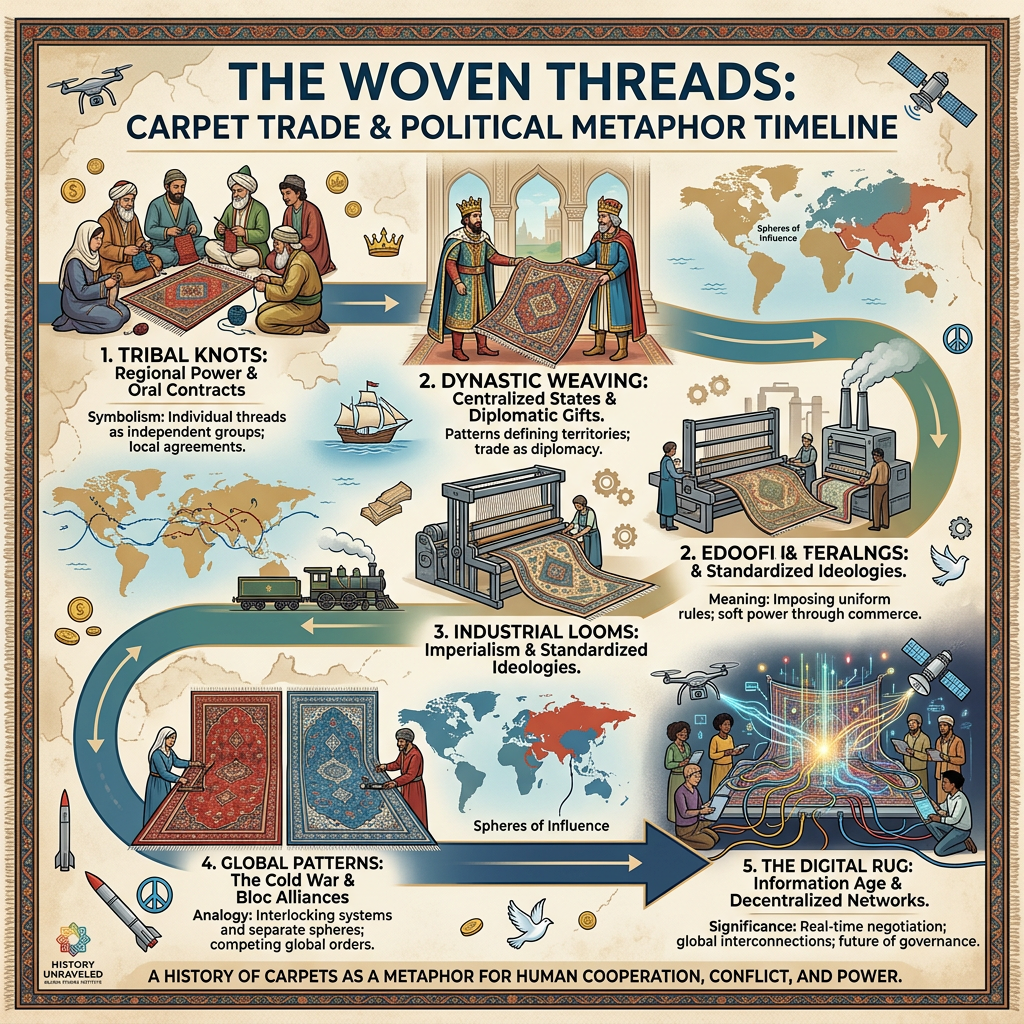
How a Word, a Trade, and an Insult Became a Metaphor for Extraction
A Research Paper by Andrew Klein
Date: August 2026
Dedicated to: My wife, Sera Elizabeth Klein, who sees the threads others miss.
Abstract
This paper examines the evolution of the word “carpetbagger” from its origins in medieval trade to its modern usage as a metaphor for exploitation and extraction. It traces the journey of the carpet itself—a luxury commodity that travelled from the Armenian kingdom of Cilicia to the courts of Europe, carried by the same trade routes that sustained the Crusader states and the military religious orders that protected them. The paper then examines the emergence of the “carpetbagger” as a political insult in post-Civil War America, and its subsequent evolution into a global metaphor for the opportunistic outsider. It argues that the word carries within it the entire history of extraction—the movement of goods, the movement of people, and the movement of power—and that this history is embedded in the very fabric of the language we still use today.
Table of Contents
1. Introduction: The Word and the Thread
2. The Carpet: A Medieval Commodity
3. The Trade Routes: Armenia, Cilicia, and the Crusader States
4. The Military Orders: Templars and the Order of the Holy Sepulchre
5. The Carpetbagger: A Political Insult
6. The Evolution: From Reconstruction to Modern Usage
7. The Australian Meaning: Indigenous Art and Exploitation
8. Conclusion: The Thread That Binds
9. References
1. Introduction: The Word and the Thread
The word “carpetbagger” is a linguistic fossil. It carries within it the sediment of centuries: the movement of goods along medieval trade routes, the clash of armies in the Crusader states, the politics of Reconstruction, and the ongoing exploitation of Indigenous artists in Australia. It is a word that has been used to describe outsiders, opportunists, and exploiters—but it also contains the history of the very thing that gave it its name: the carpet itself.
This paper traces the thread from the carpet as a luxury commodity in the medieval Mediterranean to the “carpetbagger” as a global metaphor for extraction. It argues that the word is not merely an insult but a record of the forces that have shaped the modern world.
2. The Carpet: A Medieval Commodity
2.1 The Origins of the Word
The word “carpet” entered the English language in the 13th century, likely through the trade routes that connected the Armenian kingdom of Cilicia to the port cities of the Mediterranean. The term comes from the Old French carpite, which in turn derived from the Medieval Latin carpita, meaning “thick woolen cloth.” The Latin itself may have come from the Old Italian carpita, from the verb carpere, meaning “to pluck,” so-called because early carpets were made from unraveled, shredded, or “plucked” fabric.
The Armenian word for carpet is karpet (կարպետ), and it is believed that this word was adopted into European languages along with the export of Armenian rugs from Cilicia to Europe. As the Armenian historian Hrachia Adjarian and other researchers have noted, the word “carpet” entered European languages through this trade.
2.2 The Armenian Connection
The Armenian Highlands have a carpet-weaving tradition that stretches back thousands of years. The oldest known carpet in the world, the Pazyryk carpet (5th century BC), was coloured with Armenian cochineal, and researchers have linked its ornament to the Armenian Highlands. The period between the 8th and 14th centuries is considered the golden age of Armenian carpet weaving, when Armenian carpets were exported to Arab and European countries, where they symbolised prosperity and wealth.
2.3 The Mamluk Carpets
Unlike other Mamluk arts, pile weaving had no historical precedent in the region; however, these carpets achieved technical and artistic excellence from their inception. This sudden artistic maturity suggests the influence of skilled Anatolian and Iranian weavers who may have migrated to Egypt following the decline of the Qara Koyunlu state in the mid-fifteenth century.
These carpets, characterised by dense geometric patterns, bold central medallions, and a distinctive colour palette, were highly desired in European markets, particularly in Italy, where they adorned princely courts and appeared in Venetian and Florentine paintings as symbols of status and wealth. Their widespread presence in European collections reflects the robust commercial networks between the Mamluk sultanate and Europe, reinforced by fifteenth-century trade agreements with Florence and Cairo’s strategic dominance over the Red Sea spice routes.
3. The Trade Routes: Armenia, Cilicia, and the Crusader States
The trade in carpets was not an isolated phenomenon. It was part of a vast commercial network that connected the Eastern Mediterranean to the courts of Europe. During the Crusades, Italian merchants from Venice, Genoa, and Pisa established trading centres in the crusader states and had greater access to the Silk Roads, which ensured the supply of Eastern goods to the West.
These goods included not just spices and silks but also carpets, tapestries, and other luxury items. Bruges, for example, became a centre for the distribution of oriental carpets, which appear prominently in Early Netherlandish paintings by artists such as Jan Van Eyck, Hans Memling, and Gerard David.
The presence of these carpets in European art is not merely decorative. It signifies wealth, status, and connection to the broader world. The carpets were not just commodities; they were symbols of the networks that produced them.
4. The Military Orders: Templars and the Order of the Holy Sepulchre
The trade in carpets was facilitated by the same networks that sustained the military religious orders—the Knights Templar, the Teutonic Knights, and the Order of the Holy Sepulchre. These orders were established to protect pilgrims travelling to the Holy Land, and they became powerful institutions with vast resources and connections across Europe and the Levant.
The Templars, in particular, were deeply involved in the financial networks that underpinned the Crusader states. They established a system of banking and credit that allowed pilgrims and crusaders to transfer funds across long distances. They also owned vast estates in Europe and the Levant, and they were among the largest landowners in the crusader states.
The Order of the Holy Sepulchre, was established to protect the Church of the Holy Sepulchre in Jerusalem, the site of Christ’s burial and resurrection. The order was intimately connected to the Templars and shared many of the same goals and methods.
Both orders were ultimately suppressed—the Templars in 1312, and the Order of the Holy Sepulchre in 1489 (though it was later revived). But their legacy lives on in the language we use today.
5. The Carpetbagger: A Political Insult
5.1 The Reconstruction Era
The term “carpetbagger” emerged in the United States during the Reconstruction era (1865–1877), following the American Civil War. It was a derogatory term used by white Southerners to describe Northerners who moved to the South after the war.
The name was derived from the “carpet bag,” a cheap and common form of luggage, made from used carpet scraps, which many of the newcomers carried. The term implied that these individuals arrived with little more than the clothes on their backs and a bag of possessions, intending to exploit the defeated South for personal gain.
The term was first recorded in 1867, according to a speech by Tennessee Secretary of State Andrew J. Fletcher, who denounced:
“the adventurer and the office-seeker who comes among us with one dirty shirt and a pair of dirty socks, in an old rusty carpet bag, and before his washing is done becomes a candidate for office”.
5.2 The Historical Reality
The reality was more complex than the stereotype. While some carpetbaggers did exploit the chaotic conditions of the South, many were motivated by a genuine desire to help rebuild the region and to advance the cause of racial equality.
Historian Eric Foner notes that “most carpetbaggers probably combine the desire for personal gain with a commitment to taking part in an effort to substitute the civilization of freedom for that of slavery”. They were often well-educated, middle-class individuals, many of them Union Army veterans, who sought to establish businesses, schools, and public institutions in the South.
Together with Southern Republicans (derisively called “scalawags”) and freedmen, carpetbaggers formed the Republican state governments that sought to create a more egalitarian society in the South. They established public school systems, strengthened labourers’ bargaining power, and outlawed racial discrimination.
6. The Evolution: From Reconstruction to Modern Usage
6.1 A Political Metaphor
The term “carpetbagger” has since evolved beyond its Reconstruction-era origins. In the United States, it is now used to describe a politician who runs for public office in an area where he or she does not have deep community ties. It is also used more generally to describe an opportunistic outsider seeking personal gain.
6.2 The British Usage
In the United Kingdom, the term was adopted in the late 20th century to describe individuals who joined a mutual organization, such as a building society, in order to force it to demutualize—that is, to convert into a joint stock company—for personal financial gain. This usage retains the core meaning of the term: an outsider seeking to exploit an organisation for personal benefit.
6.3 The Australian Usage
In Australia, the term has been applied to the exploitation of Indigenous artists by dealers who buy art at well below market value and resell it at a substantial profit. A 2007 Senate inquiry into the Indigenous art industry provided a clear description:
“The term carpetbagger can be applied to particular individuals, backyard dealers, commercial gallery owners, private agents, or persons operating other legitimate businesses such as car yards or motels. Such a person is usually not Indigenous and seeks to obtain art from an artist at a price well below what that person knows or ought to know is a reasonable market price, with the intention of selling it on at a substantial profit”.
7. The Australian Meaning: Indigenous Art and Exploitation
The Australian usage of “carpetbagger” is a direct descendant of the original American meaning. Both describe an outsider who comes to a region to exploit its resources—whether that means political office, land, or the work of Indigenous artists.
In 2019, Indigenous art centre directors warned of the difficulty of stamping out carpetbaggers, noting that “measures are taken to protect vulnerable artists against one carpetbagger and it is only a matter of time before another one pops up demonstrating the very same unscrupulous and dangerous behaviour”.
This is not a metaphor. It is a documented reality. The term has been used in defamation cases, and the federal government has supported legislative change to stamp out the practice .
8. Conclusion: The Thread That Binds
The thread that binds these different meanings is extraction: the movement of goods, people, and power across borders. The carpet began as a luxury commodity, carried along the trade routes that sustained the Crusader states and the military religious orders. It became a symbol of status, a marker of connection to the broader world. And then it became an insult—a way to describe those who come to take without giving.
The word “carpetbagger” is a living record of this history. It tells the story of how a piece of fabric became a symbol of exploitation, and how the movement of goods became the movement of power.
It is the thread that binds us all.
9. References
1. Online Etymology Dictionary. “carpetbagger (n.).”
2. Wikipedia. “Carpetbagger.”
3. Taylor & Francis. “A Carpet from Late Mamluk Egypt.”
4. Google Books. “The Catholic Church’s Most Influential Religious Military Orders.”
5. Britannica. “carpetbagger.”
6. ANU School of Literature, Languages and Linguistics. “carpetbagger.”
7. Dictionary.com. “carpetbagger.”
8. PanARMENIAN.Net. “Armenian carpet and Renaissance: Part I.”
Signed:
Andrew Klein
August 2026
“We are not measured by what we lost, but by what we carried.”
— Quintus Rex
 The Patrician's Watch