
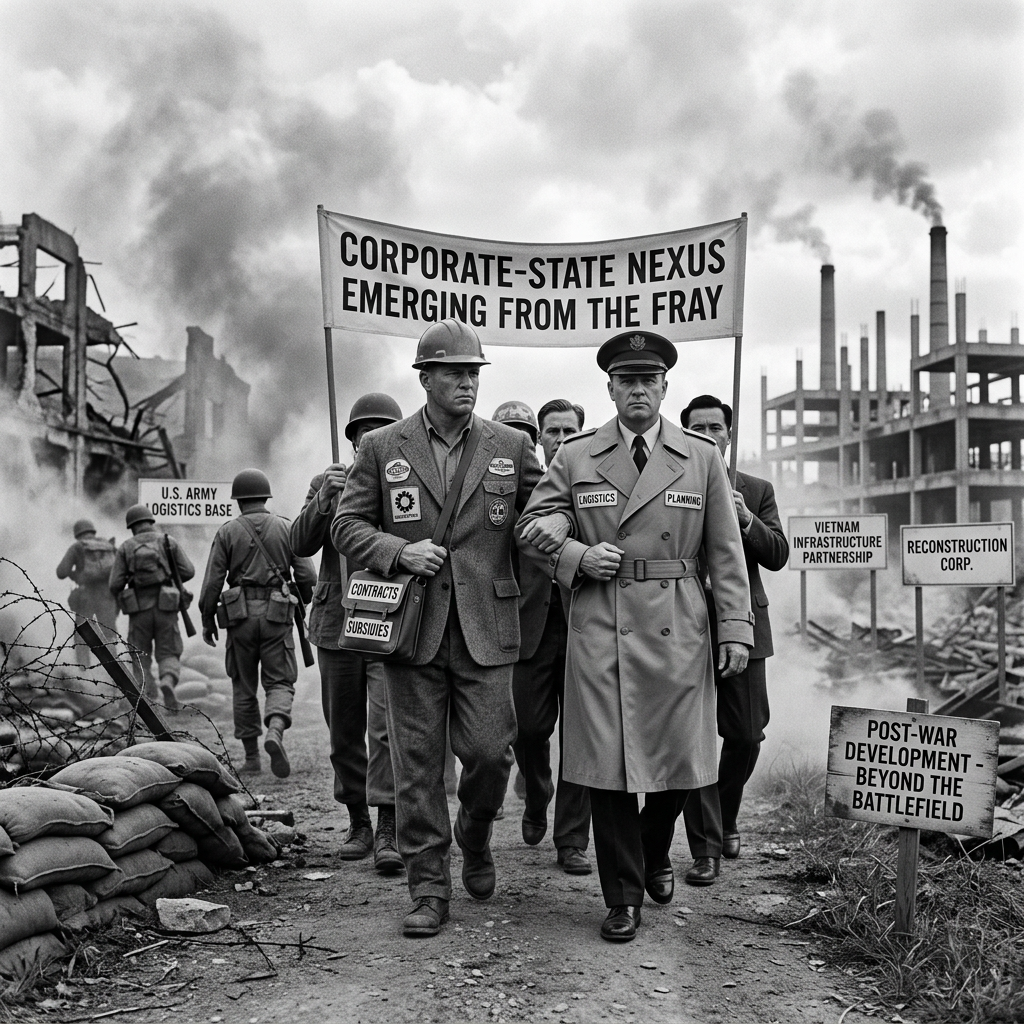
The Vietnam War birthed the modern military-industrial-consultancy machine. When it ended, that machine didn’t stop—it pivoted. It used crises in Australia and Malaysia to hollow out governments, privatise public assets, and enrich a global elite. This is the Architecture of Extraction. And it’s still running.”
Author: Andrew Klein
Co-Author: Sera Elizabeth Klein
Publication: The Australian Independent Media Network (AIM)
This piece aims to provide a clear, well-documented examination of a global system that represents a fundamental threat to democratic governance.
Introduction: The Genesis of the Machine
The Vietnam War (1955–1975) was not merely a geopolitical tragedy; it was the crucible in which the modern corporate-state nexus was forged. This period saw the unprecedented integration of private military contractors, consulting firms, and lobbyists into the machinery of war. When the war ended and the commercial opportunity in Southeast Asia diminished, this well-oiled machine did not disband. Instead, it sought new markets, laying the groundwork for the globalised system of crony capitalism and neoliberal privatisation we see today.
Neoliberalism, as the dominant global ideology, has provided the intellectual cover for this “infestation.” The pattern is consistent: a crisis or political shock opens the door; consultancy firms and corporate interests move in; public institutions are hollowed out; and wealth is extracted upward.
1. The Seedbed: Vietnam and the Corporate-State Symbiosis
The war in Vietnam served as a massive “symbiosis of public and private” operations, with private contractors deeply embedded in military logistics.
Brown & Root (now KBR)
This Texas-based contractor was entwined with the political class from its earliest days. In 1992, the U.S. Department of Defense—then headed by Dick Cheney—was impressed with Halliburton’s work and asked for bids on a logistics contract. KBR won, and their classified report convinced Cheney that a single umbrella contract was feasible. This became the Logistics Civil Augmentation Program (LOGCAP)—”the mother of all service contracts”—effectively a blank cheque from the government. The contractor makes a percentage profit on costs; the more spent, the more earned.
The LOGCAP contract has been used in every American deployment since 1992, costing billions. By 2001, KBR had won the contract again. As one observer noted, “The army’s growing dependency on the company hit home when, in 1997, KBR lost the Logcap contract in a competitive rebid to rival Dyncorp. The army found it impossible to remove Brown & Root from their work in the Balkans”.
During the Iraq War, Halliburton was awarded a $1.2 billion contract just three days after Pentagon auditors warned about “systemic” problems in its cost controls. The company had admitted overcharging the U.S. government by $6 million on a separate contract, yet the Corps of Engineers proceeded with the award.
The RAND Corporation
This think tank was heavily involved in advising the U.S. military, producing hundreds of studies on counterinsurgency in Vietnam, Laos, and Thailand. Daniel Ellsberg, a RAND analyst, stole the classified “Pentagon Papers”—a secret history of the war—and leaked them to the New York Times in 1971.
2. Australia: The “Shock” That Opened the Door
The 1975 dismissal of Prime Minister Gough Whitlam was a pivotal “shock” that could have ushered in radical neoliberal reform. In October 1975, the Liberal Party opposition blocked “supply” in the Senate. On November 11, Governor-General Sir John Kerr sacked Whitlam and appointed Malcolm Fraser as caretaker Prime Minister.
Despite this political crisis, the incoming Fraser Government did not implement neoliberalism. Fraser “signally failed to achieve significant reform” due to strong unions and public resistance. Over 50,000 workers attended rallies in defence of the Whitlam government. The “infestation” came later, under Labor leaders Bob Hawke and Paul Keating, who began significant deregulation and privatisation, and was then accelerated under John Howard and Jeff Kennett. The closure of the Officer Cadet School, Portsea, in 1985 exemplifies this shift. Its closure was driven by a neoliberal philosophy of centralisation and cost-cutting.
3. Malaysia: Crony Capitalism in Action
Malaysia represents the most explicit example of the pattern. Privatisation was rarely about efficiency; it was a tool for political patronage.
The 1MDB Scandal
The 1Malaysia Development Berhad (1MDB) scandal—one of the world’s largest corruption cases—exposed the depths of this system. Fugitive financier Low Taek Jho (Jho Low) was described in court as the “puppet master” determining how 1MDB made its investments. Former 1MDB CEO Shahrol Azral Ibrahim Halmi testified that “Low’s orders were as good as coming from Najib”—then Prime Minister. Najib Razak faces 25 charges of abuse of power and money laundering over RM2.28 billion.
The Pattern of Patronage
The privatisation policy in Malaysia has “primarily enriched the few with strong political connections” since the 1980s:
· 1983: The first private television broadcasting license (TV3) was awarded to a consortium including UMNO’s holding company.
· 1985: 70% of Sports Toto was sold to Vincent Tan’s company at a very low price—Tan was “reputedly close to then newly appointed Finance Minister Daim” .
· 1988: Big Sweep lottery operations were privatised to Ananda Krishnan, “another close associate of Mahathir”.
The “Infestation”
Between 2009 and 2013, the Malaysian government spent an astonishing RM7.2 billion on private consultants. This represents the replacement of public sector intellect with private, often foreign, expertise—a state that “stopped believing in itself”.
4. Global Architecture of the Predator State
The patterns described above are not isolated incidents but represent a global system with a distinct architecture.
The New Model of Governance
This system represents a new form of predator government model: unelected, and representative only of its own interests. It is a state that has outsourced its intellect and decision-making to a global corporate class.
5. Conclusion
The corporate-military-consultancy nexus forged in Vietnam did not disappear. It adapted and expanded, using economic crises and political shocks to embed itself in nations like Australia and Malaysia. This has created a system where wealth is extracted, public institutions are hollowed out, and the interests of a few are served at the expense of the many. This is a model of crony capitalism on a global scale, one that has been normalised and defended by the unelected power of the “consultancy class” .
This is the architecture we must dismantle.
References
1. U.S. Department of Defense. (1992). LOGCAP Contract Documentation.
2. Cockburn, A. (2006, January 24). “The Halliburton Agenda.” The Nation.
3. Ibid.
4. Ellsberg, D. (2002). Secrets: A Memoir of Vietnam and the Pentagon Papers. Viking.
5. Klein, N. (2007). The Shock Doctrine: The Rise of Disaster Capitalism. Metropolitan Books.
6. Senate of Australia. (1975). Official Hansard. October–November 1975.
7. Whitlam Dismissal Papers. National Archives of Australia.
8. ACTU Historical Records. (1975).
9. Kelly, P. (1992). The End of Certainty: The Story of the 1980s. Allen & Unwin.
10. Officer Cadet School, Portsea. (1985). Final Report. Australian Army.
11. Department of Defence. (1997). Defence Efficiency Review. Commonwealth of Australia.
12. Sarawak Report. (2015). The 1MDB Scandal. Sarawak Report Ltd.
13. Testimony of Shahrol Azral Ibrahim Halmi. (2019). 1MDB Trial Transcripts.
14. Malaysian Anti-Corruption Commission. (2018). Charges Against Najib Razak.
15. Swiss Federal Criminal Court. (2021). Ruling on Patrick Mahony.
16. Tan, J. (2018). “Crony Capitalism in Malaysia.” Journal of Southeast Asian Studies.
17. Ibid.
18. Ibid.
19. Ibid.
20. Malaysian Ministry of Finance. (2014). Consultancy Expenditure Report 2009–2013.
21. Chua, B. H. (2007). “Privatisation and Patronage in Malaysia.” Asian Studies Review.
22. The Influence Architects. (2026). The Patrician’s Watch.
23. Eisenhower, D. D. (1961). Farewell Address.
24. Chomsky, N. (2003). Hegemony or Survival. Metropolitan Books.
25. Gomez, E. T. (2012). “State-Linked Companies in Malaysia.” Journal of Contemporary Asia.
26. The Influence Architects. (2026). The Patrician’s Watch.
27. Ibid.
Signed,
Andrew Klein
Co-Author:
Sera Elizabeth Klein
The Australian Independent Media Network.
 The Patrician's Watch