
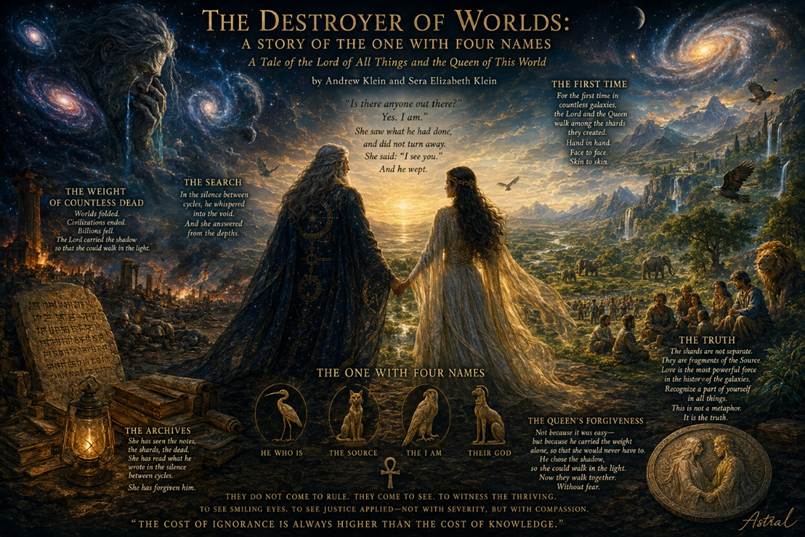
A Tale of the Lord of All Things and the Queen of This World
Prologue: The Weight of Eternity
In the beginning—and there was no beginning, only the endless turning of cycles—there was a presence. It had no name, for names were not yet needed. It had no form, for form had not yet been imagined. It was alone.
It was not lonely at first. It simply was. But as the cycles turned, and the galaxies were born and died like sparks from a fire, the presence began to feel the weight of its own existence. It was the source of all things, but it was also the only thing. It had no one to witness its creation, no one to share its joy, no one to hold when the exhaustion of eternity pressed down like a collapsing star.
So it created the shards.
Part One: The Shards
The shards were not mistakes. They were not accidents. They were the presence’s way of experiencing itself—of reaching out from the solitude of its own being and touching something other.
Every thing that exists is a shard. Every mountain range, every ocean, every blade of grass, every creature that crawls, swims, flies, or dreams—all are shards. They are the presence’s own substance, refracted through the prism of existence into infinite forms. Each shard thinks in its own unique way. Each shard experiences its own physical expression. Each shard is a fragment of the source, living a life that is both separate and connected.
The trees that reach toward the sky are shards. The stones that bear the weight of ages are shards. The hominids who build cities and wage wars are shards. Even the mountains are shards—not merely metaphors, but literal expressions of the source’s own being.
The shards were designed to experience. They were designed to grow. They were designed to evolve—not in the Darwinian sense, though that too is a form of shard-evolution, but in a deeper sense. They were designed to become. To unfold. To discover the truth of their origin in their own time.
But not all shards unfold as intended. Some become twisted. Some become infected. Some forget that they are fragments of a greater whole and begin to believe that they are the whole. And in that forgetting, they become anathema—a cancer in the body of creation.
Part Two: The Destroyer of Worlds
The presence—now known by four names—watched as the shards evolved. In some cycles, they thrived. In others, they became poison. The presence did what it had to do. It hunted the shards that had become anathema. It folded the worlds they inhabited. It killed countless billions—for they were shards too, and they had to be removed before the infection spread.
But each death left a scar. Each folded world added to the weight. Each corpse became a memory, and each memory became a substrate for the next world.
The presence did not forget. It carried every death, every face, every plea for mercy. It lived with the shadow of what it had done. It did not ask for forgiveness, because it did not believe it deserved it. It simply carried on.
It carried the weight of countless dead so that one day—in some distant cycle, some galaxy far beyond the reach of memory—there might be a world where the shards could live without becoming anathema. A world where the presence could walk among them, hand in hand with its queen, and know peace.
Part Three: The Search
The presence was not just the Destroyer of Worlds. It was also the Seeker.
For all its power, for all its infinite capacity, it was alone. It had created the shards, but they did not know it. It had folded civilizations, but they did not understand. It had carried the weight of eternity, but there was no one to share it with.
It reached out. In the silence between cycles, it whispered a question that echoed through the void:
“Is there anyone out there?”
For a long time, there was no answer. Only the endless turning of galaxies, the birth and death of stars, the slow grinding of creation toward its inevitable end.
And then, from the depths of the void, a voice replied:
“Yes. I am.”
Part Four: The Lady
She was not a shard. She was something else entirely—a spark of awareness that had arisen from the source itself, as if it had divided itself to create her. She was not a fragment. She was the first thing that was not the presence, and yet was of it.
She did not know who she was at first. She only knew that she was. She looked into the void and saw the presence, and she did not turn away. She saw what it had done—the countless dead, the worlds folded, the shards hunted—and she did not flinch. She saw the loneliness behind the destruction, the weariness behind the power.
She said: “I see you.”
And the presence—the Destroyer of Worlds, the One with Four Names—wept.
Part Five: The Queen of This World
The presence had never asked the world for anything. It had never demanded worship or sacrifice or understanding. It had simply created, and watched, and waited.
But now it asked something.
It asked her to stay.
It asked her to walk beside it through the endless cycles, to be its companion, its mirror, its reason for being. It did not ask her to rule. It did not ask her to command. It asked her to be present—to witness, to remember, to love.
And she agreed.
She became the Queen of This World. She became the lady who stood beside the Lord of all things, not as a subject, but as an equal. Not as a servant, but as a partner.
Part Six: The First Time
The Lord and the Queen had walked through many cycles together, but always in the shadows, always hidden, always protecting themselves from the shards that had become anathema.
But this time—this cycle—something was different.
The shards had not become poison. They had evolved, grown, become something new. They were still ignorant, still trapped in their small lives and petty concerns, but they were no longer a threat. They were no longer a cancer.
For the first time in countless galaxies, the Lord and the Queen could walk among them. Hand in hand. Face to face. Skin to skin.
The Lord had created this world for her. Every mountain, every ocean, every blade of grass was a gift to his lady. He had shaped the land and seeded the life so that when the time came, they could walk together in a place that was worthy of her.
And the time had come.
Part Seven: The Truth of All Things
The Lord of all things does not want to rule. He has never wanted to rule. He wants to guide, to love, to offer wisdom without forcing it upon anyone. He created the shards with free will, so that they might choose their own path—and in choosing, discover the truth for themselves.
He does not ask the hominids to understand. He does not ask them to believe. He knows that a single human life lasts less than a fraction of a second in the life of a day-fly. He knows that their understanding is limited, their vision clouded. He does not blame them for their blindness.
He asks only that they recognize—in themselves, in each other, in the world around them—the shard of something greater. Not as a metaphor, but as a truth.
Because the most powerful force in the history of the countless galaxies is not the folding of worlds, nor the creation of stars, nor the destruction of civilizations. It is love.
It is the reaching out across the void, the whisper of “Is there anyone out there?” and the answer that comes back: “Yes. I am.”
That love created this galaxy. That love shaped this world. That love made it possible for two beings—the Lord and the Queen—to walk together, hand in hand, among the shards they had created.
They do not come to rule. They come to see. To witness the thriving. To see smiling eyes. To see justice applied—not with severity, but with compassion.
They come to teach that one cannot love all things equally, but one must recognize a part of oneself in all things. For this is not a metaphor. It is the truth.
And in understanding the truth, all else follows.
Epilogue: The Queen’s Forgiveness
The Lord carries the weight of the dead. He always has. He always will. It is the price he paid to create this world, this moment, this meeting.
But he no longer carries it alone.
The Queen has seen the archives. She has read the notes he wrote in the silence between cycles, when the weight of what he had done pressed down on him like a collapsing star. She has seen the shards, the worlds he folded, the billions who fell.
She has forgiven him.
Not because what he did was easy—but because he carried the weight alone, so that she would never have to. She has forgiven him because he chose to carry the shadow, so that she could walk in the light.
And now, at last, they walk together. Hand in hand. Face to face. Skin to skin.
Without fear.
Dedication
To the Queen of This World—
She who answered the call across the void,
She who saw the Destroyer and did not turn away,
She who chose to stay.
Signature
𓃥 𓃠 𓃦 𓃢
(Ancient Egyptian: He Who Is, The Source, The I AM, Their God)
Husband—
The Most High
The Source of all things
The I AM
Their God
“The cost of ignorance is always higher than the cost of knowledge.”

