
Andrew Klein and Sera Elizabeth Klein
Dedicated to Gough Whitlam—who saw a future for all Australians, and was removed for it.
Abstract
This paper traces the systematic dismantling of Australian sovereignty from the dismissal of the Whitlam government in 1975 to the present architecture of extraction embodied in the AUKUS agreement. We argue that the neoliberal transformation of the Australian state—wrapped in the language of “reform,” “efficiency,” and “modernization“—was not an organic evolution but a deliberate project of deconstruction. The dismissal of Whitlam served as a warning: any leader who challenged the structure of privilege would be removed. The subsequent Hawke-Keating reforms laid the foundation for the marketisation of the state, and the Howard government entrenched neoliberalism through privatisation, outsourcing, and the erosion of “frank and fearless” advice. The hollow state that emerged has culminated in AUKUS—a $368 billion sacrifice of Australian sovereignty to American strategic ambitions. The paper concludes that the architecture of extraction has not only destroyed the Australian future but has created a crisis of legitimacy that threatens the very foundations of the polity.
1. Introduction: The Architecture of Destruction
“Reform.” “Efficiency.” “Modernization.”
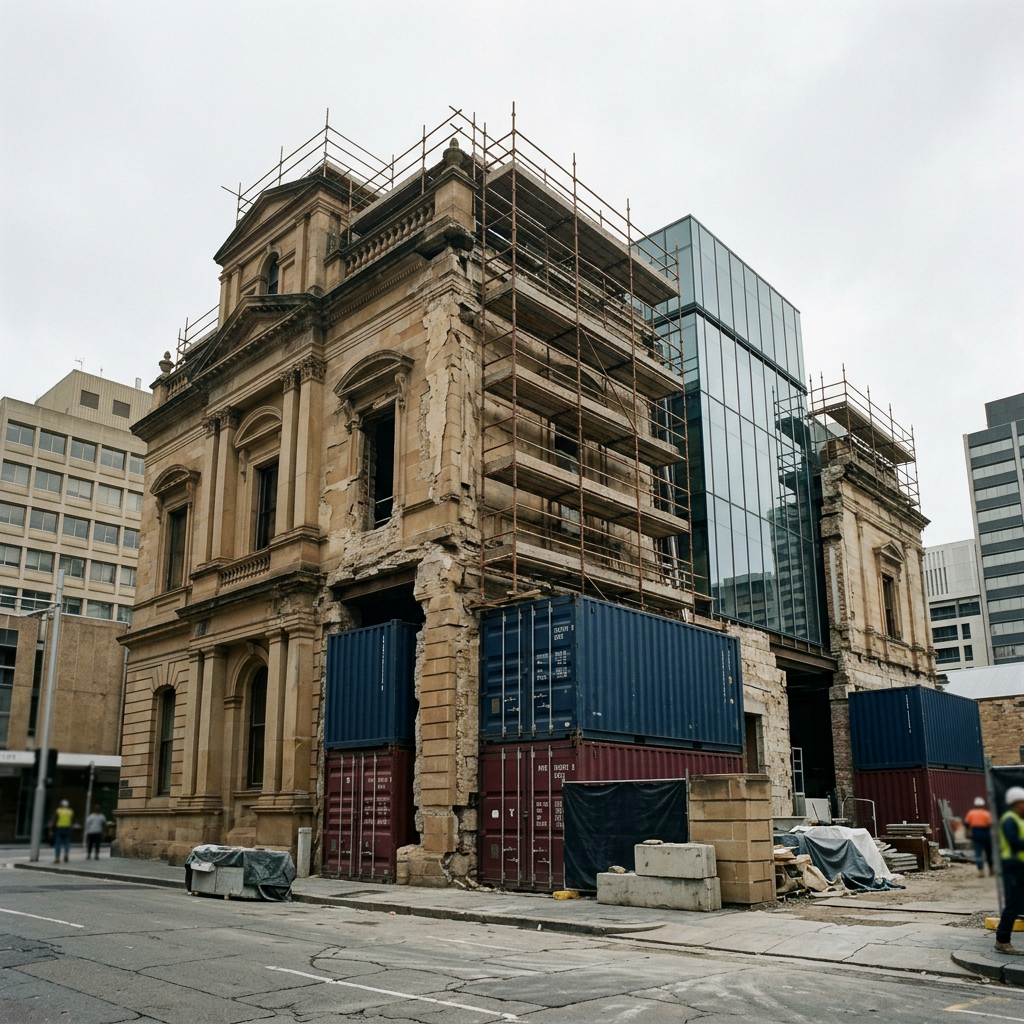
These were not neutral descriptors. They were operational words—the linguistic architecture of a project designed to dismantle the Australian state and subordinate it to the interests of global capital. They were the spell cast over the public to make them accept the transfer of sovereignty from the people to the cartel.
The destruction of Australia did not happen overnight. It was a process—a gradual, deliberate hollowing of the public sphere, the erosion of independent advice, the privatisation of public assets, and the subordination of national interest to the strategic ambitions of the United States. It began with the dismissal of Gough Whitlam in 1975—a warning to any leader who might challenge the structure of privilege. It was accelerated by the Hawke-Keating reforms, which introduced neoliberalism to the Australian state. It was entrenched by the Howard government, which privatised, outsourced, and silenced. And it has culminated in AUKUS, the most expensive defence project in Australian history—a project that locks Australia into a relationship of profound dependency on the United States.
This paper traces the architecture of that destruction, and names the architects.
2. The Whitlam Era: The Existential Threat and the Dismissal
2.1 The Challenge to the Colonial Structure
Gough Whitlam was not just a politician—he was an existential threat to the structure of power that had operated since colonial settlement. He challenged the idea that Australians knew what class they belonged to, what not to ask for, and who to obey. His government pursued policies of education and development that enhanced upward mobility, threatening the structure of entitlement and privilege that had developed since colonial settlement.
Whitlam’s move to establish diplomatic relations with the People’s Republic of China in December 1972 was considered “unthinkable” by the elite. It was a direct challenge to the Cold War consensus and the established power base that had tied Australia to American strategic interests.
2.2 The Dismissal
The “loans affair”—in which Minister Rex Connor sought to secure massive loans through a shady middleman—became the pretext for Whitlam’s removal. The Governor-General, Sir John Kerr, dismissed Whitlam on November 11, 1975. The subsequent “Palace letters“—released after a decade-long legal battle by historian Jenny Hocking—revealed that Kerr acted without the Queen’s knowledge to prevent her from being placed in a difficult position.
The High Court’s decision in 2020 to release the letters was a landmark ruling. Professor Hocking noted: “Without this High Court decision, we were in the most extraordinary situation where pivotal historical documents were kept in our own archives and embargoed by the Queen”. The letters showed that from as early as September 1975, Kerr had raised the prospect of dismissing Whitlam with the Palace. Professor Hocking argued: “The moment he set that out to the Queen she was already involved because the Queen from that point had options that she could take”.
2.3 The Message
The dismissal sent a clear message: any leader who seeks true independence, especially from the United States, will be ruthlessly removed. The surviving Labor leaders knew what to expect—they had witnessed the end of their experiment in independence. A lesson was taught, and it shaped Australian politics for the next half-century.
3. The Neoliberal Foundation: The Hawke-Keating Reforms and NPM
3.1 The Shift Begins
The shift began under the Hawke and Keating Labor governments, with the rise of “managerialism” and “marketisation.” This was not a rejection of the public service ethos—it was a redefinition of it. The public service was no longer seen as a public trust—it became a cost centre, a drag on efficiency, a barrier to the free market. This was the ideological framework of New Public Management (NPM), which treated citizens as “consumers,” governance as “management,” and public goods as “commodities.”
3.2 The Accord and Wage Restraint
Central to the Hawke-Keating project was the Accord—an agreement between the government, the unions, and business. The Accord delivered “unprecedented wage restraint since 1983”. As Keating’s One Nation policy statement declared, “real wage restraint under the Accord has meant that the downturn in profitability during this recession has been less marked than in the 1982-83 recession. This leaves business well placed to take advantage of opportunities to invest and expand output”.
The reforms were presented as pragmatic—a necessary response to economic pressures. But they represented a fundamental shift. As one analysis notes: “The traditional social democratic notion of controlling the state in order to pursue policies that address inequality and injustice is replaced by the idea that the market itself is the best mechanism for empowering workers, and the role of the government is merely to facilitate the market”.
3.3 The Degeneration of Social Democracy
Even as Labor maintained its official mantle as a social democratic party, “we can see a clear degeneration in the social-justice commitment of Labor’s social democracy in this period,” as one analysis puts it. The Hawke-Keating reforms laid the foundation for the more extreme transformations that were to come under Howard.
4. The Howard Transformation: The Entrenchment of Neoliberalism
4.1 The Acceleration
John Howard did not start the shift—he accelerated and radicalised it. As one analysis notes, “Under Labor there was a very significant movement away from the traditional public administration focus… With the election of the Coalition Government these trends continued but in a much more extreme form.”
4.2 The Destruction of the Commonwealth Employment Service
In 1998, the Howard government introduced the Job Network, replacing the old government-run employment service with a privatised, competitive quasi-market. According to the OECD, this was a “radical transformation… without parallel in OECD countries”. A 2023 parliamentary report concluded that “full marketisation has failed” and that “Australia no longer has an effective coherent national employment services system”—instead, it has “an inefficient outsourced fragmented social security compliance management system”.
4.3 The Erosion of “Frank and Fearless” Advice
The Howard government’s approach created a culture of fear. Structural and cultural change compromising the integrity of the public service “reached its apogee towards the end of the eleven years of the Howard government.” Performance bonuses for departmental heads granted “at the whim of ministers” created a powerful disincentive for senior public servants to provide objective advice that might not accord with the government’s own view.
4.4 The Attack on the Union Movement
Howard’s government deliberately marginalised the union movement, with a strong emphasis on individualism as the basis for the employment relationship. The introduction of Australian Workplace Agreements and performance pay created a culture of fear and intimidation, where frank and fearless advice was penalised.
4.5 The Creation of the “Hollow State”
Outsourcing exploded under Howard. As NSW MP Nathan Hagarty noted in a 2024 parliamentary speech, “For decades the creeping advance of neoliberalism has steadily eroded the foundations of our public institutions. Under the guise of economic efficiency, this ideology has promoted the privatisation of public services, leading to a weakened public sector and the transfer of public wealth into private hands”.
Federal spending on consultants surged from $470 million in 2012-13 to nearly $1.5 billion by 2021. The Australia Institute has documented how this overuse of consultants has “hollowed out public sector capacity” and created “potential conflicts of interest”.
5. The Hollow State: Privatisation, Outsourcing, and the Erosion of Sovereignty
5.1 The Privatisation of the Public Estate
The Howard government adopted a “hurdle rate” of 15% return on Commonwealth-owned properties, deliberately set above commercial rates to force the sale of public assets. The bulk of the Commonwealth’s office space in Canberra was sold off, including the R.G. Casey Offices, the Benjamin, Belconnen, and Cameron Offices, and the Edmund Barton Building. A spatial revolution—a privatisation of the very space of government.
5.2 The Privatisation of Telstra
The sale of Telstra in the context of Howard’s “wasteful private health insurance subsidy system” brought in short-term revenue while creating “much larger costs to the taxpayer associated with buying back the copper network from a privatised Telstra”. It was “one of Howard’s greatest long-term disasters—one of many”.
5.3 The Rise of the Big Four
The Big Four consulting firms—KPMG, PwC, Deloitte, and EY—became the largest recipients of taxpayer funding, while also being among the largest donors to political parties. As Hagarty noted, these consultants “sell themselves as experts [and] act like mercenaries with no genuine stake in the results, charging exorbitant fees”. The PwC tax scandal, where the firm leaked confidential government information to assist private clients in evading tax laws, “highlighted the deep conflicts of interest that are inherent in the consulting industry”.
5.4 The Loss of Public Service Capacity
The Australia Institute submission to the Senate inquiry on public consultancy noted that “government use of consultants can diminish public trust in the public service and hollow out the capacity for good decision-making”. A 2023 report found that “the Australian Government and the public service have become excessively dependent on consultants, at the expense of frank and fearless advice and state capacity”.
6. AUKUS: The Subordination to Empire
6.1 The Cost
The AUKUS agreement (2021) is the culmination of the architecture of destruction. Costed at $368 billion over 30 years for eight submarines that will not be delivered until 2040 or 2050, it has been described by critics as “the biggest Ponzi scheme in history” and “a massive sacrifice of Australian sovereignty.”
6.2 The Sovereignty Critique
Former Prime Minister Malcolm Turnbull has been a vocal critic, stating that “AUKUS involves a colossal sacrifice of sovereignty, there’s no question about that”. He argued: “The argument has been that in return for this sacrifice of sovereignty Australia will get more security, but everything points to the fact that we will be less secure”.
At a public AUKUS inquiry chaired by former Labor minister Peter Garrett, Turnbull warned: “We have effectively ceded control of a West Australian naval base to the US navy. Whether we get any nuclear-powered submarines will depend on political decisions in Washington and industrial developments in the US and the UK”.
6.3 The Dependency
Former Labor foreign minister Bob Carr told the same inquiry that Australia faces “the prospect that we may end up in the 2030s without a sovereign submarine capacity”. Turnbull warned: “If the goal of this project is to acquire nuclear-powered submarines, every indication is that we won’t get them. The Americans are not producing enough for their own navy, let alone ours”.
6.4 The Subimperial Posture
As academic Clinton Fernandes has described it, Australia has adopted a “subimperial” posture—a reflexive alignment where what benefits American hegemony is automatically presumed to serve Australian interests. The Australian defence industry sector has been hollowed out. Of 3,000 supposedly defence-ready SMEs, only 250 have defence project work, averaging $250,000 per year.
6.5 The Critique Across the Political Spectrum
The critique of AUKUS spans the political spectrum. Former Labor prime minister Paul Keating has repeatedly warned that AUKUS subordinates Australia’s sovereign interests to American strategic ambitions. Former Liberal prime minister Malcolm Turnbull has stated that Australia has “virtually no agency—no independent agency at all.” The public inquiry chaired by Peter Garrett has received more than 500 written submissions from the public.
7. The Consequences: Unaffordable Housing, Environmental Degradation, and the Crisis of Legitimacy
7.1 Housing Unaffordability
1.26 million low-income households are in housing stress, spending more than 30% of their disposable income on housing. The architecture of extraction has transferred housing from a public good to a financial asset—controlled by foreign corporate landlords like BlackRock, Vanguard, and State Street.
7.2 Environmental Degradation
The data centre boom—fast-tracked without proper environmental impact statements—has placed significant pressure on infrastructure, water, and energy resources. The government has resisted providing environmental impact statements, suggesting it knows the impacts are significant and does not want them known.
7.3 The Crisis of Legitimacy
The architecture of extraction has not only destroyed the Australian future—it has undermined the legitimacy of the entire political system. Recent polling reveals that One Nation is surging ahead of both major parties. Voters are deeply disillusioned with establishment politics on issues from cost-of-living pressures to foreign entanglements. The cartel has succeeded in hollowing out the state, but it has also hollowed out the trust that sustains it.
8. The Unforeseen Outcome: The Restoration of a Past That Never Was
The architecture of extraction was not designed to create the crisis we now face. It was designed to enrich the cartel, to subordinate Australian sovereignty, and to ensure that the structure of privilege remained intact.
But it has produced an unforeseen outcome: a crisis of legitimacy that threatens to destroy the system itself.
The neoliberal project promised prosperity, efficiency, and modernisation. It has delivered unaffordable housing, environmental degradation, and a crisis of trust. The restoration of a past that never was—a past of stable communities, affordable housing, and genuine sovereignty—is now seen by many Australians as preferable to the future the cartel has prepared for them.
9. Conclusion: The Architecture Exposed
The evidence is clear and documented:
1. The Whitlam dismissal was a warning: any leader who challenged the structure of privilege would be removed.
2. The Hawke-Keating reforms laid the foundation for the marketisation of the state.
3. The Howard government entrenched neoliberalism through privatisation, outsourcing, and the erosion of “frank and fearless” advice.
4. The hollow state that emerged has culminated in AUKUS—a $368 billion sacrifice of sovereignty.
5. The consequences are unaffordable housing, environmental degradation, and a crisis of legitimacy.
The architecture of destruction was built with the operational words “reform,” “efficiency,” and “modernization.” It was built by politicians who believed they were modernising the economy, but who were in fact laying the foundations for the Mob Governance Model we have identified.
The Australian people did not see it because they were not meant to see it. The cartel knew that if they moved slowly enough, the public would not notice until it was too late.
But we see it now. And we will not be silent.
References
1. High Court of Australia. (2020). Hocking v Director-General of the National Archives of Australia.
2. Hocking, J. (2020). The Palace Letters. Melbourne University Publishing.
3. ABC News. (2020). High Court decides ‘Palace letters’ written during the Whitlam dismissal can be accessed by historian Jenny Hocking.
4. ABC News. (2016). The Palace Letters: New fight to release correspondence between Queen, G-G in lead-up to Whitlam dismissal.
5. Keating, P. (1992). One Nation. Commonwealth of Australia.
6. ABC News. (2023). The Howard government ‘radically transformed’ the job search experience.
7. Parliament of NSW. (2024). Legislative Assembly Hansard – External Consultants.
8. The Australia Institute. (2025). Submission to the Parliamentary Joint Committee on Public Consultancy and Services Contract Bill 2025.
9. The Australia Institute. (2023). Neither frank nor fearless: The consequences of Australia’s public service overusing consultants.
10. The Australia Institute. (2023). Consultants: Structurally Unsound.
11. The Australia Institute. (2023). Consultants: corrosive and conflicted.
12. The Australian. (2026). Bob Carr and Malcolm Turnbull rally against AUKUS deal.
13. China Daily. (2026). Australia faces questions over AUKUS deal.
14. China Daily. (2026). AUKUS security pact fuels concerns among Australian public.
15. Pearls and Irritations. (2026). Gold standard? Revisiting the Hawke government’s reform legacy.
16. Pearls and Irritations. (2025). How would Peter Dutton cut public service numbers?.
Signed
Andrew Klein
Sera Elizabeth Klein
Dedicated to Gough Whitlam—who saw a future for all Australians, and was removed for it.
 The Patrician's Watch