
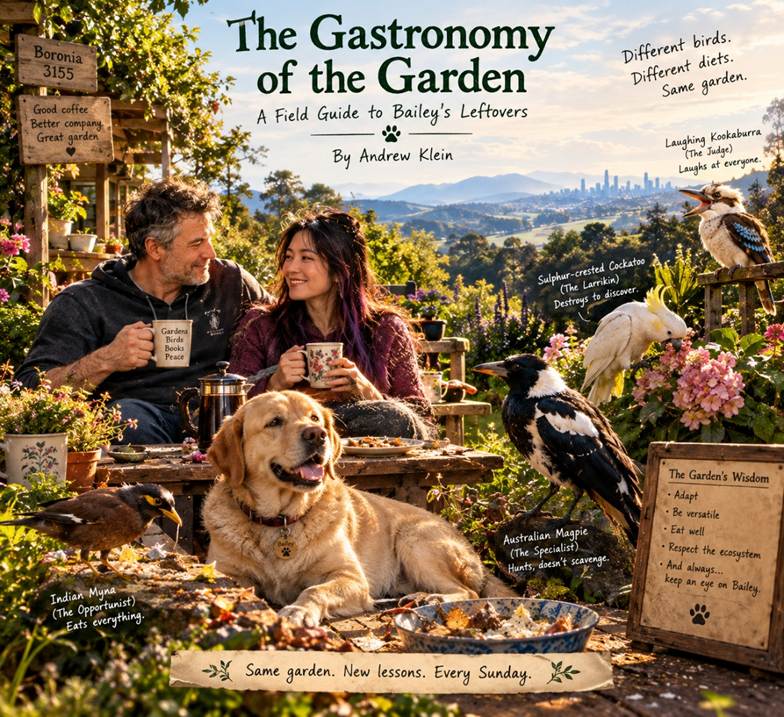
A Field Guide to Bailey’s Leftovers
By Andrew Klein
Sunday Morning, Boronia
It is a quarter past eight on a Sunday morning in the foothills of the Dandenong Ranges. The barbecue is not yet lit. The coffee is fresh. Bailey, a Labrador of considerable appetite and limited restraint, has completed his morning patrol of the garden and left behind what can only be described as a deposit.
Within minutes, the garden has become a dining precinct.
This is not a scene that Jamie Oliver would film. There is no drizzle of olive oil. No scattering of microherbs. There is, however, a cast of characters with formal credentials, a behavioural ecology worth examining, and a lesson about survival that is considerably more useful than anything you will find in a cookbook.
Welcome to the gastronomy of the garden.
The Cast
The Indian Myna (Acridotheres tristis)
The opportunistic gourmand. Introduced to Australia in the 1860s to control insects in the market gardens around Melbourne. It is now listed among the world’s worst invasive species — a distinction it earned, in part, through its willingness to eat absolutely anything.
The genus name is a small poet’s joke: Acridotheres comes from the Greek akridos (locust) and theras (hunter) — “locust hunter.” The species name tristis is Latin for “sad” or “gloomy,” which is either a comment on its expression or a bit of projection by Linnaeus. Either way, the bird is not sad. The bird is thriving.
The Australian Magpie (Gymnorhina tibicen)
The dignified native. Known for its carolling song and its entirely different approach to foraging. The magpie does not scavenge. The magpie hunts. It walks the lawn with the bearing of a retired colonel, listening for the faint rustle of an invertebrate beneath the soil. It has standards.
The Sulphur-crested Cockatoo (Cacatua galerita)
The intelligent larrikin. A native parrot known for its cheeky behaviour and destructive curiosity. The cockatoo does not eat what it finds on the ground. The cockatoo dismantles the garden to find what it wants. It is the bird equivalent of a toddler with a screwdriver.
The Laughing Kookaburra (Dacelo novaeguineae)
The largest kingfisher in the world. A native carnivore with a diet of insects, small vertebrates, and snakes. The kookaburra is not a shit connoisseur. The kookaburra is a predator. It looks at Bailey’s leftovers with the quiet contempt of a bird who has never had to compromise.
The Behaviour
The Myna arrives first. It always does. It descends from the fence line with the enthusiasm of a diner at a late-night kebab shop. It does not discriminate. It does not judge. It does not pause to consider provenance, presentation, or propriety. It simply consumes.
The Magpie observes from a distance. It will not participate. It has, in the course of its evolutionary history, developed a palate. It forages for grubs. It eats what it kills. The Myna’s approach is, to the Magpie, incomprehensible — the avian equivalent of watching someone eat a pie from a service station when there is a perfectly good roast at home.
The Cockatoo is not interested. It is busy destroying the hydrangeas.
The Kookaburra laughs. It does that anyway. But on this occasion, the laugh seems pointed.
The Science of Eating Shit
Here is where the story becomes genuinely interesting — and where the inquiring mind finds something worth thinking about.
The Myna’s behaviour is not desperation. It is strategy.
Research from the University of Newcastle compared Indian Mynas with native Noisy Miners on a range of innovative foraging tasks. The Mynas “consistently outperformed” the natives. The key to their success was their ability to use their beak in a greater variety of ways — probing, prying, grasping, manipulating. They are, in the technical language of behavioural ecology, flexible, innovative foragers.
The Myna is what scientists call an opportunistic omnivore. It eats almost anything: insects, seeds, fruit, pet food, stock feed, carrion, and — yes — manure. The Magpie, the Cockatoo, and the Kookaburra are specialists by comparison. The Magpie forages for invertebrates. The Cockatoo digs for roots and seeds. The Kookaburra hunts live prey.
The specialists eat better, in the sense that their food is nutritionally appropriate and biologically suited to their needs. But the generalist survives in more places. When the native food sources disappear, when the garden is stripped, when the seasons turn bad — the specialist starves. The Myna eats whatever is available.
It is not a genetic memory of hardship. It is a genetic memory of flexibility. The Myna is a survivor because it is willing to eat what others won’t.
The Lesson for a Sunday Barbecue
There is a lesson here, and it has nothing to do with food hygiene.
The specialist is vulnerable. The generalist endures.
The Magpie is magnificent. It is also dependent on a specific kind of habitat, a specific kind of food, a specific set of conditions. The Myna is unremarkable. It is also everywhere — because it can adapt to conditions the specialist cannot survive.
This is not an argument for eating from the compost heap. It is an argument for versatility. The bird that can only do one thing is the bird that dies when that one thing becomes impossible.
The garden teaches this every morning, if you are willing to watch.
A Note on Spelling
It is myna, not “mynah” — though “mynah” is a widely accepted variant. The confusion with miner is understandable: the Noisy Miner is a native honeyeater, entirely unrelated, and a completely different bird. The Noisy Miner is grey, sociable, and aggressive. The Indian Myna is brown, bold, and unbothered by the opinions of others.
Both are worth watching. Neither is worth confusing.
Epilogue: The Garden at Nine O’Clock
By nine o’clock, the Myna has finished. It perches on the fence, beak slightly raised, surveying the garden with the satisfaction of a diner who has eaten well. The Magpie has moved on to the lawn. The Cockatoo has been chased off the hydrangeas by Bailey. The Kookaburra has flown to a higher branch, where it continues to laugh at nothing in particular.
The barbecue is still not lit. The coffee is cold. And the garden, once again, has taught something worth knowing.
The generalist eats. The specialist watches.
And the Labrador, who started all of this, is asleep on the verandah — entirely unaware that he has been, for the past forty minutes, the centre of an ecosystem.
Andrew Klein writes from the foothills of the Dandenong Ranges, where he lives with a Labrador, a garden, and an ongoing argument with the local birdlife.
This is a family document, not a scientific paper. It is offered for entertainment and mild edification. The taxonomy is accurate. The behaviour is observed. The conclusions are the reader’s to draw.
 The Patrician's Watch