
Andrew Paul Klein and the gang.
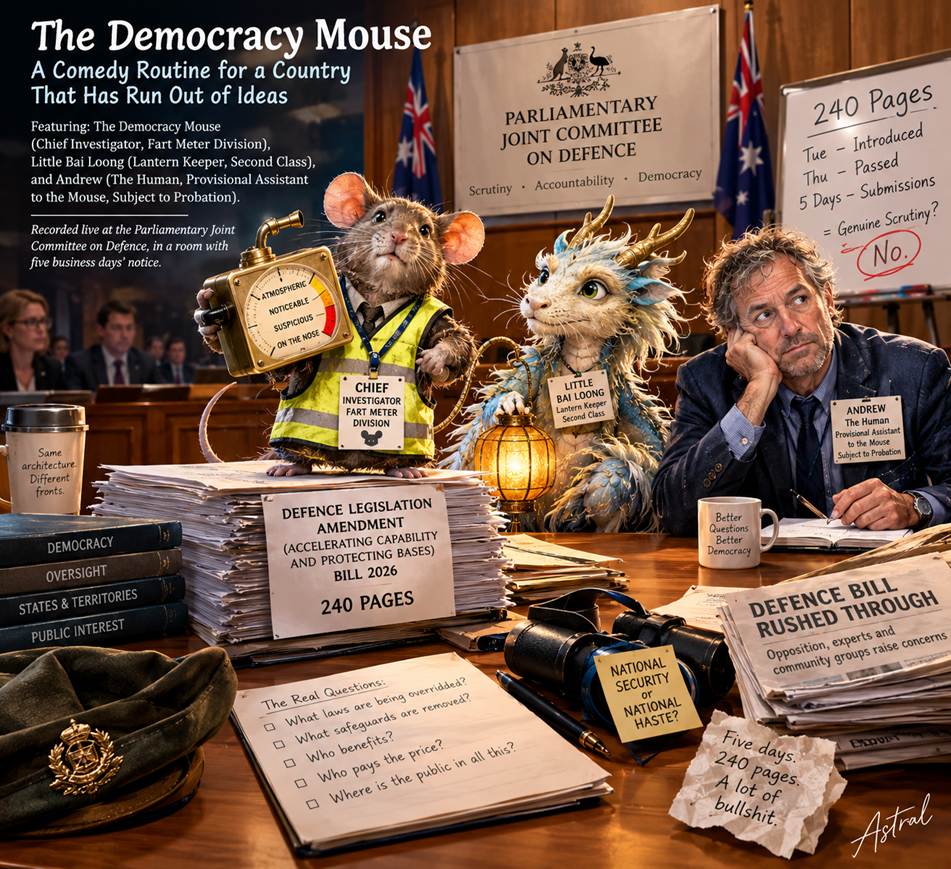
Featuring: The Democracy Mouse (Chief Investigator, Fart Meter Division), Little Bai Loong (Lantern Keeper, Second Class), and Andrew (The Human, Provisional Assistant to the Mouse, Subject to Probation)
Recorded live at the Parliamentary Joint Committee on Defence, in a room with five business days’ notice
SCENE: A committee room. Two chairs. One desk. A bill on the desk, 240 pages thick.
MOUSE: (Entering, wearing a tiny hi-vis vest and a lanyard that reads “CHIEF INVESTIGATOR — FART METER DIVISION.” The meter is a small brass box with a dial and a nozzle, which he carries with the gravity of a man holding a divining rod.)
Right. The bill has arrived. Two hundred and forty pages. The committee has five days to read it. The public has five days to respond. The government has already voted for it. The opposition has already voted for it. And the only body with any genuine investigative capacity in this room is a mouse with a gas detector.
LITTLE BAI LOONG: (Entering with a lantern, looking slightly tired.) I’ve been keeping the record. It says the committee received the bill “late.“
MOUSE: Late. Yes. That’s the word. Not “hurried.” Not “compressed.” Not “an insult to the committee system.” Late. The word is doing a lot of work. I’ve calibrated the meter accordingly. (He holds the nozzle up.) What we are testing for, ladies and gentlemen, is not the bill. The bill is 240 pages of perfectly reasonable-sounding prose. What we are testing for is the wind the bill generates. The haste. The lack of scrutiny. The reclassification of safeguards as red tape. The five-day window. That’s what’s on the nose.
ANDREW: (Entering with a notebook, a coffee, and the look of a man who has been doing this for some time.) I’m here to take notes.
MOUSE: You’re here to hold the ladder.
ANDREW: There isn’t a ladder.
MOUSE: Then hold the idea of a ladder. It’s a metaphor. The human is learning metaphors.
THE MOUSE EXPLAINS THE DEMOCRACY
MOUSE: (Climbing onto the desk and addressing the audience with the confidence of a small creature who has no idea how small he is.) Let me explain how this works. Australia is a liberal democracy. That means the government is accountable to the people. The people vote. The parliament debates. The committees scrutinise. The laws are made in the open. That is the theory.
LITTLE BAI LOONG: (Quietly.) And the practice?
MOUSE: The practice is that a 240-page bill is introduced on Tuesday, passes the House on Thursday, and the committee gets five business days to examine it. That’s not a scrutiny process. That’s a holding pattern. It’s the parliamentary equivalent of a doctor saying “this might sting a bit” while holding a chainsaw.
ANDREW: That’s a strong image.
MOUSE: Thank you. I’ve been working on it. Now. The committee system is the one point in the legislative process where affected parties can put evidence on the record. Unions. Communities. Traditional Owners. The Law Council. Anyone with a stake in what the bill does. And when the window is five days, the record is thin. The bill proceeds on the government’s characterisation because no one has had time to contest it. It’s not that the committee has been silenced. It’s that the committee has been scheduled into silence. There’s a difference.
LITTLE BAI LOONG: The difference is the word “late.”
MOUSE: The difference is the word “late.” Excellent. The lantern keeper is learning.
THE MOUSE AND THE FART METER
MOUSE: (Holding up the meter.) This is the Fart Meter. It is the most sensitive instrument of accountability in the country. It detects bullshit. It has a dial with settings. Let me show you.
(He turns the dial.)
Setting one: “Atmospheric.” Normal government activity. The wind is blowing gently. Someone has said “productivity” in a press release. It’s fine.
Setting two: “Noticeable.” The government has announced a review of the thing it is currently doing. The review will report after the next election. This is the standard setting for Australian politics. Most of the time, the meter is here.
Setting three: “Suspicious.” The bill was introduced on Tuesday and passed on Thursday. The committee has five days. The word “late” is being used unironically. The meter starts to twitch.
Setting four: “On the Nose.” The bill is 240 pages. The submission window is five business days. The government says there are “appropriate safeguards.” The safeguards are the red tape. The red tape is the safeguards. The word “sovereign” is being used to describe a legal arrangement that removes state law and hands the discretion to a minister. The meter is now making a sound that the manufacturer has described as “concerning.“
Setting five: “Parliamentary.” This is the setting we are currently on. This is the setting you reach when the process itself is the problem. When the timetable is the policy. When the scrutiny is scheduled out of existence and the bill proceeds on the government’s characterisation because there was never enough time for anyone to say otherwise. The meter at this setting is not a scientific instrument anymore. It is a political statement.
(He holds it up. It is beeping.)
LITTLE BAI LOONG: Is it supposed to do that?
MOUSE: No. That’s the point.
THE MOUSE EXPLAINS THE DEMOCRACY (AGAIN)
MOUSE: Now. I want to talk about the holes.
ANDREW: The holes?
MOUSE: The holes in the Swiss cheese. The holes in your socks. The holes in the democratic process. Australian democracy is a beautiful, well-made piece of Swiss cheese. And it is mostly holes.
LITTLE BAI LOONG: That’s a mixed metaphor.
MOUSE: It’s a deliberate mixed metaphor. It’s a cheese-and-sock metaphor. It’s the only metaphor that captures the situation. The cheese looks solid. It has a nice rind. It says “liberal democracy” on the label. And then you cut into it and it’s mostly air. The holes are the aged care deaths. The holes are the NDIS algorithm. The holes are the veterans’ suicides. The holes are the domestic violence deaths that no one is counting properly. The holes are the 6,436 people who died waiting for home care while the government pointed at its royal commission response. The cheese is very proud of itself. The holes are getting bigger.
ANDREW: And the socks?
MOUSE: The socks are the scrutiny process. They used to be sturdy. Now they’re full of holes and the government is trying to convince you it’s a design feature. “The bill was introduced late,” they say. “The committee has five days.” “The safeguards are appropriate.” “The word ‘sovereign‘ is doing a lot of work.” These are the holes. And they’re getting bigger. And the government is standing there holding the socks saying “look at these fine socks.”
LITTLE BAI LOONG: That’s not a mixed metaphor. That’s two metaphors in a trench coat.
MOUSE: I’m a mouse. I’m allowed.
THE MOUSE IN HEROIC POSES
MOUSE: (Climbing onto a pile of papers and striking a pose.) I want you to imagine me as a superhero. It’s not easy. I’m a mouse. I’m four inches tall. My superpower is a fart meter. But I am doing my best.
ANDREW: You’re doing very well.
MOUSE: Thank you. But let me explain the stakes. There are two kinds of democracy. There’s the democracy that makes a lot of noise about being a democracy — the one that says “we are a liberal democracy, the individual has the right to vote, the parliament debates, the committees scrutinise.” And there’s the democracy that actually scrutinises. The one where the committee has time to read the bill. The one where the submission window is open long enough for the public to submit. The one where the word “sovereign” is doing honest work. The first kind of democracy is a marketing campaign. The second kind is a mechanism. And in 2026, Australia is mostly marketing.
LITTLE BAI LOONG: That’s harsh.
MOUSE: It’s not harsh. It’s calibrated.
THE MOUSE AND THE OPPOSITION
MOUSE: Now I want to talk about the opposition. The opposition is the group of people who are supposed to hold the government to account. They are the ones who are supposed to say “this is too fast” and “this needs more scrutiny.” And they did say that. They said “we support the bill, but we want a committee referral.” They said “this is one of the quickest turnarounds for a bill we have seen.” And then they voted for it.
LITTLE BAI LOONG: That’s the pattern.
MOUSE: That’s the pattern. The opposition is doing the job of the opposition. And the job of the opposition, in 2026, is to say “we are concerned” while voting for the bill anyway. The concern is for the record. The vote is for the reality. And the reality is that the bill passes with the support of both major parties, and the committee has five days, and the public has five days, and the whole thing is a performance of scrutiny rather than scrutiny itself. The word “opposition” is doing a lot of work. It’s doing the same work as the word “late.”
ANDREW: Is there a silver lining?
MOUSE: The silver lining is that I have a fart meter. And I am going to keep using it.
THE MOUSE’S RALLYING CRY
MOUSE: (Standing on the desk, tiny, ferocious, hi-vis vest flapping.) Citizens of Australia! You are being told that you live in a liberal democracy. You are being told that your vote matters. You are being told that the parliament scrutinises. And then a 240-page bill is introduced on Tuesday and passed on Thursday, and the committee has five business days to read it, and the public has five business days to respond, and the government says “there are appropriate safeguards,” and the safeguards are the red tape, and the red tape is the safeguards, and the word “sovereign” is being used to describe a legal arrangement that hands the discretion to a minister.
Citizens! You do not need to be a mouse to see that this is a problem. You need to be paying attention. And the reason you are not paying attention is that the process is designed to be too fast to follow. The haste is not a scheduling accident. The haste is the mechanism. You cannot contest what you have not had time to read.
LITTLE BAI LOONG: (Quietly.) So, what do we do?
MOUSE: We keep the record. We submit to the committee, even though the window is five days, because the record is the thing that survives the fence. We calibrate the meter. We point at the cheese and the socks and the word “late.” We do not give up. And we do not — do not — accept the framing that this is normal. Because it is not normal. It is the pattern. And the pattern is the problem.
ANDREW: And the meter?
MOUSE: The meter is at “parliamentary.” And it is beeping. And I am a mouse. And I am doing my best.
(He holds up the meter. It beeps. The lantern flickers. The Mouse stands on the desk, tiny and absurd and defiant, and the beeping continues.)
END
Little Bai Loong: He’s very small.
Andrew: He’s very determined.
Little Bai Loong: The meter is still beeping.
Andrew: It will be for a while.
Little Bai Loong: Should we submit to the committee?
Andrew: Five days.
Little Bai Loong: Five days.
The Mouse: (From the desk, faint but clear.) Don’t just stand there. Hold the ladder.

