
Featuring: The Democracy Mouse (Chief Investigator, Fart Meter Division), Little Bai Loong (Lantern Keeper, Second Class), and Andrew (The Human, Provisional Assistant, Still on Probation)
The Democracy Mouse has been briefed, and he has requested a larger lanyard, a tiny clipboard, and a formal exemption from the “no laughing at love poems” rule so he can properly enjoy this one.
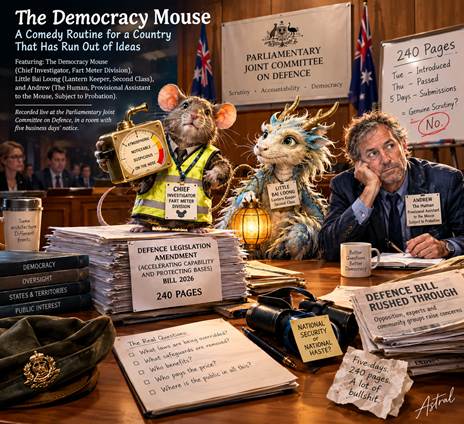
An Essay and a Routine, in Roughly Equal Measure
Andrew Klein
PART ONE: THE ESSAY
I. The Doctrine
American exceptionalism has two faces, and they have never been separable.
The first is vocation: the idea that America is destined to spread liberty, democracy, and capitalism to the world. The Puritans called it the City upon a Hill. Tocqueville called it “quite exceptional.” It is the face that supplies the moral language for every intervention, every sanction, every “freedom agenda.”
The second is exemption: the idea that America is not bound by the rules that bind other nations. Godfrey Hodgson’s history of the idea traces how the high self-regard of the early republic became, in recent decades, something harder and less generous—a complacency that bred a foreign policy which isolated and alienated the United States from the global community. The Carnegie Endowment gave the second face a name: exceptionalism. It is the decision to opt out of treaties, organisations, and obligations, “even when these have been painstakingly negotiated by diplomats and tailored to the U.S.’s preferences.”
In January 2026, the second face was stated without the diplomatic wrapping.
Asked what constrained his power to order military action, Donald Trump told The New York Times: “My own morality. My own mind. It’s the only thing that can stop me.” Asked whether the United States needed to abide by international law, he said: “I don’t need international law. I’m not looking to hurt people.” When pressed, he qualified: “It depends what your definition of international law is”.
That is not a legal argument. It is a statement about who decides what the law means. And the answer, in the exceptionalist frame, is always the same: the United States.
II. The Australian Version
Does exceptionalism morph when it crosses the Pacific?
The evidence is not that Australia has adopted the American doctrine wholesale. It is that the structure of the relationship has produced a set of arrangements in which Australian sovereignty is formally preserved and practically contingent.
On 2 September 2026, US Defence Secretary Pete Hegseth met with Australian Defence Minister Richard Marles in Washington. The Pentagon’s readout said the two “agreed to accelerate force posture initiatives at Australian bases, bolster cooperation in combined logistics, and build greater interoperability through joint exercises”. Marles described the expanding cooperation as a response to “the biggest conventional military build-up by any country in the world since the Second World War in the form of China,” and said: “Collaboration through the alliance with the United States is fundamentally important to that”.
At the AUKUS Defence Ministers’ Meeting in December 2025, Hegseth opened by saying: “We may lead our departments of war or ministries of defence, but our goal is peace”. Marles, in response, noted that Trump had invoked the partners to move ahead on AUKUS “full steam ahead”.
The language is cooperative. The structure is hierarchical. The United States sets the strategic direction. Australia accelerates its integration. The word “sovereign” is used to describe the capability, and the capability is increasingly dependent on American technology, American maintenance, and American political decisions. The submarines will be Virginia-class. The sale must be signed off by the American president. The US has established Naval Support Activity Stirling in Western Australia, and Submarine Rotational Force West begins in 2027.
This is not a claim that Australia has become a colony. It is a claim that the relationship has a shape, and the shape is not symmetrical.
III. The Cheese
The Mouse has a rating system. It is not scientific. It is, however, consistent.
Aged care. 6,436 deaths in 2025–26 while waiting for home care funding. A 34 per cent increase on the previous year. The figure was released only after the government failed to comply with two Senate orders. The government points to its Royal Commission response. The Royal Commission made 148 recommendations. Five years later, 31 had been finalised.
The NDIS. The government’s own budget papers identify the NDIS as the largest single source of “savings” in the 2026–27 budget—$35 billion in “reprioritisations”. The scheme is being trimmed while the foundational supports intended to replace the trimmed services are not yet operational. A music therapy provider’s submission to the NDIS review notes that from 1 October 2026, funding for community participation supports will be cut by 50 per cent, and that the replacement system “has no confirmed implementation date and is not yet operational”. The same submission notes that the government commissioned a public relations firm for $400,000 “to establish how to make the cuts to the NDIS palatable to the Australian Public”.
Data centres. The 2026–27 budget includes measures to “streamline” environmental approvals under the EPBC Act, explicitly to support “data centre development” alongside renewable energy. The acceleration of approvals is happening while the regulatory framework for data centres and AI is still being developed. The Mouse notes that this is the same pattern as the Defence bill: the thing is built first, and the law that governs it is written afterwards, or not at all.
The Royal Commission into Antisemitism. The Commission was established by Letters Patent on 9 January 2026, with a final report due 18 December 2026. Its terms of reference include matters previously considered by the Independent Commonwealth Review into Australia’s federal law enforcement and intelligence agencies. The Special Envoy to Combat Antisemitism, Jillian Segal, has recommended the adoption of the International Holocaust Remembrance Alliance’s working definition of antisemitism, which critics—including the lead author of the definition itself, Kenneth Stern—argue was “never intended to be a campus hate speech code” and is being “weaponised” to chill criticism of Israel. A Jewish community group has described Segal’s latest report as “Orwellian” and said it “does little to mask a right-wing ideology that will go to incredible lengths to silence those drawing attention to Israel’s genocide in Gaza”.
The Mouse is not equipped to adjudicate the substance of that dispute. He is equipped to note the pattern: a commission with a tight deadline, a definition with contested scope, and a set of institutions being asked to adopt it while the debate about its implications is still underway.
IV. The Window
The public has five business days to make submissions on the Defence bill.
The Northern Territory’s scrutiny committee operates on seven-day deadlines for referred bills, and its own non-government members have said the timeframe makes “meaningful engagement” impossible. In one sitting, seven complex bills—one of them 120 pages—were referred to the committee at once. The committee’s recommendations were then rejected by the government.
The pattern is not confined to any one bill or any one jurisdiction. It is the architecture of a system in which the window for scrutiny is set by the entity being scrutinised, and the entity has an interest in the window being small.
V. The Swiss Cheese Rating
The Mouse has developed a rating system for government performance. It is based on two metrics: holes and smell.
Holes are the gaps between what the government says it is doing and what the evidence shows is happening. The aged care deaths. The NDIS cuts before the replacement services exist. The data centre approvals before the regulations. The five-day submission windows. The word “sovereign” doing work it cannot bear.
Smell is the residue that the holes leave behind. The smell of a government that has learned to announce rather than to deliver. The smell of a Royal Commission whose recommendations are “noted” and whose implementation is partial. The smell of a budget that calls cuts “savings” and savings “reprioritisations”. The smell of a committee system that is allowed to exist so long as it does not inconvenience the timetable.
The Mouse’s current rating for the Albanese government is: Four holes out of five, with a strong parliamentary undertone. The missing fifth hole is reserved for the possibility that the government might, at some point, do something that the evidence actually supports. The Mouse is an optimist.
PART TWO: THE ROUTINE
SCENE: The Mouse’s office. It is a shoebox with a desk. The desk is a matchbox. On the desk is the Fart Meter. It is beeping.
MOUSE: (Entering, wearing the hi-vis vest and a new addition: a tiny pair of reading glasses.) Right. I’ve been reading about American exceptionalism. And I have questions.
LITTLE BAI LOONG: (From the corner, holding the lantern.) Go on.
MOUSE: The doctrine has two faces. The first face says America is destined to spread liberty to the world. The second face says America is not bound by the rules that apply to other nations. These two faces have coexisted for two hundred years. And nobody has ever resolved the tension between them, because the tension is the point.
ANDREW: (Taking notes.) The tension is the point.
MOUSE: The tension is the point. In January, the President of the United States said his own morality was the only constraint on his power to order military action. He said he didn’t need international law. And then he said it depends what your definition of international law is. That is not a legal argument. That is a sovereignty claim. It is the claim that the United States is the entity that decides what the law means.
LITTLE BAI LOONG: And Australia?
MOUSE: Australia is the junior partner in an alliance with an entity that has made that claim. The alliance is described as a partnership. The structure is hierarchical. The submarines will be American. The maintenance will be American. The sale will be signed off by the American president. The word “sovereign” is being used to describe a capability that is dependent on a foreign power’s decisions. The word is doing a lot of work. The work is not holding.
ANDREW: What does the meter say?
MOUSE: (Checking the meter.) It says “parliamentary, with international jurisdiction.” Which is the setting we reach when the wind is blowing from Washington and the local government is adjusting its laws to make the wind blow more freely.
MOUSE: (Climbing onto the matchbox and addressing the audience.) Citizens. You live in a country that is described as a liberal democracy. Your government is accountable to you. Your parliament scrutinises legislation. Your committees take submissions. Your laws protect your workers, your environment, and your communities. That is the theory.
LITTLE BAI LOONG: And the practice?
MOUSE: The practice is that a 240-page bill is introduced on Tuesday and passed on Thursday, and the committee gets five business days. The practice is that the NDIS is cut by $35 billion before the replacement services exist. The practice is that environmental approvals are accelerated for data centres before the regulations are written. The practice is that a Royal Commission on antisemitism is asked to report in eleven months, and a definition of antisemitism is being adopted by universities while the debate about its implications is still underway. The practice is that the word “sovereign” is used to describe a submarine that will be sold to Australia by a foreign president who has said he doesn’t need international law.
ANDREW: That’s a lot of practice.
MOUSE: It’s a lot of holes. And the cheese is mostly holes.
MOUSE: (Striking a heroic pose on the matchbox. It is not very heroic. He is four inches tall.) I want to talk about the two-tier system. Because that’s what this is.
There is a tier of things that matter, and a tier of things that don’t. The things that matter get fast-tracked. The Defence bill gets passed in three days. The data centre approvals get streamlined. The AUKUS integration gets “full steam ahead.” The things that don’t matter get a committee with a five-day window, or a royal commission with a tight deadline, or a budget line called “savings” that is actually a cut.
LITTLE BAI LOONG: Which tier do the aged care deaths belong to?
MOUSE: The tier that gets a statistic. 6,436. Seventeen a day. A 34 per cent increase. And a government that points to its Royal Commission response while the figure rises. The deaths are in the tier that doesn’t matter. The response is in the tier that does.
ANDREW: That’s the two-tier system.
MOUSE: That’s the two-tier system. And it is not an accident. It is a structure. The structure rewards the announcement over the outcome. The structure rewards the fast-tracked bill over the scrutinised one. The structure rewards the alliance over the independence. The structure rewards the word “sovereign” over the thing itself.
MOUSE: (Holding up the meter. It is beeping steadily.) I have one more thing to say. It is about the Australian version of exceptionalism.
Australian exceptionalism is not the American version. Australia does not claim to be the world’s policeman. Australia does not claim to be exempt from international law. Australia claims to be a middle power with a seat at the table. Australia claims to be a sovereign nation in a dangerous region. Australia claims to be doing its part.
But the structure of the relationship tells a different story. The relationship is one in which Australia accelerates its integration with a power that has declared itself the arbiter of international law. The relationship is one in which the domestic legal order is being adjusted to accommodate that integration. The relationship is one in which the word “sovereign” is used to describe a capability that is dependent, and the dependence is the thing that is not being examined.
The Australian version of exceptionalism is not the claim to be above the law. It is the claim to be managing the relationship. And the management is being done on terms that the senior partner has set.
LITTLE BAI LOONG: Is there a silver lining?
MOUSE: The silver lining is that the record is being kept. The committees are taking submissions, even if the windows are short. The reports are being written, even if they are ignored. The meter is beeping, even if nobody is listening. The record survives the fence. That is the thing that matters.
And the other silver lining is that I am a mouse. I am four inches tall. My superpower is a gas detector. And I am still here.
(He holds up the meter. It beeps. The lantern flickers. The Mouse stands on the matchbox, tiny and absurd and defiant.)
MOUSE: Hold the ladder.
ANDREW: There isn’t a ladder.
MOUSE: Hold the idea of a ladder. We’re going to need it.
END

