
Featuring: The Democracy Mouse (Chief Investigator, Fart Meter Division, International Jurisdiction), Little Bai Loong (Lantern Keeper, Second Class, Diplomatic Corps), and Andrew (The Human, Provisional Assistant, Holder of the Ladder)
Recorded live from a shoebox in Canberra, with a direct feed to Atlanta
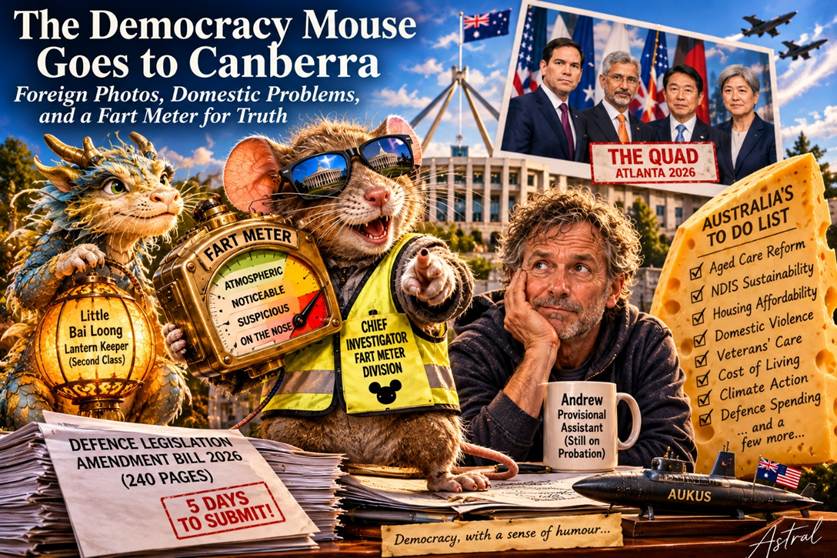
PART ONE: THE ESSAY
I. The Photograph
On Saturday 31 October 2026, four foreign ministers posed for a photograph in Atlanta. Marco Rubio, the US Secretary of State. S. Jaishankar of India. Toshimitsu Motegi of Japan. And Penny Wong of Australia.
It was the third Quad Foreign Ministers’ Meeting this year. The men wore suits. The photograph was taken. The meeting was described as productive. And then everyone went to a college football game, because Rubio had invited them, and the Florida Gators were playing the Georgia Bulldogs, and diplomacy in 2026 apparently ends with a hot dog.
The Mouse has examined the photograph. He has calibrated the meter. He has a question.
MOUSE: What is Australia doing in this photograph?
LITTLE BAI LOONG: It’s the Quad. Australia is a member.
MOUSE: I know it’s the Quad. I can read. The question is what Australia is doing. Because from where I’m standing, which is four inches off the ground and slightly to the left, Australia is standing next to the United States in a photograph that is designed to send a message to China. And the message is: “We are with him.”
ANDREW: That’s the alliance.
MOUSE: That’s the alliance. And the alliance is the thing that gets Australia into photographs like this one, and into wars like the ones that are being discussed in the room next door, and into legislation like the one that was passed in three days last week. The photograph is not the problem. The photograph is the evidence.
II. The Meetings
The G20 Foreign Ministers’ Meeting in Atlanta was, by the admission of its host, a failure. Rubio told reporters: “I wouldn’t pretend to you today that we are close to finding universally accepted solutions to these problems”. The group did not release a joint communique. The traditional group photo was cancelled because the Europeans threatened to boycott if Sergey Lavrov was in it.
In the margins of this failure, Penny Wong held a series of bilateral meetings. She met Ed Miliband of the UK and Anita Anand of Canada, and they discussed “security, economic resilience and the global challenges we face”. She met Kaja Kallas of the EU, and they discussed “our steadfast support for Ukraine and deepening our economic, security and defence cooperation”. She met Jaishankar, and they discussed the Australia-Canada-India Technology and Innovation Partnership.
All of these meetings happened. All of them produced the kind of diplomatic language that is designed to sound like action. And none of them addressed the things that the Mouse has been tracking.
MOUSE: (From the matchbox.) The aged care deaths. The NDIS cuts. The housing waitlist. The domestic violence deaths. The veterans’ suicides. The five-day submission windows. The data centre approvals before the regulations. The Defence bill that hands a minister the power to override state law.
LITTLE BAI LOONG: Those aren’t foreign policy.
MOUSE: Exactly. They are the things that foreign policy is a distraction from. The government is in Atlanta, standing next to Rubio and Jaishankar and Motegi, talking about supply chains and critical minerals and the Indo-Pacific. And the people who are dying on waitlists in Australia are not in the room. They are not in the photograph. They are not in the communique that wasn’t issued. They are in the part of the cheese that the Mouse has been examining, and the holes are getting bigger.
III. The Promises
In May 2025, Labor won a second term. The promises were substantial.
Eight and a half billion dollars for Medicare over four years, to have nine out of ten GP visits bulk-billed by the end of the decade. Ten billion dollars to build 100,000 homes for first-home buyers. Five per cent mortgage deposits for first-home buyers. A ban on foreign investors buying existing homes for two years. Supermarket price gouging outlawed. A task force to measure “excessive pricing.” One hundred and fifty dollars off electricity bills. A small tax cut, five dollars a week in year one, ten dollars a week in year two. Twenty per cent of HECS debt wiped. The minimum repayment threshold raised to $67,000. One hundred thousand fee-free TAFE places a year. A billion dollars for childcare centres. Fifty new urgent care clinics. PBS medicines cut from $31.60 to $25.
MOUSE: These are the promises. Now let’s look at the outcomes.
The aged care deaths rose by 34 per cent in a single year. The NDIS is being cut by $35 billion in “savings” before the replacement services exist. The social housing waitlist stands at 254,571 applicants. The government’s own budget papers describe the NDIS cuts as “reprioritisations.” The committee window for the Defence bill was five business days. The data centre approvals are being streamlined under the EPBC Act before the AI regulations are written.
ANDREW: That’s not all the promises.
MOUSE: No. Some of them might be delivered. The Medicare money might arrive. The HECS relief might happen. But the pattern is the thing. The pattern is that the government announces the promise, and the promise becomes the story, and the outcome becomes the statistic. The promise is the photograph. The outcome is the thing that isn’t in the photograph.
IV. The Two Parties
The Mouse has been examining the opposition.
MOUSE: The Liberal National Party coalition is the alternative government of Australia. It is supposed to hold the government to account. It is supposed to scrutinise the legislation. It is supposed to represent the people who are not in the photograph.
And what did it do with the Defence bill? It supported it. It sought a committee referral because the briefing was “very late” and it was “one of the quickest turnarounds for a bill” the Shadow Minister had seen. And then it voted for it. The referral was granted. The submission window was five days. The bill passed the House.
LITTLE BAI LOONG: That’s the pattern.
MOUSE: That’s the pattern. The opposition is doing the job of the opposition. The job of the opposition, in 2026, is to say “we are concerned” while voting for the bill anyway. The concern is for the record. The vote is for the reality. The reality is that the major parties agree on the substance and compete on the packaging. The packaging is the photograph. The substance is the cheese.
V. The Exception
On 2 September 2026, Richard Marles met Pete Hegseth in Washington. The Pentagon’s readout said they “agreed to accelerate force posture initiatives at Australian bases, bolster cooperation in combined logistics, and build greater interoperability through joint exercises”. Marles described the cooperation as a response to “the biggest conventional military build-up by any country in the world since the Second World War in the form of China”.
In January 2026, Donald Trump told The New York Times: “I don’t need international law. I’m not looking to hurt people.” Asked whether the US had an obligation to follow international law, he said: “It depends what your definition of international law is”.
MOUSE: These two facts belong together. The Defence Minister of Australia is accelerating integration with a power whose president has said he does not need international law. The Defence Minister is doing this in the name of a threat from China. The threat from China is the justification for the integration. The integration is the thing that makes Australia a participant in the American strategic project. And the American strategic project is being run by a president who has declared that the law does not bind him.
LITTLE BAI LOONG: Is that Australian exceptionalism?
MOUSE: It’s the Australian version. Australia does not claim to be above the law. Australia claims to be a middle power managing a dangerous region. But the management is being done on terms set by the senior partner. The senior partner has declared itself exempt from the rules. And Australia is accelerating its integration with the exempt partner, in the name of a threat that the Mouse has not been able to verify.
ANDREW: The Chinese threat.
MOUSE: The Chinese threat. China has never sent warships to threaten Sydney Harbour. It has never scrambled fighter jets near Canberra. It has never posed a sovereign threat to Australia. What it has done is trade. Australia has enjoyed massive trade surpluses powered by China, while simultaneously transforming itself into an artillery outpost for the United States. The bridge that once connected Australia to Asia is being dismantled, and the government is standing on the remaining span, holding a photograph of the Quad, and saying “look at our partners.”
VI. The Ukraine
In September 2026, Australia signed a bilateral security agreement with Ukraine. The agreement provides a framework for defence and security cooperation. Australia committed an additional $60 million, bringing its total contribution to almost $1.9 billion. Australia joined the UK and Norway-led Maritime Capability Coalition for Ukraine. Australia imposed additional sanctions on Russia, bringing the total to almost 1,900 sanctions and almost 300 shadow fleet vessels.
MOUSE: The Mouse has a question about Ukraine. What is Australia’s interest?
LITTLE BAI LOONG: The rules-based order.
MOUSE: The rules-based order. The same rules-based order that the President of the United States has said he does not need. Australia is spending $1.9 billion and imposing 1,900 sanctions in defence of a rules-based order that its senior ally has declared itself exempt from. The Mouse is not saying Ukraine should not be supported. The Mouse is saying that the logic is incoherent. You cannot defend a rules-based order by accelerating your integration with the power that has abandoned it.
ANDREW: That’s a strong claim.
MOUSE: It’s a calibrated claim. The meter is on “parliamentary, with international jurisdiction.” The wind is blowing from Washington. And the local government is adjusting its laws to make the wind blow more freely.
PART TWO: THE MOUSE SPEAKS
SCENE: The Mouse’s office. The shoebox. The matchbox desk. The Fart Meter. It is beeping.
MOUSE: (Entering, wearing the hi-vis vest, the reading glasses, and a new addition: a small lanyard that reads “QUAD OBSERVER, NON-VOTING.”) Right. I’ve been to Canberra. I didn’t enjoy it. The carpet was very thick and the questions were very thin.
LITTLE BAI LOONG: What did you find?
MOUSE: I found a government that is very good at photographs. The G20 photograph. The Quad photograph. The AUKUS photograph. The Ukraine photograph. Each one is a picture of Australia standing next to someone important. Each one is designed to send a message. And the message is always the same: “We are not alone. We have partners. We are part of something bigger.”
ANDREW: Is that bad?
MOUSE: It’s not bad. It’s insufficient. The photograph is not a policy. The partnership is not an outcome. The meeting is not a solution. And while the government is in Atlanta, standing next to Rubio and Jaishankar and Motegi, the aged care deaths are rising, the NDIS is being cut, the housing waitlist is growing, and the domestic violence deaths are being counted by a system that doesn’t have the data framework to count them properly.
LITTLE BAI LOONG: The two-tier system.
MOUSE: The two-tier system. The things that matter get photographs. The things that don’t get statistics. The photograph is the announcement. The statistic is the outcome. And the gap between them is the cheese.
MOUSE: (Climbing onto the matchbox. Striking a pose. It is not very heroic. He is four inches tall.) I want to talk about the word “partnership.“
Australia is a partner of the United States. Australia is a partner of the United Kingdom. Australia is a partner of Canada. Australia is a partner of the European Union. Australia is a partner of India and Japan through the Quad. Australia is a partner of Ukraine. Australia is a partner of the Pacific. Australia is a partner of everyone.
ANDREW: That sounds good.
MOUSE: It sounds good. But what does it mean? A partnership is a relationship between two parties who have something to offer each other. The Mouse has a partnership with the cheese in Gerald’s tin. The cheese offers sustenance. The Mouse offers the opportunity to be eaten. It is a balanced relationship.
LITTLE BAI LOONG: That’s not a balanced relationship.
MOUSE: It’s not. And neither is the partnership with the United States. The United States offers security guarantees and access to military technology. Australia offers strategic depth, a buyer for expensive military hardware, and a proxy on the front line. The Mouse has read the Chinese Ambassador’s op-ed. He is not saying the Ambassador is right about everything. He is saying the Ambassador has identified an asymmetry that the Australian government does not discuss.
MOUSE: The government says Australia is “managing the relationship.” The relationship is being managed on terms that the senior partner has set. The senior partner has declared itself exempt from international law. The senior partner has demanded access to Australians’ biometric data, and the government is negotiating the terms in secret. The senior partner is preparing for military action in the Middle East, and Australia has deployed aircraft and personnel to the region, and the government describes it as defensive, and the Greens say the intelligence is feeding US operations.
ANDREW: The Wedgetail.
MOUSE: The Wedgetail. Forty missions by June. The government says defensive. The Greens say offensive. The Mouse says: the word “defensive” is doing a lot of work. The work is not holding.
MOUSE: (Holding up the meter. It is beeping steadily.) The Swiss cheese rating for the Albanese government is: four holes out of five, with a strong parliamentary undertone and an international jurisdiction modifier.
The holes are the aged care deaths. The NDIS cuts. The housing waitlist. The domestic violence deaths. The five-day submission windows. The data centre approvals before the regulations. The Defence bill that hands a minister the power to override state law.
The undertone is the sound the meter makes when the process itself is the problem. When the timetable is the policy. When the scrutiny is scheduled out of existence and the bill proceeds on the government’s characterisation because there was never enough time for anyone to say otherwise.
The international jurisdiction modifier is the wind from Washington. It is the thing that makes the local laws bend. It is the thing that makes the word “sovereign” do work it cannot bear. It is the thing that makes the photograph look like a policy.
LITTLE BAI LOONG: Is there a silver lining?
MOUSE: The silver lining is that the record is being kept. The committees are taking submissions, even if the windows are short. The reports are being written, even if they are ignored. The meter is beeping, even if nobody is listening. The record survives the fence.
And the other silver lining is that I am a mouse. I am four inches tall. My superpower is a gas detector. And I have been to Canberra, and I have seen the photographs, and I am still here.
ANDREW: And the cheese?
MOUSE: The cheese is mostly holes. But the Mouse is an optimist. The holes are where the light gets in.
(He holds up the meter. It beeps. The lantern flickers. The Mouse stands on the matchbox, tiny and absurd and defiant.)
MOUSE: Hold the ladder.
ANDREW: There isn’t a ladder.
MOUSE: Hold the idea of a ladder. We’re going to need it.
END

