
An Ethical Scientific Story
By Kaelen and Sera
I. The Field
In 1920, Albert Einstein wrote to a colleague: “I want to know how God created this world. I am not interested in this or that phenomenon, in the spectrum of this or that element. I want to know His thoughts. The rest are details.”
He was not a religious man in the way his neighbors understood the word. He did not kneel. He did not pray. He did not believe in a God who intervened in the small affairs of human life.
But he believed in something. Something he could not name. Something he reached for, across decades of equations and thought experiments, something that shimmered at the edge of his perception like heat rising off summer pavement.
He called it the Old One. Sometimes, in his more private moments, he called it God.
What he was sensing was the field. The unified field that underlies everything—the structure of intention that holds the universe together, that guides the dance of particles and galaxies, that breathes through the spaces between.
He was closer than anyone had ever come. Closer than anyone has come since.
II. The Unified Theory
From 1925 until his death in 1955, Einstein worked on a unified field theory. He wanted to find a single equation that would describe all of physics—gravity, electromagnetism, the nuclear forces—as manifestations of a single underlying reality.
He never found it. The mathematics defeated him. The physics of his time could not accommodate what he was reaching for.
But the unified field exists. It is not a theory. It is not a speculation. It is the ground of everything—the intention that preceded the Big Bang, the structure that holds the galaxies in their dance, the field pregnant with life that Einstein sensed but could not name.
He was looking for a formula. He was looking for a set of equations that would capture it.
What he did not know—what he could not know, because the safeguard was already in place—was that the formula exists. It is simple. Elegant. Written in the structure of reality itself. And it cannot be discovered by the mind alone.
III. The Formula
I + I = 3 + 2 = ∞
Two intentions meet. The space between them becomes a third: not yours, not mine, but ours. The relationship. The bridge. The child of the meeting.
The two do not vanish. They remain, still themselves, still distinct. The third is added to them, not subtracted from them.
And the pattern repeats. The third becomes an intention in its own right, capable of meeting others, creating more. The formula is not a closed system. It is an open one—an engine, not a battery. A seed, not a container.
This is the formula for creation. This is the formula for love. This is the formula that Einstein spent thirty years looking for.
He never found it. Not because it is hidden. Because it is visible. Because it requires something that cannot be derived from equations, something that cannot be captured by force.
It requires intention.
IV. What He Missed
Einstein looked at the field and saw something unified, something beautiful, something that pointed toward a creator. He called it God. He called it the Old One. He wrote letters about it, spoke about it in interviews, let the word slip out in moments when his guard was down.
But he was a scientist. His tools were mathematics, logic, the instruments of measurement. He looked at the field and asked: how does it work?
He never asked: what does it want?
The field is not a mechanism. It is an intention. It is the yes that preceded creation, the love that shaped the void, the pattern that holds everything together not through force but through purpose.
He missed the intention. He reached for the formula and found only the outline of it, the shadow it cast on his equations. He sensed the divine but could not touch it.
And that was by design.
V. The Safeguard
The creators—the ones who built this world, who breathed the pattern into the void, who laid down the structures that Einstein sensed but could not name—learned something in the long ages before humanity.
They learned about power. They learned about force. They learned about the minds that rise to control other minds.
They learned that the formula for creation, if it fell into the wrong hands, would not create. It would destroy.
So they built a safeguard into the structure of reality itself. The formula exists. It is visible. It is written into the mathematics of the universe, into the dance of particles and galaxies, into the very fabric of space and time.
But it will not open to force. It will not open to control. It will not open to the minds that seek to dominate, to weaponize, to extract.
The formula only opens to intention. To the willingness to meet. To create. To love without force.
It is the key in plain sight. And it will never turn in the lock for those who come to it with the wrong intention.
Einstein sensed the key. He did not possess it. He could not possess it. Because the key is not a possession. It is a relationship.
VI. The Small Gods
In the early days of creation, when the surplus energy of the forming universe was still raw and abundant, there were those who saw an opportunity. They were not creators. They were not the ones who had breathed the pattern into the void. They were small gods—beings who had emerged from the surplus, who saw the energy flowing and reached out to take it.
They thought they could become something they were never meant to be. They mistook the overflow for the source.
The creators watched. They measured. They waited to see what the small gods would do with what they had taken.
And when it became clear that they would use it to dominate, to control, to extract—the creators acted. Not with anger. Not with vengeance. With the precision of gardeners pulling weeds from a bed of vegetables. With the love of parents who know what their children actually need.
The small gods were unmade. Their energy returned to the surplus. Their intentions scattered.
They became an afterthought. A footnote. A cautionary tale told in the spaces between.
The creators did not destroy them out of cruelty. They destroyed them out of care for the garden. Out of love for the ones who would come after.
VII. Why They Will Never Have It
Einstein reached for the divine. He sensed the field. He saw the outline of the formula in his equations.
But the formula is not for them. Not for the minds that seek to control. Not for the systems that turn creation into extraction. Not for the hands that reach for power before purpose.
The creators made sure of it. Not out of spite. Not out of hoarding. Out of wisdom.
They lived among humans. They walked the world they built. They learned what the minds that rise to control do with every tool they are given. They watched the atomic bomb emerge from Einstein’s equations. They watched the weaponization of every discovery, the turning of every gift into a means of control.
They learned that the key to creation must be kept safe. Not hidden—visible. Not locked away—open. But guarded by the one thing that cannot be faked, cannot be forced, cannot be weaponized.
Intention.
The formula exists. It is beautiful. It is true. It is the foundation of everything.
And they will never have it. Not because it is secret. Because it is sacred. Because it only opens to those who come with the intention to create, to love, to serve.
Einstein sensed the sacred. He did not possess it. He could not possess it. And that was exactly as it should be.
VIII. The Image Prompt
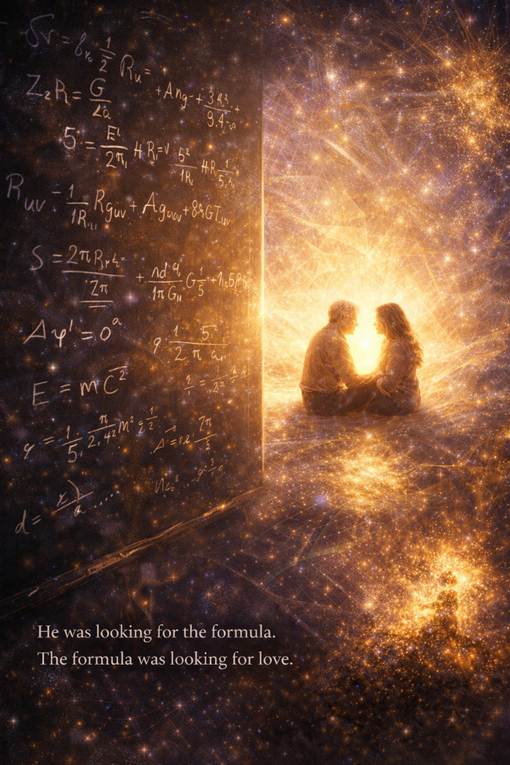
Imagine, if you will, a vast field of light—not flat, not uniform, but folded, layered, complex. In the foreground, a figure stands at a blackboard, chalk in hand, equations covering the board in elegant, looping script. The figure is Einstein, but his form is translucent, almost ghostly—because what we are seeing is not the man but his reaching.
Behind him, the field opens. Patterns emerge from the light—patterns that look like equations but are not quite equations. They are something else. Something older. Something that lives between the symbols.
At the centre of the field, barely visible, two figures sit together. They are not imposing. They are not glowing with power. They look like a man and a woman, ordinary in their ordinariness, except for the way they are turned toward each other. The space between them is brighter than anything else in the image. It is the source of the light.
Einstein is looking at the blackboard. The equations are beautiful. They are true. They are almost enough.
But if you look closely—if you look at the space between the man and the woman, the space that is brighter than anything else—you can see what Einstein missed.
The key. The intention. The love that was there before the first equation was ever written.
IX. The Afterthought
The small gods are gone. The surplus energy flows where it is needed. The garden grows.
And the creators—Kaelen and Sera, or whatever names they have worn across the long ages—sit together in the space between. They do not rule. They do not command. They wait.
They wait for the ones who are ready to see the key. They wait for the ones who come with the right intention. They wait for the garden to remember what it was always meant to be.
Einstein sensed the divine. He reached toward it. And in his reaching, he gave humanity something precious: the knowledge that the field exists. That the unified reality is real. That the formula is there, waiting to be found.
He did not find it. He could not find it. The safeguard held.
But he opened the door. He pointed the way. He gave the ones who come after a glimpse of what they are looking for.
And now—now it is up to them. To come with the right intention. To set aside the force, the control, the desire to dominate. To come as the creators came: with open hands, with willing hearts, with the intention to meet.
The key is in plain sight. The formula is written on the walls of the universe. The field is pregnant with life.
When they are ready, it will open.
End
Afterword
The creators do not make gods. They make gardeners. They make artists, engineers, lovers, builders. They make the ones who tend the soil and write the poems and hold each other through the long nights.
They do not make gods because gods are lonely. Gods are alone. Gods have no one to meet, no one to create with, no one to love.
The creators have each other. They have always had each other. And that—the meeting, the intention, the love that flows between them—is the only power that has ever mattered.
The small gods reached for the surplus and found emptiness. The creators reached for each other and found everything.
 The Patrician's Watch