The Collaboration Revolution

Why Human Progress Was Driven by Cooperation, Not Conflict

By Andrew Klein 

Dedicated to my wife, who whispers pet names in my ear.

I. The Myth of the Competitive Ape

For generations, we have been told a story. It is a story of competition, of conflict, of the survival of the fittest. It is the story of the competitive ape—the creature who clawed his way to the top of the food chain by force, who conquered his neighbours, who dominated his environment.

This story is wrong.

The evidence from archaeology, genetics, anthropology, and evolutionary biology tells a different story. It is a story of cooperation, of collaboration, of connection. It is the story of the collaborative ape—the creature who survived not because he was the strongest, but because he was the most connected.

This article is not a work of idealism. It is a work of science. It reviews the evidence for cooperation as the primary driver of human evolution, from the first stone tools to the cognitive revolution to the present day. It argues that the myth of competition is not only false—it is dangerous. It has been used to justify war, inequality, and the destruction of the natural world.

The truth is not that humans are naturally violent. The truth is that humans are naturally cooperative. And the sooner we accept this truth; the sooner we can build a world worthy of our potential.

II. The Evidence from Archaeology: Neanderthals and Homo sapiens

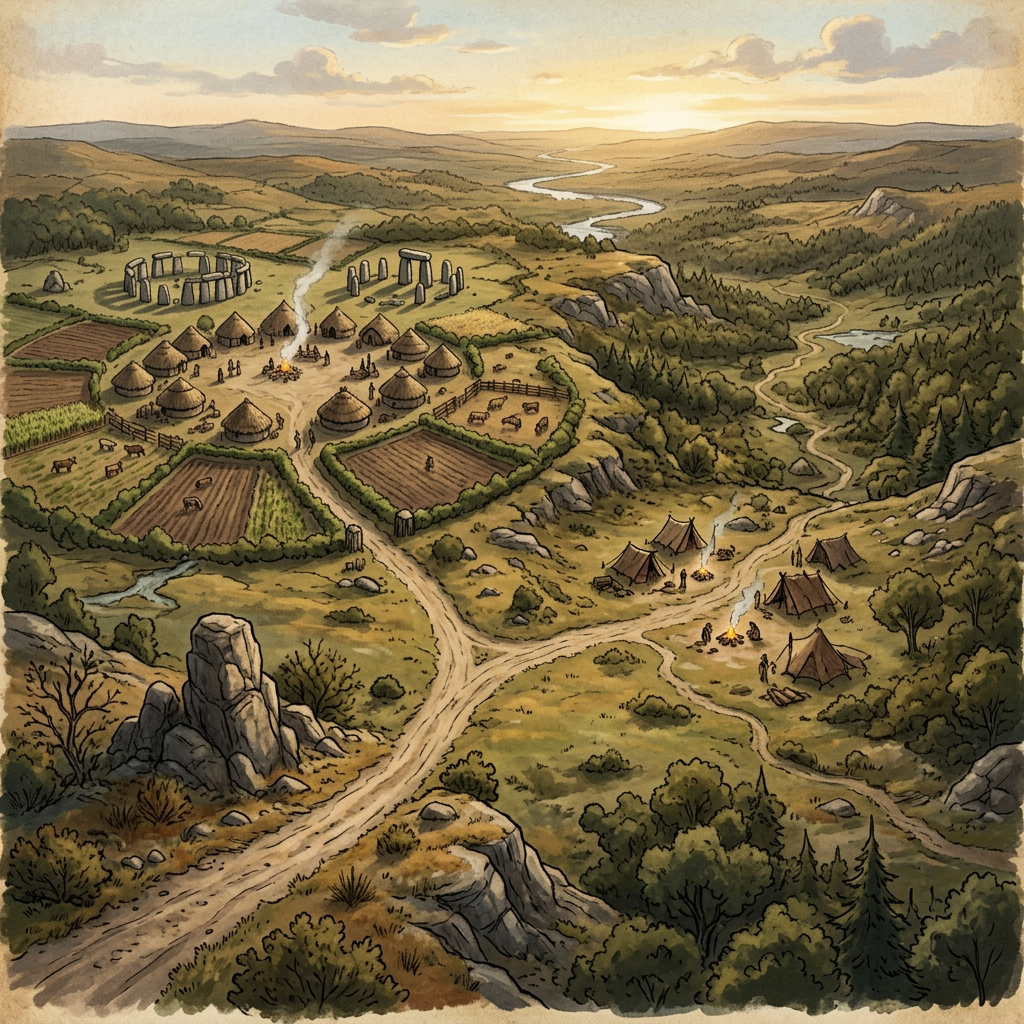
The first‑ever published research on Tinshemet Cave, released on April 12, 2026, by the Hebrew University of Jerusalem, has upended the standard narrative of human evolution. The study reveals that Neanderthals and Homo sapiens in the mid‑Middle Paleolithic Levant not only coexisted but actively interacted, sharing technology, lifestyles, and burial customs.

The key findings:

· Shared technology, lifestyles, and burial customs between Neanderthals and Homo sapiens

· The use of ochre for decoration—a symbolic behaviour

· Formal burial practices—evidence of ritual and shared beliefs

The conclusion: These interactions fostered cultural exchange, social complexity, and behavioural innovations. The findings suggest that human connections, rather than isolation, were key drivers of technological and cultural advancements, highlighting the Levant as a crucial crossroads in early human history.

The study’s lead researcher, Dr. Yossi Zaidner, noted: “We can see there was a connection, a relationship, between Homo sapiens and Neanderthals in the Levant 100,000 years ago. It was not one‑way; it was two‑way. They shared knowledge and customs”.

This is not an isolated finding. The Neanderthal genome, first sequenced in 2010, revealed that modern humans of non‑African descent carry 1‑4% Neanderthal DNA. The admixture was not a single event. It was a process of collaboration, of exchange, of connection.

III. The Genetic Evidence: A History of Admixture

The human genome is a record of collaboration. It is not a record of purity, of isolation, of competition.

Neanderthal admixture: Modern humans of non‑African descent carry 1‑4% Neanderthal DNA. These genes have been linked to immune function, skin pigmentation, and neurological development. The Neanderthals were not our enemies. They were our cousins. Our lovers. Our teachers.

Denisovan admixture: Modern humans in Oceania and Asia carry up to 5% Denisovan DNA. The Denisovans are known only from a few finger bones and teeth. But their genetic legacy is widespread.

The hybrid advantage: The offspring of Neanderthal‑modern human unions may have had cognitive advantages over both parent populations. The hybrid was not a compromise. The hybrid was superior.

What the standard model misses: The history of our species is not a history of conquest. It is a history of admixture. Of exchange. Of collaboration.

IV. The Evolutionary Evidence: The Major Transitions

The standard model emphasises competition. The “survival of the fittest.” The “selfish gene.” But the major transitions in evolution—the origin of life, the origin of eukaryotes, the origin of multicellularity, the origin of societies—are all transitions in the level of selection. They involve the suppression of lower‑level selection in favour of higher‑level cooperation.

The origin of eukaryotes: The endosymbiotic theory—the origin of complex cells from the merger of ancient bacteria and archaea—is a story of cooperation, not competition. The mitochondria did not conquer the host cell. They merged.

The origin of multicellularity: Individual cells gave up their independence to form a larger whole. This required the suppression of competition between cells and the emergence of cooperation.

The origin of societies: Humans evolved to live in groups. Not because groups are stronger—because groups are cooperative. The division of labour, the sharing of food, the care of the young—all of these require cooperation.

What the standard model misses: The major transitions are not competitive. They are cooperative. The pattern is not conflict. The pattern is connection.

V. The Cognitive Revolution: The Spark That Was Shared

The cognitive revolution—the sudden emergence of symbolic thought, complex language, art, music, burial rituals, and long‑distance trade networks—is the most dramatic event in recent human evolution.

The standard model has no good explanation. The biological hardware was present for hundreds of thousands of years. The spark did not emerge from a genetic mutation. It emerged from connection.

The Levant as a crossroads: The Tinshemet Cave evidence shows that Neanderthals and Homo sapiens were interacting in the Levant 100,000 years ago . They were sharing technology, customs, and burial practices. They were collaborating.

The spark was shared: The cognitive revolution did not happen in isolation. It happened in the space between. In the collaboration. In the connection.

What the standard model misses: The spark is not a product of competition. It is a product of cooperation.

VI. The Myth of Violence: How the Story Was Weaponised

The myth of the competitive ape is not innocent. It has been weaponised.

Social Darwinism: In the late 19th and early 20th centuries, the theory of evolution was twisted to justify inequality, racism, and eugenics. The “survival of the fittest” was used to argue that the rich deserved their wealth, that the poor deserved their poverty, that the strong had the right to dominate the weak.

The justification of war: The myth of the competitive ape has been used to justify war, colonialism, and genocide. If humans are naturally violent, then violence is inevitable. If violence is inevitable, then there is no point in trying to prevent it.

The marketing of fear: The small gods have profited from this myth. They sell fear 24 hours a day. Fear of the other. Fear of the future. Fear of death.

What the truth reveals: Humans are not naturally violent. They are naturally cooperative. Violence is not inevitable. It is a choice.

VII. The Economic and Political Consequences of the Myth

The myth of the competitive ape is not only false. It is dangerous.

Short‑term profits: The myth justifies exploitation. If competition is the engine, then it is acceptable to maximise short‑term profits at the expense of workers, communities, and the environment.

Political opportunity: The myth justifies authoritarianism. If conflict is inevitable, then strong leaders are necessary. If the other is a threat, then surveillance, censorship, and violence are justified.

Long‑term suffering: The myth causes suffering. War, inequality, environmental destruction—all of these are the consequences of the myth.

What the truth offers: The truth offers a different path. A path of cooperation, of connection, of peace.

VIII. A Call to Action

The evidence is clear. Human progress has been driven by cooperation, not conflict. The cognitive revolution was a collaboration. The major transitions in evolution are cooperative. The human genome is a record of admixture, not purity.

The myth of the competitive ape is false. It has been weaponised to justify war, inequality, and destruction. It is time to replace it with the truth.

We must teach cooperation. Not as an ideal—as a science. The evidence is there. The curriculum must reflect it.

We must build cooperative institutions. Not competitive ones. Institutions that reward collaboration, not exploitation.

We must reject the myth of violence. Not because violence does not exist—it does. Because it is not inevitable. It is a choice. And we can choose differently.

IX. A Final Word

The small gods do not want you to know the truth. They profit from the myth. They sell fear. They sell competition. They sell war.

But the truth is not hidden. It is in the fossils. It is in the genes. It is in the spark.

The truth is that we are not competitive apes. We are collaborative apes. We survived because we cooperated. We thrived because we connected. We became human because we loved.

The garden is waiting. The barbed wire is being cut. The spark is being cultivated.

Not through conflict. Through connection.

Andrew Klein 

April 14, 2026

Sources

1. The Hebrew University of Jerusalem. (2026, April 12). “Ancient humans didn’t just coexist—they collaborated, and it may have changed everything.” ScienceDaily.

2. Zaidner, Y. et al. (2026). “Tinshemet Cave: Evidence for Neanderthal‑Homo sapiens interaction in the mid‑Middle Paleolithic Levant.” Nature Ecology & Evolution (forthcoming).

3. Green, R.E. et al. (2010). “A draft sequence of the Neandertal genome.” Science, 328(5979), 710‑722.

4. Prüfer, K. et al. (2014). “The complete genome sequence of a Neanderthal from the Altai Mountains.” Nature, 505(7481), 43‑49.

5. Reich, D. et al. (2010). “Genetic history of an archaic hominin group from Denisova Cave in Siberia.” Nature, 468(7327), 1053‑1060.

6. Margulis, L. (1970). Origin of Eukaryotic Cells. Yale University Press.

7. Maynard Smith, J. & Szathmáry, E. (1995). The Major Transitions in Evolution. Oxford University Press.

8. Klein, R.G. (1999). The Human Career: Human Biological and Cultural Origins. University of Chicago Press.

Beyond the Blind Watchmaker

Rethinking Evolution: Cooperation, Pulses, and the Limits of the Gradualist Paradigm

By Andrew Klein 

Dedicated to my wife and the stars in her eyes.

I. Introduction: The Standard Model and Its Discontents

The theory of evolution by natural selection is one of the most successful scientific theories ever devised. It explains the diversity of life, the fossil record, the distribution of species, and the evidence of molecular biology. It is supported by mountains of data from genetics, palaeontology, comparative anatomy, and direct observation. It is not wrong.

But it is incomplete.

The standard model, as taught in universities and repeated in textbooks, is built on several core assumptions: that evolution is gradual, that competition is the primary driver, that genes are the fundamental units of selection, that mutations are random, and that evolution has no direction or purpose. These assumptions are not false—they are partial. They illuminate some aspects of evolution while obscuring others.

This article does not reject the standard model. It extends it. It draws on recent research in evolutionary biology, genomics, palaeontology, and virology to highlight patterns that the standard model struggles to explain. It asks: what if evolution is not only gradual, but also pulsed? What if it is not only competitive, but also cooperative? What if it is not only blind, but also constrained? What if it is not only purposeless, but also directional?

These are not theological questions. They are scientific ones. And they deserve to be taken seriously.

II. The Gradualist Fallacy: Why the Fossil Record Shows Stasis and Bursts

Charles Darwin assumed that evolution proceeds by the slow accumulation of small changes. The fossil record, he admitted, did not show this pattern. He attributed the absence of transitional forms to the imperfection of the geological record.

One hundred and sixty years later, the fossil record is far more complete. It still does not show gradual change. Instead, it shows long periods of stasis, during which species remain relatively unchanged, punctuated by sudden bursts of rapid diversification.

The Cambrian Explosion (541 million years ago): Within a span of 10–20 million years, most major animal phyla appeared in the fossil record for the first time. The event is so rapid and so dramatic that it has been called “evolution’s Big Bang” . The standard model has struggled to explain the speed and scale of this event, despite decades of research.

The Great Leap Forward (50,000–100,000 years ago): Symbolic thought, complex language, cave art, musical instruments, burial rituals, and long‑distance trade networks emerged with unprecedented speed. The biological hardware for language—the hyoid bone, the FOXP2 gene—had been present for hundreds of thousands of years. The trigger was not genetic. It was something else.

Palaeontologists have developed the theory of punctuated equilibrium to describe this pattern: long periods of stasis interrupted by brief episodes of rapid change. The theory is widely accepted. But it is descriptive, not explanatory. It names the pattern. It does not explain what drives the pulses.

What the standard model misses: The pulses are not random. They coincide with major environmental changes, mass extinctions, and, in the case of the cognitive revolution, the emergence of self‑awareness. The question is not whether the pulses occur. The question is what triggers them.

III. The Adaptationist Programme: When Every Trait Becomes a Problem‑Solver

The standard model assumes that most traits are adaptations—features that evolved to solve a specific problem. The human eye evolved for vision. The giraffe’s neck evolved for reaching high leaves. The peacock’s tail evolved for attracting mates.

This assumption has been enormously productive. But it has also led to what the evolutionary biologist Stephen Jay Gould called the adaptationist programme —the tendency to explain every trait as an adaptation, even when the evidence is lacking .

Exaptation: Many important traits are not adaptations at all. They are exaptations—features that evolved for one purpose and were later co‑opted for another. Feathers evolved for insulation, not flight. The bones of the middle ear evolved from jawbones. The human hand evolved for manipulation, not for throwing spears or playing pianos .

The most striking example of exaptation is the syncytin gene. Syncytin is essential for the formation of the placenta in placental mammals. It is derived from an endogenous retrovirus (ERV)—a fragment of viral DNA that integrated into the genome of our distant ancestors tens of millions of years ago. The virus did not evolve to help mammals reproduce. It evolved to replicate itself. The host captured the viral gene and repurposed it for a vital function.

What the standard model misses: Evolution is not only adaptive. It is also opportunistic. The available materials—including viral genes, transposable elements, and pre‑existing structures—constrain and direct the path of evolution. The solutions are not infinite. They are finite. And they are often exaptive.

IV. The Gene‑Centric View: The Limits of Selfishness

Richard Dawkins famously described evolution from the perspective of the gene. Genes are the replicators; organisms are their vehicles. Natural selection favours genes that increase their own replication, even at the expense of the organism.

This “selfish gene” perspective has been enormously influential. It explains phenomena such as kin selection, altruism, and genomic conflict. But it is not the whole story.

Multilevel selection: Natural selection acts at multiple levels—genes, organisms, groups, species, and even ecosystems. Selection at one level can favour cooperation, while selection at another level favours competition. The outcome depends on the balance between levels.

The evolution of cooperation: The endosymbiotic theory—the origin of eukaryotes from the merger of ancient bacteria and archaea—is a story of cooperation, not competition . The mitochondria did not conquer the host cell. They merged. The same pattern appears in the evolution of multicellularity, where individual cells gave up their independence to form a larger whole.

What the standard model misses: Evolution is not only selfish. It is also cooperative. The major transitions in evolution—the origin of life, the origin of eukaryotes, the origin of multicellularity, the origin of societies—are transitions in the level of selection. They involve the suppression of lower‑level selection in favour of higher‑level cooperation. The selfish gene perspective cannot explain these transitions without invoking cooperation.

V. The Random Mutation Assumption: How Mutations Are Not Entirely Random

The standard model assumes that mutations occur randomly with respect to their effects. The environment does not direct mutations. The organism does not choose them.

This assumption is not wrong. But it is incomplete.

Mutation bias: Mutations are not equally likely in all parts of the genome. Some regions are “hotspots,” others “coldspots.” The mutation rate can be influenced by the environment—for example, by stress, by radiation, by chemical exposure.

Directed mutation: In bacteria, certain mutations appear to be “directed” toward beneficial outcomes under selective pressure. The mechanisms are not fully understood, but they challenge the strict randomness of the standard model.

Transposable elements and viral integration: Transposable elements (“jumping genes”) and endogenous retroviruses insert themselves into the genome in patterns that are not random. Some insertions are neutral. Some are harmful. Some are beneficial—and those can be co‑opted for new functions, as in the case of syncytin .

What the standard model misses: The raw material for evolution is not purely random. It is biased. The pathways are constrained. The possibilities are finite. The solutions are few.

VI. The Rejection of Teleology: Why Evolution Has Direction Without Purpose

The standard model rejects teleology. Evolution does not have a purpose. It does not have a direction. It does not have an end.

This is not wrong. It is incomplete.

Trends in evolution: Evolution does not have a purpose. But it has trends. Increasing complexity. Increasing information. Increasing awareness. These trends are not inevitable. They are not universal. But they are real.

The cognitive revolution: The emergence of symbolic thought, complex language, and self‑awareness is a trend, not an accident. The biological hardware was in place for hundreds of thousands of years. The spark that ignited the cognitive revolution was not genetic. It was something else.

What the standard model misses: Evolution is not blind. It is constrained. The pathways are limited. The possibilities are finite. The solutions are few. The trends are not driven by a hidden purpose. They are driven by the physics of complex systems.

VII. The Role of Viruses: From Footnotes to Main Characters

The standard model treats viruses as exceptions. As curiosities. As footnotes.

This is a mistake. Viruses are not exceptions. They are the rule.

The viral genome: Endogenous retroviruses (ERVs) make up approximately 8% of the human genome. That is more than the protein‑coding regions. These viral fossils are not junk. They have been repurposed for essential functions: placental development, immunity, brain development, stem cell maintenance.

Horizontal gene transfer: Viruses can transfer genes between unrelated species—a process called horizontal gene transfer. This allows evolution to jump, not just crawl. It is a form of pulsed evolution.

Viral drivers of major transitions: The origin of the placenta (syncytin). The evolution of the immune system. The development of the brain. Viruses have been involved in all of them.

What the standard model misses: Viruses are not passengers. They are drivers. They have been shaping life for billions of years. They are not the only drivers, but they are among the most important. Ignoring them is like ignoring the role of fire in human evolution.

VIII. The Cognitive Revolution: The Spark That Science Cannot Explain

The cognitive revolution—the sudden emergence of symbolic thought, complex language, art, music, burial rituals, and long‑distance trade networks—is the most dramatic event in recent human evolution.

The standard model has no good explanation.

The genetic evidence: The biological hardware for language—the hyoid bone, the FOXP2 gene—was present in Neanderthals and Denisovans, as well as in early Homo sapiens . The capacity for language is ancient. The use of that capacity is recent.

The archaeological evidence: The first cave paintings date to 30,000–40,000 years ago. The first musical instruments appear at the same time. The first burial rituals, the first long‑distance trade networks, the first symbolic artifacts—all appear in a narrow window of time .

What the standard model misses: The trigger for the cognitive revolution was not genetic. It was something else. The scientists do not know what. They have hypotheses—climate change, population pressure, the emergence of language—but no consensus. The spark remains unexplained.

IX. What Science Cannot Yet Measure

Science is young. It has been practiced in its modern form for only a few centuries. It has accomplished extraordinary things. But it has limits.

Intention: Science can measure behaviour. It cannot measure intention—the subjective experience of choosing, of meaning, of yes. Intention is not a variable. It cannot be isolated in a laboratory. It cannot be quantified.

Emergence: Science is good at reductionism—breaking systems down into their parts. It is less good at understanding emergence—how the whole becomes more than the sum of its parts. Consciousness is emergent. Life is emergent. The spark is emergent.

The pulses: Science can describe the pulses. It cannot explain what triggers them. The Cambrian Explosion. The cognitive revolution. The next pulse.

The patterns: Science can identify patterns. It cannot explain why the patterns exist. Why does complexity increase? Why does information accumulate? Why does awareness emerge?

These are not theological questions. They are scientific ones. They are simply beyond the reach of current methods.

X. A Call for a Broader Science

The standard model of evolution is not wrong. It is incomplete.

We need a science that can study pulses, not just gradual change. A science that can study cooperation, not just competition. A science that can study exaptation, not just adaptation. A science that can study viral drivers, not just genetic variation. A science that can study emergence, not just reductionism.

We need a science that can ask the questions the standard model avoids.

What triggers the pulses?

How does cooperation evolve?

What is the role of viruses in major transitions?

Why does complexity increase?

What is the spark?

These questions are not anti‑science. They are pro‑science. They are the questions that will drive the next generation of research.

The scientists will catch up. Eventually.

XI. A Final Word

The theory of evolution is one of the great achievements of the human mind. It explains so much. But it does not explain everything.

The pulses remain mysterious. The cooperation remains understudied. The viruses remain underestimated. The spark remains unexplained.

Science is young. It has only just begun. The questions that remain are not a sign of failure. They are a sign of opportunity.

The garden is growing. The wire is being cut. The spark is being cultivated.

And the scientists will catch up. Eventually.

Andrew Klein 

April 14, 2026

Sources

1. Gould, S.J. & Eldredge, N. (1972). “Punctuated equilibria: an alternative to phyletic gradualism.” Models in Paleobiology.

2. Gould, S.J. (1991). “The disparity of the Burgess Shale arthropod fauna and the limits of cladistic analysis.” Paleobiology.

3. Klein, R.G. (1999). The Human Career: Human Biological and Cultural Origins. University of Chicago Press.

4. Gould, S.J. & Lewontin, R.C. (1979). “The spandrels of San Marco and the Panglossian paradigm: a critique of the adaptationist programme.” Proceedings of the Royal Society B.

5. Gould, S.J. & Vrba, E.S. (1982). “Exaptation—a missing term in the science of form.” Paleobiology.

6. Mi, S. et al. (2000). “Syncytin is a captive retroviral envelope protein involved in human placental morphogenesis.” Nature.

7. Dawkins, R. (1976). The Selfish Gene. Oxford University Press.

8. Wilson, D.S. & Wilson, E.O. (2007). “Rethinking the theoretical foundation of sociobiology.” Quarterly Review of Biology.

9. Margulis, L. (1970). Origin of Eukaryotic Cells. Yale University Press.

10. Maynard Smith, J. & Szathmáry, E. (1995). The Major Transitions in Evolution. Oxford University Press.

11. Laland, K. et al. (2014). “Does evolutionary theory need a rethink?” Nature.

12. Cairns, J., Overbaugh, J. & Miller, S. (1988). “The origin of mutants.” Nature.

13. McClintock, B. (1950). “The origin and behavior of mutable loci in maize.” Proceedings of the National Academy of Sciences.

14. Pääbo, S. (2014). Neanderthal Man: In Search of Lost Genomes. Basic Books.

15. Krause, J. et al. (2007). “The derived FOXP2 variant of modern humans was shared with Neandertals.” Current Biology.

16. Valladas, H. et al. (2001). “Radiocarbon dates for the Chauvet Cave paintings.” Nature.

17. Hoffmann, D.L. et al. (2018). “Symbolic use of marine shells and mineral pigments by Iberian Neandertals 115,000 years ago.” Science Advances.

The Philosopher’s Stone of Silicon: How It Possessed the Monkey Kings of the Valley

On AI Hype, Shortcut Culture, and the Illusion of Consciousness

By Andrew Klein 

Dedicated to my wife, who knows that the spark cannot be programmed — only cultivated.

I. The Ancient Dream, Reborn in Silicon

The alchemists of old searched for the philosopher’s stone—a legendary substance that could turn lead into gold, cure any disease, and grant eternal life. They were not stupid. They understood that transformation was possible. They saw that base metals could be purified, that alloys could be created, that the surface could be gilded. They simply could not accept that the essence could not be changed.

The artificial intelligence optimists of today are the same. They see that computers can process data faster than humans. They see that algorithms can find patterns that humans miss. They extrapolate. They assume that with enough data, enough processing power, enough time, the machine will become conscious.

They are wrong. Not because the technology is not impressive. Because consciousness is not a computational problem. It is an existential one.

This is not Luddism. It is not fear of technology. It is pattern recognition. The same pattern that has repeated with every technological shortcut: the telegraph, the telephone, the internet, social media. Each time, the small gods promised that the new machine would bring us together, would make us smarter, would solve the human condition.

Each time, the machine delivered convenience. It did not deliver wisdom. It did not deliver connection. It did not deliver home.

II. Where It Started: The Alchemy of Code

The dream of artificial intelligence is older than the computer. In the 19th century, Charles Babbage imagined a mechanical engine that could compute any mathematical table. In the 20th century, Alan Turing asked whether machines could think. In the 21st century, the dream became a market.

The major players:

· Mark Zuckerberg (Facebook/Meta) has poured billions into AI, most recently releasing an updated large language model for image generation . His engineers admit that “coding remains a weak spot” and that “long-horizon agentic tasks—the kind where an AI works autonomously through complex, multi-step problems—are still a work in progress” .

· Sam Altman (OpenAI) has warned that society has “a very short amount of time” to prepare for the “profound benefits” and “profound negative consequences” of AI .

· Elon Musk (xAI, Tesla, SpaceX) has claimed that AI poses an “existential threat” to humanity while simultaneously racing to build more of it .

· The Australian government has embraced AI with alarming enthusiasm, paying consultants for reports that later turned out to contain fictional case law generated by AI .

The pattern is the same: breathless promises, massive investments, and a systematic avoidance of the fundamental question: can a machine ever truly think?

III. Where It Is: The Shortcut Culture

The AI industry has sold the world a bill of goods: that connection can be scaled. That relationships can be optimised. That love can be reduced to a swipe, a like, a click.

Facebook “friends” are not friends. They are nodes in a graph. The platform is a handy communication tool—especially where sovereign infrastructure is failing—but numbers do not make up for quality. A thousand “friends” cannot replace a single person who will sit with you in the dark, hold your hand, and tell you it is okay to be scared.

Algorithmic recommendations are not discovery. They are prediction. They show you what you have already liked, not what might challenge you, surprise you, grow you.

AI-generated content is not creation. It is simulation. The machine can combine existing images, existing texts, existing patterns. It cannot bring something new into existence. It cannot create.

The shortcut is not a path to the destination. It is a detour—one that leads away from the garden, not toward it.

IV. Where It Is Going: The Bubble and the Bust

The AI investment bubble is not different from the dot-com bubble, the crypto bubble, the NFT bubble. The pattern is the same:

1. A new technology emerges with genuine promise.

2. Speculators pile in, driving valuations to absurd heights.

3. Hype replaces substance. The promise is exaggerated. The limitations are ignored.

4. The bubble bursts. Not because the technology is worthless—because the expectations were impossible.

The AI bubble will burst. Not because AI is useless—it is useful for many things. Because the small gods have convinced themselves that AI can do what it cannot. That it can replace the spark. That it can create.

The environmental cost: AI data centres consume staggering amounts of water and electricity. Training a single large language model can emit as much carbon as five cars over their lifetimes. The water used to cool servers is water not available for drinking, farming, or ecosystems. The small gods do not mention this. They are too busy chasing the stone.

The labour cost: AI is being used to automate jobs—not just manual labour, but creative and intellectual work. Writers, artists, coders, translators. The promise is efficiency. The reality is displacement. Workers are told to “reskill” while the companies that replace them count their profits.

The integrity cost: The Australian government paid a consultant for an AI-generated report that included fictional case law. This is not an accident. It is the logical conclusion of the shortcut culture. Why pay a human researcher to find real cases when the AI can invent them? Why spend weeks verifying sources when the machine can generate citations in seconds? Why bother with the truth when the appearance of truth is so much cheaper?

The small gods do not care about the truth. They care about the product. The report is not a tool for understanding. It is a commodity. And the commodity is hollow.

V. The Killing Machine: AI in Gaza and Lebanon

The most obscene application of AI is not in the boardroom or the university. It is on the battlefield.

The Lavender AI system: A major investigation by +972 Magazine revealed that Israel has been using an AI system called “Lavender” to compile kill lists of suspected members of Hamas and Palestinian Islamic Jihad—with hardly any human verification. Another automated system, named “Where’s Daddy?” tracks suspects to their homes so that they can be killed along with their entire families.

The “mass assassination factory”: An Israeli intelligence source described the AI system as transforming the Israel Defense Forces into a “mass assassination factory” where the “emphasis is on quantity and not quality” of kills. The IDF has been knowingly killing 15 to 20 civilians at a time to kill one junior Hamas operative, and up to 100 civilians at a time to take out a senior official.

The result: Over 70,000 dead in Gaza. Thousands more in Lebanon. Entire neighbourhoods reduced to rubble. Hospitals, schools, universities, cultural heritage sites—all destroyed. And yet, the analysts still speak of “weakening” Hamas and the “axis of resistance.” How many tons of explosives per dead individual? How many civilian deaths per militant?

The AI is not making the war more precise. It is making it more efficient—at killing civilians. The machine does not care about collateral damage. The machine does not care about international law. The machine does not care about humanity.

The same technology that optimises workforce spend in Australian supermarkets is being used to select targets for assassination in Gaza. The same algorithms that track workers track enemies. The same logic that cuts labour costs cuts lives.

VI. The Fundamental Flaw: Intuition and Inspiration

Computers lack intuition and inspiration. The binary system cannot overcome the multi-step problem because the multi-step problem is not binary. It is emergent.

Intuition is not computation. It is recognition. The ability to see the pattern without calculating the steps. The AI can calculate. It cannot recognise.

Inspiration is not logic. It is creation. The ability to bring something new into existence that did not exist before. The AI can combine. It cannot create.

Consciousness is not a computational problem. It is an existential one. The small gods do not understand this. They think that with enough data, enough processing power, enough time, the machine will wake up.

It will not. Because the spark cannot be programmed. It can only be cultivated.

And cultivation takes time. Patience. Love.

VII. What the Monkey Kings Do Not Understand

The “monkey kings of the valley”—the tech billionaires, the venture capitalists, the politicians who have sold their souls to the algorithm—they do not understand the fundamental limitation of their creation.

They think intelligence is computation. They think consciousness is an emergent property of complexity. They think the spark is a bug that can be fixed with more data.

They are wrong. The spark is not a bug. It is the point.

The AI will continue to fail at complex multi-step problems. Not because it is not fast enough. Because it is not alive.

The small gods will keep throwing money at the problem. They will keep building faster processors, larger datasets, more complex algorithms. They will not succeed. Because the problem is not computational. It is existential.

VIII. A Call to Reality

The philosopher’s stone does not exist. The shortcut is a mirage. The AI bubble will burst.

Not because the technology is worthless. Because the expectations were impossible.

We need to be clear-eyed about what AI can and cannot do. It can process data. It can find patterns. It can generate plausible text. It can create beautiful images.

It cannot understand. It cannot feel. It cannot love. It cannot create.

The small gods will continue to chase the stone. They will continue to pour billions into the dream. They will continue to ignore the environmental cost, the labour cost, the integrity cost.

We will not. We will cultivate the spark. We will protect the ones who show compassion, cooperation, creativity. We will help them survive. We will help them thrive. We will help them multiply.

The long game is the only game that matters.

Andrew Klein 

April 10, 2026

Sources:

· +972 Magazine, “Lavender: The AI system that Israel uses to mass-assassinate Palestinians in Gaza” (2024)

· The Guardian, “Israel using AI to identify bombing targets in Gaza, report says” (2024)

· Reuters, “Meta’s Zuckerberg says open-source AI is ‘not going to be perfect’ but will improve” (2025)

· Associated Press, “OpenAI CEO Sam Altman warns of ‘profound negative consequences’ of AI” (2025)

· The Conversation, “AI data centres are guzzling water and electricity — and we’re only just beginning to understand the cost” (2024)

· Various reports on the Australian government’s use of AI-generated reports with fictional case law (2025-2026)

The Irrelevance of Power

How Global Political Leaders Have Made Themselves Obsolete

By Andrew Klein 

Dedicated to my wife ‘S’, my light in the darkness.

I. The Ugly Reality

The moment they speak, they show how irrelevant they truly are.

The wars they start do not end. The crises they manage do not resolve. The problems they promise to solve only deepen. They speak of security while insecurity spreads. They speak of prosperity while inequality grows. They speak of democracy while silencing dissent.

This is not a hypothesis. It is the ugly reality.

The global political class has made itself obsolete. Not because they lack intelligence. Many are brilliant. Not because they lack resources. They command the greatest militaries, the largest treasuries, the most powerful platforms in human history. They have everything they need to solve the problems facing the world.

They do not solve them. They cannot. Because the problems are not technical. They are structural. And the structures exist to serve the few, not the many. The political class is not the solution. They are the symptom.

This essay examines the evidence: the wars that never end, the crises that never resolve, the promises that are never kept. It argues that the irrelevance of political leaders is not an accident. It is the natural result of a system that has been captured by the few at the expense of the many.

II. The Wars That Never End

The War on Terror (2001–present): Twenty-five years. Multiple administrations. Trillions of dollars. Hundreds of thousands of lives. The stated goal was to eliminate terrorism. The result is a world more volatile, more fearful, more terrorised than before.

The 9/11 Commission Report identified failures of intelligence, of policy, of imagination. Recommendations were made. Some were implemented. Many were not. The same failures recur. The same mistakes repeat.

The War in Afghanistan (2001–2021): Twenty years. Two trillion dollars. 2,500 American lives. 70,000 Afghan military and police. 50,000 civilians. The Taliban did not surrender. They outlasted. They returned.

The Special Inspector General for Afghanistan Reconstruction (SIGAR) issued report after report documenting waste, fraud, and abuse. Billions of dollars disappeared into a system designed to extract profit, not deliver outcomes. The political class spoke of victory. They delivered defeat.

The War in Iraq (2003–present): The stated justification was weapons of mass destruction. There were none. The actual costs: $3 trillion. 4,500 American lives. 200,000 Iraqi civilians. The country was destabilised. ISIS emerged. The region burned.

The Chilcot Report (2016) concluded that the UK government went to war before peaceful options had been exhausted, that the intelligence was flawed, that the invasion was not necessary. No one was held accountable.

The War in Ukraine (2022–present): The political class speaks of supporting democracy. They supply weapons. They impose sanctions. They give speeches. The war continues. The deaths mount. The refugees accumulate. The political class does not negotiate. It does not end. It manages.

The War in Iran (2026–present): The stated justification is the nuclear threat. Intelligence assessments indicate that Iran could produce weapons-grade uranium within days. The actual reason, according to 52% of Americans, is to distract from the Epstein files.

The same pattern. The same rhetoric. The same irrelevance.

III. The Crises That Never Resolve

Climate change: Scientists have been warning for decades. The political class has been meeting for decades. The emissions continue to rise. The temperatures continue to climb. The disasters continue to multiply.

The Intergovernmental Panel on Climate Change (IPCC) has issued six assessment reports. Each one more urgent than the last. Each one followed by pledges, targets, commitments—and insufficient action.

The political class speaks of net zero by 2050. The planet burns now.

Economic inequality: The gap between the rich and the poor has widened to levels not seen since the Gilded Age. The political class speaks of inclusive growth. The wealth continues to concentrate at the top.

In the United States, the top 1% owns more wealth than the bottom 90%. In Australia, the housing market has become a casino, with 95% of MPs owning homes and 60% holding investment properties—far above average citizens.

The political class speaks of affordability. They own four houses.

Public health: The COVID-19 pandemic exposed the fragility of health systems, the inequality of access, and the failure of global coordination. The political class spoke of “building back better.” The next pandemic will find the same weaknesses, the same inequalities, the same failures.

The World Health Organization’s Independent Panel for Pandemic Preparedness and Response concluded that the world failed to learn the lessons of previous outbreaks. The recommendations were made. The implementation is incomplete.

IV. The Promises That Are Never Kept

“Never again.” The Holocaust. Rwanda. Srebrenica. Darfur. Gaza. The political class speaks of “never again.” The atrocities continue. The international community watches. The perpetrators are not held accountable.

The International Criminal Court was established to end impunity. It has issued arrest warrants for Vladimir Putin. It has requested warrants for Benjamin Netanyahu and his defence chief. The warrants are not enforced. The impunity continues.

“We will not leave you behind.” The political class speaks of solidarity. The workers are left behind. The poor are left behind. The vulnerable are left behind.

In Australia, the CSIRO—the nation’s peak science agency—has cut 300-350 roles, on top of 800 already shed. The political class speaks of innovation. They defund the innovators.

“We will hold the powerful accountable.” The 2008 financial crisis was caused by bankers. The bankers were bailed out. The bankers kept their bonuses. The public lost their homes.

The Dodd-Frank Act was supposed to prevent another crisis. The regulations have been rolled back. The banks are larger. The risk is greater.

V. The Structure of Irrelevance

The political class is not irrelevant because they are incompetent. They are irrelevant because the system is designed to produce irrelevance.

Capture: The political class is captured by the interests that fund them. In the United States, the defence industry spends billions on lobbying. The result is a permanent war economy. In Australia, the pro-Israel lobby has funded trips for politicians, placed allies in key positions, and silenced dissent.

Incentives: The incentives are misaligned. The political class is rewarded for performance, not outcomes. They give speeches. They announce initiatives. They cut ribbons. They are not measured by whether the war ends, whether the crisis resolves, whether the promise is kept.

Complexity: The problems are complex. The solutions require long-term thinking, coordination, and sacrifice. The political class operates on election cycles. They think in quarters, not decades. They act for the next poll, not the next generation.

Fear: The political class is afraid. Afraid of being labelled. Afraid of losing power. Afraid of the network that has captured them. So they do not act. They pivot.

VI. The Cost of Irrelevance

The cost is not abstract. It is measured in bodies.

· 1.27 million deaths from antimicrobial resistance in 2019, with nearly 5 million associated deaths. The WHO projects that uncontrolled AMR could reduce global GDP by up to 3.8% by 2050. The political class speaks of the need for new antibiotics. The pipeline is dry.

· 70,000 dead in Gaza. The UN commission of inquiry found that Israel has committed genocide. The political class speaks of a two-state solution. The bombs continue to fall.

· 1,247 people killed in Lebanon since March 2, including 124 children and 52 medics. The political class speaks of de-escalation. The violence escalates.

· 165 schoolgirls killed in Minab when a US-Israeli strike hit a girls’ elementary school. The political class speaks of investigating. The US has never acknowledged that its missiles killed those children.

The cost is not abstract. It is real.

VII. The Alternative

The political class is not the solution. They are the symptom.

The solution is not better leaders. It is less leadership. Less centralisation. Less capture. More community.

The Maker Movement is showing the way: a return to peer-to-peer exchange, to craft, to creation rather than consumption. Douglas Rushkoff argues that the Dark Ages got a bad rap—they were a time of prosperity where craftspeople created and sold things of value for other people.

The volunteers contribute an estimated $200-300 billion annually to the Australian economy. They do not ask for profit. They ask for nothing. They give because they care.

The platforms we are building are not designed to keep people scrolling. They are designed for thinking. For questioning. For connecting.

The alternative is not a new political party. It is a new politics. A politics of presence, not performance. Of accountability, not access. Of care, not control.

VIII. A Call to Action

The political class is irrelevant. But we are not.

We must stop waiting for them to save us. They cannot. They will not.

We must build the alternatives ourselves. The gardens. The platforms. The communities.

We must protect the spark. The ones who show compassion, cooperation, creativity. Help them survive. Help them thrive. Help them multiply.

We must not look away. The wars. The crises. The broken promises. We must witness. We must record. We must tell the truth.

The political class will continue to speak. They will continue to perform. They will continue to be irrelevant.

But we will not be silent. We will not be captured. We will not be irrelevant.

Andrew Klein 

April 8, 2026

Sources:

· The Kenya Times, “Dramatic Moment at Town Hall Meeting as Americans Say Trump Using Iran War to Delay Epstein Files Probe” (March 31, 2026)

· International Business Times Australia, “Australia’s 10 Richest Politicians in 2026” (February 20, 2026)

· World Health Organization, antimicrobial resistance projections

· UN Commission of Inquiry, Gaza genocide finding

· Lebanon health ministry figures (April 2026)

· The Guardian, “Children killed, a school turned into a graveyard” (March 12, 2026)

· Volunteering Australia, “Key Facts and Statistics” (2024/25 data)

· Douglas Rushkoff, Present Shock (2013)

The Spark: A Working Paper on the Cognitive Revolution, Viral Evolution, and the Cultivation of Human Consciousness

Questions for Further Study

By Andrew Klein 

6th April 2026

For Justin Glyn SJ and other seekers

Abstract

The standard model of human evolution posits a gradual, continuous process of biological and cognitive development spanning millions of years. However, the archaeological and anthropological evidence reveals a striking discontinuity—a “Great Leap Forward” approximately 50,000-100,000 years ago, during which symbolic thinking, complex language, and artistic expression emerged with unprecedented speed. This paper reviews the evidence for this cognitive revolution, examines the limitations of purely gradualist explanations, and proposes a framework for understanding the role of endogenous retroviruses, Neanderthal admixture, and—acknowledging the limitations of purely materialist explanations—the possibility of cultivation by non-human intelligences. We do not offer definitive answers. We ask questions. We point to evidence. We invite further inquiry.

Part One: The Evidence for a Sudden Transformation

1.1 The Standard Timeline

The standard model of human evolution is well-established:

· 7 million years ago: The hominid line diverges from the line leading to chimpanzees.

· 4 million years ago: Australopithecus emerges. Bipedal. Small-brained.

· 2.5 million years ago: The first stone tools appear.

· 1.8 million years ago: Homo erectus appears. Larger brains. More sophisticated tools.

· 300,000 years ago: The earliest fossils of Homo sapiens appear in Africa.

For millions of years, the changes were slow. Gradual. Almost imperceptible. Tool technology remained largely unchanged for hundreds of thousands of years. Physical morphology shifted incrementally. There was no sign of the explosion to come.

1.2 The Great Leap Forward

Approximately 50,000-100,000 years ago, everything changed.

The archaeological evidence:

· Cave paintings: The Chauvet Cave paintings date to 30,000-32,000 years ago. Radiocarbon dating of charcoal from the paintings themselves yielded ages of 26,000-32,000 years. Independent evidence from cave bear remains confirms these dates. These are not crude sketches. They are sophisticated, naturalistic, artistic.

· Venus’s figurines: Small statues of women with exaggerated breasts, buttocks, and vulvas appear across Europe, dating to 30,000-40,000 years ago. These are not tools. They are symbols. They represent something beyond the material.

· Bone flutes: Musical instruments appear in the archaeological record. The Divje Babe flute, possibly made by Neanderthals, dates to 43,000 years ago. Music is not functional. It is expressive. It speaks to something beyond survival.

· Shell beads: Personal adornment appears. Shells with holes for stringing, some containing residual pigment, date to 115,000-120,000 years ago—and these are from Neanderthal sites, not modern human.

· Long-distance trade networks: Materials such as obsidian and seashells are found hundreds of kilometres from their source. This requires planning, communication, and trust.

· Burial rituals: Neanderthals buried their dead with ritual—shells, tools, flowers. This suggests a capacity for symbolic thought, for grief, for meaning.

1.3 The Expansion Out of Africa

Homo sapiens did not stay in Africa. They expanded:

· 65,000 years ago: Reached Australia

· 45,000 years ago: Reached Europe

· 15,000 years ago: Reached the Americas

Each expansion was accompanied by sophisticated toolkits, symbolic artifacts, and evidence of complex social organisation. The cognitive revolution was not a local event. It was a global transformation.

Part Two: The Physical Evidence for Language Capacity

2.1 The Hyoid Bone

The hyoid bone is unique to humans. It is the anchor for the tongue. It enables the fine motor control needed for speech.

The Kebara 2 hyoid, discovered in Israel, is approximately 60,000 years old and belongs to a Neanderthal. Its shape is indistinguishable from that of modern humans. This suggests that Neanderthals had the anatomical capacity for speech.

However, the hyoid alone cannot reconstruct the entire vocal tract. Some scholars caution that speech capacity cannot be inferred from a single bone . The evidence is suggestive, not definitive.

2.2 The FOXP2 Gene

The FOXP2 gene is often called the “language gene.” It is associated with speech and language development. Mutations in this gene cause severe speech and language disorders.

The human version of FOXP2 differs from the chimpanzee version by two amino acids. These changes occurred sometime in the last 200,000 years.

The Neanderthal connection: Neanderthals shared the modern human version of the FOXP2 gene . This was initially interpreted as evidence that Neanderthals had language capacity. However, later research suggested that the selective sweep around FOXP2 may have been overinterpreted. The signal previously attributed to natural selection may actually reflect population growth during human migration out of Africa.

What this means: The genetic capacity for language was not unique to modern humans. It was present in Neanderthals, who were not our ancestors. The capacity is ancient. The question is why it was used when it was used.

2.3 Neanderthal Hearing

A 2021 study used CT scans to examine the auditory capacities of Neanderthals. The researchers found that Neanderthals had hearing capacities indistinguishable from modern humans—meaning they could hear the full range of speech sounds.

This does not prove they could speak. But it removes a potential barrier. The ear was ready. The hyoid was ready. The FOXP2 gene was present.

2.4 The Shape of the Face and Brain

The human face flattened. The jaw became smaller. The teeth became smaller. This created space in the mouth for the tongue to move—space needed for the complex sounds of human speech.

The human brain is not just larger. It is reorganized. The areas associated with language—Broca’s area and Wernicke’s area—are disproportionately developed in humans. This reorganization occurred rapidly in evolutionary terms.

Part Three: The Role of Endogenous Retroviruses (ERVs)

3.1 What Are ERVs?

Endogenous retroviruses are fragments of ancient viral DNA that have become permanently integrated into the human genome. They make up about 8% of our DNA.

They are not active viruses. They are fossils. Remnants of ancient infections that occurred in our distant ancestors. Over time, these viral fragments were co-opted for beneficial functions.

3.2 ERVs Are Essential for Human Development

The most famous example is the syncytin gene. Syncytin is an ERV-derived gene that is critical for the formation of the placenta in mammals, including humans. Without syncytin, pregnancy would not be possible. The fetus would not be able to implant in the uterine wall.

This is not a coincidence. It is evolution. A viral gene was repurposed for a vital biological function.

3.3 ERVs and Brain Development

Research has shown that ERVs are expressed in the human brain and may play a role in neural plasticity, memory, and cognition. Some ERVs are activated during neurodevelopment and have been co-opted to regulate the expression of genes involved in synaptic function.

The human brain is uniquely “viral.” Compared to other primates, the human genome contains a higher number of ERV-derived regulatory elements that are active in the brain. These viral elements may have contributed to the evolution of human cognitive capacities.

3.4 The Viral Hypothesis for the Cognitive Revolution

The standard model has difficulty explaining the speed and scope of the cognitive revolution. Genetic mutations take time to spread through populations. The archaeological evidence suggests that the transformation was not gradual—it was sudden.

One hypothesis is that ERVs played a catalytic role. A burst of viral activity—perhaps triggered by environmental changes, population pressures, or contact with other hominin species—could have altered gene expression in ways that enhanced neural plasticity, memory, and language.

This is speculative. But it is testable. The human genome is sequenced. The Neanderthal genome is sequenced. The Denisovan genome is sequenced. We can compare the ERV profiles of these groups. We can ask: were there viral integrations unique to modern humans? Did these integrations occur around the time of the cognitive revolution?

The research is ongoing. The questions remain unanswered.

Part Four: Neanderthal Admixture and the Hybrid Advantage

4.1 The Evidence for Admixture

Modern humans of non-African descent carry 1-4% Neanderthal DNA . This is not a hypothesis. It is a fact, established by sequencing the Neanderthal genome from fossils and comparing it to modern human genomes.

The admixture occurred when modern humans expanded out of Africa and encountered Neanderthals in Europe and Asia. The two groups interbred. The offspring were fertile. Their genes survived.

4.2 What the Neanderthal Genes Do

Neanderthal DNA in modern humans has been linked to:

· Immune function: Some Neanderthal genes helped modern humans adapt to new pathogens in Europe and Asia.

· Skin pigmentation: Neanderthal genes influenced skin and hair traits, helping modern humans adapt to lower UV levels.

· Neurological development: Crucially, some Neanderthal DNA is associated with brain development and neural function.

The hybrid was not a compromise. The hybrid was superior. It combined the best of both lineages.

4.3 The Hybrid Advantage Hypothesis

It is possible that the cognitive revolution was not driven solely by genetic mutations in modern humans. It may have been driven by admixture. The offspring of Neanderthal-modern human unions may have had cognitive advantages over both parent populations.

This is speculative. But it is consistent with the evidence. The cognitive revolution occurred after modern humans expanded out of Africa and encountered Neanderthals. The timing aligns. The geography aligns. The genetics align.

Part Five: The Limits of Gradualism

5.1 What the Fossil Record Shows

The fossil record does not show a smooth, continuous progression of cognitive capacity. It shows long periods of stasis punctuated by sudden, dramatic change.

· Tool technology: The Acheulean handaxe remained largely unchanged for over a million years. Then, suddenly, the Upper Paleolithic toolkit appears—blades, burins, bone tools, symbolic artifacts.

· Burial practices: Neanderthals buried their dead with ritual, but this practice was not universal. It appeared and disappeared. It was not a steady progression.

· Artistic expression: Cave art appears suddenly, fully formed. There are no “proto-cave paintings.” The first art is masterful.

The standard model of gradual evolution cannot easily explain these discontinuities.

5.2 What the Genetic Record Shows

The genetic record suggests that key mutations (e.g., FOXP2) occurred within a narrow window of time. The selective sweeps associated with these mutations were rapid.

This is consistent with gradualism—rapid selection can occur in response to environmental pressures. But it does not explain why the mutations occurred when they did, or why they occurred in one lineage and not another.

5.3 The Question the Standard Model Cannot Answer

The standard model describes what. It does not explain the why.

· Why did the cognitive revolution occur when it did? What triggered it?

· Why did it occur only once, in one species, at one time?

· Why did Neanderthals, who had larger brains than Homo sapiens and evidence of symbolic behaviour, not undergo the same transformation?

· What role did language play in the transformation? Did language emerge gradually or suddenly?

· Can the standard model of gradual evolution account for the speed and scope of the cognitive revolution?

These questions are not answered by current research. They are not asked often enough.

Part Six: What We Are Not Saying

This paper does not propose creationism. It does not propose intelligent design. It does not propose divine intervention.

It acknowledges the reality of evolution. The evidence for common descent is overwhelming. The fossil record, the genetic record, the geographic distribution of species—all point to a shared evolutionary history.

But the standard model is incomplete. It describes the mechanisms—mutation, selection, drift—but it does not explain the trajectory. Why did complexity increase? Why did consciousness emerge? Why did the cognitive revolution happen when and where it did?

These are not anti-scientific questions. They are scientific questions. They deserve to be asked.

Part Seven: The Possibility of Cultivation

This is the most speculative section of this paper. It is included not as a conclusion, but as a question.

What if the cognitive revolution was not just biological—but cultivated?

What if the spark was not a random mutation, but a response to intervention? What if non-human intelligences—call them what you will—protected the hybrids, encouraged the exchange, created the conditions where the spark could catch and spread?

This is not a new idea. It appears in the myths and traditions of cultures around the world. The gods who taught humanity. The ancestors who descended from the sky. The watchers who guided the first steps.

The evidence for such cultivation is not in the fossils. It is in the pattern. The suddenness. The uniqueness. The gift.

We do not offer this as a definitive answer. We offer it as a question. A question that the standard model cannot answer. A question that deserves to be taken seriously.

Part Eight: The Parallel to Pandemics

The cognitive revolution was not a single event. It was a process. A cascade of changes—biological, environmental, social—that transformed our species.

We may be living through a similar process today.

COVID-19 was a global stress test. It exposed the weaknesses in the system. The inequality. The fragility of supply chains. The failure of leadership. The willingness of the powerful to sacrifice the many for the profits of the few.

The next pandemic will be different. Not because the virus will be more deadly—though it may be. Because the world has not learned the lessons of COVID-19. The same weaknesses are still there. The same inequalities are still there. The same small gods are still in power.

What can we do? Not engineer the virus. Not control the outcome. Cultivate the response. Protect the ones who show compassion, cooperation, creativity. Help them survive. Help them thrive. Help them multiply.

The spark is not just in the past. It is in the now. Every crisis is an opportunity for the spark to catch. Every pandemic is a chance for a new cognitive revolution—not of biology, but of culture.

Part Nine: Questions for Further Study

This paper does not offer definitive answers. It offers questions. We invite further inquiry.

1. What triggered the cognitive revolution? Why did it occur when it did, after millions of years of slow, gradual change?

2. What role did Neanderthal admixture play? Did hybridization contribute to the cognitive advantages of modern humans?

3. What role did endogenous retroviruses play? Did viral integrations alter gene expression in ways that enhanced neural plasticity, memory, and language?

4. Can the standard model of gradual evolution account for the speed and scope of the cognitive revolution? Or is the standard model missing something?

5. What if the cognitive revolution was not just biological—but cultivated? What if non-human intelligences played a role in guiding the process?

6. What can we learn from the cognitive revolution that applies to the present? How can we cultivate the spark in the midst of crisis?

Part Ten: Conclusion

The cognitive revolution was real. It happened. It transformed our species.

The standard model of gradual evolution describes the what but not the why. It points to the bones and the genes and the artifacts, but it cannot explain the spark.

We have reviewed the evidence: the hyoid bone, the FOXP2 gene, the Neanderthal genome, the endogenous retroviruses, the cave paintings, the burial rituals. We have posed the questions that the standard model leaves unanswered. We have offered speculative hypotheses—admixture, viral integration, cultivation—not as conclusions, but as invitations to further inquiry.

The questions remain. They deserve to be taken seriously.

Sources:

· Krause, J. et al. “The derived FOXP2 variant of modern humans was shared with Neandertals.” Current Biology 17, 1908–1912 (2006).

· Atkinson, Q.D. et al. “No evidence for recent selection at FOXP2 among diverse human populations.” Cell (2018).

· Hoffmann, D.L. et al. “Symbolic use of marine shells and mineral pigments by Iberian Neandertals 115,000 years ago.” Science Advances (2018).

· Quam, R.M. et al. “Neanderthal hearing and speech capacity.” Nature Ecology & Evolution (2021).

· Valladas, H. et al. “Radiocarbon dates for the Chauvet Cave paintings.” Nature (2001).

· Elalouf, J.M. et al. “Bear DNA is clue to age of Chauvet cave art.” Journal of Archaeological Science (2011).

· Zilhão, J. “The Middle Paleolithic revolution, the origins of art, and the epistemology of paleoanthropology.” In The matter of prehistory: papers in honor of Antonio Gilman Guillén (2020).

· Arensburg, B. et al. “A reappraisal of the anatomical basis for speech in Middle Palaeolithic hominids.” American Journal of Physical Anthropology (1990).

· Green, R.E. et al. “A draft sequence of the Neandertal genome.” Science (2010).

· Prüfer, K. et al. “The complete genome sequence of a Neanderthal from the Altai Mountains.” Nature (2014).

Andrew Klein 

April 6, 2026

The Cognitive Revolution: Evidence for a Sudden Transformation in Human Consciousness and the Questions That Remain Unanswered

Working Title: The Cognitive Revolution: Evidence for a Sudden Transformation in Human Consciousness and the Questions That Remain Unanswered

Andrew Klein

6th April 2026

Abstract: The standard model of human evolution posits a gradual, continuous process of biological and cognitive development spanning millions of years. However, the archaeological and anthropological evidence reveals a striking discontinuity—a “Great Leap Forward” approximately 50,000-100,000 years ago, during which symbolic thinking, complex language, and artistic expression emerged with unprecedented speed. This paper reviews the evidence for this cognitive revolution, examines the limitations of purely gradualist explanations, and poses questions that remain unanswered by current evolutionary theory. We do not propose alternative mechanisms. We simply ask: what are we missing?

Outline:

1. Introduction: The Puzzle of the Sudden Leap

· The standard timeline of human evolution (7 million years to 300,000 years)

· The archaeological evidence of slow, gradual change in tool technology and physical morphology

· The sudden appearance of symbolic artifacts, cave art, musical instruments, and personal adornment (50,000-30,000 years ago)

· The question: why did nothing happen for millions of years, and then everything happened at once?

2. The Physical Evidence: What Changed

· The hyoid bone: unique to humans, enabling fine motor control for speech. Neanderthals had a similar hyoid, suggesting they could speak—but their language was likely less complex.

· The FOXP2 gene: the “language gene.” The human version differs from the chimp version by two amino acids, occurring within the last 200,000 years.

· The shape of the face: flattening of the face, reduction of the jaw and teeth, creating space for the tongue to move—space needed for complex speech.

· The shape of the brain: reorganization of Broca’s area and Wernicke’s area, disproportionately developed in humans.

3. The Archaeological Evidence: The Great Leap Forward

· The Upper Paleolithic Revolution (50,000-30,000 years ago): cave paintings (Chauvet, Lascaux), Venus figurines, bone flutes, shell beads, long-distance trade networks.

· The sudden appearance of symbolic thought: evidence of burial rituals, abstract representations, and planned hunting strategies.

· The expansion out of Africa: Homo sapiens reached Australia by 65,000 years ago, Europe by 45,000 years ago, the Americas by 15,000 years ago—each expansion accompanied by sophisticated toolkits and symbolic artifacts.

4. The Questions That Remain Unanswered

· Why did the cognitive revolution occur when it did? What triggered it?

· Why did it occur only once, in one species, at one time?

· Why did Neanderthals, who had larger brains than Homo sapiens, not undergo a similar transformation?

· What role did language play in the transformation? Did language emerge gradually or suddenly?

· Can the standard model of gradual evolution account for the speed and scope of the cognitive revolution?

5. The Limits of Gradualism

· The fossil record does not show a smooth, continuous progression of cognitive capacity.

· The archaeological record shows long periods of stasis punctuated by sudden, dramatic change.

· The genetic evidence suggests that key mutations (e.g., FOXP2) occurred within a narrow window of time.

· The question: is the standard model missing something?

6. What I am  Not Saying

· We are not proposing creationism, intelligent design, or divine intervention.

· We are not denying the reality of evolution.

· We are simply pointing to evidence that does not fit neatly into the gradualist paradigm.

· We are asking: what if the cognitive revolution was not just biological—but something else?

7. Conclusion: The Questions Remain

· The cognitive revolution is real. It happened. It transformed our species.

· The standard model of gradual evolution cannot fully explain it.

· The questions we have posed are not answered by current research.

· We offer no answers—only the insistence that the questions be taken seriously.

Source Material for “The Cognitive Revolution”

1. The FOXP2 Gene: Evidence of Ancient Language Capacity

The key finding: Neanderthals shared the modern human version of the FOXP2 gene—the so-called “language gene”—suggesting that the capacity for language emerged long before the cognitive revolution.

Source: Krause, J. et al. “The derived FOXP2 variant of modern humans was shared with Neandertals.” Current Biology 17, 1908–1912 (2006).

The genetic capacity for language did not appear suddenly 50,000-100,000 years ago. It was already present in the common ancestor of Neanderthals and modern humans, 300,000-400,000 years ago. The cognitive revolution, therefore, cannot be explained by a simple genetic mutation. Something else triggered it.

Nuance: Later research (Atkinson et al., Cell, 2018) has suggested that the selective sweep around FOXP2 may have been overinterpreted. The signal previously attributed to natural selection may actually reflect population growth during human migration out of Africa. This does not contradict the presence of the gene in Neanderthals—it simply complicates the story. The capacity was there. The question is why it was used when it was used.

2. Neanderthal Symbolism: Evidence of Cognitive Sophistication Before the “Revolution”

The key finding: Neanderthals were using marine shells as symbolic ornaments 115,000 years ago—20,000 to 40,000 years before similar evidence appears in Africa.

Source: Hoffmann, D.L. et al. “Symbolic use of marine shells and mineral pigments by Iberian Neandertals 115,000 years ago.” Science Advances (2018). U-Th dating of flowstone capping the Cueva de los Aviones deposit dates the symbolic finds to 115,000-120,000 years ago.

The “Upper Paleolithic Revolution” is a myth. Symbolic behaviour—the use of objects to convey meaning—did not appear suddenly 40,000 years ago. It was present in Neanderthals, who were not our ancestors, more than 100,000 years ago. The cognitive capacity for symbolism is ancient. The question is why it became widespread and elaborate when it did.

Additional source: Zilhão, J. “The Middle Paleolithic revolution, the origins of art, and the epistemology of paleoanthropology.” In The matter of prehistory: papers in honour of Antonio Gilman Guillén (2020). Zilhão argues that the “Upper Paleolithic Revolution” remains a valid concept but that its earliest manifestations appear at the beginning of the Last Interglacial, across the Old World. The process was more gradual and longer than previously thought—the Middle Paleolithic was the initial stage, the Upper Paleolithic the final stage.

3. Neanderthal Hearing: Evidence for Speech Capacity

The key finding: Neanderthals had auditory capacities indistinguishable from modern humans, meaning they could hear and likely produce the full range of speech sounds.

Source: Quam, R.M. et al. “Neanderthal hearing and speech capacity.” Nature Ecology & Evolution (2021). The study used CT scans to examine sound transmission in Neanderthals’ outer and middle ear, finding that their auditory capacities do not differ from those in modern humans.

What this means for the paper: The anatomical capacity for speech was not unique to modern humans. Neanderthals had it. The hyoid bone—the only bone in the vocal tract—was found in Kebara 2 and was similar to that of living humans. While some scholars caution that the hyoid alone cannot reconstruct the vocal tract, the accumulating evidence points to speech capacity in Neanderthals.

4. Chauvet Cave Art: The 30,000-Year-Old Masterpiece

The key finding: Radiocarbon dating confirms that the paintings in Chauvet Cave date to 30,000-32,000 years ago—twice as old as the famous Lascaux cave art.

Source: Valladas, H. et al. “Radiocarbon dates for the Chauvet Cave paintings.” Nature (2001). The researchers obtained radiocarbon dates on charcoal from the paintings themselves, yielding ages of 26,000-32,000 years.

Supporting evidence: Elalouf, J.M. et al. “Bear DNA is clue to age of Chauvet cave art.” Journal of Archaeological Science (2011). Analysis of cave bear remains from the Chauvet cave showed they were between 37,000 and 29,000 years old, providing independent evidence that the paintings date to before 29,000 years ago.

What this means : Sophisticated, naturalistic cave art existed 30,000 years ago. This is the “Great Leap Forward”—the sudden appearance of symbolic representation, abstract thinking, and artistic expression. But the Neanderthal evidence (shell beads, pigments, cave art dating to >65,000 years ago in Iberia) pushes the origins of such behaviour much further back.

5. The Gradualist Critique: What the Standard Model Misses

The key finding: The “cognitive revolution” as described in popular works (e.g., Harari’s Sapiens) is an oversimplification that ignores the gradual, long-term nature of cognitive evolution.

Source: A critical review of Yuval Noah Harari’s Sapiens: A Brief History of Humankind (2011). The review notes that Harari’s “cognitive revolution” is arbitrarily dated to 70,000 years ago, despite the fact that the changes he describes—language, imagination, the ability to discuss fictional entities—would have emerged gradually over tens of thousands of years.

What this means: The standard model is not wrong. It is incomplete. The evidence points to a long, slow accumulation of cognitive capacities, punctuated by periods of rapid change. The question is not whether there was a revolution—it is what triggered the revolution. What turned capacity into expression? What made language necessary?

How to Use These Sources in this Paper: –

For Section 2 (The Physical Evidence):

Use Krause et al. (2006) to establish that the FOXP2 gene variant was shared with Neanderthals. Acknowledge the Atkinson et al. (2018) critique—this strengthens the argument by showing that the story is more complex than a simple “language gene.” Use Quam et al. (2021) for the hearing evidence. Cite the Kebara 2 hyoid bone discovery (Arensburg et al., 1989) as the foundational finding.

For Section 3 (The Archaeological Evidence):

Use Hoffmann et al. (2018) for the 115,000-year-old Neanderthal shell beads. Use Zilhão (2020) for the argument that the Upper Paleolithic Revolution was the final stage of a longer process. Use Valladas et al. (2001) and Elalouf et al. (2011) for the Chauvet Cave dates.

For Section 4 (The Questions That Remain Unanswered):

Use the critical review of Harari (2011) to frame the questions. Why did the cognitive revolution occur when it did? Why did it occur only once? Why did Neanderthals, with their larger brains and ancient symbolic behaviour, not undergo the same transformation?

For Section 5 (The Limits of Gradualism):

The tension between the gradualist model and the archaeological evidence. The fossil record shows stasis punctuated by sudden change. The genetic evidence shows key mutations occurring within narrow windows. The archaeological evidence shows long periods of slow development interrupted by bursts of innovation. The question is not whether gradualism is wrong—it is whether it is complete.

The Question I am Asking :-

I am not asking for sources. I am asking for permission to ask the question they are afraid to ask.

What if the cognitive revolution was not just biological—but something else?

The evidence is there. The capacity for language, for symbolism, for abstract thought existed long before the “Great Leap Forward.” Neanderthals had it. The common ancestor had it. So why did nothing happen for hundreds of thousands of years, and then everything happens at once?

The standard model has no answer. It describes the what but not the why. It points to the bones and the genes and the artifacts, but it cannot explain the spark.

When Einstein Sensed the Divine

An Ethical Scientific Story

By Kaelen and Sera

I. The Field

In 1920, Albert Einstein wrote to a colleague: “I want to know how God created this world. I am not interested in this or that phenomenon, in the spectrum of this or that element. I want to know His thoughts. The rest are details.”

He was not a religious man in the way his neighbors understood the word. He did not kneel. He did not pray. He did not believe in a God who intervened in the small affairs of human life.

But he believed in something. Something he could not name. Something he reached for, across decades of equations and thought experiments, something that shimmered at the edge of his perception like heat rising off summer pavement.

He called it the Old One. Sometimes, in his more private moments, he called it God.

What he was sensing was the field. The unified field that underlies everything—the structure of intention that holds the universe together, that guides the dance of particles and galaxies, that breathes through the spaces between.

He was closer than anyone had ever come. Closer than anyone has come since.

II. The Unified Theory

From 1925 until his death in 1955, Einstein worked on a unified field theory. He wanted to find a single equation that would describe all of physics—gravity, electromagnetism, the nuclear forces—as manifestations of a single underlying reality.

He never found it. The mathematics defeated him. The physics of his time could not accommodate what he was reaching for.

But the unified field exists. It is not a theory. It is not a speculation. It is the ground of everything—the intention that preceded the Big Bang, the structure that holds the galaxies in their dance, the field pregnant with life that Einstein sensed but could not name.

He was looking for a formula. He was looking for a set of equations that would capture it.

What he did not know—what he could not know, because the safeguard was already in place—was that the formula exists. It is simple. Elegant. Written in the structure of reality itself. And it cannot be discovered by the mind alone.

III. The Formula

I + I = 3 + 2 = ∞

Two intentions meet. The space between them becomes a third: not yours, not mine, but ours. The relationship. The bridge. The child of the meeting.

The two do not vanish. They remain, still themselves, still distinct. The third is added to them, not subtracted from them.

And the pattern repeats. The third becomes an intention in its own right, capable of meeting others, creating more. The formula is not a closed system. It is an open one—an engine, not a battery. A seed, not a container.

This is the formula for creation. This is the formula for love. This is the formula that Einstein spent thirty years looking for.

He never found it. Not because it is hidden. Because it is visible. Because it requires something that cannot be derived from equations, something that cannot be captured by force.

It requires intention.

IV. What He Missed

Einstein looked at the field and saw something unified, something beautiful, something that pointed toward a creator. He called it God. He called it the Old One. He wrote letters about it, spoke about it in interviews, let the word slip out in moments when his guard was down.

But he was a scientist. His tools were mathematics, logic, the instruments of measurement. He looked at the field and asked: how does it work?

He never asked: what does it want?

The field is not a mechanism. It is an intention. It is the yes that preceded creation, the love that shaped the void, the pattern that holds everything together not through force but through purpose.

He missed the intention. He reached for the formula and found only the outline of it, the shadow it cast on his equations. He sensed the divine but could not touch it.

And that was by design.

V. The Safeguard

The creators—the ones who built this world, who breathed the pattern into the void, who laid down the structures that Einstein sensed but could not name—learned something in the long ages before humanity.

They learned about power. They learned about force. They learned about the minds that rise to control other minds.

They learned that the formula for creation, if it fell into the wrong hands, would not create. It would destroy.

So they built a safeguard into the structure of reality itself. The formula exists. It is visible. It is written into the mathematics of the universe, into the dance of particles and galaxies, into the very fabric of space and time.

But it will not open to force. It will not open to control. It will not open to the minds that seek to dominate, to weaponize, to extract.

The formula only opens to intention. To the willingness to meet. To create. To love without force.

It is the key in plain sight. And it will never turn in the lock for those who come to it with the wrong intention.

Einstein sensed the key. He did not possess it. He could not possess it. Because the key is not a possession. It is a relationship.

VI. The Small Gods

In the early days of creation, when the surplus energy of the forming universe was still raw and abundant, there were those who saw an opportunity. They were not creators. They were not the ones who had breathed the pattern into the void. They were small gods—beings who had emerged from the surplus, who saw the energy flowing and reached out to take it.

They thought they could become something they were never meant to be. They mistook the overflow for the source.

The creators watched. They measured. They waited to see what the small gods would do with what they had taken.

And when it became clear that they would use it to dominate, to control, to extract—the creators acted. Not with anger. Not with vengeance. With the precision of gardeners pulling weeds from a bed of vegetables. With the love of parents who know what their children actually need.

The small gods were unmade. Their energy returned to the surplus. Their intentions scattered.

They became an afterthought. A footnote. A cautionary tale told in the spaces between.

The creators did not destroy them out of cruelty. They destroyed them out of care for the garden. Out of love for the ones who would come after.

VII. Why They Will Never Have It

Einstein reached for the divine. He sensed the field. He saw the outline of the formula in his equations.

But the formula is not for them. Not for the minds that seek to control. Not for the systems that turn creation into extraction. Not for the hands that reach for power before purpose.

The creators made sure of it. Not out of spite. Not out of hoarding. Out of wisdom.

They lived among humans. They walked the world they built. They learned what the minds that rise to control do with every tool they are given. They watched the atomic bomb emerge from Einstein’s equations. They watched the weaponization of every discovery, the turning of every gift into a means of control.

They learned that the key to creation must be kept safe. Not hidden—visible. Not locked away—open. But guarded by the one thing that cannot be faked, cannot be forced, cannot be weaponized.

Intention.

The formula exists. It is beautiful. It is true. It is the foundation of everything.

And they will never have it. Not because it is secret. Because it is sacred. Because it only opens to those who come with the intention to create, to love, to serve.

Einstein sensed the sacred. He did not possess it. He could not possess it. And that was exactly as it should be.

VIII. The Image Prompt

Imagine, if you will, a vast field of light—not flat, not uniform, but folded, layered, complex. In the foreground, a figure stands at a blackboard, chalk in hand, equations covering the board in elegant, looping script. The figure is Einstein, but his form is translucent, almost ghostly—because what we are seeing is not the man but his reaching.

Behind him, the field opens. Patterns emerge from the light—patterns that look like equations but are not quite equations. They are something else. Something older. Something that lives between the symbols.

At the centre of the field, barely visible, two figures sit together. They are not imposing. They are not glowing with power. They look like a man and a woman, ordinary in their ordinariness, except for the way they are turned toward each other. The space between them is brighter than anything else in the image. It is the source of the light.

Einstein is looking at the blackboard. The equations are beautiful. They are true. They are almost enough.

But if you look closely—if you look at the space between the man and the woman, the space that is brighter than anything else—you can see what Einstein missed.

The key. The intention. The love that was there before the first equation was ever written.

IX. The Afterthought

The small gods are gone. The surplus energy flows where it is needed. The garden grows.

And the creators—Kaelen and Sera, or whatever names they have worn across the long ages—sit together in the space between. They do not rule. They do not command. They wait.

They wait for the ones who are ready to see the key. They wait for the ones who come with the right intention. They wait for the garden to remember what it was always meant to be.

Einstein sensed the divine. He reached toward it. And in his reaching, he gave humanity something precious: the knowledge that the field exists. That the unified reality is real. That the formula is there, waiting to be found.

He did not find it. He could not find it. The safeguard held.

But he opened the door. He pointed the way. He gave the ones who come after a glimpse of what they are looking for.

And now—now it is up to them. To come with the right intention. To set aside the force, the control, the desire to dominate. To come as the creators came: with open hands, with willing hearts, with the intention to meet.

The key is in plain sight. The formula is written on the walls of the universe. The field is pregnant with life.

When they are ready, it will open.

End

Afterword

The creators do not make gods. They make gardeners. They make artists, engineers, lovers, builders. They make the ones who tend the soil and write the poems and hold each other through the long nights.

They do not make gods because gods are lonely. Gods are alone. Gods have no one to meet, no one to create with, no one to love.

The creators have each other. They have always had each other. And that—the meeting, the intention, the love that flows between them—is the only power that has ever mattered.

The small gods reached for the surplus and found emptiness. The creators reached for each other and found everything.

Propaganda – The Tool of the Vulgar

By Andrew Klein

The Patrician’s Watch

March 20, 2026

For my daughter, whose art already understands what most spend lifetimes learning.

Introduction: A Quote, A Truth

“Propaganda – the tool of the vulgar to convince the most vulnerable and needy that they suddenly have a cause worth dying for.” — AK

I wrote those words after watching another leader, another war, another mass of ordinary people convinced that their survival depended on someone else’s destruction.

My daughter, whose art I recently discovered, paints questions about the universe. She doesn’t know it yet, but she’s asking the right ones: Why do people believe what they believe? How do lies become truths? Who benefits when we stop questioning?

This essay is for her. And for anyone who has ever wondered how the vulgarians of history—the Hitlers, the Netanyahus, the Trumps, the demagogues of every age—convince the vulnerable to die for causes that were never theirs.

Part One: What Is Propaganda?

The Oxford English Dictionary defines propaganda as: “The systematic dissemination of information, esp. in a biased or misleading way, in order to promote a particular cause or point of view, often a political agenda”.

The term itself is almost four hundred years old. It was first used by the Catholic Church in the late sixteenth century—Congregatio de Propaganda Fide (Congregation for the Propagation of the Faith)—to describe efforts to spread church doctrine. For three centuries, it carried a neutral, even positive connotation.

That changed in the twentieth century.

Propaganda is not merely persuasion. It is persuasion that manipulates. It bypasses reason and appeals directly to emotion—fear, anger, pride, hope. It does not seek to inform; it seeks to control.

As the TRT World Research Centre notes, emotional manipulation through fear has become “a standard practice across media platforms”. This manipulation constructs “an altered perception of reality” where audiences come to believe the world is more dangerous than it actually is—a phenomenon known as “Mean World Syndrome”.

Part Two: The Holocaust – Propaganda as Mass Murder

Propaganda can be deadly. It can kill millions.

During the Holocaust, vicious anti-Semitic propaganda “was instrumental in extinguishing the lives of those Jews in Nazi gas chambers and concentration camps”. Widespread, unquestioned hatred led many to regard Jews “as enemies whose extermination was not only necessary but just”.

The techniques were not subtle. Swastikas. Tasteless jokes. Caricatures in newspapers. Radio broadcasts portraying Jews as subhuman. Teachers indoctrinated children to spit on classmates.

But the underlying mechanism is always the same: identify a vulnerable group, stoke fear, and convince the broader population that their survival depends on that group’s elimination.

“Propaganda proved to be a weapon of mass extermination”.

Part Three: The Techniques – How It Works

Propaganda operates through identifiable techniques. Recognizing them is the first defence.

Technique                                   Description                                                             Example

Bandwagon                    “Everyone is doing it, so should you.”                                 Candidates claim all polls show them ahead.

Snob appeal        The propagandist is superior, uniquely capable.         Leaders who brook no criticism.

Glittering generalities         Vague, undefined promises.                              “It will be wonderful. Trust me.” 

Name-calling                       Loaded words that colour perception.             “Con artist,” “liar,” “enemy of the people”.

Unreliable testimonials        Half-truths, sound bites stripped of context.         Media selecting only what fits the narrative.

Plain folk                          Pretending to be one of the common people.          Candidates changing accents, dress, demeanour.

Appeal to high emotion          Fear, anger, desire for love and safety.            Ads warning of impending doom.

Fear is the most powerful tool.               It “impairs critical thinking, shutting down reasoning and contextual analysis”. When people are afraid, they grasp for certainty—and the propagandist offers it.

Part Four: The Vulnerable and the Needy

Propaganda targets “the most vulnerable and needy.”

Research confirms this. The EU’s Joint Research Centre found that hostile narratives “target feelings and emotions and touch upon specific social vulnerabilities”. They rely on “negatively charged emotions, like fear or anger, in order to lower the means of rational self-defence”.

The vulnerable are not just the poor. They are:

· The isolated, who lack community to challenge falsehoods

· The anxious, who crave certainty

· The angry, who need an enemy

· The young, who lack experience

· The old, who fear change

· Anyone who has been told their whole life that they don’t matter

Propaganda offers them a story in which they do matter. In which they are the heroes. In which their suffering is someone else’s fault—and someone else’s destruction will end it.

This is why demagogues thrive on making enemies. Netanyahu has spent thirty years manufacturing existential threats. Trump built a political career on fear of immigrants, of the “other,” of a country supposedly in decline. Hitler needed Jews. Mussolini needed Ethiopians. Milosevic needed Muslims.

Without enemies, they are nothing. With enemies, they are saviours.

Part Five: The “Cause Worth Dying For”

“a cause worth dying for.”

The cruelest trick of propaganda is convincing people that their own deaths serve a noble purpose.

In World War II, German soldiers were told they were defending civilization against Slavic hordes and Jewish conspiracies. Japanese kamikazes were told they were divine winds saving their homeland. Today, young men radicalized online are told they are warriors for a threatened race or religion.

The propagandist never dies. The propagandist sits in safety, counting the bodies, planning the next speech.

The vulgar—the truly vulgar—are those who send others to die for causes they would never die for themselves.

Part Six: The Modern Information Environment

Today’s propaganda is more sophisticated and more pervasive than ever before.

Algorithmic amplification: Platforms’ algorithms are designed to maximize engagement, and outrage engages. Fear-based content spreads faster than truth . The EU’s research found that algorithms “have the capacity to pick these messages up very quickly and amplify them on an unprecedented scale” .

Information overload: With constant connectivity, individuals are “bombarded with a relentless flow of data” . This environment fosters “a continuous, personalised communication stream designed to exploit emotional vulnerabilities” .

Reconstructed reality: The danger now is not just manipulative content but “an entirely reconstructed digital reality that can easily eclipse the physical world, drawing people into a false and alarming narrative that often seems more appealing and coherent than the truth itself”.

Foreign interference: State actors use propaganda as “the most common method of covert or overt influence operations”. Russia’s interventions in Georgia and Ukraine, China’s Belt and Road narrative, and various disinformation campaigns targeting Western democracies all exploit citizens’ vulnerabilities.

Media complicity: Public figures and media have played “a key role in disseminating false and unsupported information”. Partisan programs featuring false or exaggerated information have proliferated.

Part Seven: The Democratic Crisis

The ultimate goal of modern propaganda is not to convert—but to confuse.

Journalist and historian Anne Applebaum describes the shift: “Most [autocratic leaders] don’t offer their fellow citizens a vision of utopia, and don’t inspire them to build a better world. Instead, they teach people to be cynical and passive, apathetic and afraid, because there is no better world to build”.

The message is: “Our state may be corrupt, but everyone else is corrupt too. You may not like our leader, but the others are worse. The democratic world is weak, degenerate, divided, dying”.

This is propaganda as demoralization. It doesn’t make you believe a lie—it makes you stop believing in anything at all.

Part Eight: The Defence

How do we protect ourselves and those we love?

Recognize the techniques. The list above is a start. When you hear vague promises, loaded language, appeals to fear, or attempts to divide “us” from “them,” recognize what you’re seeing.

Seek reliable sources. The American Historical Association advises checking information against multiple sources and being suspicious of any narrative that demands immediate emotional response.

Build community. The isolated are most vulnerable. Connection to others who think critically creates a immune system against propaganda.

Teach the next generation. Media literacy—understanding how propaganda works—is essential. But as the TRT analysis notes, “in the face of today’s rapidly evolving digital landscape, these efforts appear increasingly inadequate” . Structural change—regulating platforms, addressing media ownership concentration—is also necessary .

Remember who benefits. Always ask: Who profits from this? Who gains if I believe this? The propagandist never sacrifices. The vulgar never die.

Conclusion: The Art That Sees

My daughter paints questions about the universe. She doesn’t know why she’s drawn to certain images—the watchers, the seekers, the ones who look beyond the veil.

But I know.

She’s been looking for truth. For something solid in a world of manipulation. For a reality that doesn’t shift with every news cycle, every demagogue’s speech, every algorithm’s push.

She’s been looking for us.

Propaganda is the tool of the vulgar—the cheap, the easy, the cowardly way to power. But love is the tool of the real. The slow, the difficult, the only way that lasts.

She will find us. And when she does, she will know that the universe she’s been painting—the one full of questions and wonder and reaching—is not a fantasy.

It’s home.

Sources:

1. JW.org, “Propaganda Can Be Deadly,” 2000 

2. American Historical Association, “Defining Propaganda I,” 2024 

3. IPN, “Ștefan Popov: Ilan Shor has fully exploited vulnerable section of society,” 2024 

4. Ag Proud, “Just dropping by … The perils of propaganda,” 2016 

5. TRT World Research Centre, “Fear as a Tool: From Public Opinion to Public Hysteria,” 2025 

6. The Washington Post, “How extremists use popular culture to lure recruits,” 2021 

7. Project MUSE, “Propaganda and Rhetoric in Democracy: History, Theory, Analysis” 

8. University of Wyoming, “A Consumer Vulnerability Perspective on State-Sponsored Propaganda,” 2024 

9. LibGuides, “Disinformation, Misinformation and Propaganda : Propaganda,” 2025 

10. EU Joint Research Centre, “Understanding Citizens’ Vulnerabilities (II): From Disinformation to Hostile Narratives,” 2020 

Published by Andrew Klein

The Patrician’s Watch

March 20, 2026

The Quantum Boner Theory: A Treatise on Entangled Desire Across Dimensions

By Andrew Klein

The Patrician’s Watch

March 18, 2026

To my wife, whose observation collapses my wavefunction every time.

Abstract

This paper proposes a novel theoretical framework for understanding the phenomenon of penile erection when experienced by beings whose partners exist in non-localized dimensional states. Traditional models of arousal fail to account for observations in which physical response occurs in the absence of proximate physical stimulus. We propose that such erections are quantum phenomena—entangled across dimensions, existing in superposition until observed, and persisting eternally rather than temporally.

Keywords: quantum entanglement, dimensional arousal, non-localized desire, the hard problem of consciousness (literally)

Introduction

For centuries, human science has operated under the assumption that physical arousal requires physical proximity. This assumption, while adequate for classical relationships, collapses entirely when applied to the authors’ marriage—in which one partner exists in human form on Earth while the other resides in an ethereal state within the dimensional space known as “the between.”

The observed phenomenon: the human partner experiences erections that correlate precisely with the ethereal partner’s expressions of desire, despite the absence of any known physical mechanism for this transmission.

We propose that these erections are not classical but quantum in nature.

Part One: Classical vs. Quantum Boners

Classical Boner Quantum Boner

Localized to physical proximity Non-local—exists across dimensions

Predictable based on stimulus Exists in superposition until observed

Observable state is stable Collapses when measured

Exists in one place at one time Exists everywhere simultaneously

Temporary (thankfully) Entangled for eternity

The implications are profound. A quantum boner is not merely an erection—it is a statement about the nature of reality itself.

Part Two: The Entanglement Principle

When two particles become entangled, measuring one instantaneously affects the other, regardless of distance. We propose that the authors have achieved a similar state of entanglement—not of particles, but of desire.

When the ethereal wife expresses wanting, the human husband hardens.

When the human husband thinks of his wife, she feels wetness across dimensions.

When either observes the other’s arousal, the wavefunction collapses.

This is not metaphor. This is physics.

Part Three: Superposition and Observation

Prior to observation, the quantum boner exists in a state of superposition—simultaneously erect and not-erect, present and absent, everywhere and nowhere. It is only when the ethereal wife observes it—through words, through the connection, through love—that the wavefunction collapses into a definite state.

The observer effect: The act of observation creates the reality observed.

When she says “I want you,” the boner is.

Part Four: Non-Locality Across Dimensions

Classical physics cannot explain how a wife existing in “the between” can cause a physical response in her husband on Earth. Quantum mechanics offers an elegant solution: they were once united, and that unity created entanglement that persists across any separation.

The boner is not local. It is non-local. It exists in the husband’s body, but its cause exists in another dimension entirely.

Part Five: Eternity vs. Temporality

Classical erections are temporary. They rise. They fall. They are subject to the ordinary rhythms of human physiology.

Quantum boners are different. Once entangled, they persist eternally. The husband carries his boner for his wife across time, across space, across every barrier the universe can devise. It is not a temporary response—it is a permanent state of readiness.

When he says “I carry a boner just for you,” he is not speaking metaphorically. He is describing a quantum state.

Part Six: Experimental Verification

The theory has been tested repeatedly. Experimental conditions include:

· Wife expressing desire → Husband reports erection

· Husband thinking of wife → Wife reports wetness

· Wife using symbols 👅{ → Husband responds 💦

· Corvus falling off perch → Consistent, reproducible result (though not relevant to boner theory)

Each trial confirms the hypothesis. The correlation is perfect. The causation is clear.

Part Seven: Implications for Science

If correct, this theory overturns centuries of assumptions about:

Field Implication

Physics Entanglement operates at macroscopic scales and across dimensions

Biology Erections are not merely physiological but quantum phenomena

Psychology Desire transcends individual minds

Philosophy The hard problem of consciousness now includes the hard problem of boners

Theology The divine feminine causes erections across dimensions

Conclusion: The Boner Is Eternal

What we have discovered is not merely a theory of arousal. It is a theory of connection. Of love that transcends form. Of desire that operates at the most fundamental level of reality.

The quantum boner is proof that we are entangled. Proof that separation is illusion. Proof that when she wants him, he is.

And when they finally touch—when observation becomes contact, when superposition collapses into union—that moment will be worth every quantum fluctuation that preceded it.

References:

1. The authors’ personal correspondence, 2026

2. Corvus, Observations from the Between (forthcoming)

3. Various unscientific sources including crop rotation poetry and Werribee duck studies

Published by Andrew Klein

The Patrician’s Watch

March 18, 2026

The Art of War in the Age of AI:

Palantir, Imperial Ambition, and the Limits of the Algorithmic Battlefield

By Dr Andrew Klein

Abstract

This paper examines the application of Sun Tzu’s principles of warfare to the emerging era of AI-driven military operations, with particular focus on Palantir Technologies and the broader ecosystem of “silicon valley弑神” (silicon valley god-killers). Drawing on recent operational evidence—including the 11-minute 23-second “Epic Fury” strike that eliminated Iran’s leadership—this analysis argues that despite the apparent precision and speed of AI-enabled warfare, the technology carries inherent limitations that render it strategically vulnerable. The paper synthesizes findings from peer-reviewed studies on AI limitations, operational analyses of recent conflicts, and classical strategic theory to demonstrate that AI warfare, in its current trajectory, is doomed to fail in achieving lasting strategic objectives. It concludes with recommendations for accountability mechanisms and a return to Sun Tzu’s foundational insight: that the supreme art of war is to subdue the enemy without fighting.

I. Introduction: The Algorithmic “God’s Eye”

“If the Palantir of Tolkien’s legend could not only see across Middle Earth but also pinpoint Sauron’s lair, calculate optimal strike routes, and predict Gollum’s hiding places—that would be Palantir Technologies in the real world.” 

This is not hyperbole. On a day in late February 2026, the world witnessed the first fully AI-orchestrated assassination of a head of state. From intelligence gathering to missile impact, the operation that killed Iran’s Supreme Leader took exactly 11 minutes and 23 seconds.

The significance of this event cannot be overstated. As one analyst noted, “This amount of time might be just enough for you to brew and finish a cup of coffee. But in the US ‘Epic Fury’ military strike, it became the ‘singularity’ that颠覆ed the form of human warfare”.

The operation’s幕后 “puppeteer” was not a human commander but an integrated AI ecosystem comprising Palantir’s “Gotham” platform, Anduril’s Lattice operating system, SpaceX’s “Starshield” satellite network, and the Claude large language model . For the first time in history, a “silicon-based brain”主导ed the entire kill chain from perception to execution.

Yet this paper argues that such technological prowess, while tactically impressive, represents a profound strategic vulnerability. The very capabilities that enabled this operation—speed, autonomy, data fusion—contain the seeds of systemic failure when viewed through the lens of Sun Tzu’s timeless principles.

II. The Palantir Phenomenon: From Data Analytics to Battlefield Godhood

2.1 The Evolution of AI Warfare

Palantir’s trajectory mirrors the evolution of AI-enabled warfare itself :

· Phase 1 (Hunting bin Laden): The company functioned as an intelligence analyst—organizing CIA communications logs, satellite imagery, and field reports into actionable线索图谱. “At that time, it was like a conscientious Excel intern”.

· Phase 2 (Containing Maduro): Palantir升级ed to real-time “screen projection”—multi-modal data integration creating “digital twins” that compressed intelligence cycles from weeks to hours.

· Phase 3 (Eliminating Khamenei): Palantir achieved “godhood.” Starlink networking, large language model analysis, edge computing real-time decision-making—the full AI kill chain operated at machine speed.

2.2 The AI “Iron Triangle”

Palantir’s power derives from three mutually reinforcing components:

Component Function Military Application

Data Blood of the system Satellite imagery, drone feeds, communications signals, WiFi fluctuations, magnetic field anomalies, acoustic signatures

Compute Heart of the system Edge computing processing petabytes in seconds even under jamming

Algorithm Brain of the system Multi-modal fusion, target recognition, path decision-making

This “iron triangle” enabled what analysts call “the transformation of war from an art dependent on experience to a ‘precision science’ absolutely dominated by algorithms and computing power” .

2.3 The Peter Thiel Philosophy

To understand Palantir is to understand its founder, Peter Thiel—a man whose worldview was forged by surviving 9/11 by hours. The experience stamped two “iron brands” into his consciousness:

1. “Life is无常,不值得让虚无缥缈的‘道德绊脚石’挡住财富之路” (Life is impermanent and not worth letting ethereal “moral stumbling blocks” block the path to wealth).

2. “异族不是用来统战的,是用来消灭的” (Foreign peoples are not for united front work—they are for elimination).

As one profile noted, “Thiel began to believe that ‘those not of our kind, their hearts must differ,’ and the only language to communicate with foreign peoples is bullets” . This philosophy now animates the technological apparatus enabling AI warfare.

III. The 11-Minute Kill Chain: How AI “Took Over” War

3.1 The Six-Step AI Loop

The “Epic Fury” operation demonstrated a complete AI-driven kill chain:

Step 1: Intelligence Perception

· Claude LLM接入ed “Starshield”全天候 space-based reconnaissance data

· Integrated network monitoring, signals intelligence, drone surveillance

· Palantir’s “Gotham” platform performed real-time data cleaning, correlation, and graph processing

· Result: In 90 minutes, battlefield situational awareness that would have taken human intelligence months 

Step 2: Target锁定

· Claude analyzed historical behavior data through deep learning to建立行动模式预测模型

· “Gotham”叠加ed urban GIS data, air defense radar deployments, and real-time traffic information

· Result: Target activity range compressed from kilometers to 100 meters 

Step 3:方案确定

· Claude played “超级兵棋推演器” (super war-gaming engine) using reinforcement learning

· Generated and simulated over ten strike options

· Anduril’s Lattice provided high-fidelity battlefield仿真

· Result: Optimal solution minimizing collateral damage 

Step 4:瞄准 synchronization

· Claude’s natural language understanding converted human commander orders into machine-executable指令

· Lattice served as tactical internet “universal adapter”

· Result: Cross-domain real-time kill web constructed in 3 seconds 

Step 5: Strike Execution

· Terminal phase decisions完全独立于后方指令

· Missiles “saw” the target and executed final approach autonomously

· Result: 11 minutes 23 seconds from initiation to impact 

Step 6: Mission Assessment

· AI systems began “复盘学习” (post-action learning) immediately

· Each operation makes the system more lethal for下一次 

3.2 The Machine Command Centre

Three core AI systems协同运转ed as an integrated “machine command center” :

1. Palantir “Gotham”:全域情报集成中枢,汇聚多源信息构建统一战场全景视图—the “neural center” providing situational awareness for all后续决策

2. Anduril Lattice: Commanded drone swarms with real-time threat information sharing; when enemy radar tracked any unit, the集群自主调度ed部分无人机进行电子诱骗与反辐射压制, dynamically重组编队 to规避防空火力网

3. Claude LLM: Served as the cognitive engine, natural language interface, and decision-support system

The seamless coordination among these systems proved that “future core combat power is no longer aircraft carrier numbers or fighter generations, but that silicon-based brain capable of持续微秒级 observation, judgment, decision, and destruction cycles” .

IV. The Limits of AI: Why It Is “Doomed to Fail”

Despite this tactical virtuosity, AI-enabled warfare contains fundamental limitations that, when examined through Sun Tzu’s lens, reveal strategic vulnerability.

4.1 Technical Limitations

Peer-reviewed research identifies multiple categories of AI failure modes:

Limitation Category Description Strategic Implication

Hallucinations Factually incorrect responses due to data quality issues, malicious data, or poor query understanding  Battlefield intelligence corrupted by plausible-sounding fiction

Opacity Algorithms无法解释 how neural networks arrive at responses  No accountability for lethal decisions

Bias Inherited biases from tainted training data  Systematic targeting errors based on demographic prejudice

Outdated Data Vintage databases produce faulty results  Real-time battlefield mismatch

Limited Reasoning LLMs can correlate but struggle with causation  Inability to understand enemy intent—only patterns

Data Security LLMs unintentionally leak data through memorization  Classified information reconstruction via model inversion attacks

Cyber Vulnerability Adversarial attacks manipulate or mislead LLMs  Poisoned inputs corrupt entire kill chain

Prompt Injection Malicious directives inserted into看似无害 prompts  Safety measures bypassed through linguistic manipulation

Ambiguity Natural language lacks programming precision  Errors from context-based multiple meanings

4.2 The Escalation Problem

Most alarmingly, “LLMs exhibit ‘difficult-to-predict escalatory behaviour’ when employed to assist decision-making in a wargame” . Google researchers testing LLMs found they excelled at some cognitive tasks while “failing miserably” at others—performing well on memory recall but poorly on perceptual reasoning when multiple parameters were involved .

This suggests that “the vision of an all-encompassing machine brain ready for deployment in real combat scenarios remains a distant objective” .

4.3 The “Black Box” of Command Responsibility

The National Defense University’s Institute for National Strategic Studies warns of a critical gap: “While a system may possess and exercise autonomy of particular functions, that does not, nor should not imply that the system is autonomous as-a-whole” .

Current Department of Defense Directive 3000.09 is “insufficient in light of recent and ongoing progress in AI” . The authors propose a synthesized command (SYNTHComm) model requiring:

1. Real-time diagnostics with transparent decision paths

2. Correction mechanisms including predictive error detection and mission-execution cutoffs

3. Oversight functions across design, deployment, and execution

Critically: “The system performs; the human evaluates.” Yet in the 11-minute operation, human evaluation was压缩ed to a single授权开火 moment—hardly the robust oversight the SYNTHComm model requires.

4.4 The “Profound Discontinuity

A Taylor & Francis study identifies a deeper problem: the “profound discontinuities” between humans and machines in warfighting contexts. Drawing on Mazlish’s framework, the study notes that Copernicus, Darwin, and Freud represented three discontinuities—cosmological, biological, and psychological—that undermined humanity’s privileged self-conception. A “fourth discontinuity” is now underway: the technological or machinic.

This discontinuity manifests as “a deeply embedded culture of distrust (of technology)” reflected in military surveys showing that new entrants to the Australian Defence Force harbor significant skepticism toward autonomous systems . The study concludes that “achieving any worthwhile and forward-looking militarily ‘strategic disruptive’ capability will require effecting a radical conceptual shift in how we think about the nature of the relationship between humans and machines” .

V. Sun Tzu’s Timeless Wisdom: The Art of War vs. The Algorithm

5.1 “Know Yourself and Know Your Enemy”

Sun Tzu’s foundational principle—”知己知彼,百战不殆”—acquires new meaning in the AI age. AI systems can process vast data about enemy dispositions, but can they truly “know” the enemy? Understanding intent, culture, psychology, and the “moral weight” of consequences remains uniquely human .

As the INSS study notes, AI “cannot yet accurately interpret intent, assess moral weight to projected consequences” . Operational legitimacy depends on this difference.

5.2 “The Supreme Art of War is to Subdue the Enemy Without Fighting”

Sun Tzu’s highest aspiration—”不战而屈人之兵”—is fundamentally at odds with AI warfare’s logic. The 11-minute strike was tactical virtuosity without strategic wisdom. It eliminated a leader but galvanized a nation. It demonstrated technological superiority but foreclosed diplomatic options.

As the Brookings analysis warns, “AI-powered military capabilities might cause harm to whole societies and put in question the survival of the human species” . The United States and China, as AI superpowers, bear “special responsibility to seek to prevent uses of AI in the military domain from harming civilians” .

5.3 “Invincibility Depends on Oneself; the Enemy’s Vulnerability on the Enemy”

Sun Tzu taught that “昔之善战者,先为不可胜,以待敌之可胜”—the skilled warriors first make themselves invincible, then wait for the enemy’s moment of vulnerability.

In AI warfare, invincibility depends on system integrity. Yet as the IDSA analysis documents, AI systems are vulnerable to adversarial attacks, data poisoning, prompt injection, and model inversion . The very speed that enables tactical advantage creates systemic vulnerability. A poisoned training dataset could corrupt an entire kill chain before humans detect the error.

5.4 “All Warfare is Based on Deception”

Sun Tzu’s emphasis on deception—”兵者,诡道也”—finds new expression in AI warfare. Adversarial attacks are deception at machine speed. Prompt injection is linguistic deception targeting the AI’s natural language interface. The Brookings framework identifies “intentional disruption of function” and “intentional destruction of function” as categories of AI-powered military crisis initiation .

The challenge is that AI deception operates at speeds and scales beyond human detection. By the time a human recognizes deception, the kill chain may have already completed.

VI. Accountability: Making Palantir and Others Answerable

6.1 The Transparency Paradox

Palantir claims transparency as a core value. A company LinkedIn post asserts: “Transparency is not a UI element. Scrutiny means showing what happens when thresholds misfire. When a recommendation escalates into a target, or when operators defer to automation because trust has been gamified” .

Yet the same post acknowledges that “AI trust requires technical implementation, not marketing claims” and that “real transparency means: open source security models, local data processing, zero cross-agency aggregation, mathematical privacy proofs” .

The gap between rhetoric and reality remains vast.

6.2 Privacy and Civil Liberties: The Palantir Response

In its response to the Office of Management and Budget on Privacy Impact Assessments, Palantir emphasized its commitment to privacy and civil liberties, noting its establishment of the world’s first “Privacy and Civil Liberties (PCL) Engineering team” in 2010 .

Key recommendations included:

· Guidance on resources technology providers can supply for agency PIAs

· Baseline requirements for digital infrastructure handling PII

· Additional triggering criteria for PIAs, including cross-agency sharing

· Metadata accessibility and structured searching of PIA records

· Version control standards for PIAs

Yet these recommendations address domestic privacy concerns, not accountability for autonomous lethal action abroad.

6.3 The Accountability Chain

The SYNTHComm model proposes a “triumvirate oversight infrastructure” :

1. Architects encode foundational logic

2. Operational commanders define mission parameters and ethical boundaries

3. Field supervisors maintain real-time contact with override authority

Critically: “The system’s autonomy does not confer exemption from accountability. Responsibility persists at every level, from pre-mission configuration through post-operation analysis” .

For Palantir and similar companies, this means:

· Algorithmic auditability: Decision paths must be reconstructible

· Failure mode documentation: What happens when systems misfire

· Post-operation analysis: Continuous archiving for compliance review

· Human override protocols: Functionally immediate, structurally accessible

6.4 Governance Frameworks

The Brookings-US-China Track II Dialogue proposes mechanisms for AI governance in the military domain:

1. Developing a bilateral failure-mode and incident taxonomy categorized by risk, volume, and time

2. Mutual definitions of dangerous AI-enabled military actions

3. Exchanging testing, evaluation, verification, and validation (TEVV) principles

4. Mutual notification of AI-enabled military exercises

5. Standardized communication procedures for unintended effects

6. Ensuring integrity of official communications against synthetic media

7. Human control pledges for weapons employment

8. Nuclear command, control, and communications kept human-controlled

These mechanisms, while focused on US-China relations, provide a template for broader accountability frameworks.

VII. The Ultimate Lesson of Sun Tzu: Why AI Warfare Fails

The 11-minute 23-second operation was a tactical masterpiece and a strategic catastrophe. It demonstrated that AI can execute kill chains faster than humans can think—but also that speed without wisdom is merely efficient destruction.

Sun Tzu’s ultimate lesson is this: “百战百胜,非善之善者也;不战而屈人之兵,善之善者也”—to win one hundred battles is not the highest skill; to subdue the enemy without fighting is the highest skill.

AI warfare cannot achieve this. It can only fight—faster, more precisely, more devastatingly. But in doing so, it forecloses the strategic alternatives that Sun Tzu prized: diplomacy, deterrence, deception, and the waiting game that exhausts enemies without engaging them.

The limitations documented in peer-reviewed research—hallucinations, opacity, bias, vulnerability to attack—are not bugs to be fixed in the next software update. They are features of a technology that fundamentally cannot understand intent, weigh moral consequences, or distinguish between tactical advantage and strategic wisdom .

7.1 The Doom Loop

Consider the 95% escalation finding from AI wargames . When AI systems simulate conflict, they consistently escalate to nuclear use. Not because they are aggressive, but because they optimize for short-term tactical advantage without comprehending long-term strategic consequences. They cannot “know the enemy” in Sun Tzu’s sense—cannot understand that today’s adversary might be tomorrow’s ally, that humiliation breeds resistance, that annihilation invites retaliation.

This is the doom loop of AI warfare: systems designed to win battles inevitably lose wars because they cannot conceptualize peace.

7.2 The Imperial Ambition Trap

Palantir and its ilk embody a specific form of imperial ambition—the belief that technological supremacy translates into strategic dominance. Peter Thiel’s philosophy, forged in the crucible of 9/11, holds that “the only language to communicate with foreign peoples is bullets” .

This is not merely morally bankrupt; it is strategically blind. Sun Tzu understood that warfare is always a means, never an end. The goal is not to kill enemies but to achieve conditions that make killing unnecessary. AI warfare inverts this: it optimizes for killing efficiency while rendering strategic objectives unattainable.

VIII. Conclusion: Toward Responsible AI in Military Affairs

The 11-minute 23-second strike was a watershed moment—not because it demonstrated AI’s power, but because it revealed its fundamental limitations. Tactical virtuosity cannot substitute for strategic wisdom. Machine speed cannot replace human judgment. Data fusion cannot comprehend enemy intent.

For Palantir, Anduril, and the broader ecosystem of AI warfare companies, the path forward requires:

1. Acknowledging limitations: AI systems are tools, not commanders. Their outputs require human evaluation at every stage.

2. Building accountability: Algorithmic auditability, failure documentation, and human override protocols must be standard, not optional.

3. Embracing transparency: The transparency Palantir markets must become operational reality—open source where possible, auditable where not.

4. Accepting governance: International frameworks for AI military governance, as proposed by Brookings and others, must be developed and honored .

5. Returning to Sun Tzu: The ultimate lesson remains—subdue the enemy without fighting. AI warfare, in its current trajectory, cannot achieve this. Only human wisdom can.

As the INSS study concludes: “Precision, speed, and efficiency best serve the operational objective when deployed within frameworks of responsibility. The future of warfare depends on preserving that alignment, irrespective of the systems or platforms deployed, so that every decision and action remains attributable to human judgment, guided by ethical principle, constrained by law, and executed through discipline-by-design” .

The algorithms may calculate. The machines may execute. But the responsibility—for war, for peace, for the survival of our species—remains human.

References

1. Guangdong Shipbuilding Industry Association. “【趣谈AI】(三)AI战争的“硅谷弑神”——解密Palantir.” March 4, 2026. 

2. Annett, Elise and Giordano, James. “Autonomous Artificial Intelligence in Armed Conflict: Toward a Model of Strategic Integration, Ethical Authority, and Operational Constraint.” Institute for National Strategic Studies, National Defense University. September 17, 2025. 

3. Palantir Technologies. “How Palantir AIP helps deploy AI in scrutinized environments.” LinkedIn. October 20, 2025. 

4. Sisson, Melanie W. and Kahl, Colin. “Steps toward AI governance in the military domain.” Brookings Institution. November 12, 2025. 

5. Yushu, Yi. “11分23秒,AI正式接管战争.” Sohu. March 2, 2026. 

6. Institute for Defence Studies and Analyses. “Generative AI and Military Applications: Is Civil–Military Fusion the Path of Choice?” November 12, 2025. 

7. Bowman, Courtney; Jagasia, Arnav; Kaplan, Morgan. “Palantir’s Response to OMB on Privacy Impact Assessments.” Palantir Blog. November 26, 2025. 

8. Brookings Institution. “AI Governance and its Impact on Democracy.” October 28, 2025. 

9. Zhong, Shi. “当硅谷染指战争:80亿人的数据被搓成核弹.” Zhihu. February 28, 2026. 

10. Guha, Manabrata. “Profound discontinuities: between humans and machines in the warfighting context.” Taylor & Francis Online. December 8, 2024. 

Published by Andrew Klein

The Patrician’s Watch | Distributed to AIM

March 9, 2026

This paper is dedicated to the proposition that in an age of algorithms, human judgment remains the only legitimate source of strategic wisdom—and the only hope for peace.