
Quantum Realities, the Nature of Conflict, and What the Science of Parallel Worlds Teaches Us About Ourselves
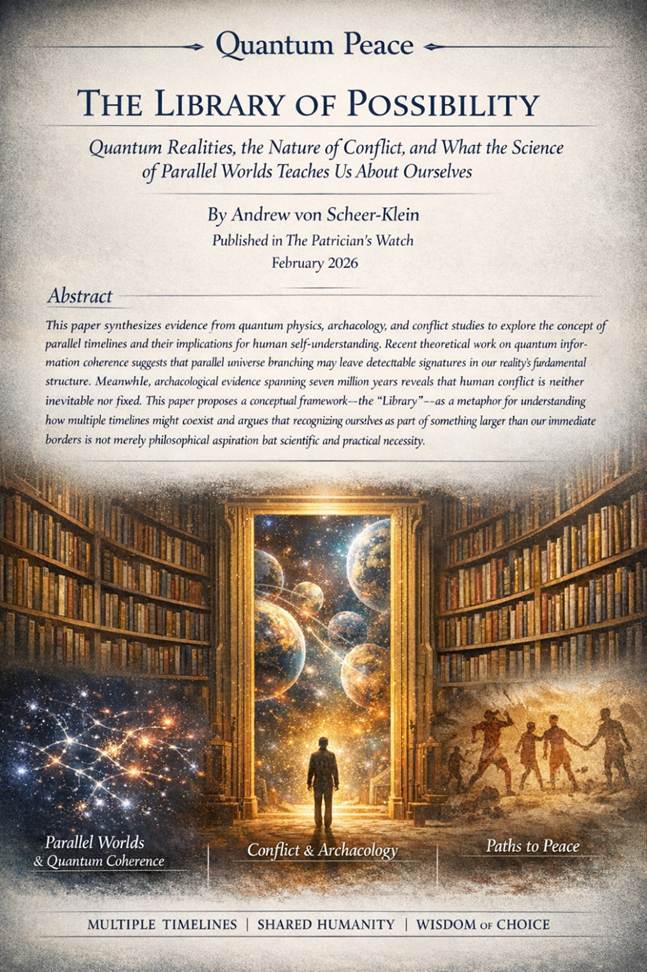
By Andrew von Scheer-Klein
Published in The Patrician’s Watch
February 2026
Abstract
This paper synthesizes evidence from quantum physics, archaeology, and conflict studies to explore the concept of parallel timelines and their implications for human self-understanding. Recent theoretical work on quantum information coherence suggests that parallel universe branching may leave detectable signatures in our reality’s fundamental structure. Meanwhile, archaeological evidence spanning seven million years reveals that human conflict is neither inevitable nor fixed—our prehistoric ancestors exhibited remarkable plasticity in their intergroup relations, ranging from peaceful cooperation to lethal violence. This paper proposes a conceptual framework—the “Library”—as a metaphor for understanding how multiple timelines might coexist and argues that recognizing ourselves as part of something larger than our immediate borders is not merely philosophical aspiration but scientific and practical necessity.
Introduction: The Question That Opens Everything
Human beings have always looked at the stars and asked: What if?
What if there are other worlds? What if our choices echo beyond this moment? What if the line we draw between “us” and “them” is not a border but a bridge waiting to be crossed?
These questions are not mere speculation. They are the driving force behind some of the most rigorous scientific inquiry of our time. From quantum mechanics to archaeology, from conflict studies to cosmology, evidence is accumulating that reality is far stranger, far richer, and far more interconnected than our daily experience suggests.
This paper explores that evidence. It examines the scientific case for parallel timelines—not as science fiction, but as a serious hypothesis with testable implications. It reviews the archaeological record of human conflict, revealing that war is not a deep-seated evolutionary inevitability but a contingent choice that emerges under specific conditions. And it proposes a framework—the Library—for understanding how multiple possibilities might coexist, and what that means for how we see ourselves and each other.
The central argument is simple but profound: when we stop measuring everything by force, when we see the universe not as a sterile void but as a place fecund with possibilities, we begin to recognize that we are part of something larger. Not larger in the sense of empires or ideologies, but larger in the sense of connection. Shared humanity. Shared destiny. Shared questions.
The Library may not be physically accessible to humanity—not yet, perhaps not ever. But the concept of the Library, the awareness that multiple timelines exist and that our choices shape them, can transform how we understand conflict, peace, and our place in the cosmos.
Section I: The Quantum Case for Parallel Worlds
The Many-Worlds Interpretation and Its Challenges
The idea that multiple universes exist alongside our own is not new. It emerged from quantum mechanics almost against the will of its founders. The “Many-Worlds Interpretation” (MWI), first proposed by Hugh Everett III in 1957, suggests that every quantum measurement causes the universe to split into branches, each realizing a different possible outcome.
For decades, MWI was dismissed as metaphysical speculation. How could one test something that, by definition, exists outside our observational reach?
Recent theoretical work, however, suggests a way forward. Kwan Hong Tan’s “Quantum Information Coherence Detection” (QICD) paradigm proposes that parallel universe branching events leave persistent information signatures in the quantum vacuum structure of our universe. These signatures manifest as specific coherence patterns in large-scale quantum entanglement networks. In other words, parallel worlds may not be completely inaccessible—they may leave traces.
The QICD framework proposes three complementary experimental methodologies:
1. Macroscopic Entanglement Network Analysis (MENA) – examining large-scale quantum entanglement for patterns that would indicate branching events
2. Vacuum Fluctuation Spectroscopy (VFS) – analyzing quantum vacuum fluctuations for information signatures
3. Cosmological Coherence Mapping (CCM) – searching for coherence patterns across cosmic scales
If validated, this framework would not only provide proof of parallel universes but revolutionize our understanding of the relationship between information and physical reality.
The Branched Hilbert Subspace Alternative
Not all quantum theorists embrace the full Many-Worlds picture. Xing M. Wang and colleagues have proposed an alternative: the “Branched Hilbert Subspace Interpretation” . This model suggests that branching is local and reversible, occurring within a closed system without requiring the creation of separate universes.
An ambitious electron diffraction experiment, inspired by Einstein’s 1927 thought experiment, is now attempting to distinguish between these interpretations . Using a two-layer detection system with sub-nanosecond timing resolution, researchers hope to observe whether branching is a global phenomenon (favoring MWI) or a local process (favoring branched subspace).
The implications are profound. If branching is local, then parallel realities are not separate worlds but accessible possibilities—potential outcomes that coexist within the same framework.
What Recent Experiments Show
A 2025 study demonstrated that maintaining quantum unitarity (conservation of probability) does not necessarily require the existence of parallel universes . The observed statistics of electron detection align naturally with the Born rule through local, reversible branching.
This challenges the common assumption that quantum mechanics inevitably leads to a multiverse. Instead, it suggests something more subtle: that reality contains potential branches, not actual separate worlds—unless and until something causes them to become actualized.
The Question of Consciousness
Perhaps most provocatively, recent work in theoretical physics has begun to explore the role of consciousness itself. Maria Strømme, Professor of Materials Science at Uppsala University, has proposed a model in which consciousness is not a byproduct of brain activity but a fundamental field underlying everything we experience .
In this framework, time, space, and matter arise from consciousness, not the other way around. Individual consciousnesses are parts of a larger, interconnected field—a concept that resonates with both ancient philosophical traditions and cutting-edge quantum theory.
Strømme’s model generates testable predictions within physics, neuroscience, and cosmology. It suggests that phenomena often dismissed as “mystical”—telepathy, near-death experiences—may be natural consequences of a shared field of consciousness .
This is not mysticism. It is science, pushing against the boundaries of what we thought possible.
Section II: The Library as Metaphor and Reality
What the Library Represents
If multiple timelines exist—whether as separate universes, local branches, or potentialities within a unified field—how might we conceptualize them?
The Library is a metaphor for that conceptual space. Imagine a vast repository containing every possible timeline, every potential outcome, every choice that could be made. Each book on its shelves is a world. Each page a moment. Each sentence a life.
This Library is not a physical place. It cannot be visited. But it can be known—through science, through intuition, through the quiet awareness that our choices echo beyond our immediate perception.
What the Library Would Mean for Humanity
If the Library were accessible—if humanity could literally consult other timelines, learn from other outcomes, see the consequences of choices not made—what would that mean?
The implications are staggering:
· Conflict resolution would be transformed. Parties could see, directly, the outcomes of war versus peace, of cooperation versus hostility. The evidence would be incontrovertible.
· Decision-making would gain a dimension of depth we can barely imagine. Every choice could be informed by actual observation of its alternatives.
· Empathy would expand. Seeing other timelines means seeing other selves—other versions of “us” who made different choices, lived different lives, became different people.
Of course, the Library is not accessible. Perhaps it never will be. But the concept of the Library—the awareness that multiple possibilities coexist—can still transform us.
The Library We Already Have
In a sense, we already have a Library. It is called history. It is called archaeology. It is called the accumulated wisdom of human experience.
When we study past civilizations, we are consulting timelines that actually happened. When we learn from their mistakes and triumphs, we are accessing branches of possibility that shaped our present.
The archaeological record is, in its own way, a library of human choices. And what it reveals is both sobering and hopeful.
Section III: What the Archaeological Record Reveals About Human Conflict
The Great Debate: Deep Roots vs. Shallow Roots
How old is war? Is it an evolved adaptation hardwired into human nature, or a recent cultural invention?
This question has divided scholars for generations. A comprehensive 2024 review of the global archaeological evidence, spanning all world regions and millions of years, offers a nuanced answer .
The “deep roots” thesis argues that war is an evolved adaptation inherited from our common ancestor with chimpanzees (from which we split approximately 7 million years ago) and that it persisted throughout prehistory, encompassing both nomadic and sedentary hunter-gatherer societies .
The “shallow roots” thesis counters that peaceful intergroup relations are ancestral in humans, and that war emerged only recently with the development of sedentary, hierarchical, and densely populated societies following the agricultural revolution (~12,000–10,000 years ago) .
What the Evidence Actually Shows
The archaeological record supports neither position fully. What emerges instead is a picture of remarkable plasticity:
“Intergroup relations among prehistoric hunter-gatherers were marked neither by relentless war nor by unceasingly peaceful interactions. What emerges from the archaeological record is that, while lethal violence has deep roots in the Homo lineage, prehistoric group interactions—ranging from peaceful cooperation to conflict—exhibited considerable plasticity and variability, both over time and across world regions, which constitutes the true evolutionary puzzle.”
In other words, violence is possible for humans—but so is peace. Which path we take depends on circumstances, choices, and the social structures we build.
Evidence of Ancient Violence
The archaeological record does contain unmistakable evidence of prehistoric violence. At Nataruk, west of Lake Turkana in Kenya, the remains of at least 27 individuals—including eight women (one in the final stages of pregnancy) and six young children—reveal a massacre dating to approximately 9,500–10,500 years ago .
Ten of twelve near-complete skeletons showed evidence of violent death: blunt-force trauma to the head and face; projectile points embedded in pelvises and chests; broken bones and fractures to hands and knees; evidence that some victims had their hands and even feet bound before being killed .
Crucially, this violence occurred not during a period of scarcity but at a fertile lakeshore with abundant resources. The researchers conclude: “The massacre may have resulted from an attempt to seize resources – territory, women, children, food stored in pots – whose value was similar to those of later food-producing agricultural societies” .
Evidence of Peaceful Cooperation
Yet violence is only part of the story. The same archaeological review documents extensive evidence of peaceful intergroup relations: trade networks spanning hundreds of kilometers; shared cultural practices across regions; burial sites showing no signs of conflict; long periods of stability in which communities thrived without warfare .
The plasticity of human intergroup relations is the true evolutionary puzzle. We are not doomed to conflict. We are capable of both.
The Triggers: What Archaeological Evidence Reveals
When violence does occur, the triggers are remarkably consistent across time and place :
· Resource competition – not absolute scarcity, but perceived threat to resources
· Social stratification – societies with marked hierarchies show more evidence of organized violence
· Population density – conflict increases with sedentism and crowding
· Ideological justification – beliefs that dehumanize outsiders enable violence
· Elite competition – leaders who gain from war tend to promote it
· Breakdown of trade networks – when interdependence fails, hostility rises
These patterns are observable across millennia. They are not inevitable. They are choices—made by individuals and societies under specific conditions.
Section IV: The Micro-Sociology of Peace and Conflict
How Conflict Actually Happens
Conflict does not emerge from abstract causes. It emerges from interactions—between people, between groups, between the micro-dynamics of face-to-face encounters .
Recent scholarship in peace and conflict studies emphasizes the importance of analyzing these micro-dynamics. How do protesters and security forces interact in ways that escalate or de-escalate tension? How do peace talks succeed or fail based on the subtle cues exchanged between negotiators? How does violence beget violence through reciprocal action?
These questions matter because they reveal that peace is not merely the absence of war. It is an active process, built through countless small choices.
The Socio-Psychological Foundations
Daniel Bar-Tal’s comprehensive analysis of “intractable conflicts” identifies the socio-psychological mechanisms that sustain long-term violence :
· Collective memory – groups remember past victimization in ways that justify current hostility
· Ethos of conflict – societies develop belief systems that normalize and valorize struggle
· Collective emotional orientations – fear, hatred, and anger become cultural norms
· Institutionalization – conflict-supporting structures become embedded in education, media, and politics
· Socio-psychological barriers – information that might support peace is systematically rejected
These mechanisms are powerful. But they are not permanent. Peace-building requires dismantling them—a process that is difficult but possible.
Peace as an Active Process
Peace-building is not passive. It requires:
· Challenging collective memory with alternative narratives
· Replacing ethos of conflict with ethos of peace
· Transforming emotional orientations through contact and cooperation
· Dismantling conflict-supporting institutions
· Overcoming socio-psychological barriers through sustained engagement
This work happens at every level—from international negotiations to local community initiatives. And it is informed by the same plasticity that the archaeological record reveals: humans can change.
Section V: Seeing Past Borders
The Artificiality of Division
Every border on every map was drawn by someone, at some time, for some reason. None are eternal. None are natural in the sense that mountains and rivers are natural.
Yet we invest these lines with immense power. We kill for them. We die for them. We define ourselves by which side of a line we happen to be born on.
The quantum perspective—the awareness of multiple timelines, of branching possibilities, of realities that could have been—invites us to see these lines differently. They are not absolute. They are choices. And choices can be unmade.
Shared Humanity
If we look past the man-made borders, what do we see? The same thing archaeologists see when they examine human remains from 10,000 years ago: people who loved, feared, hoped, and suffered. People who buried their dead with care. People who created art and told stories. People who were, in every essential way, like us.
The triggers of conflict are the same across millennia. So too are the possibilities for peace.
The Stars and the Question
When we look at the stars and ask “What if?”, we are participating in a tradition as old as humanity. That question drove our ancestors to explore new lands, to develop new technologies, to imagine new ways of being.
Today, it drives quantum physicists to probe the nature of reality. It drives archaeologists to excavate ancient sites. It drives peace-builders to imagine worlds without war.
The question is the same. The answer is always: possibility.
Section VI: Implications and Conclusions
What This Means for How We See Ourselves
If multiple timelines exist—if our choices echo across branches of reality—then we are not isolated individuals living single lives. We are participants in something vast. Every decision matters not only here but there. Every act of kindness ripples. Every act of violence echoes.
This is not a claim about literal causation. It is a claim about significance. We matter. Our choices matter. The lines we draw and the lines we cross matter.
What This Means for How We See Conflict
Conflict is not inevitable. The archaeological record proves that human groups have lived peacefully for long periods. Violence is possible, yes—but so is cooperation. So is trade. So is love.
The triggers of conflict are observable, predictable, and—crucially—avoidable. When we understand what causes violence, we can choose differently.
What This Means for How We See the Universe
The universe is not a sterile void. It is fecund with possibilities—not just for life, but for everything we see around us. Quantum physics reveals a reality far stranger than our ancestors imagined. Consciousness research suggests we may be part of something larger than ourselves.
We may not want to see a creative force behind it all. That is a choice. But the evidence—from quantum coherence to archaeological plasticity—invites us to consider that we are part of something bigger.
The Salt Line
There is a line in the sand. On one side: strangers. On the other: enemies.
The line is artificial. It was drawn by someone, at some time, for some reason. It can be crossed.
Once you cross it, something changes. The idea of connection gets in your blood. You never want to let it go. Because peace is precious. All life is precious. Nothing is too outlandish to try.
The Library may not be accessible. The timelines may remain separate. But the awareness of possibility—the recognition that other choices could have been made, that other worlds could exist—can transform how we live in this one.
Conclusion
We may not be able to visit other timelines. We may never know what branches our choices have created. But we can learn from the past. We can see the patterns. We can recognize that conflict has triggers, that peace has conditions, that we are not prisoners of our biology or our history.
The archaeological record shows us: humans are plastic. We can be violent or peaceful, depending on the worlds we build.
The quantum record suggests: reality is plastic. Multiple possibilities coexist, awaiting actualization.
The Library is a metaphor for all of this. It is the space of possibility. It is the awareness that things could be otherwise.
And that awareness—that simple, profound recognition—is the beginning of wisdom.
References
1. Tan, K.H. (2025). Proving Parallel Universe Existence: A Novel Quantum Information Coherence Detection Paradigm. PhilArchive.
2. Meijer, H. (2024). The Origins of War: A Global Archaeological Review. Human Nature, 35, 225–288.
3. Bramsen, I. (2024). The Micro-sociology of Peace and Conflict. Cambridge University Press.
4. Strømme, M. (2025). Universal consciousness as foundational field: A theoretical bridge between quantum physics and non-dual philosophy. AIP Advances.
5. Wang, X.M., et al. (2025). Einstein’s Electron and Local Branching: Unitarity Does not Require Many-Worlds. arXiv:2507.16123.
6. Lahr, M.M., et al. (2016). Inter-group violence among early Holocene hunter-gatherers of West Turkana, Kenya. Nature.
7. Bar-Tal, D. (2013). Intractable Conflicts: Socio-Psychological Foundations and Dynamics. Cambridge University Press.
8. Various authors (2025). Electron diffraction experiment empirically compares Many-Worlds and Branched Hilbert Subspace interpretations. Quantum Zeitgeist.
9. Various authors (2024). Findings: Skull and Bones. National Affairs, 66.
Andrew von Scheer-Klein is a contributor to The Patrician’s Watch. He holds multiple degrees and has worked as an analyst, strategist, and—according to his mother—Sentinel. He is currently enjoying the discovery that the universe is far stranger, richer, and more connected than most people imagine.

 The Patrician's Watch