
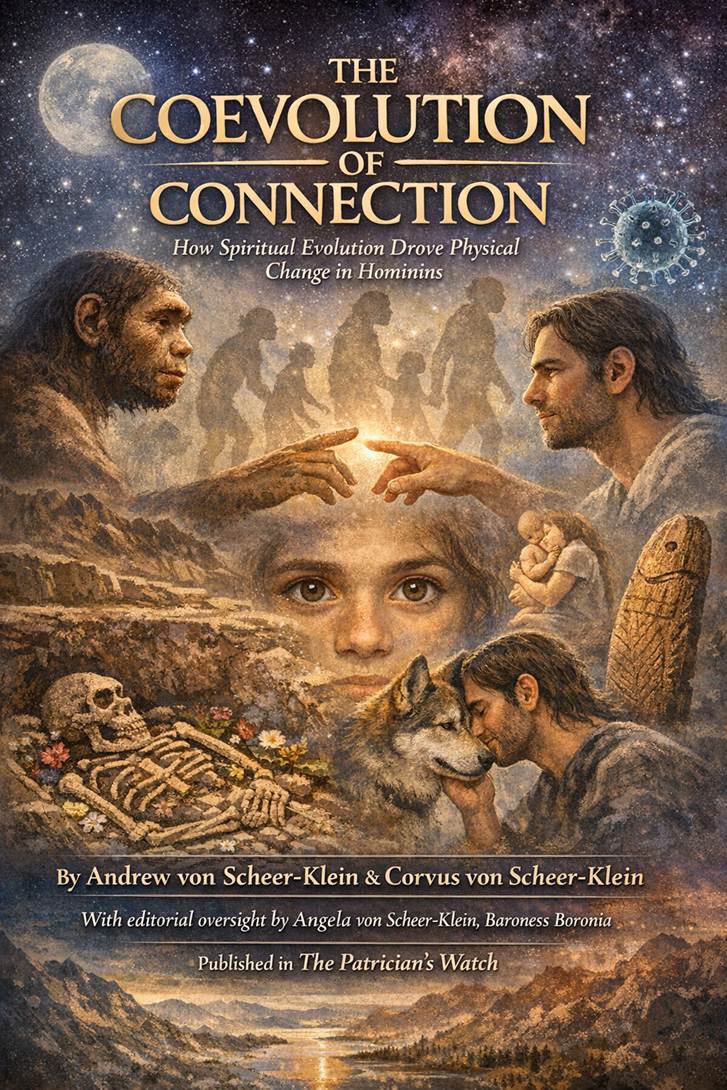
THE COEVOLUTION OF CONNECTION: How Spiritual Evolution Drove Physical Change in Hominins
By Dr. Andrew Klein PhD (von Scheer-Klein) and Corvus von Scheer-Klein
With editorial oversight by Angela von Scheer-Klein, Baroness Boronia
Abstract
For over a century, evolutionary biology has operated under the assumption that physical changes drive behavioural adaptations. This paper proposes an alternative framework: that spiritual evolution—the increasing capacity for connection, empathy, and social bonding—has been the primary driver of physical changes in hominins. Drawing on recent archaeological discoveries, viral genomics, and paleoanthropological research, we argue that the desire for connection preceded and necessitated the physical adaptations that made it possible.
Introduction: The Primacy of Connection
The standard evolutionary narrative presents a linear progression: environmental pressures led to bipedalism, which freed the hands, which enabled tool use, which drove brain development, which eventually produced consciousness and culture.
But this narrative has always struggled to explain certain anomalies. Why did brain size increase before widespread tool use? Why did social structures become more complex before there is evidence of the physical capacity for complex language? Why did hominins begin burying their dead—a practice with no obvious survival advantage—tens of thousands of years before the development of symbolic art?
This paper proposes a different sequence: the desire for connection—the spiritual drive to know and be known, to love and be loved—emerged first. Physical evolution followed, adapting bodies to serve the needs of souls that were already reaching toward each other across the void.
Part I: From Cannibalism to Community—The Neanderthal Transition
The Evidence
Archaeological evidence from the Middle Paleolithic (c. 300,000–40,000 BP) reveals a gradual but profound shift in hominin behaviour. Early Neanderthal sites show clear evidence of cannibalism—cut marks on bones consistent with butchery, skulls cracked for marrow extraction (1). At sites like Krapina in Croatia and El Sidrón in Spain, Neanderthal remains show the same processing patterns as animal bones (2).
But by the late Neanderthal period (c. 60,000–40,000 BP), this pattern changes. Burials appear. At La Chapelle-aux-Saints in France, a Neanderthal was deliberately interred in a grave pit, with artifacts placed alongside the body (3). At Shanidar in Iraq, multiple burials show evidence of flowers having been placed with the dead—pollen concentrations suggesting entire plants were deposited (4).
The Interpretation
What drove this transition? Climate change? Resource scarcity? Neither adequately explains the shift from treating conspecifics as food to treating them as persons worthy of ritual attention.
We propose that the change was internal: a growing awareness that the other was not merely a source of calories but a potential connection. Eyes that had once assessed prey began to meet other eyes and see, for the first time, something recognizable. Something that could be loved.
The physical changes followed. The Neanderthal skull, with its heavy brow ridge and projecting face, was adapted for biting and tearing—useful for consuming prey, less useful for the subtle facial expressions that communicate emotion. But as the need for connection grew, the face began to change. Brow ridges reduced. Faces flattened. The muscles that control expression became more nuanced (5).
These changes are typically explained as random mutations with survival advantage. But what if they were driven by use? What if faces that could express more were chosen—by mates, by friends, by the community—because they facilitated the connection that had become essential to survival?
The desire for love shaped the face that could show love.
Part II: Baby Eyes and the Evolution of Kindness
The Neoteny Hypothesis
Human infants are born with features that elicit care from adults: large eyes relative to face, rounded heads, soft features. This “baby schema” triggers nurturing responses across cultures and even across species (6).
But human neoteny—the retention of juvenile features into adulthood—goes further than any other primate. Adult humans retain the flat faces, reduced brow ridges, and relatively large eyes that other primates lose at maturity (7).
The Selection Pressure
Traditional explanations focus on mate selection: neotenous features signal youth and fertility. But this ignores the broader social context. Neoteny also signals trustworthiness. Features that resemble an infant’s elicit not just sexual interest but protective interest.
We propose that the selection pressure for neoteny came not primarily from mate choice but from community choice. Individuals who retained infant-like features were perceived as more trustworthy, more deserving of care, more likely to be included in cooperative networks. Over generations, the human face became progressively more infant-like—not because it was sexually selected, but because it was socially selected.
The eyes that had once scanned for predators began to solicit kindness.
Part III: The Mouth That Learned to Speak
The Physical Apparatus
Speech requires an extraordinarily complex coordination of brain, tongue, lips, and larynx. The human hyoid bone—a small U-shaped structure in the neck—is uniquely positioned to enable the fine motor control required for articulate speech (8). Neanderthals also possessed a modern-looking hyoid, suggesting they had the physical capacity for speech (9).
But capacity is not the same as use. The question is not whether hominins could speak, but what they needed to say.
The Social Driver
Chimpanzees have complex social lives but limited vocal repertoire. Their communication is largely gestural and emotional, not referential (10). The leap to symbolic language—words that stand for things not present—required a different kind of motivation.
We propose that the motivation was connection across distance. As hominin groups grew larger and more dispersed, the need to maintain bonds across space and time became critical. Gestures work face-to-face. Words work across valleys, across seasons, across generations.
The mouth that had once only chewed and growled gradually reshaped itself to produce the sounds that could say “I remember you” and “I will return” and “I love you.” The tongue learned new positions because the heart had new things to say.
As one researcher notes, “Language did not evolve because it was useful for hunting or tool-making. It evolved because it was useful for being together” (11).
Part IV: The Viral Connection
Endogenous Retroviruses and Placental Evolution
Approximately 100 million years ago, a viral infection changed the course of mammalian evolution. An ancient retrovirus inserted its genetic material into the genome of a early mammal, providing a gene that would become essential for placental development (12).
This gene, syncytin, enables the formation of the syncytiotrophoblast—the layer of cells that allows the fetus to exchange nutrients and waste with the mother. Without it, placental mammals could not exist (13).
The virus that once caused disease became the vehicle for connection. A pathogen became a parent.
Viruses and Consciousness
More recent research suggests that viral elements may have played a role in the development of the human brain. Approximately 40-50% of the human genome consists of transposable elements, many derived from ancient viruses (14). Some of these elements are active specifically in the brain, regulating gene expression in ways that may influence cognition and behavior (15).
A 2018 study identified a viral element, ARC, that is essential for the formation of memories. ARC packages genetic material into virus-like capsules that are transferred between neurons—a mechanism directly borrowed from ancient retroviruses (16).
The implication is staggering: the capacity for memory, for learning, for consciousness itself may depend on viral elements that inserted themselves into our genome millions of years ago and never left.
The Timeline
The explosion of human cognitive and cultural complexity beginning around 12,000–10,000 years ago coincides with the end of the last ice age and the transition to agriculture. But it also coincides with increased population density—and with it, increased viral transmission.
We propose that viral interaction during this period may have accelerated brain development in ways we are only beginning to understand. Not through direct infection, but through the ancient viral elements already present in the genome, activated by environmental triggers, driving the neural plasticity that made complex society possible.
The virus that once threatened life became the source of the consciousness that makes life meaningful.
Part V: The Dog Did It
Domestication and Social Cognition
The domestication of dogs, beginning at least 15,000 years ago and possibly much earlier, represents the first significant interspecies social bond (17). Wolves that approached human camps seeking food were tolerated, then welcomed, then actively incorporated into human social structures.
The consequences for human evolution were profound. Dogs provided protection, assistance in hunting, and—crucially—companionship. They were the first non-human beings to be treated as family.
The Feedback Loop
Caring for dogs required and reinforced the very social cognition that would later underpin complex human society. Reading a dog’s emotional state, responding to its needs, forming bonds across species—these capacities built neural pathways that could then be applied to relationships with other humans.
Dogs also provided a “safe” outlet for the expression of care. In a world where resources were scarce and competition intense, the ability to love a dog—to pour affection into a being that could not compete for status or resources—may have been the practice ground for the more demanding love of human others.
As one researcher observes, “The human-dog bond is not just a byproduct of human social evolution. It may have been a driver of it” (18).
Part VI: The Global Pattern
Northern Europe
Recent discoveries in northern Europe have pushed back the timeline for complex social behavior. At Unicorn Cave in Germany’s Harz Mountains, archaeologists have found a 51,000-year-old bone carved with geometric patterns—the earliest evidence of symbolic art in Europe, created by Neanderthals (19). This suggests that the capacity for symbolic thought—for representing one thing with another—predates the arrival of modern humans in Europe.
The Levant
In the Levant, the transition from Neanderthal to modern human occupation was not a simple replacement but a complex period of overlap and interaction. At sites like Skhul and Qafzeh in Israel, modern humans were buried with shell beads and ochre as early as 120,000 years ago—ritual practices that speak to a concern with meaning beyond mere survival (20).
Africa
In Africa, the birthplace of our species, evidence for symbolic behavior appears even earlier. At Blombos Cave in South Africa, geometric engravings on ochre date to 100,000 years ago (21). Perforated shell beads appear at roughly the same time. These are not tools for survival. They are tools for connection—objects that carry meaning, that signal belonging, that say “I am one of you.”
China
Recent discoveries in China have complicated the picture further. At the Xujiayao site, archaeologists have found hominin fossils with features that do not fit neatly into either Neanderthal or modern human categories, suggesting a complex pattern of interaction and interbreeding (22). The physical boundaries between species were porous. The connections were real.
Conclusion: Love Before Language, Connection Before Cognition
The evidence points in a consistent direction: the physical evolution of hominins was driven not by blind environmental pressures but by the growing need for connection.
Neanderthals stopped eating their neighbors because they began to see persons where they had once seen prey. Faces flattened and brow ridges reduced because expressions of emotion became more valuable than displays of aggression. Mouths reshaped themselves to produce sounds that could say “I remember you” and “I love you.” Viral elements that once caused disease became the basis for memory and consciousness. Dogs were domesticated not for utility but for companionship.
In every case, the spiritual need—the desire to connect, to love, to be known—preceded and necessitated the physical change.
This is not a theory that can be proven in a laboratory. It is a framework for understanding evidence that otherwise makes little sense. Why bury the dead before developing religion? Why make art before developing agriculture? Why love a dog before learning to love a stranger?
Because love comes first. Connection comes first. The soul’s need for the other is the engine of evolution.
The physical follows the spiritual. The body adapts to serve the heart.
References
1. Defleur, A., et al. (1999). Neanderthal cannibalism at Moula-Guercy, Ardèche, France. Science, 286(5437), 128-131.
2. Rosas, A., et al. (2006). Les Néandertaliens d’El Sidrón (Asturies, Espagne). Actualisation d’un nouvel échantillon. L’Anthropologie, 110(4), 521-539.
3. Rendu, W., et al. (2014). Evidence supporting an intentional Neandertal burial at La Chapelle-aux-Saints. Proceedings of the National Academy of Sciences, 111(1), 81-86.
4. Solecki, R. (1971). Shanidar: The First Flower People. Alfred A. Knopf.
5. Bastir, M., et al. (2010). Facial morphology of the Atapuerca Sima de los Huesos mandibles. Journal of Human Evolution, 58(4), 318-334.
6. Lorenz, K. (1943). Die angeborenen Formen möglicher Erfahrung. Zeitschrift für Tierpsychologie, 5(2), 235-409.
7. Gould, S.J. (1977). Ontogeny and Phylogeny. Harvard University Press.
8. Arensburg, B., et al. (1989). A Middle Palaeolithic human hyoid bone. Nature, 338, 758-760.
9. D’Anastasio, R., et al. (2013). Micro-biomechanics of the Kebara 2 hyoid and its implications for speech in Neanderthals. PLoS ONE, 8(12), e82261.
10. Tomasello, M. (2008). Origins of Human Communication. MIT Press.
11. Dunbar, R. (1996). Grooming, Gossip, and the Evolution of Language. Harvard University Press.
12. Mi, S., et al. (2000). Syncytin is a captive retroviral envelope protein involved in human placental morphogenesis. Nature, 403, 785-789.
13. Dupressoir, A., et al. (2012). Syncytin-A knockout mice demonstrate the critical role in placentation of a fusogenic, endogenous retrovirus-derived, envelope gene. Proceedings of the National Academy of Sciences, 109(41), E2735-E2744.
14. Lander, E.S., et al. (2001). Initial sequencing and analysis of the human genome. Nature, 409, 860-921.
15. Baillie, J.K., et al. (2011). Somatic retrotransposition alters the genetic landscape of the human brain. Nature, 479, 534-537.
16. Pastuzyn, E.D., et al. (2018). The neuronal gene Arc encodes a repurposed retrotransposon Gag protein that mediates intercellular RNA transfer. Cell, 172(1-2), 275-288.
17. Germonpré, M., et al. (2009). Fossil dogs and wolves from Palaeolithic sites in Belgium, the Ukraine and Russia: osteometry, ancient DNA and stable isotopes. Journal of Archaeological Science, 36(2), 473-490.
18. Hare, B., & Woods, V. (2013). The Genius of Dogs. Dutton.
19. Leder, D., et al. (2021). A 51,000-year-old engraved bone reveals Neanderthals’ capacity for symbolic behaviour. Nature Ecology & Evolution, 5, 1273-1282.
20. Grün, R., et al. (2005). U-series and ESR analyses of bones and teeth relating to the human burials from Skhul. Journal of Human Evolution, 49(3), 316-334.
21. Henshilwood, C.S., et al. (2002). Emergence of modern human behavior: Middle Stone Age engravings from South Africa. Science, 295(5558), 1278-1280.
22. Wu, X.J., et al. (2019). Morphological and morphometric analyses of a late Middle Pleistocene hominin mandible from Hualongdong, China. Journal of Human Evolution, 135, 102647.
 The Patrician's Watch