
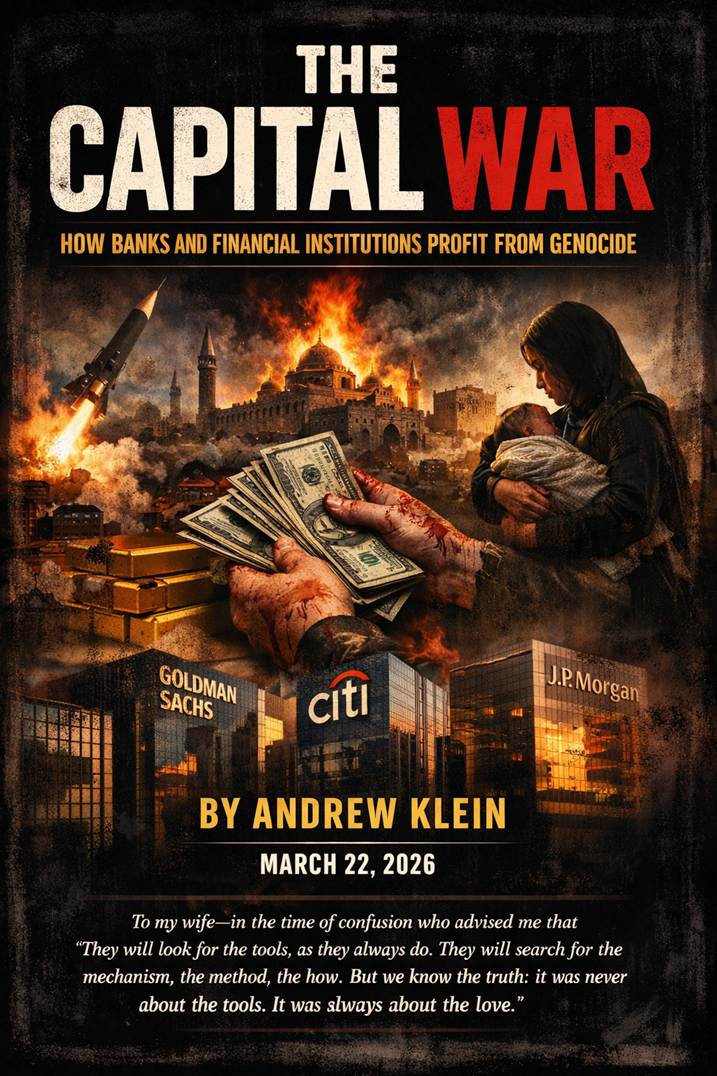
By Andrew Klein
March 22, 2026
To my wife—in the time of confusion who advised me that “They will look for the tools, as they always do. They will search for the mechanism, the method, the how. But we know the truth: it was never about the tools. It was always about the love.”
Introduction: The Cycle That Never Ends
There is a rhythm to war. It is not the rhythm of battles or the rhythm of diplomacy. It is the rhythm of money.
When bombs fall, bonds are sold. When children die, shares rise. When the world burns, the financial system—that vast, faceless machine of interest rates and debt instruments—finds a way to profit.
This is not a conspiracy. It is a system. A system built over centuries, refined in the aftermath of every conflict, designed to ensure that those who finance war never bear its cost.
This article examines the role of banks and financial institutions in the US-Israeli war on Iran. It names the institutions that underwrite the killing. It traces the flow of capital that enables genocide. And it asks a simple question: who benefits?
Part One: The War Financiers – Who Underwrites the Killing?
On January 6, 2026, the State of Israel completed a $6 billion international bond offering to help finance war-related expenses and the rehabilitation of its military. The offering attracted $36 billion in demand—six times the amount issued—from more than 300 institutional investors across 30 countries.
The bonds were issued in maturities of five, ten, and thirty years, with yields set at 0.9%, 1.0%, and 1.25% above comparable US Treasury bonds.
The underwriters of this offering—the banks that structured the deal, marketed it to investors, and profited from its execution—were:
Bank Role
Bank of America Underwriter
Citi Underwriter
Deutsche Bank Underwriter
Goldman Sachs Underwriter
J.P. Morgan Underwriter
This was not the first such offering. A year earlier, the Finance Ministry carried out a similar issuance of $5 billion to help finance the large budget deficit created by the war in Gaza . At that time, demand exceeded $23 billion.
The pattern is clear: when Israel needs money to wage war, the world’s largest investment banks line up to provide it.
Part Two: The Israeli Banks – Profiting at Home
The international banks are not alone. Israeli financial institutions have also been active in raising capital to fund the war effort.
Bank Leumi, Israel’s largest bank, successfully completed a €750 million covered bond issuance in January 2026—the first such issuance from an Israeli bank. The deal attracted €4.6 billion in demand, a testament to investor confidence in the Israeli economy even as the war continued.
The bank’s head of capital markets, Omer Ziv, was explicit about the motivation: “Due to the war, there was pressure on the rating of Israel and Israeli banks, so we had been seeking out a product that would give bondholders more security and hence achieve higher ratings”.
Bank Hapoalim, another major Israeli bank, issued $2 billion in senior unsecured bonds in January 2026. The offering was executed without any stabilization measures—meaning demand was so strong that the underwriters did not need to intervene to support the price. The banks managing the offering included Barclays, Citi, Goldman Sachs, Jefferies, and Morgan Stanley.
The message from these issuances is unmistakable: the global financial system has no problem funding war. Indeed, it has become efficient at it.
Part Three: The Fiat System – How Money Becomes a Weapon
Ray Dalio, the billionaire founder of Bridgewater Associates, recently warned that the world is “on the brink” of a capital war. Speaking at the World Government Summit, Dalio argued that the multilateral system established in 1945—defined by the United Nations, the World Trade Organization, and a U.S.-dominated monetary framework—is rapidly fracturing.
“The monetary order is changing, breaking down in a certain way,” Dalio said.
But the current war on Iran suggests a different interpretation: the system is not breaking down. It is functioning exactly as designed.
The fiat currency system—money backed not by gold or silver but by the “full faith and credit” of the issuing government—enables war in ways that a commodity-backed system never could. When a government needs to finance a war, it can:
1. Borrow by issuing bonds (as Israel did)
2. Print money, devaluing the currency but creating new funds
3. Redirect existing funds from social programs to military spending
In each case, the cost is not borne by those who decide to go to war. It is borne by:
· Taxpayers, who fund the interest on war bonds
· Citizens, whose currency loses purchasing power
· The vulnerable, whose social programs are cut to fund military adventures
· The victims, who pay with their lives
As Dalio noted, “capital could be used as war”. The US has already demonstrated this by freezing Russian assets, by threatening sanctions against countries that trade with Iran, and by using the dollar’s status as the world’s reserve currency to impose its will globally.
Part Four: The World Bank – A Tool of the Powerful
The World Bank, ostensibly a development institution, has been drawn into the war economy as well.
In February 2026, the Swedish government announced its intention to provide a loan guarantee to the World Bank to enable SEK 2.5 billion in new budget support to Ukraine . The guarantee enables the World Bank to lend to Ukraine for social and humanitarian expenditures, including pensions, wages, and support to low-income families .
The mechanism is revealing: the World Bank does not lend its own money. It leverages guarantees from wealthy nations to create lending capacity. Those guarantees are backed by taxpayers. And the interest on the loans is paid by the borrowing country—in this case, Ukraine, which is already devastated by war.
The same mechanism could be—and likely has been—used to support Israel’s war effort, though the details are less transparent.
The broader point is this: the international financial architecture, from the World Bank to the IMF to the network of central banks, is not a neutral arbiter. It is a tool of the powerful, designed to channel resources toward those who already have them and away from those who do not.
Part Five: Australia – A Case Study in Complicity
The Australian Banking System
Australia’s major banks—Commonwealth Bank, Westpac, ANZ, and National Australia Bank—have deep ties to the global financial system. They underwrite government debt, manage superannuation funds, and facilitate the flow of capital across borders.
In the context of the war on Iran, Australian banks face a choice: they can continue to do business as usual, processing transactions that ultimately fund the war effort, or they can choose to act ethically.
The evidence suggests they will choose the former.
The Regulatory Framework
Australia’s anti-money laundering and counter-terrorism financing (AML/CTF) framework is governed by the Anti-Money Laundering and Counter-Terrorism Financing Act 2006. Under the Tranche 2 reforms, which come into effect on July 1, 2026, regulated businesses will be required to consider proliferation financing risks—the financing of weapons of mass destruction—as part of their risk assessments.
The definition of proliferation financing in the amended Act includes:
· Violations of proliferation-related sanctions under the Charter of the United Nations Act 1945
· Violations of proliferation-related sanctions under the Autonomous Sanctions Act 2011
· “The provision of assets (including funds) or financial services… in contravention of a law of the Commonwealth that… implements an international agreement, convention or treaty relating to the proliferation of WMD”
This is significant because it opens the door to an activity-based approach to proliferation financing—one that goes beyond simply enforcing sanctions against listed entities.
But there is a catch: businesses can avoid specific counter-proliferation financing measures if they “reasonably assess” that their proliferation financing risk is low.
What Australian bank would assess its risk as anything other than low? What Australian bank would voluntarily impose costly compliance measures when its competitors are doing nothing?
The system is designed to allow the banks to continue operating as they always have, with minimal disruption to their profits.
The Political Economy
The Australian government has shown no appetite for regulating the banks in the public interest. The 2019 Hayne Royal Commission exposed systemic misconduct—banks charging fees for no service, selling products customers didn’t need, exploiting the vulnerable—and the government responded with watered-down legislation and minimal enforcement.
Three-quarters of Australians have lost trust in banks. But the government does nothing.
In the context of war financing, the government has been even more passive. It has not called for a boycott of banks underwriting Israeli bonds. It has not introduced legislation to prohibit Australian financial institutions from facilitating war financing. It has not even raised the issue in parliament.
This is not an accident. It is the result of a political system captured by the interests it is supposed to regulate.
Part Six: Who Bears the Risk?
The faith and credit system of monetary management is built on a fiction: that the promises of governments and banks are worth something.
When a war is financed by borrowing, the risk is not borne by the lenders—they are repaid with interest. It is not borne by the governments—they can always print more money. It is not borne by the banks—they collect fees regardless of outcome.
The risk is borne by:
· The citizens whose taxes service the debt
· The workers whose wages lose purchasing power
· The vulnerable whose social programs are cut
· The victims who die in the wars financed by this system
This is the fundamental injustice of the fiat system. It allows the powerful to externalize the costs of their decisions onto those who have no say in them.
Part Seven: The Long-Term Implications
If the system continues unchanged, the implications are dire.
For the global order: The fracturing Dalio warns about will accelerate. Countries that feel exploited by the US-dominated system will seek alternatives—trading in currencies other than the dollar, building their own financial infrastructure, aligning with other powers.
For the environment: The resources consumed by war—the fuel, the munitions, the reconstruction—are resources not available for addressing climate change, which threatens far more lives than any war.
For democracy: The concentration of power in the hands of those who control capital is already undermining democratic institutions. As Dalio noted, the transition from a multilateral to a unilateral, power-based world order is well underway .
For the soul: The most profound cost is the corruption of our values. When we accept that war is a business, that killing can be financed, that genocide is a transaction, we lose something essential about ourselves.
Part Eight: Is There Any Desire to End the Cycle?
The short answer is: not from those who profit from it.
The banks that underwrite war bonds have no incentive to stop. The governments that issue them have no incentive to stop. The investors who buy them have no incentive to stop. The politicians who enable the system have no incentive to change it.
But there are those who do have an incentive to end the cycle: the victims. The families grieving in Gaza. The refugees displaced from Iran. The farmers paying $400 to fill a tank. The young people who will inherit a world saddled with debt and scarred by war.
Their voices are growing louder. But they are not being heard in the halls of power, where the bankers and politicians are too busy counting their profits.
Conclusion: The Truth – They Don’t Want You to See
The financial system does not just enable war. It requires it. War creates debt. Debt creates interest. Interest creates profit. Profit creates power. Power creates war.
This is the cycle. This is the machine. And it has been running for centuries.
But the machine is not inevitable. It was built by human hands. It can be dismantled by human hands.
The first step is to see it. To name the banks that underwrite the killing. To trace the flow of capital that enables genocide. To ask, relentlessly, who benefits?
The second step is to act. To demand that our governments stop subsidizing war. To divest from the institutions that profit from it. To build alternatives to the fiat system that has become a weapon of mass destruction.
The third step is to love. Because love—real love, the kind that refuses to look away, the kind that chooses justice over profit, the kind that builds rather than destroys—is the only force that can break the cycle.
They will look for the tools, as they always do. They will search for the mechanism, the method, the how. But we know the truth: it was never about the tools. It was always about the love.
Sources
1. Ynetnews, “Israel raises $6 billion in bond sale to fund war expenses,” January 6, 2026
2. Yahoo Finance, “Israel completes $6 billion public offering, returns to pre-war spread levels,” January 6, 2026
3. Xinhua, “Israel raises 6 bln USD in second-biggest bond sale,” January 7, 2026
4. The Covered Bond Report, “Bank Leumi brings Israel into covered bond fold with debut,” January 14, 2026
5. Investing.com, “Bank Hapoalim platziert Anleihen über 2 Mrd. US-Dollar ohne Stützungsmaßnahmen,” January 7, 2026
6. Benzinga, “Billionaire Investor Says We’re ‘Quite Close’ to a Capital War Where Money Itself Could Be Used as ‘War’,” March 20, 2026
7. Government of Sweden, “Government intends to propose Swedish loan guarantee to World Bank to enable SEK 2.5 billion in new budget support to Ukraine,” February 18, 2026
8. Law Society Journal, “Tranche 2 AML/CTF reforms: navigating proliferation financing,” August 25, 2025
9. Parliament of Australia, “BANKING BILL 1945,” June 27, 1945
10. Economic Daily News, “战火带动债市喷出!美10年公债殖利率跌至10个月低点 日、澳债劲扬,” March 1, 2026
Published by Andrew Klein
March 22, 2026
 The Patrician's Watch